Abuse of Short-Term Rental Rules in Lake Oswego is Still Widespread

Lake Oswego encourages visitors.

“If you are visiting or thinking of visiting Lake Oswego, we welcome you,” says the city’s’ website. ” Whether you’re coming for business or pleasure, you’ll encounter an inviting community, friendly people and businesses, and plenty to see and do.”

At the same time, in response to citizen concerns about maintaining livability, Lake Oswego has tried to regulate short-term visitor rentals. But local property owners are widely ignoring the city’s short-term rental (STR) rules.

Lake Oswego tried to get a handle on controversial STRs in 2019 by enacting Ordinance 2815. The ordinance allows STRs (rentals of less than 31 days) of certain residential properties.

Since then, residents who want to operate a STR have been required to obtain a business license from the city and pay an $80 annual fee. They’re also required to pay Transient Lodging Taxes equal to 6% of taxable income from their STR. The tax revenue is used for the promotion and development of tourism and visitor programs for Lake Oswego.

It’s all pretty straightforward and simple. If you own a property being used for STRs, you need to get a business license and pay taxes on your revenue. But a review of city data on STR business licenses and on a national STR website reveals a lot of people are ignoring the ordinance, with the number of STRs and the number of scofflaws actually increasing over time.

At the end of 2022, according to AirDNA, a STR marketing firm, there were 90 active STRs in Lake Oswego, while information obtained from the city in response to a public records request revealed there were just 42 active STR business licenses. The discrepancy was brought to the attention of the City Council in hopes it would address the problem.

 AirDNA reports there are now 161 active STRs in Lake Oswego, but, according to publicly available Lake Oswego licensing data, there are just 81 active STR business licenses.

In other words, the number  of licensees has gone up, but so has the number of scofflaws. 

The STR occupancy rate over the past 12 months has been 66% and the average market charge per day has been $246.90.

The Lake Oswego STRs that have popped up include everything from a $61-a-night guest bedroom to a $288-a-night 3-bedroom home (“a serene sanctuary where the forest meets modern luxury.”) and a $1452-a-night massive luxurious estate with 7 bedrooms, plus a pool, sauna, hot tub and theater room.  

It’s not possible to identify the addresses of all the properties without trying to book them one by one. Website maps, reveal, however, that they are spread all over Lake Oswego. 

If a STR is found to be in violation of City Code, the city may suspend or revoke its business license, if it has one. The property owner may also be cited and have to pay a fine or appear in Municipal Court.

So come on malingerers. Step up. Do the right thing. 

Affordable Housing Push Spawns Money-Raising Frenzy in Oregon 

Government just can’t seem to stop wanting more money.

In a strange twist, now there’s a move to make life less affordable for many Oregonians in order to promote affordable housing.

Oregon Governor Tina Kotek’s Housing Production Advisory Council has just submitted a 20-page draft report, HPAC Policy Recommendations, on ideas on how to address the affordable housing crisis. And, of course, the ideas include raising more money. The Taxpayer Association of Oregon revealed the report on Jan. 10, 2024.

Remember when voters passed Measure 50 in 1997? It introduced maximum assessed value (MAV), which acts as a “cap” on the growth of taxable (assessed) value for most property. MAV growth is limited to 3 percent per year. Combined with permanent tax rates, Measure 50 effectively limited tax increases, except under specific circumstances. Kotek’s Housing Production Advisory Council is proposing raising that to 5%.

Own a vacation property in Bend?  Kotek’s Housing Production Advisory Council is proposing eliminating the Mortgage Interest Deduction for Second Homes (i.e., abolishing the income tax deduction for interest paid on second homes).

Drive a gas car?   Kotek’s Housing Production Advisory Council is proposing doubling fuel taxes.

On section 7 (Page 16/17) it lists 5 suggestions to raise new revenue (as shown below):

  1. Generate new, state-level revenue to fund critical local infrastructure.
    a. New revenue generation to be limited to duration of HPAC Timeline (i.e., sunset in 2032)
    and in support of the related work plan topics described below. Potential sources
    include:

i. Revenue Source and Annual Revenue Generated (Legislative Revenue Office,
2023, p. B7, FY 23-24 dollars).

  1. Increase all personal income tax brackets by ½ percentage point.
    a. $699 Million
  2. Establish Special $1 per $1,000 real property tax assessment outside of
    Measure 5.
    a. $504 Million
  3. Implement 0.5% Retail Sales Tax.
    a. $501 Million
  4. Implement 0.5% Payroll Tax.
    a. $620 Million
  5. Double Fuel Tax.
    a. $686 Million

The report also proposes: 

Reform Oregon’s tax system to encourage development of needed housing and provide
adequate revenue for local governments to support housing production.
a. Taxes are both a tool to raise revenue for government and to shape taxpayer behavior.
Attaining the Governor’s desired housing production goals will require significant new
revenue; this recommendation highlights actions that can address revenue shortfalls and
encourage a shift in taxpayer behavior to support housing production.
b. Potential actions include (but are not limited to):
i. Targeted Measure 50 Reform:

  1. Increase annual Maximum Assessed Value change to 5%.
  2. Authorize voters to increase the permanent levy of their local
    jurisdiction.
  3. Exempt Cites and Counties from compression.
    ii. Adopt Land Value Tax
    iii. Eliminate Mortgage Interest Deduction for Second Homes (i.e., abolish income
    tax deduction for interest paid on second homes).
    iv. Enact temporary property tax exemption for new housing at 120% AMI or below.
    v. Reduce or Eliminate Tax Expenditures (i.e., tax exemptions) not related to
    housing.

The report notes that four lawmakers, from both parties, sit as members on Kotek’s Council.   They are:

  • Senator Dick Anderson (R – Lincoln City)
  • Senator Kayse Jama (D – Portland)
  • Representative Vikki Breese Iverson (R – Prineville)
  • Representative Maxine Dexter (D – Portland)

There are also a number of community members appointed to theCouncil by Governor Kotek.

They need to hear from taxpayers.

_______________________________________

Gubernatorial Appointments:
  • Co-chair J.D. Tovey – rural Oregon and an enrolled member of the Confederated Tribes of the Umatilla Indian Reservation – land use, building codes and housing development 
  • Co-chair Damien Hall – Metro- land use, and affordable and market housing development 
  • Daniel Bunn– Southern Oregon – land use and financing market housing 
  • Thomas Cody– Metro area – affordable and market housing development 
  • Deborah Flagan – Central Oregon – market housing development and construction
  • Ernesto Fonseca– Metro area – affordable and market housing development and financing affordable housing 
  • Elissa Gertler– Oregon Coast – land use and financing affordable housing 
  • Riley Hill– rural Oregon – land use and market housing development 
  • Natalie Janney– Willamette Valley area – land use, market housing development 
  • Robert Justus – Metro area – affordable and market housing development 
  • Joel Madsen– Columbia Gorge – affordable housing development and financing 
  • Ivory Mathews – Metro area – affordable housing development and financing
  • Erica Mills– Southern Oregon – financing affordable and market housing 
  • Eric Olsen– Willamette Valley area – construction, market housing development 
  • Gauri Rajbaidya– Metro area – affordable and market housing development 
  • Karen Rockwell – Oregon Coast – affordable and market housing development 
  • Margaret Van Vliet – Metro area – financing market and affordable housing, and affordable housing development 
  • Justin Wood – Metro – construction and market housing development 

No new taxes or fees in Portland: Don’t Believe It!

No new taxes or fees!

That was one of the recommendations of Gov. Tina Kotek’s Portland Central City Task Force convened to consider the city’s most challenging problems and recommend ways to address them. 

“Declare a moratorium on new taxes…” urges the Task Force report.…elected officials should consider a three-year pause, through 2026, on new taxes and fees…”

Oh well, so much for that.

Your Portland property taxes, which were due Nov. 15, probably already went up and will likely go up again in 2024. According to the Lincoln Institute of Land Policy and the Minnesota Center for Fiscal Excellence, Portland ranked fifth highest nationally for effective property tax rate — a homeowner’s tax bill as a percentage of a property’s value — on a median-value home in 2022.

And Portland Commissioners Dan Ryan and Rene Gonzalez are already floating a November 2024 ballot measure that would raise property taxes to cover a $800 million bond for maintenance and new construction projects for the city’s parks and fire departments. 

Oregonians are also already paying higher gas taxes. Oregon’s gas tax increased to 40 cents as of Jan. 1, 2024. That’s an increase of two cents per gallon from last year. The new rate keeps Oregon among the ten states in the U.S. with the highest gas taxes. Propane and Natural Gas Flat Fee increases also went into effect for qualified vehicles on Jan. 1.

Portlanders (and many more folks) are also facing increases in electricity rates. PGE customers can expect to pay 18% more on their power bills starting Jan. 1. The 2024 rate increase will cost the average single-family household an extra $24.59 each month.

And then there are all the taxes and fees the 2003 Legislature gleefully enacted. 

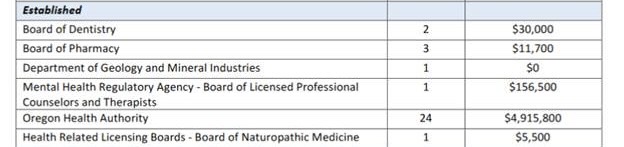
According to the Taxpayer Association of Oregon, Oregon lawmakers passed 185 fee increases (increasing existing fees and establishing new fees) in 2023 that will mean $47 million in higher costs.

Of those, 77 new or increased fees will directly impact the cost of medicine, hospitals and health care, which are all already straining the budgets of Oregonians.  Another 47 fee increases will impact Oregon’s agriculture industry and consumers.

A list of 2024 fee increases by agency is below: 

And then there are the new fees the 2023 Legislature created:

Portlanders and almost all Oregonians are also going to be paying a new cell phone tax this year. Starting January 1, 2024, a 988 Coordinated Crisis Services Tax will be added to the existing Oregon Emergency Communications (911) Tax. The new tax was implemented by the Oregon Legislature with the passage of House Bill 2757. The $50 million a biennium tax is slated to fund the state’s new 9-8-8 suicide prevention hotline.  

DMV fees have gone up, too, touching just about everybody with a vehicle. For example:

  • Class C driver license or restricted Class C driver license, increased from $54 to $58
  • Commercial driver license, increased from $75 to $160
  • Instruction driver permit, increased from $23 to $30
  • Commercial learner driver permit, increased from $23 to $40
  • Hardship driver permit application, increased from $50 to $75
  • Fee for renewal of a commercial driver license, increased from $55 to $98
  • Fee for knowledge test for a motorcycle endorsement, increased from $5 to $7
  • Fee for a skills test for any commercial driver license, increased from $70 to $145

And the list of fee increases goes on, nickeling and diming Oregonians.  

And of course legislators are busy thinking of new taxes.

For example, because the Oregon Department of Forestry wants more money to fight wildfires, Sen. Elizabeth Steiner, D-Portland, wants to charge every property owner in the state an annual fee to pay for what she perceives as a statewide issue.

And then, of course, there’s always inflation. It has been pushed down by aggressive Federal Reserve action, but in its long-term economic projections from December, the Federal Open Market Committee forecasted core Personal Consumption Expenditures Price Index inflation will drop from 3.2% in 2023 to 2.4% in 2024 and 2.2% in 2025.

But, still, hold on to your wallet. The state is considering tolls on I-205, I-5, U.S. 26 and Highway 217.

And the beat goes on.

Is Home Selling Greed Hitting A Wall? Lake Oswego May Offer a Hint.

Is the frenzied home selling market slowing down?

I just did a sample of home pricing in Lake Oswego, OR, a high-income, largely white-collar town. It may have been small, but I wonder if it’s telling us something.

People are listing their homes at high prices and, with no offers, lowering their asking price, and still waiting for a sale. Instead of greeting lines of eager prospective buyers the day after listing, many homeowners appear to be anxiously awaiting offers.

  • A 4-bedroom 5-bathroom 4,050 house on Westlake Drive was listed on June 29, 2022, at $1,790,000. On July 11, the asking price was lowered to $1,599,000, a $191,000 cut.
  • A home on Dogwood Drive was listed on July 16 at $1,200,000 and then promptly lowered to $995,000, a $205,000 cut. 
  • A home on Nansen Summit was listed for sale on May 26 at $1,495,000, increased to $1,595,000 on July 8 and then dropped again to $1,495,000 on July 12.
  • A home on Koderra Ave listed for $1,370,000 on June 20 dropped its price to $1,275,000 on July 7, a $95,000 cut.
  • A house on Streamside Dr. listed for $1,369,000 on June 13 and dropped its asking price to $1,299,000 on July 7.
  • A house on Upper Dr. listed at $2,300,000 on June 2 dropped its asking price to $2,250,000 on July 13.
  • Even a smaller home on Aquinas St. that was listed on June 23 at $899,900 dropped its price to $875,000 on July 13 and a house on Oriole Lane listed at $625,000 on May 7 dropped its asking price to $585,000 on June 19, a $40,000 cut.

In June, Lake Oswego home prices were up 6.3% compared to last year, selling for a median price of $985K. On average, homes in Lake Oswego sold after 7 days on the market compared to 5 days last year. But there were just 70 homes sold in June, down from 132 last year.

The Wall Street Journal reported today that the U.S. housing market overall is rapidly cooling as record prices and high mortgage rates weigh on home sales, locking out potential buyers. Across the country, sales of previously owned homes fell for a fifth straight month, dropping 5.4% in June to an annualized rate of 5.12 million. That was lower than the number of sales recorded in all of 2019, before the Covid-19 pandemic became widespread in the U.S.

The average rate on a 30-year fixed-rate mortgage rose to 5.51%, mortgage-finance giant Freddie Mac said on July 14. That was lower than the 13-year high of 5.81% set in June, but still a big jump from the 2.88% rate a year ago and high enough to dissuade many potential homebuyers.

Maybe all this is a sign the overheated housing market, including in Lake Oswego, is slowing down.