Washout: Hillary’s foreign policy experience does her no favors

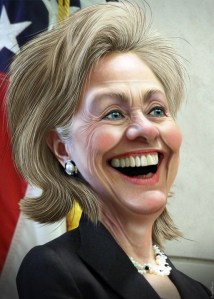
HillaryCaricature

Hillary Clinton and her backers figure she’s got at least one advantage, public trust in her foreign policy experience and judgment.

Hillary tried to highlight that factor when she told a questioner at a recent New Hampshire town hall meeting, “When you vote for someone for president, you’re also voting for a commander in chief.”

But why, exactly, does Hillary, or anybody else, think her foreign policy experience is a plus when you review her screw-ups.

Consider:

Libya

Then: Hillary Clinton urged President Obama to back a military campaign against Libyan leader Muammar Gaddafi, over the opposition of Defense Secretary Robert M. Gates and other national security experts.

Now: Libya has deteriorated into a virtual failed state run by hundreds of private militias. Eighteen months after the initial airstrikes, U.S. Ambassador J. Christopher Stevens and three other Americans were killed in attacks by militants on a U.S. diplomatic post and a nearby CIA site in Benghazi. The North African nation has become a primary outpost for the Islamic State, which has exploited the chaos to take territory, train soldiers and prove its strength outside Syria and Iraq. Washington Post, Feb. 3, 2016

Iraq

Then: On voting in favor of a resolution to take military action against Iraq in the face of Saddam Hussein’s possession of weapons of mass destruction, “I believe the facts that have brought us to this fateful vote are not in doubt,” Clinton said in a Senate speech the day before the vote. “It is with conviction that I support this resolution as being in the best interests of our nation…It is a vote that says clearly to Saddam Hussein — this is your last chance. Disarm or be disarmed.”

“We’ve ended the war in Iraq,” Obama said on June 25, 2012, at a New Hampshire rally in New Hampshire. “I’ve kept the commitments that I’ve made,” he said in Iowa on Oct. 24, 2012. “I told you we’d end the war in Iraq. We did.”

Now:

Although the Iraq war has technically been over for more than four years, Iraqis are still dying in large numbers. The number of Iraqis seeking refuge in other countries has risen considerably as the conflict between the Islamic State and the Iraqi government and associated forces continues. The U.N. has described the violence as “staggering” and noted the Islamic State may be guilty of war crimes, crimes against humanity, and possibly genocide.

A Jan. 2016 report by the UN Assistance Mission for Iraq also accuses ISIS of holding an estimated 3500 people as slaves across Iraqi territory, using many as human shields, and pressing 800-900 children into military service for the conflict.

Meanwhile, animosity Between Sunnis and Shiites is threatening the Iraq’s stability. Neighboring Iran, home to the world’s largest Shia population, is behind the country’s support for Iraq’s Shia-dominated government.

Syria

Then: Hillary Clinton joined President Obama in declaring that Syrian President Bashar Assad’s forces would cross a “Red Line” if they used chemical weapons. On Aug. 11, 2012, then-Secretary of State Hillary Clinton said in Istanbul that it’s clear to the Assad regime the use of chemical weapons is “a red line for the world.” On Aug. 20, 2012, Obama said that the use or movement of chemical weapons by the Assad regime is a red line. “We have been very clear to the Assad regime, but also to other players on the ground, that a red line for us is we start seeing a whole bunch of chemical weapons moving around or being utilized,” Obama said. “That would change my calculus. That would change my equation.”

Now:

Under the banner of fighting international terrorism, President Vladimir Putin has reversed the fortunes of forces loyal to Syrian President Bashar al-Assad, which were rapidly losing ground last year to moderate and Islamist rebel forces in the country’s five-year-old crisis. Washington Post, Feb. 3, 2016

Today, 4.6 million Syrians are refugees and 6.6 million are displaced within Syria; half are children. World Vision

Syria’s civil war is the worst humanitarian crisis of our time. Half the country’s pre-war population — more than 11 million people — have been killed or forced to flee their homes. Mercy Corps

The conflict is now more than just a battle between those for or against President Bashar al-Assad. It has acquired sectarian overtones, pitching the country’s Sunni majority against the president’s Shia Alewite sect, and drawn in regional and world powers. The rise of the jihadist group Islamic State (IS) has added a further dimension. BBC

Russia

Then: In March 2009, Hillary Clinton presented Russian Foreign Minister Sergei Lavrov with a red button with the Russian text “перегрузка”, which was intended to be the Russian word for “reset”. Clinton explained that she wanted to reset relations between Russia and the United States, to spur a new era of better ties. “The reset worked,” Clinton told CNN in August 2014.

Now: In March 2014, Russia decided “To hell with the reset” and annexed Crimea. This led to the installation of a pro-Russian government in Crimea, the holding of a disputed, unconstitutional referendum and the declaration of Crimea’s independence.

 Russia subsequently:

  • blocked a U.N. Security Council resolution on Crimea’s referendum
  • provided a Russian-made Buk missle to Ukrainian rebels who used it to shoot down Malaysia Airlines Flight 17 over eastern Ukraine, killing all 298 people on board
  • granted asylum to Edward Snowden, who’s wanted in the United States for leaking information about National Security Agency surveillance practices.
  • Provided military support to Syrian President Bashar al-Assad.

Hillary, a tested,  brilliant, strategic foreign policy expert the American people can trust? I don’t think so.


Disillusionment and despair: the Trump turmoil

Donald Trump isn’t a candidate.

Donald-Trump-Caricature

He’s a stand-in for the alienation and disillusionment so many Americans feel as both the Republican and Democratic parties have failed us.

How could it be otherwise when so much seems so wrong and fakery, misdirection, and outright lies by both parties have been so pervasive?

Consider:

  • The past several decades have seen the most sustained rise in inequality in the United States since the 19th century after more than 40 years of narrowing inequality following the Great Depression. By some estimates, income and wealth inequality are near their highest levels in the past hundred years.
  • The 2009 $830 billion stimulus package, with a claimed focus on shovel-ready projects, was supposed to fix things after the Great Recession. The legacy instead – a slow growth economy. The first 23 quarters of the recovery, which officially began in June of 2009, had an annual rate of growth of just 2.1 percent.
  • The distribution of wealth in the United States is even more unequal than that of income. The wealthiest 5 percent of American households held 54 percent of all wealth reported in 1989, rose to 61 percent in 2010 and reached 63 percent in 2013.
  • 71 percent of Americans say life has gotten worse for middle-class Americans over the past 10 years.
  • Today’s fifty-somethings may be part of the first generation in American history to experience a lifetime of downward mobility, in which at every stage of adult life, they have had less income and less net wealth than did people who were their age ten years before.
  • There is now less economic mobility in the United States than in Canada or much of Europe. A child born in the bottom one-fifth of incomes in the United States has only a 4 percent chance of rising to the top one-fifth.
  • Young Americans (ages 18-34) are earning less (adjusted for inflation) than their peers in 1980 ; the college graduating class this year left with an average student debt of $35,051.
  • In 1986, President Reagan signed legislation that was supposed to fix the illegal immigration issue once and for all. Three million applied for legal status and about 2.7 million received it. Today, about 11.7 million immigrants are living in the United States illegally. So much for the fix.
  • Despite all the “mission accomplished” and “victory is at hand” assurances, America has been at war in the Middle East for the past 15 years, with little to show for it, billions of dollars down a rathole, thousands of American soldiers dead and wounded, and continuing chaos in Afghanistan, Iraq, Libya and Yemen.
  • Despite the billions the government has spent on poverty-related programs, half of children age three and younger live in poverty.
  • The White House wants to “press the reset button” on one of Washington’s biggest challenges: its increasingly troublesome relationship with Russia,” Vice President Biden, 2/7/2009; “We’re going to hit the reset button and start fresh (with Russia),” Secretary of State Hillary Clinton, 3/6/2009
  • “If you like the plan you have, you can keep it.  If you like the doctor you have, you can keep your doctor, too.” President Obama, 6/6/2009.
  • “I ended the war in Iraq, as I promised. We are transitioning out of Afghanistan. We have gone after the terrorists who actually attacked us 9/11 and decimated al Qaeda.” President Obama, 9/14/2012
  • Despite assurances from some politicians that all’s well, the Medicare program has $28.1 trillion in unfunded liabilities over the next 75 years. Together with Social Security’s $13.3 trillion shortfall, the government has accumulated entitlement spending commitments that far exceed our capacity to pay for them.
  • In the 2012 election cycle, a tiny elite of the U.S. population, just 0.40 %, made a political contribution of more than $200, providing 63.5% of all individual contributions to federal candidates, PACs and Parties, according to the Center for Responsive Politics.
  • Fewer than four hundred families are responsible for almost half the money raised in the 2016 presidential campaign to date, a concentration of political donors that is unprecedented in the modern era.

As H.L. Mencken said, “Under democracy one party always devotes its chief energies to trying to prove that the other party is unfit to rule — and both commonly succeed, and are right.”


Berlin Redux: Those who cannot remember the past are condemned to repeat it

In July 2009, speaking at Moscow’s New Economic School, Obama said long-standing assumptions that the US and Russia were antagonists vying for spheres of influence were inaccurate.

“Given our interdependence, any world order that tries to elevate one value or people over another will inevitably fail,” he said. “That is why I have called for a ‘reset’ in relations between the United States and Russia. This must be more than a fresh start between the Kremlin and the White House, though that is important.”

“It must be a sustained effort among the American and Russian people to identify mutual interests, and to expand dialogue and co-operation that can pave the way to progress,” he added.

Obama calls for reset of U.S.-Russian relations in 2009

Obama calls for reset of U.S.-Russian relations in 2009

All this just 12 months after Bush’s hopes for better relations with Russia had been shattered by its war with Georgia.

Now, five years later, Russia has annexed the Crimean Peninsula of Ukraine and the United States is sitting by helplessly.

Obama has said that Russia, by its actions in Crimea, is on the wrong side of history.

Perhaps Obama is forgetting history.

In 1933, Adolph Hitler emphatically proclaimed Germany’s commitment to peace.

“The German government “…is…of the conviction that there can only be one great task in our time: securing peace in the world,” he declared to the Reichstag. “The German Government wishes to engage in peaceful discussions with the other nations on all difficult questions,” he added.

Hitler proclaims Germany's pursuit of peace

Hitler proclaims Germany’s pursuit of peace

That same year, however, Hitler laid the groundwork for what would become the pretext for forcefully absorbing other countries. “We have particularly at heart the fate of the Germans living beyond the frontiers of Germany who are allied with us in speech, culture, and customs and have to make a hard fight to retain these values,” he said in a policy statement submitted to the Reichstag on March 23, 1933. “The national Government is resolved to use all the means at its disposal to support the rights internationally guaranteed to the German minorities,” he said.

When Germany annexed Czechoslovakia’s Sudetenland in 1939, it was justified as an effort to “liberate” the predominantly German area and protect the abused ethnic German population . Foregoing action, Britain and France chose to negotiate a deal that preserved “peace in our time”.

Austria was next. In March 1938, a coup d’état was engineered by the Austrian Nazi Party of Austria’s state institutions in Vienna and Germany annexed Austria into the Third Reich that same month. The Nazis then held a plebiscite allowing the people to vote on the annexation and claimed that the vote in favor was 99.8 percent. (Sound familiar?)

The reaction from the Allies? Mostly words.

It wasn’t until Germany and the Soviets invaded Poland in 1939 that Britain and France declared war on Germany, too late to stop the Soviets and Nazis from slaughtering millions of Jews and Polish intelligentsia through starvation, forced labor and mass killings.

The Russian portion of Poland, by the way, was incorporated within Russia by Soviet “elections” and Russian citizenship was conferred on the Polish inhabitants. (Sound familiar?)

Allied action also came too late for Ukraine, which was overrun by the Nazis in 1941 after years of brutal killings under Stalin, during which millions of Ukrainians were murdered and millions more were sent to concentration camps.

Now we have Putin talking about the need to “protect” ethic Russians in Eastern Ukraine.

“It’s all nonsense. There are no kinds of Russian units in eastern Ukraine. No special forces, no instructors. They are all local citizens.” Russia's President Vladimir Putin

“It’s all nonsense. There are no kinds of Russian units in eastern Ukraine. No special forces, no instructors. They are all local citizens.”
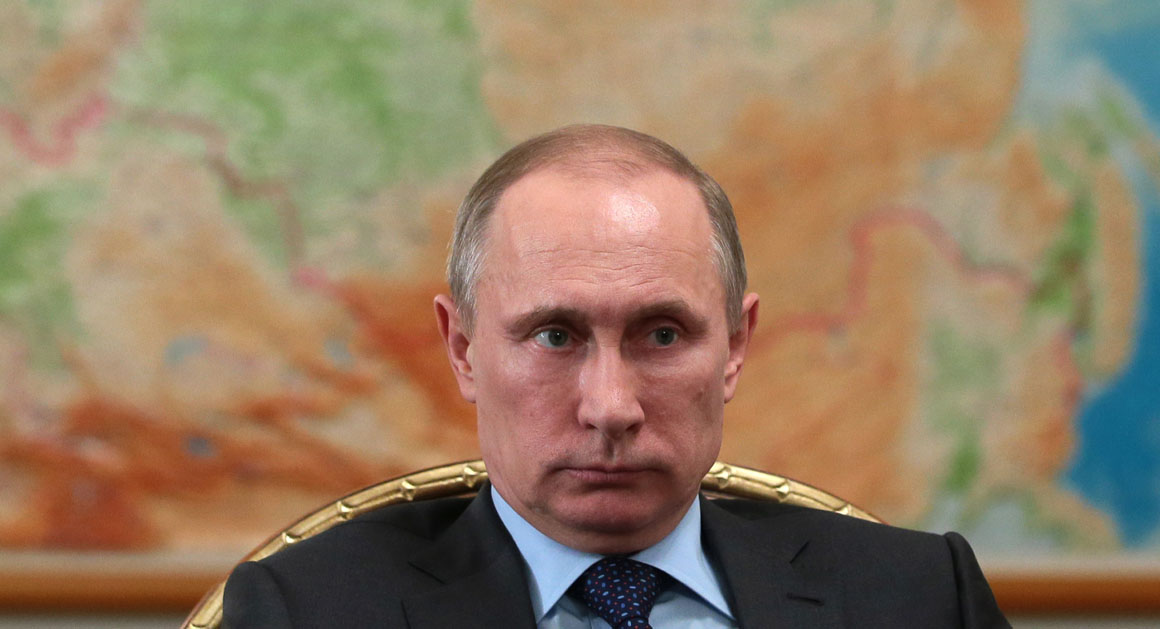
Russia’s President Vladimir Putin

On April 17, 2014, in a televised Q&A session with the Russian public, Putin observed that the Federation Council, the upper house of Russia’s Parliament, had granted him the right to use military force in Ukraine. “I really hope that I do not have to exercise this right and that we are able to solve all today’s pressing issues via political and diplomatic means,” he said.

And today, with Russian-connected demonstrators fomenting unrest in Eastern Ukraine, Russia had the gall to accuse the new Ukrainian government of flouting a just concluded agreement intended to diffuse the crisis. “The Geneva accord is not only not being fulfilled, but steps are being taken, primarily by those who seized power in Kiev, that are grossly breaching the agreements reached,” said Russian Foreign Minister Sergei Lavrov in a press conference in Moscow.

Here we go again?