U.S. vs. China: Cutting Our Own Throats

Under Xi Jinping, general secretary of the Chinese Communist Party (CCP), China’smilitary might , including its nuclear capabilities, have been expanding rapidly while it “has demonstrated an increasing willingness to use military coercion and inducements to achieve its aims”, according to the U.S. Department of Defense.

China’s dominance in global manufacturing is greater than it’s ever been. Its government subsidies are giving industries leverage to out-compete with American products. It had a nearly $1 trillion trade surplus with the rest of the world in 2024. 

China has an aggressive, global spy network and influence operation aimed at expanding and solidifying its power.

China is supporting the Russian war machine and is openly preparing for a war to take over Taiwan. 

China is aggressively bullying the Philippines and other countries with its claims on the South China Sea. 

The U.S is falling further and further behind China in shipbuilding, threatening maritime security around the world. A new report by the U.S. Trade Representative found, that U.S. international trade is “carried out on vessels made in China, financed by state-owned Chinese institutions, owned by Chinese shipping companies, and reliant on a global maritime and logistics infrastructure increasingly dominated by China.”

All together, China presents a clear and present danger to the United States,

But American consumers continue to subsidize the Community regime by procuring the countries products as though there’s a fire sale, American companies continue strengthening their ties to China and the strongest signal President-elect Donald Trump is sending to China isn’t, “I’m determined to protect American security”, but “Let’s make a deal”. 

Nothing illustrates that better than Trump’s words and actions with respect to TikTok, owned by the Chinese company ByteDance.

In April 2024, with bipartisan concern about the national security threat TikTok posed to the United States and its use as a tool to spread misinformation and propaganda, the House of Representatives voted 360 to 58 in the House and the Senate voted 78 to 18 for a bill requiring the sale of the social media platform to a U.S. company or face a shutdown.

Trump actually tried to ban the app himself in his first term by signing an executive order in August 2020 asserting that the app was capturing mass amounts of information about Americans and raising risks for the country.

“These risks are real,” the order said. “This data collection threatens to allow the Chinese Communist Party access to Americans’ personal and proprietary information − potentially allowing China to track the locations of Federal employees and contractors, build dossiers of personal information for blackmail, and conduct corporate espionage.”

In March 2024, however, Trump flipped his position, saying he was opposed to banning the app or forcing a sale. “Frankly, there are a lot of people on TikTok that love it,” Trump said on CNBC . “There are a lot of young kids on TikTok who will go crazy without it.”

On January 18, TikTok  did shut down, but after Trump promised to issue an executive order on Monday to “extend the period of time before the law’s prohibitions take effect,” it came back up. It announced, “In agreement with our service providers” the company “is in the process of restoring service. We thank President Trump for providing the necessary clarity and assurance to our service providers that they will face no penalties providing TikTok to over 170 million Americans and allowing over 7 million small businesses to thrive.”

The law allows Trump to grant a 90-day reprieve to TikTok, but only if he can certify at that point “evidence of significant progress” toward a sale. During that 90 days, of course, China’s alleged efforts to undermine United States security would continue, an issue of apparently little concern to Trump.

Trump’s inclination to pacify China and TikTok, reminds me of the protests of young Americans against the TikTok shutdown, favoring their personal TikTok addiction over American security.  These same self-absorbed young people are likely many of the same people who  are sustaining China’s economy by buying massive amounts of cheap fast fashion from Chinese companies like Temu and Shein, despite extensive reports  that the apparel hides the dirty laundry of environmental damage and labor exploitation.

Trump’s moves are not, however, going unchallenged.

Sen. Pete Ricketts (R-Nebraska), chair of the Senate Foreign Relations Committee, has urged US companies to halt operations with TikTok. “For TikTok to come back online in the future, ByteDance must agree to a sale that satisfies the law’s qualified-divestiture requirements by severing all ties between TikTok and Communist China,” Ricketts said.

Also breaking with Trump, U.S. Senator Tom Cotton, chair of the Senate Intelligence Committee, also issued a stern warning for companies deciding to work with TikTok after its resumption of service. “Any company that hosts, distributes, services, or otherwise facilitates communist-controlled TikTok could face hundreds of billions of dollars of ruinous liability under the law, not just from DOJ, but also under securities law, shareholder lawsuits, and state AGs, Cotton posted on X. “Think about it.”

Meanwhile, TikTok’s CEO is planning to attend a Trump victory rally at the Capitol One Arena in Washington, D.C. tonight (Sunday) and is expected to sit on the dais for Trump’s inauguration on Monday.

It’s a good time to remember Franz Stangl, the commandant of the Nazi concentration camp Treblinka in occupied Poland from Sept. 1942 to August 1943. Gitta Sereny, an Austrian born journalist, biographer and historian. wrote “Into That Darkness” based on interviews with Stangl after the war. Trying to understand how he acclimated to running the camp, she asked him how he managed to do it.  “It was the small steps. Small compromises,” he said. ” You see, if you can get people to stop believing in absolute right and wrong, you can get them to do anything.”

Americans succumbing to the allure of Chinese goods, American companies allowing their drive for profits to justify strengthening China’s economy and American politicians setting aside their legitimate concerns about the challenges from China are guilty of small steps, too.

Stay tuned.

Addendum

In still engaging wholeheartedly with China, American companies are repeating how so many have responded (or not) to Russia’s aggression in Ukraine.  According to Foreign Policy, as of 2023, around 800 multinational companies from Western and like-minded countries were still operating in Russia—either because they decided to stay or because they were still generating revenues there despite having pledged to leave. Around 60 percent of those global firms that operated in Russia before the full-scale invasion began in February 2022 still continue to do so. Second, Germany, the United States, and France are—by far—the top three countries of origin for Western firms that retain a presence in Russia, accounting for around half of them.

What is undeniably true , according to Foreign Policy, is that the hundreds of Western firms staying in Russia are helping Moscow finance the war in Ukraine. The data is eye-popping. In 2022 and 2023, firms from the G-7, European Union, and like-minded economies generated around $370 billion in revenues on Russian soil, which was more than Moscow’s military budget over the same period. In the first two years of the war, Western firms transferred more than $11 billion in corporate taxes to Russian state coffers, with Austrian bank Raiffeisen alone accounting for one-tenth of this amount. The data is not available yet for 2024, but a ballpark estimate suggests that Western firms probably paid another $4-6 billion in corporate taxes, bringing the total to roughly $16 billion funneled to the Kremlin since the invasion began.


More Sex is Better, Right? More News, Too?

“The sexual revolution obviously succeeded in its aim: more freedom”, writes Rob Henderson[1], who publishes a newsletter on human nature.  “But many people conflate liberation with happiness and, sadly, the world doesn’t work that way,” Women are freer today, he argues, but they are less happy.

It’s the same with access to information. We all have access to much more information today, both free and paid, but it’s debatable whether we are better informed. 

When I was a kid in a small Connecticut town in the 1950s, we got our news facts from the Meriden Record newspaper delivered in the morning and the New Haven Register newspaper delivered in the afternoon. In the mail, we got weekly issues of the magazines U.S. News & World Report, Life and Time and monthly editions of the National Geographic and Reader’s Digest. 

We also listened to radio, mostly station WTIC out of Hartford. In the early 1950s we got a black and white TV (We didn’t get a color TV until the 1960s) and started watching evening news shows. 

Those were the days, my friend. We thought they’d never end.

We thought that was plenty to connect us with local, national and world news.

But the internet proved us wrong, at least with respect to the volume and variety of available news. Where news used to come out of a straw, now it’s spewed out of a bullhorn. It’s turning us all into nervous wrecks.

As Tom Slater, the editor of Spiked put it, with the deluge of commentary out there, “We are riven by ‘culture wars’ and hot-button topics that no one cared about five minutes ago.” 

We’re smothered in a torrent of news 24/7 from a fragmented media environment, much of it of dubious veracity.

A clear majority of U.S. adults (86%) say they at least sometimes get news from a smartphone, computer or tablet, including 57% who say they do so often, according to the Pew Research Center , and a high number still get their news from television.  Americans turn to radio and print publications for news far less frequently. In 2024, just 26% of U.S. adults say they often or sometimes get news in print, the lowest number Pew’s surveys have ever recorded.

There are several different pathways Americans use to get news on their digital devices, Pew says. News websites or apps and search engines are the most common: About two-thirds of U.S. adults at least sometimes get news in each of these ways. A little more than half (54%) at least sometimes get news from social media, and 27% say the same about podcasts.

Younger people, in particular, get their news from digital devices, with 86% of people ages 18-29 and 72% of people ages 30-49 preferring digital devices as their news source. 

But is the wider availability of news making us all smarter, better informed, more responsible participants in the dialog of democracy? 

In a recent essay in The New Yorker, staff writer Adam Gopnik wrote that “the Internet age and the era of social media has led not so much to engagement as enragement, with algorithms acting out addictively on tiny tablets.” 

“The aura of the Internet age is energized, passionate, and, above all, angry,” Gopnik wrote. “The democratic theorists of old longed for an activated citizenry; somehow they failed to recognize how easily citizens could be activated to oppose deliberative democracy.”

The deluge of information posing as news has also left us in a constant rush, buried in misinformation and outright lies unchecked by gatekeepers like the editors of yore. As Hamish McKenzie, a co-founder of Substack, puts it, “With few exceptions, the media power brokers of yesterday now oversee a series of properties with dwindling reach and a limited ability to convince anyone of anything,”

One result – a growing lack of trust in all media. 

The just-released Trust in Media Survey results from Gallup “leave no doubt that members of my profession are officially America’s lowest life form,” Gopnik wrote.

The Gallup survey asked:

In general, how much trust and confidence do you have in the mass media — such as newspapers, T.V. and radio — when it comes to reporting the news fully, accurately, and fairly — a great deal, a fair amount, not very much, or none at all?

  • A great deal 7 
  • Fair amount 25 
  • Not very much 29 
  • None at all 39

That’s 68% saying they have “not very much” or “none at all” trust and confidence in mass media., which includes newspapers, magazines, radio, television, and the Internet.

In the current political environment, the fragmentation and declining reliability of the mainstream media has led to a decline of its influence. 

“One of the contradictions of the social-media age is that we can follow the campaigns incredibly closely—tracking every movement in the polls, listening to every concerning Trump remark—but somehow this flood of content makes us feel even more distant from the process, and less empowered,” Jay Caspian Kang, another staff writer at The New Yorker, asserts. “…the proliferation of content has actually weakened the mainstream media’s influence on voters, many of whom have moved on to alternative outlets of news and commentary.”

And those alternative outlets are often little more than collections of conspiratorial rubbish, like the manufactured news that Hillary Clinton was running a pizza-restaurant child-sex ring, accusations that FEMA prevented Florida evacuations in the recent hurricanes and claims that funding for storm victims was instead given to undocumented migrants. And all of this is reinforced by the echo chambers online news consumers occupy.

 “It used to be in this world that people could at least agree on the same set of facts and then they could debate what to do about those facts.,” says writer, Steven Brill. “We’re at a point where nobody believes anything. Truth as a concept is really in trouble.”

That has led to a widespread feeling of disappointment in America and its institutions.

Author and theater critic, Hilton Als, wrote of Joan Didion’s “romance with despair.” That’s where we are. Wallowing in such gloom can’t be good for this country.


[1] Rob Henderson is the author of “Troubled: A Memoir of Family, Foster Care, and Social Class.” A veteran of the U.S. Air Force, he holds a B.S. from Yale and a Ph.D. in psychology from the University of Cambridge (St. Catharine’s College).

America’s Elites Showcase TikTok, National Interests Be Damned.

Supporting Tik Tok is chic. 

At least that’s the message I get from the decision by Vogue’s Anna Wintour to choose Shou Chow, TikTok’s chief executive, as an Honorary Chair of this year’s over-the-top Met Gala in New York City tonight. 

TikTok declined to reveal to The New York Times its financial contribution to the Met Gala, but sponsors in previous years are known to have each kicked in roughly $5 million (TikTok and China are probably delighting in how cheaply the glitterati can be bought off).

The New York Times even took note of Chow’s high profile at the Met Gala with an article in Sunday’s paper, “TikTok’s Boss Takes On a Flashy Gig”.

All the official co-chairs of the splashy event – Zendaya, Jennifer Lopez, Bad Bunny and Chris Hemsworth – are likely on board, too, caring less about matters of substance than celebrity visibility.

All this at the same time as Washington, D.C. is focused on TikTok’s corrosive influence in the United States, its massive collection of potentially sensitive user information and its ownership by the Chinese company ByteDance. Those concerns have prompted the U.S. government to pass legislation banning the social media platform unless it is sold to a government-approved buyer.

China has criticized the congressional action, saying it undermines US claims of support for free speech, an ironic assertion since speech is tightly controlled in China, where the government maintains a vise-like grip on media, the internet, and personal expression and any dissent can result in arrest, torture and imprisonment. Moreover, American platforms such as Facebook, YouTube and X (formerly Twitter) have been banned in China for years.

(TikTok filed a federal lawsuit on May 7, 2024 challenging the constitutionality of the new law. The lawsuit accuses the government of trampling on TikTok’s First Amendment rights—as well as the free-speech rights of Americans—under the banner of national security)

Still, the style elite seem perfectly happy to help TikTok elevate its presence and influence, national interests be damned.

It may be because in their jaded eyes they see moral equivalence between the United States and authoritarian countries such as China, even though the evidence is clear that, as Douglas Murray, a British political commentator, wrote in The Free Press, “We have enormous moral authority, and…there is an oceanic gulf separating the many failures and shortcomings of the United States and the intentional and wanton taking of human life that is all too common in more authoritarian climes.”

It brings to mind Donald Trump’s admiration of authoritarian leaders. In a 2023 interview with Tucker Carlson on Fox, Carlson asked, “How smart is [Xi]? Could you tell?” “Top of the line,” Trump replied. “President Xi is a brilliant man. If you went all over Hollywood to look for somebody to play the role of President Xi, you couldn’t find [them], there’s nobody like that: the look, the brain, the whole thing.”

You may think that elites elevating questionable or authoritarian figures shouldn’t be of any concern. But people who enable dark forces, and even cheer them on, are ignoring the threat that China poses to democracy and rule of law around the world. 

China’s abdication of its responsibilities under the 1985 Sino-British Joint Declaration, where China promised to preserve the judicial system, legislative and executive autonomy, and all the key freedoms to which Hong Kong people had become accustomed, is hard evidence of China’s intentions.

The fact is that dismissal of China’s threat is naive. China is seeking to displace the United States and restore China to its rightful place. Lionizing people like Shou Chow ignores that reality. 

Rush to judgement: social media is eroding America’s social stability

“Let the jury consider their verdict,” the King said, for about the twentieth time that day. “No, no!” said the Queen. “Sentence first—verdict afterwards.” 

                Alice’s Adventures in Wonderland by Lewis Carroll

In today’s venomous social media environment, hair-trigger public reactions based on fragmentary, often inaccurate, information are the new norm and are hastening the disintegration of civil society. 

On Sunday, Sept. 13, 2020, at about 4:30 PM, a Lancaster, PA police officer shot and killed a Black man. Twitter exploded in collective fury:

Valnjeffewsist@ValerieNygaard: Another murder by police today in Lancaster PA. 27 year old autistic man shot four times in the chest in front of mom.

RT @lancnick: Police shot and killed a reportedly autistic man in Southwest Lancaster City today and left his body on the ground for hours.

king of da souf@jlinmadison13: Lancaster police shot a 14 year old autistic boy 4 times!!!

All stirred up, protesters were off to the races, pouring into downtown Lancaster calling for “justice.” They hurled bottles and rocks at police officers, threw traffic barricades, planters and trash cans, piled up street signs, pieces of plywood and trash bags and set them on fire and damaged a county vehicle parked in front of a police station. When the protesters ignored police orders to disperse, tear gas was deployed.

Lancaster, PA protesters, Sept. 13, 2020

The Twitter outrage continued the next day.

Sarah Meets@MeetsSarah: #LANCASTER How much of taxpayer dollars fund the police?…WHY, WHY are people getting not just shot but fucking MOWED DOWN LIKE THE CARTEL DOES by 7-10-20 bullets?? WTF is this?

As is so often the case, the reality of the shooting was quite different. It turned out that a Lancaster police officer had gone to the home of a woman who had called 911 to say her brother, 27-year-old Ricardo Munoz, was being aggressive with her mother and trying to break into her house. When the officer arrived at the scene, the man ran out of the house holding a knife and chased the police officer. The officer fired several shots, killing the man. 

All of this was captured in video footage released by the Lancaster police department. But the damage had been done.

People everywhere are becoming alarmed, or pretending to be alarmed, by real and imagined crises pushed on social media with increasing frequency, often by malicious actors. And since social media algorithms drive repetitious messages that conform to our biases, people are more likely to believe things to which they’ve been exposed repeatedly.

In a Fast Company articleHow Your Brain Keeps You Believing Crap That Isn’t TrueBob Nease wrote “…what counts as common knowledge is a mix of things that are true and other things that are false, all of which are believed because they’re widely held, frequently repeated, and routinely recalled.”  Nease calls this “fluency as a surrogate for truth.”

All this is leading to informational cascade effects as the messages of alarmists spread far and wide, magnified by celebrities, journalists and commentators, corrupting the entire chain of communications.

“The public and the media may then become less willing to publicly challenge ascendant beliefs due to a social mechanism called a reputational cascade, Matthew Blackwell wrote in Quillette“Reputational cascades behave like informational cascades, but the underlying motivation is different—people publicly embrace the beliefs of others out of social necessity rather than genuine belief.”  

In an age of alternate realities, “the devastating irony of the present moment is that for all of our near-limitless access to knowledge, the truth is not merely inaccessible, but perpetually transformed into an up-for-grabs commodity,” writes Jason Clemence, assistant professor of humanities at Regis College. And as the information load increases, it gets harder to distinguish high-quality from low-quality information, too often resulting in the propagation of misleading information and outright falsehoods.

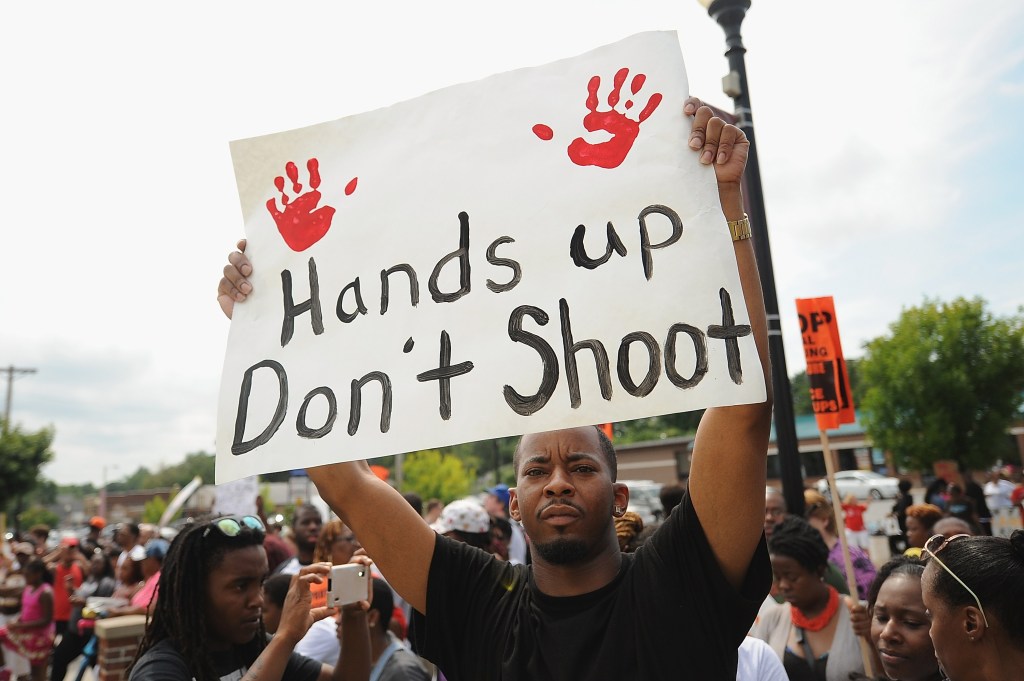
The shooting of Michael Brown is a classic case of how social media is exploited to launder false or misleading information into public discourse and increase public discord. 

Demonstrators protest outside the Ferguson, Missouri, police department during the National March on Ferguson, August 30, 2014. (Photo credit – Michael B. Thomas/AFP/Getty Images)

After the August 9, 2014 shooting death of Michael Brown by police officer Darren Wilson in Ferguson, Missouri, a St Louis suburb, the story quickly spread on social media that he died while attempting to surrender and that he had his hands raised as he pleaded with Wilson not to shoot him. “Hands up, don’t shoot” became the immediate rallying cry of protesters and the mantra of a movement.

The day after Brown’s death, protests, riots, looting and arson erupted in the vicinity of the shooting and across Ferguson.

But there are two glaring problems with this story. Brown never surrendered with his hands up, and two state investigations, as well as one by President Obama’s Justice Department, concluded that Wilson was justified in shooting Brown.

Still, major media continue to this day to refer to Michael Brown’s death as “murder” and to describe him as “an unarmed black teenager.” Challenging the “Hands up, don’t shoot” narrative in Brown’s case still risks harsh criticism or censure.

On social media, hearsay and rumor dominate and “facts” are only relevant if they reinforce an ideological predisposition. Not only that, but everybody involved in the ongoing debate is expected to choose a side without hesitation, with no further research and no further deliberation.

That is leading to an erosion of social stability that threatens the cohesion of the United States. Instead of being bound together by a shared reality, we are moving toward a society in which individual citizens care only about their own interests and those of others who are like-minded, where there is no common morality and the concept of individual sacrifice for the common good is dismissed as out-of-date.

That will put our democracy at risk.

Nobody’s watching the Democratic debates. Does it matter?

Just 1.9% of Americans watched the Dec. 19 Democratic presidential debate.

APTOPIX Election 2020 Debate

The way things are going, the audience for the 10th and last 2020 Democratic Party presidential debate on Feb. 24, 2020 will be zero.

A total of 15.26 million viewers watched the first debate on June 26, 2019. By the most recent debate on Dec. 19, the number of viewers had sunk like a stone to 6.17 million.

That’s a miniscule 1.9% of Americans.

But it doesn’t matter. What really matters is how the media of all types, particularly social media, interpret the debates to the public and grab elements of the debates to advance agendas.

Social media is the dominant influencer because:

  • National television news has a steadily shrinking audience. In the 2016 presidential race between Hillary Clinton and Donald Trump, only 10 percent of people said national nightly network television news was the most helpful news source.
  • Print newspapers have a steadily shrinking audience. Total circulation of U.S. daily newspapers today, for a U.S. population of 329 million, is less than in 1940, when the U.S. population was 132 million. In the 2016 presidential election, as many people named late night comedy shows as most helpful for political news as named a print newspaper.
  • Local TV news tends to focus on murders, fires, car crashes and the weather, not presidential politics.

Regardless of the issues discussed by the 10 Democrats during the 120 minutes of the second night of the first debate on June 27, 2019, it was a terse exchange between Kamala Harris and Joe Biden about busing that dominated subsequent coverage of the debate and online discussion. “Kamala Harris attacks Joe Biden’s record on busing and working with segregationists in vicious exchange at Democratic debate”  proclaimed the CNBC headline.

Similarly, regardless of the consequential issues discussed by the seven Democrats during the 120 minutes of the Dec. 19 debate, the media, including social media, focused on:

  • Who “won” the debate.
  • Assertions that “the knives came out” for Pete Buttigieg.
  • The vile wine cave.  Elizabeth Warren castigated Buttigieg for holding a fundraiser with rich people in a Napa Valley “wine cave.” Politico reporter Natasha Korecki said that was “the most entertaining” part of the debate. “ The conservative National Review headline read, “Biden Cruises and Buttigieg Takes Fire in the Wine Cave Debate.” The left-leaning Mother Jones said, “The “Wine Cave” Debate Was One of the Campaign’s Most Consequential Arguments.” And the story still has legs. On Sunday, Dec. 22, the New York Times ran a story relating the frustration and disappointment of the wine cave’s owners, both of whom are active Democrats, at being thrust into the public eye in such a negative manner.
  • Elizabeth Warren’s statement that economists are “just wrong” when they argue her proposals for trillions in new taxes will stifle growth and investment.
  • It was a testy night. “The political press, always thirsty for conflict, pounced,” the Columbia Journalism Review noted. “In a push notification, the New York Times alerted readers that we’d seen a “contentious evening”; Dan Balz, of the Washington Postnoted that a “collegial start” had given way to “fireworks.” There was talk of gloves coming offpummeling, and slugfests, and that was just from Politico. Another Politico piece listed the “five most brutal onstage brawls” of the night, complete with a tally chart and boxing-glove emojis.”
  • Diversity is what matters. Time pointed out that the only non-white candidate on stage was Andrew Yang.“This forced the uncomfortable conversation about how the party that talks so big about including diverse voices and that depends on minority voters ended up with such a white set of candidates in a field that was, at one point, historically diverse,” Time said.

In any case, what the American public really cared about, some media observed, wasn’t the debate but the upcoming release of Star Wars: The Rise of Skywalker. The first item in the Dec. 21, 2019 NY Times On Politics newsletter referenced this. “It appears nobody consulted the Jedi Council before scheduling a Democratic debate on the same night “Star Wars: The Rise of Skywalker” opened, the newsletter noted.

Lots of folks have chimed in about all the debates on social media, but they’ve mostly talked to others in their bubble in response to algorithm-delivered news content. As noted in Towards a New Enlightenment? A Transcendent Decade“… the emergence of the political “Twitterverse,” … has become a locus of communication between politicians, citizens, and the press, has coarsened political discourse, fostered “rule by tweet,” and advanced the spread of misinformation.”

tweet

Twitter discourse on national politics also tends to be driven by a very small segment of the population. According to the Pew Research Center, Twitter dialogue by American adults about national politics is driven by a small number of prolific political tweeters. They make up only 6% of all U.S. adults with public accounts on the site, but account for 73% of tweets from American adults that mention national politics.

Furthermore, as a Knight Foundation study  put it, Twitter is “a distorted mirror of Americans’ political views,” because it is dominated by the center left, countered by the extreme right.

Facebook plays a major role in the political debate, too, and not in a good way. As the Columbia Journalism Review reported, “Facebook is a toxic town square.” And that makes it dangerous because, it’s a primary source of political news for a growing segment off the public. A recent study conducted by the Pew Research Center estimated, for example, that more than 60% of Americans got their information about the 2016 US presidential election on Facebook.

Instagram has a growing place in public perception of politics and the debates, too, and could be a flashpoint for online disinformation during the 2020 election. “Disinformation is increasingly based on images as opposed to text,” said Paul Barrett, the author of an NYU report that’s prompted a renewed look at the problem. “Instagram is obviously well-suited for that kind of meme-based activity.”

It’s an engagement powerhouse that attracts far younger users than its parent company, Facebook, according to the NYU report  The report cited a Senate Intelligence Committee report that noted the Internet Research Agency — which led Russia’s disinformation campaigns in the 2016 election — found more engagement on Instagram than any other platform.

So, does it matter whether  fewer and fewer people are actually watching the Democratic debates? Probably not.