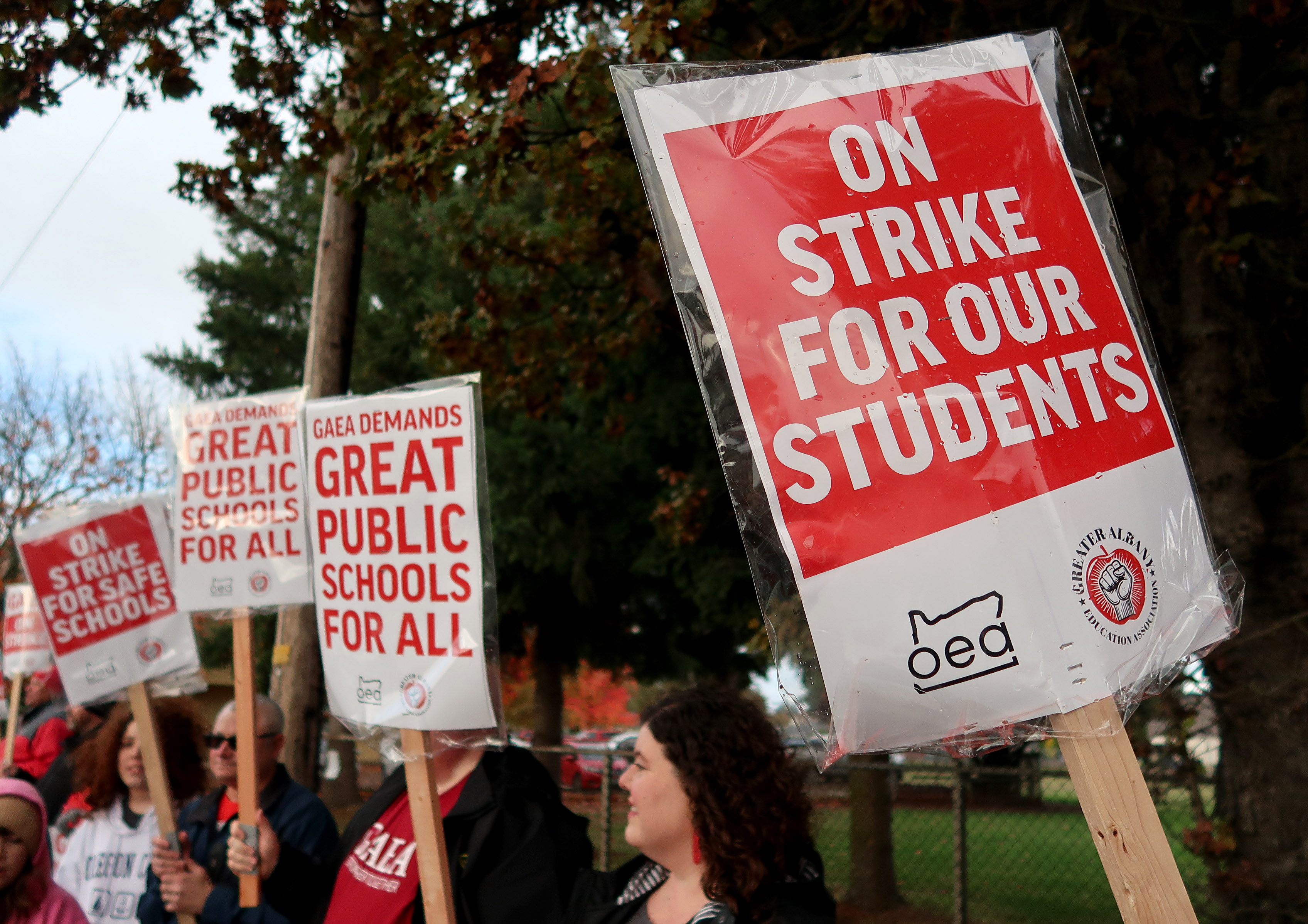
Gov. Kotek: Don’t Sign The Bill Paying Strikers

Bill to grant striking workers unemployment pay fails final vote in Oregon  Senate - OPB

Sometimes it’s nice to be first.

Oregon is justly proud, for example, that in 1971 it was the first state to pass a bottle bill to address the growing problem of litter from beverage containers and to encourage recycling.  

Other times being first is an abomination. 

That will be the case if Oregon Gov. Kotek signs SB 916, which would award up to ten weeks of unemployment insurance benefits to workers who go on strike.

The Oregon Employment Department (OED) anticipates that the bill would result in an additional $2.1 million of benefit payments in the 2025-27 biennium. Critics of the bill say this doesn’t take into account the likelihood of longer and more frequent strikes if workers can count on some income while striking.

The whole concept of strikes is an assumption that the loss of income for workers and the loss of production by employers will motivate an eventual settlement. SB 916 would change that whole dynamic, putting employers at a disadvantage. Equally egregious, because the Unemployment Insurance Trust Fund is funded through a payroll tax that is paid by employers, Oregon employers would be paying workers not to work.

What makes their strong support for this bill particularly egregious is that it is aimed at benefiting an extremely small portion of the labor force, but a sector that overwhelmingly favors the Democrats in campaign contributions. 

In 2024, just 15.9% of wage and salary workers in Oregon were union members, according to the Bureau of Labor Statistics. Dig deeper and you find that the union membership rate for public sector workers in Oregon, about 51%, is considerably higher. That is consistent across the country, where unionization is about five times higher nationwide in the public sector compared with the private sector.

Supporters of SB 916 often try to bolster their cause by alluding to the fact that New York and New Jersey already allow unemployment benefits to be paid to strikers, but they neglect to mention that both states bar public employees, such as teachers, from striking.

No wonder the bill has drawn across-the-board opposition from businesses and public entities, including already stretched local governments and school districts.

Earlier in the process, two Senate Democrats, Jeff Golden, D-Ashland and Janeen Sollman, D-Hillsboro, showed praiseworthy wisdom in voting against the bill. “Counties, cities and schools are scrambling to just maintain current services,” Sollman said. “Now is not the time to be adding more uncertainty and more expenses.”

Both senators subsequently changed their minds and voted for a scaled back bill, but Sollman’s statement is still valid.  As Senate Minority Leader Daniel Bonham, R-The Dalles, said, “This is bad policy. It’s going to be harmful to our students. It’s going to be harmful to the state.”

Despite the financial strains facing Oregon, and even the likely diversion of kicker money to address forest fires, Gov. Tina Kotek, a Democrat with strong ties to labor, has said she plans to sign the bill.

“I know the argument has been that this will be highly detrimental to our school districts,” Kotek said in a June 9 media availability. “I don’t particularly believe that is an accurate assessment of that bill and at the end of the day I support the right of folks to strike and I believe the way the bill is drafted we will actually see shorter strikes.”

Don’t count on it. 

Paying Strikers: Oregon Democrats Keep A Foolish Idea Alive

Forrest Gump must have been thinking of Oregon’s Democrats when he said that.

They’re continuing to push a bill, SB 916, that would allow striking workers in Oregon to collect unemployment benefits. Because the Unemployment Insurance Trust Fund is funded through a payroll tax that is paid by employers, Oregon employers would be paying workers not to work.

The unemployment insurance program, as the state explains, ”provides partial wage replacement benefits to eligible workers who are unemployed through no fault of their own.” It is not, and was never intended to be, a source of money to compensate workers for refusing to work.

My heavens. The Democrats are shilling for the unions again with a blatant gift. What a shock!

What makes their strong support for this bill particularly egregious is that it is aimed at benefiting an extremely small portion of the labor force, but a sector that overwhelmingly favors the Democrats in campaign contributions.

In 2024, just 15.9%  of wage and salary workers in Oregon were union members, according to the Bureau of Labor Statistics. Dig deeper and you find that  the union membership rate for public sector workers in Oregon, about 51%, is considerably higher. That is consistent across the country, where unionization is about five times higher nationwide in the public sector compared with the private sector.

Supporters of SB 916 often try to bolster their cause by alluding to the fact that New York and New Jersey already allow unemployment benefits to be paid to strikers, but they neglect to mention that both states bar public employees, such as teachers, from striking.

If you want to know who’s responsible for this appalling bill, it was sponsored by Democratic Senators Kathleen Taylor, Wlnsvey Campos, James I. Manning, Jr., Chris Gorsek, Mark Meek, and Deb Paterson, as well as Democratic Representatives Dacia Graber and Ben Bowman.  The bill was passed out of the Senate Committee on Labor and Business on Feb. 6, with Democrats Senator Khanh Pham, Senator Kathleen Taylor and Senator Aaron Woods voting aye and Republicans Senator Daniel Bonham and Senator Cedric Hayden voting nay.

Paying Striking Workers: One More Bad Idea From Oregon Democrats

Dear Oregon Legislators. Who are you going to listen to, the unions or the rest of us?

 Oregon Democrats, at the request of the AFL-CIO union, have introduced a bill, SB 916, that would allow striking workers in Oregon to collect unemployment benefits. Because the Unemployment Insurance Trust Fund is funded through a payroll tax that is paid by employers, Oregon employers would be paying workers not to work.

Public hearings on the bill before the Senate Committee on Labor and Business were held on Feb. 6 and Feb. 11, 2025.  Union supporters, particularly representatives of nurses and educators, uniformly endorsed the bill. Pretty much everybody else opposed it. 

The bill is sponsored by Democratic Senators Kathleen Taylor, Wlnsvey Campos, James I. Manning, Jr., Chris Gorsek, Mark Meek, and Deb Paterson, as well as Democratic Representatives Dacia Graber and Ben Bowman. 

The unemployment insurance program, as the state explains, ”provides partial wage replacement benefits to eligible workers who are unemployed through no fault of their own.” It is not, and was never intended to be, a source of money to compensate workers for refusing to work.

Daniel Perez with the Economic Policy Institute, founded with a pledge from eight labor unions, delivered written testimony before the Committee in support of SB 916. Ignoring the issue of whether paying strikers made sense, Perez argued that it would “result in minimal costs to the state of Oregon “and “would ensure that critical dollars continue to flow into local businesses and communities during strikes.”

Perez argued that over half of strikes end within two days and over the past four years, the median strike duration in Oregon has been five days. Therefore, the bill’s requirement that there be a 7-day waiting period before striking workers would be eligible to apply for benefitsmeant few would qualify. This , of course, ignored the issue of whether strikes would be prolonged if strikers were paid.

The Oregon School Boards Association (OSBA) asserts, for example, that if Portland Public Schools teachers went on a one month strike in 2025, it would cost the Portland school district $8.7 million if SB 916 were law at a time when the district is already struggling financially. ,

Nurses also testified in support of the bill. “By not allowing unemployment benefits, workers are being discouraged from using their legal right to collective action, creating an advantage for employers,” said one nurse. “Many healthcare workers are forced into an indefinite labor dispute without financial support, making it almost impossible to stand up for necessary changes that need to happen in the workplace.”

Individual critics were more blunt, and more persuasive.

“Are you seriously attempting to KILL businesses in Oregon?” said one. 

“Stop this wasteful spending on foolish bills.,” said another. “Passing of bills such of this will only benefit the greater Idaho movement and have more business and people move out of the state.”

 “This bill appears to be an attempt by certain politicians to woo the union vote, who will in turn donate more money to their campaigns (quid pro quo),” said another. 

“When two parties are negotiating, the cost to both sides needs to be heavy or a settlement won’t be reached.,” said another. “Paying striking employees removes the incentive to reach an agreement quickly.”

A coalition of business groups, the Oregon Farm Bureau, the Oregon Forest Industries Council, chambers of commerce, the Oregon School Boards Association and others said the bill would be “putting the state’s thumb on the scale in what should be a negotiation process between workers and employers.” Further, “If public unions strike, the impact to state (or school district, local government) budgets could be catastrophic. This is particularly alarming given the number and frequency of recent teacher strikes.”

Local governments were also outspoken in opposition to the bill. 

“At a time when local governments and businesses are grappling with tight budgets, these additional expenses would place further strain on employers who already face rising costs for wages, benefits, and regulatory compliance,” said the Marion County Board of Commissioners. “This could lead to higher taxes, service reductions, or even layoffs, the very scenario that unemployment benefits are meant to mitigate.”

The City of Hillsboro was strongly opposed as well. “This bill provides an unfair advantage to labor in a dispute by forcing all employers to fund the act of striking (or other labor disputes) and undermining the purpose of a strike,” the city said.

In my view, the arguments against paying strikers unemployment benefits clearly win out. 

But, given the tendency of Oregon’s Democratic legislators to appease unions, which overwhelmingly bankroll Democrats, the bill may still well go forward.  If it does, Portland won’t be the only part of the state in a “doom loop”. The bill would be one more nail in the coffin of the entire state’s competitiveness.