Trump’s Message to Millions: So Die, Scum

A president who once referred to Haiti and African nations as “shithole countries” is continuing his cruel attacks on people around the world suffering from disease and starvation. 

The Trump administration has moved to shut down USAID, the federal government’s lead agency for humanitarian aid and development assistance as an independent agency and integrate what remains into the Department of State under Secretary of State Marco Rubio.

 Elon Musk, head of the White House’s Department of Government Efficiency, a billionaire with zero expertise in global development, has said of USAID that it is a “criminal organization. Time for it to die.”

“We’re shutting it down,” Musk said during a live chat on X,  later adding, “We spent the weekend feeding USAID into the wood chipper. Could gone to some great parties. Did that instead.”

The Devious Duo (Photo credit: AP)

Consider:

  • USAID’s partner program PEPFAR, an anti-HIV/AIDS initiative launched by U.S. President George W. Bush in 2003, pays for antiretroviral medicines and leads efforts to halt the spread of the virus. It is estimated to have saved 25 million lives since its inception. USAID’s collapse could serve a death sentence for PEPFAR, Persuasion,  a nonprofit digital magazine, reported. In a survey of 275 H.I.V. treatment organizations in Sub-Saharan Africa, every single one reported needing to shut down programs or turn away patients.
  • The United States contributes approximately $300 million dollars annually to Gavi, the Vaccine Alliance, which targets diseases such as malaria and rabies in low- and middle-income countries Gavi supports the accelerated introduction of new and underutilized vaccines in 73 countries. Across the world, immunization yields up to a 48-fold return on investments, averting an estimated 2-3 million child deaths per year.
  • About 500,000 metric tons of food worth $340 million is in limbo, in transit or storage,Reuters reports, as humanitarian organizations wait for U.S. State Department approval to distribute it.
  • U.S.-provided cash assistance intended to help people buy food and other necessities in Sudan and Gaza has been halted, aid workers told Reuters. So has funding for volunteer-run community kitchens, an American-supported effort in Sudan to help feed people in areas inaccessible to traditional aid.
  • The US system for monitoring famine globally, designed by US government agencies, including USAID and NASA, has been taken offline.
  • The Famine Early Warning System Network (Fewsnet) was established after the 1984 famine in Ethiopia, as part of a worldwide effort to prevent a repeat of its devastating impact. Trump’s action has left  policymakers in the dark about impending hunger crises “It is regarded as a gold standard in combining weather data and political analysis to predict drought and food insecurity globally,” the BBC reported.
  • About 500,000 metric tons of food worth $340 million is in limbo, in transit or storage, as humanitarian organizations wait for U.S. State Department approval to distribute it, according to Reuters. Among the food aid in limbo is almost 30,000 metric tons meant to feed acutely malnourished children and adults in famine-stricken Sudan., The food includes lentils, rice and wheat, one worker said – enough to feed at least 2 million people for a month. 
  • The USAID shutdown stalls progress toward economic prosperity and stability, Brookings reports. It stops support for cash transfers that reach the poorest households, halts financing for women farmers who produce food and other staples, stops lifesaving health services, and disrupts public-private partnerships to help women compete in the digital economy. 
  • Some officials fear that the closure of USAID could slow the response to ongoing outbreaks of Ebola in Uganda and Marburg virus in Tanzania, according to Bulletin of the Atomic Scientists. USAID and the CDC collaborated in 2022 on a successful effort to limit the spread of an Ebola outbreak in Uganda.
  • The President’s Malaria Initiative, a US government program that funds malaria prevention and research, is led by USAID and implemented together with the CDC. (It’s website is currently “undergoing maintenance in order to be consistent with the President’s Executive Orders”)  One company has more than one million insecticide-treated bed nets in a warehouse in Ethiopia that, along with antimalarial drugs and diagnostics, it now can’t deploy, and at time when malaria transmission spikes in many countries. “Without those services — especially now that it’s the rainy season in a lot of the world — people will die,” an employee told the journal Nature. “We’re putting kids’ lives at risk by stopping this.”

Just a bunch of people in shithole countries affected. Who cares?

Confronting Chaos: Today’s New York Times

NY Times Book Review interview with Brontez Purnell, 02/25/2024:

NY Times – “What’s the last book that made you cry?”

Purnell – “The newspaper is the only thing I read that makes me cry.”

Excerpts from the Sunday New York Times, Feb. 25, 2024

Predators Leer as Moms Put Girls on Instagram, NY Times
  • Seeking social media stardom for their underage daughters, mothers post images of them on Instagram. The accounts draw men sexually attracted to children, and they sometimes pay to see more.  Interacting with the men opens the door to abuse. Some flatter, bully and blackmail girls and their parents to get racier and racier images. The Times monitored separate exchanges on Telegram, the messaging app, where men openly fantasize about sexually abusing the children they follow on Instagram and extol the platform for making the images so readily available.

          “It’s like a candy store 😍😍😍,” one of them wrote. 

  • A record number of people across the country are experiencing homelessness. The federal government’s annual tally last year revealed the highest numbers of unsheltered people since the count began in 2007.
  • …the principal challenge has come at home, where additional U.S. military assistance to Ukraine has been stymied by Donald Trump-aligned House Republicans who question the importance of Ukraine for American security and in some cases even the centrality of the North Atlantic Treaty Organization alliance itself.
  • “You feel totally helpless, totally abandoned by authorities and society in general. You feel like nothing,” said Araceli Gatica, a 32-year-old who left San Luis Acatlán, a mountain village in Guerrero (Mexico). A local gang threatened to kill her after she refused to keep paying $200 a month in extortion. She arrived recently with her three children in Ciudad Juárez, across the border from El Paso, Texas, hoping to seek asylum in the U.S.
  • Bombs that struck houses, markets and bus stations across Sudan, often killing dozens of civilians at once. Ethnic rampages, accompanied by rape and looting, that killed thousands in the western region of Darfur. And a video clip, verified by United Nations officials, that shows Sudanese soldiers parading through the streets of a major city, triumphantly brandishing the decapitated heads of students who were killed on the basis of their ethnicity.
  • Ms. Haley’s loss in South Carolina follows a string of early defeats. She argued in her speech that the nation needed new leadership in the midst of “a world on fire.” “It seems like our country is falling apart,” she said, adding that she was worried “to my core” for its future. “America will come apart if we make the wrong choices. “
  • Prominent epidemiologists have estimated that an escalation of the war in Gaza could cause up to 85,000 Palestinian deaths over the next six months from injuries, disease and lack of medical care, in addition to the nearly 30,000 that local authorities have already reported since early October.
  • And yet, even if parts of society came to terms with natural bodies, the same cannot be said for the natural process of women aging. Wrinkles are the new enemy, and it seems Gen Z — and their younger sisters — are terrified of them. Gen Z-ers are being introduced to the idea of starting treatments early as “preventative” treatment. They are growing up in a culture of social media that promotes the endless pursuit of maintaining youth — and at home, some of them are watching their mothers reject aging with every injectable and serum they can find. But considering the speed at which social media is pushing ever more unattainable beauty standards onto children, it’s time for us to consider our moral obligation to minimizing damage for the next generation.
  • … increasingly in recent months, scrolling the (Tik Tok) feed has come to resemble fumbling in the junk drawer: navigating a collection of abandoned desires, who-put-that-here fluff and things that take up awkward space…(T)he malaise that has begun to suffuse TikTok feels systemic, market-driven and also potentially existential, suggesting the end of a flourishing era and the precipice of a wasteland period.

Zimbabwe’s fate: Uganda redux?

Every day, reports of hate-driven devastation in some distant (or nearby) locale remind me that human evolution includes the repetition of atrocities on a scale that defies all reason.

              “Survivor Cafe” by Elizabeth Rosner


The people in the streets of Harare, Zimbabwe’s capital, were ecstatic earlier this week, celebrating and dancing in the streets.

Zimbabweans celebrate in the morning sun after President Mugabe resigned in Harare

After 37 years in power, Robert Mugabe had resigned as president on Tuesday, Nov. 21.

“We’re very hopeful that change is coming, it’s just so exciting for us,” Zee Musuna told a CBC News reporter in Harare. “Today has been a bright and beautiful day for all of us, because it’s the news we’ve been waiting for for a long, long time,” said his companion, Zviko Barikano.

zee-musuna-and-zviko-barikano

Zee Musuna (L) and Zviko Barikano

If you knew Uganda’s post-colonial history, you would understand why such optimism for Zimbabwe could well be short-lived.


A SIDENOTE: My interest in Uganda is based on personal experience. I graduated from the University of Denver in 1967 with a B.A. in International Relations focusing on Africa and was accepted into a graduate program in African development at Makerere University, part of the University of East Africa in Kampala. I was thrilled, but my draft board was not. This was, after all, during the increasingly bloody Vietnam War and the United States was heading toward instituting a draft. My draft board strongly cautioned me against leaving the country, dashing my Africa plans, but not diminishing my interest in the continent. Since then, I have often found myself wondering whether I would have survived Uganda’s turmoil if I’d gone there.

Makerere

University of East Africa, Kampala, Uganda


Uganda, adjacent to Kenya in East Africa, became independent from Britain in 1962.

map-of-east-africa-community

The people in the streets of Kampala, Uganda’s capitol, were ecstatic, celebrating and dancing in the streets..

ugandaIndependence

The country’s new leader, Milton Obote, was initially hailed as a man of conscience and dedication.

obote1962

Milton Obote in 1962

Over time, however, Obote’s commitment to democratic rule eroded and he became increasingly autocratic and repressive.

In 1964, anti-Obote elements tried to push him out. Obote arrested the principal plotters and suspended the 1962 constitution.

In 1967, Obote introduced a new constitution that further strengthened his executive powers. That same year he promoted an ally, Idi Amin, to brigadier general and in 1968 to major general. By 1969 Uganda was effectively an oppressive one party state.

IdiAmin

Idi Amin

In January 1971, Amin deposed Obote, dissolved the government and took sole control of the state.

People in the streets of Kampala were ecstatic, celebrating and dancing in the streets.

But it didn’t take long for euphoria to turn to horror as Amin turned to savagery against his own countrymen, initiating what the New York Times called “an 8-year reign of terror”. The Amin cabal quickly morphed into a despotic regime, wreaking havoc on Uganda’s economy and its people.

“If one historical figure could be said to embody the continent as it is stereotypically imagined — dark, dangerous, atavistic and charged with sexual magnetism — it would be Idi Amin Dada,” said Andrew Rice, author of “The Teeth May Smile But the Heart Does Not Forget. Murder and Memory in Uganda.”

 The International Commission of Jurists in Geneva estimated the number of people killed by Amin at 80,000-300,000. Exile organizations and Amnesty International estimated 500,000.

In 1979, Amin fled Uganda, eventually finding sanctuary in Saudi Arabia, and Yusufu Lule was installed as president.

People in the streets of Kampala were ecstatic, celebrating and dancing in the streets.

Yusufu Lule lasted just 68 days, before being replaced by Godfrey Binaisa. He was overthrown by supporters of former Ugandan president Milton Obote in May 1980.

People in the streets of Kampala were ecstatic.

Following an election of questionable legitimacy, Obote was sworn in as president for a five-year term on December 15 1980, promising a government of national conciliation.

Setting the tone for his rule, Obote made a memorable speech in western Uganda to a gigantic audience.

obotebushenyi

Obote’s memorable speech at Bushenyi on May 27, 1980

“The liberation of Uganda last year gave us a new lease of life and opportunity to bury our past differences and build a new nation based on unity, peace and prosperity and erect democratic institutions,” he said. “Fellow countrymen, let us therefore take a vow here and now that never again shall we allow a situation to develop in our country which through disunity would enable any individual or, for that matter a group of people to wrest control of our country, destroy our democratic institutions, plunder our natural resources or tamper with the freedom and personal liberty of our citizens.”

But Obote quickly showed himself to be no democratic peacemaker. This time, his five years of rule were marked with bloody conflicts and violent repression.

Obote resumed Idi Amin’s habits of restricting all media, ordering the arrest and torture of opponents, and pushing thousands of refugees into bordering Sudan. During Obote’s second term, thousands died from starvation, massacre or warfare.

In an Amnesty International 1985 report, the organization cited an estimate made by the U.S. Assistant Secretary of State for Human Rights and Humanitarian Affairs that between 100,000 and 200,000 people died during Obote’s second term of office. A 1992 Library of Congress country study on Uganda stated that estimates for how many people died between 1981 and 1985 is as high as 500,000 people.

So much for “unity, peace and prosperity”.

The seeds of Obote’s repeat failure were sown at the outset of his rule when several former anti-Amin soldiers, led by Yoweri Museveni, fled and launched a guerrilla war against Obote’s regime.

In 1985, Obote was toppled a second time, receiving political asylum in Zambia.

His successor? None other than Museveni, who led a rebel army to victory and became president of Uganda in 1986.

People in the streets of Kampala were ecstatic, celebrating and dancing in the streets.

Thirty-two years later Museveni is still president and the mood is less exuberant.

Museveni-HiPipo-5Star-News

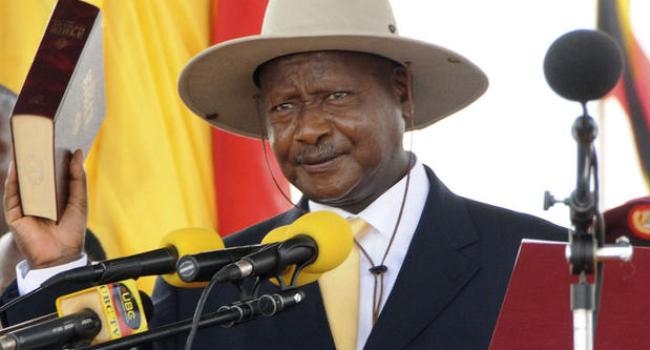
Yoweri Museveni

According to the Smithsonian, many Western governments regard Uganda as a qualified success from a development standpoint. But that growth is largely confined to the south and Kampala. Elsewhere, deep poverty is the rule.

With a per capita income of $240, Uganda is among the world’s poorest countries, with 44 percent of citizens living below the national poverty line. The nation ranks 146th out of 177 countries on the U.N.’s Human Development Index, a composite measure of life expectancy, education and living standard. Donor countries and international lending agencies cover half of Uganda’s annual budget.

In a “Uganda 2016 Human Rights Report”, the U.S. Department of State said serious human rights problems in Uganda included lack of respect for individual integrity (unlawful killings, torture, arbitrary detention, and other abuse of suspects and detainees); restrictions on civil liberties (freedoms of press, expression, assembly, association, and political participation); and violence and discrimination against marginalized groups.

Other human rights problems included harsh prison conditions, lengthy pretrial detention, official corruption, biased application of the law, societal violence, trafficking in persons, and child labor, the report said.

Museveni appears to still retain support, according to the Smithsonian, but his autocratic drift and systemic corruption risks wrecking his legacy.

A Nov. 21, 2017 report titled “Uganda’s Slow Slide Into Crisis” by the International Crisis Group, a Brussels, Belgium-based organization, is not optimistic about what will happen when Museveni leaves (or dies).

“The public appears to have little confidence that Museveni’s departure will be followed by a constitutional transfer of power,” said the International Crisis Group’s report. “Many expect that groups left out of power will confront the government. In response, the military might step in…”

“Major violence is unlikely for now, but Uganda nonetheless faces the gradual fraying of order, security and governance. Discontent is growing, particularly among youth…,” the group said.

Hard to say how long it will be before the long-suffering people of Uganda are again ecstatic, celebrating and dancing in the streets of Kampala.

dancinginthestreetsofkampala