The Democratic presidential candidates and Oregon: they could care less

Digital advertising is one of the key elements of the campaigns of Democrats running for their party’s 2020 presidential nomination. Data show that some candidates are shouting, while others are barely whispering.

According to Acronym, a progressive non-profit that tracks political digital spending, the candidates are paying Facebook and Google millions for digital ads, but spending in Oregon is barely a blip, .

Sen. Elizabeth Warren (D-MA) is the biggest spender so far.  She has spent $1,688,706 on digital ads (Facebook: $1,218,206; Google: $470,500) since launching her campaign.

WarrenLaunch

Senator Elizabeth Warren speaks during her presidential candidacy announcement event at the Everett Mills in Lawrence, MA on February 9, 2019.

The second biggest spender on Facebook and Google digital ads is Sen. Kamala Harris (D-CA). She has spent $1,640,339 (Facebook: $1.2 million; Google: $438,000).

Altogether, the Democratic candidates have spent $12,805,165 on Facebook and Google digital ads since launching their individual campaigns.

digitalspending

Yes, President Trump has spent $9,080,994, outspending every Democratic candidate.

What states have been targeted with all that money?

If you look at the top five states targeted by each of the candidates with Facebook ads, California takes the lead. It’s one of the top five targets of 15 candidates. Then there’s Iowa, which has its caucuses on Feb. 3, 2020.  It’s in the top five lists of nine candidates. Next is Texas, one of the top five states of eight candidates.

Even though New Hampshire has its primary early on Feb. 11, 2020, it’s only in the top five spending list for Facebook ads of three Democratic candidates: Pete Buttigieg, John DeLaney; and Tulsi Gabbard.

Then there’s Oregon. Oregon’s not in the top five list of any of the Democratic candidates and it’s only in the top ten list of two, Bernie Sanders and Julian Castro. But even Sanders has applied only 3.3% ($41,502) of his Facebook spending to Oregon and Castro only 2% ($8,379).

The lack of digital attention to Oregon may well be because the state’s primary isn’t until May 19, 2020, real late in the game, and it has only 52 delegates. If a candidate is trying to harvest a lot of delegates, focusing on the states with earlier primaries, including Super Tuesday, March 3, when 1433 delegates will be at stake, makes more sense.

Sorry, Oregon. You just don’t matter.


Addendum, May 5, 2019

The Democratic National Committee announced in late April that 2020 presidential candidates will each need to hit 130,000 donors to qualify for the third and fourth televised debates in the fall. Vice According to the Columbia Journalism Review, Vice News’s David Uberti reported that the high threshold may force longshot contenders to spend more on Facebook ads than they get back in donations—limiting their resources for more traditional forms of campaigning. In all, political ad spending is expected to near the $10-billion mark in 2020, up from $6.3 billion in 2016. The Wall Street Journal’s Alexandra Bruell has the figures.


Should I stay or should I go: Bernie’s conundrum.

sanderspic

Hillary Clinton and her allies want Bernie Sanders to withdraw from the race. For additional pressure, the liberal media, including Talking Points Memo,the Washington Post, Daily Kos and the NY Times are piling on in unison. With increasing vehemence, they all argue Sanders should quit because he can’t win the Democratic nomination.

“…Sanders’ campaign is now taking a scorched-earth approach toward its opponents—even if that means helping Donald Trump win the White House,” wrote David Nir in today’s Daily Kos.

Sanders’ continued presence in the race increases divisiveness in the party, his critics assert, makes it harder for Hillary to focus on Trump and forces Hillary to keep spending millions to secure her nomination that would be better spent in the general election.

On March 17, the New York Times reported that the previous week President Obama had privately told a group of Democratic donors that Sanders was close to when his campaign against Clinton would end and that the Democratic Party must soon come together to back her.

According to the Times, people at the donor event “took his comments as a signal to Mr. Sanders that perpetuating his campaign, which is now an uphill climb, could only help the Republicans recapture the White House.”

So let’s look at what Hillary did in her own 2007-2008 contest with Obama.

The objective of each of the candidates in the primaries and caucuses was to secure the support of 2,117 delegates, a majority, to the August 2008 Democratic National Convention.

At the end of 2007, Clinton led in the national polls with 42% of likely voters, over Obama at 23% and John Edwards at 16%.

On Jan. 3, Obama unexpectedly won the Iowa caucuses with 38% of the vote, over Edwards, 30%, and Clinton, 29%. That gave Obama 28 pledged delegates, Clinton 14 and Edwards 3.

At the conclusion of the next three primaries (New Hampshire, Nevada, South Carolina) on Jan. 26, the pledged delegate vote count was Obama 88, Clinton 46 and Edwards 3. This was after Obama won by a more than two-to-one margin over Clinton in South Carolina, taking 55% of the vote to Clinton’s 27% and Edwards’s 18%. After his shellacking, John Edwards suspended his candidacy on January 30, 2008.

With the Super Tuesday primaries looming, Senator Ted Kennedy endorsed Obama, a high profile endorsement that buoyed Obama’s hopes. On Tuesday, Feb. 5, with 23 states and territories and 1,681 delegates up for grabs, Obama captured 847 delegates and Clinton 834. That put Obama at 1036 pledged delegates and Clinton at 1056.

Earlier in 2008 it had been expected that the nominee would be known after Super Tuesday, but Obama and Clinton were essentially tied in pledged delegates.

During Feb. 9-19, Obama swept 11 state contests and expanded his pledged delegate lead by 120. By the end of February, Obama had 1,192 pledged delegates, Clinton 1,035. But Clinton led among super-delegates, 240 to 19.

In the March primaries and caucuses, both candidates hung in there, with Obama winning 210 pledged delegates and Clinton 205, putting Obama slightly ahead with a total of 1,562½ pledged delegates and Clinton with 1,421½.

 On March 29, Obama’s lead prompted Sen. Pat Leahy, D-Vermont, to call for Clinton to drop out of the race. “I think that her criticism (of Obama) is hurting him more than anything John McCain has said,” Leahy said. “I think that’s unfortunate.”

 As the contest continued into April, a consensus began to grow that Clinton didn’t have much of a chance to overcome Obama’s lead in pledged delegates. Coincident with that growing feeling, some Democrats began to argue that Clinton staying in the race was damaging Obama’s likelihood of success in the general election.

Clinton did go on to win in Pennsylvania, but Obama won in North Carolina and the two almost tied in Indiana on May 6. At that point, Obama led Clinton by 164 pledged delegates and there were only 217 pledged delegates left to be decided, leading to more calls for Clinton to drop out of the race.

Even comedians got in the act. “Hillary Clinton says she isn’t dropping out because there are still six states that haven’t had their Democratic primary,” said Conan O’Brien. “That’s right. Barack Obama’s favored in the states of Oregon, Montana and South Dakota, and Hillary is favored in the state of denial.”

Clinton’s fortunes deteriorated further on May 10 when Obama’s super-delegate total passed Clinton’s, making it even more likely that Clinton’s run was doomed.

But Hillary Clinton persevered.

It wasn’t until June 3 when Obama’s delegates from South Dakota and Montana primaries, plus his announcement of more super-delegates, put Obama over the majority needed for the Democratic nomination.

Still, it took until June 5 for the Clinton campaign to post a letter to supporters on its website saying Hillary would endorse Obama on June 7.

From my perspective, that pretty well sums it up. Bernie, ignore the calls to drop out coming from Hillary and her bought and paid for acolytes. Keep a-pluggin’ away.


                                       If the hills are high before

                                       And the paths are hard to climb,

                                       Keep a–pluggin’ away.

                                       And remember that successes

                                       Come to him who bides his time,—

                                        Keep a–pluggin’ away.

“Keep a-plugging away”, Lyrics of Lowly Life, Paul Laurence Dunbar

dunbar


Hillary and The Donald: Self-inflicted wounds

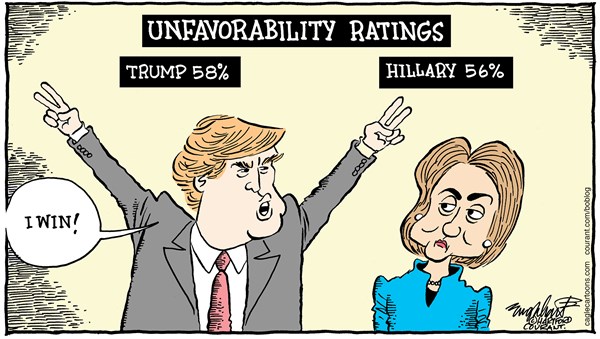
With Super Tuesday voting and other primaries and caucuses behind us, Donald Trump and Hillary Clinton are the clear leaders in the Republican and Democratic races for their party’s presidential nominations.

But they are both damaged candidates and the parties have only themselves to blame for their success.

166747_600-2

Democrats have known for years that Hillary would be a seriously flawed candidate.

 “She has always been awkward and uninspiring on the stump,” a senior Democratic consultant once told the Washington Post. “Hillary has Bill’s baggage and now her own as secretary of state — without Bill’s personality, eloquence or warmth.”

 While her damaging e-mail scandal may be relatively new, Hillary has been associated with decades of personal and political contretemps, leading to a clear case of Clinton fatigue among the populace.

Equally troubling to the Democratic Party should be Hillary’s trust gap.

In a July 2015 Quinnipiac University national poll, 57 percent of respondents said Clinton is not honest and trustworthy, one of the worst scores among all the top candidates at the time. And her scores have gotten worse. In a subsequent Quinnipiac poll, 61 percent of respondents said Clinton is not honest and trustworthy.

In an August 2015 Quinnipiac University poll, “liar” was the first word that came to mind more than others in an open-ended question when voters were asked what they think of Clinton, followed by “dishonest” and “untrustworthy”. (“Arrogant” was the first word that came to mind for Trump, but that doesn’t seem quite as toxic)

In January 2016, a poll produced for ABC by Langer Research Associates put Hillary 12 points behind Bernie Sanders, 48-36 percent, in being seen as more honest and trustworthy, a deterioration from 6 points behind in Dec. 2015 and equal to Sanders in October 2015.

But Hillary’s problems as a candidate go even deeper.

“Voters see her as an extraordinarily cynical, power-hungry insider,” James Poulos said in The Week on Feb. 2. “She is out for herself, not out for Americans. Voters know it.”

This ties in with a long-held and widespread perception that Hillary and her family are just plain greedy, what with them hauling off $190,000 worth of china, flatware, rugs, televisions, sofas and other gifts when they moved out of the White House, taking money from all sorts of unsavory people and foreign countries for their Foundation, and charging exorbitant amounts for speeches.

David Axelrod, a political consultant who helped steer Obama to the presidency, noted in his book, “Believer”, that Hillary has two other main weaknesses: she’s a polarizing rather than a “healing figure,” and she has a hard time selling herself as the “candidate of the future” given her checkered past and long political resume.

And then, as Josh Kraushaar wrote in The Atlantic before Jeb Bush dropped out, “…pundits and donors alike are vastly overrating the prospects of two brand-name candidates for 2016 — Hillary Clinton and Jeb Bush — and undervaluing the reality that the current political environment is as toxic as it’s ever been for lifelong politicians.”

Then there’s Trump

That, of course, takes us to Donald Trump, the Republican Party’s “Nightmare on Park Avenue.”

Isolated in their cocoons, party officials (and the political press) assumed an establishment candidate would emerge the victor. They denied to themselves and others for months that Trump would be a viable candidate for the Republican nomination.

Nobody was more smug in this assumption then Jeb!

He started early, rebuilding political connections, building a professional staff and laying the groundwork for a “shock and awe” fundraising blitz. But he faltered early and never regained his balance. He watched helplessly as his fund-raising advantage become a disadvantage, defining him as the establishment favorite when the Republican base was looking for a change agent.

Political leaders also overestimated voters’ desire for solid, traditional, steady candidates and too quickly dismissed Trump as a long-term threat. “Reality TV will gather a lot of interest and a lot of people enjoyed the celebrity of that, but for the last 14 years, I’ve had to live in the real world and deal with real world issues and come up with real world solutions,” former Texas Gov. Rick Perry said in mid-2015. “And that’s what the people I think of this country want out of the next president of the United States.”

Meanwhile, confident that Trump’s bombast, misstatements and insults would doom him, Republican Party leaders watched incredulously as he rolled over establishment candidates.

“Until recently, the narrative of stories like this has been predictable,” Matt Taibbi wrote in Rolling Stone. “If a candidate said something nuts, or seemingly not true, an army of humorless journalists quickly dug up all the facts, and the candidate ultimately was either vindicated, apologized, or suffered terrible agonies… That dynamic has broken down this election season. Politicians are quickly learning that they can say just about anything and get away with it.”

As Karen Tumulty wrote in the Washington Post, “Will Trump eventually cross a line — or do the lines no longer exist?”

The make-up and size of the Republican candidate field also has worked to Trump’s advantage.

There’s no love lost, for example, between most members of Congress and Ted Cruz. And with so many Republican candidates (17 at one point), voter preferences were atomized for too long and even now none of the remaining candidates are willing to drop out, preventing the emergence of a single challenger to Trump.

So here we are, facing the possibility of a Clinton-Trump election.

Just goes to show that Clarence Darrow was right. “When I was a boy I was told that anybody could become President; I’m beginning to believe it,” he said.