During World War II, President Roosevelt authorized the military to forcibly relocate people of Japanese ancestry from the West Coast to inland camps.
In April 1942, officials posted Civil Exclusion Orders No. 25 and No. 26 on telephone poles and store windows throughout Multnomah County. A few weeks later, Civilian Exclusion Order No. 49 was posted in Hood River. The orders gave Japanese-Americans only a few days to put their affairs in order before they had to report for evacuation.
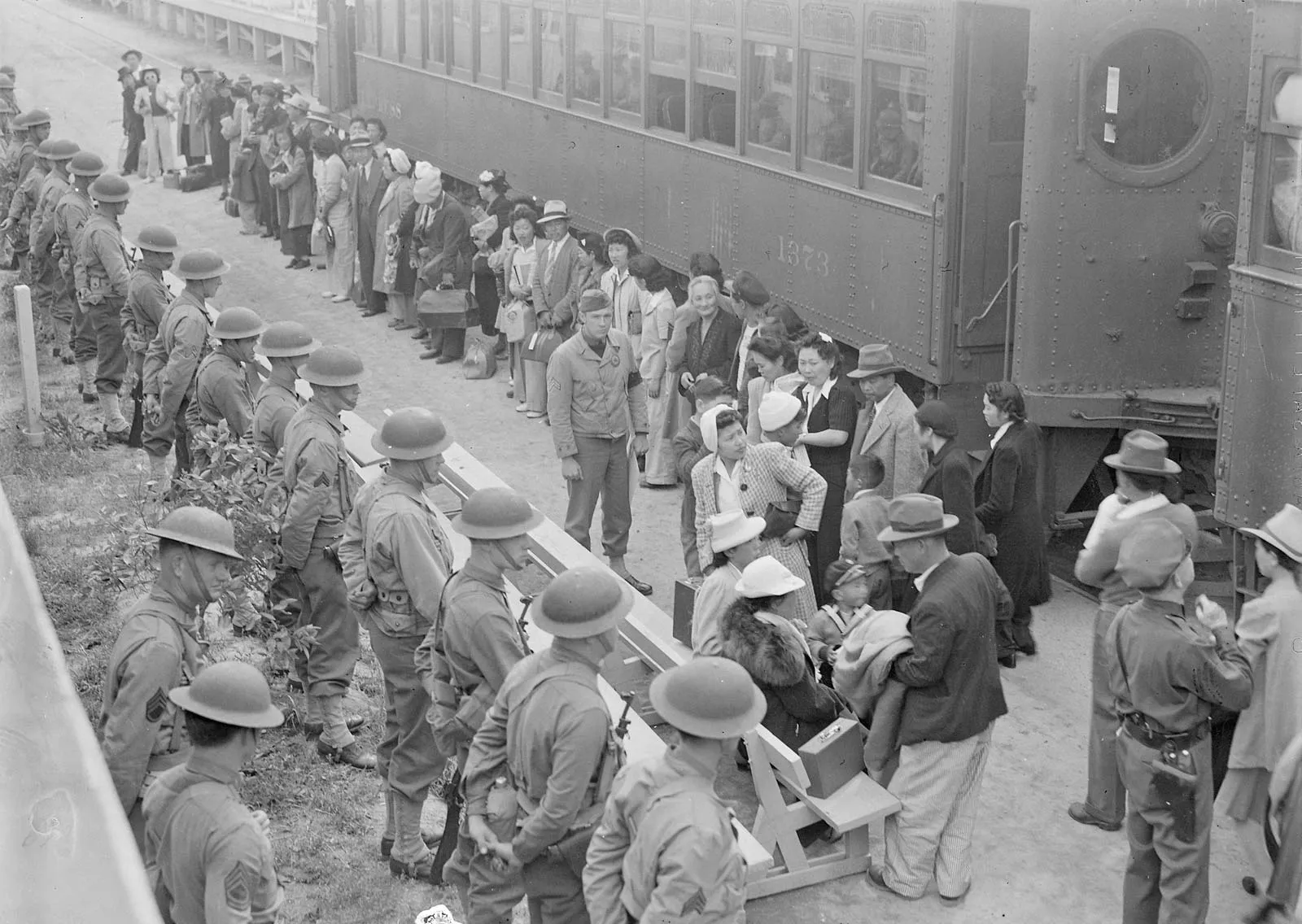
On May 5, 1942, Japanese-Americans in Military Area No. 1 reported to the Portland Assembly Center, leaving their pets, possessions, and lives behind. The center—built on the site of the Pacific International Livestock Exposition—was surrounded by barbed wire, watchtowers, and military guards armed with machine guns. The center had a peak population of 3,676.
Those living in Military Area No 2, including the Japanese Americans in Hood River, were sent by train to the Pinedale Assembly Center in California’s San Joaquin Valley, a temporary location until later transfer to permanent internment camps.
Now President-elect Trump and his coterie of illegal immigration hardliners want to use the military again and put arrested immigrants in the country illegally in camps run by the Homeland Security Department.
Will he follow through with his threats? Count on it.
“Trump 1.0 was a test for the system, but it was also a trial for an inexperienced leader who had the inclination of a wrecking ball but often lacked the capacity or the cadres to follow through,” Susan B. Glasser wrote in the Nov. 21 New Yorker. “Trump 2.0 is about an all-out attack on that system by a leader who fears neither Congress nor the courts nor the voters whom he will never have to face again.”
During the Republican primary campaign, The New York Times reported that Trump’s top immigration policy adviser, Stephen Miller, said military funds would be used to build “vast holding facilities that would function as staging )enters” for immigrants as their cases progressed and they waited to be flown to other countries.
Earlier this month, Tom Fitton, who runs a conservative group, Judicial Watch, wrote that Trump’s administration would “declare a national emergency and will use military assets” to address illegal immigration “through a mass deportation program.” Trump responded on his social media platform, Truth Social, reposting Mr. Fitton’s post with the comment, “TRUE!!!”
On Monday, Trump confirmed that he planned to declare a national emergency to carry out his promise to use the military in his mass deportations.
Trump has also threatened to use the Alien Enemies Act of 1798 – which allows presidents to deport citizens of an “enemy nation” without the typical proceedings – as part of his mass deportation plans.
Thomas Homan, a contributor to the Heritage Foundation’s controversial Project 25 and Trump’s proposed Border Czar, told Fox Business Network, “They’ll be used to do non-enforcement duties such as transportation, whether it’s on ground or air, infrastructure, building, intelligence.” Horman has also said transportation and supply assets from the Department of Defense, including military planes, could be used.
Stephen Miller, Trump’s incoming deputy chief of staff for policy, has also floated the idea of “deputising” the National Guard to carry out large-scale raids and detentions. The military could also be dispatched to the southern border with “an impedance and denial mission,” Miller has said.
“You reassert the fundamental constitutional principle that you don’t have the right to enter into our sovereign territory, to even request an asylum claim,” Miller said at the Conservative Political Action Conference (CPAC) earlier this year. “The military has the right to establish a fortress position on the border to say no one can cross here at all.”
No matter how Trump plans to use the military, the move is likely to bring an avalanche of legal challenges.
Aaron Reichlin-Melnick, a senior fellow at the American Immigration Council, said on Monday that under US law, presidents may declare a national emergency and exert emergency powers only in specific situations. “And ‘use the military for deportations’ isn’t one of those specific things,” Reichlin-Melnick wrote on social media.
Anthony D. Romero, executive director of the American Civil Liberties Union, issued the following statement: on Nov. 18:
“We are crystal clear that the next Trump administration will do everything in its power to make mass deportation raids a reality. As we ready litigation and create firewalls for freedom across blue states, we must also sound the alarm that what’s on the horizon will change the very nature of American life for tens of millions of Americans.”
In 1983, the bipartisan Commission on Wartime Relocation and Internment of Civilians reported that the internment program was a “grave injustice” driven by “race prejudice, war hysteria and a failure of political leadership.” In 1988, President Ronald Reagan signed the Civil Liberties Act, which offered a formal apology to surviving victims.
It’s hard to believe all this current Trump-inspired turmoil is what the 76,744,608 people who voted for Trump this time around wanted.

 ThinkingOregon