Making It: The Fabric of Success in Portland

A wolf sculpture by native artists Marie Watt and Cannupa Hanska Luger made in collaboration with PGF for exhibition at the Denver Art Museum.

Portland, Oregon may be struggling, but there are some promising green shoots.

All the creative American garment design and manufacturing has gone offshore and it’s likely to stay there. That’s what some pessimists say. Britt Howard, Founder and Creative Director of Portland, Oregon-based PGF, doesn’t buy it.  

When Intel Corp. wanted to celebrate its 50th anniversary in 2018, it turned to PGF. The assignment?  Breathe life into some garment ideas. 

The result? Slick, comfortable updated replicas of “bunny suits” worn in Intel’s super clean microprocessor manufacturing fabs. Then suit up some employees for a lively, eye-catching flash mob on an Intel campus. 
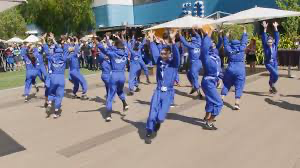
Intel flash mob by PGF

In 1960, 1,233,000 Americans were employed in the manufacturing of apparel, 5.5% of the total manufacturing workforce, according to the U.S. Department of Labor. In 2024, only about 84,000 employees were part of the apparel manufacturing industry in the United States.

Now PGF is bringing back some of those “Made in America” jobs with a full-service creative design and fabrication studio.

“At PGF, we combine expert intuition with creativity, design, and flawless execution,” says Howard, who has been shepherding PGF’s evolution since 2008. 

Britt Howard at PGF

Howard showed she had some real entrepreneurial chops when she was just 25. 

She started Portland Garment Factory in 2008 with $2400 in start-up capital from a supportive friend. A brief contract with the friend essentially said, ‘If you ever get successful, maybe you’ll pay me back.” Eight years later, Howard did so. “And very handsomely,” the friend said. 

Howard started out in a 250 sq. ft. Portland studio. The company began as a sole proprietorship, then shifted to a limited liability company (LLC) one year later. 

After moving around a bit, the company settled in at a building  at 408 S.E. 79th Ave. in Southeast Portland.

Over its first 12 years Howard continued to grow the business, accruing an impressive list of clients, including Nike, Adidas, Cotopaxi and the global advertising agency, Wieden+Kennedy. 

In some cases, the company created prototypes of products a company was considering for mass production. Other work included creating product marketing displays and specialty items that could be featured in retail stores to wow customers with their ingenuity.

The company also created sculptures. In one case, it worked with native artists Marie Watt and Cannupa Hanska Luger to create Each/Other, a monumental wolf sculpture with a fabric “hide” attached to the steel frame that was exhibited at the Denver Art Museum.

The company made a foray into making baby clothes, too. “We used to make retail products, such as thousands of baby clothes, but we almost went out of business,” Howard said. “The seller wanted to put out a product that sold for $6, but it cost us $40 to make it because of all our overhead. It was really hard to make affordable garments in the United States.”

That was one reason why Howard changed the name of her company to PGF in 2018.  “I really needed to recalibrate because we couldn’t survive as just a garment manufacturing company,” Howard said. “We needed to get away from making retail products and get into more commercial work.”

As time went by, everything seemed on track and the company’s future looked bright. 

Then, disaster!

Early on the morning of April 19, 2021, a massive three-alarm fire, later determined to have been set by an arsonist, tore through the company’s building, destroying just about everything. 

Aftermath of the fire

The potential for failure was breathing down Howard’s neck. But Howard wasn’t out.

A broad network of friends and supporters came to her rescue, starting with a team of nine women who set up a GoFundMe account to help Howard resume her business. 

“The morning of April 19th, an arsonist set fire to PGF and everything was burned from the brick walls to sewing machines to skews of clothing for clients,” the account said. “Britt lost years and years of hard work and she needs help from us to re-build her business which employs many women and is a pillar in our community.  She has gotten so many fashion labels started, contributed charitably and taken risks to help people build their brands.  This money will go toward replacing all the machines that were lost, a deposit for a new location and securing the jobs of her beloved employees.”

An astonishing 1200 donors responded with contributions ranging from $5 to $5,000, generating a total of $119,125. 

“Britt has created a Portland mainstay, and Portland needs PGF!,” a $100 donor wrote. “Not to mention, she’s an inspiration and positive force of nature in the B Corp and broader business community here. Sending PGF love.” 

While grieving her loss, Howard embarked on a what she saw as an urgent need for recovery. Within 10 months, with the GoFundMe money, insurance coverage and a mortgage, in hand, Howard was able to buy another headquarters building in Southeast Portland, a 10,000 sq. ft. corrugated metal-clad building that had previously been a gym.
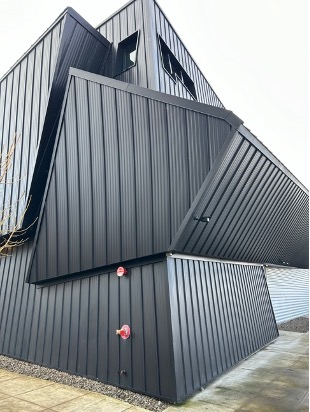
PGF Building

The three-level building is usually a beehive of activity for 17 employees, including designers, artists, expert fabricators and a Marketing and Community Coordinator.

Many of the fabricators are Vietnamese who have been with PGF for more than 10 years. “They are skilled sewers and they are really proud of the work they do,” Howard said.  
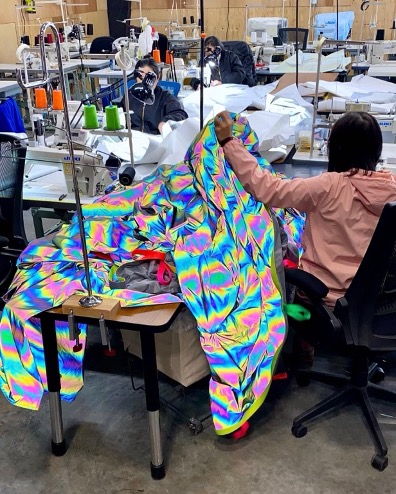
Sewers at work at PGF

“We’re now a full -service cut-and-sew manufacturing company,” Howard said. “We make soft goods, that includes wearables, clothing, accessories, curtains, upholstery items, sculptures. We also do design work in-house and we source the material, so we’re completely one-stop.”

Reflecting her commitment to responsible business practices, Howard has also secured certification of PGF as a B Corp, a company that meets high standards of verified social and environmental performance, and public transparency to balance profit and purpose.

Part of PGF’s commitment to sustainability is the reuse of materials. In 2023, for example, it created cushions using fabric scraps from past PGF projects and designed to invoke 90’s zine culture married to frenetic, modern-era multimedia art. All the cushions were stuffed with pulverized factory scraps, the result of PGF’s zero-waste manufacturing initiative.

To reward and retain her employees, Howard provides them with generous benefits, including health insurance. A particularly useful benefit that came into play when the fire hit PGF’s building in 2021 was payroll protection insurance. That allowed Howard to give paychecks to her employees for 10 months until the business could restart.

Howard has also focused on improving PGF’s operations, hiring a COO for five months in 2023. “She really helped me turn around a lot of the problems we were having, to look at them in a different way, “Howard said. “She created a reporting tool that’s very specific to this business and changed the structure of the business so more responsibility is placed on designated managers instead of everybody reporting to me,” Howard said.

In its new building, PGF has continued to create specialized products for a wide range of clients, including kimono-style uniforms for volunteers at Portland’s Japanese Garden, jackets for Oregon’s Tillamook Cheese company to highlight the launch of a shredded cheese product and Mad Hatter and White Rabbit costumes for an outdoor electronic dance music festival.

It has even created custom blue Nike tracksuits for the cast of the sports comedy-drama Ted Lasso to wear at the PEOPLE’s Post Screen Actors Guild Awards Gala in Feb. 2024.

With the pandemic, the 2023 fire and the fluctuating economy, Howard says business has been uneven in the past several years, but she maintains her optimistic spirit, tempered with acknowledgement that trouble can lurk just around the corner.

In a sign of her continuing optimism and willingness to take risks, in April 2024, Howard bought the assets of Cotton Cloud Futons in Portland’s Slabtown district and rebranded the company’s manufacturing space as “Oregon Natural Fiber Mill.”  She hopes the acquisition will enhance her company’s commitment to sustainable textile manufacturing.

Oregon Business covered the deal, noting that the factory milled U.S.-sourced cotton and wool into usable materials with a focus on organic cotton, regular cotton and polyester and that its equipment included a 100-year-old Garnett machine, a massive textile processing mechanism that converts waste into a uniform fiber to be used in other applications.

Never satisfied with standing still, Howard is aggressively pursuing new opportunities “It’s not a chill business, but we’re here to stay,” she says. “There’s lots going on, lots of opportunities everywhere. I just have to know where to put my energies.”

What Hath God Wrought: The Devastating Impact of Fast Fashion

Talk about shooting yourself in the foot.

A swarm of trade liberalization polices in the 1990s, including the North American Free Trade Agreement (NAFTA) in 1994, effectively wiped out most import restrictions and duties on foreign-made clothing, all in the name of global prosperity. 

It was supposed to be a good thing, but it is also a validation of the statement that you can’t have it all. The embrace of free trade has meant trade-offs.

Most significantly, it has almost demolished the U.S. apparel manufacturing industry, driving garment production to Asia and Latin America. Then it stimulated an explosion of environmentally destructive fast fashion. And behind most pieces of fast fashion is a story — too often a grim story about low pay, long hours and exploitation.

In the early 1800s, most garments worn by Americans were homemade. After the Civil War, U.S. factories that had produced uniforms transitioned to producing men’s suits, then to making cloaks and jackets for women. By the end of the 1860s, Americans bought most of their clothing rather than making it themselves.

Department stores rose up in the 1880s. By 1915, ready-to-wear departments had become regular features, supplemented by the arrival of mail-order catalogs from companies such as Montgomery Ward and Sears, Roebuck & Company.

Still, even by 1960, about 95% of clothes sold in the United States were made domestically. By 1980 it was about 70%. But by 2000, the amount of clothing sold in the United States that was made domestically had plummeted to 29%.  And in 2022, only about 2% percent of the apparel sold in the United States was made domestically.

Even companies that proudly proclaim their American heritage have largely abandoned their roots.

“For more than 150 years, Pendleton has set the standard for American style,” Pendleton Woolen Mills proudly proclaims. But is the iconic family-owned and operated Portland, OR-based company, rooted in late 19th century Salem, OR, still an American institution?

The honest answer – Barely. Pendleton has shifted its production, without much fanfare, almost entirely out of America.

Similarly, Made in Oregon points proudly to how has built a reputation as a purveyor of high-quality, local products. But, in fact, its ubiquitous stores have opened their shelves to products , including clothing, that are manufactured offshore if they are “designed” in Oregon, an exception you can drive a truck through. 

Not only is most American clothing now imported, but we have vastly increased the amount of clothing we buy. 

In 1960, the average American bought fewer than 25 garments each year. Now Americans buy an average of 68 items of clothing a year. Some of that is because of our culture of consumerism, driven by pervasive advertising and the availability of easy credit and the availability of a wide range of clothing products. But it’s also driven by the emergence of fast fashion, where fast-changing trends have replaced the previous focus on quality and durability. 

And that has meant an estimated 11.3 million tons of textile waste in the United States end up in landfills on a yearly basis. That’s equivalent to approximately 81.5 pounds per person per year, according to Earth.org, an environmental news site. 

Good On You, an organization that rates clothing and accessory brands, defines fast fashion as “…cheap, trendy clothing that samples ideas from the catwalk or celebrity culture and turns them into garments at breakneck speed to meet consumer demand…so shoppers can snap them up while they are still at the height of their popularity and then, sadly, discard them after a few wears.” In essence, fast fashion plays into the idea that outfit repeating is a fashion faux pas.

And this is a message fashion writers perpetuate. A Feb. 19, 2024 New York Times article, for example, tried to advise on what’s in and out:

“For women, it’s time to retire the ankle boots known as mojo booties,” the article advised. “People really wear them to anything — jail, a funeral,..Just no, girl. This is not an all-weather moment. No-show or ankle socks were once ubiquitous. Now, showing ankles is “pretty polarizing. Try layering socks over leggings, or a crew sock or quarter-length sock that shows a little bit over flats or sneakers…Infinity scarves are out, but blanket scarves, skinny scarves and mid-width waffle-knit or cashmere scarves in neutral colors are good options…”

It’s all reminiscent of Joan Didion’s trenchant observation years ago, in a 1979 New York Review of Books essay on Woody Allen, to be exact, about “…a new class in America, a subworld of people rigid with apprehension that they will die wearing the wrong sneaker, naming the wrong symphony, preferring ‘Madame Bovary.’ ”

This is at the heart of the rapidly expanding offshore clothing companies that free trade has enabled. It has allowed offshore employment to expand, improving living standards in many other countries, but not without cost.

In order to mass produce millions of inexpensive garments in a hurry,  factories are often sweatshops where laborers, too frequently children,  work for low wages and long hours in dangerous conditions. 

The shift in garment production offshore has also cost American jobs and raised sustainability concerns.

Americans employed in manufacturing apparel – 1960: 1,233,000

Americans employed in manufacturing apparel – 2022: 93,000

In 1960, 1,233,000 Americans were employed in the manufacturing of apparel, 5.5% of the total manufacturing workforce, according to the U.S. Department of Labor. By 2022, only about 93,000 employees were part of the apparel manufacturing industry in the United States.

Meanwhile, apparel from stores such as Forever 21, Zara, and H&M are mass-produced by legions of workers laboring for long hours in third world countries in sweatshop-like conditions.

Then there’s Temu, an online marketplace operated by the Chinese e-commerce company PDD Holdings. Temu, which racked up  roughly $9 billion in U.S. gross merchandise value and  spent $1.7 billion on marketing in 2023,  has emerged as a major player in the fast fashion universe in the United States. “Temu is disrupting U.S. e-commerce with tried- and-true tactics used by Chinese companies: earning razor-thin profits or losing money in exchange for market share and gradually squeezing out competitors,” says the Wall Street Journal.

Another fast-fashion behemoth is Shein, founded in Nanjing, China in 2008 as ZZKKO. Now headquartered in Singapore, while keeping its supply chains and warehouses in China, it has become the world’s largest fashion retailer. 

Shein plans to go public in 2024 (It confidentially filed for an initial public offering in Nov. 2023), though there is continuing controversy over allegations of Shein’s (and Temu’s) use of forced labor from the autonomous region of Xinjiang in China. In late 2023, Rep. Jennifer Wexton (D- VA) led a bipartisan call for the SEC to halt Shein’s IPO until it verifies that the company does not use forced labor within its supply chain.

Meanwhile, Shein and Temu “are accelerating the fashion cycle to unimaginable speeds,” Quartz,  a website focused on international business news, reported in January 2024.  The speed is being accelerated by Tik Tok, which is addictive by design. “The rise of TikTok has led to trends changing so quickly that brands and consumers cannot keep up,” Stacey Widlitz, a retail analyst, recently told the New York Times. “Everything Gen Z consumes is driven by influencers,” she said. “As fast as something comes in is as fast as something can go out.”

“The downside to all that cheap speed is, of course, the exploitation of everyone involved in its production and consumption,” said Quartz.  

The State of Fashion report, an annual publication from the industry outlet Business of Fashion and the management consultancy McKinsey and Company, notes that Shein is now producing an astonishing number of new items—2,000 to 10,000—every day,  and they are each shipping out more than a million packages to the United States daily, The Wall Street Journal reported in December.

Shein and Temu keep the costs of their fast fashion clothing down by taking advantage of a U.S. shipping provision called the “de minimis exception,” which waives duty fees for any packages with a retail value of less than $800. Since the typical order from Shein and Temu is much smaller than that, Shein and Temu paid no duty fees on imports to the U.S. in 2022, according to a congressional report. Sneaky, but legal. 

In the face of all this, there are still some America-based apparel manufacturers. Their growth and the emergence of more companies is possible with technological advancements in manufacturing and the increase in environmental and social consciousness. Reshoring apparel production is likely to be constrained, however, by supply chain issues as well as high labor costs and overhead expenses that will make it difficult for U.S. producers to price their goods competitively and maintain profitability.

So, what to do if you care about all this?

You are not helpless. You can learn to ignore Tik Tok influencers who must not be aware of Freya India’s admonition that “these people “… who do post everything are not people to aspire to. If they influence you of anything it should be to not copy their deranged behaviour and document your entire life online.”

As somebody commented on a recent New York Times story about Gen Z fashion, “Tik Tok ‘influencers’ aren’t style icons, they’re the new mall rats with a megaphone.”

 There are apps out there that give you the power to help create an ethical and  sustainable fashion industry.

GoodOnYou, for example, rates more than 3,000 clothing and accessory brands on whether they are doing the right thing for people, the environment and animals in producing ethical and sustainable clothing. Download the Good On You App

Then you can change your habits:

  • Stop buying so damn much fast fashion.
  • Be mindful of your consumption habits.
  • Remember that the most sustainable clothing is already in your wardrobe. Love the things you own.
  • Repair, rather than replace, damaged clothing.
  • Look for clothing that: 

– is manufactured in an environmentally conscious way.

– is designed and manufactured with human rights in mind.

– can be rented, loaned or swapped

– has been repaired, redesigned or upcycled

– is of high quality & timeless design

– is “Fair Trade Certified”

– is versatile and will see you through more than one season. 

Thanks to RedressRaleigh.org for some of these suggestions.

.