US Action in Venezuela: Menacing and Unpredictable

The largest U.S. military presence in the Caribbean in decades is now operating, with nearly 20% of the Navy’s deployed warships in the region, according to a Stars and Stripes’ analysis. The deployment also includes the 22nd Marine Expeditionary Unit based in Camp Lejeune and Marine Corps Air Base New River. The 22nd MEU consists of Marine Medium Tiltrotor Squadron 263 (Reinforced), Combat Logistics Battalion 26 and the Battalion Landing Team, 3rd Battalion, 6th Marine Regiment.

Additionally, a squadron of Marine Corps F-35 Lightning II fighter aircraft has been sent to Puerto Rico, where the former Naval Station Roosevelt Roads has become a staging area for U.S. forces in the region, according to Task & Purpose, a military-focused news publication.

Other American aircraft, including an AC-130J Ghostrider, an Air Force gunship designed for close air support, air interdiction and armed reconnaissance, have been spotted operating in El Salvador. The aircraft, known for being the most heavily armed gunship in history, “plays a critical role in supporting ground operations, providing close air support to troops in contact, conducting armed reconnaissance missions, and engaging enemy targets” according to The Aviationist.

An AC-130J Ghostrider being refueled

The New York Times has reported that U.S. officials ran a war game during President Trump’s first term to assess what the Venezuelan strongman Nicolas Maduro’s fall might unleash. “The results showed that chaos and violence were likely to erupt within Venezuela, as military units, rival political factions and even jungle-based guerrilla groups jockeyed for control of the oil-rich country.”

Nevertheless, asked if he would rule out U.S. troops on the ground in Venezuela, Trump said on Monday “No, I don’t rule out that, I don’t rule out anything.”

And then, of course, no matter what happens, will it matter? Mary Speck, former executive director of the Western Hemisphere Drug Policy Commission, wrote today in the Dispatch, “The United States—for all its military might—cannot defeat “narco-terrorism” unilaterally by ousting a corrupt and brutal dictator. Whatever the end game of the U.S. military deployment in the Caribbean, the region’s drug cartels have nothing to fear.”.

What is the balance of risk? ,” opinion columnist Bret Stephens wrote in November 19s New York Times. “Unintended consequences must be weighed against the predictable risks of inaction…And Trump’s hesitation will be read, especially in Moscow and Beijing, as a telling signal of weakness that can only embolden them, just as President Biden’s withdrawal from Afghanistan did.”

“Any morally serious person should want this to end,” Stephens opined. “The serious question is whether American intervention would make things even worse.”

As Puck observed on Nov. 20, “Trump’s plan for Venezuela may be a mystery even to himself. “I think he thinks about what will make him look tough, but he doesn’t think much beyond that,” said John Bolton. “He never does.”

What does the Trump administration want to achieve in this dramatic effort and what will be the cost? America waits.

U.S. Forces Now in the Caribbean

Up to 15,000 U.S. troops are in the area.
USS Newport News SSN-750
Four F/A-18E/F Super Hornets, assigned to Strike Fighter Squadrons 31, 37, 87, and 213 from embarked Carrier Air Wing Eight aboard USS Gerald R. Ford (CVN-78), and a U.S. Air Force B-52 Stratofortress operate as a joint force with the Gerald R. Ford, Nov. 13, 2025. US Navy photo
  • The “Tomcatters” of Strike Fighter Squadron (VFA) 31 – F/A-18E – from Naval Air Station Oceana, Va.
  • The “Ragin Bulls” of VFA 37 – F/A-18E – from Naval Air Station Oceana.
  • The “Golden Warriors” of VFA 87 – F/A-18E – from Naval Air Station Oceana.
  • The “Black Lions” of VFA 213 – F/A-18F – from Naval Air Station Oceana.
  • The “Gray Wolves” of Electronic Attack Squadron (VAQ) 142 – EA-18G – from Naval Air Station Whidbey Island, Wash.
  • The “Bear Aces” of Airborne Command and Control Squadron (VAW) 124 – E-2D – from Naval Air Station Norfolk, Va.
  • The “Rawhides” of Fleet Logistics Squadron (VRC) 40 Det. – C-2A – from Naval Air Station Norfolk.
  • The “Spartans” of Helicopter Maritime Strike Squadron (HSM) 70 – MH-60R – from Naval Air Station Jacksonville, Fla.
  • The “Tridents” of Helicopter Sea Combat Squadron (HSC) 9 – MH-60S – from Naval Air Station Norfolk.

Carrier Air Wing 8
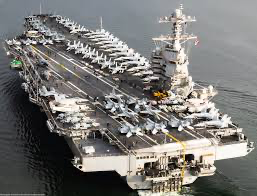

USS Gerald R. Ford (CVN-78) with 9 embarked squadrons of Carrier Air Wing Eight
Arleigh Burke-class guided-missile destroyer USS Bainbridge (DDG 96)
Arleigh Burke-class guided-missile destroyer USS Mahan (DDG 72)
Air and missile defense command ship USS Winston S. Churchill (DDG 81)

Littoral combat ship USS Wichita (LCS-13)

Guided missile cruiser USS Lake Erie (CG – 70)
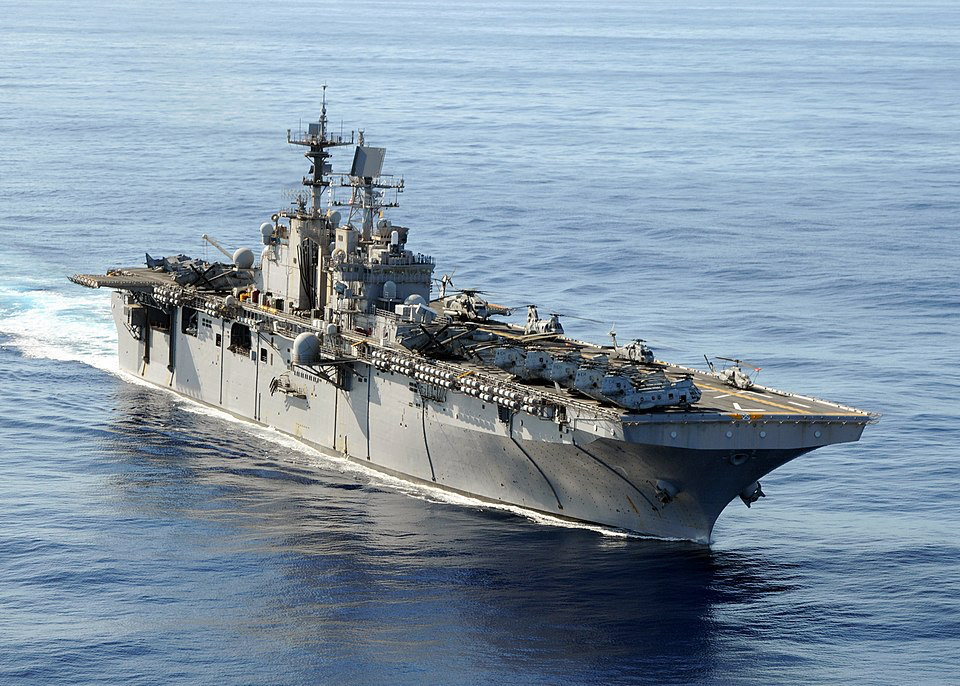
Wasp-class amphibious assault ship USS Iwo Jima (LHD-7)
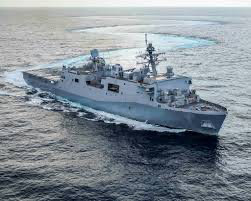
Amphibious transport dock ship USS Fort Lauderdale (LPD-28)

Amphibious transport dock ship USS San Antonio (LPD-17)

Guided missile destroyer USS Gravely (DDG-107)

Guided missile destroyer USS Stockdale (DDG-106)

“Militarily, the table is set quite effectively for air strikes,” retired Navy Adm. James Stavridis, who led U.S. Southern Command, or SOUTHCOM, from 2006 to 2009, recently told Task & Purpose. “Now it’s up to [President Trump] to decide.”

The West and Russia are Already at War…and the West Must Win

Whenever there’s an article about the West supplying more sophisticated and lethal weapons to Ukraine, there’s almost always a reference to hesitation because escalating the conflict could risk a direct confrontation with Russia. 

As much as political and military leaders might want to argue against the risk of such a confrontation, the reality on the ground, and in the air, is that it is already occurring.

In this month’s Foreign Affairs, in an article titled The Free World Must Stay the Course on Ukraine, the prime ministers of  Poland,, the Czech Republic and Slovakia wrote:

“Europeans were inspired by the visit of U.S. President Joe Biden to Warsaw and Kyiv in February. Biden reaffirmed that while the United States is far away, it is committed to freedom in Europe—and understands, as we do, that Ukraine is fighting for the freedom of all of us. Ukraine does not want to be at war with Russia. Nor do we. But it has become increasingly clear that Russia decided a long time ago that it is at war with us.”

Evidence of Russian aggression in Ukraine and elsewhere is pervasive.

Over the past several months, heavily armed Russian warplanes have repeatedly violated longstanding agreements with the U.S. by flying dangerously close to American jet fighters over Syria and over U.S. forces working in the country, US officials have said.

Russia and the United States have an agreement recognizing certain zones where the US can operate against ISIL (ISIS) fighters in Syrian areas where neither the U.S. coalition with local Kurdish troops nor the Syrian army exerts full control. Russia came to the aid of Syria’s president, Bashar Al-Assad, in 2015 in the Syrian civil war.

In March, an armed Russian Su-27 Flanker jet fighter crashed into a U.S. Reaper drone after spraying it with jet fuel on Tuesday morning over the Black Sea.  The drone fell into international waters in the Black Sea.

Despite established rules designed to prevent any sort of conflict between Russian and U.S. forces operating parallel to one another in Syria, Russian pilots are locking onto U.S. aircraft with their radars and taking other provocative actions on a daily basis, according to officials with U.S. Air Forces Central Command, Task & Purpose news reported on May 2, 2023.

A Russian Su-35 Flanker fighter jet is seen maneuvering unprofessionally within 2,000 feet of a U.S. Air Force fighter jet during an intercept in Coalition Force airspace over Syria on April 18, 2023. (U.S. Air Force/Staff Sgt. Jermaine Ayers).Source: Task & Purpose

“Russian forces have violated deconfliction protocols with Coalition forces almost 100 times in two months, conducting armed overflights of ground forces in Syria 26 times, flying within 500 feet of U.S. aircraft, and in the last week, jamming U.S. aircraft electromagnetic systems,” Air Force Lt Gen Alexus Grynkewich, head of AFCENT, told Task & Purpose“These behaviors significantly interfere with AFCENT’s ability to execute operations safely and effectively and increase the likelihood of miscalculation.”

According to the Rand Corporation, Chairman of the Joint Chiefs of Staff Mark Milley reportedly has kept a list of “U.S. interests and strategic objectives” in the Ukrainian crisis since late 2021 which includes: “contain war inside the geographical boundaries of Ukraine.” That has already been violated. 

NBC News reported on April 11 that Ukrainian agents have pursued drone attacks inside Belarus and Russia and leaders in Kyiv have considered further targets outside Ukraine, according to recently leaked secret Pentagon documents.

One document marked “Top Secret,” noted attacks allegedly orchestrated by Kyiv on a military airfield outside Minsk, Belarus, and a gas compressor station in the Moscow suburbs. 

On March 2, the Russian government accused Ukraine of sending gunmen to attack villagers in the Bryansk region, days after blaming a series of drone attacks inside the country on Ukraine.

The increasing tension with Russia may play a part in what appears to be an erosion of American support for Ukraine as the battle goes on.

In WWII, The United States declared War on Japan on Dec. 8, 1941. “No matter how long it may take us to overcome this premeditated invasion, the American people in their righteous might will win through to absolute victory,” President Roosevelt declared.  On December 11, Congress approved a resolution declaring war with Germany. The unconditional surrender of the German Third Reich was signed on Monday, May 7, 1945. Japan signed an official Instrument of surrender on September 2, 1945. 

In other words, for almost five years the Americans persevered in the face of a brutal war with international repercussions. 

Russia took control of the Ukrainian region of Crimea in March 2014. It escalated the fight in Feb. 2022 when it invaded and occupied larger portions of Ukraine. President Biden declared the attack “unprovoked and unjustified”, issued severe sanctions against top Kremlin officials and began a NATO-led military assistance program to Ukraine. In other words, aggressive U.S. military involvement  in the Ukraine war has extended for slightly more than 13 months.

Yet many Americans are already wearying of the conflict. 

An April Wall Street Journal poll found that while the number of voters who believe the U.S. is providing the right amount of support has remained stable, at about 35%, more and more think Washington is too involved. 

About 38% of voters said the U.S. was doing too much to help Ukraine, a big jump from 6% in March 2022. Meanwhile, only 20% said the U.S. should do more, down from 46% in March 2022.The erosion in support is particularly noticeable among Republicans. About 60% of Republicans said the U.S. was doing too much to support Ukraine, up from 48% in October 2022, compared with just 15% of Democrats. Even 42% of independents said the U.S. was doing too much.

In my view, this erosion of support is a dangerous trend. If we do not see this through Russia will be emboldened, the independence of former Soviet Republics will be threatened, China’s aggressiveness will be encouraged and western influence on the global stage will be challenged.

In a recent interview with the New York Times, Bernard-Henri Lévy, a prominent French intellectual, explained why he was dodging Russian sniper fire in Ukraine to make a documentary there. “In Ukraine, I had the feeling for the first time that the world I knew, the world in which I grew up, the world that I want to leave to my children and grandchildren, might collapse,” he said.

Yes, it might… if we lose our will to win in Ukraine.

Galling presidential pardons: a bipartisan thing

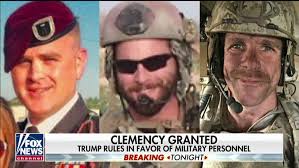
On Nov. 15, President Trump intervened in the cases of three U.S. service members accused of war crimes.

pardons

Trump signed an Executive Grant of Clemency (Full Pardon) for Army First Lieutenant Clint Lorance, an Executive Grant of Clemency (Full Pardon) for Army Major Mathew Golsteyn, both of whom were accused of murder in Afghanistan, and an order directing the promotion of Special Warfare Operator First Class Edward R. Gallagher to the grade of E-7, the rank he held before he was tried and found not guilty of nearly all of the charges against him.

In taking this action, Trump incurred the wrath of politicians, pundits and many in the general public.

A U.S. defense official told CNN that there’s concern among the department’s leadership that Trump’s pardons could undermine the military’s justice system. CNN and the New York Times also reported that senior Pentagon leadership, including Defense Secretary Mark Esper, urged Trump not to intervene in the three cases.

According to Task & Purpose,  a news site covering the military, several former military leaders echoed the same concerns.

“As President Trump intervenes in war crimes cases on behalf of individuals accused or convicted of war crimes, he … undermines decades of precedent in American military justice that has contributed to making our country’s fighting forces the envy of the world,” Gen. Charles Krulak, former commandant of the Marine Corps, said in a statement.

“I can honestly say I have not talked to a single military officer who would be in favor of pardoning any one of these three,” Gary Solis, a combat veteran and former military attorney who now teaches the laws of war at the Georgetown University Law Center and the George Washington University Law School, told Military.com.

But as contemptible and unwise as Trump’s actions are to many, he is hardly the first president to take such questionable actions.

Barack Obama issued 212 pardons and 1,715 commutations, including one of a 35-year prison sentence given to former U.S. Army soldier Bradley/Chelsea Manning for the largest leak of classified data in U.S. history to WikiLeaks.

President Bill Clinton, never one to be embarrassed by his actions, pardoned his brother Roger Clinton after Roger served a year in prison after pleading guilty to cocaine distribution charges.

In August 1999, President Bill Clinton also commuted the sentences of 16 members of FALN, a Puerto Rican paramilitary organization that had set off 120 bombs in the United States, mostly in New York City and Chicago. The commutation was opposed by the U.S. Attorney’s Office, the FBI, and the Federal Bureau of Prisons and  Congress condemned Clinton’s action by votes of 95–2 in the Senate and 311–41 in the House.

But Clinton’s most egregious pardon was one he issued on his last day in office, January 20, 2001, when, against the advice of White House aides he pardoned Marc Rich, a former hedge-fund manager. Rich had fled the U.S. during his prosecution and was living in Switzerland at the time. Rich owed $48 million in taxes and had been charged with 51 counts of tax fraud.

ThatsRich

Marc Rich

At the time of the pardon, Rich was No. 6 on the government’s list of most wanted fugitives and had been on the lam, albeit a luxurious one, for 16 years, ever since his 1983 indictment by a grand jury.

Rich’s ex-wife had donated to the Democratic National Committee, the Clinton Presidential Library and Hillary Clinton’s New York Senate campaign, raising considerable suspicion about the pardon and leading former President Jimmy Carter to call the pardon “disgraceful.”

A New York Times editorial called the pardon “a shocking abuse of presidential power.” The liberal New Republic said it “is often mentioned as Exhibit A of Clintonian sliminess.” Not that such allegations ever seemed to bother the Clintons.

And the Clintons reaped benefits from the pardon even after Rich’s death in 2013, as Rich’s former business partners, lawyers, advisers and friends continued to shower millions of dollars on the Clintons.

Of course, Clinton isn’t the only “last day in office” pardoner. Remember Peter, Paul and Mary? In 1970, Peter Yarrow was convicted of taking “improper liberties” with a 14-year-old fan, for which he spent three months in jail. On his last day in office, President Jimmy Carter granted Yarrow a pardon.

President George H.W. Bush was roundly condemned for pardoning, commuting the sentences and rescinding the convictions of six people convicted in the Iran-Contra arms-for-hostages scandal during Reagan’s presidency,

Reagan stepped up, too, pardoning New York Yankees owner George Steinbrenner after he pleaded guilty to illegally contributing to Nixon’s campaign.

Then there’s Nixon. In 1974, President Gerald Ford granted a “full, free and absolute pardon” to his predecessor Richard Nixon “for all offenses against the United States.” This broadly unpopular action was the only time a president has received a pardon. It caused a huge firestorm because Nixon was so unpopular and because there was suspicion that Ford secretly promised to pardon Nixon in exchange for him resigning and allowing Vice President Ford to succeed him.

So much for punishing bad behavior.