Our Oregon: shooting Oregon in the foot – Dems and unions want more money to spend on more “stuff”


Tax big business. “Yeah.. that’s the ticket! Yeah, you betcha!,” SNL’s Tommy Flanagan would say.
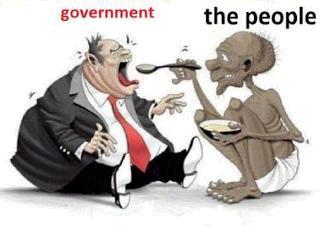
bloated-government-cartoon

A Better Oregon, a campaign organization operating under the umbrella of Portland-based Our Oregon, a coalition of unions and progressive groups, agrees.

A Better Oregon is promoting Initiative Petition 28 for the November 2016 ballot. The measure would raise the corporate minimum tax on Oregon sales of more than $25 million a year from the current minimum of $50,000 to $30,001 plus 2.5 percent of the excess over $25 million. The tax would be based solely on sales, not profit.

The Legislative Revenue Office estimates the corporate tax measure would raise $5.3 billion during the 2017-2019 biennium. Corporate taxes during that biennium under the current system are projected to reach about $1.1 billion.

In other words, the measure would increase corporate tax collections per biennium by a whopping 400 percent in one fell swoop.

Rep. Mitch Greenlick (D-Portland), when endorsing the measure, said it would eliminate much of the constant need to choose between funding critical budget concerns each legislative session. “If that passes, we’ll have a lot of money to pay for stuff,” Greenlick said.

Otherwise, Greenlick said, most of the additional revenue in the economic forecast for the 2017-2019 budget would go to cover increased PERS liabilities and the state’s increased share of Medicaid funding, leaving little additional revenue for new stuff.

But not to worry, says Ben Unger, executive director of Our Oregon. The extra money won’t come out of your pocket. It will come mostly from large out-of-state corporations.

About 1,000 corporations doing business in Oregon, mostly multi-state corporations, would be affected by the higher taxes.

“This measure will make sure that large and out-of-state corporations do their part to fund the schools and services that will make Oregon thrive,” Our Oregon says on its website.

As long ago as I can remember advocates for higher taxes in Oregon have been making “out-of-state corporations” the bogeyman, the malignant beast that’s doing Oregonians wrong and needs to pay.

But as attractive a target as these corporations are, they’re not fools. They will find a way to avoid paying the taxes or they’ll pass on the added taxes to Oregon consumers as a stealth sales tax.

Moving a company’s headquarters to another state with a more congenial tax environment, as GE is doing with its recently announced shift from Connecticut to Massachusetts, won’t solve the problem, but there are always run-arounds.

Maybe some businesses will change their ownership form to get sales in Oregon under the $25 million trigger. Others may institute some special, higher regional pricing.

Some creative companies may become benefit corporations. Our Oregon thought it was being clever and supportive of the “good guys” when it inserted a provision in its initiative to exclude benefit companies under ORS 60.754 from the higher taxes. But this opened a loophole ripe for exploitation.

The liberal coalition behind Initiative petition 28, recalling their success in a tax increase battle in 2010, may be figuring they have a sure thing again with another measure targeting big business, but hopefully Oregonians in their wisdom will see this  proposal is a reach too far.


The Democratic debate: Soak the rich. Yeah! that’s the ticket!

Remember how Jon Lovitz, as Tommy Flanagan, the pathological liar on Saturday Night Live, would build a narrative that was a series of lies and say, “Yeah! That’s the ticket!”?

The Democratic debate was like that.

Want something for nothing? When I’m president, you’ll get it: Tuition-free public colleges and universities; free mandatory parental leave, without burdening small businesses; $15 minimum wage with no increase in productivity; enhanced Social Security benefits; Tax cuts for middle-class families; Refinancing of federal college debt at a low interest rate; Government subsidies of Obamacare for people in the United States illegally; move America to 100% renewable energy with federal subsidies.

The Democrats offered up a grab bag of free stuff. How would they pay for it all? Hillary summed up the Democratic Party’s answer. “ I know we can afford it, because we’re going to make the wealthy pay for it,” she proclaimed.

JonLovitzSNL

Yeah! That’s the ticket!

Reminds me of Margaret Thatcher’s observation, “The problem with socialism is that you eventually run out of other people’s money.”

The national debt stands at $18.2 trillion, up from $10.6 trillion when President Obama took office, and it is continuing to increase an average of
 $1.88 billion a day. The debt goes up when the government doesn’t get enough revenue in a given fiscal year to pay its bills. Annual federal deficits have been shrinking lately, but that pattern isn’t expected to last as the budget takes hits in the coming years.

And then, of course, the country already faces problems with covering the huge costs of entitlements such as Social Security and Medicare.

Unless we want to embrace ever-higher deficits, money would need to be found to pay for the cornucopia of benefits the Democrats promise.

Hillary Clinton said not to worry, we’ll get it from higher taxes on the wealthy. “Right now, the wealthy pay too little and the middle class pays too much,” she said in the debate.

Echoing Clinton, Lincoln Chafee chimed in that the rich are doing fine, “so there’s still a lot more money to be had from this top echelon.”

The problem is that the top-earning 1 percent of Americans (earning about $400,000 +), a pretty fluid club of individuals on a year-to-year basis, already pay almost 50 percent of federal income taxes and the top 25 percent pay about 87 percent, making the United States extraordinarily dependent on small slices of the population.

The Congressional Budget Office has calculated that high-income earners receive only pennies in federal benefits for every dollar they pay in federal taxes. In contrast, those in the middle 20 percent of earners received $2.23 in benefits for each dollar they paid and the lowest 20 percent receive close to $20 in federal benefits for every dollar they pay in federal taxes. In other words, the high-income earners are already subsidizing middle-income and low-income Americans.

“Despite the data, accusations that the rich are not paying their fair share continue,” The Manhattan Institute has reported. “This rhetoric is based more on perception than reality, or on a mistaken belief that the government needs more funds to become further entrenched in Americans’ lives. While this rhetoric may work as a populist rallying cry, the data show that a central tenet of the political left’s platform is simply incorrect.”