Companies With Oregon Operations Eyeing Payoff From Trump’s Immigrant Deportations

Back in January, Portland’s new mayor, Keith Wilson, highlighted Portland’s commitment to its sanctuary city status, supported by Oregon’s sanctuary state laws and the Sanctuary Promise Act of 2021 that limit law enforcement’s cooperation with federal immigration authorities.

“We stand together in solidarity with our immigrant families,” he wrote. “Their lives, families, and businesses are part of the fabric of our community and we must support them during these challenging times,” Wilson wrote in a letter to the City Council. “We must come together to live our city’s shared values of freedom from fear and sanctuary from federal overreach in the days ahead, no matter what our city may face.”

Governor Tina Kotek has also publicly and consistently affirmed her commitment to upholding Oregon’s sanctuary state laws. The governor “will not back down from a fight and believes these threats undermine our values and our right to govern ourselves,” a spokesperson for Kotek said, adding that the state “will not be bullied to deport people or perform immigration enforcement.”

A lot of Oregon’s politicians, particularly Democrats, may be on board with this pro-illegal-immigrant stance. But it looks like commerce trumps morality for much of the state’s business community. A long list of companies with operations in Oregon are perfectly happy to go after government contracts aimed at helping Immigration and Customs Enforcement (ICE) with immigrant deportations.

Open Secrets, a Washington, D.C.-based nonprofit that tracks and publishes data on campaign finance and lobbying, has recently reported on for-profit companies in the United States benefiting from President Donald Trump’s plans to increase ICE deportations.

The coming windfall in deportation dollars could be immense. The House of Representatives approved a spending bill in early May that sets aside $175 billion for immigration enforcement – about 22 times ICE’s annual budget.

The bill includes the following provisions:

  • $46.5 billion for border barriers, including 701 miles of border wall, 900 miles of river barriers, 629 miles of secondary barriers, and 141 miles of vehicle and pedestrian barriers
  • $5 billion for Customs and Border Protection (CBP) facilities
  • $4.1 billion for hiring additional CBP personnel, including 3,000 new Border Patrol agents and 5,000 new Office of Field Operations (OFO) officers at ports of entry
  • $2 billion for retention bonuses and signing incentives for CBP personnel
  • $2.7 billion for border surveillance technology, including surveillance towers and tunnel detection capabilities
  • $500 million for grants to state and local law enforcement to track and monitor threats from unmanned aircraft systems
  • $450 million for Operation Stonegarden to support cooperation between CBP and state and local law enforcement

Open Secrets identified a slew of companies that are poised to benefit from President Trump’s plans to increase deportations. Every single one of them has operations in Oregon. According to Open Secrets, the companies and their contracted work are:

  • Palantir Technologies: In April 2024, ICE awarded software company Palantir Technologies a $29.8 million contract for developing ImmigrationOS, a tool to help ICE with identifying and prioritizing the deportations of individuals who are considered a risk, such as violent criminals; tracking who is self-deporting; and managing cases from the individual’s entry through detention, hearing and deportation. The tool is an extension of systems that Palantir has already delivered as part of its almost $128 million contract signed in 2022.
  • Deployed Resources: This emergency management company has been awarded over $4 billion in government contracts to build and operate border tents since 2016. On April 12,  2024, ProPublica reported that ICE awarded a new contract worth up to $3.8 billion to Deployed Resources to operate a migrant detention camp at Fort Bliss, a United States Army post in New Mexico and Texas. On April 17, ICE submitted a $5 million proposal for Deployed Resources to deliver unarmed guard services for 30 days at an ICE facility in El Paso, Texas. ICE has housed detainees at a tent facility in El Paso operated by Deployed Resources since March. The Trump administration used the Department of Defense to award Deployed Resources an unannounced $140 million contract to run the site for ICE, The facility can house up to 1,000 detainees, and ICE started transferring detainees on March 10.
  • Axon Enterprise: The company (formerly TASER International), which develops technology and weapons for public safety, law enforcement and the military,  was awarded a year-long $5.1 million contract in March to deliver body cams and equipment and a $22,376 contract to deliver tasers that have been used specifically in deportations. Several law enforcement agencies in Oregon use Axon tasers. Rick Smith, the CEO of Axon Enterprise, had a special distinction in 2024. His annual compensation, $165 million, topped CEO compensation charts in 2024 That propelled him past Apple’s Tim Cook, whose 2024 compensation totaled $74.61 million.

  • Parsons Government Services: The company is wrapping up a one-year $4.2 million contract for the transportation and guard services of ICE detainees in Newark, NJ.  It was awarded a contract worth up to $8.9 million for COVID-19 testing supplies in February, as well as an $87,467 contract in March and a $118,758 contract in April with ICE, both to provide “mobile biometric collection devices in support of the biometric identification transnational migration alert program.” 

  • General Dynamics: This weapons company was awarded new $101,034 and $80,050 contracts in March to purchase non-lethal ammunition for training purposes for ICE’s Office of Firearms and Tactical Programs.

  • Sig Sauer Inc.: A firearms company, Sig Sauer was awarded more than $200,000 worth of contracts with ICE for firearms and firearm accessories in the first months of 2025: $57,163 in February, and $19,824, $35,106 and $90,854 contracts in April. 
  • Paragon Professional Services: Awarded a $1.1 million contract on April 1 for transporting people who are detained by ICE in the New York City area and a $458,400 month-long contract to provide transportation of ICE detainees in Baltimore on April 17. ICE has also signed a five-year, $395,534 firm-fixed-price delivery order to Paragon Professional Services LLC, an Alaskan Native Corporation-owned small disadvantaged business. The contract provides transportation and guard services to support ICE’s Enforcement and Removal Operations in the Newark, New Jersey area. This award is part of a larger Indefinite Delivery Contract valued at $315.1 million that Paragon holds with ICE for security and detention services.

  • GlobalX Air is a US 121 domestic flag and supplemental airline flying the Airbus A320 family of aircraft. Our services include domestic and international ACMI and charter flights for passengers and cargo throughout the US, Caribbean, Europe, and Latin America. GlobalX is IOSA certified by IATA and holds TCO’s for Europe and the UK.
  • GEO Group: A private prison company, GEO Group announced in February a 15-year contract with ICE for 1,000 beds at its Delaney Hall Facility in Newark, New Jersey. The company said the contract is expected to add $60 million to its annual revenue in the first year. In March, GEO announced a contract with ICE for a 1,800 bed facility in Baldwin, Michigan. The contract is expected to generate $70 million in annual revenue. The company also announced in March that it altered its contract agreement for the 1,328-bed Karnes ICE Processing Center in Karnes City, Texas, to host “mixed populations” instead of solely single males. That contract is expected to generate $79 million in the first year, including $23 million in incremental revenue. Accusations of abuse and neglect of immigrants waiting for detention hearings have surfaced at Moshannon Valley Processing Center in Philipsburg, Pennsylvania, one of GEO’s facilities and one of the largest facilities of its kind in the nation, according to the Pittsburgh Post-Gazette. The paper reported that a special office of the U.S. Department of Homeland Security launched a sweeping investigation in 2024 into a litany of allegations at the center, but while the probe was still underway, the federal government gutted the special office in March 2025, raising questions about whether the investigation is still active as well as other inquiries into complaints of dangerous conditions and abuse against immigrants at centers across the country. 
  • CoreCivic: In March, CoreCivic, a private prison company, signed a five-year contract to reopen a 2,400-bed family detention center in Dilley, Texas. Annual revenue once fully operational is expected to be $180 million. In February, the company announced it would increase capacity for up to 784 ICE detainees at its 2,016-bed Northeast Ohio Correctional Center, its 1,072-bed Nevada Southern Detention Center and its 1,600-bed Cimarron Correctional Facility in Oklahoma. In addition, CoreCivic has modified a contract so that ICE may use up to 252 beds at its 2,672-bed Tallahatchie County Correctional Facility in Mississippi.

  • CSI Aviation: This New Mexico-based company is ICE’s current prime air charter contractor.  CSI has signed contracts worth more than $650 million with ICE in the past three years. Included in that total is a no-bid contract awarded to CSI for deportation flights, worth up to $219 million. The contract began on March 1, runs until August and has the possibility to be extended until February 2026.
  • Air Carrier Subcontractors: CSI Aviation subcontracts deportation flights to several companies. Historically the vast majority of the flights were operated by World Atlantic and iAero, but now by Miami-based GlobalX, part of Global Crossing Airlines Group. Tom Cartwright, an immigration activist and watchdog, has noted that “Eastern Air, OMNI, and Kaiser operate flights rarely and Gryphon small jets are only used for long distance flights occasionally to Africa, the Pacific and Europe.” Budget carrier Avelo Airlines, which operates from the Salem-Willamette Valley Airport (SLE)Redmond Municipal Airport (RDM) and the Eugene Airport, recently signed a contract with ICE to fly three planes for deportations from Mesa, Arizona. 

To date, activists and others in Oregon concerned about  President Trump’s immigration policies have generally been silent about the actions of companies with Oregon operations that are facilitating those policies. Some activists around the country, including in Eugene, Oregon, have protested against Avelo Airlines, accusing it of profiting from deportation-related flights.

Demonstrators at Tweed New Haven, CT Airport on May 12, 2025 protesting Avelo Airlines’ decision to operate deportation flights for U.S. Immigration and Customs Enforcement.

Generally, however, opposition to companies assisting ICE has been mild and barely noticed, unlike the raucus protests against American companies supplying U.S. armed forces in Vietnam, such as Dow Chemical, the primary manufacturer of napalm. 

But that relative calm may not last. The Trump administration has dramatically stepped up its pace of deportations, according to Immigration and Customs Enforcement data. In April, the latest month for which the data is available, ICE deported about 17,200 people and deportation numbers are expected to rise as more detention space is set up, deportation flights increase, and enforcement intensifies.  

Meanwhile, anti-Trump administration protests around the country are ramping up. On the horizon is the so-called “No Kings Day” protest on June 14, the same day as a massive Trump-initiated military parade in Washington, D.C. and  Trump’s 79th birthday.

The more such protests spread and grow, the more likely protest targets will expand as well.  Count on it.

Made in Old Town: Just More Corporate Welfare

During the recent Legislative session, lawmakers passed Senate Bill 5701 to set aside $2 million for the Old Town Community Association. The bill proposed putting the money toward establishing a 30,000-square-foot green manufacturing facility in the Old Town section of Portland that would help get new companies off the ground and existing companies develop new products and technologies for the footwear and apparel industry.

WHY?

The proposed facility would potentially be part of a $125 million Made In old Town (MiOT) project that would eventually include 100,000 square feet of manufacturing space, 120,000 square feet of housing and 145,000 square feet of office and retail space in eight largely vacant Old Town buildings.

MiOT’s backers need to raise $5 million from the private sector to fund the green manufacturing facility, which they hope to open by this fall. Elias Stahl, a MiOT Board Member and CEO and co-founder of  Hilos, an Old Town-based 3D-printed footwear company, told The Oregonian in March he was “extremely confident” they could raise the money.

In early April 2024, it looked like Oregon Gov. Tina Kotek might throw a monkey wrench into the deal when she said she was considering vetoing the $2 million item. “My office is awaiting more information from the development group about the viability of financing for the entire project before I make my decision,” Kotek said.

But on April 17, 2024, Kotek announced she would allow the expenditure for the project to move forward. “I am grateful to legislators for responding to our state’s most pressing needs,” she said. “In the days following last week’s notice of potential vetoes, I received adequate information to have confidence in signing…Senate Bill 5701…”

On April 11, 2024, Vince Porter, Kotek’s Economic Development and Workforce Policy Advisor, informed the governor and key staff that he had received a letter from the Old Town Project and followed up with a conversation with Jonathan Cohen, the Old Town Community Association’s treasurer, who made a “commitment that they will not request (state) funding until they have raised their own funding,” referring to the $5 million to be raised from the private sector.

 “I think the letter along with written confirmation from me will meet the requirements we specified for the project, Porter said. “ Hopefully you all feel the same. Jonathan will provide documentation during the DAS funding process demonstrating that the other financing is secured to match the state funds. This will include “seller financing” which they are counting on to complete the project.”

The MiOT project’s website announces it will be building “An Innovation Campus in a Thriving Neighborhood Creating the Next Generation of Footwear & Apparel.” The website says MiOT is currently accepting tenancy applications, with various lease terms and spaces available, and that MiOT plans to announce the first cohort of brands that have signed on as founding members early in 2025.

Democratic State Treasurer-elect Elizabeth Steiner, who previously served as a state senator representing Oregon’s 17th district, including the Old Town neighborhood, said in April, “As somebody who both cares about her district and cares about the City of Portland and the state as a whole, creative ideas like that—that revitalize a part of the city that has really been neglected, if not abandoned for a long time, and do so in a way that meet a bunch of different goals simultaneously—are a very exciting prospect for me.”

The collaborative nature of the project, its potential to revitalize a neighborhood and support re-shoring manufacturing in the U.S. has merit. But, given all the state’s “pressing needs” and the wealth and resources already available to MiOT’s key backers, plus the presence of hundreds of companies in the Portland metropolitan area tied to the footwear and apparel industry, why did the governor sign this ill-advised bill that would siphon money from Oregon taxpayers for private gain?

I can understand why politicians like Steiner would go for MiOT. Politicians love the spectacle of ribbon-cutting ceremonies and the prospect of jobs (and voters). But that shouldn’t drive this corporate welfare. that is more “free money” than “seed” money. Oregon does, indeed, have other “pressing needs” that should take a higher priority in the allocation of public dollars.

If the players behind the entire MiOT project are confident of its viability, let them provide the start-up money. If they make their vision a reality, taxpayers will have been spared the diversion of public dollars and the backers of the project can take full credit for MiOT’s success.


\

Reshaping Oregon’s Kicker: If You Can’t Win the Game, Change the Rules

Like a casino that changes the Blackjack odds by shifting from one hand-held deck to multiple decks critics of Oregon’s kicker law are preparing for a stealth raid on your wallet.

State economist, Carl Riccadonna, hired in August by Gov. Tina Kotek, “has taken it upon himself to get the forecast more in line with reality” KGW reported in November. In other words, to try to minimize (or eliminate) it.

 “I think that the truing up of the calculation under the new chief economist is really going to be helpful to provide stability when we are trying to do budgeting every two years, ” Kotek said in November. 

The Oregon Legislature passed the “Two percent kicker” law in 1979.  It requires the state to refund surplus revenues to taxpayers when actual General Fund revenues exceed the forecast amount by more than two percent. The personal income tax kicker money comes from all state General Fund revenue sources, except for corporate tax revenues. Personal income tax is the largest contributor. In 2000, voters acting on a legislative referral put a large portion of the 2% surplus kicker statute into the state constitution (Article IX, Section 14).

In October 2023, the Oregon Office of Economic Analysis (OEA) confirmed a $5.61 billion revenue surplus in the 2021-2023 biennium, triggering a tax surplus credit, or kicker, for the 2023 tax year. The surplus—the largest in state history[1]—was returned to taxpayers through a credit on their 2023 state personal income tax returns filed in 2024. 

Democrats, never at a loss for ideas on how to spend more government money, in league with unions and liberal special interest groups, are eager to see the kicker refunds throttled.

Because the kicker is in the Oregon Constitution, a ballot measure would need to be referred to the people to get them to surrender their Kicker refund, but don’t put it past the Democrat-dominated legislature to get creative to facilitate higher government spending.

“Oregon’s inaccurate revenue forecasting costs billions needed for critical public services,” said a memo Service Employees International Union Local 503, Oregon’s largest public-sector union, sent recently to Gov. Kotek.

SEIU research director, Daniel Morris, has complained that poor economic forecasting has resulted in too much money going out the door as kicker refunds.  “Over the last five forecasts it’s been embarrassingly bad,” he told OPB. “There are real consequences for the families of Oregon.”

Joe Baessler, interim executive director of  American Federation of State, County and Municipal Employees Council 75, has lambasted the kicker as well. “They’re deciding to under-inflate our revenue,” said Baessler. “It forces budgeting that is not in line with how much revenue is coming into the state and rolls back the amount of money we have for services that Oregonians want.”

The Oregon Center for Public Policy regularly rails against the kicker too. “Oregon’s kicker is a policy that worsens income inequality, racial inequality and geographic inequality,” says the Center. 

With a new state economist committed to forecast reform, Democrats holding a supermajority in the Oregon House and Senate, Tina Kotek serving as governor, and special interest groups salivating over a bigger state budget, the generous kickers of the past are in jeopardy. Count on it. 


[1] Personal Income Kicker History

Two Percent Kicker, Biennia 1979-81 to 2021-23
BienniumTax YearSurplus/Shortfall ($ millions)PercentMean ($)
1979-811981-$141None
1981-831983-$115None
1983-851985$897.70%$80
1985-871987$22116.60%$190
1987-891989$1759.80%$130
1989-911991$186Suspended
1991-931993$60None
1993-951994/5$1636.27%$110
1995-971996/7$43214.37%$290
1997-991998/9$1674.57%$100
1999-012000/1$2546.02%$160
2001-032002/3-$1,249None
2003-052004/5-$401None
2005-072006/7$1,07118.60%$610
2007-092008-$1,113None
2009-112010-$1,050None
2011-132012$124None
2013-152014$4025.60%$210
2015-172016$4645.60%$250
2017-192018$1,68817.17%$910
2019-212020$1,89817.34%$990
2021-232022$5,61944.28%

No new taxes or fees in Portland: Don’t Believe It!

No new taxes or fees!

That was one of the recommendations of Gov. Tina Kotek’s Portland Central City Task Force convened to consider the city’s most challenging problems and recommend ways to address them. 

“Declare a moratorium on new taxes…” urges the Task Force report.…elected officials should consider a three-year pause, through 2026, on new taxes and fees…”

Oh well, so much for that.

Your Portland property taxes, which were due Nov. 15, probably already went up and will likely go up again in 2024. According to the Lincoln Institute of Land Policy and the Minnesota Center for Fiscal Excellence, Portland ranked fifth highest nationally for effective property tax rate — a homeowner’s tax bill as a percentage of a property’s value — on a median-value home in 2022.

And Portland Commissioners Dan Ryan and Rene Gonzalez are already floating a November 2024 ballot measure that would raise property taxes to cover a $800 million bond for maintenance and new construction projects for the city’s parks and fire departments. 

Oregonians are also already paying higher gas taxes. Oregon’s gas tax increased to 40 cents as of Jan. 1, 2024. That’s an increase of two cents per gallon from last year. The new rate keeps Oregon among the ten states in the U.S. with the highest gas taxes. Propane and Natural Gas Flat Fee increases also went into effect for qualified vehicles on Jan. 1.

Portlanders (and many more folks) are also facing increases in electricity rates. PGE customers can expect to pay 18% more on their power bills starting Jan. 1. The 2024 rate increase will cost the average single-family household an extra $24.59 each month.

And then there are all the taxes and fees the 2003 Legislature gleefully enacted. 

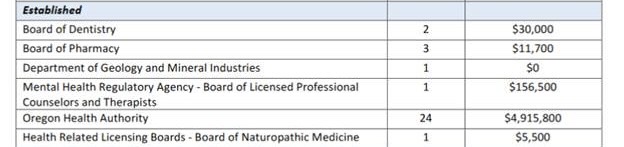
According to the Taxpayer Association of Oregon, Oregon lawmakers passed 185 fee increases (increasing existing fees and establishing new fees) in 2023 that will mean $47 million in higher costs.

Of those, 77 new or increased fees will directly impact the cost of medicine, hospitals and health care, which are all already straining the budgets of Oregonians.  Another 47 fee increases will impact Oregon’s agriculture industry and consumers.

A list of 2024 fee increases by agency is below: 

And then there are the new fees the 2023 Legislature created:

Portlanders and almost all Oregonians are also going to be paying a new cell phone tax this year. Starting January 1, 2024, a 988 Coordinated Crisis Services Tax will be added to the existing Oregon Emergency Communications (911) Tax. The new tax was implemented by the Oregon Legislature with the passage of House Bill 2757. The $50 million a biennium tax is slated to fund the state’s new 9-8-8 suicide prevention hotline.  

DMV fees have gone up, too, touching just about everybody with a vehicle. For example:

  • Class C driver license or restricted Class C driver license, increased from $54 to $58
  • Commercial driver license, increased from $75 to $160
  • Instruction driver permit, increased from $23 to $30
  • Commercial learner driver permit, increased from $23 to $40
  • Hardship driver permit application, increased from $50 to $75
  • Fee for renewal of a commercial driver license, increased from $55 to $98
  • Fee for knowledge test for a motorcycle endorsement, increased from $5 to $7
  • Fee for a skills test for any commercial driver license, increased from $70 to $145

And the list of fee increases goes on, nickeling and diming Oregonians.  

And of course legislators are busy thinking of new taxes.

For example, because the Oregon Department of Forestry wants more money to fight wildfires, Sen. Elizabeth Steiner, D-Portland, wants to charge every property owner in the state an annual fee to pay for what she perceives as a statewide issue.

And then, of course, there’s always inflation. It has been pushed down by aggressive Federal Reserve action, but in its long-term economic projections from December, the Federal Open Market Committee forecasted core Personal Consumption Expenditures Price Index inflation will drop from 3.2% in 2023 to 2.4% in 2024 and 2.2% in 2025.

But, still, hold on to your wallet. The state is considering tolls on I-205, I-5, U.S. 26 and Highway 217.

And the beat goes on.

Shemia Fagan and Oregon’s Political Rot

Political parties “…are likely in the course of time and things, to become potent engines, by which cunning, ambitious, and unprincipled men will be enabled to subvert the power of the people and to usurp for themselves the reins of government…” said George Washington. 

Washington may have preferred that the United States go forward with no parties, but since we’ve got them, the next best thing is to prevent one-party rule that strangles wise and fearless public policy and emboldens the perpetual winners.

That’s where Oregon has failed over a long time and all at once.

The Shemia Fagan scandal is just the latest illustration of rot in the body politic.

Secretary of State Fagan wouldn’t have signed up for a $10,000 a month consulting contract with Aaron Mitchell and Rosa Cazarest, owners of the La Mota chain of cannabis dispensaries, if she hadn’t thought she could get away with it.  The cannabis entrepreneurs are, after all, high-profile Democratic donors.

Before the Fagan scandal erupted, the Democratic recipients of La Mota funds happily accepted them. Willamette Week’s Sophie Peel did some spade work, revealing La Mota contributions to the following Democrats:

Gov. Tina Kotek – $68,365

Secretary of State Shemia Fagan – $45,000

Senate President Rob Wagner (D-Lake Oswego) – $12,500

Senate Democratic Leadership Fund – $10,000

State Treasurer Tobias Read – $1,800

Rep. Andrea Valderrama (D-Portland) – $500

Labor Commissioner Christina Stephenson – $7,500

Multnomah County Chair Jessica Vega Pederson – $1,000

Rep. Dacia Grayber (D-Tigard) – $1,000

Rep. Hoa Nguyen (D-Portland) – $500

Rep. Annessa Hartman (D-Gladstone) – $500

Multnomah County District Attorney Mike Schmidt – $2,000

U.S. Rep. Earl Blumenauer – $3,500

Prior to the Fagan scandal, none of the Democrats who were recipients of La Mota money were  apparently bothered by the fact the company was failing to pay its bills and taxes, according to an investigation by Willamette Week. Only after the Fagan scandal erupted did Democrats decide campaign contributions from La Mota were dirty money and scrambled to show their purity by pledging to donate those contributions to other worthy charitable causes.

Oregon’s Democratic Party also wouldn’t be so cavalier about all the campaign contributions it took from disgraced executives at FTX, the now bankrupt crypto company if they didn’t think they could get off scot free.

In their unbridled pursuit of power, Tina Kotek and the Democratic Party of Oregon chose to keep company with Nishad Singh, the 27-year-old wunderkind director of engineering at FTX. They welcomed his $500,000 contribution to the party’s campaign coffers in 2022. 

But the wheels of justice have turned since Singh made the contribution. On Feb. 28, 2023, he pleaded guilty to six criminal counts, including conspiring to commit securities and commodities fraud, during a hearing in federal court in Manhattan. 

He also pleaded guilty to defrauding the U.S. in a campaign-finance scheme in which he made illegal donations to political-action committees and candidates using funds from disgraced cyypto manager Sam Bankman-Fried’s crypto hedge fund Alameda Research.

John Ray III, the new boss of the bankrupt crypto exchange FTX, wants the $500,000 back, but the Democratic Party of Oregon has so far refused. 

Fagan’s behavior is also reminiscent of the sudden downfall of Jennifer Williamson, a former House majority leader and a leading contender to be Oregon’s next secretary of state in 2020. Williamson suddenly dropped out of the race, attributing her action to a forthcoming story in Willamette Week about questionable expenditures of campaign funds when she served in the House.  

Then there was Democrat Governor John Kitzhaber, who resigned in February 2015  amid a growing influence-peddling scandal involving him and his fiancee, Cylvia Hayes, becoming the state’s first governor to resign in disgrace.


Gov. Kitzhaber and Cilvia Hayes

Kitzhaber ‘s resignation came in the face of a state criminal investigation and a string of demands from top state officials to step down.

There have also been questionable actions by other Democratic leaders. 

At one extreme, there was Neil Goldschmidt, a former governor, former Secretary of Transportation under President Jimmy Carter and ex-mayor of Portland. Goldschmidt, while Portland’s mayor during the mid-1970s, had sex on many occasions with a 14-year-old girl. Goldschmidt tried to define his actions as “an affair”. 

He started having sex with the girl when he was 35 and married. She was a babysitter for his young children and the daughter of a neighbor who worked in his office. 

A key element tying all these scandals together is the long Democratic rule in Oregon. It has led too many in the party to act with impunity, just as Richard J. Daily and the Democratic political machine ran Chicago with bare-knuckle politics for 21 years as dozens of politicians fed on the city’s political corruption.

Oregon hasn’t elected a Republican governor since 1982, when Gov. Vic Atiyeh won re-election.  Republican s have also failed to achieve majorities in the Senate and House for ages.

Oregon has been ill-served by the concentration of political power in Democrat’s hands for so long that the party has an overpowering stench to it. As former U.S. Senator Pat Toomey (R-PA) put it, “Unchecked power pushes parties to excess regardless of which party is in power.”

In Oregon, it’s been the Democrats for far too long.

Memo to Gov. Kotek: Don’t Override Oregon’s Land Use Law to Site Data Centers

Gov. Tina Kotek has taken every opportunity to wax eloquent about the promise of legislation she signed on April 13, 2022 to attract semiconductor-related investment and good-paying jobs to Oregon. 

“This bill is an absolutely essential tool for leading a coordinated effort with the private sector to ensure we can compete for federal funds to expand advanced manufacturing in Oregon,” Kotek said in a news release. “We are poised to lay the foundation for the next generation of innovation and production of semiconductors.”

She’s been less forthcoming about exactly how she intends to implement the legislation.

Under Oregon’s innovative statewide land use planning program, created in 1973 with passage of the Oregon Land Use Act (SB 100), each of the state’s cities and metropolitan areas has created an urban growth boundary around its perimeter – a land use planning line to control urban expansion onto farm and forest lands.

Senate Bill 4 granted Kotek a blank check to bring some plots of land into Oregon’s urban growth boundaries, changing land use restrictions at her whim, to entice investment in Oregon’s semiconductor industry. Kotek will be able to designate up to eight sites, including two more than 500 acres in size, for manufacturing facilities.

In an April 21 KGW-TV interview on Straight Talk with Laurel Porter, Porter asked, “If somebody doesn’t want to sell, will the state be able to take that land?” A skilled politician, Kotek sidestepped the question, saying it isn’t yet clear yet whether land outside the current urban growth boundary will need to be accessed.

Of equal or greater consequence, Kotek has also been less than forthcoming about whether she would use her authority under the legislation to site data centers.

Data centers house networked computers, storage systems and computing infrastructure that organizations use to assemble, process, store and disseminate large amounts of data. Enterprise data centers increasingly incorporate facilities for securing and protecting cloud computing resources and in-house, on-site resources.

Senate Bill 4 says the governor can designate land that relates “to the semiconductor industry, advanced manufacturing or the supply chain for semiconductors or advanced manufacturing.” 

Seeking to clarify the governor’s intentions, I asked her office, “Does the governor interpret this to mean the bill would allow her to designate sites to be used for data centers?” 

The governor’s office asked me to give them a date/time I was seeking a response by and I did so. After that, crickets.

Repeated requests for a response drew a blank. 

The question deserves a clear answer from the governor.

In my view, the legislature did not intend to give the governor authority to commandeer sites for data centers, which already enjoy substantial financial subsidies and access to abundant water and energy.  Any attempt to do so should be aggressively challenged. 

The primary motivations behind Senate Bill 4 were to secure not only investment, but also a sizable number of high-paying jobs to bolster Oregon’s economy. 

If there’s one thing data center investments do not bring, it is an abundance of high-paying jobs. 

The cavernous highly automated data centers that have been proliferating in Hillsboro and elsewhere in Oregon are mostly devoid of people. 

Intel’s multiple campuses in Hillsboro and Aloha serve approximately 22,000 employees, the company’s largest concentration of facilities and talent in the world, and likely an equal number of contract workers.

In contrast, while Hillsboro is considered one of the fastest growing data center markets in the country, workers at the centers are sparse.

For example, The Oregonian reported earlier this year that Twitter employs only 18 people at its Hillsboro data center while Digital Realty Trust’s data center had just three Hillsboro employees.

Not only are data centers underpopulated, the workers in them are not generally highly paid. While the average annual wage of Intel Oregon employees exceeds $132,000, the average annual wage of data center technicians in Oregon is $46,800 per year for entry level positions and $62,400 for the most experienced workers, according to Talent.com.

In other words, the last thing Oregon needs is for Gov. Kotek to bypass Oregon’s land use laws to attract more massive data centers that gobble up even more land..

And she needs to make it clear now that she will not do so. 

Affordable Housing and Oregon’s Two-Faced Democrats

Talk about duplicity.

Oregon Democrats are taking opposite sides on affordable housing and dealing with homelessness.

First, Gov. Kotek and the Democratic Party trumpet their support for affordable housing and secure passage of  two bills, HB 2001 and HB 5019,  known as the Affordable Housing & Emergency Homelessness Response Package, that will inject $200 million into speeding up construction of affordable housing in Oregon 

Then Senate Democrats turn around and push out of the Committee on Housing and Development a bill, SB 611, that would modify an existing rent control law to cap rent increases at buildings more than 3 years old at 10% or 5% plus the consumer price index. 

So what is it folks? Do you want to spur more affordable housing and cut down on homelessness or do you want to sabotage the housing market with counterproductive restraints on the free market. 

The fact is, rent control doesn’t work. Any short-term benefits, including the applause of some misinformed constituents, are always overshadowed by the long-term problems rent control creates.

As Swedish economics professor Assar Lindbeck has observed, “Rent control appears to be the most efficient technique presently known to destroy a city — except for bombing.” 

Time for some consistency.

It’s Time for Tina Kotek and the Democratic Party of Oregon to Pay The Piper

“A man is known by the company he keeps,” wrote Aesop. So’s a woman.

In their pursuit of power, Tina Kotek and the Democratic Party of Oregon chose to keep company with Nishad Singh, the 27-year-old wunderkind director of engineering at FTX, the disgraced and now bankrupt crypto company.

They welcomed Singh’s 2022 $500,000 contribution to the party’s campaign coffers. 

But the wheels of justice have turned since Singh made the contribution. 

On Feb. 28, Singh pleaded guilty to six criminal counts, including conspiring to commit securities and commodities fraud, during a hearing in federal court in Manhattan. 

He also pleaded guilty to defrauding the U.S. in a campaign-finance scheme in which he made illegal donations to political-action committees and candidates using funds from disgraced cyypto manager Sam Bankman-Fried’s crypto hedge fund Alameda Research. Singh has also allegedly taken part in a straw donor scheme to funnel money to left-leaning candidates and causes Bankman-Fried didn’t want connected to his own name, according to the Wall Street Journal.

John Ray III, the new boss of the bankrupt crypto exchange FTX, wants the $500,000 back. 

I asked the party whether it intended to do so, but got no response. 

Campaign finance records with the Oregon Secretary of State show the Democratic Party of Oregon has been merrily spending money, $166,424.05 so far in 2023, but none of it has been a refund to FTX. That has left the party’s account with  just $37,128.95, down substantially from the $691,532 it had on hand as of Nov. 28, 2022.

Frankly, it looks like the party is deliberately trying to avoid building a balance sufficient to repay Singh’s donation. It may also be hoping time will diminish the public pressure to return Singh’s donation.

Oregonians shouldn’t let Kotek and the Democratic Party of Oregon off the hook. It’s time for them to pay the piper.

Brad Avakian and his party are worried

With polls showing Republican Dennis Richardson leading Democrat Brad Avakian in the Oregon Secretary of State race, it looks like Avakian’s supporters are worried.

avakianfrown

Why isn’t this man smiling?

Just in the first three days of this month they pumped $398,915 into his campaign, according to state filings.

Although union members account for just 14.8 percent of wage and salary workers in Oregon, they play a big role in Avakian’s campaign. Union donations in the first three days of November included:

  • The NEA Fund for Children and Public Education – $50,000
  • AFSCME – $30,000
  • Local 48 Electricians PAC (4572) – $15,000
  • American Federation of Teachers-Oregon Candidate PAC (113) – $10,000
  • Ironworkers Political Action League Muti Candidate Committee – $5,000
  • Our Oregon – $5,000
  • Oregon AFSCME Council 75 – $4,000

Some donors to other Democratic candidates may be surprised to learn that another significant source of recent donations to Avakian is the campaign committees of fellow Democratic candidates. In a move that should be prohibited, those committees simply took contributions to them and, in effect, passed them on to Avakian.

These donors include:

  • Friends of Tobias Read – $5,000
  • Sara Gelser for State Senate (4680) – $1,000
  • Blumenauer for Congress – $2,000
  • Friends of Mark Hass (11487) – $1,000
  • Rosenbaum for Senate (Diane) (1430) – $1,000
  • Friends of Lee Beyer (14049) – $5,000
  • Friends of Tina Kotek (4792) – $5,000
  • Reardon for Oregon (15621) – $3,000
  • Kurt Schrader for Congress – $5,000
  • Elect Ellen Rosenblum for Attorney General (15406) – $5,000
  • Friends of Jeff Barker (4270) – $2,000
  • Friends of Jennifer Williamson (15145) – $2,500

Other large contributors to Avakian’s campaign in early November included the Cow Creek Band of Umpqua Tribe of Indians ($10,000) , the Oregon Health Care Association PAC (275), $5,000) , Cain Petroleum ($5,000) and James D. Fuiten, President of Metro West Ambulance ($5,000).

These recent contributions brought Avakian’s campaign committee total to $2,216,482.79 as of Nov. 3, 2016, substantially more than the $1,490,837.52 raised by Richardson, as of Nov. 4.

We’ll see whether all this loot can pull Avakian ahead.


Memo to Portland landlords: raise your rents now

norentcontrol

Oregon House Speaker Tina Kotek (D-Portland) wants to be a decider on regulating the cost of rental housing.

Kotek and other ill-informed Democrats want Oregonians struggling with rising rents to believe that ending the statewide ban on local rent-control measures is the holy grail that will solve their problems.

Don’t be fooled. Rent control is a simplistic political solution to a complex problem.

Though liberals may castigate the free market and favor government intervention, the facts on the ground support the conclusion that the free market works with rentals.

After a rental market boom has pushed up prices across the country, rents in some of the hottest markets are now starting to decline.

While the national apartment market is still performing above the long-term average, the moderation from the unsustainable levels of 2014 and 2015 has come, particularly in urban cores.

“Apartment rents declined in some of the country’s priciest cities during the third quarter, a dramatic reversal that could signal the end of a six-year boom for the U.S. rental market,” said Axiometrics Inc, a provider of apartment and student housing market intelligence.

The market is feeling the effects of the concentrated new supply according to Axiometrics. “In particular, rent growth has declined precipitously in markets with the highest rents in the country, such as New York and the San Francisco Bay Area,” Axiometrics reported recently. “Rent levels declined year over year in the three major markets with the highest rents – San Francisco, New York and San Jose.”

In other words, rent control promoters, the market works.

Not that this will dissuade liberal deniers. So, raise your rents now, landlords, before the know-nothings go into action.