The fatuous fight for $15

mcdonalds

Hold the burgers, hold the fries! MAKE OUR WAGES SUPER SIZE!!! ‪#fightfor15


New York’s Gov. Andrew Cuomo announced earlier this month that he would set a $15 minimum wage for all state workers on his own and without legislative action.

Cuomo’s move will give raises to about 10,000 state workers, adding $20.3 million annually to state spending by the time the increase is fully phased in.

What the heck. No skin off his nose. The state doesn’t have to make a profit. Take it out of taxpayers’ pockets.

That seems to be the attitude of a lot of folks these days. Wages have been stagnant for years for most people and inequality is the topic de jour. Let’s give a whole bunch of people a raise.

But whatever people say to pollsters about their support for higher minimum wages, that doesn’t necessarily translate into a willingness to pay the higher prices for goods and services that often result.

Furthermore, a sweeping across-the-board $15 an hour mandate that might be bearable for a business in Portland also might be devastating for a small business in Astoria, Echo or Pendleton.

The Economic Policy Institute, a left-leaning policy organization with ties to the organized labor movement, says, “All workers deserve a wage sufficient to support themselves and their family.”

The problem is that the minimum wage was never intended to be enough to support a family and that even a $15 minimum wage would still be a long way from achieving that goal.

In Oregon, for example, a family of four needs to earn about $64,000 for a reasonably comfortable living. A $15 an hour wage in a full-time 40-hr week would translate into an annual income of just $31,200.

It’s not even clear that raising the minimum hourly wage to $15 would be a clear victory for all the poor. It would certainly raise the wages of many workers, but it would also likely lead to the elimination of many jobs traditionally open to unskilled minimum-wage earners. In addition, most of the benefits of an increase to $15 an hour would not go to people actually living in poverty.

In fact, about 50 percent of current minimum-wage workers are under 25, and about 25 percent are teenagers. The unemployment rates of both groups are already higher than the 5 percent national unemployment rate.

People without a job are much more likely to be living in poverty than those who are employed. Furthermore, many of those earning less than $15 an hour today are not the primary breadwinners in families. That being the case, a better way to address poverty would be to work harder to position the unemployed for the workforce and to target income supplements on low-income families through such programs as the Earned Income Tax Credit.

When I see a plaintive story about Suzie, a fast food worker who protests that she’s been working at the counter for 4 years and hasn’t seen any substantial raises, my first thought isn’t, “Well, double Suzie’s pay, youInstead, I think, “How can you justify a big jump in pay to someone who has been performing the same low-skill job for 4 years, with no increase in her expertise and no increase in her productivity that enhances the company’s bottom line?” That may sound brutal, but it’s how things work at every single successful company. It can’t be otherwise.

Supporters of the $15 an hour minimum wage also err when they say it won’t cost much. A $15 an hour minimum wage would not happen in isolation. There would be a cascading effect on other workers, thus a greater cost impact on the employer.

If you raise the hourly pay of the McDonald’s crew from $9.25 to $15 an hour, a 62 percent increase, can you leave the shift manager’s pay at $10.20 an hour, and so on up the ladder?

At some point a franchise owner will say, “enough!” McDonalds has tested automated self-service kiosks that have been shown to reduce customer wait times and generate higher sales than ordering from workers at the counter asking, “Do you want fries with that?” That may be the future if we go down the $15 road?


Merkley’s money: pick your poison

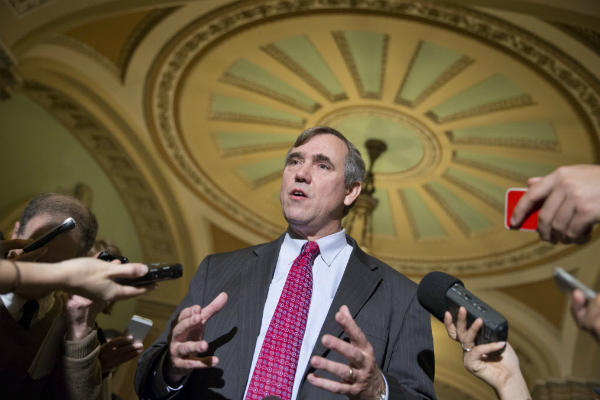
I got a friendly personal note from Senator Jeff Merkley the other day. Well, it was addressed to me and had his signature, so I think it was personal.

Anyway, he told me that if I’m “fed up with special interests always getting their way in Washington” he needs my help because “the special interests that are used to calling the shots are hell-bent on defeating me in 2014.” And in a kind of ironic twist, he said he needs lots of money because every supporter he adds today will be “a rejection of the big money politics that’s created a government by and for the powerful.”

This is the same man who has raised nearly $8 million from the special interests that he embraces, particularly unions, lawyers and law firms, and real estate interests. In the DC game, it’s more a matter of picking your poison than staying pure.

specialinterests

During 2009 -2014, principal contributors to Merkley’s campaign have been:


Industry    Total raised       From Individuals From PACS
lawyers/law firms $337,313 $259,615 $77,698
Leadership PACs $166,500 0 $166,500
Real estate interests $146,868 $74,358 $72,510
Building trade unions $117,000 0 $117,000


The lawyer/law firm contributors include the American Association for Justice, also known as the Association of Trial Lawyers of America ($26,000) and the Boston-based law firm, Thornton & Naumes ($25,000). Thornton & Naumes is a heavy hitter in the contributions game, having contributed $326,250 so far during the 2014 election cycle. That made it the top contributor to 23 members of Congress, all but one a Democrat.

The trial lawyers have been long-time big-time money machine for the Democratic Party. Already losing tort-reform battles in states run by Republican governors and legislatures, and threatened by the GOP-led House, the trial lawyers are deathly afraid of having to deal with a GOP-led Senate, too, so they’re manning the barricades and handing out cash..

Another special interest heavily invested in Merkley is the real estate industry, blamed by some for exacerbating the housing collapse by promoting easy-credit policies.

Then there are the unions. Now there’s a special interest.   Unions making big contributions to Merkley in the 2014 election cycle include:

  • International Brotherhood of Electrical Workers, $30,000
  • Communications Workers of America, $25,000
  • National Electrical Contractors Assn., $25,000
  • International Association of Fire Fighters, $23,500
  • Operating Engineers Union, $20,000
  • Teamsters Union, $20,000
  • Painters & Allied Trades Union, $18,000
  • International Longshoremen’s Association, $18,000
  • International Association of State/County/Municipal Employees, $16,500.

In 2013, the union membership rate–the percent of wage and salary workers who were members of unions–was 11.3 percent, according to the federal Bureau of Labor Statistics. The number of wage and salary workers belonging to unions, was 14.5 million.

The strongest union representation in 2013 was with public-sector workers, which had a union membership rate (35.3 percent) more than five times higher than that of private-sector workers (6.7 percent). This reflects a fairly steady decline in union membership over the years. Thirty years ago, for example, the union membership rate was 20.1 percent, and there were 17.7 million union workers.

Unions in the United States are waging an aggressive effort to maintain their membership and to support union-friendly government policies. And Merkley’s on board.


Merkley’s money: what a difference a term makes

HandsOut

Things are different now.

When Democrat Jeff Merkley first ran for the U.S. Senate in 2008, he raised a total of $6,512,231.

Now that he’s a Senator, he’s already reported raising $6,286,013 for his reelection and the 2014 race, in theory, hasn’t even begun. The Republicans haven’t even chosen who will run against him.

That means Merkley’s total haul is likely to go much higher as individuals, special interests and Democratic Party funds ramp up their donations to keep him in office.

The two parties are in a no-holds-barred struggle for control of the Senate, where pollsters and analysts think the Republicans have a shot at taking control with a good showing in the November 2014 elections. Merkley isn’t often mentioned as being in a high-risk race, but then former Senator Gordon Smith wasn’t thought to be vulnerable early on either.

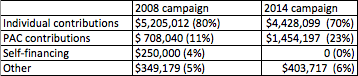
With 5 years as a U.S. Senator now behind him, the sources of Merkley’s donations are shifting. A smaller share is coming from individual contributors and twice as much from political action committees (PACs). Also, more unions are stepping up as big contributors, his big donors have less of an Oregon focus and Merkley isn’t having to dig into his own pocket.

merkleySenate

According to the Center for Responsive Politics, contributions to Merkley’s campaign committee for his 2008 campaign and for his 2014 campaign as of Dec. 31, 2013 break down as follows:

Screen Shot 2014-03-26 at 10.18.34 PM

For his 2008 Senate race, Merkley’s largest 10 contributors (individuals and PACs) to his campaign committee were:

JStreetPAC $78,180
Council for a Livable World $55,889
State of Oregon employees $35,050
Oregon Health & Science University $33,964
Moveon.org $26,731
Stoel, Rives et al $23,323
League of Conservation Voters $21,500
Intel Corporation $17,920
Newmark Knight Frank $17,300
Intl. Brotherhood of Electrical Workers $17,200

The largest contributor to his 2008 campaign, Washington, D.C-based JStreetPAC, makes contributions to candidates who support a two-state solution for Israel and Palestine and robust American military aid to Israel. “I am and will continue to be a staunch supporter of the special relationship between the U.S. and Israel,” Merkley said during his 2008 campaign.“I will always seek to ensure its strength and foster its growth.”

The second largest contributor to his 2008 campaign, Council for a Livable World, is a Washington, D.C.-based non-profit advocacy organization dedicated to reducing the danger of nuclear weapons. Merkley subsequently voted in 2010 for a new Strategic Arms Reduction Treaty (START) with Russia and in February 2014, Merkley and Senator Edward J. Markey (D-Mass.) introduced legislation that would cut $100 billion over the next decade from the U.S. nuclear weapons budget.

The bill, S. 2070, would shut down all U.S. missile defense activities, reduce from 12 to eight the number of SSBN(X) ballistic-missile submarines that are set to replace the retiring Ohio-class fleet and limit to eight the number of Ohio-class submarines that can currently be fielded. The bill has been referred to the Senate Committee on Armed Services where its languishing.

The largest 10 contributors (individuals and PACs) to Merkley’s campaign committee for his 2014 race as of the end of 2013 are significantly different, with much less of an Oregon focus:

Votesane PAC $31,250
Thornton & Naumes $25,000
Intel Corporation $22,050
Honeywell Intl. $20,000
Operating Engineers Union $20,000
Intl. Association of Firefighters $18,500
Blue Cross/Blue Shield $17,100
League of Conservation Voters $15,314
American Crystal Sugar $15,000
Communications Workers of America $15,000

Votesane PAC, a non-partisan channel for political donations, has funneled $1.6 million to candidates in the 2014 election cycle, with almost all of it going to Democrats.

The only union showing up in Merkley’s list of top 10 contributors for his 2008 race was the International Brotherhood of Electrical Workers at $17,200. Three unions show up as his biggest contributors for the 2014 race so far with a total of $53,500.

Also making their debut as major Merkley contributors are individuals from Thornton & Naumes, a Boston, Mass. law firm with class action expertise that has represented people claiming they were victims of asbestos and toxic exposure, defective products, financial fraud, and personal injury accidents.. Law firms and lawyers have been the top contributors to Merkley’s 2014 campaign as of Dec. 31, 2013, donating a total of $296,363.

This only reveals, of course, donations up the end of 2013. Expect a lot of shifts as the campaign progresses.

Merkley has already spent $3,045,241, or almost half, of the funds he’s raised since 2008. Recently, the largest single amount has gone to Mandate Media,a Portland-based internet strategy,services,and advertising firm specializing in progressive political candidates and advocacy organizations. Mandate is also associated with BlueOregon, a widely distributed progressive e-newsletter.

The top 5 recipients of the campaign’s recent expenditures were:

Mandate Media $200,485
CHS Mailing $141,305
Kauffman Group $125,163
Linemark Printing $ 71,639
Benenson Strategy Group $ 47,000

It’s important to recognize that much of the money now being spent on campaigns is so-called independent expenditures, spending by groups and individuals who claim they are not coordinating their activities with a candidate’s campaign committee.

In Merkley’s 2008 race, for example, according to FindTheBest, the following outside groups spent about $675,000 in support of his candidacy:

Committee Amount

Service Employees International
Union Committee on Political Education
(SEIU Cope) $430,238
League of Conservation Voters Inc. $145,317
Democratic Senatorial Committee $ 47,746
League of Conservation Voters
Action Fund $ 40,862
Moveon.org Political Action $ 7,026

It’s likely that similarly large amounts of independent expenditures will occur in the 2014 race.

Data sources: The Center for Responsive Politics (http://www.opensecrets.org), a non-profit, non-partisan research group based in Washington, D.C.; FindTheBest (www.findthebest.com; http://bit.ly/1nYKKSA),a network of for-profit websites connected to help consumers and businesses make informed decisions.

merkleySenate