It’s not just print newspapers that are dying; their readers are, too.

Cemeteries in Huntersville, NC | Gethsemane Cemetery & Memorial Gardens

Not that long ago, printed newspapers dominated the news landscape and seemed to have a promising future.

In 1940, daily circulation of print newspapers in the U.S. was 41.1 million, according to the Pew Research Center. It was a rare home that didn’t start the day with a newspaper at the breakfast table. At my home in Wallingford, CT, we had two papers delivered daily in the 1940s. In the morning, we got the Meriden Record; In the afternoon we got the New Haven Register. Established about 1812, the Register was one of the oldest continuously published newspapers in the United States.

In the mid-1980’s, weekday print newspaper circulation in the U.S. reached a peak of 63.3 million.  Americans avidly followed stories about events such as the assassination of Indian Prime Minister Indira Gandhi, the introduction of Apple’s original Macintosh personal computer (accompanied by a still heralded Orwellian-themed “1984” TV ad), the agreement between China and the United Kingdom to transfer power in Hong Kong from the UK to China in 1997 and Villanova’s stirring 66-64 upset victory over Georgetown in the NCAA championship. 

Onward and upward, thought media leaders. 

Print newspapers hung in there until the early 2000s. Then the bottom began to fall out. By 2012, daily print circulation was down to 43.4 million. By 2020, Pew Research estimated that print circulation had fallen to just under 24.3 million. What happened? The internet and age.

Print newspaper readers have always tended to be older, more affluent, and more educated. Publishers and advertisers used to like that. The problem is that as those older readers have aged and died, they have not been backfilled by subsequent generations. Instead, younger readers have been gravitating to digital communications channels.

And the shift has accelerated across print platforms where readers have been aging fast.

In a 2012 Pew Research Survey, just 23% of respondents said they read a printed newspaper the previous day. The highest readership, 48% was among those 65 and older. The lowest was those 18-24, at 6%, and 25-29, at 10%.

Pew – where people got news yesterday


The percentages saying they read a printed newspaper yesterday have continued to steadily decline.
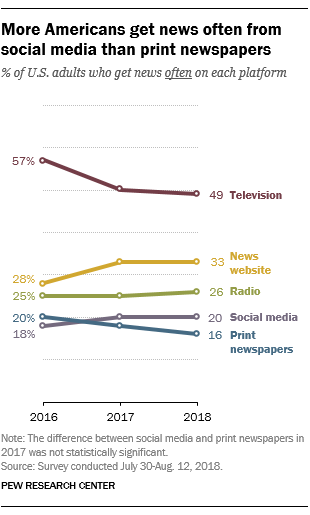
A newer May 2021 survey revealed that most consumers never use newspapers as a source of news, and only 25 percent of adults aged 65 or above (those who engage with newspapers the most) reported reading newspapers every day. Meanwhile, even older folks are warming up to online news. Those over 50 are also warming up to the web. In 2016, 32% of the news readers in the 50+ age group expressed a preference for the web. This increased to 43% in a 2019 survey. Newspapers have become even less popular as a news source than radio, and are also among the least used daily news sources among adults aged 18 – 24.

If this young cohort keeps its print avoidance as it ages, print newspapers will eventually lose almost their entire audience.

The biggest threat is probably to local papers with smaller circulation. Papers with a significant number of print subscribers, such as the still profitable Wall Street Journal and The New York Times, are in a better position.

About five years ago, the Journal’s Editor-in-chief, Gerard Baker, was asked by a writer for the Nieman Lab whether he saw a day when there would be no print edition at all.

I don’t really foresee the day when there’s no print edition,” Baker said. ” I mean, who knows — we live in a rapidly changing world. Who can really say anything with conviction about what will be 10, 15, 20 years hence? But as things stand, we have a million print subscribers who really value the print edition of the paper. They really want it. They’re prepared to pay a significant amount of money for what they pay for a print newspaper. There continues to be strong demand for the print product, and we will continue to need to meet that demand. I don’t foresee any other changes in the foreseeable future.”

Notwithstanding this rosy prediction, in Sept. 2017 the paper announced it would stop publishing its European and Asian editions. Falling overseas sales and plunging print advertising revenue in recent years drove the decision, according to the Journal. In Oct. 2020, it took another step away from print, cutting print editions of its fashion and luxury lifestyle insert WSJ. Magazine from a dozen to eight.

Those are the drip drip signs of changing attitudes at the Journal about the viability of print.

Meanwhile, most of the paper’s subscription growth is on the digital side. In 2017, of the paper’s 2.1 million subscribers, 1.08 million were digital. Daily print readership now stands at about 734 thousand copies, while digital subscribers total about 2.7 million.

It’s a similar story at The New York Times. In 2017, the paper had 540,000 daily print and 2.2 million digital subscribers. Daily print readership now stands at about 795,000 copies, while digital subscribers total about 5.7 million.

A friend of mine told me he used to subscribe to the daily print version of the Columbus (Ohio) Dispatch, even after he moved away from Columbus, until he realized he was spending $1000 a year for the subscription. A 12-month digital subscription today is just $119.88.

In all three cases, it costs a lot less to be a digital subscriber, so you have to really love print to go that way. Fewer and fewer people do.

An added note: Covid-19 isn’t helping either. Covid-19’s devastation has hit the elderly the hardest. Of the more then 800,000 Americans who have died from Covid-19, 75% have been 65 or older, according to the Centers for Disease Control and Prevention. That’s the newspaper audience.

Is “Safety” the new goal in journalism?

Nearly 300 reporters, editors, and other employees at the Wall Street Journal sent a letter to the publisher on Tuesday asserting the Opinion section’s “lack of fact-checking and transparency, and its  apparent disregard for evidence, undermine our readers’ trust and our ability to gain credibility with sources.”

So far, so good. One would hope that Opinion pieces in the WSJ are factual, although there’s not always agreement on “the facts.”

But the letter went on to criticize one opinion piece, “The Myth of Systemic Police Racism,” noting that “multiple employees of color publicly spoke out about the pain this Opinion piece caused them.”

Is this what it’s come to? Newspapers shouldn’t publish Opinion pieces that may make some staff feel discomfort.

This reminds me of the brouhaha over the New York Times’ Opinion section running an op-ed by Sen. Tom Cotton (R., Ark.) that called for the U.S. government to deploy military troops to deter looting amid protests sparked by the May 25 killing of George Floyd in Minneapolis. A slew of New York Times reporters and editors revolted, claiming  in high dudgeon that the op-ed endangered their Black colleagues and contained factual errors.

Aggrieved Times staffers went so far as to tweet a screenshot of the piece’s headline captioned with the same phrase: “Running this puts Black @NYTimes staff in danger.”

Even the staff’s unions jumped in, issuing a statement “…in response to a clear threat to the health and safety of journalists we represent.”

Nonsense!

This kind of overreaction is just another example of the current insistence of the fragile among us that society must focus on ensuring all people are “safe,” that their self-esteem isn’t damaged.

An op-ed pissed somebody off. Some reporters found an op-ed in their own newspaper objectionable. So what.

I spent 10 years as a reporter at The Oregonian. I disagreed, sometimes vehemently, with editorials and opinion pieces in the paper, but I never felt threatened by them.

Bari Weiss, a former writer and opinion editor at the New York Times, tied the turmoil over Cotton’s op-ed to a conflict between the “Old Guard” that “lives by a set of principles we can broadly call civil libertarianism” and a “New Guard” with “a different worldview” that endorses “ ‘safetyism’, in which the right of people to feel emotionally and psychologically safe trumps what were previously considered core liberal values, like free speech.”

“Heaven forbid an opinion on a newspaper’s op-ed page should offend someone,” wrote Washington Post  columnist Kathleen Parker.

Or as one the New York Times’ own columnists, Bret Stephens, put it, “As important as it is to try to keep people safe against genuine threats, it is not the duty of the paper to make people feel safe by refusing to publish a dismaying op-ed.”

Yes, being a reporter can be dangerous. Forty-nine journalists were killed in 2019, 57 were being held hostage and 389 were in prison, according to the non-profit group Reporters Without Borders.

murderedjournalist

Javier Valdez Cárdenas, 50, a veteran journalist who specialized in covering drug trafficking, was gunned down in broad daylight in Culiacán, the capital of Mexico’s northwestern state of Sinaloa.

But who was in imminent danger because Sen. Tom Cotton wrote an inflammatory op-ed?

The exaggerated sensitivity seen today on many college campuses is not modulating as students graduate. It is being retained as graduates enter the workforce.

Weiss thinks what’s going on at the New York Times is representative of what’s happening across all U.S. media.  “The civil war inside The New York Times between the (mostly young) wokes and the (mostly 40+) liberals is the same one raging inside other publications and companies across the country. The dynamic is always the same,” Weiss wrote on Twitter. “They assumed they shared that worldview with the young people they hired who called themselves liberals and progressives. But it was an incorrect assumption.”


Now more than ever, Oregon needs a hiring freeze

budget1


Senate Republican Leader Ted Ferrioli, of John Day, has called for a hiring freeze in Oregon’s public sector, saying it will ignite economic growth.

“A hiring freeze in the public sector will ignite growth in the private sector that has been suffering under the rapid growth of government,” said Ferrioli. “We should not be artificially growing government at the cost of the Oregon worker and their loved ones. Grandpa always said when you find yourself in a hole, quit digging.”

The State of Oregon Employment Department data shows that government has had an explosive growth in jobs that has not been matched by growth in the private sector, which is the engine of the economy.

Additionally, the Taxpayer Association says that Oregon out-spends 39 other states and that our state budget grows twice as fast as population and inflation rates combined. State employees make almost double what average working Oregonians make, earning on average $89,000 compared to $45,893.

Whats worse, 35 years of double-digit growth has produced big scandals and billions in preventable mistakes.

“We must end the era of government gone wild.”

Ferrioli has it right.

Most states, when they confront financial hard times, put a hold on hiring.

Gov. Asa Hutchinson of Arkansas, in an effort to strengthen state finances, imposed a state hiring freeze last year that whittled 1,161 employees from the payroll.

Nebraska Gov. Pete Ricketts, whose state missed revenue forecasts last fiscal year and is forecasting a miss again because of declines in farm income, also put on a hiring freeze for state employees. “As Nebraskans, we don’t spend money we don’t have,” Ricketts said.

 Businessess pull back when they face financial challenges, too.

Macy’s, faced with unfavorable earnings, decided to shut down 68 stores and cut more than 10,000 jobs.

Dow Jones & Co., like many news organizations that have been letting people go in the face of declining revenue, is planning to lay off dozens of reporters and editors at the Wall Street Journal because of persistent drops in print advertising income. The news and information business of News Corp, which publishes the Wall Street Journal and other newspapers, reported a 7% decline in revenue in the 4th quarter of 2016.

In December 2011, then Gov. John Kitzhaber, who was also facing budget troubles, ordered a hiring freeze. But when Gov. Brown released her recommended budget for 2017-19, she chose not to do the same.

In fact, with Oregon facing a $1.7 billion budget shortfall in the 2017-19 biennium, buried in the Governor’s Budget is a proposal to actually increase the state government workforce from 38,737 in 2015-17 to 39,412 in 2017-19. That’s an increase of 675 full-time equivalent employees.

“Using the cost information from the Legislative Fiscal Office, this 1.7 percent increase would cost the state more than $120 million in compensation costs for the 2017-19 biennium,” according to Facing Reality, a Cascade Policy Institute report offering alternative budget proposals. “A prudent step of a hiring freeze would free up resources and ward off some of the pressure to increase taxes, fees, and charges,” the report said.

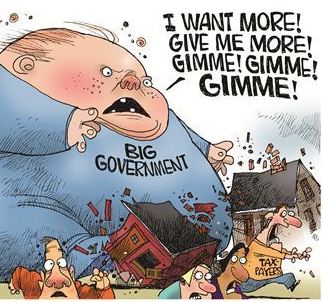
An ever-expanding state is not sustainable without ever-increasing taxation.   If Oregon is to responsibly manage its finances, an across-the-board rigorously enforced hiring freeze, with stringent requirements for exceptions and restrictions on hiring contractors, should be instituted NOW.

Then the size of the state workforce should be held down by careful pruning of ineffective and bloated programs and the hiring freeze should be continued in the 2017-2019 budget, which would encourage state agencies to optimize the staff they have.

Surely the governor and Legislature, with a state workforce of 38,737, can find ways to meet the state’s needs by adjusting the workload and assignments of that workforce.

In the end, the state and taxpayers will be better off for it.