Trump is Putting Radio Free Europe Journalists in Harm’s Way

Donald Trump loathes the media. 

Shortly after assuming the presidency in January 2017, he accused the press of being an “enemy of the American people”. He hasn’t held back from continuing his war on the press in succeeding years. 

As an American citizen, and a former journalist at Oregon’s leading newspaper, The Oregonian, I wince every time Trump levels another unseemly attack on the media. 

Now, his decision to withdraw funding from Radio Free Europe/Radio Liberty (RFE/RL), a move endorsed by his sidekick Elon Musk, who has described the media group as “just radical left crazy people talking to themselves,” is angering me even more because it is putting journalists’ lives in danger.

In a sudden, but not out-of-character, slash-and-burn move, the Trump administration sent out an email to employees at Voice of America (VOA) on March 15, 2025 putting them on paid administrative leave “until otherwise notified” and instructing them not to enter the VOA offices or access its internal systems. Radio Free Asia, also funded by the US, has lost its funding as well.

The moves have left exiled Russian journalists working for RFE/RL “high and dry” and at risk of being stranded overseas without any legal status. “If it can’t find funding soon, the company won’t be able to pay its staff and the consequence would potentially put a very large number of journalists who are exiled from authoritarian regimes at grave risk,” a source told The Guardian.

“Many of RFE/RL’s Russian journalists operate from Prague, Riga and Vilnius, with their work visas often tied to their employment,” the Guardian is reporting. “Terminating the broadcaster’s funding would trigger visa expirations, leaving them without legal status within months. Deportation to Russia for any of them would expose them to criminal prosecution. “

According to the Guardian, RFE/RL journalists are regarded as “foreign agents”, making them the target for arrest should they return to Russia.

RFE/RI is suing the Trump administration in an effort to reverse the cancellation of its funding, but its success is uncertain. 

In the meantime, if any of the RFE/RI’s journalists suffer harm because of Trump’s actions, the blood will be on his hands. 

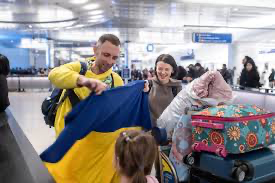
Will Trump Abandon Ukrainian Refugees? Count on it, he says.

Remember when America welcomed Ukrainians with open arms and warm hearts when Russia initiated a brutal invasion of Ukraine in 2022?

So much for “Send these, the homeless, tempest-tost to me, I lift my lamp beside the golden door!” when Donald Trump takes office again on January 20, 2025.

The United States under President Trump is expected to join Pakistan and Iran in forcefully returning foreigners who have arrived from war-torn countries. And with the fall of Syria’s President Bashar al-Assad, pressure is likely to grow to repatriate Syrians in the United States under TPS protection

The Costs of War Project is a nonpartisan research project based at the Watson Institute for International and Public Affairs at Brown University. It seeks to document the direct and indirect human and financial costs of U.S. wars in Iraq and Afghanistan and related counterterrorism efforts. According to Costs of War, over one million Afghans were forcibly returned from Pakistan and Iran in 2023. Under the current Taliban regime, forced returns to Afghanistan are continuing, despite a non-return advisory from the United Nations Refugee Agency (UNHCR).

 “States have a legal and moral responsibility to allow those fleeing Afghanistan to seek safety, and to not forcibly return refugees,” the Refugee Agency says.

Various governments justify this trend of increasing returns to Afghanistan by arguing that active war has subsided since August 2021, when the U.S. initiated a chaotic withdrawal from the country, Costs of War asserts.

Trump has made it crystal clear he plans to repatriate Ukrainians who are in the United States under the Temporary Protected Status (TPS) program. Set up in 1990, the program gave the federal government the ability to grant work permits and deferrals from deportation to nationals of any designated nation going through or recovering from natural or man-made disasters.

An ongoing Ukrainian refugee crisis began in February 2022 when Russia invaded Ukraine, with over 6 million refugees fleeing Ukraine across Europe. The United States announced on March 4, 2022, that Ukrainians would be provided Temporary Protected Status (TPS).  There are now approximately 50,205 Ukrainian refugees  in the United States protected by the TPS program. During the designated TPS period, TPS holders are not removable from the United States and not detainable by DHS based on their immigration status. TPS for Ukrainians was recently extended until April 19, 2025, only three months after Trump’s inauguration. 

The Heritage Foundation’s “Project 2025”, which Trump disavowed during the campaign when criticism of it erupted, has resurfaced as a policy driver since Trump’s election. It outlines a plan to end TPS, calling it a program that encourages illegal immigration. If confirmed, Trump’s pick for Secretary of the Department of Homeland  Security, South Dakota Gov. Kristi Noem, would likely will lead the charge to terminate TPS designations and send Ukrainian refugees home to the continuing war and devastation.

Is this what the 76,744,608 people who voted for Trump this time around wanted?

“War, huh. What’s it good for?

On this Memorial Day, it seems like the United States has been at war for most of my lifetime. The cost in American lives has been unbearable. Parents of friends, and friends themselves, have died. The financial cost has been astronomical. The impact on our culture has been massive. The resulting erosion of trust in government has been substantial. What have we accomplished?

Vietnam

In 1964, President Lyndon Johnson used reports of attacks on two American ships in the Gulf of Tonkin as political cover for a Congressional resolution that gave him broad war powers in Vietnam. There were only two dissenting votes, Senators Morse of Oregon and Gruening of Alaska.

As American involvement in the war and body counts escalated, so did anti-war protests at home. The end came when Saigon in South Vietnam fell to the communists in April 1975.
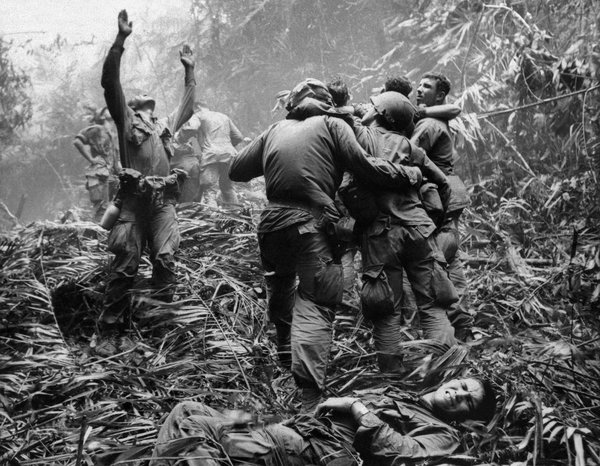
VietnamUStroops

David Halberstam wrote “The Best and the Brightest” about the overconfident people in leadership roles in the United States who pursued the war.

“The basic question behind the book,” he said, “was why men who were said to be the ablest to serve in government this century had been the architects of what struck me as likely to be the worst tragedy since the Civil War.” (The term “Best and the brightest “ has often been twisted since then to mean the top, smart people, the opposite of Halberstam’s original meaning)

Now, 41 years later, the U.S. and Vietnam are reconciling. The U.S. wants the business opportunities that are expected to open up in Vietnam and a counterweight to Chinese adventurism.

vietnamObama

President Obama reviewing a guard of honor during a welcoming ceremony at Vietnam’s Presidential Palace in Hanoi, May 23, 2016.


Cost of the Vietnam War to the United States                                            $173 billion

U.S. military fatal casualties of the Vietnam War                                             58,220

Grieving families of U.S. military fatal casualties of the Vietnam War       58,220


Afghanistan

The Afghanistan war began in October 2011 to oust the Taliban that sheltered al Qaeda chief Osama Bin Laden after the September 11, 2001 attacks on the United States.

USTroopsInAfghanistan

The U.S.-led coalition in Afghanistan ended its combat mission in December 2014, according to the White House.

In terms of Western goals — things are right back where they started: needing to keep Afghanistan free of extremists and a viable country for its people, CNN recently reported. The result is thousands of refugees and a continued safe haven for ISIS.

The Taliban currently controls more territory than at any time since 2001, when it ruled from the capital, Kabul, Western defense officials say, and the United Nations says civilian casualties are at a high since it began keeping records in 2009, according to the Wall Street Journal.

The United Nations said 3545 civilians were killed in 2015 as Taliban stepped up attacks after British and American troops left at end of 2014.

Furthermore, U.S. intelligence agencies have been warning the White House that the Taliban could seize more Afghan territory, including population centers, during this summer’s fighting season, in part because the Afghan government and its military forces are so weak, according to the Journal.


Cost of the war in Afghanistan to the United States                            $686 billion

U.S. military fatal casualties of the war in Afghanistan                          2,381

Grieving families of U.S. military fatal casualties                                      2,381

Iraq

On March 19, 2003, the United States and coalition forces, began a war in Iraq against Saddam Hussein, the Sunni leader of Iraq.

When explosions from Tomahawk cruise missiles launched from U.S. fighter-bombers and warships in the Persian Gulf began to rock Baghdad, President George W. Bush said in a televised address, “At this hour, American and coalition forces are in the early stages of military operations to disarm Iraq, to free its people and to defend the world from grave danger.”

husseinstatue

U.S. soldiers hold back crowds as the statue of Saddam Hussein falls in Baghdad, April 9, 2003, by Peter Nicholls

The Shia-led governments that have held power since Hussein was toppled have struggled to maintain order and the country has enjoyed only brief periods of respite from high levels of sectarian violence. Violence and sabotage have continued to hinder the revival of an economy shattered by decades of conflict and sanctions.

Politically and economically, Iraq’s trajectory is currently a negative one, Brookings said recently. The country is politically fragmented at all levels and the centrifugal forces appear to be gaining strength. This, in turn, has paralyzed the government, suggesting that the most likely paths for Iraq are toward a situation analogous to the Lebanon of today.

Cost of the Iraq War to the United States                                             $818 billion

U.S. military fatal casualties of the Iraq War                                             4,491

Grieving families of U.S. military fatal casualties of the Iraq War       4,491


“War, huh

Good God, y’all

What is it good for?”

      “War” by Edwin Starr