Oregon’s Lane County Considering Name Change. Why Stop There?

Some folks in Lane County, Oregon want to rename the county because, as the Eugene Register-Guard newspaper put it, Joseph Lane’s “…pro-slavery sentiments and actions against Native Americans don’t align with today’s values.”

Joseph Lane

Joseph Lane, the county’s namesake, was Oregon’s first territorial governor. According to the Register-Guard, he owned at least one slave, a Native American boy, held an “apprenticeship…often recognized as a legalized form of slavery,” over a young man after slavery became illegal, and led actions of violence against Native Americans.

While the re-namers are at it, why not go a whole hog, do a thorough statewide house cleaning? After all, a lot of Oregon’s county names are problematic.
BENTON COUNTY

Thomas Hart Benton, Benton County’s namesake, owned slaves on a 40,000-acre holding where he had a plantation near Nashville, TN. A strong believer in America’s Manifest Destiny, he was also a staunch advocate of the disenfranchisement and displacement of Native Americans in favor of European settlers.

Let’s rename Benton County.

CROOK COUNTY

George R. Crook is Crook County’s namesake. As a member of the U.S. military fought against several Native American tribes in the west, including in Oregon. After the Civil War,he successfully campaigned against the Snake Indians in the 1864-68 Snake War and the Paiute in Eastern Oregon near the eastern edge of Steen’s Mountain.

Let’s rename Crook County.

CURRY COUNTY

George L. Curry, Curry County’s namesake, was the last governor of the Oregon Territory. During the Yakima War against Native Americans, in 1855, Governor Curry raised a force of 2,500 volunteers and led them into battle in support of federal troops.  

Oregon prepared for statehood under Governor Curry, approving a state constitution in 1857 that prohibited new in-migration of African Americans and made illegal their ownership of real estate. Although enabling legislation was never passed and the clause was voided by the 14th and 15th Amendments passed after the Civil War, the ban remained a part of Oregon’s constitution until it was repealed in 1927.

Let’s rename Curry County.

DOUGLAS COUNTY

U.S. Senator Stephen A. Douglas, Douglas County’s namesake, was the foremost advocate of the view that each territory in the United States should be allowed to determine whether to permit slavery within its borders. He was one of four Northern Democrats in the House of Representatives to vote against the Wilmot Proviso that would have banned slavery in any territory acquired from Mexico.

After marrying Martha Martin in March 1847, her father bequeathed her a 2,500-acre cotton plantation with 100 slaves in Missippi. Douglas hired a manager to operate the plantation while using his allocated 20 percent of the income to advance his political career. 

Let’s rename Douglas County.

GILLIAM COUNTY

Colonel Cornelius Gilliam, the namesake of Gilliam County, fought against Native Americans in 1832 during the Black Hawk War in the Midwest and in the Seminole Wars in Florida in 1837.  He led volunteer forces in the Cayuse Indian War in 1847 and as colonel of a regiment of volunteers he fought the Walla Walla and Palouse near the Touchet River in the Walla Walla Valley, He was also instrumental in military operations to expel the Mormon colony from Missouri.

Let’s rename Gilliam County.

HARNEY COUNTY

Major General William S. Harney, namesake of Harney County, was commander of the U.S. Army’s Department of Oregon. In 1832, he fought in the Black Hawk War against the Saukj and Fox tribes, which quelled the last Indian resistance to white settlement in the region around Chicago. 

During 1835-42, he fought Native Americans in Florida’s Second Seminole War. At the Battle of Ash Hollow in western Nebraska, soldiers under his command indiscriminately killed Brulé Lakota men, women, and children, earning him the sobriquet, The Butcher. According to the Oregon Encyclopedia, Harney was “A brash, opportunistic cavalry officer with an explosive temper and a vindictive predilection for conflict with Indians,” who at one point bludgeoned to death a family female house slave.

Let’s rename Harney County.

JACKSON COUNTY

President Andrew Jackson, namesake of Jackson County, owned a Tennessee plantation, the Hermitage, where he owned slaves.  Over his lifetime, he owned a total of 300 slaves and at his death in 1845, he had over 150.

He led troops during the Red Stick War of 1813–1814, leading to The subsequent Treaty of Fort Jackson which required the Creek  tribe to surrender vast tracts of present-day Alabama and Georgia. He also commanded U.S. forces in the First Seminole War against Native Americans, which led to the U.S. annexation of Florida. In 1830, he signed the Indian Removal Act, which forced tens of thousands of Native Americans from their ancestral homelands east of the Mississippi and resulted in thousands of deaths.

Let’s rename Jackson County.

JEFFERSON COUNTY

Jefferson County was named for Mount Jefferson, which was named for President Thomas Jefferson by Lewis and Clark on their westward expedition. Jefferson owned more than 600 slaves during his life. The slaves he owned at the time of his death were sold to pay the debts of his estate.

As US Secretary of State, Jefferson issued in 1795, with President Washington’s authorization, $40,000 in emergency relief and 1,000 weapons to French slave owners in Saint-Dominque (Modern day Haiti) in order to suppress a slave rebellion. When elected president, Jefferson brought slaves from Monticello to work at the White House.

Let’s rename Jefferson County (and Mount Jefferson while we’re at it). 

JOSEPHINE COUNTY

Virginia “Josephine” Rollins is the namesake of Josephine County. Her claim to fame was that she was the first white woman to live in the area. That alone might be considered racist enough to justify renaming Josephine County.

Let’s rename Josephine County.

LINN COUNTY

U.S. Senator Lewis F. Linn of Missouri is the namesake for Linn County. He was honored as an early champion of the Donation Land Claim Act of 1850. The Act spurred a huge migration into Oregon Territory by offering qualifying citizens free land just to white male citizens 18 years of age or older who resided on property on or before December 1, 1850. Members of Native tribes were not U.S. citizens and therefore could not own land under the law.

“The DLCA was the only federal land-distribution act in U.S. history that specifically limited land grants by race, essentially creating an affirmative action program for White people,” Kenneth R. Coleman wrote in the Oregon Historical Quarterly. “Perhaps most decisively, the issuance of free land resulted in a massive economic head start for White cultivators and initiated a long-standing pattern in which access to real estate became an instrument of White supremacy and social control.”

Let’s rename Linn County.

POLK COUNTY

President James K. Polk, Polk County’s namesake, was a property owner who used slave labor. He owned a plantation in Mississippi and even increased his slave ownership during his presidency. 

Polk inherited 20 slaves from his father and in 1831 became an absentee cotton planter, sending enslaved people to clear plantation  land that his father had left him near Somerville, Tennessee. Four years later Polk sold his Somerville plantation and, together with his brother-in-law, bought 920 acres of land, a cotton plantation near Coffeeville, Mississippi and transferred slaves there. He purchased more slaves in subsequent years. In an era when the presidential salary was expected to cover wages for the White House servants, as president  Polk replaced them with enslaved people from his home in Tennessee.

Let’s rename Polk County.

SHERMAN COUNTY

William Tecumseh Sherman, Sherman County’s namesake, was a Union hero in the Civil war, but far from an abolitionist. “For one thing, Sherman was a white supremacist,” novelist Thom Bassett wrote in the New York Times in an opinion piece about Sherman’s Southern Sympathies. “All the congresses on earth can’t make the negro anything else than what he is; he must be subject to the white man,” Sherman wrote his wife in 1860. “Two such races cannot live in harmony save as master and slave.”

History had forced the institution of slavery on the South, Sherman thought, and its continued prosperity depended on embracing it, Bassett wrote. “Theoretical notions of humanity and religion cannot shake the commercial fact that their labor is of great value and cannot be dispensed with.” 

Let’s rename Sherman County.

WASHINGTON COUNTY

And let’s not forget Washington County.

President George Washington was the namesake for Washington County.

One of the original four counties of the Provisional Government in Oregon and first called Twality, the county was renamed in 1849 in honor of the president.

Washington’s Virginia estate, Mount Vernon, was home to hundreds of enslaved men, women, and children, on who’s labor he depended to build and maintain his household and plantation. Over the course of his life, at least 577 enslaved people lived and worked at Mount Vernon. At his death,  Mount Vernon’s enslaved population totaled 317 people. In his will, he ordered that his slaves be freed at his wife’s death, but that request applied to fewer than half of the people in bondage at Mount Vernon. Those owned by his wife’s estate were inherited by Martha Washington’s grandchildren after her death.

According to the Mount Vernon plantation’s current website, “After the Revolution, George Washington repeatedly voiced opposition to slavery in personal correspondence. He privately noted his support for a gradual, legislative end to slavery, but as a public figure, he did not make abolition a cause. “

Time to change the name of Washington County, too, don’t you think?

Stuck: running in place in Oregon

I work in Hillsboro, OR where evidence of a strong economy is everywhere. It’s tempting to assume that family income must be growing by leaps and bounds in Washington County, too, and to extrapolate and assume all is well statewide.

Not so much.

In fact, even Washington County isn’t doing that great, despite the presence of Intel, which has been growing like kudzu, feverishly sprouting buildings and good jobs.

Way back, growth in the U.S. economy was accompanied by income increases across the board, improving the lot of the poor and expanding the middle class. Everybody shared in the rising tide.

middle_class_family

But that hasn’t been happening for a long time. Now a lot of people find themselves working harder, but just treading water.

“Over the past 25 years, the (U.S.) economy has grown 83 percent, after adjusting for inflation — and the typical family’s income hasn’t budged,” according to a recent analysis by the Washington Post. “In that time, corporate profits doubled as a share of the economy. Workers today produce nearly twice as many goods and services per hour on the job as they did in 1989, but as a group, they get less of the nation’s economic pie.”

The result? In 81 percent of America’s counties, median family income is lower today than it was 15 years ago, the Post analysis revealed.

What about in Oregon? I decided to look deeper. The data shows that in 25 Oregon counties, the inflation-adjusted median family income is lower today than it was 15 years ago.

That’s true even in Washington County where median household income, adjusted for inflation, actually peaked in 1999 at $72,787. That year was also the peak for such wildly dispersed counties as Clackamas, Deschutes and Malheur.

The situation is even worse in counties such as Baker and Lake where median family income, adjusted for inflation, hit its peak 35 years ago.

If you really want to hit bottom, there are six counties, including Curry, Lane and Wheeler, where medium family income, adjusted for inflation, peaked 45 years ago. That’s right, almost half a century ago, when Richard Nixon was inaugurated President and the Apollo 11 astronauts, Neil Armstrong and Edwin E. Aldrin, Jr., took their first walk on the moon.

So what we have in Oregon is an economy in which few of us are really better off economically then we were years ago.

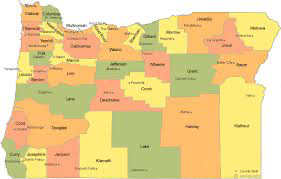
Here’s the county-by-county breakdown of when median household income, adjusted for inflation, peaked in each of Oregon’s 36 counties and the level at which it peaked.

Oregon-county-map

County Peak Year Amount
Hood River 2013 $56,725
Sherman 2009 $52,664
Washington 1999 $72,787
Clackamas 1999 $72,264
Columbia 1999 $63,555
Yamhill 1999 $62,070
Polk 1999 $59,218
Benton 1999 $58,558
Deschutes 1999 $58,159
Multnomah 1999 $57,733
Marian 1999 $56,673
Linn 1999 $52,326
Crook 1999 $50,759
Jackson 1999 $50,734
Clatsop 1999 $50,289
Jefferson 1999 $49,678
Tillamook 1999 $48,026
Wallowa 1999 $44,726
Josephine 1999 $43,406
Malheur 1999 $42,525
Morrow 1979 $57,126
Wasco 1979 $54,645
Harney 1979 $54,318
Umatilla 1979 $50,513
Lake 1979 $49,714
Grant 1979 $48,786
Union 1979 $48,006
Lincoln 1979 $47,053
Baker 1979 $42,760
Lane 1969 $52,736
Coos 1969 $52,171
Gilliam 1969 $49,892
Klamath 1969 $49,511
Curry 1969 $49,042
Wheeler 1969 $40,675

SOURCES: U.S. Census and American Community Survey. Amounts in 2013 dollars.

Vote? Fuhgettaboutit

A bunch of folks won in Oregon’s May  20 primary elections, but that doesn’t mean they enjoy the enthusiastic support of Oregonians. In fact, far too often a small number of Oregonians are determining the winners and losers in Oregon politics. Only about one-third of registered voters bothered to vote in the May primaries.

And this doesn’t take into account the fact that significant numbers of eligible adults 18 years and older are not even registered to vote.

non_voters

In the hotly contested Republican primary for the U.S. Senate race against Jeff Merkley, candidate Monica Wehby captured 132,501 votes, 49.99 percent. That allowed her to overcome her principal challenger, Jason Conger, who pulled in 99,706 votes, 37.61 percent.

Wehby’s victory sounds impressive until you realize that there are 650,176 Oregonians registered as Republicans. That means Wehby won the primary with the votes of just 19.77 percent of registered Republicans. Those are the only people who can vote in Oregon’s Republican primary in the state’s closed primaries.

Votes in Washington County Commission races were similarly low. There are 284,138 registered voters in the county.For the nonpartisan Commissioner-at-large position, Andy Duyck won with 43,837 votes. That’s 15.4 percent of registered voters.

The fact is, despite Oregon’s much-vaunted vote-by-mail system, the May primary had one of Oregon’s lowest voter turnouts ever and turnout has been falling for years.

Why?

In races where there seems to be no real contest, motivating voters to turn out is damn hard. Jeff Merkley won the Democratic primary for U.S. Senator with 271,344 votes, just 33 percent of registered Democrats.

In other cases, it’s hard to get excited when there truly is no contest. For example, in three Metro races the incumbent candidates, Carlotta Collette, Shirley Craddick and Kathryn Harrington, had no opponents.

In some cases the ideological split in a voting district is so unbalanced, with Democrats or Republicans firmly in control, that going to the polls if you’re in the minority seems like a total waste of time. A Republican in Multnomah County may feel that way as may eligible voters in most Congressional districts in the U.S. According to the Pew Research Center, political scientists and analysts disagree on why so few House districts are competitive; some blame gerrymandering, while others say the district maps reflect a politically polarized America where people are more likely to live among those who think like they do.

Then there are the races that just don’t engage voters, where few voters feel any connection to whoever wins and probably couldn’t even name the incumbent if asked.

Of course, Oregon’s closed primary system is also a guilty party. With 648,146 Oregonians registered as Nonpartisan (nonaffiliated, minor parties & others), a number that’s been growing steadily, none of them can vote in a Republican or Democratic primary.

There’s also the growing disenchantment with politics and politicians in general in Oregon and across the country. In Kentucky, for example, turnout was only 26 percent in a nationally covered intensely competitive primary between U.S. Senate Republican Leader Mitch McConnell and Matt Bevin.

Washington County or Casino County?

By Bill MacKenzie

You know the typical casino ad. The gorgeous blonde’s crystal blue eyes gaze adoringly at the urbane, fashionably dressed man as he places a bet. The couple is surrounded by smiling, equally fashionable friends enjoying the gaiety.

You almost expect Jay Gatsby to stroll into the scene from West Egg and enjoy the fun.

Dede’s Café, hiding off to the side in the Hillsboro Promenade at the corner of Southwest Baseline Road and Southwest Cornelius Pass Road in Hillsboro, is the raw reality of the casino Washington County has become.

At Dede’s, six video lottery machines with brightly lit screens are crammed into a space not much more expansive than a large walk-in closet. On a recent mid-afternoon visit, I found all the machines being used by solitary, slightly disheveled men and women in jeans and sweatshirts.

All of them looked hypnotized by the glow of the screen in front of them. Almost motionless, except for the rapid movement of their hands to push the play buttons, they sat mute in the dim light.

A man with a black hat pulled down over his gray hair slipped a $10 bill in one machine and started briskly tapping the play buttons. He got up to $46.45 on Game of Dragons II, but didn’t take his winnings and celebrate. Instead, in a few minutes he fell back to $5.19.

Switching to a Zeus game, he bounced up to $23.49. When he went to $6, he shifted to another game. After 20 minutes of play, when he was down to 35 cents, he slipped in another $20 bill and resumed play.

MIT anthropologist Natasha Dow Schüll knows such people well. In her book, “Addiction by Design,” she shows how the rhythm of gambling at electronic terminals puts people into a trancelike state in which gamblers keep playing not to win, but so they can stay “in the game” and maximize their “time on device.”

Oregon voters overwhelmingly approved the lottery in 1984. It launched in 1985 at a Portland event featuring an 84-foot-tall inflatable King Kong, perhaps symbolizing the behemoth the lottery would become.

Dede’s Café is now part of a rising river of lottery money flooding Oregon. The money has turned the county and the state into unwitting addicts as Oregon’s lottery take has gone from $87.8 million in 1986 to $1.1 billion in 2013. It’s a very big business.

The lure of raking in lottery dollars without having to raise taxes has long been appealing to politicians anxious to satiate government’s insatiable thirst for revenue. In fact, the lottery is often referred to as a “voluntary tax,” though Schüll’s research calls the “voluntary” part into question.

In fiscal year 2013, 204 lottery retailers in Washington County generated net receipts of $87.7 million from 1,035 video terminals, almost equal to the number of video slot machines at the Wildhorse Casino in Pendleton.

The numbers are even more impressive when you combine net receipts from video terminals with sales of traditional games, such as scratch-its and Megabucks. Together, these totaled $125.7 million in all of Washington County.

Washington County sees a return from all this gambling activity in the form of direct and indirect jobs and money the state devotes to parks, natural resources, education and various economic development efforts.

The county also receives direct payments equal to 2.5 percent of lottery proceeds. This money must be applied to economic development/job creation programs, liberating county revenue for other priorities.

But the lottery bounty also means the county and state are increasingly relying on the generous flow of lottery dollars, which are not a dependable or sustainable source of revenue. If lottery revenue declines, or even fails to grow, a lot of established programs could face tough adjustments.

Washington County residents are getting decidedly mixed messages. On the one hand, business and government leaders are aggressively delivering messages about the importance of education and hard work in achieving success.

At the same time, the lottery undermines the messages by constantly suggesting in tantalizing ads and much ballyhooed winner announcements that riches are just one lucky ticket or one play away.

So go ahead. Make your wager. Just remember that in the end, the house always wins.

Bill MacKenzie is a former congressional staff member, newspaper reporter and communications manager for a Hillsboro company.

Originally published in the Hillsboro Tribune,  Nov. 11, 2013

Turning unemployment into self-employment

By Bill MacKenzie

Ronald Reagan once wisecracked, “The nine most terrifying words in the English language are, ‘I’m from the government and I’m here to help.’”

But sometimes, the government gets it right.

Julie Thomas knows that. Thomas recalls with sadness when her beloved black lab, Barney, had cancer. Wanting desperately to ease Barney’s pain, Thomas, an employee at Intel’s Hillsboro site, studied small animal massage and began treating her pet. When Thomas learned she was going to be let go by Intel, she decided to take a risk and change careers to work in canine water therapy.

But how could she get the business off the ground while unemployed? Oregon’s Self Employment Assistance Program (SEAP) came to her rescue.

The regular Unemployment Compensation program requires unemployed workers to be actively seeking work to get benefits. SEAP allows unemployed people to collect allowances equal to their benefits while devoting all their time to starting a business, rather than looking for another job.

The program was created in 1993 after passage of federal legislation championed by then-U.S. Rep. Ron Wyden. SEAP is now active in seven states, including Oregon. In 2012, legislation sponsored by Wyden — now Oregon’s senior U.S. Senator — provided for $35 million in grants to states to improve administration and promotion of the program.

With the economy still struggling, SEAP offers a lifeline to some entrepreneurs.

“It seemed a perfect fit for me,” Thomas said.

Thomas opened her business, Doggie Paddle, in Portland in October 2010.

“I’m not making the money I made working in a corporation,” she said, “but I’m doing something with animals, something of service, something for which I have a passion.”

Thomas is just one of several thousand Oregonians who have taken advantage of SEAP, including 55 now enrolled from Washington County, with seven of those from Hillsboro.

With SEAP support, Dave Crosswhite of Tigard started Oregon Backflow Testing, which tests backflow prevention devices that help to prevent hazardous materials from entering drinking water. He said SEAP was a huge factor.

“It took the pressure off of needing to produce an income right away and allowed me to focus on building the business and not having to job search in order to receive benefits,” he explained.

Glen Wagner and Steve Bauer signed up after they both lost their technology jobs. They decided to start a company called Open Lore in Beaverton that would deliver assisting technology to people having difficulty reading English, primarily those with dyslexia.

“Unfortunately, with multiple kids in college and still relatively young, at least at heart, we did not have the complete means to meet our family obligations and the capital expenses of starting a new technology business,” Wagner said. “With SEAP, we could put our heart and soul into the business.”

But SEAP is not without its weaknesses.

Key SEAP performance data is based only on surveys returned by program participants, but a lot of participants don’t return the surveys. For example, a recent Oregon survey sent out to 356 SEAP participants got only 78 replies — a 22 percent return.

So the state doesn’t know how many people sign up for SEAP, exhaust their benefits and end up with no business and no job. Some of those missing may be in worse shape than when they started.

Another glaring weakness is, success in Oregon hasn’t been determined on the basis of how many SEAP participants start and maintain a successful business. Rather, success has been judged by how well the state promotes SEAP and how much money is distributed to participants. Only government could think that way.

In addition, although SEAP requires that potential participants fill out an application scored to determine the feasibility of their proposed business, there’s no real follow-up. That means no assurance participants will take advantage of the array of support programs available to help grow and sustain a business. Failure may too often be the consequence.

Only about half of all new businesses survive five years or more, and only about one-third survive 10 years or more. To improve their odds, SEAP-related businesses need continuing guidance. After all, although new businesses create new jobs, it’s only when they succeed and expand that real job growth occurs.

Bill MacKenzie is a former congressional staff member, newspaper reporter and communications manager for a Hillsboro company.

Originally published in the Hillsboro Tribune,  Sept. 13, 2013