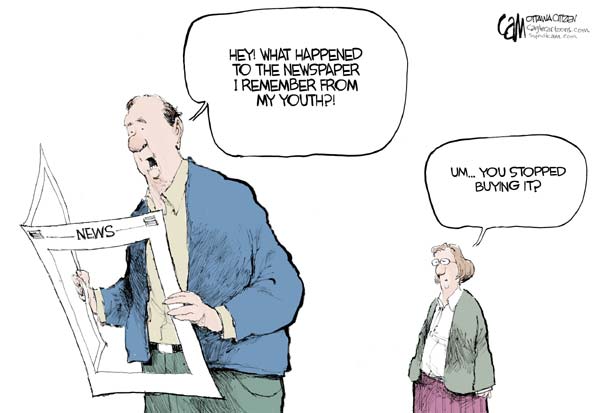
Local News: The Times They Are a-Changin’

It used to be that if you didn’t read your local newspaper you simply didn’t know what was going on.

When I was growing up in the small town of Wallingford, Connecticut in the 1950s, my family read the Meriden Record, established in 1867, at the breakfast table and the New Haven Register, around since 1812, in the afternoon.

When I moved to Lake Oswego, Oregon, a suburb of Portland, in 1987, one of the first things I did was subscribe to the local paper, the Lake Oswego Review.

In 2006, Lake Oswego spent $20 million to acquire some property featuring an 89,000 sq. ft. office complex, intending to transform the site into a community center.  But all hell broke loose when local opposition to the plan surfaced.  Over coming years, the issue generated persistent news coverage in the Lake Oswego Review.

A couple years in, I asked a local friend, an educated professional, “So, what do you think about the controversy over the proposed community center?”

“Huh,” he replied. “Don’t know much about it.” I was shocked. He didn’t subscribe to the Lake Oswego Review, the principal news source for local residents.

That was back when as many as 8,500 local newspapers still played a critical role in the civic health of communities across America.

But since 2000, more than 3,200 newspapers in the country have simply vanished. In 2025, only about 36% of U.S. adults said they got news from their local daily paper at least sometimes, down from around 55% in 2000, and I suspect that percentage has continued to slip, particularly among young people. Overall news trust is also continuing to decline, although the most trusted news brands continue to be local television outlets and regional or local newspapers.

The loss of local media coverage in Oregon has been painful for the producers and consumers.

The Chronicle, which had served the southern Willamette Valley region in Lane County since 1909, focusing on Springfield, Creswell, Cottage Grove and Pleasant Hill, died a painful death earlier this month.

The staff of the Chronicle on their last day.

“We never put our heads down or ran on muscle memory,” Executive Editor Erin Tierney-Heggenstaller wrote in the last edition. “We were strategic, offering communities with virtually no other credible journalistic outlet what people say they want: award-winning hyper-local news about family, friends, and neighbors; practical reporting to make daily life easier; and curated content edited with standards that social media, AI slop, and corporatized commodity news no longer offer. “Build it, and they will come.” But they didn’t.”

The Lake Oswego Review hasn’t been spared from the same tumult.

Founded in 1921 as the Western Clackamas Review, renamed the Oswego Review in 1928, and then the Lake Oswego Review in 1961, the paper underwent several transformations, gradually expanding its readership and impact. By 1976, the paper was being published twice a week, totaling 90 pages and with a circulation of 8,200.  In 1978, Eagle Newspapers, an Oregon regional newspaper group rooted in John Day, purchased the paper.

In 1996, former Review editor Steve Clark and his wife, Randalyn, bought the Review and its parent company, Community Newspapers Inc. Over the next few years, the company grew to include nine community newspapers. In August 2000, Lake Oswego residents Robert and Marilyn Pamplin bought Community Newspapers and transitioned it to Pamplin Media Group. Over the next 24 years, Pamplin grew to include two dozen newspapers in Oregon and their corresponding websites, including the Lake Oswego Review and the group’s flagship, the Portland Tribune, which had launched in February 2000.

“The Tribune and its family of newspapers provides the ‘right stuff’ that citizens need to engage effectively — with government, with each other, with the bigger world,” former Metro councilor Rex Burkholder said in 2016. “News, especially news that is about what is happening here and now, in one’s own community, is essential nourishment for anyone wanting to make a difference.”

On June 1, 2024, Mississippi-based Carpenter Media Group bought the entire Pamplin Media Group for an undisclosed sum. Carpenter, founded in 2023, says on its website, “The newspapers, websites and magazines we lead are the cornerstones of their communities, allies to businesses, incubators for innovation, and cultivators of journalistic talent. We aim to forge a well-informed, interconnected, and prosperous society – one community at a time.”

So much for that. In Oregon, a massacre followed.

Among the victims was the Lake Oswego Review, which had built a strong track record of publishing award-winning investigative and enterprise journalism, and two other Pamplin papers in adjacent cities, the West Linn Tidings and the Wilsonville Spokesman.

On February 11, 2026, the three papers were merged into one,The Review, a pale imitation of its three predecessors. The entire August 12, 2026 issue of The Review ran just 24 pages, including one self-congratulatory page promoting local stories in The Review, three pages of public notices and one page urging readers to let Oregon legislators know they value access to public notices in their local paper. The August 19 issue had just 15 pages of news.
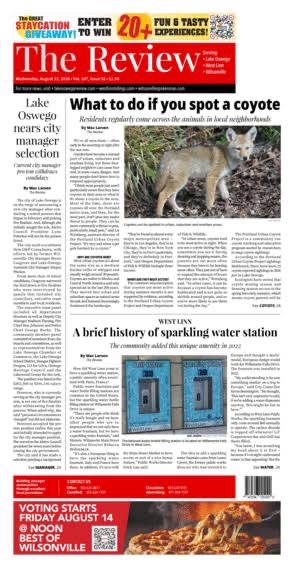
With that kind of shrinkage in news coverage, it hardly matters whether my Lake Oswego friend subscribes to the local paper today.

Meanwhile, other local news outlets have shriveled as well.

In October 2024, Carpenter Media Group bought the EO Media Group, which owned Oregon’s Bend Bulletin, the East Oregonian and other rural Oregon newspapers, and proceeded to slash and burn the papers’ staffs. John Carr, Senior VP of Oregon and Washington at Carpenter Media, said the cuts were “necessary financial changes and cost-cutting measures that will stabilize these publications for the future.”

The Portland Tribune had 40-50 newsroom staffers when it launched in February 2001. It ceased printing in June 2025 following major newsroom cutbacks and layoffs and now operates strictly as a digital, online-only news service that requires a paid subscription to access. Although Multnomah County still describes the Tribune on its website as a ” Portland city newspaper, offering comprehensive coverage of news, sports, business, people and entertainment”, it now has just one reporter, Hannah Seibold , who describes herself as “the sole survivor of the Portland Tribune at this point”.

The Oregonian newspaper, once the Portland area’s dominant local news source, has suffered as well. Founded in 1850 as a four page weekly, its first issue printed in a log shack on Portland’s SW First and Morrison,

I joined The Oregonian as a business reporter in 1987. It was a robust, well-respected paper then, with a proud past and a much-anticipated future. Daily Monday-Friday circulation was 319,624; Sunday circulation 375,914. When I left the paper 10 years later in 1997 to take a corporate communications job, daily Monday-Friday circulation was 360,000, Sunday circulation 450,000. We were on a roll.

Much of that success was attributed to Sandra Mims Rowe, who came on as editor in 1993 and tried to energize the newsroom with a hiring spree, bringing on reporters and editors from around the country. Under her leadership, the newsroom distinguished itself by winning five Pulitzers.

But the paper wasn’t able to escape the tumult of the newspaper business during her tenure. By the time she left the paper in Dec. 2009, she had to cut staff, salaries and benefits as circulation and revenue declined.

In 2009, The Oregonian’s daily circulation sat at 268,572 and Sunday circulation at 344,950, causing the paper to lose its position as one of the top 25 Sunday circulation papers in the country. That same year, the paper announced a long-term policy that protected full-time employees from layoffs for economic or technological reasons would end.

By 2012, daily circulation sank to 228,599, only slightly higher than circulation in 1950, and the declines continued. Talented reporters began departing in droves, some pushed out, others motivated by buy-outs. At the same time the once powerful paper saw its clout diminish as it abandoned rural Oregon and 7-day-a-week print distribution. 

When I left The Oregonian in 1997 to take a corporate communications job, the paper employed a newsroom staff of about 400 journalists (reporters, editors, and photographers). The newsroom staff now consists of about 66 employees.

The paper publishes print editions just four days a week, while continuously updating its digital content. Average daily print circulation is 29,325 copies and Sunday print circulation is 44,294 copies. The days are long gone when what was in The Oregonian, particularly its opinion section and columnists, dominated local conversations all day.

So here we are. A once mighty paper hollowed out and humbled. A growing population served by a smaller paper. A weakened paper that no longer drives the daily discussion at the proverbial water cooler (or over a latte). A diminished, editorially impotent presence with a dwindling ability to hold powerful interests accountable.

But is the local news environment as depleted as often presumed? Is the gloomy view unwarranted?

As the size and impact of the traditional major dailies and weeklies in the Portland metro area have shrunk, other news outlets are working to fill the gap. Some of their audiences are limited and their coverage is not very deep, but together they are beginning to fill a continued need and judicious selectivity can provide unexpectedly broad local news coverage.

There is still, however, too much online coverage of national news and not enough of local. As Public Media Company CEO Tim Isgitt recently said to Poynter, “…public media is facing a perfect storm. We’re part of a rapidly changing media and technology landscape that is providing unlimited content — but perhaps not the content we need. We can get any national journalism we need, but we can get very little local journalism from this landscape…We’re part of a media and technology landscape that is largely failing our society — with detrimental societal impacts, whether it’s misinformation, lack of trust or the effects it’s having on polarization, teen mental health or the loneliness epidemic.”

Some local media in Oregon are trying to do better.

Willamette Week, an alternative paper and digital media outlet, continues to offers cultural, civic and political coverage and reaches hundreds of thousands of print and online viewers, even if it tends to focus on only a few topics each week and its daily local online news coverage is limited. 

The Portland Mercury, an alternative bi-weekly, offers coverage of local arts, music, and city culture. 

There are also a number of hyper-local outlets such as the Northwest Examiner, the Southeast ExaminerMontavilla News, The Bee, Star NewsThe StJohns Review, The Mid-County Memo and The Skanner

Other options include the solid news site OPBCity Cast Portland, a website and a daily podcast for local news, Oregon Capitol Chronicle, part of the States Newsroom, and a relative newcomer, Axios Portland, with two reporters, Meira Gebel and Kale Williams.

And there’s still Oregon Business, around since 1981, that reports on a wide range of topics such as leadership, innovation, technology, culture, politics and environment, and the Portland Business Journal, published since 1984, which delivers local commercial news, data, and networking opportunities for the Portland, Oregon metro area.

Another innovative outlet focusing on local business news is Portland Inno, a digital media outlet powered by the Portland Business Journal, focused on Portland’s local startup, technology and innovation economies. A recent story, for example, broke the news that Mark Ronay, who founded materials company Liquid Wire in 2016, had launched a company is called Spectralsurf, aimed at  bringing down the costs of semiconductor manufacturing, with funding from Portland Seed Fund and ONAMI .

Then there are Portland’s television stations, KGW 8, KOIN 6, KATU 2 and KPTV Fox 12, offering varying levels of useful local news.

Portland’s local news outlets sometimes provide mindless drivel and poorly-researched gossip, comparable to the blitzing of the podium done by the Trump administration on a regular basis, and there’s a lot of slop out there, but they can also produce substantial deeply-researched impactful stories and the fact is the public is hungry for reliable local news.

Increasingly, however, that hunger for local news is being met not by the news outlets noted above, but by social media. Young people, in particular, move between podcasts, X accounts and YouTube livestreams where there’s no editorial control, no reviews and no accountability, where skepticism is required, but not often employed. Of course, young people will eventually grow older, but there is little likelihood that they will grow into accessing media as their parents did.

For the first time globally, more people are getting their news from social media platforms featuring independent online news personalities and commentators on platforms like Substack, TikTok and YouTube than television or news websites, according to a new report by the Reuters Institute for the Study of Journalism. This is particularly the case with younger audiences who often stumble upon information passively, consuming news that is automatically served to them through algorithm feeds, comment sections, and trending topics.

 “…most Americans now get their information and form their opinions through creators, podcasts, Substacks, group chats,” says Renée DiResta, an Associate Research Professor at Georgetown University’s McCourt School of Public Policy. “Most traditional institutions have only minimal engagement or presence in those spaces. So that ecosystem runs on a very different model of legitimacy. People are following people, not institutions. They’re following people that they find appealing or relatable. Somebody coming to you from their kitchen.”

Substack is one beneficiary off this trend. One of the more prolific, and controversial, Substack commenters in the Portland area is Keven Dahlgren, who writes on homeless issues in  Truth on the Streets. Another widely read site is Oregon Roundup by Jeff Eager, which says it covers “Oregon’s uniquely dysfunctional state government and the politics that create it.”

One problem, though, is that of the strong, reliable news, even local news, is only available if you are willing to shell out for a subscription, and many people are not. As one commenter on a substack post, Second Rough Draft, recently noted, “…the press sells what the public wants to buy. If there was a greater market for light, the media would cut back on the heat…elite audiences willing to pay are getting ample good information and others choose to pay less and get less.”

The Reuters Institute notes in a report, another troubling sign, that it is seeing stagnation or decline in overall online news engagement. People are turning away from the news. “The trends are worse among younger people and those without a university degree,” Reuters says. 

Some of that decline may be simply due to the way social media works. “Social media algorithms are optimised for engagement, with the goal of keeping people on the platform as long as possible, ” according to Reuters. “This has seen social media companies prioritising things like entertaining short-form video and de-prioritising news…Political news caused headaches for them, so they turned away.”

The problem is locally-focused social media can be a swamp and it can be hard to separate truth from the muck.

“… in different, darker corners of the internet, it has become a source of endless misinformation and disinformation dispensed by a panoply of influencers, conspiracy theorists, edgelords, grifters and con men, DIY gurus, hostile foreign actors, and partisan echo chambers full of dittoheads and doxers,” observes John Ramage, a former and Arizona State University professor of English, on Substack. “It is a world without gatekeepers, regulators or arbiters, an epistemic wild, wild west where anyone who relies on evidence-based reasoning is dismissed as an establishment tool.”

Then there’s the problem of what’s happening when news-searchers engage with social media, such as items on X. 404 Media recently noted that X’s algorithm learns what you hate and shows you more of it, according to a new study just published in the Proceedings of the National Academy of Sciences (PNAS). The paper, titled Value misalignment of X’s feed algorithm is a reflection of value tensions in engagement, found that the site’s algorithm prioritized engagement above all else when it generated a user’s For You Page. 

“When a user on X sees a post that makes them mad — like a press release from a politician from a political party they don’t like — sometimes they’ll fight about the post in the replies,” 404 Media noted. “It doesn’t matter who you follow or what your stated values are, X reads replying as engagement and will send more of the infuriating posts the user’s way.”

Reviewing The Story of Your Life: How Social Media Shapes the Way We Experience Everything, New York Times book critic Alexandra Jacobs noted that with social media,”All was sweet, innocent fun for awhile, then the algorithm came along and ruined everything, like a drifter in a Cormac McCarthy novel”, with all sorts of deleterious effects.

Or as historian Anton Jäger said recently on the Ezra Klein Show, “…our attention is fundamentally shaped now by algorithms that care about controversy, that care about newness, that are hunting amorally and constantly for whatever will get a rise out of people.”

It’s also important to realize that slop is proliferating on the web — some studies say 50 percent of online articles are now artificially generated. Then there are so-called “pink slime” sites, publications that mimic the appearance and output of traditional news organizations. Snopes, an online fact-checking and myth-busting website, can help sniff out such sites. 

it’s incumbent on citizens to proactively be selective in their news habits. In “Ordinary People, Extraordinary Times: How to Reclaim Your Power, Fight for Freedom and Reimagine Democracy”, Skye Perryman, the president and CEO of the national nonprofit Democracy Forward, urges Americans to do an inventory of the sources of their news and information and “to become an active, purposeful seeker of information rather than passively absorb whatever comes our way.” 

However you consume local news, “Studies have shown that the supply of local news is correlated with higher rates of civic engagement,” says the Agora Journalism Center at -the University of Oregon. “Robust local journalism matters to how informed citizens are, and according to another recent Knight Foundation report, a healthy news and information ecosystem creates “a virtuous circle whereby improved information contributes to improved community outcomes.”

If you want an educated, informed public in a position to make wise judgments, quality local journalism is key. As Thomas Jefferson wrote  in 1787, “The way to prevent irregular interpositions of the people is to give them full information of their affairs through the channel of the public papers, and to contrive that those papers should penetrate the whole mass of the people.”

I Told You So: The Ritz-Carlton Portland Goes Bust

Two years ago I wrote a post about the likely failure of the Ritz-Carlton Residences in Portland:

THE RITZ-CARLTON RESIDENCES IN PORTLAND: A TOWERING MISTAKE

Now we know it was a towering mistake, indeed, a fiasco, a classic misreading of the market.

Keller Williams Realty Professionals began marketing individual condos at prices ranging from $1,1000,000 for a one bedroom 2 bath 1,105 sq. ft unit to $8,999,000 for a 3 bedroom 4 bathroom 3,256 sq. ft unit. Principal and interest on the mortgage, plus property taxes and condo fees, could have translated to an $8000 a month expense for the 1 bedroom.

Willamette Week’s Anthony Effinger reported today that only 8% of  the 132 Ritz-Carlton condominiums have sold, a failure of massive proportions that could have potentially major repercussions for the City of Portland  and its struggling downtown core. His entire article is reproduced below:

In July 2025, Ready Capital Corp., based in New York, said it had taken possession of Block 216, the 35-story building in Portland’s West End that has ground-floor retail, five floors of office space, a 251-room Ritz-Carlton Hotel and 132 Ritz-Carlton residences.

Lender to Ritz-Carlton Tower Says Foreclosure Best Option for $503 Million Loan

The lender to Block 216, Walter Bowen’s gleaming West End skyscraper, sounded an ominous note about the property in an earnings report Monday.

New York-based Ready Capital said the best strategy for its $503 million construction loan would be to take possession of the property, instead of waiting for repayment.

“Ownership is [the] best net present value outcome for RC,” Ready Capital wrote in a 25-page supplement to its fourth-quarter earnings.

Ready Capital CEO Thomas Capasse went into more detail on a conference call.

“While the original strategy was to refinance the construction into a bridge loan, the current appraisal and other factors favored ownership and serial asset disposition on the components as the best net present value outcome,” Capasse said, according to a transcript of the call.

Translation: foreclose on the 35-story building and sell it in chunks.

Block 216 has ground-floor retail, five floors of office space, a Ritz-Carlton Hotel and Ritz-Carlton Residences. Ready Capital acquired the Block 216 loan in March 2022, when it bought Mosaic Real Estate Credit LLC, the building’s original construction lender.

Like so many downtown towers, Block 216 has struggled to land office tenants. Just 23% of the office space is leased, according to Ready Capital. Nor has Bowen been able to sell many of the 132 Ritz-Carlton condominiums. Only 8% have sold, according to Ready Capital’s earnings report, at an average of $1,105 per square foot.

The hotel is underperforming, too, Ready Capital said. Its average revenue per available room was $188 in 2024, compared with $343.28, the average for all Ritz-Carlton hotels during the same period. The chain is owned by Marriot International Inc., which provided the average figure in its full-year earnings report.

Ready Capital said it plans to stabilize the three components of the angular glass tower—commercial, condo and hotel—then sell the office space and hotel portion within two years. Unloading the condos will take three years, Ready Capital said.

Neither Block 216 management nor Bowen’s company, BPM Real Estate Group, returned calls and emails seeking comment. Ready Capital’s press office didn’t return an email. Nor did its chief financial officer, Andrew Ahlborn.

One bright spot: Block 216’s retail space, where a food hall called Flock opened in January, is 100% leased, Ready Capital said.

The earnings report spurred a 27% decline in Ready Capital shares on Monday, mostly because the company halved the quarterly dividend it pays to investors to 12.5 cents a share to “better align the dividend with projected cash earnings in the short-term and to preserve book value,” Capasse said on the conference call.

Concern about the Block 216 loan also may have also weighed on the stock. In addition to the $503 million loan, Ready Capital also owns $62 million of preferred equity in the project, for a total of $565 million.

Ready Capital said it has set aside $130 million to cover the declining value of Block 216. Given that reserve, Ready Capital values it at about $435 million. At that valuation, Block 216 accounts for about one-quarter of common shareholders’ equity in Ready Capital.

Ready Capital shares closed at $4.95 today, down from $8.39 a year ago.

Is Carrick Flynn’s Money Going To Do The Trick? Maybe Not.

All those millions donated to Carrick Flynn and a new poll shows he is, at best, tied with Andrea Salinas in the Democratic primary for Congress in Oregon’s 6th District.

On behalf of Salinas’s campaign, Public Policy Polling, a respected and reliable polling firm, polled 591 Democratic voters in the district earlier this week. Across the district, 18% of potential Democratic voters supported Salinas, 14% Flynn and no other candidate exceeded single digits.

The margin of error of the pole was +/- 4 percentage points, so it’s possible Flynn and Salinas are actually tied.  Salinas’s lead increased to 39% to 23 % among voters who have already cast their ballots, according to The Hill.

Of those who had already mailed back their ballots, Salinas led Flynn 39% – 23%, but that may not mean much because fewer than 10% of Democrats had returned their ballots by Thursday. 

Carrick Flynn’s crypto-financed rise in the polls has run into a few potholes lately. 

After the Democratic House leadership campaign arm, the House Majority PAC, injected $1 million into Flynn’s campaign, the other candidates lambasted the action.

Six of the nine Democrats seeking to win the Democratic primary rapidly issued a statement denouncing the House Majority PAC’s donation to Flynn. “We strongly condemn House Majority PAC’s unprecedented and inappropriate decision…” the joint statement said. “We call on House Majority PAC to actually stand by our party’s values and let the voters of Oregon decide who their Democratic nominee will be.”

Then CHC Bold PAC , a Democratic-aligned PAC supporting the election of Hispanic Democrats to Congress, condemned the House Majority PAC’s donation to Flynn. The PAC reminded  others that Latina women have been critical to Democratic victories and the PAC’s support for Flynn ignored a highly qualified Latina, Andrea Salinas, was in the primary battle. 

“HMP is tasked with defending the House Majority by boosting Democrats and holding Republicans accountable, not with spending critical resources against a woman who has spent decades fighting for progressive causes and who will excite Democratic voters in November,” a Bold PAC statement said. Bold PAC then put its money where its mouth was, donating $1 million to Salinas.

Flynn may also have undercut some of his momentum by making some politically ill-advised comments questioning environmentalist’s support for spotted owl protections. According to E&E News, Flynn said protecting the owl made him “indignant or angry” because it hurt livelihoods.

Rubbing salt in the wound, Flynn was accused of expressing sympathy, on  a podcast “Oregon Bridge”,  with Timber Unity, a group formed to oppose climate change policies, and was later accused in Mother Jones of having  “… had no qualms associating with violent extremists and far-right groups.”

In a May 4, 2022 , Willamette Week article, Flynn disputed allegations he had shown support for Timber Unity. “So, I’m emphatically not a Timber Unity supporter,” he said. “I do have concerns about the economic effect conservation had on timber communities. But I have concerns about economic effects of any large economic trends or any government regulation on communities.”

To bolster his case, Flynn urged people to listen to the April 13, 2022 podcast and hear what he said.  He’s such a fast talker on the podcast he can be hard to follow, but his remarks are, in fact, not consistent with the characterization of his views by critics as anti-environmentalist.

Nevertheless, with nuance hardly a hallmark of political debate, E&E News headlined its story, “Ore. Democrat slams spotted owl protections, rakes in cash,” and a group of Oregon environmental organizations issued a joint statement blasting Flynn, saying they were .”..stunned and deeply saddened to hear Carrick Flynn, a Democratic candidate running for Congress, make comments mocking critical environmental protections.” 

Willamette Week’s disclosure that Flynn has rarely voted in Oregon probably hasn’t helped him either. Reporters Nigel Jaquiss and Rachel Monahan discovered that Flynn has voted just twice in the past 30 elections and did not vote in 2020despite being registered to vote in Oregon since he was a teenager. “I’m not political,” Flynn said on the Oregon Bridge podcast. “I’m solutions oriented.” Flimsy excuses for his voting record, essentially “I was out of town,” haven’t helped either.

“That raised questions about, why people are dropping $7 million, $8 million for this candidate who seems to have very little connection to the district?” said James Moore, a political science professor at Pacific University. “Who is this guy, and what’s going on?”

Will The Oregonian survive?

Local news coverage is dying.

dyingnewspapers

The latest casualty — the entire staff of the New Orleans Times-Picayune. All 161 of them, , including reporters and editors, are losing their jobs.

On May 2, the Times-Picayune’s rival, the New Orleans Advocate, bought the Times-Picayune and plans to merge the papers under a single masthead and website. The seller — Advance Local Media LLC, the parent of Oregonian Media Group.  Even winning  two Pulitzers for its coverage of Hurricane Katrina didn’t serve the Times-Picayune.

Randy Siegel, CEO of Advance Local, assured the New York Post’s Keith J. Kelly that the sale of the Times-Picayune was a one-time thing. But what if it’s not? Is The Oregonian/OregonLive at risk, too?

Daily newspapers like the Times-Picayune and The Oregonian were once pervasive throughout the United States, with many communities having both a morning and evening paper, and sometimes a weekly local paper as well. But daily local newspapers are now in decline, dealing with cratering circulation, a reduction in print editions and drastic staff cuts.

According to the Wall St. Journal, nearly 1,800 US newspapers shut down between 2004 and 2018, including more than 60 dailies and 1,700 weeklies. Hundreds of communities have lost their local newspapers. Between 1,300 and 1,400 communities that had newspapers of their own in 2004 now have no news coverage at all, according to the UNC Center for Innovation and Sustainability in Local Media.

It was once unthinkable that papers such as the Cincinnati Post, the Albuquerque Tribune, the New York Sun, the Rocky Mountain News, and the Tampa Tribune would close, but they are all gone now. Nicco Mele, former director of Harvard’s Shorenstein Center, predicts that half of remaining titles will disappear within the next two years.

Newspaper consumption in Oregon is already dropping precipitously, with daily and weekly circulation combined falling from 1.4 million in 2004 to 796,000 in 2019, the UNC Center says.

Some of the remaining Oregon papers are what the UNC Center calls “ghosts”  because their newsroom staffing has been so dramatically pared back, often by more than half,  that the remaining journalists cannot adequately cover their communities.

In January 2018, when Willamette Week broke that The Oregonian was laying off another 11 newsroom staffers, the Portland Mercury observed, “After repeated rounds of layoffs, it’s hard to imagine The Oregonian having anywhere else to cut. But the news business’s grim prognosis marches on, so the cuts continue.”

“For those inclined to point fingers at The Oregonian or our parent company Advanced Publications: Ad revenue across our industry continues to plummet precipitously. Layoffs in local newsrooms are happening everywhere. And it fucking sucks,” Oregonian reporter Shane D. Kavanaugh tweeted.

Compared with its breadth and depth in the 1990s, The Oregonian/OregonLive has become a ghost. When I was a business reporter at The Oregonian in the 1980s and 1990s, the business team of reporters and editors was a robust 8-10 individuals covering a panoply of topics from energy and healthcare to labor and retail. OregonLive’s list of staff today includes just one reporter, Mike Rogoway, specifically devoted to business coverage , unless you also count Jeff Manning, who is listed as a reporter covering Health Care Business, OHSU.

Sports coverage is still robust, with 12 reporters and editors, but just one reporter, Gordon Friedman, is specifically assigned to covering everything going on at Portland City Hall.

When the Jan. 2018 layoffs were announced, The Oregonian/OregonLive’s editor and vice president of content, Mark Katches, said to the paper’s staff, “You’re probably asking yourself, when will these cuts end? I wish I could answer that. Although we have made progress growing our digital audience while also producing award-winning, and important journalism, the revenue picture continues to pose challenges for our company – as is the case across the media landscape.”

In August 2018, Katches abandoned ship himself to take a new job as executive editor of the Tampa Bay Times, another paper that has had its own struggles both before and since it acquired its competitor,  the Tampa Tribune, in 2016 .

With all the strife in the newspaper business, is The Oregonian/OregonLive ripe for the same fate as the Times-Picayune.

Don’t think it can’t happen.


Trump’s Not The First To Try To Control the Drip Drip Drip

leaks

Media are joining in on the hysteria about the Trump Administration’s efforts to control federal government communications.

“Federal agencies are clamping down on public information and social media in the early days of Donald Trump’s presidency, limiting employees’ ability to issue news releases, tweet, make policy pronouncements or otherwise communicate with the outside world, according to memos and sources from multiple agencies,” Politico reported today, Jan. 25.

Willamette Week jumped on the bandwagon today as well, telling readers, “Send us tips, oppressed comrades!”

“Got information that would make a great story, but worried about revealing who you are? (Because you work for, say, the U.S. Environmental Protection Agency under President Trump?) WW has two new ways to send tips without disclosing your identity,” WW said.

“It’s a dark time right now,” because of Trump Administration restrictions on the use of social media and other channels by government employees, a former Obama administration spokeswoman told Politico. “From what we can tell, the cloud of Mordor is descending across the federal service,” added Jeff Ruch, executive director of the watchdog group Public Employees for Environmental Responsibility.

Before everybody goes off the deep end on all this, assuming it’s something new under the sun with the evil Trump, let’s step back a bit.

Every administration in recent memory has tried mightily to control the flow of information it doesn’t want disclosed from its agencies, with varying degrees of success.

In 1962, President Kennedy approved the wiretapping of a New York Times reporter and then set in motion Project Mockingbird, illegal CIA domestic surveillance on American reporters.

Richard Nixon fought leaks to the media with a vengeance. After an initial honeymoon with the media, he later distrusted them and fought them tooth and nail, believing coverage of him was deeply biased. And, frankly, it was. As Politico’s John Aloysius Farrell wrote in 2014, “Just because he was paranoid doesn’t mean the media wasn’t out to get him.”

A recent report commissioned by the Committee to Protect Journalists blasted the Obama administration for being overly aggressive in controlling government communications with the media, too, saying its information disclosure policies had a“…chilling effect on accountability.”

“The war on leaks and other efforts to control information are the most aggressive I’ve seen since the Nixon administration,” said Leonard Downie, a former Washington Post executive who authored the study.

David Sanger, the chief Washington correspondent for the New York Times, said in the report: “This is the most closed, control-freak administration I’ve ever covered.”

The report told of how the Obama administration used the 1917 Espionage Act to prosecute leakers and created the “Insider Threat Program” requiring government employees to help prevent leaks to the media by monitoring their colleagues’ behavior.

The report also described how the Justice Department secretly subpoenaed and seized all the records for 20 Associated Press telephone lines and switchboards for two months of 2012, after an AP investigation into a covert CIA operation in Yemen.

“Put all these together and it paints a pretty damning picture of an administration that talks about openness and transparency but isn’t willing to engage with the media around these issues,” said Joel Simon, executive director of the Committee to Protect Journalists.

So before everybody goes ballistic, singling out Trump’s efforts to tightly manage public pronouncements and minimize leaks, consider that he’s part of a long line of presidents who have fought hard to do the same.

That’s just a fact. Depressing, isn’t it.

Is Motor Voter Promoting Voter fraud in Oregon?

Oregon Gov. Kate Brown was thrilled when she signed the automatic motor voter registration bill on March 16, 2015.

motor-voter-law-brown

But does it have a flaw that could enable fraud?

Under Oregon’s Motor Voter law, when an eligible unregistered voter (over 17 years old, an Oregon resident and a US citizen) visits the DMV to apply for, renew, or replace an Oregon drivers’ license, ID card, or permit, that person receives a mailing from the Oregon Elections Division explaining their options for registering to vote.

Recipients of the mailing can:

  • Do nothing. In that case, the person is registered to vote as a nonaffiliated voter (not a member of a political party).
  • Choose a political party by returning the card. Joining a political party will allow the person to vote in its primary elections.
  • Use the card to opt-out and decline to register to vote.

On Oct. 25, 2016, Willamette Week ran a story that reviewed the new voter numbers. It noted that since the start of 2016, the Motor Voter law has added 247,501 newly registered voters. The story also noted that 9,292 DMV-generated voter registration cards could not be delivered.

Who are those 9,292 people? Could that mean that 9,292 people were fraudulently registered to vote?

According to Dr. Russell Terry, a Voter Engagement Advocate in the Oregon Secretary of State’s Elections Division, cards returned to the Elections Division as undeliverable can be because:

  • the address does not adhere to the USPS standardization for mailing addresses
  • the individual provided DMV with an address before updating their address through USPS
  • the individual is not identified as being at the address to which the mail is delivered

You might expect that a few addresses would be invalid if it took a while to send out the cards and people moved in the interim. But Terry said the transfer of data from the DMV to the Elections Division “…is only a few days, before or right around the time DMV would be mailing a driver’s license to that address as well.”

Is there a way, then, to check whether the people whose cards were undeliverable are legitimate voters?

I asked if I could access a list of all the names and addresses on those cards so a sampling could be checked.

Nope. “The Oregon Vehicle Code prohibits the disclosure of those individuals and their information,” Terry said.

So were up to 9,292 registered Oregon voters not eligible voters on Nov. 8? Who knows?

Given that situation, should the names of the 9,292 people whose cards were undeliverable be struck from the voter rolls?

Yes.


Why is Val Hoyle smiling?

moneyinpolitics

Like Hillary Clinton, Rep. Val Hoyle, D-Eugene, who’s running for Secretary of State,  wants to get the obscene amounts of money out of politics…..later.


That way, she can rake in bundles of money now while running for Oregon Secretary of State as a champion of fundraising reform.

hoyle-mobile

Val Hoyle (D-Eugene)

In the past, Hoyle has said she supports enacting a constitutional amendment to limit campaign contributions, so long as the limits aren’t “unreasonably low”.

She has also blamed Democratic losses outside Oregon on “fear and cynicism” among voters fostered by large political contributions “from a small handful of special interests”.

So much for worrying about special interests.

According to state records, Hoyle has raised $587,000 to date, putting her at the top of the fundraising pile among the Secretary of State candidates.

Val Hoyle (D)……………………..$592,728

Brad Avakian (D)…………………$387,482

Dennis Richardson (R)………….$297,413

Richard Devlin (D)……………. ..$172,315

Sid Leiken (R)……………………..$ 45,104

Hoyle’s biggest contributor is Michael Bloomberg, a New York businessman who supports aggressive gun control measures. On April 29, he gave Hoyle $250,000 in appreciation for her support of legislation that passed in the last session expanding background checks to almost all private firearm transfers.

“Mike is supporting Val Hoyle because her leadership in passing Oregon’s background check bill is truly notable,” Howard Wolfson, a spokesman for Bloomberg, told Willamette Week in an email. “No one in the country has worked harder —or more successfully—to take on the NRA than she has.”

Hoyle has also received $105,000 in contributions from Emily’s List, a Washington, D.C.-based political action committee that supports female candidates.

Without those two large contributions, both from out-of-state, Hoyle would have raised just $237,728, which would have put her behind both Brad Avakian and Dennis Richardson in fundraising totals.


P.S.: The other candidates aren’t exactly pure in their fundraising either, although they’re collecting nothing comparable to Hoyle from individual donors.

Brad Avakian’s larger contributions

  • $40,000 from United Food and Commercial Workers Local 555
  • $30,000 from Oregon School Employees Association – Voice of Involved Classified Employees (2307)
  • $10,000 from Pacific NW Regional Council of Carpenters, SSF
  • $10,000 from Oregon League of Conservation Voters PAC (2352)
  • $7,500 from Peter Goldman, a Seattle attorney
  • $6,000 from Naral Pro-Choice Oregon PAC (172)
  • $2,500 from Mt. & M Gaming, operator of The Last Frontier Casino in La Center, WA


Dennis Richardson’s larger contributions 

  • $25,000 from Sherman and Wanda Olsrud of Medford, OR
  • $15,000 from Larry Keith of Salem, OR
  • $15,000 from James Young of Lebanon, OR
  • $15,000 from Freres Timber, Inc. of Lyons, OR
  • $10,000 from Stephen M Greenleaf of Medford, OR
  • $10,000 from Richard E Uihlein of Lake Forest, IL
  • $10,000 from Murphy Co. of Eugene, OR
  • $5,000 from Zidelle Collin s of Shady Grove, OR
  • $5,000 from David A deVilleneuve of Central Point, OR

If it matters to Oregonians, it’s in (The Washington Post) Willamette Week

For those of you who don’t remember, Bob Packwood was the first.

Former Senator Bob Packwood (R-Ore)

Former Senator Bob Packwood (R-Ore)

On Nov. 22, 1992, the Washington Post reported that 10 women had accused Sen. Bob Packwood of sexual harassment. Even though one of The Oregonian’s own reporters was among the 10, and the paper had gotten tips about Packwood’s behavior, incredibly it had failed to aggressively pursue the matter. The Oregonian’s failure to break the story was mortifying for the entire paper.

Adding to the shame was a bumper sticker that began appearing around Portland:

washPoststicker

Oregonian editor, Bill Hilliard, later told the Washington Post, in a massive understatement, that his paper “should have been a little more aggressive… We were worried about ruining a man’s career.”

Neil Goldschmidt was second.

Neil Goldschmidt

Neil Goldschmidt

Nigel Jaquiss, a reporter at Willamette Week, was researching the role of former Oregon Governor, and later power player, Neil Goldschmidt, in efforts to take over Portland General Electric. He was making good progress on the story, but got hints there was more.

“It was shaping up to be a pretty good story,” Jaquiss told the American Journalism Review, “but I kept getting pushed by people… ‘There’s more you ought to be looking at… There’s a girl..'”

Jaquiss’ aggressive digging eventually revealed that Goldschmidt, when he was the married Mayor of Portland, had begun raping a neighbor’s 14-year-old daughter on a regular basis over a three-year period. Sources said Goldschmidt often took the girl to her parents’ basement, to hotels and other private spots for sex.

When Willamette week posted a summary of the story on its website, it spread like wildfire. The Oregonian had been beaten again.

Not only had The Oregonian been beaten again, this time by a local alternative weekly, but The Oregonian made things even worse. When it ran the Goldschmidt story it appeared to many readers to soft-pedal Goldschmidt’s actions as “an affair” with “a high school student”. Oregonians went ballistic.

A memo of a staff meeting at the Oregonian revealed that there was a lot of internal angst, too. The memo noted: “Steve Duin felt strongly that our coverage today was too reverential. We are dealing with a child molester. He made a very impassioned plea for doing the who knew what when story — lots of people became rich riding Goldschmidt’s coat tails — and why they kept it secret. He suggested that readers might think we’d learned nothing from Packwood and that we are hands off people in power.”

And now the Kitzhaber-Cylvia Hayes scandal.

John Kitzhaber and Cylvia Hayes

John Kitzhaber and Cylvia Hayes

Again, it was Nigel Jaquiss and Willamette Week that broke the story and followed up with bombshell after bombshell.

The Oregonian followed up with some revelations, but it was late to the party. It’s most significant role in the evolving saga was to run an editorial on Feb. 4, 2015 calling on Kitzhaber to resign, arguing, “…it should be clear by now to Kitzhaber that his credibility has evaporated to such a degree that he can no longer serve effectively as governor.”

What’s happening to The Oregonian, once the state’s dominant paper of record, now a mere shadow of its former self?

It may sound hackneyed, but great newspapers like the Oregonian were once the indispensable guardians of our freedom. Seasoned reporters have served as watchdogs to ensure good government and reinforce good citizenship. The Oregonian has been a key ingredient of  civic dialogue and discourse in the state.

David Simon, a former Baltimore Sun reporter who created the award-winning HBO series The Wire, warned at a U.S. Senate hearing on the “Future of Journalism”, that “high-end journalism is dying in America.”  Oregon can’t afford for The Oregonian to be among those at death’s door.


Disclosure: I worked as a reporter at The Oregonian during the 80s and 90s.