
Portland, Oregon may be struggling, but there are some promising green shoots.
All the creative American garment design and manufacturing has gone offshore and it’s likely to stay there. That’s what some pessimists say. Britt Howard, Founder and Creative Director of Portland, Oregon-based PGF, doesn’t buy it.
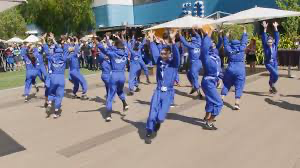
When Intel Corp. wanted to celebrate its 50th anniversary in 2018, it turned to PGF. The assignment? Breathe life into some garment ideas.
The result? Slick, comfortable updated replicas of “bunny suits” worn in Intel’s super clean microprocessor manufacturing fabs. Then suit up some employees for a lively, eye-catching flash mob on an Intel campus.
In 1960, 1,233,000 Americans were employed in the manufacturing of apparel, 5.5% of the total manufacturing workforce, according to the U.S. Department of Labor. In 2024, only about 84,000 employees were part of the apparel manufacturing industry in the United States.
Now PGF is bringing back some of those “Made in America” jobs with a full-service creative design and fabrication studio.
“At PGF, we combine expert intuition with creativity, design, and flawless execution,” says Howard, who has been shepherding PGF’s evolution since 2008.

Howard showed she had some real entrepreneurial chops when she was just 25.
She started Portland Garment Factory in 2008 with $2400 in start-up capital from a supportive friend. A brief contract with the friend essentially said, ‘If you ever get successful, maybe you’ll pay me back.” Eight years later, Howard did so. “And very handsomely,” the friend said.
Howard started out in a 250 sq. ft. Portland studio. The company began as a sole proprietorship, then shifted to a limited liability company (LLC) one year later.
After moving around a bit, the company settled in at a building at 408 S.E. 79th Ave. in Southeast Portland.
Over its first 12 years Howard continued to grow the business, accruing an impressive list of clients, including Nike, Adidas, Cotopaxi and the global advertising agency, Wieden+Kennedy.
In some cases, the company created prototypes of products a company was considering for mass production. Other work included creating product marketing displays and specialty items that could be featured in retail stores to wow customers with their ingenuity.
The company also created sculptures. In one case, it worked with native artists Marie Watt and Cannupa Hanska Luger to create Each/Other, a monumental wolf sculpture with a fabric “hide” attached to the steel frame that was exhibited at the Denver Art Museum.
The company made a foray into making baby clothes, too. “We used to make retail products, such as thousands of baby clothes, but we almost went out of business,” Howard said. “The seller wanted to put out a product that sold for $6, but it cost us $40 to make it because of all our overhead. It was really hard to make affordable garments in the United States.”
That was one reason why Howard changed the name of her company to PGF in 2018. “I really needed to recalibrate because we couldn’t survive as just a garment manufacturing company,” Howard said. “We needed to get away from making retail products and get into more commercial work.”
As time went by, everything seemed on track and the company’s future looked bright.
Then, disaster!
Early on the morning of April 19, 2021, a massive three-alarm fire, later determined to have been set by an arsonist, tore through the company’s building, destroying just about everything.

The potential for failure was breathing down Howard’s neck. But Howard wasn’t out.
A broad network of friends and supporters came to her rescue, starting with a team of nine women who set up a GoFundMe account to help Howard resume her business.
“The morning of April 19th, an arsonist set fire to PGF and everything was burned from the brick walls to sewing machines to skews of clothing for clients,” the account said. “Britt lost years and years of hard work and she needs help from us to re-build her business which employs many women and is a pillar in our community. She has gotten so many fashion labels started, contributed charitably and taken risks to help people build their brands. This money will go toward replacing all the machines that were lost, a deposit for a new location and securing the jobs of her beloved employees.”
An astonishing 1200 donors responded with contributions ranging from $5 to $5,000, generating a total of $119,125.
“Britt has created a Portland mainstay, and Portland needs PGF!,” a $100 donor wrote. “Not to mention, she’s an inspiration and positive force of nature in the B Corp and broader business community here. Sending PGF love.”
While grieving her loss, Howard embarked on a what she saw as an urgent need for recovery. Within 10 months, with the GoFundMe money, insurance coverage and a mortgage, in hand, Howard was able to buy another headquarters building in Southeast Portland, a 10,000 sq. ft. corrugated metal-clad building that had previously been a gym.
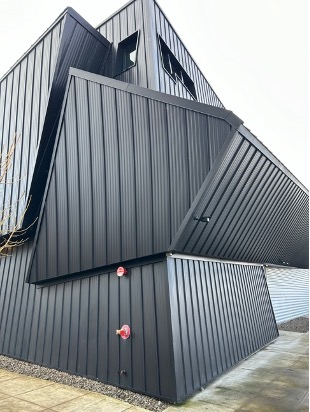
The three-level building is usually a beehive of activity for 17 employees, including designers, artists, expert fabricators and a Marketing and Community Coordinator.
Many of the fabricators are Vietnamese who have been with PGF for more than 10 years. “They are skilled sewers and they are really proud of the work they do,” Howard said.
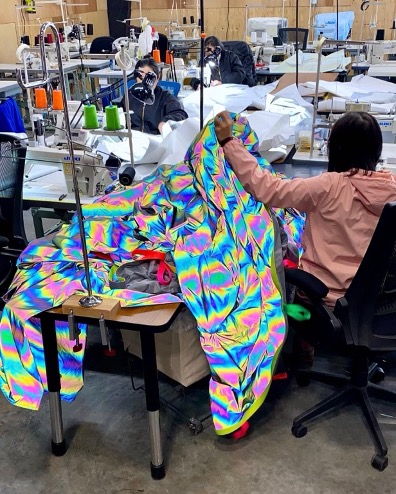
“We’re now a full -service cut-and-sew manufacturing company,” Howard said. “We make soft goods, that includes wearables, clothing, accessories, curtains, upholstery items, sculptures. We also do design work in-house and we source the material, so we’re completely one-stop.”
Reflecting her commitment to responsible business practices, Howard has also secured certification of PGF as a B Corp, a company that meets high standards of verified social and environmental performance, and public transparency to balance profit and purpose.
Part of PGF’s commitment to sustainability is the reuse of materials. In 2023, for example, it created cushions using fabric scraps from past PGF projects and designed to invoke 90’s zine culture married to frenetic, modern-era multimedia art. All the cushions were stuffed with pulverized factory scraps, the result of PGF’s zero-waste manufacturing initiative.

To reward and retain her employees, Howard provides them with generous benefits, including health insurance. A particularly useful benefit that came into play when the fire hit PGF’s building in 2021 was payroll protection insurance. That allowed Howard to give paychecks to her employees for 10 months until the business could restart.
Howard has also focused on improving PGF’s operations, hiring a COO for five months in 2023. “She really helped me turn around a lot of the problems we were having, to look at them in a different way, “Howard said. “She created a reporting tool that’s very specific to this business and changed the structure of the business so more responsibility is placed on designated managers instead of everybody reporting to me,” Howard said.
In its new building, PGF has continued to create specialized products for a wide range of clients, including kimono-style uniforms for volunteers at Portland’s Japanese Garden, jackets for Oregon’s Tillamook Cheese company to highlight the launch of a shredded cheese product and Mad Hatter and White Rabbit costumes for an outdoor electronic dance music festival.
It has even created custom blue Nike tracksuits for the cast of the sports comedy-drama Ted Lasso to wear at the PEOPLE’s Post Screen Actors Guild Awards Gala in Feb. 2024.
With the pandemic, the 2023 fire and the fluctuating economy, Howard says business has been uneven in the past several years, but she maintains her optimistic spirit, tempered with acknowledgement that trouble can lurk just around the corner.
In a sign of her continuing optimism and willingness to take risks, in April 2024, Howard bought the assets of Cotton Cloud Futons in Portland’s Slabtown district and rebranded the company’s manufacturing space as “Oregon Natural Fiber Mill.” She hopes the acquisition will enhance her company’s commitment to sustainable textile manufacturing.
Oregon Business covered the deal, noting that the factory milled U.S.-sourced cotton and wool into usable materials with a focus on organic cotton, regular cotton and polyester and that its equipment included a 100-year-old Garnett machine, a massive textile processing mechanism that converts waste into a uniform fiber to be used in other applications.
Never satisfied with standing still, Howard is aggressively pursuing new opportunities “It’s not a chill business, but we’re here to stay,” she says. “There’s lots going on, lots of opportunities everywhere. I just have to know where to put my energies.”
 ThinkingOregon
Absolutely superb piece, Bill. A great and inspiring story about a local company with international reach I was completely unaware of.
Many thanks for doing thi.