Another depressing day for newspapers

tough-times-header1

Being in the newspaper business in the United States is like being in the eye of a hurricane. What was once stable is enduring  a cataclysm as recently robust newspapers fall by the wayside, leaving their employers and readers abandoned.

The latest casualty is The Tampa Tribune. The Tampa Bay Times announced yesterday that it was buying and shutting down the Tribune, its daily rival. The Tribune employed 265 full-time staff. At least 100 of those are expected to be let go.

The move was so quick The Times didn’t even let The Tampa Tribune put out a last paper for the staff to say goodbye to all it’s readers. Visitors to the website of the 123-year-old Tribune are already being redirected to the website of the Times.

The Tribune went from heady times to death in a relatively short period of time.

“We were the scrappy, energetic staff that did not want to get beat by the St. Pete Times,” wrote Barbara Boyer, now a reporter at the Philadelphia Inquirer.

“We worked hard and played hard at a paper that rapidly expanded in the 1990s with reporters in the far reaches of inner Florida. We were one big, happy — but somewhat dysfunctional — family,” wrote Barbara Boyer said on the paper’s Facebook alumni page.

Revolution Capital, a private equity firm that owned the Tribune, treated it like any other investment, according to NiemanLab. Their formula — buy undervalued company, milk cash flow, sell off valuable assets, shut down the rest — can work just as well in any industry. And once you strip out any sense of civic responsibility, the formula works.

In this case, according to NiemanLab, Revolution Capital bought the Tribune in 2012 for a mere $9.5 million. It gutted the cost structure — going from 618 employees in 2012 to 265 this week. Revolution then identified a core Tribune asset — the land underneath its offices — and sold it off to condo developers for $17.75 million — a nifty profit. Then, seeing what an unending series of revenue declines ahead, it got whatever it could for the core product and signed the paper’s death warrant.

Meanwhile, The Oregonian’s future continues to be hazy as well.

Certainly the barely there periodic print edition, which gives  almost as much space to comics as to the news, is slipping gradually into oblivion.  With the shift to digital news undermining the earnings of The Oregonian and other traditional newspapers across the country, you have to wonder how long the paper, now a mere shadow of its former self, will be able to hold on, and whether at some point anybody but the alumni and employees will care if it doesn’t.

Sock it to ’em: Hales and the left long for more taxes

More taxes. That’s the left’s answer for everything. Usually, they try to spread out the tax increases so you won’t notice how the total is escalating. But this year, they’re going whole hog.

Funny Tax Picture 2

On Tuesday, Portland Mayor Charlie Hales proposed an $8.7 million increase in the Business License Fee. Now 2.2 percent of a business’ net profit, the fee would increase to 2.5 percent for 25,200 Portland businesses.

“We need to be responsible leaders by providing enough revenue to deliver basic City services and invest in making lasting progress on our challenges,” Hales said. “A slightly larger fee on business’ profits will have a far-reaching, positive impact on the city as a whole.”

Meanwhile, Our Oregon, a coalition of unions and progressive groups, is promoting Initiative Petition 28 for the November 2016 ballot.

The measure would raise the corporate minimum tax on Oregon sales of more than $25 million a year from the current minimum of $50,000 to $30,001 plus 2.5 percent of the excess over $25 million. The tax would be based solely on sales, not profit.

The Legislative Revenue Office estimates the corporate tax measure would raise $5.3 billion during the 2017-2019 biennium. Corporate taxes during that biennium under the current system are projected to reach about $1.1 billion.

In other words, the measure would increase corporate tax collections per biennium by a whopping 400 percent in one fell swoop.

“If that passes, we’ll have a lot of money to pay for stuff,” said Rep. Mitch Greenlick (D-Portland).

All this would be on top of Portland’s much-maligned Arts Tax, which a large swath of the city’s liberal population isn’t paying, and an additional 10 cents a gallon gas tax in Portland, the brainchild of Portland Commissioner Steve Novick, that would generate $64 million over the next four years if voters approve it on May 17.

Yesterday, May 3, an Oregon judge approved ballot language for another tax, a payroll tax that would support Portland State University. Supporters will now begin collecting signatures to get the tax on the ballot in November. The proposed one-tenth of 1 percent payroll tax on wages paid by Portland-area businesses would generate about $40 million annually for PSU.

And if all these new taxes aren’t enough, the increases in the minimum wage that the Democrats in the state Legislature just pushed through will start in July.

Meanwhile, Gov. Brown is meeting in Portland today with lawmakers and business executives to start the process of crafting a multi-billion dollar funding package for state roads. The package would likely involve higher gas taxes and vehicle registration and driver license fees.

Hold on  to your wallets, folks.


Let them eat cake: the White House Correspondents Association dinner

Ninety-three murders of journalists have been documented in Mexico since 2000, according to Article 19, an international organization devoted to freedom of the press.

Want some names? In the first three months of 2016, there were 69 attacks against the press in Mexico, including the murders of three journalists: Marco Hernández Bautista, Anabel Flores Salazar and Moisés Dagdug Lutzow.

Anabel-Flores-Sala_2684761a

Mexican reporter Anabel Flores Salazar, a 32-year-old mother of two, was discovered on the side of the road half-naked with her arms tied behind her back and a plastic bag over her head. She worked as a crime reporter for the newspaper El Sol de Orizaba in the eastern state of Veracruz


But the journalists, politicians and celebrities didn’t let any of that get in the way of the revelry, schmoozing and self-congratulatory behavior at the White House Correspondents Association dinner on April 30.

Like at the Academy Awards, toned and tanned women in designer outfits posed for the cameras on the red carpet as they arrived. There were actresses Kerry Washington, Vivica A. Fox and Carrie Fisher (with her dog, Gary), models Karlie Kloss, Kendall Jenner and Daniela Lopez, even the entire cast of The View.

kendalljenner

Media and public policy expert Kendall Jenner at the White House Correspondents Association dinner, April 30, 2016. Source: perezhilton.com


All the talk after the splashy dinner, more like Anna Wintour’s annual Met Gala than a media event, was about comedian Larry Wilmore’s controversial remarks. None of the talk was about how the event affirmed the close, almost cloying, relationships between the politicians and the political press who cover the White House.

If you want an explanation for the precipitous across-the-board bipartisan decline in the public’s respect for the press, you have it in the White House Correspondents Association dinner.

When I handled public relations for a major corporation, a standard warning to employees likely to come into contact with the media was, “Remember. A reporter is not your friend.” That didn’t mean the media were your enemy, just that no matter how amiable they might be, their objective is to search out the news, to inform the public debate, not to serve as a marketing arm of the company.

The media in Washington, D.C. seem to have forgotten that.

The White House Correspondents Association dinner that began on May 7, 1921 as a somewhat stuffy black-tie event for 50 guests (yes, all men) has expanded to a 2620 guest dinner and a bacchanalia of parties stretching out over days.

A turning point in the dinner’s perception came in 2012 when respected NBC newsman Tom Brokaw said on “Meet the Press” that it was “time to rethink” the celebrity-focused occasion since it, in his words, “separates the press from the people that they’re supposed to serve, symbolically.”

“What kind of image do we present to the rest of the country?” Brokaw asked. “ Are we doing their business, or are we just a group of narcissists who are mostly interested in elevating our own profiles?”

If you wonder where Donald Trump came from, and even to some degree Bernie Sanders, this is it. The whole self-congratulatory White House Correspondents Association affair is a celebration by politicians and the press of their specialness, a reminder of why so many Americans feel abandoned and ignored by the elite decision-makers who live in their bubble of mutual admiration.

“…now it’s not just one night of clubby backslapping, carousing and drinking between the press and the powerful, it’s four full days of signature cocktails and inside jokes that just underscore how out of step the Washington elite is with the rest of the country,” wrote Politico before this year’s dinner. “It’s not us (journalists) versus them (government officials); it’s us (Washington) versus them (the rest of America).”

Saving the saviors: don’t abandon our Afghan partners

Thousands of desperate people in Afghanistan who want to emigrate to the United States legally face government restrictions and bureaucratic delays that put them at risk.

interpreterafghan2

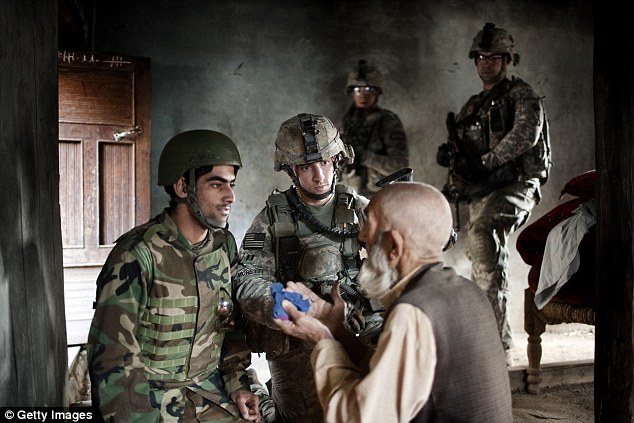
An Afghan interpreter assists U.S. troops


On Thursday, the House Armed Services Committee approved 60-2 the 2017 Defense spending bill that would abandon thousands of these people who risked their lives, and the lives of their families, to help U.S. soldiers in Afghanistan.

The U.S. State Department can now approve just 4000 visas for at least 10,000 of these brave men and women who are waiting for America to reach out its hand to them.

Not only does the Defense spending bill now being considered not relax that limit, but it would add restrictions.

The only Afghans who could apply to the program would include interpreters who served with the U.S. military and went “traveling off-base with such personnel or performing sensitive and trust activities for United States military personnel stationed in Afghanistan.”

That language would leave out Afghans who do maintenance or security on U.S. bases as well as those who work at the U.S. Embassy in Kabul.

“These are people who have put their lives on the line not just for their country, but for ours,” Representative Seth Moulton, (D-Mass) a former Marine Corps officer, said when he introduced an amendment to create additional visas. “The very least we can offer them is a chance to stay alive.”

Moulton’s amendment failed, but the bill has more hoops to go through before coming law.

Going forward, Congress should protect the Afghans who protected our troops.To do otherwise would be a stain on our country’s commitment to justice.

America First: of course.

When Donald Trump laid out his foreign policy agenda on Wednesday, April 27, many of the critical commentators latched on to his statement, “America first will be the major and overriding theme of my administration.”

Donald Trump

Republican presidential candidate Donald Trump gives a foreign policy speech at the Mayflower Hotel in Washington, Wednesday, April 27, 2016. ePhoto/Evan Vucci

“Trump’s New Slogan Has Old Baggage From Nazi Era” was the headline of a Bloomberg column. “America first” and the idea it represented — American neutrality towards the Nazis — has been largely banished from respectable discourse, the column said, in an attempt to discredit Trump.

Critics suggested that Trump was advocating a discredited policy that had been soundly rejected by Americans before WWII. It’s not that simple.

The fact is that until Japan’s attack on Pearl Harbor, Americans were genuinely divided between interventionism and isolationism. Millions of patriotic Americans believed that it was not in the nation’s interest to get involved again in European turmoil. Some polls showed that in June 1940, American opinion was split two-to-one in favor of staying out of the war, even if it meant Britain losing.

Started on September 4, 1940, the America First Committee, which favored nonintervention in Europe’s war, had 450 chapters across the country at its peak.

America First’s most outspoken leader was Charles Lindbergh, famous for having been the first to fly solo across the Atlantic in 1927.

lindberghamericafirst.banner.AP

Lindbergh speaks at an America First Committee rally in Oct. 1941

After the attack on Pearl Harbor, however, Lindbergh became active in the war effort.

As for America First, it was dissolved on December 10, 1941, three days after the Japanese attack on Pearl Harbor.

I’m not a big fan of Trump, but attempts to discredit him by his reference to America First are off-base. The hard-headed philosophy of putting America first in foreign policy decisions is not obsolete and Trump’s foreign police prescription is not isolationist.

“No country has ever prospered that failed to put its own interests first. Our friends and enemies put their interests above ours, and we must start doing the same,” Trump said on Wednesday.

Former Secretary of State Condoleezza Rice said the same thing, though in a different way.  “In a democracy as pluralistic as ours, the absence of an articulated ‘national interest’ either produces a fertile ground for those wishing to withdraw from the world or creates a vacuum to be filled by parochial groups and transitory pressures,”she said.

Ensuring a nation’s survival is a critical obligation of a leader in foreign policy. You will not be a successful leader of America if you recoil from the urgency of protecting the national interest, of making America first.


Talk about inequality!

Buying a Tesla? You’re probably pretty well off.

2016_tesla_Model_S

2016 Tesla Model S

After all, the 2016 Tesla Model S 70 has a Manufacturer’s Suggested Retail Price (MSRP) of $71,200. For the high-horsepower Model S P85D, you’ll shell out $106,200. Check off all the options boxes and you’ll be looking at more than $131,000.

Or how about other electric car options, such as a 2016 BMW i8 for $141,695, a 2016 Cadillac ELR for $64,995, a 2016 Porsche Panamera S E-Hybrid for $94,250 or a 2016 Porsche Cayenne S E-Hybrid for $78,250.

If you want to go downscale, there’s also the 2016 Nissan Leaf at $29,860, the 2016 Chevrolet Volt  at $33,995 or the 2016 Volkswagen e-Golf at $29,815.

Whatever the price, the rest of us will be helping you out with a federal tax credit of up to $7500. Maybe that would make some sense if the credit was helping a broad swath of the population. But it’s not.

Even though some electric vehicles on the market are relatively low-priced, it’s the affluent who are buying them. Well-off people who have incomes in the top 20% of all taxpayers are claiming 90 percent of federal electric vehicle (EV) tax credits, according to a recent study out of the Energy Institute at Haas, at the University of California, Berkeley.

The impact of the tax credit on the federal budget is the same as it would have been with a direct subsidy because the federal government ends up with less revenue.

Maintaining such tax credits for the affluent is insane public policy.

At a time of rising national debt, and struggling efforts to meet the country’s essential needs, subsidizing the well-off to encourage them to buy electric vehicles makes no sense and exacerbates inequality.

Perhaps  Oregon State Representative Phil Barnhart, D-Eugene, Chair of the House Revenue Committee, could be the Oregon leader of an effort to repeal of the federal electric vehicle tax credit and state-level electric vehicle tax breaks. After all, Barnhart, who is always railing about the need to close tax loopholes that favor big business and the rich and to adjust our tax system to increase fairness, owns a Tesla.


Clinton’s winning… and losing

Like the houseguest who overstayed her welcome, Hillary Clinton is losing admirers the longer she’s on the stage.

hillarycartoon

She won a decisive victory in New York’s Democratic primary yesterday. You’d think the victory was evidence of her steady climb in popular approval, a sign of voters’ deep and growing affection for her.

But the closer she comes to victory, the more people dislike her.

In January 2013, just prior to her official resignation as Secretary of State on Feb. 1,  just 25 percent of voters from both parties held a negative view of Hillary.

By March 2016, a Wall Street Journal/NBC survey revealed that among voters in both parties, 51 percent held a negative view of Hillary and 38 percent held a positive view.

This month, things were considerably worse. An April 10-14 poll showed that among voters in both parties, 56 percent held a negative view of Mrs. Clinton and 32 percent held a positive view. The way things are going, nobody will really like her by November.

Her only saving grace, if you can call it that, is that no candidate on the Democratic or Republican side is seen favorably by more than 50 percent of registered voters.

—-

By the way, Hillary’s New York victory yesterday was less impressive than her performance in 2008. That year, when she won the primary against Barack Obama, she carried all but one of New York’s 62 counties.

This time, she lost all but 13 of New York’s counties to Bernie Sanders, an astonishing shift. What saved Hillary in the popular vote was that her wins were concentrated in populous urban areas, including Buffalo, Syracuse and New York City.

primarymapNY

Memo to Verizon strikers: you’re doomed

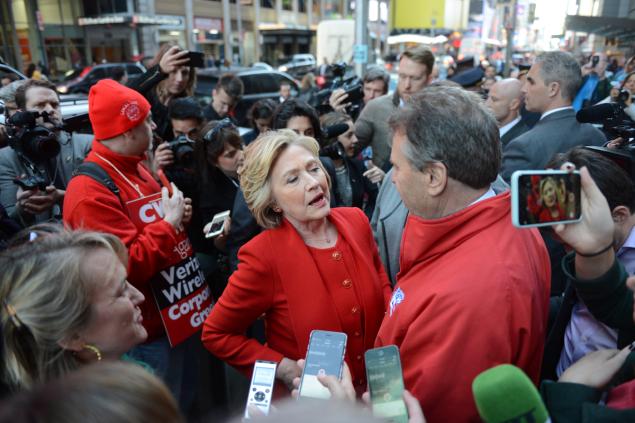
Hillary Clinton and Bernie Sanders are mining for union votes, so their pandering to the 39,000 Verizon strikers is par for the course.

Both greeted strikers yesterday at Verizon offices in Brooklyn and Manhattan. “This is just another major corporation trying to destroy the lives of working Americans,” Sanders said  in Brooklyn. “And today you’re standing up not just for justice for Verizon workers. You’re standing up for millions of Americans who don’t have a union.”

sandersverizon2

Bernie Sanders addressing striking Verizon workers IN Brooklyn. “Thank you for your courage in standing up against corporate greed,” he told them.


hillaryverizon2

Hillary Clinton speaks to union leader, Denis Tranor, while she visits striking Verizon workers in Manhattan.

The full-throated proclamations of support from Clinton and Sanders don’t, however, change the fact that the jobs of most of the strikers are doomed.

That’s because, as was the case with a 2011 Verizon strike, many of the strikers service the company’s shrinking landline, or wireline, phone business, or the company’s FIOS network, where Verizon is trying to reduce its role. They don’t service Verizon’s Wireless network, which provides most of Verizon’s profits.

The striking workers are complaining about not sharing in Verizon’s profits, but ignoring the fact that they are not the ones generating the profits. Why in heaven’s name would Verizon want to go out of its way to accommodate the strikers when the customer base they serve is collapsing?

All the public back and forth accusations being covered in the media, which love conflict, obscure the simple fact that the business is changing and nothing the strikers or the politicians grasping for votes say will change that.


Rocket Man: a retiree’s encore act

   “The future cannot be predicted, but futures can be invented.” Dennis Gabor, 1963

international-space-station

The International Space Station. Magical, isn’t it?

Retirement can be a new beginning, not just an end.

Jim Nadir, who retired from Intel after 33 years there, is a space enthusiast with an impassioned commitment to kids.

JimNadirpicture

Jim Nadir mentoring a student

When he retired, Jim chose not to spend his time in an easy chair or on the golf course. Instead, he served as a volunteer at Valley Christian High School in San Jose, CA. For the past three years, he’s been mentoring students in the school’s unique advanced space program. The highly lauded program develops student experiments for the International Space Station (ISS), develops rockets and will launch the school’s first satellite from the ISS next year.

The ISS Program is a STEM (Science Technology Engineering Math) outreach to schools around the world. Together with the partner schools, it has launched 73 experiments to the ISS over the past 6 years.

Enthusiastically devoted to mentoring, Jim has helped junior high and high school students put experiments aboard the ISS. He also participates in the school’s satellite development and rocket programs. The rocket program launches high powered sounding rockets from the San Joaquin Valley and Black Rock, Nevada that go from two to eight miles into the atmosphere.

Allie is one of Jim Nadir’s success stories. When they first met three years ago Allie was in 7th grade at Valley Christian Middle School. She was withdrawn, so shy she often hung back from even telling her teachers and classmates her name.

allieRocket

Allie working on a project

A teacher noticed that Allie had a natural curiosity and placed her in the newly created junior high ISS class, a challenging class attended mostly by A-level students. The class was a proof of concept that junior high students were up to the task to put experiments aboard the ISS. There, Allie began to go through a gradual metamorphosis, like a butterfly emerging from a chrysalis.

Her enthusiasm ignited, Allie joined the high school’s ISS program as a freshman. “She got motivated and charged up there and just suddenly blossomed into a very responsible young person,” Jim said.

Once timid Allie, now a sophomore, recently made a video interview with NASA, describing her involvement with the ISS program. “She couldn’t even tell you her name three years ago and now she’s confidently standing in front of a camera,” Jim said. The video ran on NASA TV in connection with a March 22, 2016 launch of a resupply mission to the ISS.

ISSstation

A United Launch Alliance Atlas V rocket carrying Orbital ATK’s Cygnus spacecraft on a resupply mission to the International Space Station, with Valley Christian High School experiments on board,  lifts off from Space Launch Complex 41 on Cape Canaveral Air Force Station in Florida on March 22, 2016

“One of the most exciting aspects to the ISS program is that students are given a chance to apply what is learned in the classroom to a project which will deliver unique results that can be applied to real world problems,” Allie said.

“When I first entered the program, I was not particularly sure what my true passions were,” Allie added. “ I have found that I possess talent in both science and mechanical engineering. I know precisely what my skill sets are and what I am actually capable of, and I owe it all to the ISS program.”

Andy’s another success story. He was in the same junior high ISS class as Allie where he innovated new fluidic bags, spore injectors and pioneered the use of peristaltic pumps. His innovations propagated into the high school and went to other schools as well. “I found out that I could innovate and make decisions,” said Andy.

His junior high experiment was presented at the ASGSR (American Society for Gravitational and Space Research) Conference in Pasadena where it won “Best Use of the Space Station” award from CASIS (Center for the Advancement of Science in Space), the sole manager of the International Space Station U.S. National Laboratory.

Valley Christian High School offers students the opportunity to specialize through its Applied Math, Science and Engineering (AMSE) program. The ISS Project provides students with the opportunity to conceive, design, build, test, integrate, and qualify computer-controlled science experiments that are then sent into space and are active on the International Space Station for a minimum of 30 days.

Recent experiments studied plant growth, protein crystallization, radiation profiles aboard the ISS, the behavior of ant colonies, and bacteria growth in a microgravity environment.

Many of these experiments have their roots in previous NASA experiments and are extending them to the next logical step. For example, Dr. Jan Leach (Colorado State) discovered that soy bean plants in microgravity are more susceptible to fungal infections. The students, after reviewing her NASA paper, sent two experiments to combat fungal infection, one uses inoculation and the other uses vibrations in an attempt to strengthen the plant’s cell walls to resist infection. This vibration experiment has caught NASA’s interest because of its unique approach.

Jim spends most of his time mentoring students developing experiments, guiding them on satellite development or developing rocket simulation environments. This involves helping with such things as how to design a transistor circuit, building reliable fluid bags, micro fluidic component validation, PCB design, mechanical planning, and software development.

Jim retired from Intel’s Santa Clara, CA site in 2007. He told me his story in the hope it will inspire other retirees who would enjoy “putting their DNA into space” while doing something meaningful for the next generation of students or whatever else will help change the world for the better.

______

Jim Nadir’s Intel career: Jim began his  33 year career at Intel developing peripherals for the 8086. He subsequently developed the layout and circuits for Intel’s first standard cell library and logic synthesis (pioneered at Intel Haifa), and later was the leader for the Pentium Instruction cache and the Itanium Data Cache. He then moved into New Business Development ASIC group and later pursued FPGA technology and other programmable fabrics for custom and small volume runs.

Resources:

The Encore Career Handbook, a comprehensive, nuts-and-bolts guide to making a difference and a living in the second half of your life.

http://www.Encore.org – A non-profit that is spearheading efforts to engage millions of people in later life as a vital source of talent to benefit society.


The truth be told: Bill Clinton and Black Lives Matter

The real truth-teller in Hillary’s political campaign isn’t the candidate. It’s her husband.

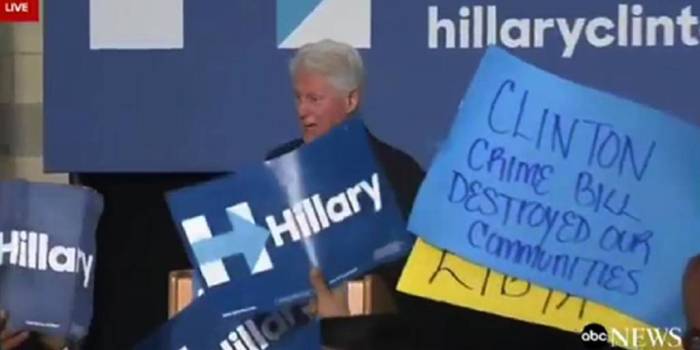
Yesterday, Bill Clinton got into quite a set-to with Black Lives Matter protesters in Philadelphia. What set it off was the chants of protesters repeatedly interrupting his remarks to protest his 1994 crime bill on the claim it was anti-black.

billclintonphilly

The protesters also held up signs saying things such “Clinton’s crime bill destroyed our communities” and “Black youth are not super-predators,” referring to a remark Hillary made in a 1996 address at New Hampshire’s Keene State College in support of the 1994 Violent Crime Control Act. “We can talk about why they ended up that way, but first we have to bring them to heel,” she said then.

Earlier this year, Hillary backtracked in an effort to pacify Black Lives Matter and other critics. “Looking back, I shouldn’t have used those words, and I wouldn’t use them today,” Hillary Clinton told the Washington Post.

Bill Clinton’s lengthy and spirited response to the Philadelphia protesters was more clearly a full-throated defense of his own administration’s record than an endorsement of his wife, but much of it was right on.

Sounding like a conservative at times, Clinton defended strict law enforcement as something that was necessary to protect black families from marauding black gangs and drug dealers committing black-on-black violence in inner cities.

“Let’s just tell the whole story,” Bill Clinton said, asserting that his crime bill was flawed because of Republican objections, but it was still a critical, necessary bill. “I talked to a lot of African American groups. They thought black lives mattered. They said ‘take this bill, because our kids are being shot in the street by gangs. We have 13-year-old kids planning their own funerals.”

“And because of that bill and the background check law, we had a 46 year low in the deaths of people by gun violence, and who do you think those lives were,” Clinton said. “Whose lives were saved that mattered?”

When the protesters continued interrupting him, Clinton got even more animated and defended Hillary’s use of the term “super predators” in 1996. “I don’t know how you would characterize the gang leaders who got 13-year-old kids hopped up on crack and sent them out into the street to murder other African American children,” he shouted. “You are defending the people who kill the lives you say matter. Tell the truth.”

“When somebody won’t hush and listen to you, that ain’t democracy,” Clinton said. “They’re afraid of the truth. Don’t you be afraid of the truth.”

You got it, Bill.