Stuck: running in place in Oregon

I work in Hillsboro, OR where evidence of a strong economy is everywhere. It’s tempting to assume that family income must be growing by leaps and bounds in Washington County, too, and to extrapolate and assume all is well statewide.

Not so much.

In fact, even Washington County isn’t doing that great, despite the presence of Intel, which has been growing like kudzu, feverishly sprouting buildings and good jobs.

Way back, growth in the U.S. economy was accompanied by income increases across the board, improving the lot of the poor and expanding the middle class. Everybody shared in the rising tide.

middle_class_family

But that hasn’t been happening for a long time. Now a lot of people find themselves working harder, but just treading water.

“Over the past 25 years, the (U.S.) economy has grown 83 percent, after adjusting for inflation — and the typical family’s income hasn’t budged,” according to a recent analysis by the Washington Post. “In that time, corporate profits doubled as a share of the economy. Workers today produce nearly twice as many goods and services per hour on the job as they did in 1989, but as a group, they get less of the nation’s economic pie.”

The result? In 81 percent of America’s counties, median family income is lower today than it was 15 years ago, the Post analysis revealed.

What about in Oregon? I decided to look deeper. The data shows that in 25 Oregon counties, the inflation-adjusted median family income is lower today than it was 15 years ago.

That’s true even in Washington County where median household income, adjusted for inflation, actually peaked in 1999 at $72,787. That year was also the peak for such wildly dispersed counties as Clackamas, Deschutes and Malheur.

The situation is even worse in counties such as Baker and Lake where median family income, adjusted for inflation, hit its peak 35 years ago.

If you really want to hit bottom, there are six counties, including Curry, Lane and Wheeler, where medium family income, adjusted for inflation, peaked 45 years ago. That’s right, almost half a century ago, when Richard Nixon was inaugurated President and the Apollo 11 astronauts, Neil Armstrong and Edwin E. Aldrin, Jr., took their first walk on the moon.

So what we have in Oregon is an economy in which few of us are really better off economically then we were years ago.

Here’s the county-by-county breakdown of when median household income, adjusted for inflation, peaked in each of Oregon’s 36 counties and the level at which it peaked.

Oregon-county-map

County Peak Year Amount
Hood River 2013 $56,725
Sherman 2009 $52,664
Washington 1999 $72,787
Clackamas 1999 $72,264
Columbia 1999 $63,555
Yamhill 1999 $62,070
Polk 1999 $59,218
Benton 1999 $58,558
Deschutes 1999 $58,159
Multnomah 1999 $57,733
Marian 1999 $56,673
Linn 1999 $52,326
Crook 1999 $50,759
Jackson 1999 $50,734
Clatsop 1999 $50,289
Jefferson 1999 $49,678
Tillamook 1999 $48,026
Wallowa 1999 $44,726
Josephine 1999 $43,406
Malheur 1999 $42,525
Morrow 1979 $57,126
Wasco 1979 $54,645
Harney 1979 $54,318
Umatilla 1979 $50,513
Lake 1979 $49,714
Grant 1979 $48,786
Union 1979 $48,006
Lincoln 1979 $47,053
Baker 1979 $42,760
Lane 1969 $52,736
Coos 1969 $52,171
Gilliam 1969 $49,892
Klamath 1969 $49,511
Curry 1969 $49,042
Wheeler 1969 $40,675

SOURCES: U.S. Census and American Community Survey. Amounts in 2013 dollars.

Who owns Chuck Riley?

Democrat Chuck Riley’s defeat of Republican Bruce Starr on Nov. 4 for Oregon’s 15th District Senate seat cost a ton of money. Now, like a company that’s gone public, his key supporters are going to expect a return on their investments.

rileySenate

As of Dec. 8, 2014, Riley’s campaign committee, Friends of Chuck Riley, had raised $913,372.33 and spent $889,757.01, according to records on file with the Oregon Secretary of State. The onslaught of campaign cash was so great that the contest ended up being the most expensive state Senate race in Oregon history.

But it was also a very tight race, with Riley finally coming in ahead by just 287 votes out of 39,734 cast. Likely costing Starr the race was the Libertarian candidate, Caitlin Mitchel-Markley, who captured 3,593 votes.

That suggests the next race will be hard fought as well, particularly if no 3rd party candidate runs, and that it will again require a substantial war chest. To create that war chest Riley will have to placate some big givers. After all, it was the big givers who filled his coffers, not the little people.
So who does Chuck Riley owe for his victory?

The biggest cash/in-kind contributors to Friends of Chuck Riley were Riley’s own Democratic Party, unions, a climate change activist, trial lawyers, and two national gun control groups.

The money from the Democratic Party came from two groups, the Senate Democratic Leadership Fund ($174,585.50)
and the Democratic Party of Oregon ($107,577.56), which received significant contributions from some of the same characters as Riley’s committee.

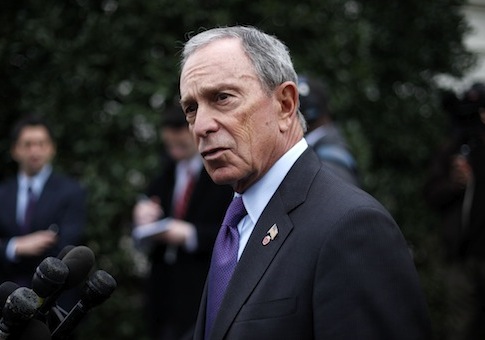
For example, former New York City Mayor Michael Bloomberg’s gun control group, Everytown for Gun Safety, donated $75,000 directly to Friends of Chuck Riley and $50,000 to the Senate Democratic Leadership Fund.

Michael Bloomberg

Michael Bloomberg

Riley’s committee also pulled in $10,000 from the Brady Campaign to Prevent Gun Violence.

Other big contributors to Riley’s Committee included:

• Service Employees International Union (SEIU) $204,460.39

This includes: $193,661.96 from Citizen Action for Political Education of SEIU Local 503; $10,798.43 from Committee on Political Education of SEIU Local 49.

seiu

• Oregon League of Conservation Voters PAC $191,120.02

OLCV made an in-kind contribution of $127,498.50 in the form of a TV ad. The balance was in the form of: cash; in-kind field work, postage, preparation and production of advertising and a phone program. The TV ad money came out of a $130,000.00 contribution to OLCV from NextGen Climate Action Committee, established by billionaire Tom Steyer to help candidates who support the need to deal with climate change.

Oregon_League_of_Conservation_Voters-270x222

• Oregon Trial Lawyers Association PAC $38,477.87

otla_logo

• Oregon American Federation of State, County
and Municipal Employees (AFSCME) Council 75
Political Soft $17,500.00

afscme

• Oregon Education Association – People for
Improvement of Education $8,342.00

OEA_logo

• Other unions $10,500.00

Joint Council of Teamsters No. 37 Political Fund
$1,750

United Food and Commercial Workers Union Local
555
$4,500

Oregon School Employees Association – Voice of
Involved Classified Employees
$1,000

International Union of Operating Engineers, Local
701 Misc PAC
$250

American Federation of Teachers-Oregon Candidate
PAC
$3,000

All of the above contributions totaled $752,563.34. That’s 85 percent of total expenditures by Riley’s committee.

Compare that with the amount that came in from contributors of $100 or less, about $8000. That’s less than 1 percent of total expenditures by Riley’s committee. Even if all the small contributors had bundled their money in an effort to enhance their potential influence, they would have been a small player. They might as well have spent their money on a nice dinner out.

So, how are we going to know the influence of the big donors on Riley? It’s not going to be easy.

First of all, it’s not clear that the size of Riley’s war chest was the key determinant in his victory. There’s no hard evidence of a constant linear linkage between campaign money and victory, although a candidate does need enough money to deliver key messages to critical audiences.

But now that Riley has been elected, the major donors are likely to influence positions Riley takes.Equally important, large donations to Riley are likely to give certain interests better access to him to influence public policy in general.

Big donors will also probably have an ability to influence the shape and specifics of legislation that’s before Riley much earlier in the legislative process, when it’s harder for the public to detect.

Large donations may also carry the day on critical votes where Riley’s one vote for or against can determine the fate of a bill. “These low salience critical votes present the most likely circumstances for members to repay groups for their financial support,” according to Lynda Powell at the University of Rochester in a paper on The Influence of Campaign Contributions on Legislative Policy.

One thing is clear – the big donors are going to be keeping an eye on Riley, just like big investors keep an eye on the stock market. All investments carry some risk, but the reward for risk can be a great return.

return-on-investment1

United Streetcar and Earl Blumenauer’s misplaced boosterism

Only a politician would want to throw good money after bad, arguing that a failed company should get MORE federal dollars.

The Washington Post, in a Nov. 29 story picked up by both Willamette Week and the Portland Business Journal, told of how Portland’s United Streetcar, supposedly destined to reinvigorate the U.S. streetcar business, failed miserably.

unitedStreetcar

In 2005, Oregon’s own Rep. Peter DeFazio (D) secured $4 million for Portland to buy an American-made streetcar. The contract went to Clackamas-based United Streetcar, a company founded that year, “Leading the way for today’s urban transport needs,” the company’s website says.

United Streetcar was formed in December 2005. It is a subsidiary of Oregon Iron Works, Inc., which recently became a division of Vigor Industrial.

Despite White House cheerleading, United Streetcar became a symbol of ineptitude, with frequent missed deadlines and cost overruns. It ended up building just 18 streetcars for three customers, and still couldn’t deliver them on time. According to the Post, the company has no new orders and the facility built to produce up to 24 streetcars a year is dormant.

But Blumenauer, arguing that the U.S. needs to make streetcars and not give the business to foreigners, wants the government to double down. Specifically, he wants the Feds to order 500 or 1,000 streetcars and give some U.S. companies a shot at making 50 or 100 each.

“That would get production humming,” Blumenauer told the Post.

Does he even remember the United Streetcar fiasco, or care?

In a classic instance of the Peter Principle at work, in August 2010, President Obama appointed Chandra Brown, President of United Streetcar, to the Department of Commerce Manufacturing Council. “Throughout her career, Chandra Brown has demonstrated how good leadership can allow smart companies to do well on the bottom line, do right by their employees, and do good for the country,” said Senator Jeff Merkley (D-OR).

Chandra Brown

Chandra Brown

Then, in March 2013, President Obama again helped Brown fail upwards again by appointing her Deputy Assistant Secretary for Manufacturing at the U.S. Department of Commerce.

I guess Blumenauer figures that if Brown can mess up and move up, there’s no reason why he shouldn’t help United Streetcar do the same.

Over the top: Oregon’s $10 million State Senate election

“There are two things that are important in politics,” U.S. Senator Mark Hanna said in 1895. “The first is money and I can’t remember what the second one is.”

Candidates for Oregon’s state Senate showed the truth in that observation in their 2014 races, which led to campaign spending of $10 million. That’s right, $10 million to decide the winners of just 16 Senate seats in a state with a smaller population than Kentucky.

Oregon Senate

Oregon Senate

That’s $10 million, enough to cover the annual tuition and fees of 1026 students at the University of Oregon.

But wait. There’s more. Candidates in 3 of those 16 races ran unopposed and candidates in 7 others were in such uncompetitive races that the victor won by more than 15%. That leaves just 6 seats with real races.

Here are the 6, with the expenditures by each candidate and the winning margins:

Screen Shot 2014-11-22 at 5.42.14 PM

Of the 6 competitive races, the Democrats won 4 and the Republicans 2, giving the Democrats more solid control of the Senate.

Based on filings with the Oregon Secretary of State, the committees of all the candidates for the 16 Senate seats spent a combined total of $7,816,657.33 in the primary and the general elections.

The most expensive race in terms of candidate committee spending expenditures was the one between Bruce Starr and Chuck Riley with total expenditures of $1,794,346.39. That made it the most expensive State Senate race in Oregon history.

Bruce Starr (L) and Chuck Riley

Bruce Starr (L) and Chuck Riley

On top of these candidate committee expenditures, the Senate Republican and Democratic Party Leadership Funds spent a bundle.

Figuring out how much they spent beyond the spending of the candidate committees gets a little tricky here. That’s because some of the money spent by the Senate Leadership Funds came from contributions by candidate committees. These contributions also show up as expenditures by the candidate committees, so counting them also as expenditures by the Leadership Funds would be double counting. Therefore, in order to accurately figure out additional spending by the Leadership Funds you have to subtract the money they received from the candidate committees. Got it?

In the case of the Senate Democratic Leadership Fund, the contributions it received beyond donations from the candidate committees include $50,000 from Everytown for Gun Safety (former New York Mayor Michael Bloomberg’s operation), $100,000 from the Democratic Leadership Campaign Committee (A Washington, D.C.-based group that works to win state legislative seats and chambers for Democrats), and $50,000 from the Oregon Priorities PAC.

Michael Bloomberg

Michael Bloomberg

After the election, Everytown for Gun Safety, which also contributed $75,000 to the successful State Senate campaign of Chuck Riley-D and $250,000 to Gov. Kitzhaber, boasted of its campaign influence. “…the election of Rep. Sara Gelser (who received $186,014.40 from the Senate Democratic Leadership Fund) to the state Senate signals a pro-background check majority in 2015, which clears the most significant roadblock in Everytown for Gun Safety’s work over the past two years to pass a background check bill there,” Everytown said.

The extra expenditures by the Senate Democratic Leadership Fund, beyond contributions it received from candidate committees, totaled $1,140,387.53.

In the case of The Leadership Fund for Senate Republicans, major contributions, beyond donations from the committees of the candidates running in 2014, included $15,000 from the Oregon Sportsmens Association PAC, $45,000 from the Oregon Family Farm Association PAC, $25,000 from the Taxpayers Association of Oregon PAC and $20,000 from the Pacific Seafood Group Employee PAC.

The Republican Leadership Fund, just like the Democratic Leadership Fund, also received substantial sums from current state senators not running in 2014. Friends of Ted Ferrioli, for example, raised $305,298.28 in 2014, then turned around and donated $213,500 of that to the Republican Leadership Fund.

Using the same formula as with the Senate Democratic Leadership Fund, the extra expenditures by The Leadership Fund for Senate Republicans totaled $1,222,851.

Add it all up and you have $10,179,985.80.

And that doesn’t even count money spent by other groups in support of Senate candidates, including some so-called dark money which will never be disclosed.

Clearly, Oregon is headed for the big time. The question: what are the big contributors going to expect as a return on their investments?

Climate change and guns: the long arms of out-of-state billionaires reach into the Oregon Senate

What do Tom Steyer of San Francisco (and Lake Tahoe and Pescadero) and Michael Bloomberg of New York (and Bermuda, London, Colorado and Florida) have to do with Oregon politics? A lot it turns out.

Their money helped the Democrats strengthen their hold on the Oregon Senate and potentially push through controversial environmental and gun control legislation.

Bloomberg is the billionaire co-founder of Bloomberg L.P., a privately held financial software, data and media company based in New York City, and a former mayor of New York City.

Michael Bloomberg

Michael Bloomberg

Steyer is a billionaire who co-founded the $21 billion Farallon Capital Management fund. He spent an estimated $65 million this election through his NextGen Climate political action committee (PAC) to help candidates who support the need to deal with climate change.

Tom Steyer

Tom Steyer

Steyer spent $8.5 million in Colorado to help Democrat Sen. Mark Udall in his losing race against Republican Cory Gardner.

He also spent $11 million in Iowa to help Democrat Bruce Braley in his losing Senate race against Republican Joni Ernst.

His ambitions in Oregon were considerably more modest, but could still have a big impact. Here his NextGen PAC spent $130,000 to help Democrat Chuck Riley in his race against Republican State Senator Bruce Starr and Democrat Sara Gelser in her Senate race against Republican Betsy Close.

Riley defeated Starr in a squeaker by just 221 votes, 17,930 to 17,709; Gelser handily defeated Close by 27,375 to 21,571.

Riley’s campaign finance report doesn’t show any contributions from Streyer’s out-of-state PAC. That’s because the PAC donated the money to the Oregon League of Conservation Voters (OLCV) PAC, which is for all intents and purposes an arm of the Democratic Party. The in-state OLCV PAC then used the funds to support Riley, giving him a total of $191,120.02.

To further bolster the Democrat’s cause, Steyer’s NextGen Climate Action Committee also gave $100,000 to the Democratic Party of Oregon.

Gelser’s campaign finance report doesn’t show any contributions from Streyer’s out-of-state PAC either, but it does show $76,755.36 from the OLCV.
.
Meanwhile, Bloomberg’s EveryTown for Gun Safety Action Fund sent $75,000 to Riley’s campaign, as well as $250,000 to Gov. Kitzhaber and $50,000 to the Senate Democratic Leadership Fund.

Everytown for Gun Safety was created earlier this year by combining a Bloomberg-backed group, Mayors Against Illegal Guns, with Moms Demand Action for Gun Sense in America, a movement that grew out of the Newtown shootings in 2012. The two groups have been working together since December.

Did the Steyer and Bloomberg money make a difference?

According to filings with the Oregon Secretary of State, Riley raised a total of $891,153.99 for his campaign and Starr a total of $901,097.63. That means a significant portion of Riley’s campaign money came just from Steyer and Bloomberg.

Add whatever impact Steyer’s $100,000 donation to the Democratic Party of Oregon had on Riley’s race and these two out-of-staters likely played a huge role in Riley’s victory.

According to filings with the Oregon Secretary of State, Gelser raised a total of $843,711.67 for her campaign. Of that, $76,755.36 came from the OLCV. Close raised significantly less, $556,628.14.

The Steyer/OLCV money probably didn’t play as much of a key role in Gelser’s victory, but it surely helped expand her advantage.

Oregon tried to limit the influence of out-of-state campaign contributions in 1994 when it passed Ballot Measure 6 that amended the Oregon Constitution to limit out-of-district contributions to 10 percent of the total. But a federal appeals court ruled in 1998 that the limit violated the First Amendment and was unconstitutional.

So expect more of the same in future Oregon elections, and then some.

Merkley loses

As of Oct. 15, 2014, Senator Jeff Merkley’s Leadership PAC had given out contributions to other Senate Democrats running for office in Nov. 2014. Based on the results of the election, he didn’t make very good investments. And now he’s going to be in the minority, too. Tough luck.

merkleySenate

Total to Democrats: $91,000
Total to Republicans: $0

Recipient Total

Begich, Mark (D-AK) $10,000 LOST
Braley, Bruce (D-IA) $ 1,500 LOST
Coons, Chris (D-DE) $ 5,000 LOST
Franken, Al (D-MN) $ 5,000
Grimes, Alison (D-KY) $ 5,000 LOST
Hagan, Kay R (D-NC) $ 7,500 LOST
Landrieu, Mary L (D-LA) $ 7,500 WILL LOSE
Markey, Ed (D-MA $ 2,000
Nunn, Michelle (D-GA) $ 5,000 LOST
Peters, Gary (D-MI) $ 1,500
Pryor, Mark (D-AR) $ 7,500 LOST
Reed, Jack (D-RI) $ 5,000
Schatz, Brian (D-HI) $ 2,500
Shaheen, Jeanne (D-NH) $ 7,500
Udall, Mark (D-CO) $ 5,000 LOST
Udall, Tom (D-NM) $ 3,500
Walsh, John (D-MT) $ 5,000 WITHDREW
Warner, Mark (D-VA) $ 5,000

Based on data released by the FEC on October 25, 2014.
Center for Responsive Politics.

In responsione: OSU and state support for higher education

After I wrote about Oregon’s abandonment of higher education, focusing on the situation at the University of Oregon, Steve Clark, Vice President for University Relations at OSU, responded to me with some informative comments.

Steve Clark, Oregon State University

Steve Clark, Oregon State University

Mr. Clark agreed to let me share them:

Like you, at Oregon State, we worry about the cost of higher education for Oregonians. I would like to share with you a number of steps we have taken to minimize the impacts of this change in state funding, but we do realize that there is more work to do in this regard. And while our efforts are many and have had a positive impact, we continue to urge Oregon legislators to restore higher education funding at least to levels provided in 2007.

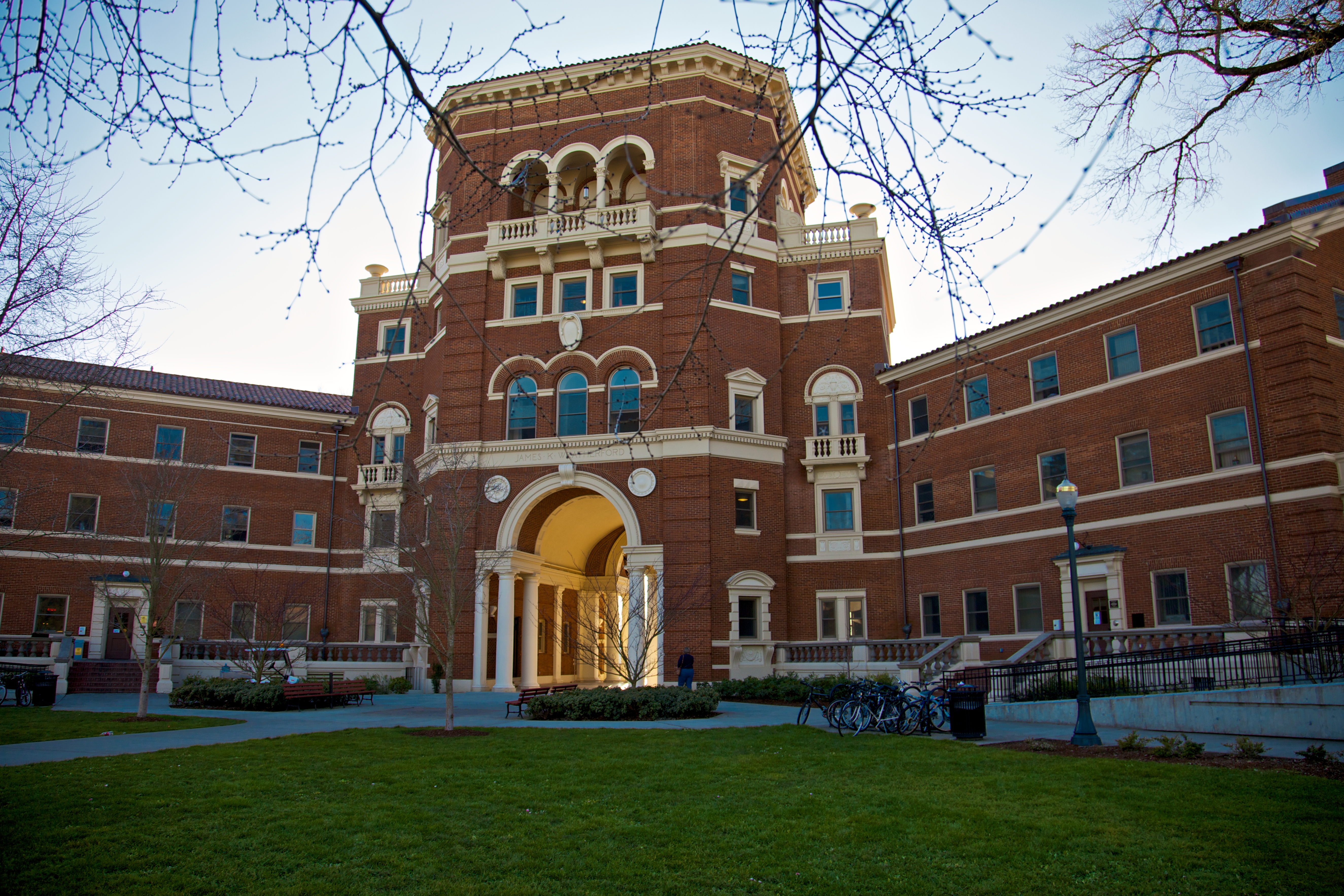
Weatherford Hall at Oregon State University

Here is some information that I hope aids you and shows how Oregon State remains a public university for Oregonians.

I realize that while your column largely shared statistics about the University of Oregon, your point was that all of Oregon’s public universities are public in name only.

While OSU’s out-of-state and international enrollment has grown over the past decade, OSU’s undergraduate enrollment is still 74% made up of Oregonians. That percentage has declined over the past decade, but we have pledged to not let it fall below 66%. That’s our land grant mission.

Meanwhile, we have launched OSU Open Campus to bring educational programs directly to Oregon communities in partnership with local school districts, ESDs and community colleges. And we have dual degree partnerships with all of our Oregon’s 17 community colleges … so students can simultaneously enroll at OSU and the community college near their home and then transfer after a year or two of community college to attend Oregon State without losing credits. In some cases – such as in an agricultural sciences program with Klamath Community College – a student can graduate in four years without ever having to come to Corvallis, but instead take community college courses for two years or so and then complete their degree taking OSU on-line distance learning classes.

We do recognize tuition and fees are expensive. OSU’s in-state tuition and fees are $9,123 per year compared to the $9,918 you pointed out about UO. Still that is a lot more than students paid 7 to 10 years ago. Out-of-state tuition at OSU is $26,295 per year compared with $30,888 at UO.

With such a heavy tuition load in mind, we launched many years ago our Bridge to Success program. It enables 2,600 to 3,000 Oregonians per year to attend OSU without paying any tuition and fees. The program combines Oregon Opportunity Grants, federal Pell funds and university funds. And then there is our OSU Foundation philanthropy – The Campaign for OSU has raised more than $183 million for student scholarships.

Yes, there is a significant issue with how the state funds higher education in Oregon and we are working with the legislature to change that. Time will tell about such efforts. Meanwhile, as Oregon’s statewide university, we will not abandon Oregonians. And we will work hard to moderate costs, bring higher education to many Oregon communities, and grow funding for financial aid for students.

Steve Clark

Oregon’s abandonment of higher education: it’s criminal

The Oregon Legislature should be declared a crime scene.

Oregon’s state universities are increasingly that in name only. Because of the Legislature’s calculated callousness or pure indifference in funding Oregon universities, young people across the state are facing soaring college loan debts and diminished opportunities for higher education.

The state is also sabotaging its goal of ensuring that 40 percent of all adult Oregonians have a bachelor’s degree or higher by 2025 and undermining the rationale for the state having a say in the operations of what are still called public universities.

SONY DSC

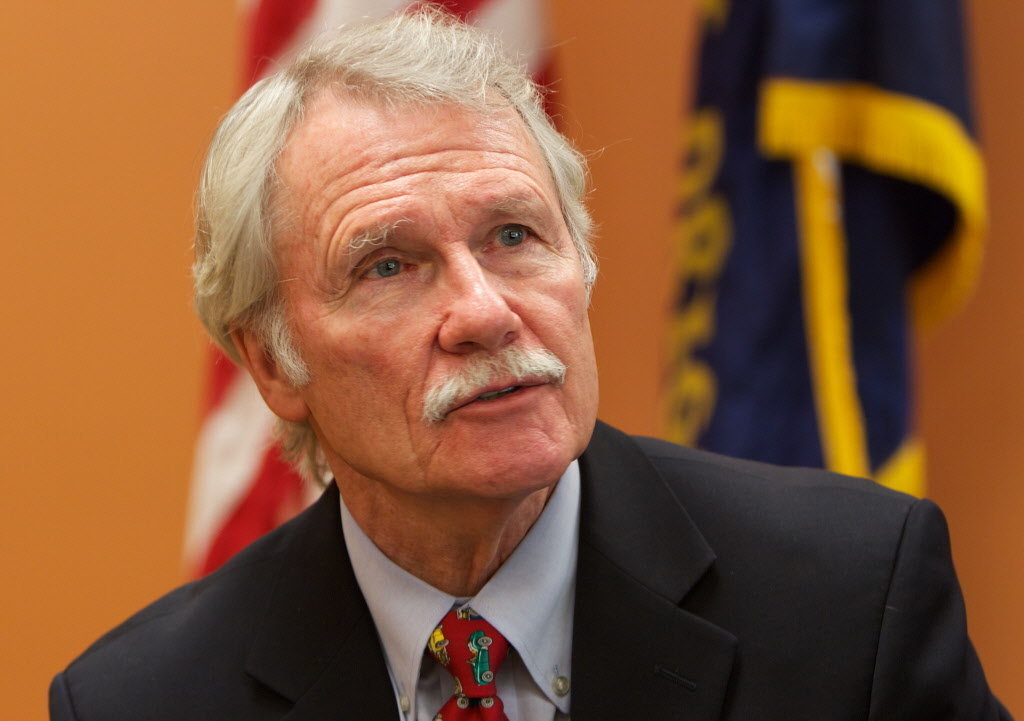
Governor John Kitzhaber says he deserves to be re-elected because he froze tuition at Oregon colleges.

Sure, for one year.

In June, the state Board of Higher Education approved a tuition freeze for in-state undergraduates for the 2014-2015 academic year.

But that was after steadily escalating tuition rates for in-state undergraduates, particularly after voters approved Measure 5 in 1990 and K-12 school funding shifted to the state, with a devastating impact on state support for higher education that has continued to today.

Over the past 15 years, tuition and fees at the University of Oregon, for example, leaped from $3810 for the 1999-2000 academic year to $9918 for the 2014-2015 academic year.

In other words, since the 1999-2000 academic year, tuition and fees for in-state undergraduates have increased 160 percent. You can’t duck the fact that this
substantially outpaced the 42.8 percent rate of inflation.

During that same period, the state’s share of the University of Oregon’s annual operating budget has been in steady retreat from 17.1 percent in 1999-2000 to 5.5 percent in 2013-2014. Extrapolating this trend, state investment will reach zero by 2022.

Coincident with the loss of state support has been an increase in out-of-state students. In the 2013-2014 academic year, non-residents, undergraduate and graduate, reached 46.5 percent of total enrollment.

The University cloaks the leap in out-of-state students as a well-intentioned effort to ensure diversity, but it’s really all about money. In 2014-2015, for example, while in-state students are paying $9918 in tuition and fees, out-of-state students are paying $30,888.

It could be argued that out-of-state students aren’t displacing in-state students, given that the number of undergraduate in-state students has increased about 20 percent since 1999-2000. The number of out-of-state students, however, mushroomed by 250 percent during the same period.

What that means is that the university is likely drawing fewer students from low-income Oregon families and competing more aggressively for students who can afford a more expensive education. In addition, as the state’s population has increased, it’s getting tougher for in-state students to get in.

Had the state not cut university funding so severely, it could have or kept tuition and fees down or accommodated more in-state students.

The pullback in state funding raises the question of why the state continues to impose its will on the universities in so many ways. “The defunding of public higher education by the states inevitably inaugurates a new conversation about who controls them and whose interests are to be served,” says Thomas Mortenson, senior scholar at The Pell Institute for the Study of Opportunity in Higher Education.

Indeed.


Originally published in the Hillsboro Argus, Oct. 28, 2013


Killing Trust: Kitzhaber the unobservant

John Kitzhaber’s latest tour of duty in the governor’s chair has exposed him as an empty suit in terms of faithfully overseeing the government he runs.

kitzhaberjpg

First, he hired education czar Rudy Crew. Remember him?

Rudy Crew (R) with Governor Kitzhaber

Rudy Crew (R) with Governor Kitzhaber

Crew checked in to his $280,000 a year job as Oregon’s first chief education officer in June 2012. Hailed by Kitzhaber as a man with a track record of leadership and innovation, his collapse as a leader was quick and dramatic.

Crew spent a year travelling extensively, often first class, on the state’s dime to speak at non-Oregon related events, took vacations at every turn, and made the scrambled eggs-and-bacon circuit around the state, telling the same heartwarming stories over and over again, while he continued to make money on the side. On July 1, 2013, Crew checked out and headed back East, a failed experiment in every way.

“How big of a setback was the Rudy Crew fiasco?” Portland Business Journal Publisher Craig Wessel asked Kitzhaber in January 2014. “It had to be difficult.”
“It was,” Kitzhaber responded. “It was an embarrassment.”

It was more than that. It was a complete failure to exercise good judgment and to oversee the performance of a key figure in Kitzhaber’s administration.

Then there’s Cover Oregon, another debacle.

coveroregonAd

Millions were spent there on a disastrous website, ubiquitous advertising and highly paid top staff (The total compensation of the each of the top ten highest paid of Cover Oregon’s employees in early 2014 was between $154,000 and $229,000, more than their boss, Kitzhaber.) In April 2014, Cover Oregon’s board of directors voted to close the state-run exchange and adopt the Federal HealthCare.gov exchange in 2015.

Cover Oregon’s troubles were compounded when the state tried shenanigans to avoid making public a scathing report on the program by consultant, Clyde Hamstreet. The report was made available to the media only after it was requested under Oregon Public Records Law.

“In retrospect, I should have been more engaged in the (Cover Oregon) project,” Kitzhaber said in November 2013. I’ll say.

Then there’s the matter of First Lady Cylvia Hayes.

Cylvia Hayes at an Oct. 9. 2014 press conference where she admitted entering into an illegal marriage in 1997.

Cylvia Hayes at an Oct. 9. 2014 press conference where she admitted entering into an illegal marriage in 1997.

On Oct. 8, Willamette Week raised serious questions about her business dealings and possible conflicts of interest while associated with Kitzhaber. Subsequent stories have disclosed that, unknown to Kitzhaber, Hayes accepted $5,000 as payment for illegally marrying an Ethiopian immigrant in 1997, allowing the man to remain in the U.S.

On Oct. 12, Kitzhaber asked the Oregon Government Ethics Commission to determine whether Hayes is subject to state ethics laws and, if so, whether she has broken them.

A better question is why is he only paying attention now? Where has he been since his third term began on ensuring that all of Hayes’ business relationships comported fully with state ethics rules?

Pay attention, John.

Anti-GMO, Anti-Vaccine, Anti-Flouride: Anti-Science

Where did all these anti-science cranks come from?

GMOcameFromGroceryStore

With an increasingly educated population, you’d think Oregon would be moving more toward rational, science-based thinking, but agenda-driven ideologues are pushing hard in the other direction.

Kari Chisholm, a Democratic political operative and founder of BlueOregon, a progressive political blog, sent me a message the other day urging me to sign a petition pledging to vote YES this fall on Measure 92. The measure would require that all raw food and packaged food that is entirely or partially produced with genetic engineering be labeled. Kari said he wants GMO labeling because when he eats junk food he can’t tell whether there’s anything genetically engineered in there.

He’d probably be better off just not eating junk food and leaving the rest of us alone. He’d be healthier and the rest of us wouldn’t have to deal with his anti-science GMO labeling blather.

The fact is, there is NO credible scientifically-based evidence that genetically engineered products are unsafe. As Pamela Ronald, a UC-Davis plant geneticist, noted in the Scientific American: “After 14 years of cultivation and a cumulative total of 2 billion acres planted, no adverse health or environmental effects have resulted from commercialization of genetically engineered crops.”

As a fallback, knowing that the science isn’t with them, the GMO labeling advocates say we need labeling because we need to know what’s in our food. A friend of mine without any scientific knowledge on the issue recently told me that alone is a reason to support Measure 92. But it’s not.

That’s because the argument is a smokescreen. The anti-science labeling advocates’ agenda is really to create the appearance of danger. As the editors of Scientific American have said, “…mandatory GMO labels would only intensify the misconception that so-called Frankenfoods endanger people’s health.”

The fact is, GMOs are as safe as other foods. If the labeling proponents are determined not to consume genetically engineered products, they can buy “100 Percent Organic” products and leave the rest of us alone.

keep-calm-gmo-safe

Everybody and their brother with real expertise on the issue has concluded that genetically engineered products are safe. This includes the American Medical Association, the World Health Organization, the American Society for the Advancement of Science, The National Academy of Sciences, The Royal Society of Medicine, The French Society of Science, The European Commission, The Union of German Academics of Sciences and Humanities, and on and on.

But the ill-informed anti-science GMO Chicken-Littles just keep going. After all, they’ve already convinced far too many gullible people that fluoride and vaccines are dangerous. Why stop now?