If it matters to Oregonians, it’s in (The Washington Post) Willamette Week

For those of you who don’t remember, Bob Packwood was the first.
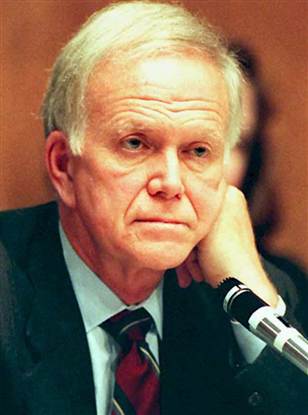
Former Senator Bob Packwood (R-Ore)

Former Senator Bob Packwood (R-Ore)

On Nov. 22, 1992, the Washington Post reported that 10 women had accused Sen. Bob Packwood of sexual harassment. Even though one of The Oregonian’s own reporters was among the 10, and the paper had gotten tips about Packwood’s behavior, incredibly it had failed to aggressively pursue the matter. The Oregonian’s failure to break the story was mortifying for the entire paper.

Adding to the shame was a bumper sticker that began appearing around Portland:
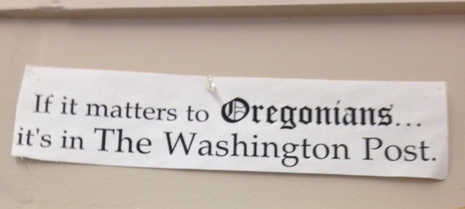
washPoststicker

Oregonian editor, Bill Hilliard, later told the Washington Post, in a massive understatement, that his paper “should have been a little more aggressive… We were worried about ruining a man’s career.”

Neil Goldschmidt was second.

Neil Goldschmidt

Neil Goldschmidt

Nigel Jaquiss, a reporter at Willamette Week, was researching the role of former Oregon Governor, and later power player, Neil Goldschmidt, in efforts to take over Portland General Electric. He was making good progress on the story, but got hints there was more.

“It was shaping up to be a pretty good story,” Jaquiss told the American Journalism Review, “but I kept getting pushed by people… ‘There’s more you ought to be looking at… There’s a girl..'”

Jaquiss’ aggressive digging eventually revealed that Goldschmidt, when he was the married Mayor of Portland, had begun raping a neighbor’s 14-year-old daughter on a regular basis over a three-year period. Sources said Goldschmidt often took the girl to her parents’ basement, to hotels and other private spots for sex.

When Willamette week posted a summary of the story on its website, it spread like wildfire. The Oregonian had been beaten again.

Not only had The Oregonian been beaten again, this time by a local alternative weekly, but The Oregonian made things even worse. When it ran the Goldschmidt story it appeared to many readers to soft-pedal Goldschmidt’s actions as “an affair” with “a high school student”. Oregonians went ballistic.

A memo of a staff meeting at the Oregonian revealed that there was a lot of internal angst, too. The memo noted: “Steve Duin felt strongly that our coverage today was too reverential. We are dealing with a child molester. He made a very impassioned plea for doing the who knew what when story — lots of people became rich riding Goldschmidt’s coat tails — and why they kept it secret. He suggested that readers might think we’d learned nothing from Packwood and that we are hands off people in power.”

And now the Kitzhaber-Cylvia Hayes scandal.

John Kitzhaber and Cylvia Hayes

John Kitzhaber and Cylvia Hayes

Again, it was Nigel Jaquiss and Willamette Week that broke the story and followed up with bombshell after bombshell.

The Oregonian followed up with some revelations, but it was late to the party. It’s most significant role in the evolving saga was to run an editorial on Feb. 4, 2015 calling on Kitzhaber to resign, arguing, “…it should be clear by now to Kitzhaber that his credibility has evaporated to such a degree that he can no longer serve effectively as governor.”

What’s happening to The Oregonian, once the state’s dominant paper of record, now a mere shadow of its former self?

It may sound hackneyed, but great newspapers like the Oregonian were once the indispensable guardians of our freedom. Seasoned reporters have served as watchdogs to ensure good government and reinforce good citizenship. The Oregonian has been a key ingredient of  civic dialogue and discourse in the state.

David Simon, a former Baltimore Sun reporter who created the award-winning HBO series The Wire, warned at a U.S. Senate hearing on the “Future of Journalism”, that “high-end journalism is dying in America.”  Oregon can’t afford for The Oregonian to be among those at death’s door.


Disclosure: I worked as a reporter at The Oregonian during the 80s and 90s.

Brian Williams is gone. So what?

For all the sturm and drang about Brian Williams’ banishment from NBC Nightly News, who really cares?

Brian Williams

Brian Williams

When Walter Cronkite anchored the CBS Evening News, about 28 million viewers tuned in on average.

CBS_Evening_News_with_Cronkite,_1968

Today, fewer viewers tune in to CBS, ABC and NBC all together on a typical night.

The most recent State of the News Media study from the Pew Research Center reported that an average of just 22.6 million people watched one of the three commercial broadcast news programs on ABC, CBS or NBC in 2013, only 7 percent of the country’s 316.5 million population. And NBC Nightly News with Brian Williams, the most-watched program, had an average of only 8.5 million viewers.

Even recognition of nightly news anchors has fallen precipitously. Another Pew Research study reported that in 1985, 47 percent of people polled recognized the face of CBS News anchor Dan Rather. In 2013, just 27 percent recognized Brian Williams.

The age of network evening news viewers is slipping, too, according to Pew Research. While a slight majority (56%) of those 65 and older say they watch nightly network news, only 26 percent of those age 30-49 do and just18 percent of Americans under 30.

Morning news is in trouble, too, with average viewership of 13.4 million. Even the leader, ABC’s Good Morning America, averaged only 5.5 million viewers

The networks’ Sunday morning political news shows aren’t exactly barn-burners either. In the last six months of 2012, Face the Nation on CBS averaged just 2.97 million viewers, NBC’s Meet the Press 2.94 million viewers and ABC’s This Week 2.57 million viewers.

So where are Americans going for their news?

Not print newspapers. Their circulation has been dropping like a stone. And even though many of the top online news sites belong to print newspaper companies, online ad revenue is far from replacing lost print ad revenue.

“As the digital revolution continues to erode the print newspaper business, the only ones likely to survive will be those backed by the almost unlimited funds of billionaires…,” observes Accuracy in Media. The only problem is that the number of struggling newspapers far outnumbers the billionaires willing to save them.”

In other words, the present and the future are digital. So much for evening network news anchors. Sorry, Lester.

Jesse Jackson and the outrage machine: now it’s about Little League

A couple hours. That’s all it took for Jesse Jackson to publicly express outrage about Little League International’s decision to strip the U.S. Championship from Chicago’s all-black Jackie Robinson West team, and to make it a racial matter.

Jesse Jackson at a Feb. 10 press conference spoke out against the decision to strip Jackie Robinson West of its Little League national title.

Jesse Jackson at a Feb. 10 press conference spoke out against the decision to strip Jackie Robinson West of its Little League national title.

Little League International determined on Wednesday that the Jackie Robinson West Little League and Illinois District 4 Administrator knowingly violated Little League International Rules and Regulations. They did so by placing players, otherwise known as suburban ringers, on their team who did not qualify to play because they lived outside the team’s boundaries.

Like the ubiquitous Al Sharpton, Jackson inserted himself into the issue by calling a press conference where he told Little League International to reverse its decision and questioned whether its motivations were racial.

“Is this boundaries or race?,” Jackson asked, before threatening legal action if Little League doesn’t rescind it’s decision.

Rev. Michael Pfleger, a Roman Catholic priest and social activist in Chicago, who joined Jackson at the press conference,  also raised the race issue.

“When you’re going over to voter registration and going to birth certificates and doing all this time of hunting and a witch hunt that’s been going on for the last number of months, I can’t help but wonder the question if the same thing would have been done with another team from another place, another race,” Pfleger said.

Even a player’s parent, Venisa Green, jumped on the bandwagon. “It is amazing to me that whenever African-Americans exceed the expectations that there is always going to be fault,” she said.

Meanwhile, in the true spirit of fun in kid’s sports, Channel 5 NBC Chicago reports that a suburban coach of another Little League Team who raised suspicions about the make-up of Jackie Robinson West said Wednesday that he has received death threats.

So I guess the Jackie Robinson West kids have lost more than the U.S. Championship. They’ve lost their innocence.

The deification of the Kennedys: Act II

You’d think the John F. Kennedy Presidential Library and Museum in Boston, and the non-stop hagiography of the man by his admirers, would be enough. But no. Another monument to the Kennedys is going up, this one the Edward M. Kennedy Institute for the United States Senate on the campus of the University of Massachusetts Boston.

Given that Ted Kennedy was only one of more than 1900 Senators in U.S. history, you might expect his extended family and vast network of acolytes would have been satisfied with a Ted Kennedy Room in the adjacent $20.8 million, 135,000 sq. ft. John F. Kennedy Presidential Library and Museum, all constructed with private funds.

But that obviously wouldn’t do. The 68,000 sq. ft. $79 million Edward M. Kennedy Institute, actually costing more than President Kennedy’s library and museum when adjusted for inflation, is expected to open to the general public on March 31, 2015. It will be a temple to Ted, complete with a full-scale replica of the current U.S. Senate Chamber, inaugurated in 1859.

The Edward M. Kennedy Institute for the United States Senate

The Edward M. Kennedy Institute for the United States Senate

Rendering showing a replica of the U.S. Senate chamber that will be the central feature of the Edward M. Kennedy Institute for the U.S. Senate

Rendering showing a replica of the U.S. Senate chamber that will be the central feature of the Edward M. Kennedy Institute for the U.S. Senate

Ted Kennedy’s shrine will also have extensive museum space for exhibits, a café, classrooms, conference facilities and a gift shop. About all it’s missing is an eternal flame.

The gift shop, presumably, will not include replicas of the 1967 Oldsmobile Delmont 88 that Ted Kennedy drove off Dike Bridge into the channel between Chappaquiddick and Martha’s Vineyard in 1969, drowning 29-year-old Mary Jo Kopechne. Nor is it likely to display a plaque noting that Kennedy left the scene and did not notify the police of the midnight incident until the following morning.

Sen. Edward M. Kennedy's car is pulled from the water on July 19, 1969 after going off a bridge in Chappaquiddick the night before. The body of Mary Kopechne of Washington, D.C., was found in the rear seat. Her death was attributed to drowning.

Sen. Edward M. Kennedy’s car is pulled from the water on July 19, 1969 after going off a bridge in Chappaquiddick the night before. The body of Mary Kopechne of Washington, D.C., was found in the rear seat. Her death was attributed to drowning.

Nor is it likely the Institute will highlight tales of his drinking and raffish behavior that were part of his public persona, according to the Washington Post.

The extravagant monument to Ted Kennedy is also a monument to the ability to tap into federal money, with $38 million of its construction budget coming from the federal government. Former Massachusetts Senator John Kerry and Rep. Edward Markey tried to get even more appropriated to the lavish project, but failed.

That was a small victory for taxpayers, but with all the more pressing priorities in this country , the whole project should have been scuttled.

Hillary & Brian: two peas in a pod

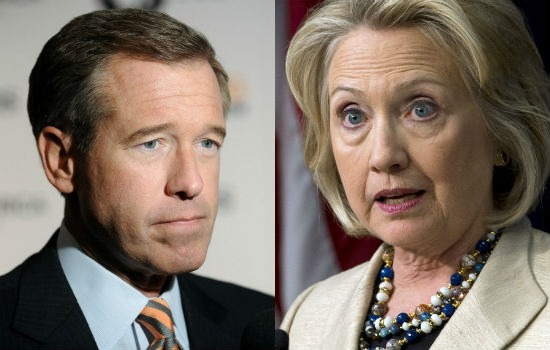
Hillary Clinton surely knows how Brian Williams feels after his lie about being in a helicopter in Iraq that was hit by a rocket-propelled grenade.

WilliamsHillary

In March 2008, Hillary tried to embellish her foreign policy chops by reminiscing about a trip she made to Bosnia in 1996.

“I remember landing under sniper fire,” she said. “There was supposed to be some kind of a greeting ceremony at the airport, but instead we just ran with our heads down to get into the vehicles to get to our base.”

The problem was, that never happened. Instead, she disembarked without any disruptions at all, unless you consider a charming little girl greeting her with a poetry reading.

The Washington Post’s Factchecker reported that the entertainer, Sinbad, who was also on the trip, refuted Hillary’s telling of the story, saying the “scariest” part of the visit was deciding where to eat.

Hillary not only dismissed Sinbad as just “a comedian,” but doubled down on the danger she claimed to have encountered. “I was moved up into the cockpit,” she told reporters. “Everyone else was told to sit on their bullet proof vests. We came in in an evasive maneuver. Those of you who have been on a C-17 or C-130 know that one of their great characteristics is that they can take off very quickly and they can maneuver agilely to avoid incoming fire. There was no greeting ceremony and we were basically told to run to our cars. Now that is what happened.”

Not so. Further media analysis concluded that Hillary and her plane were never confronted by any security threats.

Still, Bill Clinton defended his wife’s recollections on the campaign trail, attributing her possible error to her age.

Perhaps it was age that also led Clinton to claim she was instrumental in bringing peace to Northern Ireland. When challenged and accused of substantially inflating her role, including by Nobel Peace Prize winner Lord Trimble of Lisnagarvey who said her claim was a “wee bit silly”, Hillary dismissed the criticism as “nitpicking.”

Maybe Brian Williams should follow Hillary’s lead; just insist that all the uproar over his lying is nitpicking. Instead of being censured, he could end up a candidate for President of the United States.

The emerging 1099 economy: the new sweatshop

If your total income in 2013 put you in the top 40 percent of Americans, you’ve likely gotten richer over the past 20 years, according to the Federal Reserve. If you are anybody else, your income, after adjusting for inflation, has probably gone down.

This trend will likely continue if the independent contractor business model enabled by technology multiplies. The winners will be the educated, specialized elite with full-time jobs and benefits who file W-2 tax forms; the losers will be independent contractors who file 1099-MISC tax forms.

On-demand worker company TaskRabbit CEO Leah Busque told TechCrunch, a technology news website, that the company’s goal is to “revolutionize the world’s labor force.” It and similar companies relying on independent contractors are accomplishing that if you consider the revolution to be back to the future of sweatshops.

Automatons

Consider that under current law, independent contractors aren’t entitled to:

  • A minimum wage
  • Health benefits
  • Unemployment insurance
  • Retirement plans.
  • Workers’ compensation
  • Job protections

Uber and Lyft, both of which use independent contractors, are two of the best known 1099 companies, but others are sprouting like weeds. They include Homejoy (house cleaners), Handy (home cleaners and handymen), Postmates (couriers deliver goods locally), Spoonrocket (restaurant food delivery), Washio (laundry and dry-cleaning), DogVacay (pet sitting), Zirtual (personal assistants for entrepreneurs and professionals), Kitchensurfing (personal chefs) and TaskRabbit (personal tasks).

Washio allows customers to place laundry and dry-cleaning orders online and sends “ninjas” to pick up and deliver items. Washio doesn’t actually do any cleaning; it sends clothes to third party facilities. Independent contractors use their own vehicles, and cover their own costs, to go hither and yon picking up and dropping off clothes.

Online job source TaskRabbit asks people, “What can we take off your plate?” It offers “fully vetted Taskers to get the job done”, allowing the customer to “kick back and relax” and pay the bill online when the job is done. TaskRabbit makes its money by taking a 20% service fee off the payment.

TaskRabbit makes it clear that Taskers are independent contractors and that Taskrabbit is no more than “ a communications platform which enables the connection between Clients and Taskers.”

The company reinforces that message by saying it “…has no liability regarding the Service” and “…is not responsible for the performance of Users, nor does it have control over the quality, timing, legality, failure to provide, or any other aspect whatsoever of Tasks Clients, nor of the integrity, responsibility or any of the actions or omissions whatsoever of any Users.”

SherpaVentures, a venture capital firm, predicts that so-called “freelance marketplace” or “managed-service” labor models used by these companies are poised to transform industries like law, health care, and investment banking, and that fewer people will have traditional full-time or part-time jobs as a result.

According to Sherpa, “perpetual, hourly employment is often deeply inefficient for all parties involved, with the employer having to employ long-term workers for short-term needs and the worker missing the independence and productivity that come with freelancing and make workers happier.”

Futurist Thomas Frey, predicting 1099 nirvana, asserts that on-demand work will mean freedom. “…those who master the fine art of controlling their own destiny will rise to the inspiring new lifestyle category of “rogue commanders of the known universe,” he says.

A shift to independent contracting is more likely, however, to create a permanent underclass with meager, unreliable income, no benefits and few protections.

TaskRabbit CEO Busque says future work will be more flexible and “much more in the hands of what I like to call micro-entrepreneurs—people setting their own schedules, setting their own rates, saying what skills they have and what they’re good at.”

Valleywag, a Gawker Media tech blog, puts it a little differently: “If TaskRabbit Is the Future of Employment, the Employed Are Fucked”

Republicans and abortion: a fool’s errand

Let me see if I have this right?

House Republicans exultantly voted on Thursday, Jan. 22, for a bill (H.R. 7) that would forbid the use of taxpayer funding to pay for abortion.

The House Of Representatives votes on H.R. 7

The House Of Representatives votes on H.R. 7

So Republicans, who routinely rant about taxpayer dollars supporting poor freeloaders with too many kids who are burdening the welfare system, want to make sure that people who can’t afford to get an abortion have more babies.

The Hyde Amendment, passed annually as part of an appropriations bill, already prevents using federal funds to pay for abortion, except in cases of incest, rape and life endangerment of the mother, but H.R. 7 would make that permanent law.

The House bill would restrict the use of federal funds to cover abortions, including through the Medicaid federal-state insurance program for low-income Americans, government-owned health-care facilities and the tax credits available to some people to subsidize the cost of health plans purchased under the Affordable Care Act.

Of course, denying to pregnant low-income women any government assistance for abortions pretty much guarantees that more unwanted babies will be born and that the mother and child will be even more dependent on government aid. In many cases, it also means that the child will be taken care of, or not taken care of, by an unwed mother, too often a teenager, that both will struggle to realize a decent life and that society at large will bear the burden of their failure to thrive.

It’s bad enough that many states, with conservatives cheering them on, have eroded Roe v. Wade by adopting measures that severely limit access to abortion for all women, including restrictions that end up constraining the number of clinics in a state that can perform abortions. That means low-income women wanting an abortion are left out in the cold because they can’t afford to travel to a faraway clinic.

The pregnant daughter of a member of Congress probably faces no such financial barrier if she wants an abortion.

After all, a report from OpenSecrets.org showed the median net worth of a member of Congress was $1,029,505 in 2013, compared with an average American household’s median net worth of  $56,355. Keeping up the trend, half of this year’s freshman class were already millionaires upon their arrival.

Meanwhile, Congress isn’t the only abortion battlefield. Outside the Beltway, Republican gains in numerous states in the November elections strengthened the anti-abortion zealots in statehouses and governor’s offices.

And so the struggle continues.

Musings: cowardly snipers, Selma, the Oregon Cultural Trust and failing schools

Lot’s of random thoughts lately.

Cowardly snipers

That great progressive American patriot, Michael Moore, made another of his well-informed, well-reasoned comments the other day on his Twitter account. Speaking out about Clint Eastwood’s movie, “American Sniper”, Moore said, “My uncle killed by sniper in WW2. We were taught snipers were cowards. Will shoot u in the back. Snipers aren’t heroes. And invaders r worse.”

Current and former American soldiers alive today because of the effectiveness of American snipers in Iraq and Afghanistan had no comment.

AmericanSniper1

Selma

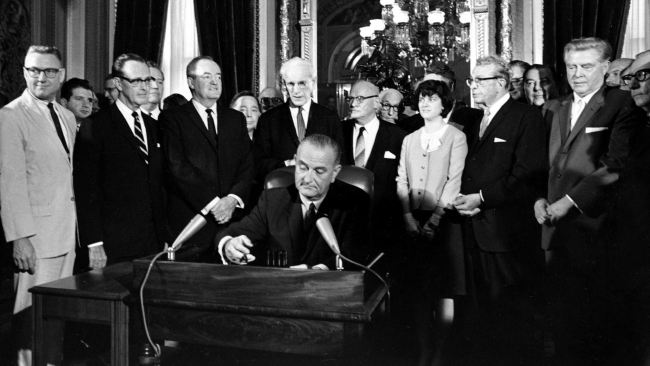
The hyperventilating critics of President Lyndon B. Johnson’s portrayal in the movie, Selma, need to chill out.

Joseph Califano Jr., a top assistant to Johnson, said, for example, that the movie took “dramatic, trumped-up license” with the truth and “falsely portrays President Lyndon B. Johnson as being at odds with Martin Luther King Jr. and even using the FBI to discredit him, as only reluctantly behind the Voting Rights Act of 1965 and as opposed to the Selma march itself.”

President Lyndon B. Johnson signs the Voting Rights Act of 1965

President Lyndon B. Johnson signs the Voting Rights Act of 1965

It’s a MOVIE, folks, not a documentary. And, by the way, where were all you historical accuracy nuts when the idolatrous TV and theater movies about John F. Kennedy omitted scenes of his sexual escapades and the hagiographies about his brother, Ted Kennedy, skipped over his responsibility for the death of Mary Jo Kopechne?

Oregon Cultural Trust

The billboard on Broadway urges donations to the Oregon Cultural Trust. “Donate/Match, get the whole match back,” the billboard says.

CulturalTrust-Billboard

The way the program works is you add up your donations for the year to one or more of the participating cultural nonprofits and then make a donation to the Cultural Trust in an equal amount. Your donation to the Cultural Trust will come back to you dollar for dollar at tax time when you claim your cultural tax credit.

In 2009, the Legislature stole $1.8 million from the Trust for Cultural Development account of the Oregon Cultural Trust to deal with state budget pressures. The Senate tried to defend itself by claiming it just took money from Oregon Cultural Trust license plates, not public donations.

Horsepucky! It was out-and-out theft.

So don’t trust ’em. If they were willing to break the public trust over a lousy $1.8 million, they’ll do it again. Don’t donate a dime to the Trust this year, or next. We both know the Legislature will raid it again someday.

Failing schools

In his Jan. 20 State of the Union address, President Obama said he wants the federal and state governments to cover 100 percent of the junior college tuition for students who meet minimal standards. Of course, the program wouldn’t really be free. Obama wants to raise taxes to pay for the fed’s share.

And the proposal ignores the fact that the biggest problem at community colleges isn’t the cost, but the dismal completion rate. According to the National Center for Education Statistics, at 2-year degree-granting institutions, only 31 percent of first-time, full-time undergraduate students who began their pursuit of a certificate or associate’s degree in fall 2009 attained it within three years. This graduation rate was just 20 percent at public 2-year institutions.

Portland Community College graduation

Portland Community College graduation

Part-time junior college students don’t do well either. Even when given four years to complete certificates and degrees, no more than a quarter make it to graduation day, according to a Complete College America report to the nation’s governors. The rest wander aimlessly through too many class choices, get committed to jobs, relationships mortgages and more and end up with nothing finished and backbreaking debt.

Of course, it’s not just the junior colleges that fail. Too many students arrive ill-prepared by their K-12 educations to succeed at higher education and channeled into remedial courses that don’t work.

Obama’s community college plan: free is a very good price

“Free is a very good price,” Portland pitchman Tom Peterson used to say in ubiquitous advertisements for his retail stores.

Barack Obama must have been listening to Tom, based on his new proposal that community college be tuition-free for students who meet minimal standards.

“Community college should be free for those willing to work for it because, in America, a quality education should not be a privilege that is reserved for a few,” Obama said on Jan. 9.

Portland Community College registration.

Portland Community College registration.

Of course, despite the tendency of Democrats to define things paid for by the government as “free” and spending on favored programs as “investments”, Obama’s community college proposal won’t really be free. Federal taxes and state revenue will need to pay the bill, so either something else will have to be cut or taxes will have to be raised.

All the beneficiaries of Obama’s proposed junior college program would need to do is attend community college at least half-time, maintain a 2.5 GPA, and make steady progress toward completing their program. What a deal.

The Federal Government would cover three-quarters of the average cost of community college and the states would be expected to come up with the rest.

How much will it all cost? Who knows? The White House said the free-for-all program would help about 9 million students each year and that it would save a full-time community college student $3,800 in tuition per year on average. If all 9 million students go full-time, that would translate into a whopping annual cost of $34.2 billion, with $25.6 billion of that coming from the feds and $8.6 billion from the states.

And then there’d be the additional facilities and teachers community colleges would need pay for to accommodate the influx of free-for-all students? Who would pay for that?

Obama says he’ll include details on the federal costs in his January 20 State of the Union address and in his proposed budget.

Whatever number he comes up with, it’s likely to grow year after year because community college costs will grow, particularly with guaranteed federal money flowing in.

Another legitimate concern is grade inflation. As noted earlier, to get the free tuition students would need to maintain a 2.5 GPA. Anybody who thinks that community college instructors would not be inclined to inflate grades, and even be subtly pressed to do so, to keep the money coming is naive.

According to the National Center for Education Statistics, the completion rate at 2-year degree-granting institutions is pretty abysmal. Just 31 percent of first-time, full-time undergraduate students who began their pursuit of a certificate or associate’s degree in fall 2009 attained it within 150 percent of the normal time required to do so, or within 3 years for a 2-year degree. The graduation rate was just 20 percent at public 2-year institutions.

Obama’s plan seems to assume that the main thing holding students back from satisfactorily completing coursework at community colleges is the cost, particularly of tuition. But many other factors are likely to be determinative, including poor K-12 preparation for a significant number of students and the need for remedial courses that many students can’t successfully complete. Making community college free for everybody won’t solve these problems.

In fact, without any skin in the game, students may be even less motivated to complete their studies.

Another glaring weakness of Obama’s proposal is the absence of any income qualifications for the tuition aid. Presumably the executive’s son and the gas station attendant’s daughter would both be equally eligible for the giveaway. At a time of severe budget constraints, what’s the point of that?

But why worry about the details. It’ll be free.