Marie Nahayo’s lifeless body was found hanging from a tree in the courtyard of her home in Burundi, East Africa on March 8 of this year.
Human rights monitoring groups flagged her case as part of a deeply worrying trend of “staged suicides”—disguised murders intended to cover up violent crimes. During that month alone, 11 lifeless bodies were found across the country all killed by extreme violence.
“March 2026 marks the continuation of a cycle of serious and systematic human rights violations in Burundi,” reported ACAT-Burundi, a human rights group. “The evidence gathered confirms that the right to life, a fundamental pillar of any rule of law, is repeatedly violated in various forms: assassinations, enforced disappearances and torture.”
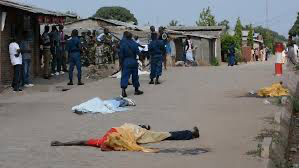
Bodies in the street in Cibitoke neighborhood of Bujumbura, Burundi (Human Rights Watch)
“At the same time, Burundi struggles with high malnutrition, limited access to clean water, sanitation, and healthcare, and frequent climate disasters that intensify hunger and poor living conditions,” says Third Country Deportation Watch.
The US State Department urges travelers to re-evaluate trips to Burundi due to safety and security risks, with the potential for political unrest and violent crime — such as armed robbery, carjacking, home invasions, and assault — existing nationwide.
Despite this perilous situation, on August 27, 2026, the United States detained and forcefully transferred 12 nationals from Cameroon, Angola, Mauritania, and Sudan to Burundi under a third country removal agreement.
“Such arrangements are taking shape in particular in Africa, where Mr. Trump has ushered in a new style of diplomacy that prioritizes deal-making over enforcing human rights and promoting democracy,” the New York Times reported in April 2026. “The policy is called “America First in Africa”.
”More than 23,000 people have reportedly been sent from the United States to 26 countries other than their own in 2026. According to Third Country Deportation Watch, at least 35 countries have signed agreements with the United States to take deported immigrants as the Trump administration pays other countries with documented histories of corruption and human rights abuses millions of dollars to take in deported people under “third country” agreements.
The Guardian recently reported that in August about 20 people were put on a flight in the US, shackled at the wrists, waist and ankles, and sent to Liberia as part of a major third-country deportation arrangement. When six of them refused to get off the plane, they were dropped off in another African country, Equatorial Guinea, “one of the world’s most repressive and corrupt regimes, where armed men took them to a former luxury hotel turned detention centre in the capital, Malabo, where they have been held ever since,” the Guardian reported.
On Sept. 18, the New York Times reported that two men deported to Equatorial Guinea by the Trump administration “were hooded, bound, beaten with guns and shoved down a flight of stairs recently by police officers at a remote hotel where immigrants are being held indefinitely, according to witnesses and lawyers. Videos and interviews show that police aggression inside the hotel escalated in recent weeks and peaked on Sept. 11. The police put burlap sacks over the two men’s faces, tied their hands with rope, beat them with guns and shoved them down the stairs as several deportees watched. The beatings were recounted by multiple witnesses and lawyers.
Equatorial Guinea agreed to take deportees from the UnitedStates, but has given them no legal rights or documents that would let them live or work there, even temporarily, leaving them in limbo.
About 1200 Venezuelan migrants have been sent to El Salvador, with many of them deposited in CECOT (the Center for Terrorism Confinement)—a notorious maximum-security mega-prison. Migrants have testified that they were shot with rubber bullets and beaten on a regular basis. Many of them have alleged that they were routinely raped and tortured.
ICE has also deported migrants originating from countries such as Afghanistan and Iran to volatile regions like the Central African Republic and South Sudan. The U.S. State Department warns “Do not travel to Central African Republic due to risk of unrest, crime, kidnapping, landmines, and terrorism” and “Do not travel to South Sudan due to risk of unrest, crime, kidnapping, and health risks”.
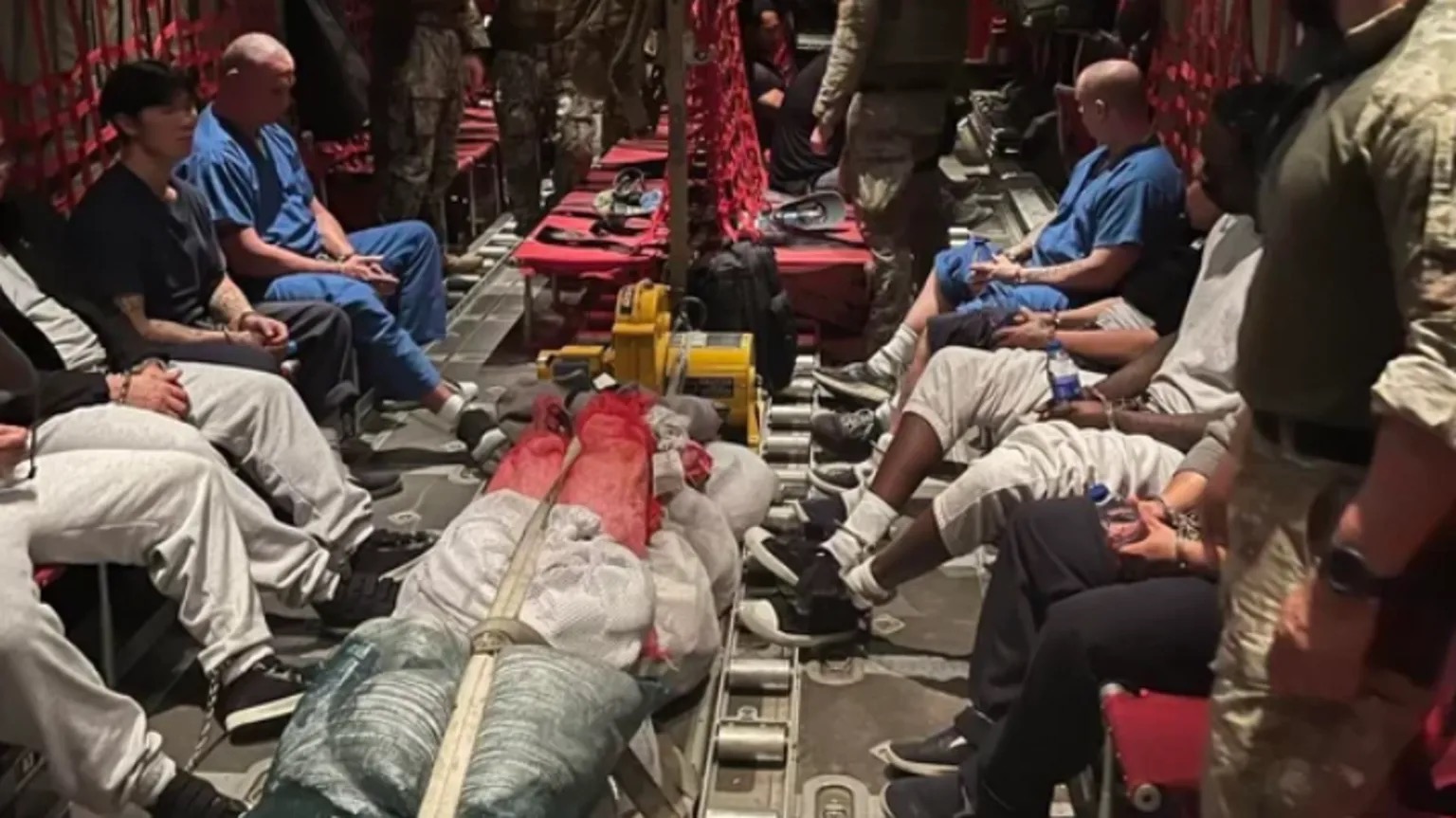
Detainees have also been sent to the African nation of Eswatini, where they’ve been held in a maximum-security prison without charge and with no access to legal counsel.
Not only are people being deported, but the administration is making the process as cruel as possible.
“There have been widespread reports of ICE agents using the threat of sending people to third countries in order to pressure them to sign and accept deportations to their home countries,” says Amnesty International. “The cruelty is by design. It is meant to force immigrants to live in fear …filled with fear that they’ll be arrested and deported to an unfamiliar and possibly unsafe place.”
“The cruelty is the point,” Adam Serwer wrote in a seminal essay in The Atlantic in October 2018. “President Trump and his supporters find community by rejoicing in the suffering of those they hate and fear,” he said.
 ThinkingOregon