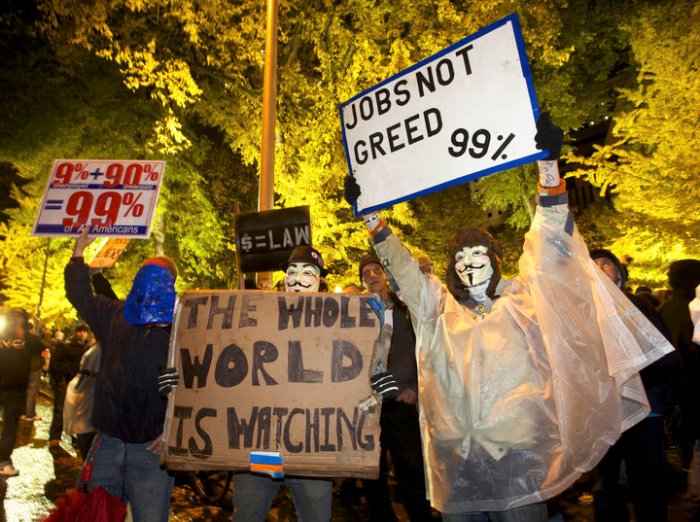
Kamala was ready: that little girl was me

thatLittleGirlWasMe_black_unisexFront__33504.1561695616

If you don’t think political campaigns are tightly scripted, consider what Kamala Harris said in last night’s Democratic debate.

Acronym, which analyzes digital strategy and investments across the political spectrum, noted after the debate that the biggest breakout moment was when Harris went after Joe Biden on desegregation. In doing so, she drew on a story of her personal experience as a young girl who was bused to school that became a viral video clip.

Some viewers might have seen that moment as a deeply personal, spontaneous reaction by Harris that revealed her genuineness. Hardly.

As Acronym noted, “Her campaign team seemed *very* ready for the moment, sharing well-designed graphics on Facebook, Twitter, and Instagram, and quickly pushing out related t-shirts with her quote from the stage, “That little girl was me,” for sale.”

To help things along, Harris plugged her website in her closing remarks.

So much for spontaneity.


Reparations: paying for the sins of our fathers

Ezekiel 18:19-20

Ezekiel 18:20 / Jeremiah 31:30.

Ezekiel 18:20

On June 19, 2019, a subcommittee of the House Judiciary Committee convened a hearing on H.R. 40, a bill that would study the feasibility of and proposals for reparations for descendants of slaves in America.

That was also Juneteenth, a day celebrating the emancipation of black people and “reminding the country of its original debt, and the debts it has since accrued,” Vann R. Newkirk II wrote in The Atlantic.

What, exactly, do current and future generations of Americans owe for the long past transgressions of others against blacks? Have we all inherited our fathers’ guilt?

In Germany, the descendents of a Nazi sympathizer have been gtrappling with a similar question.

Acknowledging their father’s anti-Semitism, his Nazi sympathies and the abuses that took place at a business he owned in Germany during the Nazi era (that is now a multi-billion dollar holding company), Albert Reimann Jr’s children  concluded they needed to make amends.

The New York Times recently reported that the Reimann children are donating to institutions that assist former forced laborers under the Nazis and doubling the budget of the family foundation to fund projects that “honor the memory of the victims of the Holocaust and of Nazi terror.”

“I have to do something,” said Martin Reimann, one of Albert Reimann Jr’s grandchildren.

Do Americans need to “do something,” to make amends for slavery and its ugly aftermath and, if so, should it take the form of reparations?

What should we do because of the sins of our fathers? How much culpability do living Americans have for the persistence of slavery in their country for so many years, for allowing the ideals of reconstruction to be undermined and tolerating racist practices to persist?

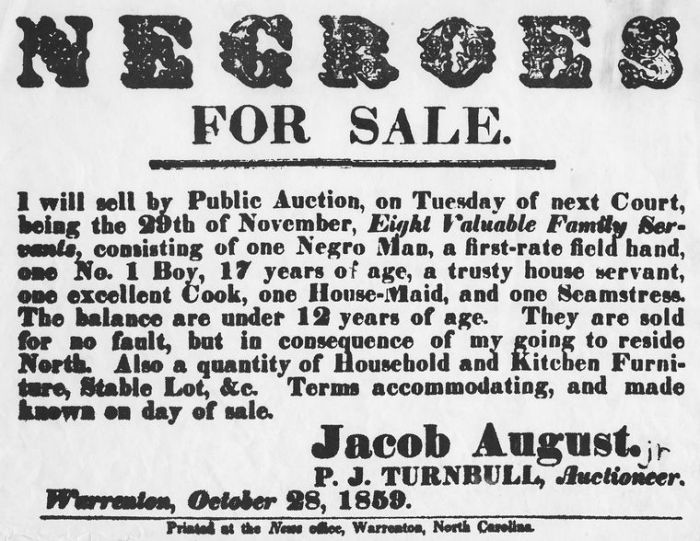
negroesforsale

As far back as 1964, Whitney Young, Jr., executive director of the National Urban League, called for reparations of sorts, “a domestic Marshall Plan” for blacks comparable to America’s massive aid to Western Europe after WWII. “Disadvantaged for three centuries,” Young wrote, “American Negroes require compensatory benefits . . . “

Ibram X. Kendi, Director of the Antiracist Research and Policy Center at American University, has argued, “To oppose reparations is to be racist. To support reparations is to be anti-racist. The middle ground is racist ground.”

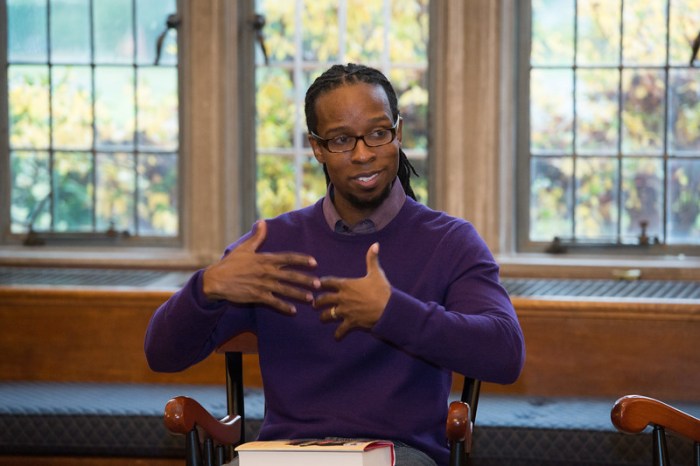
Dr. Ibram Kendi speaks during Morning Meeting

“To oppose reparations is to be racist.”  – Ibram X. Kendi


“Only an expansive and expensive compensation policy for the descendants of the enslaved and relegated of the scale Lincoln proposed for the enslavers and subsidized could prevent the racial wealth gap from compounding and being passed onto another generation,” Kendi wrote.

There’s no question that the evils of slavery left a deep stain on America and that reconstruction and subsequent racist policies have done damage to American blacks. It’s also clear that this country must come to terms with its legacy of slavery.

But as Lance Morrow, a senior Fellow at the Washington, D.C.-based Ethics and Public Policy Center, has said, a full-throated reparations debate in the United States will not be conflated with a positive and healing gesture; all it will do is “push the country to angrier extremes on either side, stimulating fresh antagonisms.”

Coleman Hughes, a black Quillette columnist, took a similar approach in testimony before the House subcommittee on June 19:

“If we were to pay reparations today, we would only divide the country further, making it harder to build the political coalitions required to solve the problems facing black people today; we would insult many black Americans by putting a price on the suffering of their ancestors; and we would turn the relationship between black Americans and white Americans from a coalition into a transaction—from a union between citizens into a lawsuit between plaintiffs and defendants.”

Sen. Bernie Sanders, D-NH, has already taken a similar position.”First of all, its likelihood of getting through Congress is nil.,” he said in 2016. “Second of all, I think it would be very divisive.”

Even Barack Obama has questioned the feasibility and advisability of reparations.

“Theoretically, you can make, obviously, a powerful argument that centuries of slavery, Jim Crow, discrimination are the primary cause for all those gaps,” President Obama said to Ta-Nehisi Coates in an Oct. 19, 2016 interview for The Atlantic. “That those were wrongs done to the black community as a whole, and black families specifically, and that in order to close that gap, a society has a moral obligation to make a large, aggressive investment, even if it’s not in the form of individual reparations checks, but in the form of a Marshall Plan, in order to close those gaps.”

“It is easy to make that theoretical argument,” Obama said. “But as a practical matter, it is hard to think of any society in human history in which a majority population has said that as a consequence of historic wrongs, we are now going to take a big chunk of the nation’s resources over a long period of time to make that right.”

An attempt to decide on the specifics of a reparations program would also be a nightmare. Who would even be eligible? If it’s individuals, who alive today has suffered as a direct result of slavery?

Coleman Hughes accepts the merit of reparations paid to Holocaust survivors, victims of internment during World War II, and victims of the Tuskegee experiments, for example, “but not reparations for “poorly-defined groups containing millions of people whose relationship to the initial crime is several generations removed.”

It’s unfortunate that so many of those competing for the Democratic presidential nomination have chosen to embrace reparations. It may enhance their appeal to the left wing of their party, but it likely alienates many more people. And now that the reparations cat is out of the box, everybody and their brother may demand reparations for past injustices.

An April 2019 Rasmussen poll found that just 21 percent of likely voters think taxpayers should pay reparations to black Americans who can prove they are descended from slaves.

Fox News poll that same month found that 60 percent of Americans oppose paying cash reparations to descendants of slaves and only 32 percent support it.  Even a July 2018 poll by Data For Progress, a progressive think tank, found that 68 percent were opposed.

But some of the Democratic candidates endorsing billions in reparations must figure that African-Americans will embrace the concept, and African-Americans are a good share of likely voters in South Carolina, one of the early primaries, and on Super Tuesday, March 3..

Frankly, buying votes was much cheaper and made more sense when they only handed out free beer at the polls.


Cap-and-Trade: Oregon Republicans are blowing it (Just like they did with last walk-out)

oregonC02Emissions

Oregon Senate Republicans stayed away from the Capitol Thursday, preventing a vote on HB 2020, a key bill for Democrats that would cap greenhouse gas emissions. The walk-out is a mistake, just as was another walkout in May.

Resolution of the last Republican walk-out in May 2019 involved an agreement by Democrats to sacrifice a bill that would have tightened vaccine exemptions and a gun reform bill that would have tightened gun restrictions.

The Republicans might have placated some of their anti-vaccine and anti-gun control base, but those voters were never going to switch political sides anyway. Moreover, the anti-vax crowd is actually pretty small. Just 17% of Americans believe that “parents should be able to decide not to vaccinate their children, even if that may create health risks for other children and adults,” according to Pew Research.

Resolution of the May Republican walk-out also involved included a pledge by the Republicans not to walk out again for the rest of the 2019 session. The new walk-out compromises that commitment.

The Republicans claim that the agreement was conditional on them having opportunities to have a meaningful impact on HB 2020 as it moved forward. So much for that..

A key Republican goal is to get an emergency clause in the cap-and-trade bill removed. The clause would allow the bill to go into effect immediately after Gov. Brown signs it, preventing opponents from trying to refer the bill to voters for a costly and contentious fight.

Removal of the emergency clause could mean the Democrats would be facing iffy public votes on two major bills dear to their hearts, the cap-and-trade law and the Student Success Act, which will impose a gross receipts tax on Oregon businesses to fund $2 billion in education spending every two years.

A Senate agreement to remove the emergency clause would also mean sending the bill back to the House for another vote, a potentially time-consuming move that could mean no resolution before the Legislative session is set to end on June 30.

Frankly, the Democrats would be slitting their own throats if they agreed to remove the emergency clause. Oregon has a high environmental profile, but winning a public vote on the cap-and-trade law, with its projected cost of $550 million just in the first year and a sweeping progressive spending agenda, would be a heavy lift. The projected increase in gasoline and residential natural gas prices alone could turn off voters.

Knowing all this, the Democrats are unlikely to capitulate this time around.

Risky business: Corporate messaging and abortion.

Remember when people used to buy products because they were well made, priced right and met their needs?

Corporate meddling in politically contentious issues to signal virtue of one kind or another has put an end to that.

Businesses have been trying to position themselves as good corporate citizens for years in order to bring about a more favorable operating environment, but earlier efforts focused on neutral moves like raising public awareness of such things as charitable contributions, employee volunteerism and hiring veterans.

Recently, however, companies have been more willing to take public stands on truly controversial issues in order to raise their public profile… and sell more products.  And it just happens to be that federal and state lawmakers are simultaneously using abortion politics to rile their voters ahead of the 2020 election.

An example of this new outspokenness is the response to restrictive abortion legislation recently enacted in several states, including Missouri, Georgia, Mississippi, Kentucky, Alabama, and Ohio.

On May 7, 2019, Georgia Governor Brian Kemp signed a law that would ban abortion as soon as physicians can detect a heartbeat, which can be as soon as six weeks (before some women are aware they’re pregnant).

brianKempabortion

Georgia Governor Brian Kemp signing abortion law.

“Georgia is a state that values life,” Kemp said at the bill signing. “We protect the innocent, we champion the vulnerable, we stand up and speak for those that are unable to speak for themselves.”

On May 15, Alabama’s governor, Kay Ivey, signed a law defining a fetus as a legal person “for homicide purposes” and making performing an abortion in the state a felony.

Netflix, Disney and WarnerMedia responded that they might stop producing television shows and movies in Georgia, and multiple actors threatened that they wouldn’t work in Georgia if the state’s law takes effect.

“I think many people who work for us will not want to work there, and we will have to heed their wishes in that regard,” said Disney CEO Bob Iger. “… we will work with the ACLU and others to fight it in court,” said Netflix chief content officer Ted Sarandos.

Earlier this month, leaders of more than 180 businesses, including Maria Pope, President and CEO of Portland General Electric, signed a letter that ran as an ad in The New York Times opposing the restrictive abortion laws enacted recently in multiple states.

mariapopePGE

Maria Pope, President and CEO of PGE, signed the “Don’t Ban Equality” letter.

“It’s time for companies to stand up for reproductive health care,” the Don’t Ban Equality letter said. Restricting abortion is “bad for business.”

dontbanequality


A problem with corporate virtue signaling like this as a marketing strategy is that it assumes the company has other people’s best interests at heart, that it’s not driven by profit seeking. There’s a risk that even altruistic millennials passionate about social causes will see through that, increasing cynicism, not brand loyalty.

Another issue with corporations trying to sell themselves as social justice warriors is that, as Tara Isabella Burton wrote in Vox, companies are pushing the spending of money “as a ritualistic as well as transactional act.” That can backfire. Purchases based on product quality are more likely to be sustained than those based on ever-changing corporate advocacy.

Public policy positions taken by corporate leaders on social issues may also not reflect the views of many employees or consumers, despite the presumptions of executives that others must be in alignment.

On abortion, for example, polling shows that Americans are actually fairly evenly split between those who identify as pro-life and those who identify as pro-choice. A majority of Americans, including many Democrats, support abortion restrictions in the second and third trimesters. In short, corporate honchos are mistaken if they believe most Americans are unrestricted abortion supporters.

As columnist David Byler wrote in the Washington Post, “… neither Republican nor Democratic voters unanimously want the total victory that activists on both sides are agitating for. Republicans are generally pro-life and Democrats are mostly pro-choice, but there’s real dissent among the rank-and-file voters in both camps. Our constantly shifting status quo may be unnerving to the most engaged pro-choice and pro-life advocates. But whatever they might say, the average U.S. voter wants a negotiated compromise in the abortion wars.”

Corporate evangelizing on all sorts of social issues can run afoul of public and employee attitudes, particularly with toxic social media serving as a megaphone for unhinged mobs of ever-smaller tribes determined to play a role in a debate.

Ideology-driven public positioning can also alienate employees and potential hires who are not in sync with a company’s cultural alignment or simply value open thinking.

”Internally, if leaders can create safe avenues for employees with different values and beliefs to voice their ideas (about CSR practices, products, or other business-related issues), this may lead to greater innovation, not to mention goodwill among those who value ideological tolerance as an over-arching feature of their workplace,” several U.S. business professors wrote in United States Politics and Policy.

Then there’s the fact that organizations and individuals who praise corporate intervention on sensitive public issues are generally much less enthused when the intervention has a conservative bent.

A striking example of this is the left’s outrage over comments made in July 2012 by Dan Cathy, Chick-fil-A’s CEO, to the Baptist Press. Cathy said he was “guilty as charged” in his support of what he described as traditional marriage. “We know that it might not be popular with everyone, but thank the Lord, we live in a country where we can share our values and operate on biblical principles,” Cathy said.

To say the least, all hell broke loose, with liberals and LGBTQ activists condemning Cathy and endorsing Chick-fil-A boycotts.

Controversy resurfaced with a March 2019 report by the progressive organization Think Progress that the chain’s foundation donated $1.8 million in 2017 to groups Think Progress said have anti-LGBTQ agendas.

Then there’s the shifting attitudes in the corporate world, which make executives unreliable moral leaders. “Americans ought to be cautious before making corporations their moral compass or primary vehicle for reform,” Adam Winkler, a professor of law at UCLA, wrote recently in The New Republic. “The policy positions taken by U.S. companies on social issues today lean in the direction of inclusion. But tomorrow might be different, if the country—or a business’s particular consumer base—turns in a different direction.

If all this keeps up, you may soon be nostalgic for the days when companies tried to sell their products with simple “plop, plop, fizz, fizz” jingles.


The Democratic presidential candidates and Oregon: they could care less

Digital advertising is one of the key elements of the campaigns of Democrats running for their party’s 2020 presidential nomination. Data show that some candidates are shouting, while others are barely whispering.

According to Acronym, a progressive non-profit that tracks political digital spending, the candidates are paying Facebook and Google millions for digital ads, but spending in Oregon is barely a blip, .

Sen. Elizabeth Warren (D-MA) is the biggest spender so far.  She has spent $1,688,706 on digital ads (Facebook: $1,218,206; Google: $470,500) since launching her campaign.

WarrenLaunch

Senator Elizabeth Warren speaks during her presidential candidacy announcement event at the Everett Mills in Lawrence, MA on February 9, 2019.

The second biggest spender on Facebook and Google digital ads is Sen. Kamala Harris (D-CA). She has spent $1,640,339 (Facebook: $1.2 million; Google: $438,000).

Altogether, the Democratic candidates have spent $12,805,165 on Facebook and Google digital ads since launching their individual campaigns.

digitalspending

Yes, President Trump has spent $9,080,994, outspending every Democratic candidate.

What states have been targeted with all that money?

If you look at the top five states targeted by each of the candidates with Facebook ads, California takes the lead. It’s one of the top five targets of 15 candidates. Then there’s Iowa, which has its caucuses on Feb. 3, 2020.  It’s in the top five lists of nine candidates. Next is Texas, one of the top five states of eight candidates.

Even though New Hampshire has its primary early on Feb. 11, 2020, it’s only in the top five spending list for Facebook ads of three Democratic candidates: Pete Buttigieg, John DeLaney; and Tulsi Gabbard.

Then there’s Oregon. Oregon’s not in the top five list of any of the Democratic candidates and it’s only in the top ten list of two, Bernie Sanders and Julian Castro. But even Sanders has applied only 3.3% ($41,502) of his Facebook spending to Oregon and Castro only 2% ($8,379).

The lack of digital attention to Oregon may well be because the state’s primary isn’t until May 19, 2020, real late in the game, and it has only 52 delegates. If a candidate is trying to harvest a lot of delegates, focusing on the states with earlier primaries, including Super Tuesday, March 3, when 1433 delegates will be at stake, makes more sense.

Sorry, Oregon. You just don’t matter.


Addendum, May 5, 2019

The Democratic National Committee announced in late April that 2020 presidential candidates will each need to hit 130,000 donors to qualify for the third and fourth televised debates in the fall. Vice According to the Columbia Journalism Review, Vice News’s David Uberti reported that the high threshold may force longshot contenders to spend more on Facebook ads than they get back in donations—limiting their resources for more traditional forms of campaigning. In all, political ad spending is expected to near the $10-billion mark in 2020, up from $6.3 billion in 2016. The Wall Street Journal’s Alexandra Bruell has the figures.


Unionizing Burgerville: workers of the world unite…then quit.

Time passes. Things change.

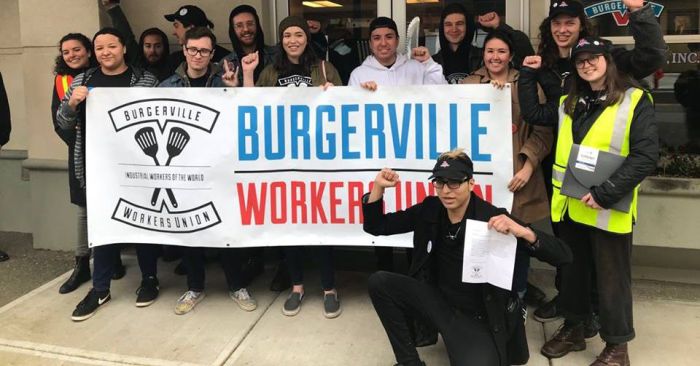
That’s certainly been the case at Burgerville, where workers at the company’s restaurant at 3504 SE 92nd Ave. in Portland voted 18-4 in April 2018 to form a union.

burgervilleworkersunion

Over the next 12 months, employees at four more Burgerville sites followed suit:

May 13, 2018: 19119 SE McLoughlin Blvd. site – 17 yes, 5 no

Dec. 11, 2018: 1122 SE Hawthorne Blvd. site –  13 yes; 9 no

April 3, 2019: 8218 NE Glisan St. site – 15 yes, 9 no

April 4-5, 2019: 1135 NE Martin Luther King Jr Blvd. site – 14 yes, 7 no

Adding it all up, 111 Burgerville employees at a total of five locations have voted on whether to form a union.

Burgerville says it hasn’t kept track of which specific employees participated in the union votes, so it can’t quantify how many of the 111 voters are still employed by the company. It has determined, however, that of the 142 employees who were working in the five unionized locations during their respective votes, only 94 of them, or 66%, are still employed at Burgerville.

Furthermore, the lead organizers of the unionizing effort at three of the five restaurants no longer work at Burgerville. Two resigned their positions less than one month following their locations’ votes and a third organizer just resigned.

The fast-food industry is currently grappling with record employee turnover. According to MIT Technology Review, the turnover rate in the fast-food industry is 150%. In other words, the typical fast food restaurant is seeing its entire workforce, plus half of its new hires, replaced in 12 months.

Burgerville is doing better, perhaps because of its expansive benefits, including health insurance, vacation pay and financial wellness training. Still, the annual turnover rate across its 42 restaurants in 2018 was 83% (up from 71% in 2017), according to the company.

What all this means is:

  • Three of the five union organizers are no longer working at Burgerville.
  • A significant share of all the Burgerville employees who voted in the five union elections since April 2018 are likely not still working at the company.
  • It is highly likely that few of the 142 employees who were working at the five unionized locations during their respective votes will still be employed at Burgerville 12 months from now.
  • Few of the employees at the five Burgerville locations 12 months from now will have participated in the original votes to unionize.

Why, then, should the employees at the five locations one year from now be forced to be members of a union?

Unfortunately, future employees at the five Burgerville  restaurants probably won’t be given an opportunity to vote on whether to be represented by a union and, if so, which one.

One option to address this situation could be automatic representation elections whenever employee turnover by a bargaining unit over time exceeds a certain percentage. A bill introduced in Congress in 2017 (H.R. 2763 – Employee Rights Act) proposed 50 percent be the trigger.

Another possible solution, suggested by both Samuel Estreicher, a Professor of Law at New York University School of Law, and Michael Oswalt, an Associate Professor of Law at the Northern Illinois University College of Law, is regularly scheduled union representation elections the same way we regularly schedule political elections.

Estreicher, who called his proposal “easy in, easy out,” suggested that every two or three years the employees in a unit, after an initial minimal required showing of interest, would have an opportunity to vote in a secret ballot whether they wish to continue the union’s representation, select another organization, or have no union representation at all.

Oswalt argued that regularly scheduled union representation elections would be better than the simple continuation of the status quo.

“…workplace culture would slowly shift, creating an atmosphere where workers would feel internal pressure to, at the very least, think about the ramifications of selecting or not selecting a bargaining agent,” Oswalt wrote.

That would  be a good thing for Burgerville workers.


Scofflaw City: Eugene’s blizzard of unpaid parking tickets

 If you see a notice on your windshield that says, “Parking Fine,” it’s not a compliment.
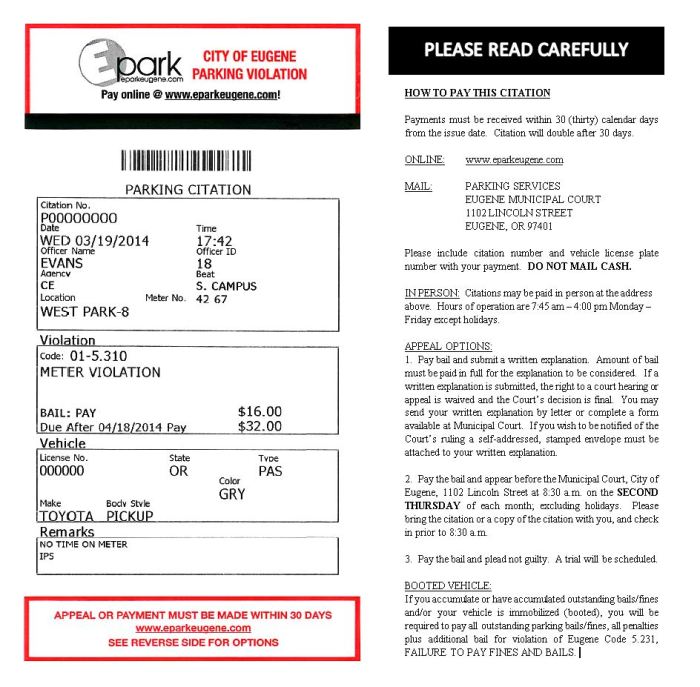
eugeneparkingticket

Are you a University of Oregon student who has skipped paying a Eugene parking ticket? If so, you’re not alone.

It’s like the wild west out there, with thousands of students, locals and out-of-towners ignoring their parking tickets in Eugene.

In 2018, the city declared 8,356 parking tickets delinquent and sent them out for collection. Over the past four years the total sent out for collection reached a staggering 91,621 tickets. And still, a lot don’t get paid.

The city says it doesn’t track unpaid parking tickets by geographic area, so it doesn’t have data on where all the unpaid tickets were handed out, whether the University of Oregon district, for example, has a high delinquency rate.

Frustrated with all the scofflaws and sensitive to the loss of the ticket revenue, for the past four years the city has been sending delinquent parking tickets to Austin, TX-based Linebarger Goggan Blair & Sampson, LLP.  Linebarger, a collection agency masquerading as a law firm, is one of the nation’s largest government debt collectors.

“We help communities thrive,” the firm says.

With 46 offices and 112 attorneys across the country, the firm is a money-raising behemoth in the parking ticket business.  It claims to collect $1 billion annually in delinquent taxes, traffic citations, parking tickets and tolls.

Some other Oregon cities have contracts with different collection agencies. Bend and Salem for example, have contracts with Professional Credit Service (PCS), a Springfield, OR-based company.

For Bend tickets, PCS adds collection fees of 23% of the total balance and keeps that amount when collecting on a delinquent parking ticket.

In Salem’s case, PCS collects 25% of the principle amount, while the City receives the principle. In cases where there is interest, the City and PCS split this amount evenly.

If a delinquent $10 Salem parking ticket is sent to PCS, the total due becomes $12.50. If 10 cents in interest is assessed before the bill is paid, the total due becomes $12.60. PCVS would retain $2.60 of that and the city $10.10.

Under Eugene’s arrangement with Linebarger, the firm can retain a 20 percent commission of the total amount collected for its work.

Example: 

  • Parking citation: $100.
  • Accrued interest: $21.60 (Interest is calculated at a rate of 18% from the date the account is referred to Linebarger for collection until paid in full)
  • Total owed: $121.60 (Parking fine + Accrued Interest).
  • Commission to Linebarger: $24.32 (20% of $121.60)
  • Payment to City of Eugene: $97.28

If the city’s Parking Enforcement Department places an immobilization device on a vehicle for unpaid fines that have been sent to Linebarger for collection, those delinquent accounts are recalled back to Eugene’s Municipal Court. In such cases, the city isn’t obligated to pay Linebarger a commission for the collection of the citations.

The city considers it reasonable for Linebarger to pursue a collection claim for up to two years. That’s one reason why Linebarger has a reputation for being persistent in its mail and call center collection efforts.

Over the past four years, Eugene has sent delinquent parking tickets with initial fines of $3,072,918 to Linebarger for collection, according to data provided by Jill Wright, a Court Operations Specialist with the City of Eugene, in response to public records requests.

Joe Householder, a Managing Director and spokesman for Linebarger, said the firm’s collection efforts have allowed it to remit $911,003.00 to the city. That represented $627,420.02 in fines and $283,583.98 of interest charges, the city said. This means Linebarger recovered just 20 percent of the original delinquent fines, plus interest.

In other words, a whole lot of delinquent tickets still don’t get paid, even after persistent and extensive efforts to locate delinquent miscreants, forceful letters, and aggressive call centers.

Our overall results are what matter and our overall results are routinely strong,” Householder said.

“Some accounts take a day to resolve; some take years,” he added. “In some cases, we’ll connect with the person on our first outreach attempt but they’re not ready to resolve the matter – maybe they’re waiting till they get their tax refund, or some other expected money comes in. In those cases, we have to stay in touch week after week or month after month and remind them of the debt.”

“In other cases,” Householder said, “just finding the person can take a long time. They’ve moved multiple times, they’ve remarried and changed their name – any number of factors can make it a challenge.”

So, don’t assume you’re safe because you’ve managed to escape Linebarger’s reach so far. “We continue to pursue collections of the remaining outstanding tickets,” Householder said.

Furthermore, if Linebarger fails to collect the balance on your delinquent parking ticket, and your vehicle is found on a city lot or street, the city may still immobilize the vehicle with a boot device.

Linebarger collects a wide array of receivable types for government clients, primarily payments due on taxes, traffic citations, parking tickets, and tolls.

Much of Linebarger’s work is pretty simple. In Eugene’s case, the Court forwards a record of delinquent parking tickets and Linebarger follows up with letters and pestering recorded phone calls to miscreants urging them to pay up.

“Partnering with Linebarger allows our clients to focus their resources on their core responsibilities, while we focus on locating and contacting the relative few who have continued to ignore their delinquent parking tickets,” the firm’s website says.

To counter the thuggish image of collections agents, Linebarger portrays itself as a company with “a big heart beneath that law firm veneer,” and says its work collecting unpaid bills is helping communities thrive by raising money for parks, schools and essential service.

But it hasn’t been able to avoid some criticism.

For some unexplainable reason, the Better Business Bureau (BBB) gives the Linebarger firm an A+ rating, while at the same time giving it the lowest possible rating, just one star of a possible five, based on customer reviews. Hundreds of complaints have been filed with the BBB against Linebarger nationwide. Complaints range from inaccurate notices of delinquent accounts and rude call center employees to harassing collection calls and allegations of fraudulent charges.

“I am being charged for parking violations in Denver, CO,” wrote one BBB reviewer. “I live in Oregon and have never been to Colorado.”

“I got a letter, that I find threatening, regarding an unpaid parking ticket from 12 years ago,” wrote another reviewer. “Give me a break!”

Yelp reviews are similar, with an overall rating of one star out of 5.

What do Eugene’s Parking Services Manager, Jeff Petry, and City Manager, Jon Ruiz, have to say about all this? Nothing.

Despite repeated requests that they answer a series of questions relating to the parking ticket and collections program, neither responded. So much for government transparency.


______________

Parking Ticket Fines in Eugene

Overtime Violations

Parking meters and time limits are placed in high use parking areas of Eugene to encourage turnover which increases accessibility for everyone and supports local businesses that rely on street parking for customer access.

Time limit citations in Eugene are $16.

Other Violations


 Violation Fine Amount
Parking in Space Reserved for Persons with Disabilities
First Offense
Second Offense
$200
$400
Storage of Vehicles on Street /Abandoned Vehicle
First Offense
Second Offense
$25
$50
Parking on Sidewalk, Crosswalk, or in Front of a Driveway $25
Parking in a Yellow, Bus, Taxi or Tow-Away Zone $25
Parking on wrong side of the street (facing the wrong way) $25
Parking in Bike Lane $40

For more information on parking fines, see the Municipal Court’s Presumptive Fine Schedule.

Fines Increase If Not Paid Within 30 days 
Parking citations (tickets) that are not paid or contested within 30 calendar days will double. Citations not paid within 120 days will be sent to a collection agency, and interest will begin to accrue.

Source: City of Eugene, https://bit.ly/2tKY7wC


Will The Oregonian survive?

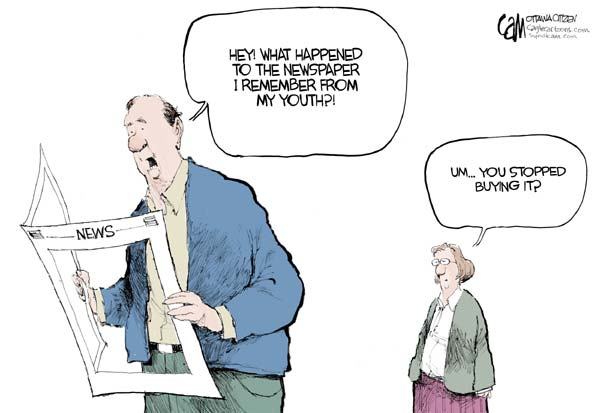
Local news coverage is dying.

dyingnewspapers

The latest casualty — the entire staff of the New Orleans Times-Picayune. All 161 of them, , including reporters and editors, are losing their jobs.

On May 2, the Times-Picayune’s rival, the New Orleans Advocate, bought the Times-Picayune and plans to merge the papers under a single masthead and website. The seller — Advance Local Media LLC, the parent of Oregonian Media Group.  Even winning  two Pulitzers for its coverage of Hurricane Katrina didn’t serve the Times-Picayune.

Randy Siegel, CEO of Advance Local, assured the New York Post’s Keith J. Kelly that the sale of the Times-Picayune was a one-time thing. But what if it’s not? Is The Oregonian/OregonLive at risk, too?

Daily newspapers like the Times-Picayune and The Oregonian were once pervasive throughout the United States, with many communities having both a morning and evening paper, and sometimes a weekly local paper as well. But daily local newspapers are now in decline, dealing with cratering circulation, a reduction in print editions and drastic staff cuts.

According to the Wall St. Journal, nearly 1,800 US newspapers shut down between 2004 and 2018, including more than 60 dailies and 1,700 weeklies. Hundreds of communities have lost their local newspapers. Between 1,300 and 1,400 communities that had newspapers of their own in 2004 now have no news coverage at all, according to the UNC Center for Innovation and Sustainability in Local Media.

It was once unthinkable that papers such as the Cincinnati Post, the Albuquerque Tribune, the New York Sun, the Rocky Mountain News, and the Tampa Tribune would close, but they are all gone now. Nicco Mele, former director of Harvard’s Shorenstein Center, predicts that half of remaining titles will disappear within the next two years.

Newspaper consumption in Oregon is already dropping precipitously, with daily and weekly circulation combined falling from 1.4 million in 2004 to 796,000 in 2019, the UNC Center says.

Some of the remaining Oregon papers are what the UNC Center calls “ghosts”  because their newsroom staffing has been so dramatically pared back, often by more than half,  that the remaining journalists cannot adequately cover their communities.

In January 2018, when Willamette Week broke that The Oregonian was laying off another 11 newsroom staffers, the Portland Mercury observed, “After repeated rounds of layoffs, it’s hard to imagine The Oregonian having anywhere else to cut. But the news business’s grim prognosis marches on, so the cuts continue.”

“For those inclined to point fingers at The Oregonian or our parent company Advanced Publications: Ad revenue across our industry continues to plummet precipitously. Layoffs in local newsrooms are happening everywhere. And it fucking sucks,” Oregonian reporter Shane D. Kavanaugh tweeted.

Compared with its breadth and depth in the 1990s, The Oregonian/OregonLive has become a ghost. When I was a business reporter at The Oregonian in the 1980s and 1990s, the business team of reporters and editors was a robust 8-10 individuals covering a panoply of topics from energy and healthcare to labor and retail. OregonLive’s list of staff today includes just one reporter, Mike Rogoway, specifically devoted to business coverage , unless you also count Jeff Manning, who is listed as a reporter covering Health Care Business, OHSU.

Sports coverage is still robust, with 12 reporters and editors, but just one reporter, Gordon Friedman, is specifically assigned to covering everything going on at Portland City Hall.

When the Jan. 2018 layoffs were announced, The Oregonian/OregonLive’s editor and vice president of content, Mark Katches, said to the paper’s staff, “You’re probably asking yourself, when will these cuts end? I wish I could answer that. Although we have made progress growing our digital audience while also producing award-winning, and important journalism, the revenue picture continues to pose challenges for our company – as is the case across the media landscape.”

In August 2018, Katches abandoned ship himself to take a new job as executive editor of the Tampa Bay Times, another paper that has had its own struggles both before and since it acquired its competitor,  the Tampa Tribune, in 2016 .

With all the strife in the newspaper business, is The Oregonian/OregonLive ripe for the same fate as the Times-Picayune.

Don’t think it can’t happen.


Local school board elections: local no more.

Statewide political action committees (PACs) getting involved in local school board elections?

Somehow, it just doesn’t seem right.

On March 15, 2019, NARAL Pro-Choice Oregon’s PAC announced its endorsement of 15 school board candidates in the state. One was John Wallin who’s running for re-election to the School Board of Lake Oswego, where I live.

NARAL+Pro-Choice+Oregon_1548349301

NARAL says it “works to advance the most progressive pro-choice policies in the nation.” All 15 of the candidates it endorsed “…have affirmed their commitment to advancing reproductive health equity for students in their school districts,” the PAC said.

“I’m very excited to have this endorsement,” Wallin said at an April 29 school board candidate forum. “This is a group that supports prevention of sexual violence and comprehensive health education. I sought it out, I met with them and talked about my beliefs. They stand for things I believe in.”

johnwallin

John Wallin

According to NARAL, it makes contributions to local elections such as for the Lake Oswego School Board because “Pro-choice school board members have the unique opportunity to protect and expand access to comprehensive healthcare, including access to contraceptives and evidence-based sexuality education for Oregon’s students.”

Wallin’s campaign website , however, says nothing about his views on NARAL’s positions. The only thing it says on student health and safety is:

 School should always be a place for learning and not fear and anxiety from concerns about physical safety, bullying, and schoolwork. We should work to strengthen the physical security of our buildings, mental health services, and student nutrition.”

Wallin’s submission to the Voter’s Pamphlet says nothing about his support for NARAL positions either.

Wallin didn’t say at the forum whether he also sought out the support of:

  • The United Food & Commercial Workers Union Local 555, which has made an in-kind donation of $1390.40 for literature, brochures and printing, or
  • The Oregon School Employees Association (represents the school district’s classified employees) which made a $6,500 cash contribution to his campaign. or
  • State Senator Robert Wagner, D-Lake Oswego, who made multiple in-kind contributions totaling $2,395.22 for postage, plus a $1,000 cash contribution.

Taken together, the contributions above total $11,285.62, almost half of the $22,637.16 received by the Friends of John Wallin campaign committee as of  April 25, 2019.

What’s next, local school board races supported entirely by national unions and the Democratic National Committee?

The CEO-worker pay ratio: worse than useless

The annual release of data required by the SEC on the pay ratios of CEOs and the median worker at their company is out.

clownpay

The data show that Nike CEO Mark Parker makes a heck of a lot more than a typical Nike employee. The estimated ratio of Parker’s annual total compensation ($9,467,460) to the median annual total compensation of all Nike employees ($24,955) was 379 to 1 in fiscal year 2018.

Comcast CEO Brian Roberts did even better in 2018. His compensation package ($35.003,000)compared with Comcast’s median employee’s compensation ($82,205) resulted in a CEO pay ratio of 426 to 1.

As expected, the release of the data is spurring all sorts of overheated grievances.

“Look at all the overpaid, greedy CEOs.” “The facts are in. Inequality is destroying America. This proves it.”

There’s no question that CEO compensation has been escalating.

ceotoworkerratioi

The problem is the comparative CEO-worker data generated in response to the Dodd-Frank Wall Street Reform and Consumer Protection Act and implemented by the SEC is seriously flawed, misleading and unreliable and its collection a colossal waste of businesses’ time and money.

Passed in 2010 during the Obama administration, the pay ratio requirement took effect in 2017. Ostensibly, the purpose was to ensure that the devastating 2008 financial crisis wouldn’t be repeated, to increase the transparency of executive compensation and to provide investors with another piece of information to consider when determining whether the compensation of their CEO is appropriate.

“This simple benchmark will help investors monitor both how a company treats its average workers and whether its executive pay is reasonable,” said Sen. Robert Menendez (D-NJ), who introduced the pay ratio provision in the Dodd-Frank Act.

But the numbers really say nothing useful about how a company treats its workers or whether the CEO’s pay is reasonable.

That’s partly because the real motive of the pay ratio advocates was to give the left a tool to propel its inequality agenda. The proponents wanted to promote envy and class warfare, to argue that the once-great America as a land of opportunity is vanishing and that more aggressive government intervention guided by liberal principles is necessary.

As SEC Commissioner Michael S. Piwowar said in a dissenting statement on the pay ratio rule when it was approved, “Today’s rulemaking implements a provision of the highly partisan Dodd-Frank Act that pandered to politically-connected special interest groups and, independent of the Act, could not stand on its own merits. “

“The bottom line is that this is one of the sillier and more pointless disclosures that I have ever seen,” David Yermack, a professor of finance at NYU’s Stern School of Business, told The Atlantic.

Nike, for example, spelled out all sorts of qualifiers in disclosing its pay ratio figures:

nikeparkerpayratiop

“The SEC rules for identifying the median compensated employee and calculating the pay ratio based on that employee’s annual total compensation allow companies to adopt a variety of methodologies, to apply certain exclusions, and to make reasonable estimates and assumptions that reflect their compensation practices. As such, the pay ratio reported by other companies may not be comparable to the pay ratio reported above, as other companies may have different employment and compensation practices and may utilize different methodologies, exclusions, estimates, and assumptions in calculating their own pay ratios.”

The ridiculousness of the whole exercise is illustrated by some of the sharp swings in some companies’ ratios from 2017 to 2018, as the Wall Street Journal recently reported.

Shipbuilder Huntington Ingalls  Industries Inc. and potash producer Mosaic Co.reported, for example, that the typical worker got half as much in 2018 as the year before. At Honeywell International Inc.,the data showed the typical worker’s compensation was 33 percent higher in 2018 than 2017.

The fact is, every company calculates the pay ratio differently, partly because the SEC rule gives companies wide leeway in identifying median workers.

Some year-to-year ratio fluctuations reflect acquisitions or spinoffs that revamp a company’s workforce. Others are attributable to whether the median employee has a traditional pension plan, or new ways of identifying that middle employee.

Companies don’t have to account for independent contractors if they don’t set their pay, for example, so, a company with a highly paid CEO and loads of low-paid independent contractors can massage its numbers to look better.

Companies can also manipulate the numbers by identifying their median worker in a variety of ways.

“To identify the median employee, the rule would allow companies to select a methodology based on their own facts and circumstances,” the SEC rule says. “A company could use its total employee population or a statistical sampling of that population and/or other reasonable methods. A company could apply a cost-of-living adjustment to the compensation measure used to identify the median employee.”

The pay ratio numbers also can fluctuate when there are different types of businesses. For example, at Goldman Sachs, an investment banking, securities and investment management firm where most employees are highly educated and highly paid professionals, the pay ratio figure will obviously be lower than at McDonalds where most employees are less educated and earn modest wages.

Businesses that employ a lot of part-time or seasonal workers, or that employ a lot of foreign workers in countries with comparatively lower wages, will also have high ratios.

Then there are the compliance costs borne by companies collecting and submitting the data. “The SEC total initial cost of compliance for all 3,571 registrants affected by the Section 953(b) requirements is expected to be approximately $1,315 million, “ the SEC  said in the Final Rule in 2015.

To top it all off, the disclosures required by the SEC rule do little to help investors make decisions on trades. Not only is the pay ratio calculation based on wildly different data used by different companies, but CEO-worker pay ratios are not especially reliable indicators of how a company will perform.

It’s not that reporters and editorial writers don’t know the pay ratio numbers are pretty much worthless and politically motivated. It’s just that a story that gives them a chance to rail about inequality is too much to miss.

As Stanford University Professor Joseph Grundfest said when the SEC rule was finalized in 2015, “Ultimately, the ratios that companies will disclose in their SEC filings will not be grist for meaningful debate so much as fodder for shocking headlines. Individually, factoids about executive compensation can be truly, deeply bananas, and some media outlets capitalize on that.”

Portland’s pay ratio surcharge – more lunacy

Occupy Wall Street protesters demonstrate in Portland

Protesters demonstrate in Portland.

Given the unreliability of the pay ratio numbers, Portland’s pay ratio tax is a farce, too, just another tool to raise revenue.

In December 2016, the Portland City Council voted to impose a surtax on CEO compensation that would be added to the city’s business tax on publicly traded companies whose chief executives earn more than 100 times the median pay of their employees.

The surcharge was set at an additional 10 percent in taxes if their CEO’s compensation is greater than 100 times the median pay of all their employees and 25 percent if the pay ratio is greater than 250 times the median.

The city initially figured the surtax would generate about $2.5 to $3.5 million per year.

Only Commissioner Dan Saltzman showed wisdom in voting against the proposal by then-Commissioner Steve Novick.

As noted earlier, Portland’s tax is based on unreliable data and will fail miserably in meeting Novick’s hope that it “would prod corporate America back to equitable pay scales.” The tax is surely irritating to businesses, but it’s not likely to change their compensation practices.

Moreover, even if some shamed companies reduce their CEO’s pay and spread around the cut, it won’t mean much to other employees.

For example, The Kroger, Co which owns Fred Meyer, reported its CEO W. Rodney McMullen’s pay was $11,534,860in fiscal year 2018, which Kroger said was 547 times its median worker’s pay of $21,075.

Even if Kroger reduced its CEO’s pay to $1 million, and distributed the rest equally to Kroger’s 453000 employees, they would each see an annual raise of just $25.46.

In other words, the surcharge is just another way to pad the city’s coffers.

portlandtaxes