Hillary’s answer to everything: tax the wealthy

When 69 percent of prospective voters consider you dishonest and untrustworthy, and you want desperately to put your e-mail scandal behind you, one option is to try to sway people with lots of free stuff.

Hillary Clinton has put out dozens of proposals that are going to cost billions of dollars.

A lot of of them don’t say how she’ll pay for them.

That’s the case with her $30 billion proposal to revitalize coal country, her promise of affordable broadband internet service to all households by 2020, and her proposal that start-up founders and early employees be able to have their federal student loans delayed or forgiven.

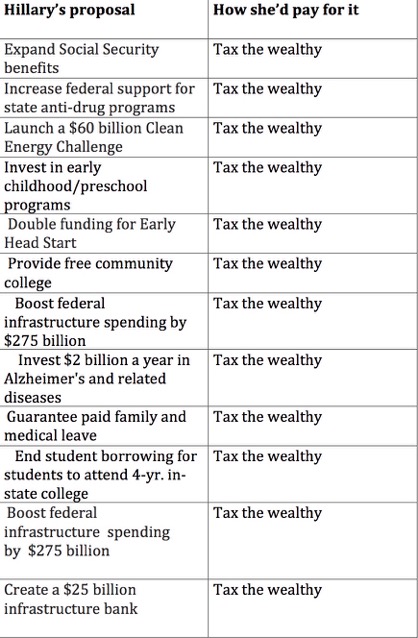
Most of the time, however, Hillary’s very clear about how she wants to pay for her federal largesse…. tax the wealthy.

Hillaryimage2

Hillary Clinton wants to cut taxes for low- and middle-income filers and raise taxes on the wealthy.

In her 2008 primary campaign against Barack Obama, Hillary said the wealthy paid too little in taxes and middle class paid too much. That was why she promised tax cuts for middle-class families and no tax increase of any kind on people earning under $250,000 a year.

This time around, Clinton is proposing raising taxes on high-income taxpayers, modifying taxation of multinational corporations and increasing estate and gift taxes. Almost all the tax increases would be paid by the top 5 percent (those earning less than $300,000 in 2015 dollars).

Take a look:

Hillary’s proposal

The problem is, if Hillary were to restrict her tax increases to “wealthy” Americans making more than $250,000 a year , she’d be imposing all the increases on just 2.7 percent of all filers, who already pay 50.6 percent of all income taxes.  And if she simultaneously lowered taxes for everybody else, the share paid by filers making more than $250,000 a year would pay an even larger percentage of the total. Talk about inequality!

whopaysthemosttaxes

Give the Laureate money back, Bill (Clinton)

Priorities USA Action, a major super-PAC supporting Hillary Clinton, just returned a $200,000 contribution it received illegally from a construction company with federal government contracts. The super PAC returned the money after the contribution was disclosed by the Center for Public Integrity.

Hillary’s husband, Bill, should follow Priorities’ example and give up the $16.5 million he collected from Laureate Education Inc., a for-profit company with a sketchy record. Returning the money would also be consistent with Hillary’s condemnation of underperforming and deceptive for-profit education institutions.

Selling out as a corporate shill has rarely been so lucrative as it has been for ex-president Bill Clinton.

In 2010, he signed on to become an “Honorary Chancellor” for Laureate International Universities, part of Baltimore, MD-based Laureate Education Inc.

clintonlaureate

Former President Bill Clinton speaking as honorary Chancellor at Laureate Education

Laureate has 86 schools serving about 1 million students online and on physical campuses in 28 countries across the Americas, Europe, Asia, Africa and the Middle East.

bill-hillary-clinton-laureate

In return for serving as a front man for the privately held company, Clinton collected $16.5 million between 2010 and 2014. Laureate also has donated between $1 million and $5 million to the Clinton Foundation.

While Clinton worked for Laureate, he and the company consistently refused to say how much he was being paid, but an analysis of the Clinton’s tax returns revealed the numbers.

In the statement released with their tax returns, Hillary Clinton said of their financial success, “…we owe it to the opportunities America provides.” That’s one way to look at it.

Laureate aggressively marketed its relationship with Bill Clinton and it paid off.

New York Magazine described Bill Clinton as the “face” of Laureate. When Laureate secured approval to build a new for-profit university, Torrens University Australia, in Adelaide, South Australia (where for-profits are called “private” institutions), the headline in The Australian newspaper read: “First private university in 24 years led by Clinton.”

Bill Clinton resigned his Honorary Chancellor position at Laureate in April 2015.

If he’d done his homework before hooking up with Laureate, he’d have found a lot of reasons not to sign on (aside from avoiding blatant money-grubbing).

As New York Magazine put it, “While some of the company’s schools are highly ranked, others have been accused of low admissions and academic standards, “turbocharging enrollment” to boost revenues, and deceptiveness about tuition costs — the same troubling practices that caused the Obama administration to try to stanch the flow of federal-student-loan dollars to for-profit schools in the United States.”

So, Bill, a little advice. Rid yourself of this stain by returning the $16.5 million to Laureate or (preferably) donate it to a worthy education program (Not the Clinton Foundation). It’s the right thing to do.


WES is a mess: abandon it.

WES

WES is a mess. It’s time for TriMet to admit WES was a mistake, cut its losses and abandon the line.

The first step should be for TriMet’s Board of Directors to rescind its approval for TriMet to bid on acquiring more cars to join  the Westside Express Service train that runs a 14.7-mile limited schedule between Wilsonville and Beaverton.

When I’ve written about WES previously, I focused on its failure to meet expectations. Now I’m convinced its deficiencies justify simply shutting it down and cutting its losses. TriMet needs to stop throwing good money after bad.

On May 25, after just six minutes of consideration, TriMet’s Board of Directors voted unanimously to approve bidding on the purchase of two used Budd RDC passenger diesel railcars from Dallas Area Rapid Transit (DART) for a total of up to $1.5 million. An additional $550,000 is expected to be needed for retrofit work to make the cars service-ready.

“We need to plan for ridership growth,” TriMet spokeswoman Mary Fetsch told The Oregonian. “Staff believes that these cars would meet the expected demands for the growing WES service for at least the next ten years…,” Neil McFarlane, TriMet’s general manager, said to the Board in a May 25 memo.

Oh sure, plan for massive ridership growth.

In early 2009, TriMet predicted WES would have 2,400 daily riders its first year of operations and 3000 by 2020.

But things started to go south quickly. WES began operating in February 2009. By Dec. 2009, weekday boardings averaged 1,140. By June 2010, the last month of Fiscal Year (FY) 2010, weekday boardings for the year averaged 1,200, less than half the number TriMet had predicted.

TriMet General Manager Fred Hansen told The Oregonian it was way too early to say if the agency’s heavy-rail gambit was a mistake.

He was wrong.

In FY15, weekday boardings averaged just 1869. Equally disturbing, operating costs per boarding on WES are stubbornly high at $13.50, versus $2.83 on busses and $2.14 on MAX.

Operating cost per boarding ride measures the direct cost of providing each ride. Operating costs are expenses for labor, energy and expendable supplies to provide transit service and to maintain vehicles and plant facilities. It does not include general andf administrative costs, interest or depreciation.

WESgraphwithkey

Here we are in 2016 and the situation is still appalling.

As of April 2016, the most recent month for which I was able to obtain data from TriMet, average daily boardings in FY16 are just 1,779. Operating costs per boarding ride are also still substantially imbalanced, at $2.67 for busses, $2.01 for MAX and $12.56 for WES.

The WES figure translates into a fare recovery ratio of operating costs of just 8.1 percent. Operations costs are expenses for labor, energy and expendable supplies to provide transit service and to maintain vehicles and plant facilities.

And these figures don’t even take into account the $161.2 million spent to build WES.

Even if WES reaches 3000 average daily boardings, operating costs per boarding ride will remain much higher than for busses and MAX.

The fact is, WES is a train wreck. It’s time to shut it down.

Coming to Portland’s book burning party?

bookburning
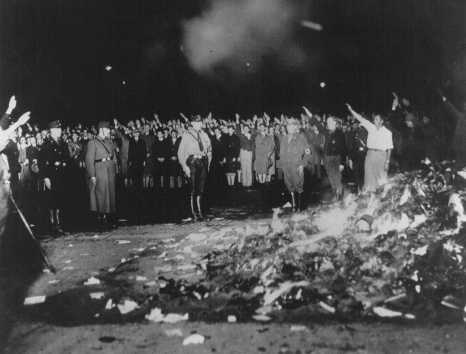
The Portland (Oregon) Public School board recently voted to prohibit textbooks or classroom materials questioning the mainstream thinking about climate change. The Cascade Policy Institute’s comments on the action, reprinted here, deserve attention.
 
“Resolution No. 5272 is two pages long, but the most chilling part is the final sentence:
 
‘[Portland Public Schools] will abandon the use of any adopted text material that is found to express doubt about the severity of the climate crisis or its root in human activities.’
 
The primary purpose of education is to teach students how to be critical thinkers. Now that the School Board has declared that expressions of doubt about complex scientific topics will be banned, what is the point of going to school?
 
Regardless of the subject we should encourage students to be skeptical. The more questioning the better. They will be poorly prepared for adult living if they spend their childhood years being spoon-fed in schools where skepticism is prohibited.
 
Public education already faces a growing challenge from private schools, online learning, and home-based education. If Resolution 5272 is upheld, Portland Public Schools will give parents one more reason to leave.”

Will you vote for Hillary… or for a woman?

Alex Conant, Marco Rubio’s communications director during his presidential race, recently sat down with the Huffington Post to discuss the campaign.

Conant: “Look, I think what we saw last night (June 7) is what we’re going to see from the Clinton campaign every day from now until November. Which is, they’re going to make this election a referendum on whether or not you want a woman in the White House. Not whether or not you want Hillary Clinton in the White House. I think that’s her only message.

Huffington Post: Do you think it plays?

Conant: It’s better than asking people to vote for Hillary.

hillaryFirstFemalePres


This illuminating conversation took place the day after the California and New Jersey primaries, when Clinton picked up enough delegates to become the presumptive nominee after focusing heavily on being the first female candidate of a major political party.

In sync with Conant’s observation, Hillary triumphantly claimed the Democratic nomination, focusing on the “first woman” theme.

“Thanks to you, we’ve reached a milestone, the first time in our nation’s history that a woman will be a major party’s nominee,” she announced to applause at a campaign event at the Brooklyn Navy Yard.

Responding in lockstep, media across the country announced Hillary’s victories with stories emphasizing that she would be the first woman to win a major party’s presidential nomination:

Clinton claims milestone as first female major-party nominee, wins California primary. Los Angeles Times

Hillary Clinton’s historic moment. Hillary Clinton — former first lady, former U.S. senator, and former secretary of state — has become the first woman to capture a major-party nomination for president. CNN

‘History made’: Clinton claims nomination. Hillary Clinton triumphantly claimed the Democratic nomination for president on Tuesday, calling for party unity to stop Donald Trump as she became the first woman in U.S. history to lead a major-party ticket. Politico

Hillary Clinton becomes first female presidential nominee from a major party after securing enough delegates. Daily News.

Following the party line, when Oprah Winfrey endorsed Hillary for President on June 7 (Wow! That was a surprise), she highlighted that it is time for voters to elect the nation’s first female president.

“I’m with her,” she told Nancy O’Dell of ‘Entertainment Tonight’. “It’s a seminal moment for women. What this says is that there is no ceiling. That ceiling has gone ‘boom,’ you know?”


It’s no secret that Hillary is a damaged and flawed candidate, so the “first woman” approach makes a lot of sense.

Her e-mail scandal may be fairly recent, but she is associated with decades of personal and political blunders and scandals that have led a high level of Clinton fatigue among the public.

“She has always been awkward and uninspiring on the stump,” a senior Democratic consultant once told the Washington Post. “Hillary has Bill’s baggage and now her own as secretary of state — without Bill’s personality, eloquence or warmth.”

The Democratic party has also known for a very long time it is confronting a serious Hillary trust gap.

In a July 2015 Quinnipiac University national poll, 57 percent of respondents said Clinton is not honest and trustworthy, one of the worst scores among all the top candidates at the time. In a subsequent Quinnipiac University poll, “liar” was the first word that came to mind more than any other in an open-ended question when voters were asked what they thought of Clinton, followed by “dishonest” and “untrustworthy”.

In a more recent Washington Post-ABC News national poll, 57 percent of people said they didn’t believe Hillary was honest and trustworthy.

But Hillary’s problems as a candidate go even deeper than that.

“Voters see her as an extraordinarily cynical, power-hungry insider,” James Poulos said in The Week magazine on Feb. 2. “She is out for herself, not out for Americans. Voters know it.”

This ties in with a wide perception that Hillary and Bill are just plain greedy, what with them hauling off $190,000 worth of china, flatware, rugs, televisions, sofas and other gifts when they moved out of the White House, taking money from all sorts of unsavory people and foreign countries for their Foundation, and charging exorbitant amounts for speeches.

David Axelrod, a political consultant for Obama, noted in his book, “Believer”, that Hillary has two other main weaknesses: she’s a polarizing rather than a “healing figure,” and she has a hard time selling herself as the “candidate of the future” given her checkered past and long political resume.

So here we are, facing the possibility Hillary will become the “first woman” president not because of, but despite, herself (and maybe because her opponent is another deeply flawed candidate).

Just goes to show that Clarence Darrow was right. “When I was a boy I was told that anybody could become President; I’m beginning to believe it,” he said.


WES: going off the rails

stagecoach

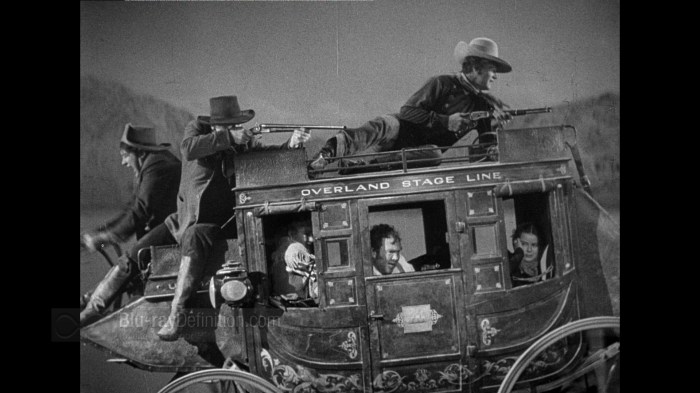
“We’re in a fine fix, my friends.”  Stagecoach. 1939.

TriMet is buying 2 more train cars for WES, the Westside Express Service train that runs a 14.7-mile limited schedule between Wilsonville and Beaverton.

Hey, why not? When things are going downhill, double down.

On May 25, after just six minutes of consideration, TriMet’s Board of Directors voted unanimously to approve bidding on the purchase of two used Budd RDC passenger diesel railcars from Dallas Area Rapid Transit (DART) for a total of up to $1.5 million. An additional $550,000 is expected to be needed for retrofit work to make the cars service-ready.

“We need to plan for ridership growth,” TriMet spokeswoman Mary Fetsch told The Oregonian. “Staff believes that these cars would meet the expected demands for the growing WES service for at least the next ten years…,” Neil McFarlane, TriMet’s general manager, said to the Board in a May 25 memo.

Oh sure, plan for massive ridership growth.

In early 2009, TriMet predicted WES would have 2,400 daily riders its first year of operations and 3000 by 2020.

But things started to go south quickly. WES began operating in February 2009. By Dec. 2009, weekday boardings averaged 1,140. By June 2010, the last month of Fiscal Year (FY) 2010, weekday boardings for the year averaged 1,200, less than half the number TriMet had predicted.

TriMet General Manager Fred Hansen told The Oregonian it was way too early to say if the agency’s heavy-rail gambit was a mistake.

He was wrong.

In FY15, weekday boardings averaged just 1869. Equally disturbing, operating costs per boarding on WES are stubbornly high at $13.50, versus $2.83 on busses and $2.14 on MAX.

Operating cost per boarding ride measures the direct cost of providing each ride. Operating costs are expenses for labor, energy and expendable supplies to provide transit service and to maintain vehicles and plant facilities. It does not include general andf administrative costs, interest or depreciation.

WESgraphwithkey

Here we are in 2016 and the situation is still appalling.

As of April 2016, the most recent month for which I was able to obtain data from TriMet, average daily boardings in FY16 are just 1,779. Operating costs per boarding ride are also still substantially imbalanced, at $2.67 for busses, $2.01 for MAX and $12.56 for WES.

The WES figure translates into a fare recovery ratio of operating costs of just 8.1 percent. Operations costs are expenses for labor, energy and expendable supplies to provide transit service and to maintain vehicles and plant facilities.

And these figures don’t even take into account the $161.2 million spent to build WES.

Even if WES reaches 3000 average daily boardings, operating costs per boarding ride will remain much higher than for busses and MAX.

The fact is, WES is a train wreck.

Microsoft and LinkedIn: Irrational exuberance?

M&A

Microsoft is buying LinkedIn for $25.2 million, even though LinkedIn isn’t profitable. LinkedIn reported a net loss of $8.4 million, or 6 cents per share, in the quarter ending Dec. 31, 2015 and has forecast a much weaker-than-expected 2016.

Moreover, the number of unique monthly visitors to LinkedIn didn’t grow over the second half of 2015. Plus, total page views were down in the quarter ending Dec. 31, 2016 for just the second time in the past 16 quarters.


Microsoft’s history of acquisitions isn’t exactly an endorsement of the company’s prescience. Microsoft’s purchase of aQuantive in 2007 for $6 billion and of Nokia’s handset business in 2014 for $7.2 billion were complete failures.

Then there was Microsoft’s $1.2 billion purchase of Yammer in 2012.

“This is the best Silicon Valley deal we’ve seen all year,” said Eric M. Jackson in VentureBeat, a source for news on technology innovation. “Facebook’s $1 billion purchase of Instagram makes Microsoft’s pickup of Yammer look like the Louisiana Purchase by comparison.”

Four years later Yammer is an afterthought at Microsoft.

In fact, the first question to Microsoft CEO Satya Nadella on a Monday conference call alluded to this. “You’ve had a tough track record in large M&A,” said Brent Thill, a UBS analyst. “Why is this deal different?”

Irrational exuberance, Microsoft?

Liberals love science, except on GMOs

Have some doubts about human-caused climate change. Get over it, liberals say. It’s an indisputable fact, a sure thing, unassailable. Science proves it and you gotta trust science.

Heck, it’s so clear-cut, even the Portland School Board has unanimously adopted a resolution that directs district officials to get rid of classroom materials that express “doubt about the severity of the climate crisis or its root in human activities.”

The Board didn’t clarify whether that meant such faulty materials were to be burned, a la Fahrenheit 451 where Captain Beatty burned books because they produce “two sides to a question to worry him”.

But scads of liberals take a different tack when the issue is GMOs.

bamGM0

Ranting and raving that GMOs just aren’t safe, they demand labeling of products containing GMOs and insist there’s a need to protect the non-GMO food supply. In a 330-page publication dismissing the “myths” about the safety of GMOs, Earth Open Source, an organization that “is presenting the evidence regarding the social, environmental, and health impacts of GMO foods”, asserts “that those disagreeing with GMO proponents’ claims of safety include hundreds of eminent scientists.”

GMOatCostco

A display at a Costco store

But science says differently.

GMO crops are as safe to eat as their non-GMO counterparts and have no negative environmental impacts according to a comprehensive report released on May 17 by the National Academy of Sciences —a group founded by the U.S. Congress to provide expert scientifically-based advice on a variety of issues. The report is a 388-page, comprehensive look at every aspect of genetically engineered crops.

Key messages in the report, summarized by National Geographic, are:

  • GMO crops are safe to eat…there’s no evidence of harm.
  • The GMO crops in our food system have “…helped farmers protect yields from insects and weeds.”
  • The report found no adverse affects on biodiversity or danger from interbreeding between GMO crops and wild relatives.
  • The economic benefits to farmers have been well-documented.
  • Appropriate regulation is imperative, and that regulation should be based on the characteristics of the crop, rather than the technique used to develop it, whether GMO or non-GMO.
  • Ongoing public conversations about GE crops and related issues should be characterized by transparency and public participation.

The National Academy of Sciences report also notes that both genetic engineering and conventional breeding are important to crop improvement. Each method has strengths and weaknesses, and treating them “as competing approaches is a false dichotomy; more progress in crop improvement can be brought about by using both … than by using either alone.”

So, will the GMO alarmists finally see the light? Will they embrace science and back off? Doubtful. But at least now there’s a stronger argument to challenge their illusions.

Clinton, Trump and the housing crisis: a different perspective

Hillary Clinton and her surrogates think they have found something to damage Donald Trump, statements he has made about opportunities to profit from a housing market crash.

But have they? A deeper look suggests Trump was prescient in his analysis of the housing market.

Ten years ago Trump was recorded saying, “I sort of hope that (a housing market crash) happens because then, people like me would go in and buy” and “If there is a bubble burst, as they call it, you know you can make a lot of money.”

foreclosure

At a campaign rally on Tuesday, Clinton jumped on the quotes, accusing Trump of wishing for a financial crash so he could “make some money for himself.”

The Democratic National Committee (DNC) piled on, saying in a press release that Trump “cheered on” the collapse of the housing market. The DNC also observed that the housing crash devastated minorities such as Hispanics and African-Americans (who happen to be a key part of Hillary’s base).

“Donald Trump’s lack of concern for the economic well-being of hard-working families shows that he doesn’t have the judgment and temperament to occupy the Oval Office,” wrote DNC spokesperson Luis Miranda.

But another way to look at it is Trump was being pretty smart and perceptive—and if the Clintons had been smart, they could have made some money, too (not that they needed any more).

The 2008 financial crisis was triggered to a significant degree by subprime mortgages, loans made to people with poor credit or with little documentation to back up their financial fitness. These mortgages were transformed into toxic financial products by investment specialists who made a bundle when the products were sold.

The danger these subprime mortgage products posed wasn’t foreseen by Janet Yellen, Chair of the Board of Governors of the Federal Reserve System.

“While a tightening of credit to the subprime sector and foreclosures on existing properties have the potential to deepen the housing downturn, I do not consider it very likely that such developments will have a big effect on overall U.S. economic performance,” Yellen said well into the foreclosure crisis. ” I say this, in part, because these mortgages represent only a small part of the overall outstanding mortgage stock.”

Yellen went on to misread the economy, saying, “I think that the current stance of policy is likely to foster sustainable growth with a gradual ebbing of inflation over time.”

The danger these subprime mortgage products posed also wasn’t foreseen “by the chief executives of America’s premier banks,” said a New York Times book review of the best-selling book, The Big Short. “It was not foreseen by government regulators, by Treasury officials or by the Fed. It was foreseen, however, by a handful of investors, who were aghast at the madness they saw on the Street and who used their prescience to make a fortune off the financial system’s calamitous meltdown.”   

the-big-short1-1080x607

Trump should fire back at Hillary by pointing out that she’s made some contentious allegations her supporters might resent. For example, she laid some of the blame for the housing crisis on greedy, dishonest homeowners.

“…certainly borrowers share responsibility as well,” Clinton said in a speech at NASDAQ headquarters. “Homebuyers who paid extra fees to avoid documenting their income should have known they were getting in over their heads” and people across the country “…who were busy buying two, three, four houses to sell for a quick buck don’t deserve our sympathy.”

Nothing’s simple, is it?

“War, huh. What’s it good for?

On this Memorial Day, it seems like the United States has been at war for most of my lifetime. The cost in American lives has been unbearable. Parents of friends, and friends themselves, have died. The financial cost has been astronomical. The impact on our culture has been massive. The resulting erosion of trust in government has been substantial. What have we accomplished?

Vietnam

In 1964, President Lyndon Johnson used reports of attacks on two American ships in the Gulf of Tonkin as political cover for a Congressional resolution that gave him broad war powers in Vietnam. There were only two dissenting votes, Senators Morse of Oregon and Gruening of Alaska.

As American involvement in the war and body counts escalated, so did anti-war protests at home. The end came when Saigon in South Vietnam fell to the communists in April 1975.

VietnamUStroops

David Halberstam wrote “The Best and the Brightest” about the overconfident people in leadership roles in the United States who pursued the war.

“The basic question behind the book,” he said, “was why men who were said to be the ablest to serve in government this century had been the architects of what struck me as likely to be the worst tragedy since the Civil War.” (The term “Best and the brightest “ has often been twisted since then to mean the top, smart people, the opposite of Halberstam’s original meaning)

Now, 41 years later, the U.S. and Vietnam are reconciling. The U.S. wants the business opportunities that are expected to open up in Vietnam and a counterweight to Chinese adventurism.

vietnamObama

President Obama reviewing a guard of honor during a welcoming ceremony at Vietnam’s Presidential Palace in Hanoi, May 23, 2016.


Cost of the Vietnam War to the United States                                            $173 billion

U.S. military fatal casualties of the Vietnam War                                             58,220

Grieving families of U.S. military fatal casualties of the Vietnam War       58,220


Afghanistan

The Afghanistan war began in October 2011 to oust the Taliban that sheltered al Qaeda chief Osama Bin Laden after the September 11, 2001 attacks on the United States.

USTroopsInAfghanistan

The U.S.-led coalition in Afghanistan ended its combat mission in December 2014, according to the White House.

In terms of Western goals — things are right back where they started: needing to keep Afghanistan free of extremists and a viable country for its people, CNN recently reported. The result is thousands of refugees and a continued safe haven for ISIS.

The Taliban currently controls more territory than at any time since 2001, when it ruled from the capital, Kabul, Western defense officials say, and the United Nations says civilian casualties are at a high since it began keeping records in 2009, according to the Wall Street Journal.

The United Nations said 3545 civilians were killed in 2015 as Taliban stepped up attacks after British and American troops left at end of 2014.

Furthermore, U.S. intelligence agencies have been warning the White House that the Taliban could seize more Afghan territory, including population centers, during this summer’s fighting season, in part because the Afghan government and its military forces are so weak, according to the Journal.


Cost of the war in Afghanistan to the United States                            $686 billion

U.S. military fatal casualties of the war in Afghanistan                          2,381

Grieving families of U.S. military fatal casualties                                      2,381

Iraq

On March 19, 2003, the United States and coalition forces, began a war in Iraq against Saddam Hussein, the Sunni leader of Iraq.

When explosions from Tomahawk cruise missiles launched from U.S. fighter-bombers and warships in the Persian Gulf began to rock Baghdad, President George W. Bush said in a televised address, “At this hour, American and coalition forces are in the early stages of military operations to disarm Iraq, to free its people and to defend the world from grave danger.”

husseinstatue

U.S. soldiers hold back crowds as the statue of Saddam Hussein falls in Baghdad, April 9, 2003, by Peter Nicholls

The Shia-led governments that have held power since Hussein was toppled have struggled to maintain order and the country has enjoyed only brief periods of respite from high levels of sectarian violence. Violence and sabotage have continued to hinder the revival of an economy shattered by decades of conflict and sanctions.

Politically and economically, Iraq’s trajectory is currently a negative one, Brookings said recently. The country is politically fragmented at all levels and the centrifugal forces appear to be gaining strength. This, in turn, has paralyzed the government, suggesting that the most likely paths for Iraq are toward a situation analogous to the Lebanon of today.

Cost of the Iraq War to the United States                                             $818 billion

U.S. military fatal casualties of the Iraq War                                             4,491

Grieving families of U.S. military fatal casualties of the Iraq War       4,491


“War, huh

Good God, y’all

What is it good for?”

      “War” by Edwin Starr