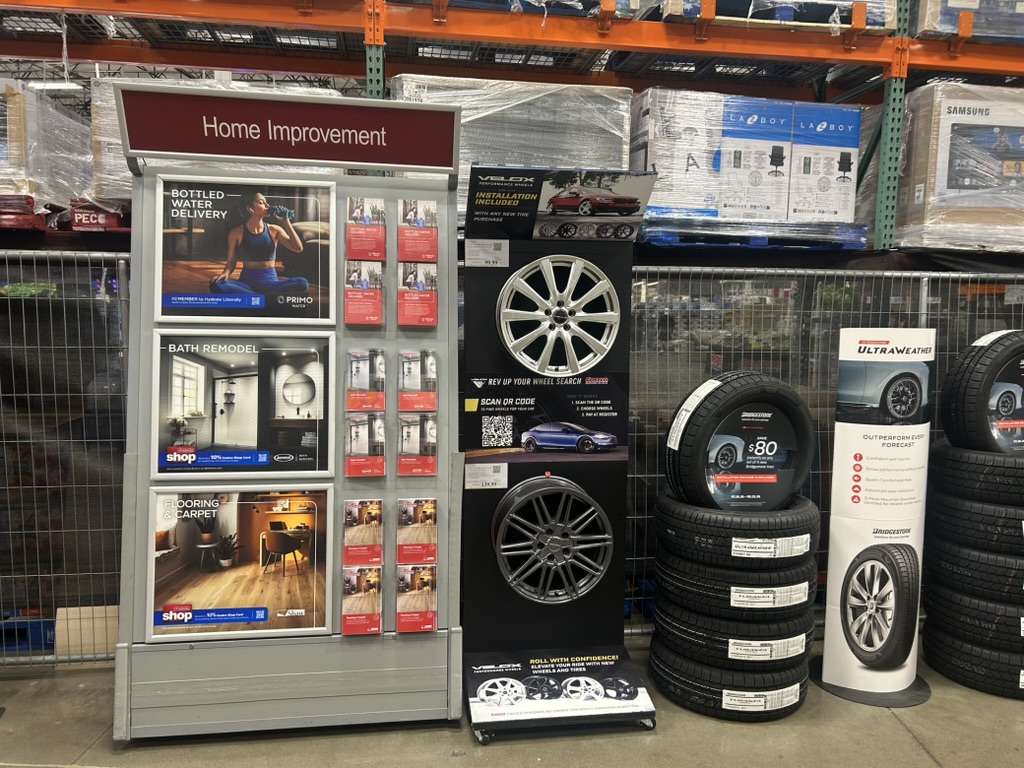
Jacuzzi Bath Remodeling and Costco: A Flawed Partnership

Display at my local Costco

Who knew a remodeled bathroom could change your life. You’ve probably seen one of Jacuzzi Bath Remodel’s TV ads. “Is your bath or shower old and outdated? Our design experts can work with your style to create the customized bath of your dreams without breaking the bank. Jacuzzi Bath Remodel can make your dream bath a reality.”

For many people, one reason Jacuzzi Bath Remodel is assumed to be a high-quality company offering superior service at a reasonable price is because of its tie-in with Costco. Jacuzzi Bath Remodel is one of many companies that have an official marketing and sales partnership with Costco. In this case, it gives Costco members an exclusive promotional rebate in the form of a shop card on qualifying purchases.

But look behind the curtain.

Jacuzzi Bath Remodel is a national brand that operates across the country through a network of authorized dealers and franchisees. There are 33 reviews for Jacuzzi Bath Remodel of Portland on Yelp.  They are overwhelmingly negative:

“Jacuzzi customer service is an absolute joke…Trying to get them to do anything or treat us like our issue is a big deal is like pulling teeth…Customer service acts like they are bored to tears when we call.”

“We found out about Jacuzzi from a sales representative at Costco. When we had the sales appointment at our house we were guaranteed to get updates about our materials and project completion date, neither happened. After multiple tries to contact the company we settled on a project date. 2.5 months later. The morning of the jacuzzi employees showed up without a previous courtesy call or text. They worked for 2 hours and 45 minutes and left because “their van broke down”.

“Our 2 day shower replacement was more like 2 or 3 weeks and they had to come back several times later to fix misaligned panels…We thought with their top tier pricing, we’d get a quality product and workmanship. Obviously, high price is no guarantee of either. Very disappointed in this big-name brand.”

“If able I would give Jacuzzi Bath and Remodel a ZERO We arranged a shower remodel with them through a Costco promotion.”

Reddit is replete with complaints about Jacuzzi Bath and Remodel as well:

“Jacuzzi came out with high pressure sales tactics, $26k to replace a walk-in shower if I agreed the day of otherwise it went to $32k for their “1-year” guaranteed quote. Needless to say I laughed them out of my house. I had previous quotes to remodel the entire bathroom for less than what they wanted for just the shower.”

The Better Business Bureau of Portland has received complaints about the Portland operation as well:

“The project was supposed to start April 6th 2026 And I still haven’t gotten the job completed. I have No shower and now my toilet isn’t working…This was supposed to be a 2 day job. 3 months and still nothing.”

 Trustpilot reviews are critical, too, as the site’s summary notes:

“…most reviewers were let down by their experience overall. Many people found the pricing to be excessively high, often tens of thousands more than other contractors, and felt pressured by aggressive sales tactics to commit quickly. Customers also reported significant dissatisfaction with customer service, including unreturned calls, missed appointments, and persistent unwanted contact after expressing disinterest. Furthermore, many encountered poor product quality, with issues like staining, loose parts, and components not working correctly shortly after installation. Installation processes were frequently criticized for not being completed in the promised timeframe, causing damage to homes, and often involving subcontractors whose work quality was inconsistent.”

And then there’s something else to watch out for – financing costs. A Jacuzzi Bath Remodel website says: “Financing offer available through third-party lenders under terms of applicable loan program. No interest for 12 months if paid in full within 12 months. Interest will be charged to you from purchase date if purchase balance is not paid in full within 12 months.” If the cost of your project is $20,000 and you still owe $15,000 after 12 months, the interest due at a 28%. interest rate, for example, would total $2,371.08.

An Oregon City, Oregon couple’s experience with a Jacuzzi Bath Remodel contractor serves as a warning.

The couple, both in their 70s, hired Jacuzzi Bath Remodel in March of 2025. According to their daughter, the total cost of the project was expected to be about $20,000. They paid $10,000 upfront as a downpayment with the understanding that installation would begin in approximately six weeks and that the remodel itself would take about two days.

What followed, however, was months of delays, failed installation attempts, poor communication, and an unbelievable amount of disruption to their home.

About 14 weeks passed before the contractor came to the couple’s home to begin the project, only to discover that the wrong bathtub had been ordered. After another installation attempt was scheduled, the bathtub arrived damaged. A third attempt brought a third damaged bathtub. Meanwhile, the bathroom sat with exposed framing, unfinished walls and an opening in the floor to the basement below.

“Communication had also been extremely frustrating,” their daughter said. “Phone calls and messages would routinely go unanswered for days, and at times, weeks.” 

The couple finally gave up on the contractor, but the company tried to charge them a penalty for cancelling their order and they “had to beg for their money back”, their daughter said. Then they spent $20,463 at Home Depot in October 2025 to have the remodel done correctly.

Costco has an overwhelmingly positive public reputation, built on high customer trust. Its membership renewal rate is reported to be over 90% If it wants to maintain its reputation it needs to ensure its marketing and sales partnerships are reliable, on the up-and-up and consistently meeting consumer expectations. Right now it looks like they aren’t.

So, c’mon Costco! Fix this.


Scofflaw City: Eugene’s blizzard of unpaid parking tickets

 If you see a notice on your windshield that says, “Parking Fine,” it’s not a compliment.

eugeneparkingticket

Are you a University of Oregon student who has skipped paying a Eugene parking ticket? If so, you’re not alone.

It’s like the wild west out there, with thousands of students, locals and out-of-towners ignoring their parking tickets in Eugene.

In 2018, the city declared 8,356 parking tickets delinquent and sent them out for collection. Over the past four years the total sent out for collection reached a staggering 91,621 tickets. And still, a lot don’t get paid.

The city says it doesn’t track unpaid parking tickets by geographic area, so it doesn’t have data on where all the unpaid tickets were handed out, whether the University of Oregon district, for example, has a high delinquency rate.

Frustrated with all the scofflaws and sensitive to the loss of the ticket revenue, for the past four years the city has been sending delinquent parking tickets to Austin, TX-based Linebarger Goggan Blair & Sampson, LLP.  Linebarger, a collection agency masquerading as a law firm, is one of the nation’s largest government debt collectors.

“We help communities thrive,” the firm says.

With 46 offices and 112 attorneys across the country, the firm is a money-raising behemoth in the parking ticket business.  It claims to collect $1 billion annually in delinquent taxes, traffic citations, parking tickets and tolls.

Some other Oregon cities have contracts with different collection agencies. Bend and Salem for example, have contracts with Professional Credit Service (PCS), a Springfield, OR-based company.

For Bend tickets, PCS adds collection fees of 23% of the total balance and keeps that amount when collecting on a delinquent parking ticket.

In Salem’s case, PCS collects 25% of the principle amount, while the City receives the principle. In cases where there is interest, the City and PCS split this amount evenly.

If a delinquent $10 Salem parking ticket is sent to PCS, the total due becomes $12.50. If 10 cents in interest is assessed before the bill is paid, the total due becomes $12.60. PCVS would retain $2.60 of that and the city $10.10.

Under Eugene’s arrangement with Linebarger, the firm can retain a 20 percent commission of the total amount collected for its work.

Example: 

  • Parking citation: $100.
  • Accrued interest: $21.60 (Interest is calculated at a rate of 18% from the date the account is referred to Linebarger for collection until paid in full)
  • Total owed: $121.60 (Parking fine + Accrued Interest).
  • Commission to Linebarger: $24.32 (20% of $121.60)
  • Payment to City of Eugene: $97.28

If the city’s Parking Enforcement Department places an immobilization device on a vehicle for unpaid fines that have been sent to Linebarger for collection, those delinquent accounts are recalled back to Eugene’s Municipal Court. In such cases, the city isn’t obligated to pay Linebarger a commission for the collection of the citations.

The city considers it reasonable for Linebarger to pursue a collection claim for up to two years. That’s one reason why Linebarger has a reputation for being persistent in its mail and call center collection efforts.

Over the past four years, Eugene has sent delinquent parking tickets with initial fines of $3,072,918 to Linebarger for collection, according to data provided by Jill Wright, a Court Operations Specialist with the City of Eugene, in response to public records requests.

Joe Householder, a Managing Director and spokesman for Linebarger, said the firm’s collection efforts have allowed it to remit $911,003.00 to the city. That represented $627,420.02 in fines and $283,583.98 of interest charges, the city said. This means Linebarger recovered just 20 percent of the original delinquent fines, plus interest.

In other words, a whole lot of delinquent tickets still don’t get paid, even after persistent and extensive efforts to locate delinquent miscreants, forceful letters, and aggressive call centers.

Our overall results are what matter and our overall results are routinely strong,” Householder said.

“Some accounts take a day to resolve; some take years,” he added. “In some cases, we’ll connect with the person on our first outreach attempt but they’re not ready to resolve the matter – maybe they’re waiting till they get their tax refund, or some other expected money comes in. In those cases, we have to stay in touch week after week or month after month and remind them of the debt.”

“In other cases,” Householder said, “just finding the person can take a long time. They’ve moved multiple times, they’ve remarried and changed their name – any number of factors can make it a challenge.”

So, don’t assume you’re safe because you’ve managed to escape Linebarger’s reach so far. “We continue to pursue collections of the remaining outstanding tickets,” Householder said.

Furthermore, if Linebarger fails to collect the balance on your delinquent parking ticket, and your vehicle is found on a city lot or street, the city may still immobilize the vehicle with a boot device.

Linebarger collects a wide array of receivable types for government clients, primarily payments due on taxes, traffic citations, parking tickets, and tolls.

Much of Linebarger’s work is pretty simple. In Eugene’s case, the Court forwards a record of delinquent parking tickets and Linebarger follows up with letters and pestering recorded phone calls to miscreants urging them to pay up.

“Partnering with Linebarger allows our clients to focus their resources on their core responsibilities, while we focus on locating and contacting the relative few who have continued to ignore their delinquent parking tickets,” the firm’s website says.

To counter the thuggish image of collections agents, Linebarger portrays itself as a company with “a big heart beneath that law firm veneer,” and says its work collecting unpaid bills is helping communities thrive by raising money for parks, schools and essential service.

But it hasn’t been able to avoid some criticism.

For some unexplainable reason, the Better Business Bureau (BBB) gives the Linebarger firm an A+ rating, while at the same time giving it the lowest possible rating, just one star of a possible five, based on customer reviews. Hundreds of complaints have been filed with the BBB against Linebarger nationwide. Complaints range from inaccurate notices of delinquent accounts and rude call center employees to harassing collection calls and allegations of fraudulent charges.

“I am being charged for parking violations in Denver, CO,” wrote one BBB reviewer. “I live in Oregon and have never been to Colorado.”

“I got a letter, that I find threatening, regarding an unpaid parking ticket from 12 years ago,” wrote another reviewer. “Give me a break!”

Yelp reviews are similar, with an overall rating of one star out of 5.

What do Eugene’s Parking Services Manager, Jeff Petry, and City Manager, Jon Ruiz, have to say about all this? Nothing.

Despite repeated requests that they answer a series of questions relating to the parking ticket and collections program, neither responded. So much for government transparency.


______________

Parking Ticket Fines in Eugene

Overtime Violations

Parking meters and time limits are placed in high use parking areas of Eugene to encourage turnover which increases accessibility for everyone and supports local businesses that rely on street parking for customer access.

Time limit citations in Eugene are $16.

Other Violations


 Violation Fine Amount
Parking in Space Reserved for Persons with Disabilities
First Offense
Second Offense
$200
$400
Storage of Vehicles on Street /Abandoned Vehicle
First Offense
Second Offense
$25
$50
Parking on Sidewalk, Crosswalk, or in Front of a Driveway $25
Parking in a Yellow, Bus, Taxi or Tow-Away Zone $25
Parking on wrong side of the street (facing the wrong way) $25
Parking in Bike Lane $40

For more information on parking fines, see the Municipal Court’s Presumptive Fine Schedule.

Fines Increase If Not Paid Within 30 days 
Parking citations (tickets) that are not paid or contested within 30 calendar days will double. Citations not paid within 120 days will be sent to a collection agency, and interest will begin to accrue.

Source: City of Eugene, https://bit.ly/2tKY7wC


Paralyzed Veterans of America: hold the applause

Who wouldn’t sympathize with, and want to help, paralyzed American veterans?

A glossy, multi-colored letter and pamphlet came in the mail the other day from the Salem-based Oregon Chapter of Paralyzed Veterans of America (PVA). The principal message was a plea for me to be a sponsor or buy tickets to a May 14, 2016 gala and auction in Wilsonville.

paralyzed-veterans-of-america-the-phone-call-feat-ben-affleck-large-9

Like so many other pleas to help our veterans, it sounds good…until you look behind the curtain at the non-profit’s finances.

The national PVA organization is among the top charities that collect the bulk of public contributions to veterans’ causes.

But according to the Center for Public Integrity, The national headquarters of Paralyzed Veterans of America (PVA) has a long history of high fundraising expenses and low program expenses that actually help disabled veterans.

The Better Business Bureau’s (BBB) Giving Alliance says the PVA doesn’t meet its standards, principally because the BBB is unable to verify that the PVA spends at least 65 percent of its total expenses on program activities and no more than 35 percent of related contributions on fund raising. Related contributions include donations, legacies, and other gifts received as a result of fund raising efforts.

The BBB reviewed PVA’s 2014 audit report for fiscal year 2014 and concluded that it didn’t provide an accurate presentation of PVA’s fund raising and program service expenses.

According to the audited financial statement, PVA incurred joint costs of $58,587,922 for informational materials and activities that include fund raising expenses in 2014. Of this, PVA allocated $32,132,043 to program service expenses and $24,945,288 (21%) to fund raising expenses. The BBB disagreed with PVA’s decision to count $32,132,043 of direct mail appeals to the program service category, arguing that most of that expense should be considered fundraising.

If all the proper spending was allocated to fundraising, the PVA actually spent $57,077,331 on fundraising in 2014, or 39 percent of its expenses. Add what it spent on administrative expenses, and 42 percent of its budget went to non-program expenses, a monstrously high level.

The PVA’s financial records also show an dismal performance at the state level in Oregon. According to information the Oregon chapter submitted to the IRS, in its fiscal year ending Sept. 30, 2014, the Oregon Chapter’s expenses totaled $628,567.

The chapter reported spending just $139,868 on professional fundraising services, but it spent another $62,863 on “Public Awareness” and $6550 on “advertising and promotion”. That adds up to $209,281 focused on fundraising, or 33 percent of total spending.

Look even closer and you find that the Oregon Chapter spent just $92,164, 15 percent of its total spending, on grants and other assistance to individuals in the U.S. and on benefits to or for members in 2014. Almost all the rest went to fundraising, salaries, benefits, payroll taxes, legal expenses, accounting, office expenses, travel, insurance, depreciation, and contract services.

“The scoundrels and the thieves and the rip-off artists … that want to make a lot of money know that these are categories of charities where the American public is gravitated, it pulls at the heartstrings and they know that the tendency of Americans is to give impulsively, emotionally with that pull,” Ken Berger, president and chief executive officer of Charity Navigator, an independent charity evaluator, told the Center for Public Integrity. “They exploit that and they use that.”