PGE and Why the EV Revolution is Stalling

Update 9/24/2025: I see a lot of electric vehicles (EVs) around town, but apparently looks are deceiving. As of May 2025, 119,850 “zero emissions vehicles” (ZEV) were registered in Oregon, equaling 3.2 percent of the total vehicle fleet, according to the Cascade Policy Institute. Of those, only 84,636 were true zero-emission vehicles powered entirely by a battery. The remaining 35,214 vehicles were plug-in hybrids, which still rely on gasoline. The numbers show Oregon has reached just 34 percent of former Governor Kate Brown’s EV Adoption Targets established during her era.

The hoopla was energizing.

On Oct. 26, 2019, PGE celebrated the grand opening of its Eastport Plaza Electric Avenue EV charging station at 4000 SE 82nd Avenue in Portland.

“These charging stations are important to the mission of PGE, because we are committed to doing our part in solving global warming and Climate Change,” said PGE’s President & CEO, Maria Pope.

The Eastport Plaza location joined already operating Electric Avenue operations in Milwaukie, Hillsboro, Wilsonville, and downtown Portland.

Smiling PGE officials, representatives from TriMet, the City of Portland, and Multnomah County enthusiastically cut a ribbon to officially open the new 82nd Ave. charging station.

The national mood on EV’s was optimistic, too.

Global plug-in vehicles come in two basic varieties—all-electric (BEV) and plug-in hybrids (PHEV). Ddeliveries reached 2.1 million units for 2018, 64% higher than for 2017.  About 69% of sales were BEV and 31% were PHEV. Global BEV sales in 2019 were increasing at a slower pace than previously, but global plug-in vehicle deliveries still were headed toward 2.3 million units in 2019. Electrification was clearly on the minds of most forward-looking utilities. 

More than four years later the mood is considerably less upbeat.

The pace of adoption has markedly slowed, and analysts have suggested the country is no longer likely to hit the federal government’s sales targets. Government targets for EV sales in 2024 call for each car manufacturer to hit 22% electric vehicle sales or face hefty fines. EV experts are warning the growth rate in electric vehicle uptake simply isn’t strong enough to make that target. 

Earlier this week, dealers representing about 5,000 stores wrote to President Biden saying the charging infrastructure remains scattershot and unsold EVs are piling up on their lots. The letter urged Biden to “hit the brakes” on an EPA proposal that could codify the agency’s strictest-ever tailpipe emissions limitsproposed last April

“Mr. President, we share your belief in an electric vehicle future,” the latest letter says. “We only ask that you not accelerate into that future before the road is ready.”

This followed an earlier November letter from about 4,000 dealerships calling on Biden to reconsider the proposed regulations, which they argued would mandate an unrealistic shift to battery-electric vehicles in the U.S.

A recent visit to the Eastport Plaza Electric Avenue charging site offers some reasons why manufacturers and dealers are getting antsy about EVs. And potential buyers, too.

The site has four DC fast chargers and two Level 2 chargers.[1] When I pulled in riding in a Nissan Leaf, one of the charging ports was broken. I was later told it had been broken for months. The three other fast chargers were in use. One vehicle was at 86% charged, one at 39% and the third at 22%. Only the 86% vehicle was occupied.

Broken charger at Eastport Electric Avenue

 Choices open to us were to use a slow Level 2 charger or sit and wait for one of the fast charger slots to open up. Unlike at a gas station, there’s no assurance the vehicles ahead of you will move on in a timely manner.

We encountered similar issues at PGE’s Electric Avenue site in the heart of downtown Milwaukie at the corner of SE McLoughlin Blvd. and Jackson St. 

As at Eastport, the Milwaukie site has six charging ports, four DC fast chargers and two Level 2 chargers. All four fast charging stations were occupied with no drivers in the vehicles. One vehicle was at 59%, one at 74%, one at 59% and one at 89%. One of the slow Level 2 chargers was being used, with the driver in the vehicle. 

It is considered acceptable to leave your vehicle unoccupied while it’s charging, It used to be common EV etiquette, however, that when your vehicle was at 80% you would make way for another vehicle if others were waiting.

The U.S. Department of Energy still says, “Unless you truly need every ounce of driving range available in your vehicle, consider unplugging your electric vehicle when it has reached 80 percent charge or an acceptable charge level for your immediate driving needs.” 

EV owners tell me the 80% rule is, however, now commonly abused. Another common abuse is leaving a fully charged vehicle unoccupied for an extended period, with no way for a waiting driver to know how long the wait will be. One EV driver can tell how much longer another EV needs to charge by reading the digital readout on the charger stating the EV’s current degree of charge and the length of time for its charging, but that doesn’t guarantee the vehicle owner will unplug in a timely manner. 

The Department of Energy also urges EV owners not to consider charging sites as resting places. An EV owner will often use a charge point as an hours-long parking spot versus a place to recharge and go,” the Department says.  Doing so, of course, adds an extra problem in that extra-long periods of charging time tops off the battery, which is not optimal for EV performance.

Then, of course, there are gas and diesel vehicle owners who see open charging spaces as prime parking spots. “In a crowded parking lot, the sight of any open electric car charging spot can be too tempting for some to resist,” the Department of Energy warns.

PGE’s charging stations accept all major credit cards, but if you want to sign up for pre-paid or monthly subscription pricing for Electric Avenue chargers, things get a little more complicated because PGE has partnered with Shell Recharge to accomplish that.[2]

First, you have to download the Shell Recharge app to your phone in the Apple App store Google Play store or order a Shell Recharge RFID card.

When you’re ready to charge your vehicle, you have to activate a charging session through the Shell Recharge app or scan your Shell Recharge charging card. If you are at an Electric Avenue charger, you can select “subscription” in the app if you’d like to pay just $25 per month for unlimited charging at Electric Avenue chargers or choose another preferred payment option. When you’re done, your card will automatically be charged for the session.

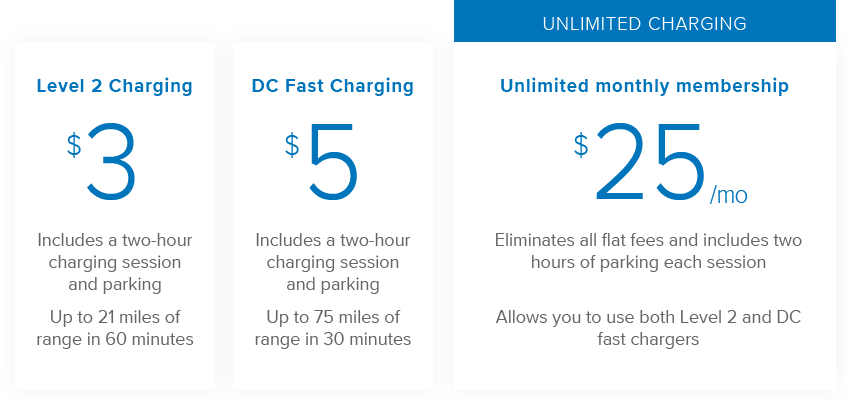
Charging prices at PGE’s sites are:

                                                                             Source: PGE

Unlike at a gas station where the price per gallon generally stays the same 24/7, prices may vary during peak times (weekdays from 3 to 8 p.m.) During this period, PGE says $0.19/kWh will be charged to your credit card or Shell Recharge account in addition to your $3, $5 or $25 unlimited pricing structure.

Whatever the price, Oregon’s hyper-projections for electric vehicle adoption are proving to be wishful thinking. And it’s probably not just about EV prices, battery life and range. Unless you have a charging station at home, you are forced to rely on public chargers, and that, as we discovered, can be a frustrating challenge. 

On Nov. 6, 2017, Gov. Kate Brown signed Executive Order 17-21 stating “It is the policy of the State of Oregon to establish an aggressive timeline to achieve a statewide goal of 50,000 or more registered and operating electric vehicles by 2020.” (emphasis in original). 

In 2019, Senate Bill 1044  set a target of 250,000 registered Zero Emission Vehicles on Oregon roads by 2025. In December 2022, Gov. Brown, in a burst of environmental overreach that slavishly followed California’s lead, announced that all new cars sold in Oregon would have to be emissions-free starting in 2035.

The number of Oregon-registered zero emission vehicles on Oregon roads as of September 2023 was just 70,000.  

The likelihood that this number will grow to 250,000 over the next 12 months is nil.


[1] There are three power levels at EV charging stations. Level 1 is the standard wall plug found in homes that delivers 120V. You will generally get only 2-5 miles worth of charging power every hour. Level 2 delivers twice the amount of power with 240V, offering 40-65 miles of charging power every hour. DC Fast Charge is the delivers 480V, which can fill 80% of most car batteries in 30 to 40 minutes.

Oregon’s Traditional Public Schools Are Cruisin’ For A Bruisin’

Thank goodness for Mississippi.

Only Mississippi lost a larger share of K-12 public school students in the 2022-2023 school year than Oregon. 

Oregon’s public schools have lost 30,000 students since the fall of 2019. lowering total enrollment by 5% to 552,000 students in the fall of 2022.

Ethan Sharygin, director of Portland State University’s Population Research Center, told The Oregonian a switch from public school to private school represents about one-quarter of the “missing” students, many left to be homeschooled and some simply dropped out or weren’t enrolled in kindergarten when they reached the age of 5. Smaller slices of the loss are due to families moving out of state and to a gently declining birth rate.

Portland Public Schools (PPS) have been hit particularly hard by declining enrollment. The PPS website says “…With more than 49,000 students in 81 schools, it is one of the largest school districts in the Pacific Northwest.” But that’s far from reality. 

In the 2022-23 school year, total enrollment was actually  43,023 and a Portland Public Schools Enrollment Forecast 2022-23 to 2036-37, Based on October 2021 Enrollments   projected enrollment will continue to fall throughout most of the forecast horizon, reaching 42,047 in 2025-27, 39,561 in 2031-32 and 39,123 in 2035-36. 

Under a “low growth scenario” enrollment could go down further to 37,350 in 2035-36.  The difference is primarily due to different assumptions about the levels of net migration (the net movement into and out of the District) of the District’s population.          

Every single one of the missing children will represent a loss of revenue to the school district. That’s because Oregon school districts receive (in combined state and local funds) an allocation per student, plus an additional amount for each student enrolled in more costly programs such as Special Education or English Language Learners.

If a departing student shifts to homeschooling, there is no money transfer to families at this point, but the student’s school still loses that student’s funding allocation.

If a student shifts to one of Oregon’s 132 public charter schools, whether a brick-and-mortar institution or an online entity, the money the traditional school got for that student goes to the district sponsoring the charter school. Oregon law then provides that a sponsoring district must pass on to its charter school at least 80 percent of its per-pupil grant for K-8 students and 95 percent of its per pupil grant for grade 9-12 students.

Charter school enrollment in Oregon rose steadily from 1.7 percent of total public school enrollment in 2006-07 to 8.2% (46,275 students) in 2020-2021, then slipped slightly to 7.7% (42,668 students) 2021-2022. Charter school enrollment rose again in the 2022-2023 school year, however, to 11.9% (46,278 students) with 30,578 attending brick-and -mortar schools and 15,700 attending virtual public charter schools.

Right now in Oregon, once a school district has 3% or more of its students enrolled in a virtual public charter school outside the district, it can generally start denying requests. But school choice advocates have been pushing to eliminate that cap. Legislative efforts to remove the cap have failed to date, but that may not hold.

The outflow of students to charters may also accelerate if a movement in Oklahoma is replicated in Oregon. Many parents abandon traditional public schools because they want a more religious-oriented environment for their children. In early June, Oklahoma approved America’s first religious charter school.  The Archdiocese of Oklahoma won approval to launch an online charter school that would embrace Catholic doctrine.

Some advocates of religious schooling have been suggesting that any effort to stop charter schools from being religious is a form of discrimination against religion. Ultimately, this issue will end up in court, perhaps the U.S. Supreme Court. 

Another potential problem could come from the increasing public pressure for more school choice. 

The Cascade Policy Institute, a libertarian think tank based in Oregon, is at the forefront of Oregon’s school choice movement. “Oregon’s public schools, largely controlled by teachers’ unions, are a one-size-fits-all system that leaves many students behind,” the Institute argues. “Traditional public schools, charter schools, magnet schools, online learning, private and parochial schools, homeschooling, and tutoring are all paths to success for students. All options should be valued, and parents should be empowered to choose among them to help their children succeed.”

Cascade is particularly enamored of Education Savings Accounts (ESAs), where a percentage of the funds that the state otherwise would spend to educate a student in a public school is deposited into accounts associated with the student’s family. The family may use the funds to spend on private school tuition or other educational expenses. 

There are currently voucher and similar programs in 32 states and the District of Columbia, according to EdChoice, a free-market organization that promotes public money for private education. Voucher programs often are characterized in state legislation as “scholarship programs,” but whatever the name, the policies result in a transfer of public money to private institutions. Some even subsidize home-schooling.

In Arizona, the school choice movement has secured a school voucher program which has exploded since it was signed into law in 2022. 

Arizona’s voucher program allows any child in the state to receive roughly $7,000 each year of their K-12 education while getting instruction at home or attending private school. The Arizona Department of Education recently estimated that enrollment in the program would continue to skyrocket and cost $900 million next year, nearly $300 million more than expected, Public school funding would have to go down to pay for it. 

More students have applied for Iowa’s state-funded education savings accounts than expected as well, meaning the cost of paying for the private school scholarships could exceed what the state budgeted.

As of June 13, 2023, 17,520 applications had been submitted for the program, which will provide eligible families with $7,600 per child in state money to be used solely to pay for private school costs such as tuition and fees. A nonpartisan Legislative Services Agency had earlier  estimated  that 14,068 students would be approved to receive education savings accounts in the program’s first year. Families still have until June 30 to apply for the program, meaning the number of applications is likely to increase further.

Imagine the hit to traditional public school funding if similar programs were enacted in Oregon.

Regardless of the specific school choice options adopted, the prognosis for public school enrollment in Oregon is grim. How Oregon adapts in managing the enrollment decay is going to be a challenge.

Yet Another Multnomah County Tax is on the Ballot: Vote No

Multnomah County Democrats, who have probably never found a tax they didn’t like, are supporting a new capital gains tax on county residents, further burdening an already overtaxed populace.

People who take the time to read their voters pamphlet for the May 16, 2022 election will see Multnomah County Ballot Measure 26-238, “Eviction Representation for All”. The measure would create a program that would provide “free, culturally specific and responsive legal representation, with translation, to persons sued in Multnomah County residential proceedings (including post foreclosure) as well as related housing claims and appeals, including to maintain public housing assistance.”

The program would be funded by a new, adjustable 0.75 % tax on net capital gains of county residents.  The tax rate could be increased or decreased based on the county’s annual reports. 

In other words, the new tax revenue would pay for lawyers to help people fight with property owners. 

Minimizing evictions may be a worthy goal, but not every social problem should generate a new tax on already burdened taxpayers. A realignment of priorities would be preferable

Without a doubt, this measure is a disaster in the making.

Although advocates argue the measure would only tax individuals, not businesses, that’s a fiction. As a study done by Perkins & Co for the Portland Business Alliance concluded, “Businesses organized as pass-through entities such as a sole proprietorship, partnership, limited liability company (except those electing to be taxed as a C corporation), and S corporation are taxed at the individual level. The majority of Multnomah County small business owners reflect the annual activity of their businesses on their individual income tax returns.”

Someone selling their business in Multnomah County would also have to pay the capital gains tax with no other investments to offset any gains. 

The Perkins & Co report also noted that “taxpayers would be subject to this tax even if they were otherwise nontaxable for federal, Oregon, and other local tax purposes. “ For example, retirees withdrawing from their retirement investment accounts might not be subject to federal or Oregon income taxes, but they might have to pay could pay have to pay Multnomah County’s capital gains tax on their savings , reducing their retirement income if their withdrawals are categorized as capital gains. 

Equally disturbing, Perkins & Co. concluded that homeowners selling their residence at a profit would owe the proposed local capital gains tax on all gains from the sale. 

The Cascade Policy Institute has rightly pointed out another flow in the measure — the 0.75 % tax rate is adjustable. “Most of us have been around long enough to know that when a tax rate is adjustable, the only way is up,” Cascade says. 

Resident small business owners in Multnomah County already face a barrage of taxes, resulting in the second highest marginal individual income tax rate in the United States after New York City, and has suffered population losses in each of the past two years. Piling on with yet another poorly designed tax would compound the county’s problems. 

Vote No!

School Choice In Oregon: Proceed With Caution

Parents of Oregon’s K-12 public school students are between a rock and a hard place. Stay with their faltering public school or push for more school choice.

As a whole, it’s a dark moment for Oregon’s public schools:

  • One of every five Oregon high school students don’t graduate in four years.
  • A depressingly small percentage of Oregon students in grades 4 and 8 tested at a proficient level or higher in mathematics and reading in 2022 in the National Assessment of Educational Progress (NAEP)
  • Severe mental health challenges and behavioral issues have ramped up in schools as students have shifted from online to hybrid learning and back to in-classroom learning.
  • Oregon’s young people have been abandoning public schools at an distressing rate. Enrollment declined 3.7%. in the 2020-2021 school year, another 1.4% in the 2021-2022 school year and 0.1% in the 2022-2023 school year. Public school enrollment statewide dropped by more than 30,000 students, or 5%, from October 2019 to October 2022 statewide, the second highest in the country, according to Stanford University.  Only Mississippi, not a state we want to envy, lost a larger share.

Conservative public policy research organizations such as the Portland-based Cascade Policy Institute, say the time is ripe for more school choice. 

“Oregon families urgently need more options so they can find the right fit for their children to learn effectively and safely,”  says Cascade. “Traditional public schools, charter schools, magnet schools, online learning, private and parochial schools, homeschooling, and tutoring are all paths to success for students.”

The frustration many parents have with Oregon’s underperforming public schools is understandable as well. 

As a conservative, it’s tempting to unreservedly join the school choice chorus and to think that going full speed ahead in broadening school choice will calm down the tempest and enhance learning. 

But some caution is needed.

The problem is that for all the handwringing about traditional brick-and-mortar public schools by school choice evangelists, they too often fail to acknowledge that the “do your own thing” alternatives aren’t necessarily better. And some are worse, much worse.

No matter how bad some public schools are, the fact is bad teachers, weak curriculum. incompetence and sloth are not found just in public brick-and-mortar schools.

Options school choice advocates usually trumpet include public brick-and-mortar charter schools, public online charter schools, private schools and homeschooling.

There are currently 133 public charter schools serving 46,275 students in Oregon, according to the Oregon Department of Education. Of those, 102 are physical brick-and-mortar schools and 31 are virtual/online/cyber schools. 

Under Oregon law, a charter school is a separate legal entity operating under a binding agreement with a school district sponsor. Charter schools in Oregon, including online charters, are publicly funded, so parents don’t pay tuition. Instead, the Oregon Department of Education distributes State School Fund money to each school district that sponsors a charter school.

Unfortunately, the performance of Oregon’s charter schools is all over the map in terms of tested proficiency in key areas, graduation rates, parent satisfaction and other criteria. 

For example, at Oregon Charter Academy (formerly Oregon Connections Academy), a heavily advertised online charter school sponsored by the Santiam Canyon School District, just 35.1% of all students taking the state assessment in Mathematics, 54.6% of all students taking the state assessment in English Language Arts and 51.4% of all students taking the state assessment in Science tested “Proficient” in 2021-2022.

Some other online public charter schools in Oregon are much worse.

At Cascade Virtual Academy, an online charter school sponsored by the Mitchell School District, just 21.7% of all students taking the state assessment in Mathematics, 35.2% of all students taking the state assessment in English Language Arts and 24.8% of all students taking the state assessment in Science tested “Proficient” in 2021-2022.

The experiences of many Oregon children during the pandemic also revealed that exclusive online schooling led to depression, undue stress, low levels of social inclusion, anxiety and learning losses for many students. 

Oregon’s brick-and-mortar charters have an uneven record as well.

For example, at The Academy for Character Education, a K-12 public charter school in Cottage Grove, 58% of all students taking the state assessment in Mathematics, 63.8% of all students taking the state assessment in English Language Arts and 48.8% of all students taking the state assessment in Science tested “Proficient” in 2021-2022.

In contrast, at the Ione Community Charter School, a K-12 public Charter school in Ione, just 26.8% of all students taking the state assessment in Mathematics, 40.8% of all students taking the state assessment in English Language Arts and 13.3% of all students taking the state assessment in Science tested “Proficient” in 2021-2022.

The same variability in quality exists with private schools in Oregon. 

At private schools, parents, not the state, pay the bills. There are 483 private schools serving 57,768 K-12 students in Oregon, with about half religiously affiliated (most commonly Christian and Catholic) according to Private School Review. 

The Cascade Policy Institute, which asserts that the K-12 public school system is a “dysfunctional government school monopoly,” wants to establish an Empowerment Scholarship Account program under which a portion of state-level education funding would be converted to portable accounts for students to use wherever they want, which would benefit private schools. 

Cascade praises a new Arkansas law which creates Educational Freedom Accounts for all K-12 students, to be phased in by 2026. Individuals choosing a Freedom Account will get 90% of what public schools get per student in state funding from the previous school year, equal to $6,600 for the current year. They can spend this money on private school tuition, textbooks, tutoring, and other approved educational expenses.

But “private” does not automatically mean “superior”. The academic performance of private schools can vary widely and it can be hard to pin down their performance because they are not required to participate in statewide testing.

So parents take their chances when they send their children to private schools.

School choice could become an even more contentious issue in Oregon if there’s pressure to provide taxpayer dollars to religious schools.

Wisconsin, Iowa and Utah already offer vouchers to parents to enroll their children in approved private and religious schools. An effort is also underway in Oklahoma to extend publicly paid vouchers to online religious schools. The Catholic Church in Oklahoma City and Tulsa wants to create St. Isidore of Seville Catholic Virtual School, which would be the country’s first publicly-funded religious charter school. 

(NOTE: On Oct. 9, 2023, the Oklahoma Statewide Virtual Charter School Board (OSVCSB) voted 3-2 to approve the contract with St. Isidore of Seville Catholic Virtual School to make the first religious public charter school in the country. The school’s application was approved in June and is already facing legal action. The OSVCSB hired an outside legal team after Attorney General Gentner Drummond denied representing the board in litigation since the board went against his prior legal advice. Now, the board has approved a contract to outline how the board expects the first taxpayer funded religious charter school to operate.)

For many Oregon parents, the preferred alternative to public or private schools is homeschooling. 

Oregon law (ORS 339.035) allows a child (between ages 6, and 18, grades 1-12) to be taught by a parent, guardian, or private teacher in the child’s home. Homeschool families may choose their own curriculum, and may use the Oregon’s Academic Content Standards to guide their instruction; however, there is no requirement to adhere to Oregon academic standards. 

Oregon education officials estimate that most of the more than 20,000 students in Oregon who are not in public schools are being homeschooled, about 40% more than in 2019, before the pandemic moved classes online. 

Parents of students between the ages of 6-18 are supposed to notify their local Education Service District (ESD) of their intent to home school within 10 days of beginning to home school, but compliance is not comprehensive.

A homeschooler is expected to take standardized testing by August 15 of the summer following the completion of 3rd, 5th, 8th, and 10th grades, as long as the child has been homeschooled since at least February 15 of the year preceding testing (18 months before the test deadline).

The required tests include grade-level math (concepts, application, skills), reading (comprehension), and language (writing, spelling/grammar, punctuation, etc.)

With the above information, you might think that public oversight of homeschoolers is comparable to that of public school because the state knows how all homeschooled students are performing. You’d be wrong.

As Earthsong Homeschool says, “Homeschooling in Oregon is easy. There are no laws specifying record keeping, attendance, or mandatory subjects. You do not need a college degree or teaching degree to teach your child. You register your child as homeschooled and test every few years. It’s that easy. In Oregon, you do not have to use grade level curriculum. Your child does not have to do what their public-school counter parts are doing.”

Homeschooled students are not required to take common standardized tests that measure academic progress. They can opt out, and many of them do.

Homeschoolers’ tests are also scored on a percentile, so the score a child gets represents how many people taking the same test got a lower score. In other words, the scores don’t represent how well the child knows the material, only how well the child performs relative to every other homeschooler taking the test. Even then, if a child scores at the 15th percentile or above, then the ESD simply files the report and there’s no follow-up.

Homeschoolers also don’t have to report their scores to anybody unless their education service district (ESD) asks for them. But the state cares so little about how these children are doing that ESDs almost never request test scores, according to the Oregon Department of Education.

Not that it would make much difference if ESDs did request the scores.

That’s because homeschoolers only need to report their composite percentile score. This is an almost useless single percentile representing a child’s performance on all three subjects together. It’s almost as though the state doesn’t really want to know how homeschoolers are doing.

Earthsong points out that Oregon homeschooling parents “can even legally be radical unschoolers”, relying on a child’s innate curiosity and desire to learn by not following any set homeschool curriculum.

Psychologist Peter Gray, author of “Free to Learn,”  wrote in Psychology Today that unschooling parents  “allow their children freedom to pursue their own interests and to learn, in their own ways, what they need to know to follow those interests,”

Unschooling advocate Akilah Richards frames it as a social justice practice, defining unschooling as a “child-trusting, anti-oppression, liberatory love-centered approach to parenting and caregiving.”

Critics of unschooling assert that it ignores research on the benefits of direct instruction for mastering skills in math and reading, which can leave children without basic literacy or numeracy skills, and is correlated with higher rates of drug use, delinquency, social isolation, and poor academic performance.

So, what to do?

As King Mongkut reluctantly cries in the play, The King and I, “Tiz a puzzlement!”

There is some validity to the view that the traditional public school system in the United States, a monopoly financed by taxes whether or not your child attends, and a one‐​size‐​fits‐​all approach that doesn’t respond to the needs of diverse students, provides few incentives to innovate or respond to families’ needs.

It’s also true that opinion on public education is souring, with Americans now giving lower grades to schools both locally and nationally than before the pandemic. Today, only about one in five Americans give the nation’s schools an A or B. Last year, Gallup found public satisfaction with K-12 schools was at its lowest level in more than 20 years.

In a June 2022 poll, Gallup found that only 13 percent of Republicans and 43 percent of Democrats have “a great deal” or “quite a lot” of confidence in U.S. public schools.

A shift to an education system that offers more choices could drive quality improvements in traditional public schools, because there would be a financial incentive for them to retain students.

Broader school choice would also allow parents to seek educational institutions that fit their children’s needs better than their traditional public schools. 

 “A universal (school choice) program would generate enough demand for robust market entry in the long run, meaning more choices for all families,” argues the Cato Institute, a Washington, D.C.-based conservative think tank. “If parents do not perceive that certain schools or services will be appropriate for their children, they will not choose them—enticing schools to improve or force them to close down. The schools that are a quality match for many children will be financially rewarded and expand in the long run.”

“If the primary school choice mechanism is the supply of high‐​quality schools, we should allow the market to determine which institutions are high quality,” says the Cato Institute. “The choices of individual parents, rather than bureaucrats, can determine which schools remain open and which ones close.”

Clearly, it’s criminal to keep children in lousy underfunded public schools with lousy teachers and lousy administrators, and with no ability to opt out, to choose a better alternative. 

But let’s not fool ourselves. More choices could mean a further splintering of the body politic.

A shift to an education system that offers a multitude of taxpayer-funded choices could end up shattering efforts to foster national identity and rich common values that foster mutual respect and active citizenship. 

As Kwame Anthony Appiah, a British-American philosopher and writer, put it in a graduation address at the University oi Pennsylvania, education is “a means both to foster the autonomy of the child—the capacities to make his way in the world—and to promote the welfare of the polity.”

If American parents all “do their own thing”, as many school choice evangelists advocate, the divisiveness and polarization inflicting American society today is likely to increase and we’ll become even more atomised.

Disadvantaged and vulnerable children may also be shortchanged in the maelstrom. And as more children are taught only what their parents want them to learn, shared values will erode. School choice shouldn’t be a license for parents to handicap their children. America has an interest, after all, in an educated populace.

In short, the pell-mell rush toward more school choices will not be an unalloyed good if it undermines academic achievement, community, justice, common principles, mutual respect and political coexistence.

All this suggests teacher unions, parents and the legislature need to move forward with care if Oregon’s children are to be well-served in their education.

So, yes to school choice, but be damn careful.

Is Portland losing its luster?

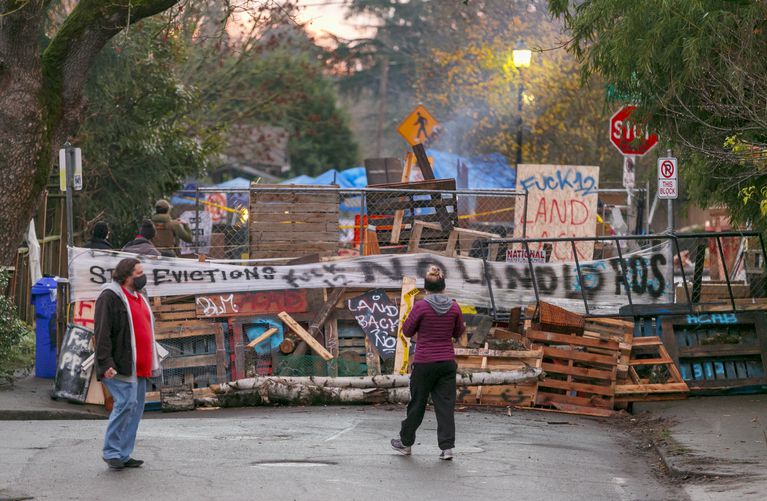
“A standoff between the police and protesters over a mixed-race family’s eviction in Portland, Ore., is stirring up old ghosts of segregation and redlining from the 20th century,” the New York Times declared on Friday morning, Dec. 10.  “…barricades constructed with orange traffic cones, plywood, overturned dumpsters and wooden doors blocked vehicle access to the area around the house in all directions. Protesters dressed in black sat at the barricades, some warming themselves at makeshift fires.”

Neighbors walk past the protester-erected barricades, Dec. 10, 2020 on North Mississippi Ave. in Portland.
Kristyna Wentz-Graff / OPB

By late Saturday evening, a gofundme account, Save The Kinney Family Home, had raised $308,257 from 5,900 sympathetic donors, even though the story of what was going on with the house and its residents was constantly shifting. Meanwhile, neighbors seethed as the protest spread over several blocks and fears grew of clashes between activists and Portland Police.

 A sheriff’s office news release says 81 calls for service were made in the area between September 1 and November 30, because of fights, shots fired, burglary, thefts, vandalism, noise violations and threats by armed individuals. Meanwhile, accounts of open hostility to journalists covering the turmoil increased, including physical assault.

All this turmoil came after residents of Portland’s Laurelhurst neighborhood homes had gotten sick and tired of the steady growth in homeless camping in the area in blue tarp-covered tents and RVs, the trash, the garbage, needles everywhere, feces on their property, people urinating openly in their yards.

Homeless campsite at Laurelhurst Park, Portland, OR

On Nov. 19, the City of Portland finally responded to constant complaints when workers and volunteers began sweeping the encampment, removing the campsite construction and cleaning up the surrounding area. 

News of the sweep spread locally, regionally and nationally, adding to the long list of stories appearing across the country about the problems in Portland, Oregon during the year. Protests initially sparked by the May death of George Floyd in Minneapolis turned into violent tear gas-filled clashes with police that turned fatal in late August when an antifa supporter shot and killed a counter-protester. 

Police use chemical irritants and crowd control munitions to disperse protesters during a demonstration in Portland on Sept. 5, 2020. (AP Photo/Noah Berger)

Protests, riots, vandalism, intimidation, shootings, murders, tear gas, arrests, looting, indiscriminate destruction dominated news about Portland for much of 2000. The turmoil may have been primarily in certain hotspots, but the perception has grown nationally that all of Portland, the liberal utopia, is a hot mess, a metropolis of mayhem.

You can’t help but think it has diminished Portland’s reputation and caused potential newcomers from other parts of the country to have second thoughts.  

Until recently, Portland has been among the most popular urban magnets for migrating Americans, particularly the young and educated that modern cities covet.

Migration data from the U.S. Census Bureau’s 5 year American Community Survey showed that Portland was one of the places attracting the most young adults age 25-34 during 2012-2017. Seven metropolitan areas, Houston; Denver; Dallas; Seattle; Austin; Charlotte; and Portland exhibited annual net migration gains for young adults that exceeded 7,000. The Portland Metropolitan Area’s gain was 7,203, of which an astonishing 41% were college graduates.

In 2018, based on data from the Census Bureau’s 2018 one-year American Community Survey, the Portland Metro Area dropped off the list. Instead, the top seven metro areas attracting millennials were Seattle, with a net migration of about 11,300, followed by Denver, Austin, San Antonio, Charlotte, Houston, Nashville.  Phoenix, Paradise NV and Columbus, Ohio. Portland didn’t even make the top 10.

All the negative publicity Portland has been getting lately may have pushed its desirability down even further. 

Portland’s reputation as a popular hub for millennial renters certainly appears to be slipping as other up-and-coming cities nationwide take the top spots. According to one real estate analysis, Portland ranked 13th overall among the top millennial hotspots for renters, on average, for the years 2015-2020. But in 2020 alone, the Rose City dropped to 22nd, behind such up-and-coming places as Washington, D.C., Memphis, TN and San Antonio, TX.

An increasing number of millennial renters are choosing more affordable areas, such as Austin, TX, the number 1 hotspot for millennial renters in 2020. The rapidly developing area saw both its employment offerings and its residents’ incomes swell in recent years, while still maintaining a lower cost of living than other major business centers. 

Homebuying in Portland is getting tougher for millennials, too. In October 2020, the median sale price of a Portland area home rose to $435,000 and there’s a widening gap between median home prices and median household incomes. To secure a 20% down payment for a median-priced home, millennials would need to save $87,000. And that’s just the down payment. 

Portland’s appeal probably isn’t helped by the fact that in 2020 Portland became the city with the highest personal income taxes in the United States. The news was delivered in testimony to the Oregon Legislature. The State Tax Research Institute reported that state and local income taxes in Portland total nearly 14% — a rate that’s higher than San Francisco or New York.

Even tourists are getting less enchanted with Portland. A headline in a story in The Oregonian said recently, “Tourists’ views of Portland turn sharply negative, another blow to hospitality industry.”   

Perception clearly matters. As Elaine Lindberg tweeted in response to The Oregonian story, “Every Portland-related post I put on my Facebook page seems to elicit an “I’ll never go to that dangerous city” reply. They think the whole huge city is a riot zone and that every resident is an anarchist. It’s SO frustrating and sad; I worry that our businesses can’t recover.”

Alternative schooling in Oregon: is the cure worse than the disease?

School-Choice_banner

More choices don’t always mean better choices.

Oregon, eager to appease vocal parents, gives them lots of K-12 options if they don’t want to send their children to traditional brick-and-mortar public schools.

This being National School Choice Week, alternative schooling advocates are in a particularly celebratory mood. “The landscape of options to meet the learning needs of today’s students is more diverse than ever, ” Kathryn Hickok,  executive vice president of the Cascade Policy Institute, said on Monday, Jan. 27.  “Empowering parents to choose among these options can unlock the unique potential of every child. “

There’s no question that alternative schooling can be seductive. After all, it can offer flexibility, more curriculum choice, self-paced learning, protection from threatening ideas and religious freedom. And I’m inclined to think that parents should have a role to play in conveying important values to their children.

It’s not clear, however, that all the schooling choices out there are better for the children or are adequately preparing young people to succeed and participate in our complex economy.

In addition, the fragmentation of our educational system may be undermining the need for all members of our society to see themselves in common cause – a necessity for the survival of our democracy. Where too many people are isolated from their peers, they may be less likely to see a relationship of mutual commitment and responsibility to others.

A case study: Junction City School District

junctioncitytower

According to the Junction City, OR School District, of all of its  K-12 students in the 2019-2020 school year:

  • 1820 are attending district public schools
  • 74 are attending online public charter schools
  • 37 are being home schooled
  • >52 are attending private schools

Some district students may also be attending brick-and-mortar public charter schools, such as Triangle Lake, Willamette Leadership and Network Charter School, but they are not located within the district’s boundaries.

Students can attend a brick-and-mortar charter school without a release from the Junction City School District and such schools are not required to send the district a roster. The result is that no trail of paperwork is exchanged between the schools regarding Junction City resident students who attend the charter schools.

Online Public Charter Schools

According to the Junction City School District, as of Oct. 2019, district students were attending the following online public charter schools:

  • Oregon Connections Academy  (renamed Oregon Charter Academy in the 2020-2021 school year) – 4 students
  • Baker Web Academy – 42 students
  • Destinations Career Academy of Oregon – 1 student
  • Fossil Distance Learning Programs – 21 students
  • TEACH-NW – 6 students

bakerweblogo1  destinationslogoORCAlogo1  Print

fossiltownlogo

FOSSIL DISTANCE LEARNING ACADEMY

The academic performance of individual students attending the online public charter schools cannot be determined on the basis of available data. Only data on the performance of grades as a whole, based on standardized tests taken in English Language Arts, Mathematics and Science, are public.

That means there’s no way of knowing whether the students living within the Junction City School District who attend these schools are doing well or not.

The Oregon Department of Education does, however, collect data on the online schools, and it is dispiriting. It is clear that the schools are drawing children and money away from public schools while failing to provide a good alternative.

Despite that, the schools, also called cyber and virtual schools, are multiplying like fruit flies. “Other states have… increased oversight of fast-growing online schools,” noted a 2017 report by the Oregon Secretary of State’s Audits Division. “In contrast to these states, Oregon’s laws allow online schools to increase enrollment rapidly regardless of their performance.”

While online charter champions churn out a torrent of supportive stories that assert traditional schools are relics, critics are pummeled as Neanderthals unwilling to accept change.

Oregon’s online public charter schools and the districts sponsoring them are listed below:

Sponsoring District Online School 2018-19 Total Enrollment
Baker SD 5J Baker Web Academy 1,808
Mitchell SD 55 Cascade Virtual Academy 69
North Clackamas SD 12 Clackamas Web Academy 445
Eagle Point SD 9 Crater Lake Charter Academy 292
Mitchell SD 55 Destinations Career Academy of Oregon 38
Fossil SD 21J Fossil Charter School 755
Gervais SD 1 Frontier Charter Academy 303
Mitchell SD 55 Insight School of Oregon Painted Hills 305
Gresham-Barlow SD 10J Metro East Web Academy 522
Santiam Canyon SD 129J Oregon Connections Academy 3,886
North Bend SD 13 Oregon Virtual Academy 1,900
Scio SD 95 Oregon Virtual Education 37
Sheridan SD 48J Sheridan AllPrep Academy 128
Frenchglen SD 16 Silvies River Charter School 432
Estacada SD 108 Summit Learning Charter 1,081
Marcola SD 79J TEACH-NW 306
Fern Ridge SD 28J West Lane Technology Learning Center 73
Harney County SD 4 Oregon Family School 266
Paisley SD 11 Paisley School 215

Source: Oregon Department of Education

Oregon Connections Academy (ORCA), the largest online public charter school in terms of enrollment, is a target of many online school critics who argue that such schools stand out more for their aggressive tactics to recruit and enroll students than for their academic excellence. (The school was renamed Oregon Charter Academy in the 2020-2021 school year)

ORCA was placed on Oregon’s federally mandated improvement list after only 21.9 percent of tested students at the school met or exceeded math standards and 41.8% of tested students met or exceeded English Language Arts standards in 2018-19.

Baker Web Academy hasn’t performed well either. Just 28.1% of tested students at the Academy were proficient in math and 56.5 % of tested students were proficient in English Language Arts in 2018-19.

At TEACH-NW, 77.4% of tested students met or exceeded English Language Arts standards, but just 41.9% of tested students met or exceeded math standards in 2018-2019.

Attendance at online schools isn’t their strong suit either.

ORCA attendance has been dreadful. Regular attendance was only 63.4% during the 2018-19 school year and an average of 59.7% over the past three school years. That indicates chronic absenteeism.

At Destinations Career Academy, regular attendance was a dismal 26% in both the 2018-19 and 2017-18 school years. The online school says it combines traditional high school academics with industry-relevant, career-focused electives. Its poor attendance isn’t a very good start for those who will be eventually expected to show up regularly and on time at work.

Then there are graduation rates.

Graduation rates at all Oregon public schools, including online public charters, are calculated the same way by the Oregon Department of Education (ODE) as an “adjusted cohort graduation rate.” That rate is the percentage of all students who graduate from high school with a diploma within a four-year cohort period after they start 9th grade.

Graduation rates for 2019 are based on students who first entered high school during the 2015-16 School Year.

In 2019, the graduation rate for all Oregon public schools was 80.01%.  For the Junction City School District, it was 85.16%. In sharp contrast, the graduation rate at Baker Web Academy was 62.50% and at Oregon Connections Academy 56.40%.

Only the Fossil Distance Learning Program has had a consistently high graduation rate of 83.33% – 100% over the past several years. It is worth noting, however, that Fossil hasn’t been dealing with as many students with disabilities, English language learners and low-income students as the Junction City School District.

TEACH-NW started in 2017 and Destinations Career Academy of Oregon in 2018, so neither has a graduation rate for a cohort that entered during the 2015-16 school year.

Another way to evaluate school performance is to look at students’ on-track performance, the percent of freshman who have at least 25% of the credits needed to graduate with a regular diploma by the beginning of their sophomore year. Students on-track to graduate by the end of their freshman year are more than twice as likely as students who are off-track to graduate within four years of entering high school.

The 2018-19 on-track average was 85% for all Oregon public schools and 82% for the Junction City School District. In contrast, the average was just 62% at Baker Web Academy and 59% at Oregon Connections Academy.  Data is not available for the other online public schools Junction City School District students attended that year.

Even brick-and-mortar charter schools are critical of their online counterparts. While they may be at the same charter dance, they’re engaged in an increasingly hostile pas de deux.

“For a significant number of “students who are attending full-time, fully online schools, the outcomes are pretty devastating,” M. Karega Rausch, vice president of the National Association of Charter School Authorizers, told attendees at an Education Commission of the States’ National Forum on Education Policy.

What all this data indicates is that most Junction City parents enrolling their children to online public charter schools are not choosing superior alternatives to district schools.

Homeschooling 

How about children who are being homeschooled instead of sent to the traditional public schools?  Is that a superior alternative?

As noted earlier, there are 37 registered homeschoolers in the Junction City School District, a small portion of the estimated 22,000 statewide.

Parents of students between the ages of 6-18 are supposed to notify their local Education Service District (ESD) of their intent to home school within 10 days of beginning to home school, but compliance is not comprehensive.

A homeschooler is expected to take standardized testing by August 15 of the summer following the completion of 3rd, 5th, 8th, and 10th grades, as long as the child has been homeschooled since at least February 15 of the year preceding testing (18 months before the test deadline).

The required tests include grade-level math (concepts, application, skills), reading (comprehension), and language (writing, spelling/grammar, punctuation, etc.)

With the above information, you might be tempted to say that public oversight of homeschoolers is obviously comparable to that of public school because the state knows how all homeschooled students are performing. You’d be wrong.

First, homeschooled students are not required to take common standardized tests that measure academic progress. They can opt out, and many of them do.

Second, homeschoolers’ tests are scored on a percentile, so the score a child gets represents how many people taking the same test got a lower score. In other words, the scores don’t represent how well the child knows the material, only how well the child performs relative to every other homeschooler taking the test. Even then, If a child scores at the 15th percentile or above, then the ESD simply files the report and there’s no follow-up.

Third, homeschoolers don’t have to report their scores to anybody unless their education service district (ESD) asks for them. But the state cares so little about how these children are doing that ESDs almost never request test scores, according to the Oregon Department of Education.

Not that it would make much difference if ESDs did request the test scores.

That’s because homeschoolers would only need to report their composite percentile score. This is an almost useless single percentile representing a child’s performance on all three subjects together. It’s almost as though the state doesn’t really want to know how homeschoolers are doing.

What is clear, then, is that nobody really knows whether Junction City parents who are homeschooling their children are providing them with an equal or superior alternative to District schools.

Private schools

According to the Junction City School District, more than 52 students in the district attend private schools, but obtaining an accurate count is difficult.

“Private schools are not required to report to us as to how many (or which) JC resident students are attending private school,” said Kathleen Rodden-Nord, the district superintendent. “Our estimate is based on when my assistant has called them to inquire about the number.”

The count can also be off because some students whose transfer to an online public charter school was approved by the district are also enrolled in private schools.

According to the Junction City School District, private Schools in the district offering classes within the K-12 band, and their enrollment of district students, include:

  • The Strive Academy (Grades 4-12) – 12
  • Docere Academy of Arts (Grades 7-10) – 11
  • Nature Discovery Christian School (Grades PK-12) – 52

I visited The Strive Academy and Docere Academy of Arts on Jan. 15, 2020 to gather information about their operations.

The Strive Academy

The Strive Academy was hard to find. After driving by the school’s address, 375 Holly Street, several times and seeing no school signs, I figured maybe it had suddenly moved or closed. To find out, I knocked on the door of Martial Arts America, the business at the Holly Street address.

strivedoor

To my surprise, Strive was located inside the business. Outfitted for martial arts training, with striking bags along the wall and a thick mat covering most of the floor, the sole indication of a school in the room was a long table where seven children of varying ages sat with their laptops. The only adults in the room were Ruth Garcia, Strive’s owner and Director, and an assistant. Overall, the scene looked more like a children’s gym/playroom than a school and it was hard to believe much real, intense, creative learning was going on.

striveclassroom

The Strive Academy

Garcia, who has no background in education, said the school serves students in 5th – 12th grade. It has about a dozen students enrolled and a capacity of 15, she said. . All core classes (science, math, social studies and language art) are taken online through Baker Web Academy, which is tuition-free because it is a public online charter school.

For the online classes, Strive says it uses only accredited and approved online schools recognized by the Council for Higher Education Accreditation (CHEA) and the United States Department of Education.

CHEA does not, however, “recognize” any online K-12 schools. “We don’t have anything to do with K-12, only post-secondary education,” said Eric G. Selwyn, CHEA’s Membership and Information Administrator. The U.S. Department of Education doesn’t recognize, approve or accredit any online K-12 schools or programs either.

Most of the students now at Strive initially sought approval from the Junction City School District to transfer to Baker Web Academy, Garcia said. Once enrolled at Baker Web, they also enrolled at Strive.

The academic performance of the individual students at Strive is a true mystery, partly because it is not Strive that is grading them, but Baker Web Academy. Furthermore, the Oregon Department of Education discloses performance measures by grade level, not by individual students.

Docere Academy of Arts

Docere Academy of Arts wasn’t that easy to find either. The school gives its address as 530 W 7th Ave, Junction City, but that address is attached to a building identified on a plaque at the entrance as Christ’s Center.

ChristsCenter

Entrance to Christ’s Center Church

Learning from my experience with Strive, I walked into the building and asked if they knew anything about Docere.  It turned out the church building was a former elementary school and Docere was in a classroom down one of the hallways.

Like Strive, Docere operates in one large room, though Docere’s space is furnished and pleasantly decorated like a traditional classroom setting.

Docereclassroom

A student at the Docere Academy of Arts

Docere embraces John F. Kennedy’s view that, “This country cannot afford to be materially rich and spiritually poor.”

“…my hope and vision is to see a school for girls that starts with the Bible as our foundation for all subjects and to inspire a love for learning and discovering God’s truths through academia and the arts,” the school’s Director and instructor,  Jaymie Starr, says in a standard letter to prospective families and students.

Starr said the school currently serves 11 girls in grades 7-10. As with Strive, all core classes are offered only online, with most students registered at Baker Web Academy and a few with the Junction City School District’s online program, JC Online.

There are two people on Docere’s staff according to its website, Jaymie Starr (also identified as Barbara J. Starr in other records) and her husband, Jeffery Starr.

The website says Jaymie holds an Associate’s of Biblical Studies degree from University of the Nations, which is not accredited by any recognized accreditation body. “The goal of the U of N is to teach students how to apply biblical truth practically and to fulfill the Great Commission (Matthew 28:18-20),” The university’s website says.

Jaymie completed a year of teacher training from U of N through their satellite campus in Tyler, TX.  The program, Teachers For The Nations (TFN), says it teaches how to “train the student to prepare and present Biblically-based lesson plans for every subject in the curriculum.”

According to Docere’s website, Jaymie’s husband, Jeffery Starr, is a Youth Pastor at Christ’s Center Church. He also works as a middle school track and cross country coach at Junction City’s Oaklea Middle School. “I love Jesus, my family and coffee!,” he says on his Facebook page.

Although Docere’s classroom setting is superior to Strive’s, the academic performance of the individual students at Docere  is just as much a mystery. Baker Web Academy is grading them, not Docere, and the Oregon Department of Education discloses performance measures only by grade level, not by individual students.

Then there’s the money

One thing all the alternative schooling arrangements have in common is that somebody is making money.

At Docere, Strive and other private schools that access online coursework through public charter schools, the online classes may be free, but all the private schools have additional charges.

At Strive, all new students pay a $149 processing fee that also covers a martial arts uniform. Then there is a $99 a month charge for a required martial arts class twice a week. In addition, tuition is $300 a month, which covers field trips and instruction in things such as robotics, music, art and first aid. That translates into $3740 for a school year for a new student.

If the school was operating at capacity, it would generate $56,100 of revenue over a 9-month school year. “You’re paying for a safe place, a safe environment,” Garcia said.

At Docere, there’s a registration fee of $100 and a monthly tuition fee of $275 per student with a $50/month sibling discount. The tuition is expected to cover the majority of costs for everything from weekly science labs, dance workshops, and art classes to cooking classes and field trips. Tuition also covers the school’s rent, activity costs, salary for the school director, payments to other teachers, tutor costs, substitutes, supplies, copies and wifi. That translates into $2,575 for a school year for a new student.

With 11 students, the school is generating $28,325 of revenue over a 9-month school year.

The big money, however, isn’t being made by the private schools.  It’s being made by the online public charter schools that provide the coursework.

These schools aren’t collecting tuition from their students. Instead, the mostly poorly performing online schools  are being supported with money diverted from the state’s brick-and-mortar public schools. The Oregon Department of Education distributes State School Fund money to each school district that sponsors a charter school; the district then passes on most of that money to the charter school.

 The Santiam Canyon School District sponsors Oregon Connections Academy, which had the largest enrollment of 3,886 students on Oct. 1, 2019. The State School Fund gave the district $30,419,216.36 for the 2018-19 school year to support that sponsorship.

Oregon law provides that a sponsoring district must pass on to its charter school at least 80 percent of its per-pupil grant for K-8 students and 95 percent of its per pupil grant for grade 9-12 students.

The Santiam Canyon School District chose to retain 1% ($304,192.16) of the State School Fund money it received and then to charge Oregon Connections Academy 3.5% ($1,054,025.85) of the balance as a management fee for the provision of services for the 2018-19 school year. That translated to $1,358,218.01 in revenue to the Santiam Canyon School District and $29,060,998.35 in revenue to Oregon Connections Academy.

Distributions to all the Oregon school districts sponsoring online public charter schools that year are shown below:

County District sponsor Charter school SSF $ rec’d
Linn Santiam Canyon SD 129J Oregon Connections Academy  $  30,419,216.36
Coos North Bend SD 13 Oregon Virtual Academy  $  14,510,307.99
Baker Baker SD 5J Baker Web Academy  $  14,147,825.08
Clackamas Estacada SD 108 Summit Learning Charter  $    8,616,826.86
Wheeler Fossil SD 21J Fossil Charter School  $    5,856,698.56
Multnomah Gresham-Barlow SD 10J Metro East Web Academy  $    4,047,657.29
Clackamas North Clackamas SD 12 Clackamas Web Academy  $    3,511,076.97
Wheeler Mitchell SD 55 Cascade Virtual Academy; Destinations Career Academy of Oregon; Insight School of Oregon-Painted Hills  $    3,409,914.44
Harney Frenchglen SD 16 Silvies River Charter School  $    3,367,207.13
Marion Gervais SD 1 Frontier Charter Academy  $    2,350,696.75
Lane Marcola SD 79J TEACH-NW  $    2,348,684.27
Jackson Eagle Point SD 9 Crater Lake Academy  $    2,256,338.83
Harney Harney County SD 4 Oregon Family School  $    2,032,711.22
Lake Paisley SD 11 Paisley Charter School  $    1,618,021.06
Yamhill Sheridan SD 48J Sheridan All Prep  $    1,047,705.30
Lane Fern Ridge SD 28J West Lane Technology Learning Center  $        579,874.37
Linn Scio SD 95 Oregon Virtual Education  $        232,202.48

Source: Oregon Department of Education

     Oregon’s State School Fund sent $100,352,964.96 to school districts sponsoring online public charter schools for the 2018-2019 school year.

All that money for a mostly substandard education and mediocre results.

Some State School Fund money may also be leaking back to the parents of the online students in the form of cash, debit cards or school-controlled accounts that students and their families are supposed to use for school-related purposes.

In a late 2019 posting to the Junction City School District’s districts website, Rodden-Nord  alleged that some online public charter schools are using State School Fund money to give their students “stipends”  that ranged from $900 per student to at least $2000 per student. “A handful of Junction City families seeking a release from our district to attend a virtual charter program have expressed that they do not want to do JC Online (the district’s online program) because we do not provide such a stipend and they need it, or want it,”  Rodden-Nord said.

The TEACH-NW website confirms that annual so-called “allotments” will be made to students in the 2019-2020 school year as follows, with amounts allocated based on initial enrollment quarter:

According to Phillip Johnson, the Director at TEACH-NW,  allotments can be used to cover academic materials such as textbooks, school supplies, curriculum materials, approved instructional programs (i.e. music, dance), enrichment experiences, educational subscriptions, educational fees, tutoring services, some athletics fees and equipment, field trips, and internet expenses as approved by the student’s Educational Facilitator (assigned teacher).

“All expenditures are closely monitored (daily) by our account supervisor,” Johnson said. “Families do have access to a program issued debit card which is under the direct control of our program (activation, deactivation, loading). We also process reimbursements for those families who prefer to not use their debit card. All expenditures must be directly linked to the student’s Individual Learning Plan (ILP) which is aligned to state standards.  Failure to maintain program compliance results in allotment suspension.”

Amber Jallo, Enrollment Manager at the Fossil Distance Learning Program, said her school also supplies funds to families. “We supply $1500 of ed funds,” she said. “This breaks down to be $750 per semester. These funds can be spent on curriculum, field trips and enrichment.”

Jim Smith, Superintendent of the Fossil School District, added,  “We provide educational funds to purchase curriculum and instruction.  All purchases must meet all requirements provided in our policies. Our students can currently use these funds for curriculum, educational supplies, tutoring, instruction, and field trips.”

Daniel Huld, Superintendent of Baker Charter Schools, said they don’t provide students with any such stipends.

Even if online public charter schools do give some of their State School Fund money to students or their families, they may not be breaking any rules if the funds are intended to be used for school-related expenses.  “To our understanding there is nothing that explicitly prohibits this in the charter school statutes, or in state law that speaks specifically to this issue,” said Jenni Knaus, a Communications Specialist at the Oregon Department of Education.

_______________________

I get it that the alternative education choices reflect a lack of confidence in traditional educational institutions. However, despite the almost messianic belief in alternative schooling held by many supporters, it’s clear from the facts on the ground that they have not found the promised land.

A close look reveals a brutal truth — there are major flaws in many of the alternative options being chosen by Oregon parents and the damage being inflicted on their children could be severe.

All Oregonians, particularly the legislature and governor, should care because education is not just a private good.  Studied indifference or washing our hands of the consequences of educational malfeasance can have serious consequences for the community at large.

As Chester Finn Jr., Distinguished Senior Fellow and President Emeritus at the Thomas B. Fordham Institute, put it, “Once you conclude that education is also a public good—one whose results bear powerfully on our prosperity, our safety, our culture, our governance, and our civic life—you have to recognize that voters and taxpayers have a compelling interest in whether kids are learning what they should…”


Is TriMet “riding the winds of change”? Not really.

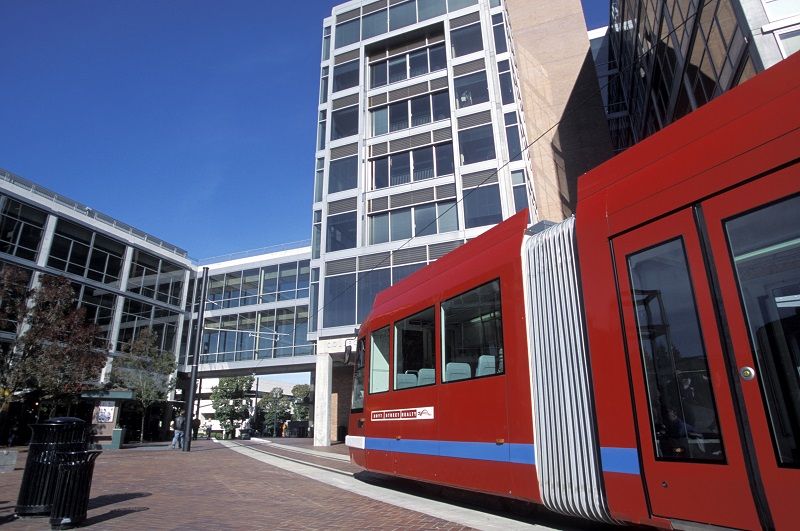
Portland-Streetcar-cm

Think TriMet’s New Electric Buses Run on Wind Power? Think Again.

By Rachel Dawson

TriMet unveiled five new battery-electric buses (BEBs) in April 2019, the sides of which all donned images of windmills and sweeping gusts of wind. The BEBs each cost around $1 million, nearly twice as much as a traditional diesel bus. And these buses are just the beginning: The TriMet board voted last year to replace the entire fleet with battery-electric buses for $1.18 billion by 2040, a $500 million premium over a diesel fleet.

TriMet has been hailed an environmental hero for “riding the winds of change.” TriMet Spokesperson Roberta Altstadt claimed that TriMet was the first in the United States to “operate an electric bus on 100% renewable energy.” Without further research, it would be easy to think that TriMet’s new buses ran on clean wind energy. And that is exactlywhat TriMet is hoping you would think. But you would be wrong.

If the buses don’t run on 100% wind power, how is TriMet able to get away with saying they do?

TriMet spends $228.75 per month on what are known as renewable energy certificates (RECs) from PGE. RECs are a tradable commodity sold by renewable energy facilities (such as wind farms) to the wholesale market, that purport to represent the “environmental amenities” of certain renewable energy projects. By purchasing the RECs, TriMet has bought the legal right to claim it is using renewable energy; however, the agency has not purchased any energy itself.

This would be like my paying someone else to exercise at the gym for me, and then telling my family and friends I go to the gym. The person I pay reaps both financial and physical benefits while I merely get to pretend I have them.

Supporters of RECs claim the certificates offset fossil fuels and pay for the generation of new renewable energy. However, these claims are not entirely accurate. According to Daniel Press, a Professor of Environmental Studies at UC Santa Cruz, “RECs do little to reduce emissions in the real world because they have become too cheap to shift energy markets or incentivize businesses to build new turbines.” The income generated from RECs does not come close to the millions needed to construct more wind turbines, which means that RECs themselves don’t offset fossil fuels.

Despite its claims, it would be impossible for TriMet to run on 100% wind power unless it disconnected from the regional mixed grid and hooked up to its own personal wind farm. Even then, TriMet would be forced to rely on other backup power sources due to the volatility of wind generation.

While a wind turbine may be available to produce energy around 90% of the time, the average wind farm in the United States in 2018 had a capacity factor of only 37.4%. The capacity factor refers to the amount of energy produced in a year as a fraction of the farm’s maximum capacity. Wind farms produce electricity when winds reach about nine miles per hour and stop at roughly 55 mph to prevent equipment damage. If the wind isn’t blowing (or isn’t blowing strongly enough), little to no power can be generated.

This poses problems, as the electrical grid requires constant equilibrium or blackouts will result—power supply must meet energy demand. Every megawatt of wind power has to be backed up by an equal amount of traditional, “non-green” sources like coal and natural gas to account for times when wind energy isn’t generated. This would be like keeping a car constantly running at home in case the one you’re driving on the road fails.

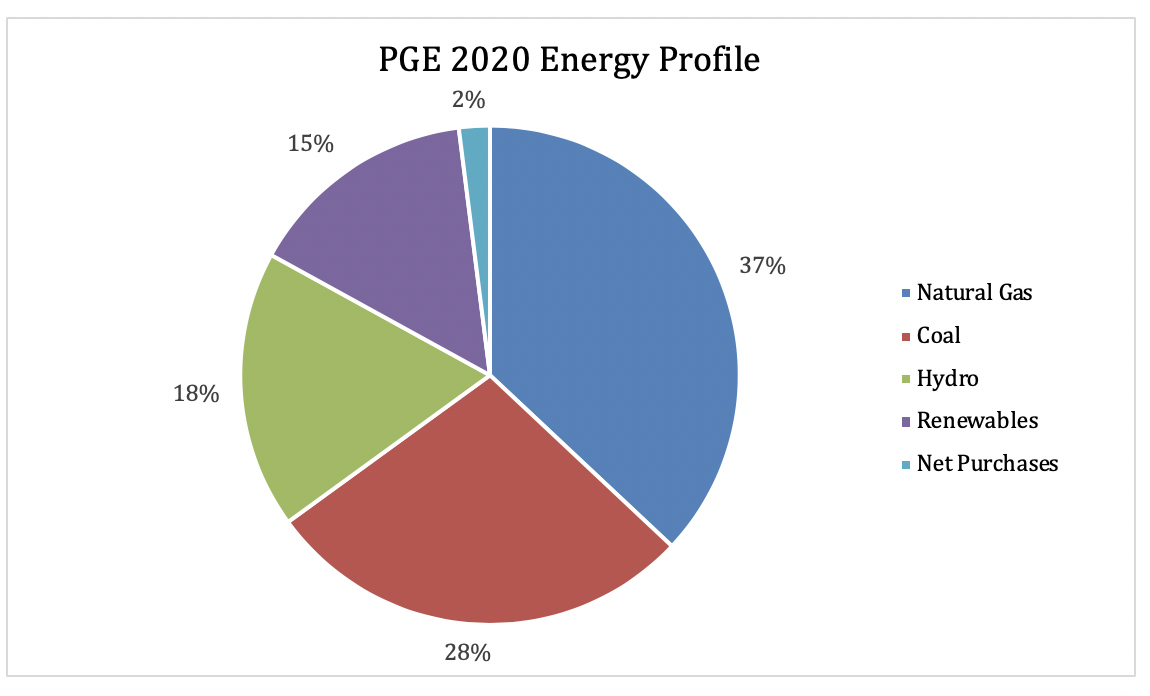
Instead of a wind farm, TriMet receives its electricity from Portland General Electric, the same mixed grid your home is likely powered by. In 2020, this mixed grid will be made up of 37% natural gas, 28% coal, 18% hydro, 15% renewables, and 2% purchased power (power purchased on the wholesale market). Since wind only makes up a portion of renewables used by PGE, less than 15% of the electricity used by the “wind” buses is powered by wind. A greater percentage of the electricity used by TriMet’s BEBs comes from coal plants than wind farms.

If TriMet were honest with its riders, it would replace the windmills on the sides of the new buses with coal, natural gas, and hydroelectric power plants. In the name of accuracy, TriMet could place a windmill in the corner, demonstrating the small percentage of power generated by wind farms.

So instead of riding the “winds of change,” keep in mind that you’re just riding a really expensive bus.

Rachel Dawson is a Policy Analyst at Cascade Policy Institute, Oregon’s free market public policy research organization.


Hijacking Oregon Justice


Kate Brown

Oregon Gov. Kate Brown

Former Portland City Commissioner Steve Novick was hired by  Gov. Kate Brown’s Oregon Department of Justice in June 2018 as a Special Assistant Attorney General (SAAG).

Sounds simple and straightforward. It’s not.

It’s just plan wrong and Brown and her Attorney General, Ellen Rosenblum, shouldn’t be allowed to get away with it.

Oregon’s Cascade Policy Institute is pointing out that Novick’s entire salary is being paid by an out-of-state private source, New York University’s State Energy & Environmental Impact Center, which is backed by Bloomberg Philanthropies. The Center is covering Novick’s legal fellowship with the aim of strengthening state attorney general offices in their crusade against the Trump administration’s environmental policies.

The unprecedented practice of providing external funding to state attorneys general to push a policy agenda ought to raise ethical concerns, the Cascade Policy Institute asserts, and justifiably so. As attorney Andrew Grossman put it: “What you’re talking about is law enforcement for hire….Really, what’s being done is circumventing our normal mode of government.”

In August 2018, Competitive Enterprise Institute published a report by Christopher Horner which details the roots and function of the SAAG program. Law Enforcement for Rent: How Special Interests Fund Climate Policy through State Attorneys General describes the genesis of the SAAG program as an informal coalition between states, spearheaded by former New York Attorney General Eric Schneiderman.

According to Justus Armstrong, a Research Associate at Cascade Policy Institute, a letter included in the report’s appendix from Schneiderman and Vermont Attorney General William Sorrell to Oregon Attorney General Ellen Rosenblum shows she was invited to a March 2016 meeting of this coalition. The letter describes the program as “an important part of the national effort to ensure the adoption of stronger federal climate and energy policies.” Correspondence between members of the coalition (also compiled by Horner) expresses a desire to collaborate on targeting companies in the energy industry with regulatory and enforcement tools.

This same environmental policy agenda drives NYU’s Center, as expressed in its communication with state attorneys general. Emails state that the “opportunity to potentially hire an NYU Fellow is open to all state attorneys general who demonstrate a need and commitment to defending environmental values and advancing progressive clean energy, climate change, and environmental legal positions.” NYU’s website directs interested attorneys general to demonstrate a need for outside funding to pursue these legal positions.

If this sounds questionable, imagine a similar practice being used to serve other political agendas. If a nonprofit backed by Charles and David Koch offered to fund a position in a state to provide legal assistance on regulatory matters, would it be considered a conflict of interest? If the National Rifle Association were bankrolling state employees to serve as a “resource” on gun law enforcement, would it raise red flags? This isn’t simply about protecting the environment versus not. It’s a question of impropriety and corruption. NYU states in its agreements that fellows owe their loyalty solely to the state attorney general once they’re assigned there, but SAAGs like Novick are still being paid by an outside source while working on behalf of the state.

According to the Associated Press, Oregon deputy legislative counsel Marisa James said in a Sept. 11, 2018 legal analysis that the fellowship program violates state law because special assistant attorney general Steve Novick is paid by an entity other than the state and reports to the center and the attorney general.

“We conclude that some aspects of Mr. Novick’s appointment conflict with the Attorney General’s authority to appoint assistants under ORS 180.140,” Ms. Jacobs said in a letter obtained by The Washington Free Beacon.

Oregon Deputy Attorney General Frederick Boss disagreed, arguing in a Sept. 24, 2018 letter that the arrangement is “consistent with many longstanding SAAG appointments in areas like tobacco enforcement, bond issuance, and complex health care transactions.”

It appears that Rosenblum was anxious about the ethical gray areas of this arrangement from the start. Emails from within the DOJ show that Rosenblum instructed the DOJ not to use the word “volunteer” to describe Novick’s position in his hiring paperwork. The obfuscating language of the hiring process is notable: In reality, Novick isn’t working as a “volunteer” or a “research fellow,” but as an environmental lawyer, as he has been for years. Rosenblum also showed apprehension about the potential media attention the unprecedented arrangement could draw, as one email states:

“We need to be sure we are prepared to explain his position to the media, who, no doubt, will be interested. (Because he is being paid by an outside entity—which is quite unusual I think)….”

As Armstrong notes, Novick’s position is quite unusual indeed, and Oregonians deserve an explanation. Regardless of one’s views on Novick, Rosenblum, or Bloomberg’s environmental policy agenda, embedding privately funded legal counsel in our justice department is a conflict of interest. The Attorney General’s office should be loyal to Oregon citizens, not out-of-state donors, and should uphold the law rather than push a legislative agenda.


Gov. Brown’s Hiring Freeze: Too Little, Too Late

brownhandsraised

Finally.

More than two months after Senate Republican Leader Ted Ferrioli of John Day called for a hiring freeze in Oregon’s public sector, Democratic Gov. Kate Brown has signed an executive order imposing a hiring freeze.

But it will only last until June 30 of this year. Too little. Too late.

In deciding on a hiring freeze, Brown’s no bold innovator. She’s following what more responsible states and businesses have done before.

Gov. Asa Hutchinson of Arkansas, in an effort to strengthen state finances, imposed a state hiring freeze last year that whittled 1,161 employees from the payroll.

Nebraska Gov. Pete Ricketts, whose state missed revenue forecasts last fiscal year and is forecasting a miss again because of declines in farm income, also put on a hiring freeze for state employees. “As Nebraskans, we don’t spend money we don’t have,” Ricketts said.

Businessess pull back when they face financial challenges, too.

Macy’s, faced with unfavorable earnings, decided to shut down 68 stores and cut more than 10,000 jobs.

In December 2011, then Gov. John Kitzhaber, who was also facing budget troubles, ordered a hiring freeze. But when Gov. Brown released her recommended budget for 2017-19, she chose not to do the same.

In fact, with Oregon facing a $1.6 billion budget shortfall in the 2017-19 biennium, buried in the Governor’s initial budget was a proposal to actually increase the state government workforce from 38,737 in 2015-17 to 39,412 in 2017-19. That’s an increase of 675 full-time equivalent employees.

“Using the cost information from the Legislative Fiscal Office, this 1.7 percent increase would cost the state more than $120 million in compensation costs for the 2017-19 biennium,” according to Facing Reality, a Cascade Policy Institute report.

“A prudent step of a hiring freeze would free up resources and ward off some of the pressure to increase taxes, fees, and charges,” the report said.

An ever-expanding state is not sustainable without ever-increasing taxation.   If Oregon is to responsibly manage its finances, an across-the-board rigorously enforced hiring freeze, with stringent requirements for exceptions and restrictions on hiring contractors, should be imposed for the entire next biennium.

Surely the governor and Legislature, with a state workforce that’s already at 38,737, can find ways to meet the state’s needs by adjusting the workload and assignments of that workforce.

Take a leap folks. Do the right thing.


Now more than ever, Oregon needs a hiring freeze

budget1


Senate Republican Leader Ted Ferrioli, of John Day, has called for a hiring freeze in Oregon’s public sector, saying it will ignite economic growth.

“A hiring freeze in the public sector will ignite growth in the private sector that has been suffering under the rapid growth of government,” said Ferrioli. “We should not be artificially growing government at the cost of the Oregon worker and their loved ones. Grandpa always said when you find yourself in a hole, quit digging.”

The State of Oregon Employment Department data shows that government has had an explosive growth in jobs that has not been matched by growth in the private sector, which is the engine of the economy.

Additionally, the Taxpayer Association says that Oregon out-spends 39 other states and that our state budget grows twice as fast as population and inflation rates combined. State employees make almost double what average working Oregonians make, earning on average $89,000 compared to $45,893.

Whats worse, 35 years of double-digit growth has produced big scandals and billions in preventable mistakes.

“We must end the era of government gone wild.”

Ferrioli has it right.

Most states, when they confront financial hard times, put a hold on hiring.

Gov. Asa Hutchinson of Arkansas, in an effort to strengthen state finances, imposed a state hiring freeze last year that whittled 1,161 employees from the payroll.

Nebraska Gov. Pete Ricketts, whose state missed revenue forecasts last fiscal year and is forecasting a miss again because of declines in farm income, also put on a hiring freeze for state employees. “As Nebraskans, we don’t spend money we don’t have,” Ricketts said.

 Businessess pull back when they face financial challenges, too.

Macy’s, faced with unfavorable earnings, decided to shut down 68 stores and cut more than 10,000 jobs.

Dow Jones & Co., like many news organizations that have been letting people go in the face of declining revenue, is planning to lay off dozens of reporters and editors at the Wall Street Journal because of persistent drops in print advertising income. The news and information business of News Corp, which publishes the Wall Street Journal and other newspapers, reported a 7% decline in revenue in the 4th quarter of 2016.

In December 2011, then Gov. John Kitzhaber, who was also facing budget troubles, ordered a hiring freeze. But when Gov. Brown released her recommended budget for 2017-19, she chose not to do the same.

In fact, with Oregon facing a $1.7 billion budget shortfall in the 2017-19 biennium, buried in the Governor’s Budget is a proposal to actually increase the state government workforce from 38,737 in 2015-17 to 39,412 in 2017-19. That’s an increase of 675 full-time equivalent employees.

“Using the cost information from the Legislative Fiscal Office, this 1.7 percent increase would cost the state more than $120 million in compensation costs for the 2017-19 biennium,” according to Facing Reality, a Cascade Policy Institute report offering alternative budget proposals. “A prudent step of a hiring freeze would free up resources and ward off some of the pressure to increase taxes, fees, and charges,” the report said.

An ever-expanding state is not sustainable without ever-increasing taxation.   If Oregon is to responsibly manage its finances, an across-the-board rigorously enforced hiring freeze, with stringent requirements for exceptions and restrictions on hiring contractors, should be instituted NOW.

Then the size of the state workforce should be held down by careful pruning of ineffective and bloated programs and the hiring freeze should be continued in the 2017-2019 budget, which would encourage state agencies to optimize the staff they have.

Surely the governor and Legislature, with a state workforce of 38,737, can find ways to meet the state’s needs by adjusting the workload and assignments of that workforce.

In the end, the state and taxpayers will be better off for it.