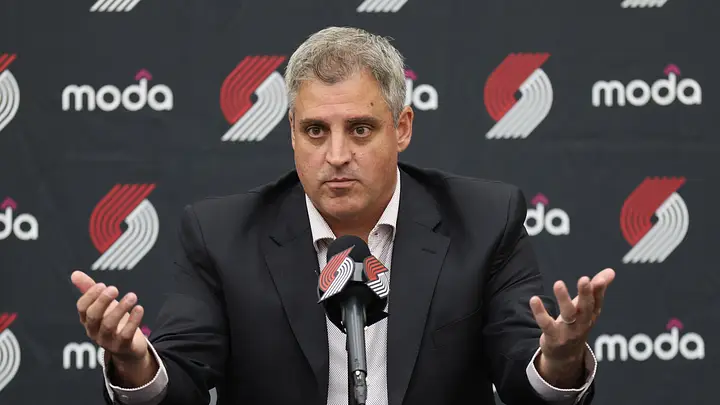
Don’t Give ANY Taxpayer Money to Tom Dundon and His Cronies for the Moda Center

The Portland City Council approved a term sheet for a possible Moda Center renovation on August 12, one more step in a potential misguided commitment to a billionaire and his buddies. 

The term sheet commits what The Oregonian has dubbed “a torrent of taxpayer money” of up to $573 million in public funds for the renovation of the Moda Center, including a state commitment of $365 million, a Portland commitment of $120 million and a Multnomah County commitment of $88 million. Portland would also commit up to $275 million in maintenance costs on the arena over the next 20 years and Multnomah County would chip in $13 million for capital expenses.

Don’t cry for Texas billionaire Tom Dundon and Rip City Rising, the group he leads in the Blazers deal, under which the group purchased 80.1% of the Trailblazers at a $4 billion valuation and the remaining 19.9% at a $4.5 billion valuation. Whatever they pay is likely to be rewarded with a much bigger payday down the road. At some point they are going to turn it over and probably make a bundle.

On august 21, it was reported that Marc Lore had agreed to sell his control stake in the NBA’s Minnesota Timberwolves and the WNBA’s Minnesota Lynx to billionaire investor Marc Stad at a $4.5 billion enterprise value. Lore and Alex Rodriguez purchased their initial controlling stake in the Minnesota Timberwolves and Minnesota Lynx from Glen Taylor based on a  $1.5 billion valuation, completing the process in June 2025.

And look at what one owner just pulled off selling the Los Angeles Lakers. 

Earlier this month, Mark Walter sold the Los Angeles Lakers to Bob Iger, the former Disney CEO and Los Angeles notable, and Josh Kushner, a venture capitalist. The deal came together in three days: $12.5 billion for a team that Walter bought less than a year ago for $10 billion. 

Dundon and his investment group also stand to reap billions from the Blazers acquisition down the road. What makes ordinary people who would never go along with subsidies for billionaires become willing supporters of such rewards when they become politicians? 

The payoffs for other buyers of NBA teams who have subsequently sold their teams have been eye watering.

  • Boston Celtics: Bought by an investment group, Boston Basketball Partners L.L.C, led by Wyc Grousbeck that purchased the team in 2002 for $360 million; sold to an investment group led by private equity mogul Bill Chisholm in August 2025 for $6.1 billion.
  • Phoenix Suns: Bought by Robert Sarver, leading an investment group called Suns Legacy Partners, in 2004 for $401 million; billionaire mortgage lender, Mat Ishbia, purchased the majority stake of the Suns and the WNBA’s Mercury for $4 billion in 2023.
  • Dallas Mavericks: Mark Cuban purchased a majority stake in the Dallas Mavericks from H. Ross Perot Jr. in January 2000 for $285 million; Cuban sold a majority interest in the team to Miriam Adelson and Patrick Dumont of the Adelson family casino empire for $3.5 billion in 2023.
  • Charlotte Hornets: Michael Jordan bought a majority stake in the Charlotte Bobcats (now the Hornets) from founder Bob Johnson in March 2010 for $275 million; sold his majority stake for $3 billion to a group led by Gabe Plotkin and Rick Schnall in July 2023. 
  • Golden State Warriors: Bought from Chris Cohan by Joe Lacob and Peter Guber for $450 million in July 2010; current valuation estimated at  $10.8 – $11.3 billion.
  • Milwaukee Bucks: Bought by former U.S. Senator Herb Kohl in 1985 for $18 million; sold by Kohl to Wes Edens and Marc Lasry in 2014 for $550 million; current estimated valuation $4.1 – $4.5 billion. 
  • LA Lakers: Bought by Jerry Buss in 1979 for $67.5 million; in June 2025, Buss family agreed to sell controlling interest to Mark Walter, a minority owner since 2021 and owner of the L.A. Dodgers, for $10 billion. 

And the money changing hands in these deals is likely to get bigger. “I am absolutely convinced that we have not reached anything close to a ceiling,” Irwin Kishner, a partner at the law firm Herrick and co-chair of its sports law division, told The New York Times. And particularly with the most recognizable teams, he said, “you could only envision the numbers going further north.”

Enough already with the taxpayer support!

Portland’s Next Mayor? Who Cares?

Portland’s Next Mayor?

In all the turmoil and media attention focused on Portland’s new ranked choice voting election in November, much of the focus has been on the contest for mayor.[1]

Why?

The next mayor is going to be a eunuch. No, I don’t mean a castrated man. I mean the word metaphorically, in the sense an ineffectual or powerless person.

It’s the new 12-person City Council that will have the power to enact laws. The new mayor won’t even sit on the City Council or vote on council items (except to break a tie).  The mayor, and the new city administrator, who will be appointed by the mayor with council approval, will be in charge of carrying out City Council actions and crafting the city budget.

The mayor will also be tasked with appointing a city administrator, city attorney, and police chief, but that will also be only with the City Council’s approval. And to top it all off, the mayor won’t have veto power over council decisions. 

The mayor will serve more as a $175,463-a-year figurehead than a legislator, Tate White, a member of the city’s government transition team, told OPB earlier this year. “They’re going to be partnering with other jurisdictions, they’ll be standing at press conferences, they’re going to be the people meeting with representatives from sister cities when they come and visit, it will be far more ceremonial,” she said.

But don’t count on the new 12-person City Council, with three representatives per four new geographical districts and only one staff person for each City Council member, to be all that cooperative, efficient or effective. It might be more functional than New York City’s 51-member City Council, but likely not much. After all, a City Council member can be elected with as little as 25% + 1 votes, so their constituencies will be pretty damn small.[2] One consequence could be a Councilor able to remain in office by consistently satisfying just that smaller segment of eligible voters.

Jeff Jacoby, an award-winning columnist for the Boston Globe, calls the ranked choice voting process “democracy on the Rube Goldberg model”, where  ideas that supposedly simplify people’s lives wreak havoc instead.


[1] Mayoral candidates include three current members of Portland City Council: Rene Gonzalez, Mingus Mapps and Carmen Rubio. Others running are: Saadiq Ali, early childhood educator Shei’Meka As-Salaam, inventor James Atkinson IV, REAP youth advocate Durrell Kinsey Bey, financial advisor Nancy Congdon, Yao Jun He, advocate for the unhoused and community activist Michael O’Callaghan, artist and performer Liv Osthus, city hall veteran and green energy advocate Marshall Runkel, owner and president of TITAN Freight Systems Keith Wilson and maintenance supervisor Dustin Witherspoon. 

[2] Charter reform’s explanation of how “single transferable vote” (STV) will work: 

“Councilors of each district are elected using a proportional method of ranked choice voting known as single transferable vote. This method provides for the candidates to be elected on the basis of a threshold. The threshold is determined by the number of seats to be filled plus one, so that the threshold is the lowest number of votes a candidate must receive to win a seat such that no more candidates can win election than there are seats to be filled. In the initial round, the number of first rankings received by each candidate is the candidate’s vote count. Candidates whose vote counts are at least the threshold are declared elected. Votes that counted for elected candidates in excess of the threshold are called surplus. If fewer candidates are elected in the initial round than there are seats to be filled, the surplus percentage of all votes for the candidates who received a surplus are transferred to the next-highest ranked candidates in proportion to the total numbers of next-highest rankings they received on the ballots that counted for the elected candidate. If, after all surpluses have been counted in a round, no additional candidates have a vote count that is at least the threshold, the candidates with the lowest vote counts are successively eliminated in rounds and their votes are counted as votes for the candidates who are ranked next highest on the ballots that had been counted for the eliminated candidates, until another candidate has a vote count that is at least the threshold or until the number of candidates remaining equals the number of seats that have not yet been filled. The process of transferring surpluses of elected candidates and eliminating candidates continues until all positions are elected.”