Oregon Transportation Bill Would Pummel Vehicle Owners

Democrats in Salem are preparing to dig much deeper into your pocket with a massive transportation revenue bill, HB 2025. Because its multiple parts obscure its impact on individuals, let’s look at what it would mean for car owners, which is about 92% of households in Oregon. There are over two dozen increases to vehicle-related fees in the bill.

  • Planning on buying a new car?  Oregon’s zero percent vehicle sales tax has made it a great state in which to purchase a car. HB 2025 proposes a new Vehicle Sales Tax in the form of a 2% “transfer tax” on the sale price of new cars and a 1% tax on used cars valued at over $10,000. The average price paid for a new car in the U.S. in May 2025 was $48,799, according to Kelley Blue Book (Up from$21,041 in 2020).[1]That would mean a sales tax of $975.98 on your new car. The average price paid for a used car in Oregon is $35,556. That would mean a $335.56 sales tax. 
  • Fees for vehicle registration would go up, too. Registration of a new car would increase from $43 to $113.
  •  Oregon’s current vehicle registration fees for gas-powered passenger vehicles range from $126 to $156. The bill proposes a $66 increase to the existing vehicle registration fees. If you currently pay $126 to re-register your car, the cost could increase to $192 ($126 + $66) under HB 2025.
  • The cost of new license plates would rise from $12 to $33.
  • The cost to take a driver’s skill test at the DMV would increase from $45 to $111.
  • Buying or owning a gas-powered vehicle? Oregon’s current 40 cent per-gallon gas tax would increase to 50 cents per gallon in 2026 and 55 cents per gallon in 2027. The gas tax would be indexed to inflation beginning in 2029. The average vehicle in Oregon uses approximately 489 gallons of gas per year. That would mean a $48.90 increase in gas costs in 2026 and a $73.35 increase in gas costs in 2027.
  • Buying or own an electric or plug-in hybrid vehicle? A Road Usage Charge (RUC), a mandatory per-mile fee, would be imposed on electric and plug-in hybrid vehicle owners starting July 1, 2026 or these drivers could opt for a flat annual fee, initially set at $340. The proposed $340 annual tax is based on driving 18,000 miles a year at 20 mpg at the new gas tax rate
  • A payroll tax that funds public transit via the Statewide Transportation Fund would increase from 0.1% currently to 0.3% by 2030. The tax would increase to 0.18% in 2026 and then to 0.25% in 2028 and 0.3% in 2030.

In a time of growing economic stress for Oregonians, it’s going to be enough to drive you to the poor house.


[1] That was up from the average price of $21,041 for a new car in 2000. In other words, not only will multiple costs associated with a car go up under HB 2025, but you will likely be making increasingly higher monthly payments on your new car because you’ll take longer to pay it off. While 3-year car loans were once common, they are less typical now. Today, the most common car loan terms are 60 months (five years) and 72 months (six years), and increasingly car buyers are agreeing to go with seven and eight year car loans, leading to higher total financing costs. Then there’s the growing cost of repairs. Garage repair costs are up are up over 43% in there past six years and the cost of fixing damaged cars has gone up 28% since just 2021, according to the U.S. Bureau of Labor Statistics.

Paying Striking Workers: One More Bad Idea From Oregon Democrats

Dear Oregon Legislators. Who are you going to listen to, the unions or the rest of us?

 Oregon Democrats, at the request of the AFL-CIO union, have introduced a bill, SB 916, that would allow striking workers in Oregon to collect unemployment benefits. Because the Unemployment Insurance Trust Fund is funded through a payroll tax that is paid by employers, Oregon employers would be paying workers not to work.

Public hearings on the bill before the Senate Committee on Labor and Business were held on Feb. 6 and Feb. 11, 2025.  Union supporters, particularly representatives of nurses and educators, uniformly endorsed the bill. Pretty much everybody else opposed it. 

The bill is sponsored by Democratic Senators Kathleen Taylor, Wlnsvey Campos, James I. Manning, Jr., Chris Gorsek, Mark Meek, and Deb Paterson, as well as Democratic Representatives Dacia Graber and Ben Bowman. 

The unemployment insurance program, as the state explains, ”provides partial wage replacement benefits to eligible workers who are unemployed through no fault of their own.” It is not, and was never intended to be, a source of money to compensate workers for refusing to work.

Daniel Perez with the Economic Policy Institute, founded with a pledge from eight labor unions, delivered written testimony before the Committee in support of SB 916. Ignoring the issue of whether paying strikers made sense, Perez argued that it would “result in minimal costs to the state of Oregon “and “would ensure that critical dollars continue to flow into local businesses and communities during strikes.”

Perez argued that over half of strikes end within two days and over the past four years, the median strike duration in Oregon has been five days. Therefore, the bill’s requirement that there be a 7-day waiting period before striking workers would be eligible to apply for benefitsmeant few would qualify. This , of course, ignored the issue of whether strikes would be prolonged if strikers were paid.

The Oregon School Boards Association (OSBA) asserts, for example, that if Portland Public Schools teachers went on a one month strike in 2025, it would cost the Portland school district $8.7 million if SB 916 were law at a time when the district is already struggling financially. ,

Nurses also testified in support of the bill. “By not allowing unemployment benefits, workers are being discouraged from using their legal right to collective action, creating an advantage for employers,” said one nurse. “Many healthcare workers are forced into an indefinite labor dispute without financial support, making it almost impossible to stand up for necessary changes that need to happen in the workplace.”

Individual critics were more blunt, and more persuasive.

“Are you seriously attempting to KILL businesses in Oregon?” said one. 

“Stop this wasteful spending on foolish bills.,” said another. “Passing of bills such of this will only benefit the greater Idaho movement and have more business and people move out of the state.”

 “This bill appears to be an attempt by certain politicians to woo the union vote, who will in turn donate more money to their campaigns (quid pro quo),” said another. 

“When two parties are negotiating, the cost to both sides needs to be heavy or a settlement won’t be reached.,” said another. “Paying striking employees removes the incentive to reach an agreement quickly.”

A coalition of business groups, the Oregon Farm Bureau, the Oregon Forest Industries Council, chambers of commerce, the Oregon School Boards Association and others said the bill would be “putting the state’s thumb on the scale in what should be a negotiation process between workers and employers.” Further, “If public unions strike, the impact to state (or school district, local government) budgets could be catastrophic. This is particularly alarming given the number and frequency of recent teacher strikes.”

Local governments were also outspoken in opposition to the bill. 

“At a time when local governments and businesses are grappling with tight budgets, these additional expenses would place further strain on employers who already face rising costs for wages, benefits, and regulatory compliance,” said the Marion County Board of Commissioners. “This could lead to higher taxes, service reductions, or even layoffs, the very scenario that unemployment benefits are meant to mitigate.”

The City of Hillsboro was strongly opposed as well. “This bill provides an unfair advantage to labor in a dispute by forcing all employers to fund the act of striking (or other labor disputes) and undermining the purpose of a strike,” the city said.

In my view, the arguments against paying strikers unemployment benefits clearly win out. 

But, given the tendency of Oregon’s Democratic legislators to appease unions, which overwhelmingly bankroll Democrats, the bill may still well go forward.  If it does, Portland won’t be the only part of the state in a “doom loop”. The bill would be one more nail in the coffin of the entire state’s competitiveness. 

Oregon Democrats are going to get your kicker, one way or another

State Senator Jeff Golden wrote an Opinion column in The Oregonian recently calling for diversion of the next kicker, recently forecasted to be $1.8 billion, to a dedicated Wildfire Programs Fund, which the state treasurer would invest.

It’s just one more way for a hungry Democrat-run government to raid your pocketbook. 

The idea came out of a workgroup of 36 stakeholders chosen by Gov. Tina Kotek to deliberate over alternative funding sources for dealing with wildfires. 

The key options identified were:

  • Kicker Funds: One-time use to “jump-start” wildfire funding.
  • Bottle Bill Adjustment: increase the bottle deposit to include a non-refundable portion for wildfire funding.
  • Insurance retaliatory tax – Dedicate a portion of existing retaliatory taxes paid by out-of-state insurers to the State.
  • Ending Balance: Dedicate 0.5% of previous biennium’s appropriations (if there is an ending balance) to the Wildfire Fund. 
  • One time transfer from the Rainy Day Fund (RDF) – directed to wildfire.
  • Lottery Funds – Constitutionally dedicate a portion of lottery funds for wildfire.
  • Landowner assessment rates and existing structure – will be part of the solution. 

The proposal to create a Wildfire Programs Fund “stands out from the others,” Golden wrote.

“Funding for our programs would come not from the $1.8 billion principal—that would be preserved – but rather from the investment interest it earns.,” Golden wrote. “Assuming 5% annual return (a reasonable guess judging by the Treasury’s investment history), the fund would annually generate $90 million – $180 million each biennium – for wildfire programs. While that’s not enough to cover all our needs, it sure looks good relative to the $87 million budgeted in the current two-year cycle.”

The Legislature has fooled around with the kicker before. In 1991 and 1993, budget problems relating to Ballot Measure 5 of 1990 prompted lawmakers to suspend the kicker, withholding $246 million from taxpayers. Then, in 2007, lawmakers succeeded in diverting funds from the corporate kicker to a surplus account called the rainy day fund.

Public resistance to diversion of the kicker has historically been strong. As one current Reddit post says, “The Oregon State government is run as efficiently as an HOA. The kicker policy at least mandates them to return surpluses rather than letting this group of clowns spend it on whatever is fashionable and keeps them in office.”

There’s also long been suspicion that free-spending Democrats will take undue advantage of any relaxation in kicker policy.“This past session, I was approached multiple times by Democrats who wanted to use the kicker for some purpose, and their requests were well over $10 billion,” Senate Minority Leader Tim Knopp, R-Bend, told OPB in 2023. “The reason I haven’t done any of that is, once you open the door, you’re going to spend it all.”

That’s still true. 

Money Talks: It looks Like a Bynum / McLeod-Skinner Race in the 5th District Democratic Primary

Janelle Bynum and Jamie McLeod-Skinner are running neck-and-neck in the money race in the contentious Democratic primary for the 5th Congressional District seat occupied by Kurt Schrader until replaced by Lori Chavez-DeRemer.

The race is a top target for Democrats trying to flip the U.S. House, which is now narrowly in Republican hands. The district, which voted for Joe Biden in 2020 and has more registered Democrats than Republicans, stretches from Bend to Portland. 

According to campaign finance numbers posted today by the Federal Election Commission (FEC), Bynum and McLeod-Skinner had raised almost equal amounts and had almost equal cash-on-hand as of the end of 2023.  Bynum had raised $439,286.38 and had $233,246.16 cash-on-handMcLeod-Skinner had raised $438,831.45 and had cash-on-hand of $242,300.59.

Two of the other three other Democrats in the primary race, Kevin Easton and Matthew Davie, haven’t yet filed their campaign finance reports for all of 2023. The third, Metro President Lynn Peterson, had raised $254,603.76, but had just $52,834.13 cash-on-hand, as of the end of 2023.

Going forward, Bynum may have the advantage given that the Democratic Congressional Campaign Committee announced its support for her on January 29, noting that it had put her on its “Red to Blue” list of key candidates running to replace Republican members as part of the Democrats’ strategy to reclaim the House majority.

Bynum may also have an edge because she’s attracting more out-of-state money. Recent out-of-state contributions include $4,500 from Brian Hairston, owner of Dunham Management Group in Englewood, NJ, $3,300 from James Williams owner of Estel Foods in Saint Louis, MO and $3,300 from Troy A. Carter Sr., a congressman from Louisiana. 

The primary winner will take on Republican U.S. Rep. Lori Chavez-DeRemer, who won her seat in 2020, defeating Democrat McLeod-Skinner 51% – 49%.

Chavez-DeRemer’s end-of-the-year campaign finance report with the FEC shows she had raised $2,529,913.60 and had cash on hand of $1,608,021.56. Her aggressive fundraising is expected to make her a strong candidate in the race against her eventual Democratic opponent. 

Despite the Democratic lead in registrations in the district, the Cook Political Report rates the race as a toss-up. 

Lynn Peterson is in Trouble

Lynn Peterson was primed and ready.

In June 2023, Metro President Lynn Peterson announced she was running in the Democratic primary for the 5th Congressional District seat occupied by Kurt Schrader until replaced by Lori Chavez-DeRemer.

“I’ll bring a track record of developing common sense solutions and getting things done to Congress,” Peterson said. “I’m going to fight not only for needed investments in housing, public safety, transportation and education, but also our fundamental rights to vote and seek reproductive health care.”

The race is a top target for Democrats trying to flip the U.S. House, which is now narrowly in Republican hands. The district, which voted for Joe Biden in 2020 and has more registered Democrats than Republicans, stretches from Bend to Portland. 

Peterson jumped out of the gate with an endorsement from DeFazio and over 50 endorsements from officeholders and community leaders from throughout the 5th District and the state.

What could go wrong?

Well, money.

In an email blast today, Peterson said, “For the next few months, our fundraising numbers will help set the narrative as we approach the primary and look toward the general election. (emphasis in originalFor many, these numbers serve as a proxy metric for viability.”

According to campaign finance numbers posted today by the Federal Election Commission (FEC), Peterson had just $52,834.13 cash on hand as of the end of 2023.

The other four Democratic primary candidates, Janelle Bynum, Kevin Easton, Jamie McLeod-Skinner and Matthew Davie, haven’t filed their campaign finance reports for all of 2023, but Bynum and McLeod-Skinner had healthy balances as of Sept. 30, 2023 (Bynum: $217,842.324; McLeod-Skinner: $154,767.48). 

In addition, The Democratic Congressional Campaign Committee gave Bynum a lift when it announced its support for her on January 29, noting that it had put her on its “Red to Blue” list of key candidates running to replace Republican members as  part of the Democrats’ strategy to reclaim the House majority.

 The primary winner will take on Republican U.S. Rep. Lori Chavez-DeRemer, who won her seat in 2020, defeating Democrat Jamie McLeod-Skinner 51% – 49%.

Chavez-DeRemer hasn’t filed her end-of-the-year campaign finance report with the FEC, but as of Sept. 30, 2023, she had cash on hand of $1,290,581.19. It’s expected that her aggressive fundraising efforts continued in the fourth quarter of 2023, making her a strong candidate in the race against her eventual Democratic opponent. 

Despite the Democratic lead in registrations in the district, the Cook Political Report rates the race as a toss-up. 

The Oregon Governor Race: Will the Republicans Blow It Again?

First impressions can be deceiving.

Washington, D.C. residents were baffled Wednesday when they saw people appearing to parachute into the city. Alarmed police ordered staff at the U.S. Capitol complex to evacuate due to a “probable threat” from a nearby aircraft. Turns out it was a pregame Army parachute-demonstration team performing for a Washington Nationals baseball game.

Rising public dissatisfaction with Oregon’s direction, delivering the impression that the Oregon governor’s race is going to be a win for Republicans this time around, could be a false alarm for Democrats, too. 

A February 17-23 , 2022 OPB Primary Election Survey by DHM Research asked, “All things considered, do you think that things in Oregon are headed in the right direction, or do you feel that they are off on the wrong track?” An overwhelming 73% of respondents said Oregon is on the wrong track. 

This should bode well for Republicans, out of the governor’s chair since 1987.  But, based on the campaigns currently being waged by candidates in the Republican primary, they could still snatch defeat from the jaws of victory.

An April 13, 2022, poll of likely Republican voters by Nelson Research showed that the leaders were Bud Pierce at 6.5%, Christine Drazan with 6.3%, Stan Pulliam with 4.2% and Bob Tiernan at 3.5%. None of the other Republican contenders garnered even 3%. 

The lack of real Republican enthusiasm for any of the candidates is evident, however, by the fact that with just two weeks from mail ballots going to voters and four weeks until the May 17, 2022 primary, almost 68 percent of respondents were still undecided.

Even counting the undecided who were leaning toward each candidate, Pierce was only at 10.7%, Drazan 8.2% and Pulliam, Tiernan and Bill Sizemore at 5.2% each. 

Pierce, who lost to Democrat Kate Brown in 2016, is pitching himself as “a true outsider” who is “sane, secure, stable”.  But already a one-time loser, Pierce, 65, comes across, to put it mildly, as old hat. He’s the Adlai Stevenson of the 2022 Republican primary.

Christine Drazan, 49, is promising “A new direction. for Oregon,” but she is also embracing some Republican views on abortion that turn off a lot of Oregon voters. “Christine received Oregon Right to Life’s endorsement in her previous two runs for office and is honored to have their support once again in the race for governor,” said Trey Rosser, Drazen’s campaign manager. Most Oregonians, on the other hand, have consistently opposed more restrictions on abortion.

Tiernan, in his current ad, comes across not as a hard-driving man of the people, but as a mean-spirited scold. “I’ve got what it takes,” he says, but his forced smile is insincere and off-putting.

Pulliam isn’t doing himself any favors with his outreach efforts, either.

In one television ad, he complains about critical race theory, a trendy topic that argues racism is racism is systemic in America’s institutions. In another ad, he promises not to “allow transgender athletes to compete in girls sports…Because my girls shouldn’t have to play against boys, and neither should yours.” Despite both of these issues being hot items for the right on the national stage, neither shows up on a list of hot-button issues for Oregon voters and could pigeonhole Pulliam in a general election.

Part of the problem for all the Republican candidates was revealed in a Nov. 2021 poll by  conducted by Republican pollster Fallon Research & Communications.

In the poll of 600 likely Oregon Republican primary voters, 75% viewed Donald Trump favorably, about 58% believed the 2020 election was “stolen” from Trump and about 60% said Republican candidates for statewide office should be “more like Trump.” In 2020, Joe Biden defeated Trump 56.5% – 40.4%. Those Biden voters aren’t likely to vote for a conservative Republican candidate for governor the general election.

Sure, a lot of Oregonians are pissed, but do any of the leading Republicans have an answer? Not so far. And as much as many Oregonians are frustrated with things as they are, that doesn’t make them all Republicans. As a politics junkie recently observed on twitter, “More and more I am convinced that the average voter is driven by repulsion, not attachment. They don’t vote for a party because they like it. They vote for a party because it isn’t the OTHER party, which they really despise.”

This may be a weak year for Democrats generally, but to win the governorship the Oregon Republican candidate will need to present a savvy, appealing, inspiring alternative.

So far, they’re all missing the boat.

After adjournment, the deluge

stormcoming

I guess it wasn’t enough for Democrats to allow people in the country illegally to get Oregon driver’s licenses, ignoring voters who soundly rejected the practice in 2014. Oregon’s Democrat-controlled 2019 Legislature also voted to bury Oregonians in a deluge of tax increases.

“Only time will tell whether there will be political consequences for Oregon Democrats who enacted this tax hike, Patrick Gleason, Vice President of State Affairs at Americans for Tax Reform, wrote in Forbes. “What is certain is that Oregon lawmakers are making their state a less attractive place to do business, create jobs, invest, and raise a family, and they are doing so at a time when other states are implementing reforms to make their tax and regulatory climates more welcoming.”

 At the top of the 2019 Legislature’s tax list is the gross receipts tax on sales inside the state’s borders that exceed $1 million, whether or not the business makes a profit. The tax, equivalent to a sales tax, is expected to raise $2 billion per biennium. The legislative revenue office says the tax will hit about 40,000 businesses. This less than three years after almost 60% of Oregon voters rejected Measure 97, a ballot measure that would have imposed a state gross receipts tax. 

Adding insult to injury, the Democrats passed SB 116 setting a particularly inconvenient election date if a tax repeal petition now seeking signatures qualifies for the ballot. Rather than having the vote take place during the general election in 2020, when there’s likely to be high interest and participation, the bill provides for a special election on January 21, 2020.

I guess they figured picking Christmas or New Year’s Day for the vote would be too obvious an attempt at manipulation.

Paid Family Leave legislation (HB 2005-B) is going to cost you, too. A 1% payroll tax will fund a paid family leave insurance program (FAMLI) to be administered by the Oregon Employment Department.  The tax will come on top of the business sales tax.

A Revenue Impact statement projected that employers will pay $542.3 million and employees $1,029.6 in 2021-2023. In 2023-2025, employers will pay $ 775.0 million and employees $1,471.5 million.

Then there’s the maneuvering with the kicker.  The collective “kicker” tax rebate Oregonians will likely receive when they file in 2020 is going to be $108 million smaller, thanks to HB 2975, a bill Gov. Kate Brown signed into law in April.

 And don’t forget SB 861, which provides for paying the postage for election ballots. It will cost taxpayers an estimated $1.7 million per election. Gov. Brown pushed for the law, figuring it would increase voter turnout. In a rather bizarre statement, given the widespread availability of stamps, Brown testified that low-income and younger residents don’t always have access to postage stamps.

There’s also HB 2449-B, a 50-cent increase in the emergency communications tax on our phones, which will bring the total to $1.25 per month.

Oregon’s minimum wage law is increasing employer costs, too.

According to the Office of Economic Analysis Department of Administrative Services, the law will result in a slowdown in job growth. “While the impact is small when compared to the size of the Oregon economy, it does result in approximately 40,000 fewer jobs in 2025 than would have been the case absent the legislation,” the office has reported.  “Our office is not predicting outright job losses due to the higher minimum wage; however, we are expecting future growth to be slower as a result.”

And next year, Oregon voters will get a chance to vote on an increase in yet another Oregon tax, this one on tobacco. If approved, the cigarette tax would increase by $2 a pack and E-cigarettes and cigars would be taxed at 65% of their wholesale price.

Whew, what a torrent!

As the humorist Gerald Barzan observed, “Taxation with representation ain’t so hot either.”


The Democratic presidential candidates and Oregon: they could care less

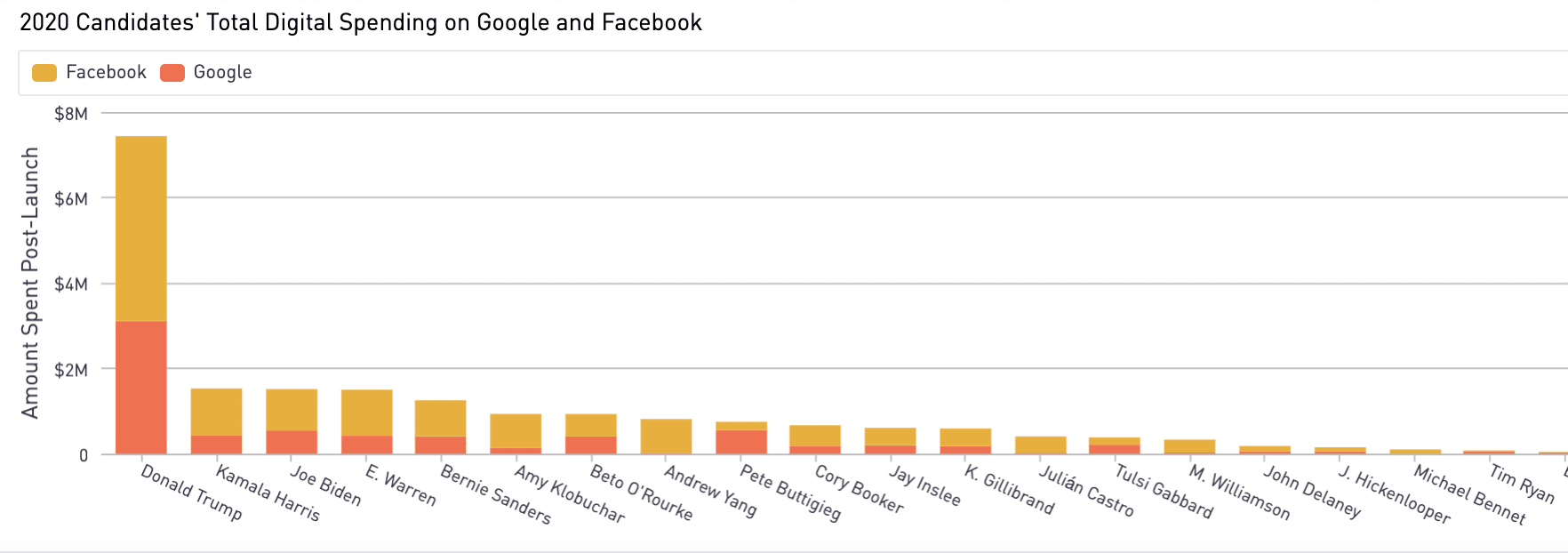
Digital advertising is one of the key elements of the campaigns of Democrats running for their party’s 2020 presidential nomination. Data show that some candidates are shouting, while others are barely whispering.

According to Acronym, a progressive non-profit that tracks political digital spending, the candidates are paying Facebook and Google millions for digital ads, but spending in Oregon is barely a blip, .

Sen. Elizabeth Warren (D-MA) is the biggest spender so far.  She has spent $1,688,706 on digital ads (Facebook: $1,218,206; Google: $470,500) since launching her campaign.

WarrenLaunch

Senator Elizabeth Warren speaks during her presidential candidacy announcement event at the Everett Mills in Lawrence, MA on February 9, 2019.

The second biggest spender on Facebook and Google digital ads is Sen. Kamala Harris (D-CA). She has spent $1,640,339 (Facebook: $1.2 million; Google: $438,000).

Altogether, the Democratic candidates have spent $12,805,165 on Facebook and Google digital ads since launching their individual campaigns.

digitalspending

Yes, President Trump has spent $9,080,994, outspending every Democratic candidate.

What states have been targeted with all that money?

If you look at the top five states targeted by each of the candidates with Facebook ads, California takes the lead. It’s one of the top five targets of 15 candidates. Then there’s Iowa, which has its caucuses on Feb. 3, 2020.  It’s in the top five lists of nine candidates. Next is Texas, one of the top five states of eight candidates.

Even though New Hampshire has its primary early on Feb. 11, 2020, it’s only in the top five spending list for Facebook ads of three Democratic candidates: Pete Buttigieg, John DeLaney; and Tulsi Gabbard.

Then there’s Oregon. Oregon’s not in the top five list of any of the Democratic candidates and it’s only in the top ten list of two, Bernie Sanders and Julian Castro. But even Sanders has applied only 3.3% ($41,502) of his Facebook spending to Oregon and Castro only 2% ($8,379).

The lack of digital attention to Oregon may well be because the state’s primary isn’t until May 19, 2020, real late in the game, and it has only 52 delegates. If a candidate is trying to harvest a lot of delegates, focusing on the states with earlier primaries, including Super Tuesday, March 3, when 1433 delegates will be at stake, makes more sense.

Sorry, Oregon. You just don’t matter.


Addendum, May 5, 2019

The Democratic National Committee announced in late April that 2020 presidential candidates will each need to hit 130,000 donors to qualify for the third and fourth televised debates in the fall. Vice According to the Columbia Journalism Review, Vice News’s David Uberti reported that the high threshold may force longshot contenders to spend more on Facebook ads than they get back in donations—limiting their resources for more traditional forms of campaigning. In all, political ad spending is expected to near the $10-billion mark in 2020, up from $6.3 billion in 2016. The Wall Street Journal’s Alexandra Bruell has the figures.


California Democrats are worried: Counting illegal immigrants

immigrantsWall

California could lose a seat in the House of Representatives and some Congressional districts could lose population if the millions of illegal immigrants living in the state, which has the largest number of illegal immigrants by far, aren’t counted in the 2020 census.

Oddly enough, California could improve its chances of holding onto that seat if more illegal immigrants come to the state and are counted in the census. Maybe that plays a part in California’s decision to be a Sanctuary State.

The U.S. Census Bureau attempts to count all persons in the U.S. living in residential structures, including prisons, dormitories and similar “group quarters” in the official decennial census. People counted must include citizens, legal immigrants, non-citizen long-term visitors and illegal (or undocumented) immigrants.

This approach was endorsed by the U.S. Supreme Court in April 2016 in EVENWEL ET AL. v. ABBOTT, GOVERNOR OF TEXAS, ET AL, where the Court rejected counting just eligible voters in determining legislative districts.

Efforts in Congress to change this approach have failed to date.

Accordingly, a low number of illegal immigrants counted by the Census in one state may result in that state losing some representation in Congress while high illegal immigration into another state that is counted in the Census can enlarge that state’s representation.

A research report by Election Data Services released Dec. 26, 2017, concluded, “…California is very close to actually losing a congressional seat in 2020, the first time that state will have lost a seat in its nearly 160-year history.” It could lose the seat because “for the last several decades California’s population growth has been relatively flat when compared to other states.”

That makes it even more important to Democrats that everybody is counted. Democrats are worried that if foreign immigration into California slows under Trump, and legal and illegal immigrants don’t step up in the 2020 census, that could hold down the state’s total population count and the count in individual Congressional districts.

Oregon could gain a seat

The Election Data Services report also concluded that, based on new Census Bureau population estimates for 2017 released on Dec. 26, 2017, 12 states clearly will be affected by changes in their congressional delegation if the new numbers were used for apportionment today.

New York, West Virginia, Illinois, Michigan, Minnesota and Pennsylvania are projected to lose a seat in Congress using the new data.

On the other hand, Oregon is projected to gain a House seat, as well as Colorado, Florida and North Carolina. Texas will gain two seats based on the new data.

Since 1941, by law the number of seats in the U.S. House of Representatives has been capped at 435, so if a given state gains a House seat then another state must lose one.


NOTE: For more discussion on counting illegal immigrants in the U.S. Census, see Constitutionality of Excluding Aliens from the Census for Apportionment and Redistricting Purposes, Congressional Research Service Report.


Politicians are laundering Harvey Weinstein’s filthy lucre

Disingenuous – “Not candid or sincere; giving a false appearance of simple frankness”

moneylaundering

Senate Minority Leader Chuck Schumer (D-NY) Democrat of New York, is shocked, shocked to find that Harvey Weinstein is a serial sexual harasser of women (And even more egregious, the New Yorker reported today that three women had told a writer there that Weinstein raped them). So shocked is Schumer that he’s going to show his purity by getting rid of the money Weinstein has given to him over the years.

“Sen. Schumer is donating all of the contributions to several charities supporting women,” Matt House, a spokesman for the Democratic leader told the Washington Post.

Other Democrats have gotten religion, too. Lawmakers who have said they will be donating Weinstein’s contributions include: Sen. Richard Blumenthal, D-Conn., Sen. Al Franken, D-Minn., Sen. Elizabeth Warren, D-Mass., Sen. Patrick Leahy, D-Vt., and Sen. Cory Booker, D-N.J.

No word yet from dozen of other Democrats who have gleefully taken Harvey Weinstein’s money over the years. The Center for Responsive Politics, a non-profit, nonpartisan research group that tracks the effects of money and lobbying on elections and public policy, has a record of those donations.

According to the Center, recipients of Weinstein’s money include the Democratic Party of Oregon, the Democratic Congressional Campaign Committee and such Democratic luminaries as Barack Obama, Hillary Clinton, Sen. Diane Feinstein (D-CA), Sen. Kirsten Gillibrand (D-NY), Sen. Barbara Boxer (D-CA), and even, in an odd twist, the Midwest Values PAC. Weinstein has also made donations to the Clinton Foundation. The Foundation’s website  says Weinstein gave $100,001 to $250,000 through June 2017.

Weinstein has also served as a bundler, collecting contributions from other wealthy donors. According to the Center for Responsive Politics, he was a bundler for Barack Obama and Hillary Clinton, raising millions for both.

But here’s the rub.

The contrite Democrats are being more than a little disingenuous.

Many of the Democrats who say they will be re-gifting Weinstein’s contributions plan to give the money to organizations that support Democrats. In other words, the money’s going to be laundered through liberal groups right back to Democrats and their causes.

The Democratic National Committee, for example, has said it will give some of Weinstein’s donations to Emily’s List, Emerge America and Higher Heights. Emily’s List’s entire focus is on electing more pro-choice Democratic women. Emerge America’s focus is on increasing the number of Democratic women leaders in public office. Higher Heights works to elect Black women, a primary constituency of the Democratic Party (94 percent of black women voted for Hillary Clinton in 2016).

Chuck Schumer has said he’ll donate Weinstein’s money to women’s rights groups. You can safely bet that means liberal women’s rights groups that support the Democrats’ agenda, not the National Pro-Life Alliance or The Independent Women’s Forum, a conservative think tank.

Most money laundering is dangerous because it can lead to a criminal investigation. But don’t count on any of the Democrats caught in Harvey Weinstein’s web to face such consequences. They’re politicians. They’re protected.


.