Free Is (not) A Very Good Price: Oregon Democrats Propose Co-Pay-Free Health Access Bill

freeis

The 79th Oregon Legislature got underway on Wednesday and already Democrats want to give away more free stuff to some Oregonians, even though the state is facing an almost $2 billion deficit.

Jennifer Williamson, D-Portland, Majority Leader in the Oregon House, posted on item on Facebook on Tuesday (Jan. 30) highlighting a bill before the Oregon Legislature. The bill would require coverage of specified health care services, drugs, devices, products and procedures related to reproductive health.

The bill, H.B. 2232, was introduced by Rep. Jeff Barker, D-Aloha, and Sen. Laurie Monnes Anderson, D-Gresham. It now sits in the  House Committee On Health Care. It would require insurers in Oregon to cover contraceptive drugs and devices approved by the Food and Drug Administration with no co-payment, co-insurance or deductible.

The same requirement would apply to a range of reproductive health services, including prenatal care, well-woman visits, screening for sexually transmitted infections, voluntary sterilization and abortion.

A complete list of items and services covered by the bill is provided below.

A story in the New York Times said 30 million women across the country gained co-pay-free access to preventive services like contraception under the Affordable Care Act. “By codifying the protections of the Affordable Care Act, the bill would protect Oregonians’ access to birth control and other preventive health care in the event of a repeal,” the Times reported.

The bill says health care providers will be reimbursed for providing all the required products and services without any deduction for coinsurance, copayments or any other cost-sharing amounts.

Of course, nothing is really free. Mandated free stuff is an illusion foisted on the public by pandering politicians. If the state requires insurance companies to provide products and services for free, and the state promises to reimburse them, the state will have to come up with the money to do that. At this point, nobody knows how much that would be.

But, hey, why worry. H.B. 2232 would give Democrats a chance to cater to a key constituency and the state is only facing a budget deficit of almost $2 billion.


Items and services covered by H.B. 2232

A health benefit plan offered in this state must provide coverage for all of the following services, drugs, devices, products and procedures:
(a) Well-woman care, including screenings, assessments and counseling.
(b) Pregnancy-related services, including pregnancy tests, preconception care, abortion and prenatal care.
(c) Counseling for sexually transmitted infections, including but not limited to human immunodeficiency virus and acquired immune deficiency syndrome. (d) Screening for:
(A) Chlamydia;
(B) Gonorrhea;

(C) Hepatitis B;
(D) Hepatitis C;
(E) Human immunodeficiency virus and acquired immune deficiency syndrome; (F) Human papillomavirus;

(G) Syphilis;

(H) Anemia;
(I) Urinary tract infection;
(J) Rh incompatibility;
(K) Gestational diabetes;
(L) Osteoporosis; and
(M) Cervical cancer.
(e) Screening and appropriate counseling or interventions for:
(A) Tobacco use; and
(B) Domestic and interpersonal violence.
(f) Folic acid supplements.
(g) Breastfeeding comprehensive support, counseling and supplies.
(h)(A) Screening to determine whether genetic counseling related to the BRCA1 or BRCA2 genetic mutations is indicated;
(B) Genetic counseling; and
(C) If indicated, BRCA testing.
(i) Breast cancer mammography.
(j) Breast cancer chemoprevention counseling.
(k) Any contraceptive drug, device or product approved by the United States Food and Drug Administration, subject to all of the following:
(A) If there is a therapeutic equivalent of a contraceptive drug, device or product approved by the United States Food and Drug Administration, a health benefit plan may pro- vide coverage for either the requested contraceptive drug, device or product or for one or more therapeutic equivalents of the requested drug, device or product.

(B) If a contraceptive drug, device or product covered by the health benefit plan is deemed medically inadvisable by the enrollee’s provider, the health benefit plan must cover an alternative contraceptive drug, device or product prescribed by the provider.

(C) A health benefit plan must provide coverage without a prescription for all contraceptive drugs available for over-the-counter sale that are approved by the United States Food and Drug Administration.

(D) A health benefit plan may not infringe upon an enrollee’s choice of contraception and may not require prior authorization, step therapy or other utilization control techniques for covered contraceptive drugs, devices or other products approved by the United States Food and Drug Administration.

(l) Voluntary sterilization.
(m) Patient education and counseling on contraception.
(n) Services related to the administration and monitoring of drugs, devices, products and services required under this section, including but not limited to:

(A) Management of side effects;
(B) Counseling for continued adherence to a prescribed regimen

(C) Device insertion and removal;

(D) Provision of alternative contraceptive drugs, devices or products deemed medically appropriate in the judgment of the enrollee’s provider; and

(E) Diagnosis and treatment services provided pursuant to or as a follow-up to a service required under this section.

(o) Any additional preventive services for women that must be covered without cost sharing under the 42 U.S.C. 300gg-13, as identified after the effective date of this 2017 Act by the United States Preventive Services Task Force or the Health Resources and Services Administration of the United States Department of Health and Human Services.


Union Members Can Stop Subsidizing Liberal Candidates and Causes


liberalconservativesigns

A question to conservative Oregon union members (I know you’re out there): Why are you contributing to union political funds when most of the money ends up supporting liberal Democratic candidates?

About 18% of the electorate across the country was from union households in the Nov. 8, 2016 presidential election. Donald Trump captured 43% of those union-household voters.

In Oregon, 14.8 percent of the wage and salary workforce belonged to a union in 2015. It’s not clear how they voted, but it’s likely, based upon national patterns, that a decent share voted Republican.

Still, Oregon’s unions overwhelming endorsed Democrats. For example, all but two of the AFL-CIO’s 2016 Legislative endorsements in Oregon were for Democrats (one was an independent, one a Republican), as were all the statewide candidate endorsements.

Similarly, in the 2016 election, political contributions from Oregon’s unions went overwhelmingly to Democrats. For example, SEIU’s PAC, Citizen Action for Political Education (CAPE), spent $2,001,758.89 on the 2016 election. Of that, $706,750.00 went to Defend Oregon (the group pushing Measure 97), $205,000 to the Committee to Elect Brad Avakian, $180,000 to the Kate Brown Committee, and $37,380 to The Real Mike Nearman Committee (created to defeat Republican Mike Nearman).

So why don’t more union members who disagree with their union’s political stances decline to contribute to their union’s PAC and opt out of supporting the union’s political activities. It’s not that hard to do. All a union member has to do is become an “agency fee payer”, sometimes also called a “Fair Share Payer” or “Non-member.”

Oregon allows public employees who are part of a collective bargaining unit to refuse membership in the union that represents that unit. But because the union still has to negotiate on their behalf, these nonmembers must contribute to cover costs which cover collective bargaining, contract administration and grievance adjustment, but not costs associated with political activities.

This worker right was established in 2012 when the U.S. Supreme Court decided that while employees can be required to pay dues for the direct benefits they get from the union, they can’t be forced to give money to unions for political activities.

According to Steve Buckstein,  Founder and Senior Policy Analyst at Cascade Policy Institute, even before the 2012 Court decision, a telephone company employee named Harry Beck spent over two decades fighting for the right to opt out of paying the political portion of his union dues to the Communications Workers of America. In 1988, the U.S. Supreme Court ruled in his favor in Beck v. CWA and created what are now known as Beck rights. Harry is now retired and lives in Oregon. You can watch him tell his story here: https://www.youtube.com/watch?v=a29L3ouJ6tw.

Political spending by unions can be substantial…and influential.

In a Sept. 2015 report to individuals who pay Fair Share fees, the liberal-leaning Oregon Education Association (OEA) said 22.9 percent of its total expenses were nonchargeable for Fair Share fee payers and the liberal-leaning National Education Association (NEA) said a whopping 62.71 percent of its total expenses were nonchargeable for Fair Share fee payers.

This means that if annual OEA dues were $600, they could have been reduced to $462.60 and if annual NEA dues were $185, they could have been reduced to $68.99.

Think of it. Workers, rather than union bosses, deciding for themselves how, or whether, they want to spend their money on political causes.


Hear that sucking sound? That’s Oregon tax Initiative Petition 28

Democrats and their union allies want to suck more money out of Oregon businesses than we thought.

govttaxes

Oregon’s Legislative Revenue Office predicted today (May 23, 2016) that Initiative Petition 28, if approved in November, would generate $6.1 billion in new revenue by the 2017-19 biennium. That’s almost $1 billion more than the $5.3 billion initially predicted.

Talk about greed!

The Revenue Office’s report also estimated that 38,220 private sector jobs would be lost by 2022 if the initiative passed. Meanwhile, in an odd twist, the public sector would add 17,700 jobs.

Talk about an absurd outcome!

And Gov. Kate Brown’s thoughtful response?  “I greatly appreciate the analysis provided by the Legislative Revenue Office, which helps inform our understanding of the impacts of IP-28,” Brown said. “As I have said previously, the problem I remain focused on is how to improve our graduation rate and fund essential services while sustaining economic growth and protecting Oregon jobs. I will begin discussions with my legislative colleagues about a way forward that, should the measure pass, would safeguard new revenue for education while sustaining economic growth and protecting Oregon jobs.”

Whew! Makes you wonder if the governor is being paid by the word.

Initiative Petition 28 is being promoted by A Better Oregon, a campaign organization operating under the umbrella of Portland-based Our Oregon, a coalition of unions and progressive groups.

The measure would raise the corporate minimum tax on Oregon sales of more than $25 million a year from the current minimum of $50,000 to $30,001 plus 2.5 percent of the excess over $25 million. The tax would be based solely on sales, not profit.

Corporate taxes during the 2017-2019 biennium under the current system are projected to reach about $1.1 billion.

In other words, the passage of Initiative petition 28 would increase corporate tax collections per biennium by almost 600 percent in one fell swoop.

Rep. Mitch Greenlick (D-Portland), when endorsing the measure, said it would eliminate much of the constant need to choose between funding critical budget concerns each legislative session. “If that passes, we’ll have a lot of money to pay for stuff,” Greenlick said.

Otherwise, Greenlick said, most of the additional revenue in the economic forecast for the 2017-2019 budget would go to cover increased PERS liabilities and the state’s increased share of Medicaid funding, leaving little additional revenue for new stuff.

“This measure will make sure that large and out-of-state corporations do their part to fund the schools and services that will make Oregon thrive,” Our Oregon says.

As long ago as I can remember advocates for higher taxes in Oregon have been making “out-of-state corporations” the bogeyman, the malignant beast that’s doing Oregonians wrong and needs to pay.

But as attractive a target as these corporations are, they’re not fools. They will find a way to avoid paying the taxes or they’ll pass on the added taxes to Oregon consumers.

Then we’d all pay.

The liberal coalition behind Initiative petition 28, recalling their success in a tax increase battle in 2010, may be figuring they have a sure thing again with another measure targeting big business, but hopefully Oregonians in their wisdom will see this proposal is a reach too far.


An abuse of power: Oregon Democrats and the short session

When Governor Brown signed the new minimum wage law on March 2 she hailed it as an example of Oregon’s collaborative spirit. Far from it.

The Democrats have been using this year’s short session to run the Legislature like an authoritarian one-party state. That’s what happens when one party is in control for so long.

2013-congress

In one case, the Democrats steamrolled Republicans and rammed a minimum wage bill, SB 1532, through the Legislature in just one month.

The Senate passed the bill 16-12, with the vote going strictly along party lines. The House vote was 32-26, with every Republican again voting no.

Under this major law that will impact workers and employers across the state, the base state minimum wage will rise to $9.75 on July 1. Wages will then rise at different rates in in three geographic areas, with the Portland area reaching $14.75 in 2022.

Then there’s what The Oregonian has called “one of the most far-reaching pieces of energy legislation the state has ever seen.”

On March 1, the Democrats rammed through the House on almost a strict party-line vote, the latest version of a controversial bill that would end the use of coal to provide power to Oregonians within two decades and expand the use of renewables to 50% of the power supply by 2040. Republicans then repeatedly failed to derail the legislation, after which all but one Democrat voted to pass the bill, overwhelming the no votes of 12 Republicans (one didn’t vote).

In this case, it wasn’t only the Republicans that were shut out of the process; so was the Oregon Public Utility Commission. The Oregonian reported that state utility regulators say they were shut out when it came time to craft the legislation and when members of the Commission tried to voice their concerns publicly, the governor’s office muzzled them.

To top it off, Democrats have abused the short Legislative session itself.

When voters approved Measure 71, providing for annual legislative sessions, in 2010, there was a general expectation that the short sessions would deal with emergencies and lower-impact bills, leaving the longer sessions for comprehensive and high-impact bills where deliberation and public input would be required.

Democrats have cast that approach aside this short session and run amok with major partisan legislation.

Apparently its true, to slightly rephrase Mark Twain’s observation, that “No man’s life, liberty, or property are safe while the Oregon Legislature is in session.”


Hillary and The Donald: Self-inflicted wounds

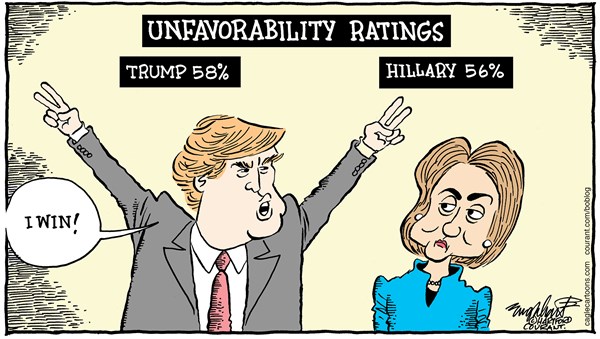
With Super Tuesday voting and other primaries and caucuses behind us, Donald Trump and Hillary Clinton are the clear leaders in the Republican and Democratic races for their party’s presidential nominations.

But they are both damaged candidates and the parties have only themselves to blame for their success.

166747_600-2

Democrats have known for years that Hillary would be a seriously flawed candidate.

 “She has always been awkward and uninspiring on the stump,” a senior Democratic consultant once told the Washington Post. “Hillary has Bill’s baggage and now her own as secretary of state — without Bill’s personality, eloquence or warmth.”

 While her damaging e-mail scandal may be relatively new, Hillary has been associated with decades of personal and political contretemps, leading to a clear case of Clinton fatigue among the populace.

Equally troubling to the Democratic Party should be Hillary’s trust gap.

In a July 2015 Quinnipiac University national poll, 57 percent of respondents said Clinton is not honest and trustworthy, one of the worst scores among all the top candidates at the time. And her scores have gotten worse. In a subsequent Quinnipiac poll, 61 percent of respondents said Clinton is not honest and trustworthy.

In an August 2015 Quinnipiac University poll, “liar” was the first word that came to mind more than others in an open-ended question when voters were asked what they think of Clinton, followed by “dishonest” and “untrustworthy”. (“Arrogant” was the first word that came to mind for Trump, but that doesn’t seem quite as toxic)

In January 2016, a poll produced for ABC by Langer Research Associates put Hillary 12 points behind Bernie Sanders, 48-36 percent, in being seen as more honest and trustworthy, a deterioration from 6 points behind in Dec. 2015 and equal to Sanders in October 2015.

But Hillary’s problems as a candidate go even deeper.

“Voters see her as an extraordinarily cynical, power-hungry insider,” James Poulos said in The Week on Feb. 2. “She is out for herself, not out for Americans. Voters know it.”

This ties in with a long-held and widespread perception that Hillary and her family are just plain greedy, what with them hauling off $190,000 worth of china, flatware, rugs, televisions, sofas and other gifts when they moved out of the White House, taking money from all sorts of unsavory people and foreign countries for their Foundation, and charging exorbitant amounts for speeches.

David Axelrod, a political consultant who helped steer Obama to the presidency, noted in his book, “Believer”, that Hillary has two other main weaknesses: she’s a polarizing rather than a “healing figure,” and she has a hard time selling herself as the “candidate of the future” given her checkered past and long political resume.

And then, as Josh Kraushaar wrote in The Atlantic before Jeb Bush dropped out, “…pundits and donors alike are vastly overrating the prospects of two brand-name candidates for 2016 — Hillary Clinton and Jeb Bush — and undervaluing the reality that the current political environment is as toxic as it’s ever been for lifelong politicians.”

Then there’s Trump

That, of course, takes us to Donald Trump, the Republican Party’s “Nightmare on Park Avenue.”

Isolated in their cocoons, party officials (and the political press) assumed an establishment candidate would emerge the victor. They denied to themselves and others for months that Trump would be a viable candidate for the Republican nomination.

Nobody was more smug in this assumption then Jeb!

He started early, rebuilding political connections, building a professional staff and laying the groundwork for a “shock and awe” fundraising blitz. But he faltered early and never regained his balance. He watched helplessly as his fund-raising advantage become a disadvantage, defining him as the establishment favorite when the Republican base was looking for a change agent.

Political leaders also overestimated voters’ desire for solid, traditional, steady candidates and too quickly dismissed Trump as a long-term threat. “Reality TV will gather a lot of interest and a lot of people enjoyed the celebrity of that, but for the last 14 years, I’ve had to live in the real world and deal with real world issues and come up with real world solutions,” former Texas Gov. Rick Perry said in mid-2015. “And that’s what the people I think of this country want out of the next president of the United States.”

Meanwhile, confident that Trump’s bombast, misstatements and insults would doom him, Republican Party leaders watched incredulously as he rolled over establishment candidates.

“Until recently, the narrative of stories like this has been predictable,” Matt Taibbi wrote in Rolling Stone. “If a candidate said something nuts, or seemingly not true, an army of humorless journalists quickly dug up all the facts, and the candidate ultimately was either vindicated, apologized, or suffered terrible agonies… That dynamic has broken down this election season. Politicians are quickly learning that they can say just about anything and get away with it.”

As Karen Tumulty wrote in the Washington Post, “Will Trump eventually cross a line — or do the lines no longer exist?”

The make-up and size of the Republican candidate field also has worked to Trump’s advantage.

There’s no love lost, for example, between most members of Congress and Ted Cruz. And with so many Republican candidates (17 at one point), voter preferences were atomized for too long and even now none of the remaining candidates are willing to drop out, preventing the emergence of a single challenger to Trump.

So here we are, facing the possibility of a Clinton-Trump election.

Just goes to show that Clarence Darrow was right. “When I was a boy I was told that anybody could become President; I’m beginning to believe it,” he said.


Tweedledee. Tweedledum: The two parties spend with abandon.

tweedledumTweedledee

Tweedledee. Tweedledum. This is what we get when the two parties work together, a massive spending spree.

A $1.1 trillion federal spending bill and a $650 billion tax package unveiled today show that neither party gives a damn about holding down spending. It’s not that all the items to be funded are wasteful or unneeded, but the package will push spending above previously agreed limits by $66 billion in 2016 and permanently extend a vast array of tax benefits that will add at least a half-trillion dollars to the federal deficit, once a matter of great concern.

deficit

  • Bowing to pressure on Republicans and Democrats from medical device manufacturers across the county, including in Oregon, anti-Obamacare zealots, and ticked-off unions with expensive healthcare plans, the legislation will postpone for two years (which probably means forever) a 2.3 percent excise tax on medical devices manufacturers, that was expected to raise $29 billion of net revenues over 10 years and a so-called “Cadillac Tax” tax on expensive employer-sponsored healthcare plans, that was projected to raise about $30 billion over 10 years to cover new spending under Obamacare. Then, to add insult to injury, the legislation makes the Cadillac tax refundable when it restarts. The lost taxes will blow a hole in planned funding to cover the cost of Obamacare.
  • The Defense Department will get $1111 billion for new military equipment, including F-35 Joint-Strike Fighters, Black Hawk helicopters, attack submarines and guided missile destroyers.
  • A 40-year-old oil export ban will be rescinded and, in trade, Democrats will get expensive extensions of wind and solar power tax incentives.
  • A research and development tax credit will be expanded and extended permanently.
  • The $1,000 Child Tax Credit will be extended permanently.
  • The Earned Income Tax Credit will be permanently extended.
  • A federal health program for first responders and construction workers who worked at the World Trade Center site after 9/11 and a separate victims compensation fund will be extended at a cost of $8 billion.
  • A National Oceans and Coastal Security Fund will be created to “support work that helps Americans understand and adapt to forces like sea level rise, severe storms, and ocean acidification” associated with climate change.
  • The American Opportunity Tax Credit, an annual credit for tuition and other qualified expenses, will be permanently extended.
  • A $250 annual deduction on qualified expenses of teachers will be indexed for inflation and permanently extended.
  • Five tax credits tied to charitable donations by individuals and businesses will be permanently extended.
  • Funding for the IRS will be frozen, punishing the IRS for targeting conservative groups, but also further limiting its ability to go after tax scofflaws and, this, reducing tax receipts.
  • A $255 per month pre-tax benefit for parking and public transportation expenses will be permanently extended.

But aside from all the spending, Congress did accomplish a few good things.

There will be a pay freeze for Vice President Biden, for example.

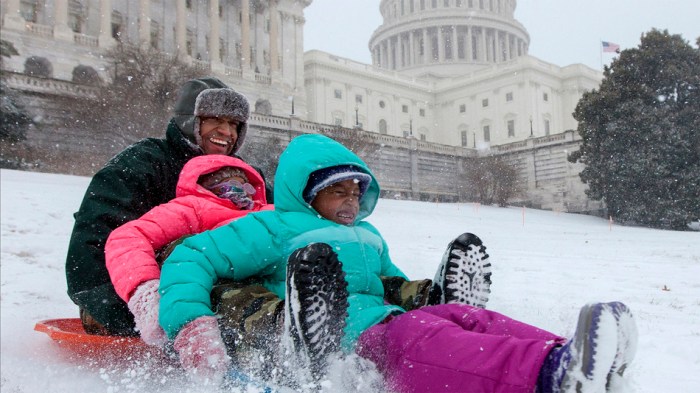
Also, earlier this year the dour, stick-in-the-mud Capitol Police said sledding by gleeful children and adults on the snow of Capitol Hill would no longer be allowed. The package asks that the Capitol Police rescind that prohibition so the jollity can resume.

Capitol-Sledding

Sock it to ’em: the left dreams of more taxes and more government

The left’s collective veneration of the state and readiness to surrender self- reliance to its generosity are becoming ever more evident as the presidential race accelerates.

After exhaustive research, the New York Times has concluded that if the federal government raised taxes on the wealthy it could generate a lot of money. You don’t say.

tax-cartoon

The Times also figured out that the potential amount of revenue the government could raise from the wealthy would depend on how much the government raised their taxes. That’s groundbreaking.

Not only that, The Times said, but the government could raise one hell of a lot of revenue from high earners “…while still allowing them to take home a majority of their income,” How very thoughtful.

The Times effused over the things the government could do with a ton of additional tax revenue, like eliminating undergraduate tuition at all the country’s four-year public colleges and universities, as Senator Bernie Sanders has proposed. The potential next step — student loan forgiveness?

With the base of the Democratic Party moving swiftly to the left, you can expect more of these “we can do it because the wealthy will pay for it” proposals.

In the end, the Times took 2085 words to conclude that the more you tax rich people, the more taxes the government will collect (assuming the well-off don’t figure out how to avoid paying the taxes) and the more the government can spend on all sorts of stuff.

What the Times didn’t do is address the question of whether it would be a good thing for the government to reap enormous revenue increases and vastly expand its penetration into our daily lives.

Do we really want a massive expansion of government that would be a successor to the New Deal and the Great Society?

When you invite the government to pay for more things, the government becomes your partner, or, more likely, your boss. Is that what Americans want?

When government gives you things, they always come with new federal rules and regulations accompanied by known and unknown costs. Is that the American dream?

The Times also didn’t address the growing fiscal problems we are already facing:

  • Federal spending still exceeds revenue by over 400 billion dollars a year
  • deficits are expected to resume growing
  • even with declines in discretionary spending imposed by sequestration, entitlements are expected to grow in the future.

“You wouldn’t know that we have an unsustainable fiscal path from the debate we’re having right now,” Rudy Penner, a former director of the Congressional Budget Office, told the Wall Street Journal.

A message to the left and the NY Times. Be careful what you wish for.


(P.S. – Yes, I know, you also have conservatives proclaiming how they want to cut taxes when we can’t even pay our bills now, but that’s another story)

Disillusionment and despair: the Trump turmoil

Donald Trump isn’t a candidate.

Donald-Trump-Caricature

He’s a stand-in for the alienation and disillusionment so many Americans feel as both the Republican and Democratic parties have failed us.

How could it be otherwise when so much seems so wrong and fakery, misdirection, and outright lies by both parties have been so pervasive?

Consider:

  • The past several decades have seen the most sustained rise in inequality in the United States since the 19th century after more than 40 years of narrowing inequality following the Great Depression. By some estimates, income and wealth inequality are near their highest levels in the past hundred years.
  • The 2009 $830 billion stimulus package, with a claimed focus on shovel-ready projects, was supposed to fix things after the Great Recession. The legacy instead – a slow growth economy. The first 23 quarters of the recovery, which officially began in June of 2009, had an annual rate of growth of just 2.1 percent.
  • The distribution of wealth in the United States is even more unequal than that of income. The wealthiest 5 percent of American households held 54 percent of all wealth reported in 1989, rose to 61 percent in 2010 and reached 63 percent in 2013.
  • 71 percent of Americans say life has gotten worse for middle-class Americans over the past 10 years.
  • Today’s fifty-somethings may be part of the first generation in American history to experience a lifetime of downward mobility, in which at every stage of adult life, they have had less income and less net wealth than did people who were their age ten years before.
  • There is now less economic mobility in the United States than in Canada or much of Europe. A child born in the bottom one-fifth of incomes in the United States has only a 4 percent chance of rising to the top one-fifth.
  • Young Americans (ages 18-34) are earning less (adjusted for inflation) than their peers in 1980 ; the college graduating class this year left with an average student debt of $35,051.
  • In 1986, President Reagan signed legislation that was supposed to fix the illegal immigration issue once and for all. Three million applied for legal status and about 2.7 million received it. Today, about 11.7 million immigrants are living in the United States illegally. So much for the fix.
  • Despite all the “mission accomplished” and “victory is at hand” assurances, America has been at war in the Middle East for the past 15 years, with little to show for it, billions of dollars down a rathole, thousands of American soldiers dead and wounded, and continuing chaos in Afghanistan, Iraq, Libya and Yemen.
  • Despite the billions the government has spent on poverty-related programs, half of children age three and younger live in poverty.
  • The White House wants to “press the reset button” on one of Washington’s biggest challenges: its increasingly troublesome relationship with Russia,” Vice President Biden, 2/7/2009; “We’re going to hit the reset button and start fresh (with Russia),” Secretary of State Hillary Clinton, 3/6/2009
  • “If you like the plan you have, you can keep it.  If you like the doctor you have, you can keep your doctor, too.” President Obama, 6/6/2009.
  • “I ended the war in Iraq, as I promised. We are transitioning out of Afghanistan. We have gone after the terrorists who actually attacked us 9/11 and decimated al Qaeda.” President Obama, 9/14/2012
  • Despite assurances from some politicians that all’s well, the Medicare program has $28.1 trillion in unfunded liabilities over the next 75 years. Together with Social Security’s $13.3 trillion shortfall, the government has accumulated entitlement spending commitments that far exceed our capacity to pay for them.
  • In the 2012 election cycle, a tiny elite of the U.S. population, just 0.40 %, made a political contribution of more than $200, providing 63.5% of all individual contributions to federal candidates, PACs and Parties, according to the Center for Responsive Politics.
  • Fewer than four hundred families are responsible for almost half the money raised in the 2016 presidential campaign to date, a concentration of political donors that is unprecedented in the modern era.

As H.L. Mencken said, “Under democracy one party always devotes its chief energies to trying to prove that the other party is unfit to rule — and both commonly succeed, and are right.”


Hypocrisy, thy name is Democrats

You can almost smell the Democrat’s hypocrisy.

hypocrisy-meter

On Feb. 20, the Oregon House passed a bill, H.B. 2177, that would automatically register to vote anybody with a driver’s license. Every single one of the 35 yes votes came from Democrats.

On March 5, the Oregon Senate passed the bill. Every single one of the 17 yes votes came from Democrats.

On March 16, an ebullient Gov. Kate Brown, another Democrat, signed the bill with a flourish.

“I am absolutely thrilled to be signing this into law as the new governor,” Gov. Kate Brown said at the signing ceremony. “Virtually every Oregonian will be able to have their voice be heard.”

Senate Majority Leader Diane Rosenbaum, D-Portland, echoed that sentiment. “Today our pioneering spirit brings us to a crucial reform that will empower our citizens,” she said. “While other states take steps to limit voter participation and to disenfranchise voters, the Oregon Legislature is bucking that trend. We are leading the nation.”

Yes, indeed, the Democrats patted themselves on the back for their grand support of voter’s rights.

But I guess they’re support of voting rights has its limits.

On March 25, the Senate voted 20 to 10 to approve S.B. 927, a bill that makes it clear Metro can move ahead with construction of an Oregon Convention Center hotel with $78 million of subsidies without having to be bothered by pesky voters. Every yes vote came from a Democrat. Now it’s up to the House.

How ironic that so many of the very people Oregonians have voted for are so quick to approve legislation that would deny others the right to vote.

Smell the aroma of hypocrisy? It stinks.

Ted Kennedy and Al Sharpton: no excuses

(Addendum: Al Sharpton is at it again. The New York Times reported on Nov. 19, 2014,  that Sharpton “has regularly sidestepped the sorts of obligations most people see as inevitable, like taxes, rent and other bills. Records reviewed by The New York Times show more than $4.5 million in current state and federal tax liens against him and his for-profit businesses.”

“Sidestepped” is too polite a word for how Sharpton has behaved. And this is a man President Obama turns to for guidance?)

Reading all about Al Sharpton’s emergence as a respectable political leader and go-to guy for President Obama, I’m reminded of Ted Kennedy.

Liberal Democrats loved Ted Kennedy.

He was the standard-bearer for the liberal wing of the Democratic Party. He was their beloved champion for his work on health care, education, immigration reform, civil rights, voting rights, workers’ rights and other causes.

TeddyKennedyMaryJo

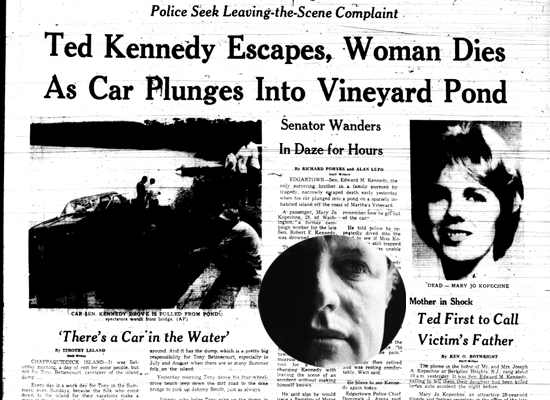
So what did Democrats do when faced with the news that Kennedy’s actions had caused the death of 28–year-old Mary Jo Kopechne when he drove an Oldsmobile 88 into a tidal channel on Chappaquiddick Island in 1969? They stuck with him.

What did they do when it was learned he had left the scene of the accident, consulted with a high-powered group of political and legal advisors, and didn’t notify the police for 10 hours after the accident. They stuck with him.

What did they do when State police detective-lieutenant George Killen said, “Senator Kennedy killed that girl the same as if he put a gun to her head and pulled the trigger?” They stuck with him.
They looked on without reproof when Kennedy’s only punishment was losing his driving license for a year and receiving a suspended two-month jail sentence.

All was forgiven. The liberal special interest groups that depended on his support in the contentious political arena, even the usually outspoken Liberal women’s rights groups, either stayed silent or defended him then and in the years to come. After all, he was one of them, a supporter of their agendas.

And Massachusetts voters continued sending Kennedy back to the Senate until his death on August 25, 2009, after which liberals eulogized him as a great American and a great senator.

“I can think of no one who engendered greater respect or affection from members of both sides of the aisle,” said President Obama in 2009 remarks on Kennedy’s death.

“I just hope we remember how he treated other people…,” said Vice President Biden, ignoring Kennedy’s reputation on the Hill as a “the rules don’t apply to me” boor whose appalling behavior was well documented.

Joyce Carol Oates suggested that even if Kennedy had caused the death of a young woman, he had redeemed himself by accomplishing so much good work thereafter, by his “…tireless advocacy of civil rights, rights for disabled Americans, health care, voting reform, his courageous vote against the Iraq war.”

Liberal’s willingness to excuse Ted Kennedy, even in the face of his clear guilt in the death of a young woman, reminds me of their tolerance for, and even promotion of, Al Sharpton’s ascension to political prominence.

Sharpton’s infamous rise in public notoriety has been well documented.

A 1987-1988 case that drew national attention revolved around Sharpton’s involvement with 15-year-old Tawana Brawley, a black woman from New York who accused six white men of raping her and leaving her in a garbage bag smeared with and covered with racist words written in charcoal.

Sharpton, who accused government officials of trying to cover up for the rapists because they were white, led the way in spurring a national uproar over the case.

brawley_sharpton_custom-1a3219e3e6986346b22e7fb0aea7ab0f3833f78e-s6-c30

He was later rebuked and fined after a grand jury concluded that Brawley had not been the victim of a forcible sexual assault and that she may herself have created the appearance of an attack.

In 1991, Sharpton stirred up black fury in the Crown Heights area of Brooklyn when a Jewish driver hit and killed a black boy, Gavin Cato, with his car.

At the boy’s funeral, Sharpton vilified Jewish “diamond merchants” who killed black children in Brooklyn.

Days of anti-Semitic riots culminated in the murder of Yankel Rosenbaum, an Australian Jew who had nothing to do with the incident, being stabbed to death in the midst of a mob of about 30.

The New York Post reported that after the driver of the car was cleared of charges and left for Israel, Sharpton flew to Tel Aviv to slap the driver with a civil suit. When a passer-by at Israel’s Ben Gurion Airport recognized Sharpton, she shouted, “Go to hell!”
“I am in hell already,” Sharpton replied. “I am in Israel.”

In December 1995, during a Harlem protest stirred up by Sharpton, a black man entered Freddy’s Fashion Mart, a Jewish-owned clothing store, took out a gun, ordered the black customers to leave and set a fire that killed himself and eight other people.

Sharpton was accused of having spurred the devastation by delivering and facilitating incendiary racist and anti-Semitic comments on black radio stations and at the protest.

In Sept. 2013, the New York Post reported that Robert F. Kennedy Jr. had written in a previously secret diary, “Al Sharpton has done more damage to the black cause than [segregationist Alabama Gov.] George Wallace. He has suffocated the decent black leaders in New York. His transparent venal blackmail and extortion schemes taint all black leadership.”

Sharpton, pitching himself as America’s leading advocate of social justice, shows up everywhere there’s a TV camera and a potential racial dispute to be exploited. Most recently, he made himself visible in Ferguson, Missouri.

Now Obama, the Democratic Party and other liberals are legitimizing Sharpton and giving him a highly visible chair at the table.

It’s an appalling comment on their willingness to embrace one of their own regardless of his contemptible actions.