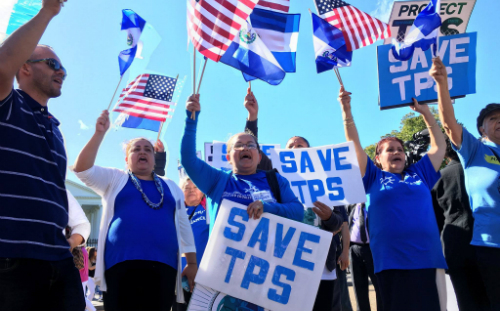
Trump’s Anti-Immigrant Invective Signals Trouble for Those With Temporary Protected Status

Photo: American Friends Service Committee

UPDATE 02/02/2025: The New York Times reported today that the Trump administration has ended Temporary Protected Status, or T.P.S., for more than 300,000 Venezuelans in the United States, leaving the population vulnerable to potential deportation in the coming months, according to government documents obtained by The New York Times. “The Trump administration’s attempt to undo the Biden administration’s T.P.S. extension is plainly illegal,” said Ahilan Arulanantham, who helps lead the Center for Immigration Law and Policy at the U.C.L.A. School of Law. “The T.P.S. statute makes clear that terminations can only occur at the end of an extension; it does not permit do-overs.”

——————————————————-

President-elect Donald Trump has made it crystal clear. 

America’s “immigration crisis” is a “massive invasion” spreading “misery, crime, poverty, disease and destruction to communities all across our land” and the nation’s cities are being “flooded” by the “greatest invasion in history” of undesirables from “every corner of the earth, not just from South America, but from Africa, Asia, Middle East,” Trump bellowed at the Republican National Convention in July 2024.

One action Trump plans to take in response to the “invasion” is to cut back on the Temporary Protected Status (TPS) program. Set up in 1990, the program gave the federal government the ability to grant work permits and deferrals from deportation to nationals of any designated nation going through or recovering from natural or man-made disasters.

If you recall the uproar over unfounded claims that Haitians who live and work legally in Springfield, Ohio, were eating their neighbor’s cats and dogs, those Haitians are TPS holders. In an interview with NewsNation, Trump said the influx of migrants in Springfield “just doesn’t work” and “you have to remove the people; we cannot destroy our country.”

To say the least, the fate of those in Oregon with TPS will be precarious, too, under the upcoming Trump administration.

I asked Oregon’s Office of Immigrant and Refugee Advancement how many people in Oregon are here under the Temporary Protected Status program, but they never responded. But I located a report by the Congressional Research Service (CRS) on the TPS topic. According to the CRS, as of March 31, 2024, there were an estimated 2,705 individuals with TPS in Oregon, fewer than the 9,500 in Washington, but more than the 510 in New Mexico. The current number in many states is likely higher now because the number of TPS individuals in the United States has increased by about 150,000 since March. 

TPS offers qualifying individuals already in the U.S. work authorization and a temporary legal status to remain in the country if their home country is determined unsafe. TPS offers up to 18 months of relief to qualifying individuals based on the status of that country. For example, the TPS program is scheduled to end in March 2025 for El Salvador and in April 2025 for Sudan, Ukraine, and Venezuela. 

TPS designations can be terminated prior to expiration with 60 days notice. TPS status can also be extended by the Department of Homeland Security. For example, on Oct. 17, 2024, the department extended through Aug. 3, 2025, the validity of certain Employment Authorization Documents (EADs) issued to Temporary Protected Status (TPS) beneficiaries under the designation of Haiti.

Since 1990, successive Republican and Democratic administrations have largely automatically renewed certain key TPS designations

The impact of Trump’s plans on current TPS holders could be calamitous. That’s partly because the number of people in the United States under TPS exploded under President Biden.

In 2020, TPS protected about 330,000 people from 10 countries who would otherwise be subjected to disease, violence, starvation, the aftermath of natural disasters, and other life-threatening conditions. The largest group of TPS recipients was from El Salvador (195,000 people) followed by Honduras (57,000 people) and Haiti (50,000 people).

Other countries with TPS holders included Nepal (8,950 people), Syria (7,000 people), Nicaragua (2,550 people), Yemen (1,250 people), Sudan (1,040 people), Somalia (500 people), South Sudan (84 people), Guinea (930 people), and Sierra Leone (1,180 people). 

With President Biden’s term winding down, there are now over 1 million immigrants in the United States under TPS status. Qualifying individuals include people from 16 countries, with Venezuelans, Haitians and Salvadoreans the largest groups of TPS beneficiaries.[1]

Under the Biden administration, new TPS designations have been issued for six countries (Afghanistan, Cameroon, Ethiopia, Myanmar [also known as Burma], Ukraine, and Venezuela), and extended for ten others (El Salvador, Haiti, Honduras, Nepal, Nicaragua, Somalia, South Sudan, Sudan, Syria, and Yemen). The government has also granted or extended a similar protection, deferred enforced departure (DED), for people from Hong Kong and Liberia, with an estimated 3,900 and 2,800 covered respectively.

If a TPS designation ends, beneficiaries return to the immigration status that the person held prior to receiving TPS, unless that status has expired or the person has successfully acquired a new immigration status.

 If the Trump administration is aggressive in ending the TPS program, its beneficiaries in Oregon and elsewhere would return to being undocumented at the end of a TPS designation and become subject to removal. 

“It’s possible that some people in his administration will recognize that stripping employment authorization for more than a million people, many of whom have lived in this country for decades, is not good policy” and economically disastrous, Attorney Ahilan T. Arulanantham, a teacher at the University of California, Los Angeles School of Law, recently told PBS News. “But nothing in Trump’s history suggests that they would care about such considerations.”


[1] Countries Currently Designated for TPS. Select the country link for additional specific country information.

On the Cusp of Chaos: Trump’s Deportation Purge

The American people have given Donald Trump ultimate power,” says Paul Glastris, editor in chief of the Washington Monthly, “They’re going to get the Trump agenda, good and hard.”

America’s “immigration crisis” is a “massive invasion” spreading “misery, crime, poverty, disease and destruction to communities all across our land” and the nation’s cities are being “flooded” by the “greatest invasion in history” of undesirables from “every corner of the earth, not just from South America, but from Africa, Asia, Middle East,” Donald Trump bellowed at the Republican National Convention in July 2024. “They’re coming from prisons. They’re coming from jails. They’re coming from mental institutions and insane asylums. We have to stop the invasion into our country that’s killing hundreds of thousands of people a year.”

Did you miss Trump describing migrants as “vermin” who would “poison the blood of the country”? How about when he said in 2023 that some South American countries were deliberately emptying their “insane asylums” and “mental institutions” to send the patients to the United States as migrants.

You likely didn’t miss Trump’s solution? “Carry out the largest deportation operation in American history” the Republican platform said in “one of a series of bold promises that we will swiftly implement” Trump promised.  Huddled masses, yearning to breathe free? Not in Trump country. Deport ’em all.

Easier said than done.

First, let’s talk about numbers.

In 2021, when Joe Biden took office, the figures thrown around for the number of undocumented/illegal/unauthorized/ (whatever word you choose) immigrants in the United States varied by a million or so. The Migration Policy Institute (MPI) put the number at 11.2 million. The Center for Migration Studies said there were approximately 10.3 million.

Curiously, much of the media coverage of the immigration situation today continues to use the 11 million figure, despite the upsurge in border crossings. That may be a sign of lazy reporting, purposefully misleading numbers for ideological reasons, different collections methods or confusion over how to count migrants.

Trump’s numbers have been all over the map. In March 2024, he said 15 million migrants had crossed into the United States border over just the past two years. In August, he said 10 million had come across the border since Biden took office. In later election rallies, he cited a 20 million crossings figure during Biden’s tenure as president. .And in his one televised debate with Kamala Harris he claimed 21 million migrants were crossing the border every single month.

One number often used to track migrants is “encounters” with migrants, including people who tried to cross into the US illegally and people who tried to enter legally but were deemed inadmissible.  According to the Border Patrol, since Biden became president in January 2021, there have been more than 10 million encounters, about 8 million of those at the southwest land border with Mexico, up from 2.4 million encounters during the Trump administration. The number is not, however, a reliable count of people who stay in the US. Some are sent back and some are counted multiple times from multiple attempts to cross the border. The encounters number also, obviously, do not count those who manage to slip across the border and escape undetected.

Compounding the numbers problem, the Wall Street Journal reports that Trump wants to “revoke deportation protections from millions of immigrants, including tens of thousands of Afghans evacuated after the fall of Kabul and hundreds of thousands of Ukrainians allowed in after the Russian invasion.”

Whatever the accurate number, it’s one hell of a lot of people, about equal to the entire population of Georgia.

How exactly does Trump plan to deport them all?

Is he going to demand that the military, the FBI, the Border Patrol, local police, the whole shebang of law enforcement, round them up and put them in detention centers?

On Nov. 18, The New York Times reported Trump had confirmed that he intended to declare a national emergency and use the U.S. military in some form to assist in his plans for mass deportations of undocumented immigrants.

The Times said Trump used his social media platform, Truth Social, to respond to a post made earlier in November by Tom Fitton, who runs the conservative group Judicial Watch, and who wrote that Mr. Trump’s administration would “declare a national emergency and will use military assets” to address illegal immigration “through a mass deportation program.” At around 4 a.m. on the 18th, Mr. Trump reposted Mr. Fitton’s post with the comment, “TRUE!!!”

Trump’s top immigration policy adviser, Stephen Miller, told the Times earlier in 2024 said that military funds would be used to build “vast holding facilities that would function as staging centers” for immigrants as their cases progressed and they waited to be flown to other countries. The Homeland Security Department would run the facilities, Miller said.

Is he going to commandeer railroad lines, planes and riverboats to ferry them to the Mexican border?

How’s Trump going to pay for this massive deportation program? The American Immigration Council, an admittedly pro- immigrant group, says the cost of deporting 13 million immigrants in the U.S. illegally could cost $968 billion over a little more than a decade.

Then there are the courts. Do Trump’ and his henchmen expect the American Civil Liberties Union and immigrant advocacy groups to forego court battles if Trump again tests the bounds of his legal authority. The ACLU’s website already promises, “Starting on day one, we’re ready to fight for our civil liberties and civil rights in the courts, in Congress, and in our communities. We did it during his first term – filing 434 legal actions against Trump while he was in office – and we’ll do it again.”

Of course, no matter what Trump wants to do, not all countries will be willing to accept the return of their citizens. Trump faced that problem in his first term.

In a 2016 speech in Phoenix, Trump said, “There are at least 23 countries that refuse to take their people back after they’ve been ordered to leave the United States, including large numbers of violent criminals. They won’t take them back. So we say, ‘Okay, we’ll keep them.’ “Not going to happen with me, not going to happen with me.”

Not so fast, Mr. Trump. U.S. Immigration and Customs Enforcement (ICE) defines any country that fails to cooperate with the U.S. immigration removal process as “recalcitrant”. According to ICE, “Uncooperative countries significantly exacerbate the challenges presented to ICE by the U.S. Supreme Court’s decision in Zadvydas v. Davis, 533 U.S. 678 (2001). In this case, the Supreme Court ruled that: With narrow exceptions, noncitizens with final orders of removal — including noncitizens determined to pose threats to the community or considered flight risks — may not be detained by ICE beyond a presumptively reasonable period of six months if there is no “significant likelihood of removal in the reasonably foreseeable future”.

The Trump administration may also encounter enforcement resistance from so-called “sanctuary” jurisdictions across the country, which include: Alameda, Berkeley, Fremont, Los Angeles, Oakland, San Francisco (county and city), San Mateo County, Santa Ana, Santa Clara County, and Watsonville in California; Boulder and Denver in Colorado; King County, Seattle, and Walla Walla County in Washington; Portland in Oregon; and even Washington, D.C. The Los Angeles City Council has already voted to prohibit city resources from being used for federal immigration enforcement.

“Americans are being squeezed out of the labor force and their jobs are taken,” Trump said at the Republican Convention. “By the way, you know who’s taking the jobs, the jobs that are created? One hundred and seven percent of those jobs are taken by illegal aliens.” But not all employers will likely be cooperative in immigrant sweeps. The Pew Research Center estimated that unauthorized immigrants represented about 4.8% of the U.S. workforce in 2022.  About two-thirds of U.S. crop-farm workers are foreign-born, for example, and 42% aren’t legally authorized to work in the country,  About two-thirds of U.S. crop-farm workers are foreign-born, and 42% aren’t legally authorized to work in the country, according to a Labor Department report.

“Implementing Trump’s (deportation) plan would be a logistical nightmare and social tragedy, with consequences reverberating beyond the deportees and into the lives of over 20 million people living in mixed-status households, including 5.5 million U.S.-born children suddenly missing one or both parents,” the Center asserts.

Then, no matter how individuals voted, there’s the question of how Americans across the board are going to respond to Trump’s draconian deportation program once it hits their neighborhood. I expect there will be a backlash. I couldn’t put it better than Yascha Benjamin Mounk, Associate Professor of the Practice of International Affairs at Johns Hopkins University’s School of Advanced International Studies. In a post-election podcast conversation with American political scientist Francis Fukuyama, Mounk said:

“When you have very lax policies and high levels of illegal immigration, people say, “clamp down, we want to close the border,” and the moment you start doing the things you actually need to do to clamp down, they start to say, “well, hang on a second, I didn’t want this kid to die. I didn’t want those kids to be separated from their parents. I didn’t want this particular member of the community, who’s been here for 25 years and who seems like a very good and reasonable person, to suddenly be taken and sent back to where they came from.” And so I think even on that issue, which was a winning issue of Trump’s and which he clearly has a popular mandate…he may quite quickly lose public support, nevertheless.”

Well put.

Bynum vs. Chavez-DeRemer/ Tis a Quandary

Chavez-DeRemer vs. Bynum

Republican incumbent Lori Chavez-DeRemer and Democratic challenger Janelle Bynum are at each other’s throats in Oregon’s 5th Congressional District race

At recent debates on KOIN TV in Portland and KTVZ in Bend, each candidate asserted that their opponent couldn’t be trusted. Bynum worked hard to tie Chavez-DeRemer to  Republican presidential candidate Donald Trump and the conservative Republicans in the House. Chavez-DeRemer, in turn, attacked Bynum for supporting Measure 110, the drug decriminalization measure later amended by House Bill 4002 in the face of public backlash against the measure. 

No question, Bynum is a flaming liberal. In September, House Minority Leader Hakeem Jeffries showed up in Portland to bolster her campaign. Par for the course, he accused Chavez-DeRemer of being aligned with extreme MAGA Republicans and Donald Trump., who Democrats portray as an imminent threat to democracy.

In contrast, Chavez-DeRemer works hard to portray herself as a moderate. She was ranked the 29th most bipartisan House member, and the most bipartisan Oregon member of the House, in an analysis released in May 2024 by the Lugar Center and the McCourt School of Public Policy at Georgetown University. But she has endorsed Trump’s return to the White House, has praised the Supreme Court ruling that overturned Roe v. Wade and has voted for a number of bills critics claim support the MAGA agenda.

The high-profile race is being run in a swing district created when the Legislature changed the district’s boundaries in 2021so it included a presumably more Democratic Bend. The race is now one of just a few that could decide who controls the U.S. House of Representatives.

So what to do if you are in the middle?

If Trump wins the White House, a vote for Chavez-DeRemer increases the likelihood that the House will stay in Republican hands. The Democrats now have a majority in the Senate but current thinking is that the Republicans have a high probability of retaking control with a net gain of two seats or by winning the presidential election along with a net gain of one seat. 

A particularly endangered Democrat is Senator Jon Tester of Montana, who trails his Republican challenger, Tim Sheehy, a wealthy Republican businessman. Polls suggest he’s toast because of the changing demographics of the state.  Republicans are also expected to flip West Virginia — where Joe Manchin is retiring- in the face of competition from Republican Governor Jim Justice . 

Of course, Democrats are still hopeful they can hold onto critical Senate seats in states like Ohio and Arizona and there are signs of weakness in Republican  Senator Ted Cruz’ s  race against Democratic challenger Colin Allred.

But if Trump wins, and the Republicans can hold on to the House and retake the Senate, that clean sweep would give Trump and his MAGA allies an opportunity to govern with impunity. If that’s not what you want, your best choice might be to vote for Bynum , even if you lean conservative, to increase the likelihood the Democrats will at least control the House and be in a position to block the more unpalatable elements of Trump’s MAGA agenda.

Tricky, isn’t it?

Donald Trump. Meet Lonesome Rhodes.

Andy Griffith in “A Face in the Crowd”

The blistering movie A Face in the Crowd deliciously exposes how Americans are seduced by people who swindle us. “This parable about a small-town con man who attains the power to sway the nation to his whims is America: our fanaticism, whimsy, and desire for elusive authenticity at the expense of our souls,” April Wolfe wrote in a spot-on review of the 1957 movie.

Andy Griffith, in his first film role, long before he played Andy Taylor, the low-key widowed sheriff of Mayberry, plays a charismatic hayseed who rises to popularity in a television show and, with an exaggerated sense of his new persuasive power, goes berserk. 

Russ Buettner and Susanne Craig, investigative reporters for The New York Times, recently wrote a lengthy, perceptive and revealing inside story of how the producers of “The Apprentice” crafted a TV version of Donald Trump — measured, thoughtful and endlessly wealthy — that ultimately fueled his path to the White House.

The story meticulously exposed how the producers of The Apprentice turned Trump from a slightly garish, smug New York real estate schmuck with a history of business failures who worked out of a musty, messy office into business royalty, an astute, self-made billionaire.

“The facts never really mattered,” the New York Times story noted. “Drama mattered. Comedy mattered. Entertainment value mattered. Mr. (Mark) Burnett (the show’s executive producer) liked to call it “dramality.” And Mr. Trump was dramatic, occasionally funny, and always entertaining.”

So when he came down the escalator in June 2015, staging the announcement of his candidacy for president, he was a new man, remade by reality television.

Since producing The Apprentice, Burnett has made other successful shows, including “Shark Tank” and “The Voice”, but as Patrick Radden Keefe  wrote in The New Yorker in 2018, “…his chief legacy is to have cast a serially bankrupt carnival barker in the role of a man who might plausibly become the leader of the free world. “I don’t think any of us could have known what this would become,” Katherine Walker, a producer on the first five seasons of “The Apprentice,” told Keefe. “But Donald would not be President had it not been for that show.”

The New York Times story agreed. 

But Burnett and his associates kept their opinion of Trump to themselves, giving him free reign to elevate his prominence based on lies.

Commenters on the Times story savaged Burnett and his associates for foisting Trump on the American public. 

“Mark Burnett created this mess the country is in,” one commenter posted in the paper’s online comments section. “The dumbing-down of America is from all reality TV and especially this egocentric reality “star” turned president. It’s all a complete disgrace that has ruined the fabric of our country.”

“You couldn’t print what I think of these garbage people,” another commented. ”Between Burnett’s greed… and all these enablers, they tipped over the first Domino to end what is left of our Democracy.” 

“He was always a 2-bit husband, father and criminal,” wrote another. “Then, the megalomaniac and pathological narcissist gets a gig on probably one of the most scripted and controlled shows ever produced and becomes a 2-bit actor. Ratings and fakery will take you a long way in TV.” 

“He’s a phony who starred in a show that presented him as a wildly successful businessman while his real business “empire” was failing with numerous bankruptcies despite his $400 million inheritance,” said another. “His political success is also a product of the same fake narrative coupled with a vast army of low information voters who enjoy his racist tinged insult comic act.”

But Burnett and his cronies weren’t the only ones willing to hide the reality of Trump from the public.  Hangers-on who rode Trump’s coattails to the White House and then stayed on in Trump’s administration were guilty, too.

They were perfectly willing to advance an empty vessel of a man created by television, just like the admirers of Chance, a simple gardener whose TV-informed utterances are mistaken for profundity in Peter Sellers’ 1979 movie, Being There.

The essential difference between Chance and Trump is in their relative naïveté.. Chance is a picture of childlike innocence thrown out among vultures. Trump is no innocent. Nor are the hangers-on who have attached themselves to his star like remora, fishes noted for attaching themselves to sharks for food and locomotion.

The remora men (they are mostly men) who have attached themselves to Trump, likely knowing full well of his destructive narcissism, includes key campaign advisors Roger Stone, Corey Lewandowski, Paul Manafort, Steve Bannon, Brad Parscale, and Hope Hicks, his Chiefs of Staff, Reince Priebus, John Kelly and Mark Meadows, as well as cabinet members including Secretary of State Mike Pompeo, Secretary of Defense Jim Mattis, Attorney General Jeff Sessions, Secretary of Transportation Elaine Chao and Ambassador to the United Nations, Nikki Haley.

Then, of course, there were the Republican members of Congress who derided Trump and his incendiary rhetoric in private and gave him rapturous praise in public. I recall reading a story about how, after Trump left a private meeting with key members of Congress when he was president, they could be heard laughing at him.

They have all been in a position to tell the truth to the American people, to the mob Trump has spawned, but they have chosen not to. They are as guilty as Burnett, more-so because they had an obligation to the country.

They all have displayed the same self-serving weakness as the men and women who were well aware of President Biden’s declining mental and physical state, kept it from the public and still backed him in his ego-driven selfish run for another term. “Taken together, this is all a troubling portrait — of unelected staffers trying to shield the public from Biden’s declining mental health so they can preserve their access to power and ability to make policy,” Philip Klein wrote in the National Review.  

We deserve better. 

Buried in Political Fundraising Texts? Grin and Bear It.

Like the bubonic plague, a pestilence of political fundraising messages has descended on me. 

“WOW, we’re blown away!” said a frenetic message I recently received from the Democratic Congressional Campaign Committee (DCCC). “Since Kamala Harris announced Governor Tim Walz as her running mate, Top Democrats have UNLOCKED a 400% match through MIDNIGHT Tonight!!!…So please: Will you rush a 4X-MATCHED $3 to the DCCC…”

The Republicans are after me, too.

“Patriot – please don’t ignore this message; we’re grasping at straws here…,” said a recent text message from the National Republican Senatorial Committee (NRSC). “The Democrats are already out-raising and out-spending our America First candidates… Can we count on you to give $10 to ensure Senate Republicans can fight back against Joe Biden and his extremist Democrats in the Senate?”

And in a text message reminiscent of Mission Impossible, where instructions to a secret agent self-destruct after playing, I got a text from Donald Trump Jr. pleading for money and adding, “Please handle this message with care & delete after reading.”

I’m registered as “unaffilated” with a party, but still get most of the online entreaties from Republican-affiliated groups. That may be because, according to research conducted by YouMail, Republicans are outpacing Democrats in political text messaging in 2024 by a ratio of at least 2 to 1. 

“Lara Trump viewed your profile yesterday and nominated you for LIVING LEGEND STATUS,” said one message from the Republican National Committee. “This is the highest honor the co-chair can bestow, and she selected YOU.”

Kellyanne Conway, who served as Senior Counselor to President Trump during his term, has pleaded with me to complete a National Security Survey and, by the way, “Will you contribute your most generous gift to support our campaign to take back the Senate and elect a Republican majority?”

Why, you might ask, are the Democratic and Republican parties so damn aggressive in their fundraising? After all, the Biden—now Harris—campaign committee raised $284.1 million and Trump’s campaign committee raised $217.2 million in total between January 2023 and June 30, 2024, the most recent date for which Federal Election Commission filings are available.

Initial numbers from July suggest, however, that the money race has tightened. The Harris campaign reported it raised $310 million last month and had $377 million in cash on hand, while the Trump campaign reported raising just $138 million in July, but still had $327 million in cash on hand.

And both parties expect to spend a lot more.

A report from AdImpact predicted that the 2024 cycle will be the most expensive presidential campaign ever, with total spending expected to reach $10.69 billion, 19% more than spending in the 2019-2020 presidential cycle.

Since text messaging is the primary tool for fundraising, expect a lot more of it. 

And don’t expect to stop the deluge by replying “STOP”. That’s a useless effort that tells the sender your phone number is both active and responsive. Blocking the sender’s phone number won’t do much either, because all it does is stop messages from that specific blocked number.

So hang in there. It will end on Nov. 5. 

One more thing:

A common feature of political fundraising texts is an attempt to lure you in with a promise your donation will be matched (equaled or multiplied) by an unknown source. It’s likely a ruse. Don’t believe it.

According to OpenSecrets, a nonpartisan, independent nonprofit that tracks money in U.S. politics, “…legal experts say it is hard to see how donation matching could happen given campaign contribution limits. And there are no accountability mechanisms to determine whether campaigns actually follow through with their promises.”

“I think these promised matches are largely a marketing ploy from direct mail fundraising,” Michael Kang, a law professor at Northwestern whose expertise includes campaign finance, told OpenSecrets. “They stir up contrived urgency.”

Liberal Media Jump on the Kamala Harris Bandwagon

Gag me with a spoon.

Talk about shifting on a dime.

President Biden withdraws from the 2024 race, Vice President Kamala Harris picks up the mantle and the liberal media jump on board.

Even Biden’s withdrawal statement is being cast mostly as a brave, selfless, patriotic effort, like a “don’t speak ill of the dead” obituary, rather than an admission that the Democratic Party’s leaders and wealthy donors had abandoned him. 

It wasn’t long ago that the press delighted in portraying Harris as a largely ineffectual, slightly dim and somewhat daffy politician with a habit of speaking in a kind of garbled incoherent word salad and a failed policy effort as Biden’s border czar.  

Last week, New York Times columnist David Brooks cautioned that “…as of 18 months ago, she would not have made an effective president or even a good candidate. She ran a disastrous presidential campaign and has been a mediocre vice president, even measured by the low standards of the office. She could always repeat the normal Democratic positions but had no distinctive view for where the country needed to go.”

Now, with Biden out, the media is transforming Harris from a somewhat awkward and cringy figure in the Democratic Party to a “cool” pop culture personality with a sterling reputation in a matter of days, commented CNN commentator Van Jones. 

New York Magazine went over the top in its latest issue with this cover:

The New York Times has even attempted to turn the tide on Harris’ sometimes derided laughter, saying “The Trump campaign sees Harris’s laugh as a vulnerability to exploit. But far from a liability, it is one of her most effective weapons.”

In a flash, Harris has gone from an unaccomplished player in foreign affairs to a widely admired wonderkind. A New York Times story on her foreign policy chops was even headlined, “A Global Reputation For a Steely Resolve And Deft Diplomacy.”

“…the consensus among foreign officials and diplomats is that Ms. Harris has a firm grip on international affairs,” the Times enthused in a July 27 article quoting Chancellor Olaf Scholz of Germany: “She is a competent and experienced politician who knows exactly what she is doing and has a very clear idea of her country’s role, of developments in the world, and of the challenges we face.”

When Biden tweeted his exit, the Democratic Party and its acolytes “…declared a triumph of democracy and the end of popular “disillusionment,” observed author and reporter Matt Taibbi. “Attention shifted to the real candidate, Kamala Harris, who was not only MLK, Gandhi and Captain America, but a woman of color with a Jewish husband…” 

Party stalwarts are jumping on board with superlatives, too. “I’ve known Kamala Harris a long time,” wrote Hillary Clinton. “This brilliant prosecutor will make the case against convicted felon Donald Trump.”

On July 28, Lydia Polgreen, an opinion columnist with the New York Times, wrote that “…Harris had been significantly underrated, that the chatter about her flaws for the past four years maybe didn’t tell her full story and that she had some unique talents and traits that made her a stronger candidate than her record might suggest.”

Rather than hold Harris’ missteps against her, Polgreen turned them into positives. 

“I see a woman who struggled to compete for power against her peers, buried under an array of vague and unstated expectations about whether she gave the right answers, had the right ideas, was smart or specific enough,” Polgreen wrote. “Like any woman of ambition, I deeply relate to these experiences. As strange as it might seem, I have come to think these experiences could make her the ideal candidate in a surreal campaign against a man who is so certain of himself, who admits to no mistakes, who has no humility and who, for many of us, is utterly unrelatable.”

Jenny Holland, who writes “Saving Culture (from itself)” on substack, says “The establishment blob is so desperate to avoid a Trump presidency that they are willing to support a woman who is so flippant and unserious that she would embrace a youth culture trend of “brat”, which means being “just that girl who is a little messy and maybe says dumb things sometimes, who feels herself but then also maybe has a breakdown but parties through it.” 

Still, Harris may want to tread lightly before embracing her newfound adulation as a given. The press can be your friend, but it can also turn on you. 

Identity Politics is Alive And Well at The New York Times

I’m a member of Tau Kappa Epsilon fraternity, one of the largest men’s collegiate fraternities in North America.  If I ran for office, would you assume all 12,000 voting-age collegiate members of my fraternity and all the living TKE alumni would support me?  

Ronald Reagan was a member of Tau Kappa Epsilon fraternity, too. When he ran for president, did the news media assume the votes of all his TKE fraternity brothers were a sure thing?

The New York Times seems to think that members of all the Black Greek-letter sororities and fraternities at US colleges are a ready-made bloc of Kamala Harris supporters in her quest for the presidency because she’s been a member of the Black sorority Alpha Kappa Alpha since her undergraduate days at Howard University. 

“As Vice President Kamala Harris’s presidential campaign rushes to shore up its base, its efforts will be bolstered by a ready-made coalition: the more than two million members of Black Greek-letter organizations who have quickly united to mobilize Black voters nationwide,” the Times reported today.  

“A united Black Greek front has the potential to offer even more significant political advantage, as their voter engagement programs reach millions every four years,” the Times added. 

Maya King, the Times reporter who wrote the story, says in her bio, “As a native Southerner, I have been most fascinated by the ways the region has changed politically, culturally and demographically over the last few presidential election cycles — and how those changes are connected.”

But King barely acknowledged those changes in her article. The cheerleading article barely mentioned that there have been signs of deteriorating Black support for the Democratic ticket and growing Black consideration of Donald Trump. 

In November 2023, the Times reported that Black voters were  more disconnected from the Democratic Party than they have been in decades, frustrated with what many saw as inaction on their political priorities and unhappy with President Biden, a candidate they helped lift to the White House. Polls by the Times and Siena College found that 22 percent of Black voters in six of the most important battleground states said they would support former President Trump in the 2024 election, and 71 percent would back President Biden.

Erosion of Black support for the Democratic Party has also been found by the Pew Research Center. The Center reports that although the majority of Black voters across education levels are Democrats, there has been a decrease in affiliation with the Democratic Party in recent years. While 93% of Black voters with college degrees identified with or leaned toward the Democratic Party in 2012, that number decreased to 79% in 2023.

Biden’s withdrawal from the 2024 presidential contest and Harris’  ascension may well change some Black voters’ preferences, but it’s not likely to be a universal shift. Harris, for example, is a progressive Democrat, but only 28 percent of black Democrats consider themselves liberal, according to the Pew Research Center, while 70 percent identify as moderate or conservative.

On June 25, the Times reported on data  captured by a new Harvard study that shows Black voters  have slightly shifted toward Trump since 2020. “One possible explanation is that some Black voters’ economic gains have allowed them to focus more on noneconomic issues — such as abortion and L.G.B.T.Q. rights — on which they are more conservative than typical Democrats,” the Times said.

The fact is, Black candidates can’t rely on group solidarity. “It’s certainly true that black voters support black Democratic candidates at higher rates, … but analysis of past elections and campaigns shows that black voters have never prioritized simple descriptive representation over other factors, like party affiliation, campaign viability, candidate electability, preexisting relationships with the black community and a sense of authenticity,” according to the New York City-based Brennan Center for Justice. 

For the New York Times to publish a story assuming Black solidarity for a Black presidential candidate who’s a member of a Black sorority is irresponsible journalism.

As James Bennett, who was the editorial page editor at The New York Times from May 2016 until his forced resignation in June 2020 over a controversial op-ed, has said, “The reality is that the Times is becoming the publication through which America’s progressive elite talks to itself about an America that does not really exist.”

Trump/Vance Threaten The Competence of the Federal Civil Service

Donald Trump has made it clear he wants to overhaul the federal civil service and erode merit system principles. Sen. J.D. Vance, R-Ohio, Trump’s pick for vice president, has said that if Trump wins re-election, he should “…fire every single mid-level bureaucrat” and “replace them with our people.”

At campaign events, Trump has promised to “obliterate the deep state,” what he believes is a network of non-elected government employees working under cover to bypass elected officials and further their own contrary agenda.

I’m sure it sounds straightforward, simple and appealing to Trump’s ideological followers who think career civil servants would work to stymie Trump’s conservative policies if he’s re-elected.

But firing all the federal government’s mid-level bureaucrats and replacing them with political appointees would be a disaster for America.

I know that because I’m a former mid-level federal bureaucrat. I know that much of the work in multiple government agencies by U.S. civil servants is highly specialized, complex, and essential for an efficient government that serves the people. 

Under the U.S. General Service (GS) pay scale, the GS-1 through GS-7 range generally marks entry-level positions, mid-level positions are in the GS-8 to GS-12 range and top-level positions (senior managers, high-level technical specialists, or physicians) are in the GS-13 to GS-15 range.

I served in that mid-level band. As a Foreign Affairs Officer with the National Marine Fisheries Service during part of my professional career, I worked with the Department of State on international fisheries negotiations, principally with Russia, Canada and Asian nations. In preparing for that job, I earned a bachelor’s degree in International Relations, a master’s degree in Political Science and a master’s degree in Marine Affairs. I had also written a proposal for the United Nations Conference on the Law of the Sea and worked for an international marine conservation non-profit in Canada.

Many others on my team had similar backgrounds. During my time in government I worked with a wide range of exceptional people with broad experience and academic backgrounds doing specialized work that advanced American interests. 

“Almost all Western democracies have a professional civil service that does not answer to whatever political party happens to be in power, but is immune from those sorts of partisan wranglings,” says Kenneth Baer, who served as a senior Office of Management and Budget (OMB) official. “They bring… a technical expertise, a sense of long history and perspective to the work that the government needs to do.”

Gutting the civil service and replacing experienced workers with political hacks, as Trump and Vance advocate, would be irresponsible.

Don’t let it happen.

President Biden: Stay or Go?

Option 1: Everybody just throw up their hands in dismay and let the fur fly.

Option 2: Adopt a “Stand by your man” attitude. Treat the current controversy as much ado about nothing, just “one bad night”. It wouldn’t be the first time the party ignored obvious personal failures by prominent members. Regardless of the current sturm and drang over Biden’s well-being and mental stability, just hang in there and hope the furor will dissipate, relying on the American public’s inability to focus on anything for more than a few days (or minutes). Count on spineless, wishy-washy electeds, such as Rep. Jerry Nadler (D-NY), to back off their calls for Biden to step aside. Ignore the fact that Biden, even if he hangs on, may not be well enough to lead for another four years even if he wins. 

Option 3: Keep up the practiced deception, despite the evidence. The Wall Street Journal reported today that aides, in order to protect the president from scrutiny (and keep their jobs and influence), kept a tight rein on his travel plans, news conferences, public appearances and meetings with donors. Ignore the fact that hordes of aides and elected Democrats have deceived the public and that most voters think Joe is just too damn old. Oliver Wiseman wrote today in The Free Press, “As Biden geared up for a second run, it was clear that any young, ambitious Democrat who dared to challenge him would be all but disowned by their party… In poll after poll, Democratic voters told the party they wanted someone other than Biden at the top of the ticket. But the party apparatus ignored them. Now look where we are.”

Option 4:  Convince Biden to step down before the convention, making Kamala Harris President. Anoint Harris as the nominee at the party’s convention, in the midst of riotous pro-Palestinian demonstrations  (Shades of the riots at the 1968 Democratic convention in Chicago, which lead to Hubert Humphrey’s loss to Richard Nixon in the general election) On June 27, the day of President Biden’s debate, Harris’ approval rating was 39.4 percent, while her disapproval rating was 49.4 percent.. ignore the fact that her approval numbers have actually fallen since the first presidential debate sparked calls for Biden to quit the race. According to FiveThirtyEight’s average, on June 27, the day of the debate, Harris’ approval rating was 39.4 percent, while her disapproval rating was 49.4  percent. On July 5, Harris’ approval rating stood at 37.1 percent and her disapproval rating was 51.2 percent, not a hopeful sign if she runs against Trump, whose approval numbers have actually been rising.

Option 5: Convince Biden to withdraw as the party’s nominee at the Democratic Convention and initiate an open convention, releasing the pledged delegates he has accumulated to date (3,894 of 3,937 committed so far). All those delegates could then vote for whomever they chose. That might, of course, run the risk of alienating minority voters who would resent the party automatically not elevating Kamala Harris (she wouldn’t even be assured of keeping the No. 2 job),  setting off chaos on the convention floor and leaving the party’s eventual nominee just weeks to make his/her case to voters before the Nov. 5 election.  

Option 6: Back to Option 1.

Executives Warming to Trump Are Making a Mistake

In the 1930s, fashion entrepreneur Hugo Boss saw opportunity in Hitler’s rise. A German businessman and an early member of the Nazi Party, his clothing company used forced labor in German-occupied territories and prisoner-of-war camps to manufacture uniforms for the SS and the Wehrmacht.

The willingness of business interests to align themselves with dubious political leaders has a long history.

Some of America’s top business executives are carrying on the tradition today with their apparent willingness to reconnect with Donald Trump.

At a June 13 Business Roundtable meeting in Washington, D.C., about 80 CEOs met with Trump, including Apple’s Tim Cook, JP Morgan’s Jamie Dimon, Citigroup’s Jane Fraser, Bank of America’s Brian Moynihan and  Xerox CEO Steven Bandrowczak. 

The executives told the Wall Street Journal their willingness to listen to Trump stems from frustration with President Biden, a growing sense that Trump could win the presidency again and a desire to shape the Republican’s agenda before the election. 

This warming to Trump comes despite his legacy of inflammatory and divisive rhetoric, his role in the chaos of Jan. 6 and his relentless effort to undermine the 2020 election and overturn the legitimate results. This is also a man who  admired the Tiananmen Square massacre in China and told Xi Jinping that he had no problem with Xi putting ethnic/religious minorities into detention camps. 

Larry Diamond, an expert on democratic governance at the Hoover Institution, told CNN that Trump, clearly a damaged man, “has massive responsibility for creating the normative atmosphere in which extremism, hatred, racial bigotry and violent imagery have prospered and metastasized.”

“Looking back at it now, the most surprising thing about the Donald Trump presidency is that we survived it at all: the lies, the chaos, the ignorance, ugliness, recklessness and lawlessness,” Bill Press, a senior political contributor on CNN, wrote in The Hill. Press noted not only “how bad the Trump presidency was, but how dangerous, operating without any limits, a repeat Trump performance would be.”

Too many American business leaders seem ready to ignore that ominous warning. They are doing so at great risk to themselves and America.