Deceptive Political Fundraising: A Cautionary Tale

Politicians running deceptive political fundraising campaigns can’t count on hiding in the dark. 

A case in point.

Earlier this year I started getting bombarded with high-intensity inflammatory emails, such as one urging me to support President Trump’s use of the Insurrection Act and another telling me, “Without mandatory voter ID in ALL 50 states, your vote will be replaced by an illegal alien”. And, of course, every email asked for a contribution. 

I noticed none of the emails actually listed a political candidate associated with it, just something called Bill PAC.  It turned out BILL PAC is a political action committee associated with William C. (Bill) Eigel, a conservative former state senator from the 23rd District in Missouri’s St. Charles County who’s now seeking the post of St. Charles County Executive. Some more digging revealed he’s running a deceptive national fundraising campaign targeting vulnerable seniors. 

That motivated me to write a couple stories:

Those stories came to the attention of Rudi Keller, Deputy Editor of  The Missouri Independent, a nonpartisan, nonprofit news organization covering state government, politics and policy. It’s an affiliate of States Newsroom, the nation’s largest state-focused nonprofit news organization. The Capitol Chronicle in Oregon is part of the network. 

Keller took a more exhaustive look at Eigel’s BILL PAC  and wrote a story that ran today in the Missouri Independent and The States Newsroom. His in-depth story further exposed the deceptive tactics of Eigel’s BILL PAC:

Republican Bill Eigel is once again facing accusations that his campaign relies on deceptive fundraising tactics to lure out-of-state donors to give recurring contributions

Former State Sen. Bill Eigel of Weldon Spring, shown in a 2024 photo, is using recurring donations from across the country to finance his bid for St. Charles County executive (Rudi Keller/Missouri Independent).

Keller exposed how people across the country, overwhelmingly seniors, are being lured into contributing to BILL PAC, unaware that it is supporting a local Missouri Republican, not a national conservative campaign. 

 A retired man from Reston, VA, a consistent donor to Republican state and federal candidates and committees, made an astonishing 65 separate online donations to BILL PAC, according to reports submitted to the Missouri Ethics Commission in 2025.

Keller tracked down some donors who had unwittingly committed to monthly recurring donations. 

A retired woman in Texas has contributed $1,205 in 74 separate donations since December. All are about the same dates each month.

A 92-year-old Korean War veteran from Nebraska named Russell Wood, made 35 donations totaling $1,050 over the last year to Bill Eigel’s campaign for St. Charles County executive. But Wood told Keller he has never heard of Eigel or set foot in St. Charles County and had no idea he had made so many donations to Eigel’s campaign.

People running for public office at the federal, state and local level always run the risk of taking an “ends justifies the means” approach to campaigning, observes Judy Nadler at the Markkula Center for Applied Ethics at Santa Clara University.

“The conduct of the campaign itself can say a lot about the ethical principles a candidate brings to public life,” she says.  That’s something Eigel, Missourians and all voters should ponder.

Portland’s Proposed Parks Levy: Rewarding Incompetence

Portland’s Lincoln Park

Please, sir, hit me again. 

That’s what it sounds like some Portland voters are saying when they voice support for Measure 26-260 to maintain the city’s parks with a five-year levy that would increase the rate of taxation from 80 cents to $1.40 per $1,000 of assessed value, a massive 75% increase. 

What business would reward a division’s mismanagement and profligacy by giving it more money? 

What citizen would tolerate giving more money to a bureaucracy that has consistently failed in its mission while boosting its employment ranks? In 2020, Portland Parks and Recreation had 566 full-time employees. As of January 31, 2025, it had 792 full-time employees, almost a 30%increase. Good grief.  

What voters already burdened with absurdly high taxes in an uncertain economy would purposefully burden themselves even more?  What voters are unconcerned about the Legislature passing the $4.3 billion gas tax/wage tax bill Governor Kotek is eventually going to sign, particularly when, as numerous economists are observing, folks at the top part of the income and wealth distribution are doing fabulously well, but the other 80% are getting worried.

According to the Tax Foundation, an independent, nonpartisan non-profit research think tank, Portland residents already face some of the highest taxes in the country. “City, county, regional, and state taxes on individual and both net and gross business income combine to create a crushing tax wedge, yielding some of the highest marginal rates on wage income nationwide,” the Tax Foundation says.

What citizen would reward a bureaucracy that, according to a fiscal management audit released on Oct. 15 by the Portland City Auditor’s Office, “…has not taken a systematic approach to finding and implementing cost-saving, revenue-generating or service-reduction strategies.” 

Then again, Portland voters have a history of tolerance for, even endorsement of, ineffective government.

In a May 2025 special election, Portland voters, ignoring cautionary arguments, supported Measure 26-259, a $1.83 billion bond to completely rebuild or renovate three high schools, the largest school bond in Oregon history, ignoring projections that there won’t be nearly enough students to fill them. The Oregonian also reported that the new schools would be three of the most expensive high schools ever built in the United States.

The massive spending will also result in space for 15,300 high school students, while Portland State University’s Population Research Center projected in July 2024 that the Portland School District will only have about 10,700 students by 2039. 

The last thing Portland needs now is another irresponsible spending measure. Vote NO on  Measure 26-260.

Portland City Council Voters: Do You Know What You Did?

All you Portland voters. Remember how you voted 58.1% to 41.9% on Measure 26-228 to switch to a ranked choice voting (RCV) system for the Portland City Council?

“In the end, we saw monumental wins that will change the landscape of our local democracy and advance opportunity for communities of color,” enthused the Coalition of Communities of Color after the vote.

“Portlanders made history by demanding a government that is effective, accountable and representative,” said Debra Porta, co-chair of the Charter Commission, which initially recommended voters consider the sweeping changes .

“The passage of Measure 26-228 is an historic step towards a democracy that truly gives all Portlanders a seat at the decision making table and a government that meets their basic needs,” said Sol Mora of the group Portland United for Change, which advocated for the measure. “This victory was powered by the people for the people.”

Well, supporters got what they wanted. But while Measure 26-228 required mote than 50% yes votes in Portland to pass, the 12 new city councilors elected under the the quirky new system didn’t need 50% to win in the 4 new districts.

This is how the RCV reform proposal described the system: 

 “If no candidate receives a majority of the vote in the initial round, subsequent rounds are counted in which (i) candidates retain the number of votes counted for them in the first and any subsequent rounds that already occurred; and (ii) the candidates having the fewest votes are successively eliminated in rounds and their votes are counted as votes for the candidates who are ranked next on the ballots that had been counted for the eliminated candidates. The process of eliminating candidates and transferring their votes to the next-ranked candidate on ballots repeats until a candidate has a majority of the vote.”

The Councilors of each district were elected using a proportional method of RCV known as “single transferable vote” (STV). In this system, voters rank the candidates and if a candidate gets more votes than needed to be elected the extra, or surplus, votes get transferred to the voter’s next choices. The charter reform proposal was so convoluted it took almost 300 words to explain how it would work (See below for complete text).

Under this system, a candidate running for a seat in a multimember district could win a position on the Council with as little as 25% of the vote, or maybe even less.

And that’s exactly what happened.

Eleven of the twelve Councilors were elected with 25% of the vote in their district. One newly-elected Councilor, Jamie Dunphy in East Portland’s District 1, was even elected with just 22.8% of the vote.

District 1’s three final winners were Candace Avalos, Loretta Smith and Dunphy. In the 1st round, Avalos was the first choice of just 19.4% of the vote, Smith was the first choice of 13.1% and Dunphy was the first choice of 11.9%.

One consequence of all this is that the newly elected Councilors may be able to remain in office by consistently satisfying just that small segment of eligible voters and ignoring those who are disenchanted with their performance because it would require 75% of voters to vote against the entrenched councilor to remove him or her.

As Tim Nesbit, a former chief of staff to former Democratic Governor Ted Kulongoski and a critic of the ballot measure before its passage, wrote in the Portland Tribune, “This will be a ‘welcome to the Hotel California’ for candidates who seek office in the first council election to follow. It will be easy to check in to the council, but much harder to be forced to leave.”

Charter reform’s explanation of how “single transferable vote” (STV) would work: 

“Councilors of each district are elected using a proportional method of ranked choice voting known as single transferable vote. This method provides for the candidates to be elected on the basis of a threshold. The threshold is determined by the number of seats to be filled plus one, so that the threshold is the lowest number of votes a candidate must receive to win a seat such that no more candidates can win election than there are seats to be filled. In the initial round, the number of first rankings received by each candidate is the candidate’s vote count. Candidates whose vote counts are at least the threshold are declared elected. Votes that counted for elected candidates in excess of the threshold are called surplus. If fewer candidates are elected in the initial round than there are seats to be filled, the surplus percentage of all votes for the candidates who received a surplus are transferred to the next-highest ranked candidates in proportion to the total numbers of next-highest rankings they received on the ballots that counted for the elected candidate. If, after all surpluses have been counted in a round, no additional candidates have a vote count that is at least the threshold, the candidates with the lowest vote counts are successively eliminated in rounds and their votes are counted as votes for the candidates who are ranked next highest on the ballots that had been counted for the eliminated candidates, until another candidate has a vote count that is at least the threshold or until the number of candidates remaining equals the number of seats that have not yet been filled. The process of transferring surpluses of elected candidates and eliminating candidates continues until all positions are elected.”

Bynum vs. Chavez-DeRemer/ Tis a Quandary

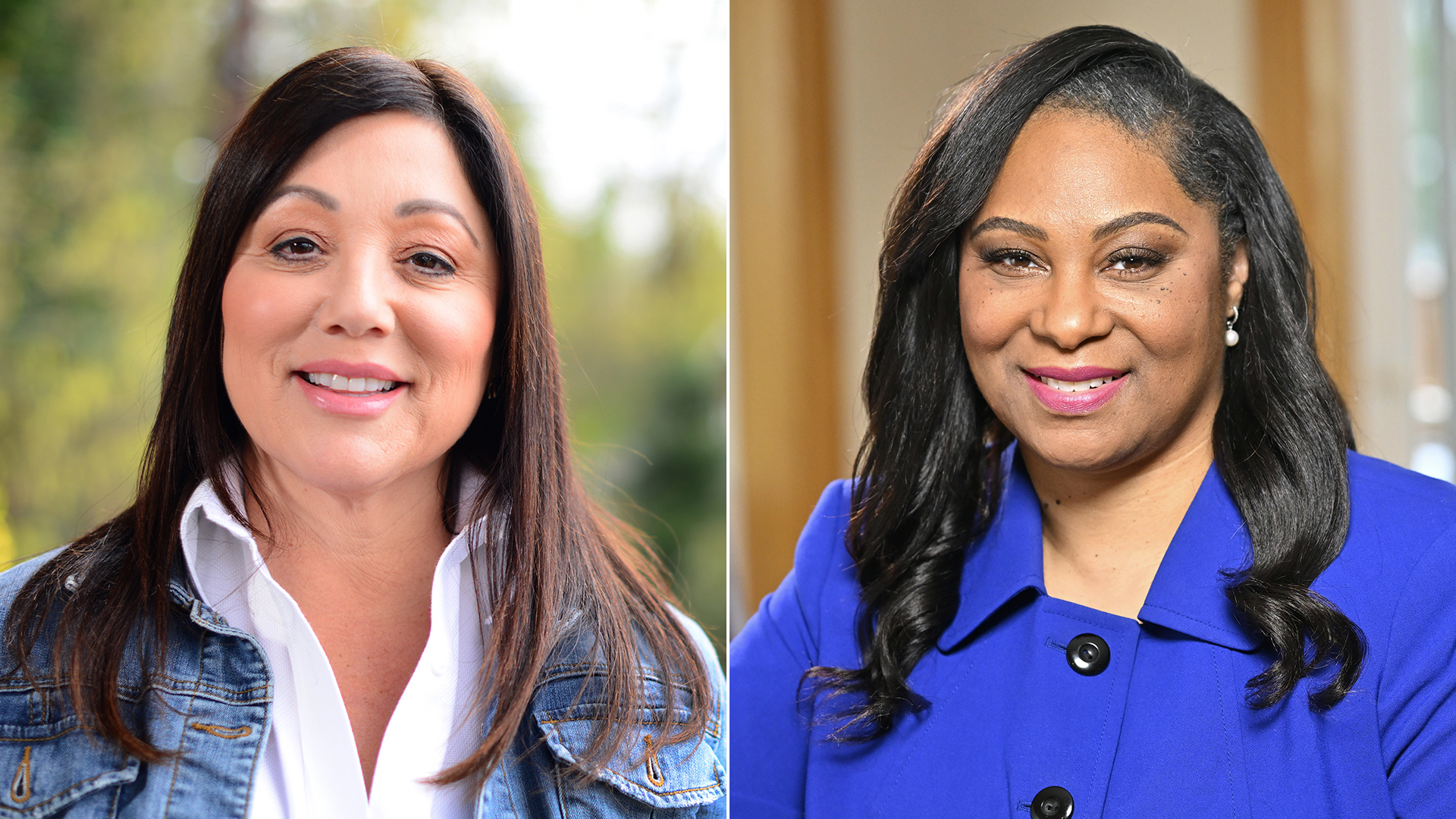
Chavez-DeRemer vs. Bynum

Republican incumbent Lori Chavez-DeRemer and Democratic challenger Janelle Bynum are at each other’s throats in Oregon’s 5th Congressional District race

At recent debates on KOIN TV in Portland and KTVZ in Bend, each candidate asserted that their opponent couldn’t be trusted. Bynum worked hard to tie Chavez-DeRemer to  Republican presidential candidate Donald Trump and the conservative Republicans in the House. Chavez-DeRemer, in turn, attacked Bynum for supporting Measure 110, the drug decriminalization measure later amended by House Bill 4002 in the face of public backlash against the measure. 

No question, Bynum is a flaming liberal. In September, House Minority Leader Hakeem Jeffries showed up in Portland to bolster her campaign. Par for the course, he accused Chavez-DeRemer of being aligned with extreme MAGA Republicans and Donald Trump., who Democrats portray as an imminent threat to democracy.

In contrast, Chavez-DeRemer works hard to portray herself as a moderate. She was ranked the 29th most bipartisan House member, and the most bipartisan Oregon member of the House, in an analysis released in May 2024 by the Lugar Center and the McCourt School of Public Policy at Georgetown University. But she has endorsed Trump’s return to the White House, has praised the Supreme Court ruling that overturned Roe v. Wade and has voted for a number of bills critics claim support the MAGA agenda.

The high-profile race is being run in a swing district created when the Legislature changed the district’s boundaries in 2021so it included a presumably more Democratic Bend. The race is now one of just a few that could decide who controls the U.S. House of Representatives.

So what to do if you are in the middle?

If Trump wins the White House, a vote for Chavez-DeRemer increases the likelihood that the House will stay in Republican hands. The Democrats now have a majority in the Senate but current thinking is that the Republicans have a high probability of retaking control with a net gain of two seats or by winning the presidential election along with a net gain of one seat. 

A particularly endangered Democrat is Senator Jon Tester of Montana, who trails his Republican challenger, Tim Sheehy, a wealthy Republican businessman. Polls suggest he’s toast because of the changing demographics of the state.  Republicans are also expected to flip West Virginia — where Joe Manchin is retiring- in the face of competition from Republican Governor Jim Justice . 

Of course, Democrats are still hopeful they can hold onto critical Senate seats in states like Ohio and Arizona and there are signs of weakness in Republican  Senator Ted Cruz’ s  race against Democratic challenger Colin Allred.

But if Trump wins, and the Republicans can hold on to the House and retake the Senate, that clean sweep would give Trump and his MAGA allies an opportunity to govern with impunity. If that’s not what you want, your best choice might be to vote for Bynum , even if you lean conservative, to increase the likelihood the Democrats will at least control the House and be in a position to block the more unpalatable elements of Trump’s MAGA agenda.

Tricky, isn’t it?

Portland’s Next Mayor? Who Cares?

Portland’s Next Mayor?

In all the turmoil and media attention focused on Portland’s new ranked choice voting election in November, much of the focus has been on the contest for mayor.[1]

Why?

The next mayor is going to be a eunuch. No, I don’t mean a castrated man. I mean the word metaphorically, in the sense an ineffectual or powerless person.

It’s the new 12-person City Council that will have the power to enact laws. The new mayor won’t even sit on the City Council or vote on council items (except to break a tie).  The mayor, and the new city administrator, who will be appointed by the mayor with council approval, will be in charge of carrying out City Council actions and crafting the city budget.

The mayor will also be tasked with appointing a city administrator, city attorney, and police chief, but that will also be only with the City Council’s approval. And to top it all off, the mayor won’t have veto power over council decisions. 

The mayor will serve more as a $175,463-a-year figurehead than a legislator, Tate White, a member of the city’s government transition team, told OPB earlier this year. “They’re going to be partnering with other jurisdictions, they’ll be standing at press conferences, they’re going to be the people meeting with representatives from sister cities when they come and visit, it will be far more ceremonial,” she said.

But don’t count on the new 12-person City Council, with three representatives per four new geographical districts and only one staff person for each City Council member, to be all that cooperative, efficient or effective. It might be more functional than New York City’s 51-member City Council, but likely not much. After all, a City Council member can be elected with as little as 25% + 1 votes, so their constituencies will be pretty damn small.[2] One consequence could be a Councilor able to remain in office by consistently satisfying just that smaller segment of eligible voters.

Jeff Jacoby, an award-winning columnist for the Boston Globe, calls the ranked choice voting process “democracy on the Rube Goldberg model”, where  ideas that supposedly simplify people’s lives wreak havoc instead.


[1] Mayoral candidates include three current members of Portland City Council: Rene Gonzalez, Mingus Mapps and Carmen Rubio. Others running are: Saadiq Ali, early childhood educator Shei’Meka As-Salaam, inventor James Atkinson IV, REAP youth advocate Durrell Kinsey Bey, financial advisor Nancy Congdon, Yao Jun He, advocate for the unhoused and community activist Michael O’Callaghan, artist and performer Liv Osthus, city hall veteran and green energy advocate Marshall Runkel, owner and president of TITAN Freight Systems Keith Wilson and maintenance supervisor Dustin Witherspoon. 

[2] Charter reform’s explanation of how “single transferable vote” (STV) will work: 

“Councilors of each district are elected using a proportional method of ranked choice voting known as single transferable vote. This method provides for the candidates to be elected on the basis of a threshold. The threshold is determined by the number of seats to be filled plus one, so that the threshold is the lowest number of votes a candidate must receive to win a seat such that no more candidates can win election than there are seats to be filled. In the initial round, the number of first rankings received by each candidate is the candidate’s vote count. Candidates whose vote counts are at least the threshold are declared elected. Votes that counted for elected candidates in excess of the threshold are called surplus. If fewer candidates are elected in the initial round than there are seats to be filled, the surplus percentage of all votes for the candidates who received a surplus are transferred to the next-highest ranked candidates in proportion to the total numbers of next-highest rankings they received on the ballots that counted for the elected candidate. If, after all surpluses have been counted in a round, no additional candidates have a vote count that is at least the threshold, the candidates with the lowest vote counts are successively eliminated in rounds and their votes are counted as votes for the candidates who are ranked next highest on the ballots that had been counted for the eliminated candidates, until another candidate has a vote count that is at least the threshold or until the number of candidates remaining equals the number of seats that have not yet been filled. The process of transferring surpluses of elected candidates and eliminating candidates continues until all positions are elected.”

Identity Politics is Alive And Well at The New York Times

I’m a member of Tau Kappa Epsilon fraternity, one of the largest men’s collegiate fraternities in North America.  If I ran for office, would you assume all 12,000 voting-age collegiate members of my fraternity and all the living TKE alumni would support me?  

Ronald Reagan was a member of Tau Kappa Epsilon fraternity, too. When he ran for president, did the news media assume the votes of all his TKE fraternity brothers were a sure thing?

The New York Times seems to think that members of all the Black Greek-letter sororities and fraternities at US colleges are a ready-made bloc of Kamala Harris supporters in her quest for the presidency because she’s been a member of the Black sorority Alpha Kappa Alpha since her undergraduate days at Howard University. 

“As Vice President Kamala Harris’s presidential campaign rushes to shore up its base, its efforts will be bolstered by a ready-made coalition: the more than two million members of Black Greek-letter organizations who have quickly united to mobilize Black voters nationwide,” the Times reported today.  

“A united Black Greek front has the potential to offer even more significant political advantage, as their voter engagement programs reach millions every four years,” the Times added. 

Maya King, the Times reporter who wrote the story, says in her bio, “As a native Southerner, I have been most fascinated by the ways the region has changed politically, culturally and demographically over the last few presidential election cycles — and how those changes are connected.”

But King barely acknowledged those changes in her article. The cheerleading article barely mentioned that there have been signs of deteriorating Black support for the Democratic ticket and growing Black consideration of Donald Trump. 

In November 2023, the Times reported that Black voters were  more disconnected from the Democratic Party than they have been in decades, frustrated with what many saw as inaction on their political priorities and unhappy with President Biden, a candidate they helped lift to the White House. Polls by the Times and Siena College found that 22 percent of Black voters in six of the most important battleground states said they would support former President Trump in the 2024 election, and 71 percent would back President Biden.

Erosion of Black support for the Democratic Party has also been found by the Pew Research Center. The Center reports that although the majority of Black voters across education levels are Democrats, there has been a decrease in affiliation with the Democratic Party in recent years. While 93% of Black voters with college degrees identified with or leaned toward the Democratic Party in 2012, that number decreased to 79% in 2023.

Biden’s withdrawal from the 2024 presidential contest and Harris’  ascension may well change some Black voters’ preferences, but it’s not likely to be a universal shift. Harris, for example, is a progressive Democrat, but only 28 percent of black Democrats consider themselves liberal, according to the Pew Research Center, while 70 percent identify as moderate or conservative.

On June 25, the Times reported on data  captured by a new Harvard study that shows Black voters  have slightly shifted toward Trump since 2020. “One possible explanation is that some Black voters’ economic gains have allowed them to focus more on noneconomic issues — such as abortion and L.G.B.T.Q. rights — on which they are more conservative than typical Democrats,” the Times said.

The fact is, Black candidates can’t rely on group solidarity. “It’s certainly true that black voters support black Democratic candidates at higher rates, … but analysis of past elections and campaigns shows that black voters have never prioritized simple descriptive representation over other factors, like party affiliation, campaign viability, candidate electability, preexisting relationships with the black community and a sense of authenticity,” according to the New York City-based Brennan Center for Justice. 

For the New York Times to publish a story assuming Black solidarity for a Black presidential candidate who’s a member of a Black sorority is irresponsible journalism.

As James Bennett, who was the editorial page editor at The New York Times from May 2016 until his forced resignation in June 2020 over a controversial op-ed, has said, “The reality is that the Times is becoming the publication through which America’s progressive elite talks to itself about an America that does not really exist.”

Don’t Count On Allegations of Campaign Financing Foul Play In McLeod-Skinner’s Race Stirring Things Up

Jamie McLeod-Skinner

I’m a political junkie. Have been forever. When I was a kid, i went with my father to drop off Eisenhower/Nixon campaign material at homes in our neighborhood, in the 8th grade a local paper printed my first letter to the editor on a national policy dispute, and my career included serving on the staff of a committee of the House of Representatives. Even now, Lord knows how many political news sites I monitor.

But I’m a peculiar outlier. Face it, most folks could care less about politics most of the time. They ignore day-to-day political drama. A recent Gallup poll found that only 32% of Americans pay close attention to politics.  I think it’s less.

I bring this up because some may think the current dust-up over campaign contributions in the Jamie McLeod-Skinner/Janelle Bynum Democratic primary race in Oregon’s 5th District is going to influence a lot of voters. 

I doubt it.

The Democratic establishment, including the Democratic Congressional Campaign Committee and Gov. Tina Kotek (D) are backing Bynum. But now a new super PAC, Health Equity Now, has reserved about $352,000 in advertising with spots supporting McLeod-Skinner, according to the media tracking firm AdImpact. The ads began running in the Portland market on Wednesday. 

The PAC didn’t register with the Federal Election Commission (FEC) until May 3, allowing it to avoid filing information on its donors before the election occurs next Tuesday, May 21.

News media have jumped on the story. OPB said the whole affair is “raising questions about whether Republicans are trying to tilt the scales in the contest.” The Oregon Capital Chronicle Outside reported the outside money money “…spurred accusations from Democrats that Republicans are meddling to ensure incumbent GOP Rep. Lori Chavez-DeRemer faces a weaker opponent in November. “

ABC News reported a Bynum spokesperson said the ad buys “certainly looks like there are ties to Republicans.” 

“Let us be crystal clear, Jamie McLeod-Skinner is House Republicans’ dream opponent because they know they can beat her — making this shady GOP election meddling in a Democratic primary all the more alarming,” said Blakely Wall, a spokesperson for the Bynum campaign.

So why do I think this tempest won’t much matter?

Sure, there are incessant polls on political opinions, but that doesn’t mean people are constantly paying attention to politics in general or political shenanigans in particular. 

“We often talk about high-information voters versus low-information voters,” Larry Sabato, the director of the University of Virginia’s Center for Politics, told Columbia Journalism Review. ” What we leave out is the no-information voter. They’re the ones on social media or watching these crank news shows from the far right.… They actually know less than they would if they didn’t watch news at all. I’m very pessimistic.”

Most Americans think the country is in deeply polarized times, but sixty-five per cent of respondents to a Pew survey last year said that they were “exhausted”, not absorbed,  when thinking about politics. It’s probably worse now.

Even if some of our population have some interest in public policy, it’s hard to find it. A recent New Yorker article referred to when the late Neil Postman, an education scholar at New York University, wrote of the distinction between George Orwell and Alduous Huxley’s visions of the future. “Orwell feared that the truth would be concealed from us, Postman wrote. “Huxley feared the truth would be drowned in a sea of irrelevance.”

In the Internet/AI age, meaningful political information is “drowned in a sea of irrelevance.” And what does get through is more likely to be disinformation or to stir cynicism. A recent University of Michigan study shows that people regularly on social media were exposed to more political attacks and came away more cynical and distrustful of politic. Instead of becoming more involved, that can make them frustrated, disgruntled and disengaged. 

Then there’s the diminishing availability of real political news. Newspapers, once the main source of such news for everybody from business leaders to rural smalltown farmers, are a dying breed. And many of the ones that survive are on a resources diet. The Oregonian, once a powerful force with statewide coverage, is a shell of its former self. 

And if you are reading this, you are a tiny, and shrinking, part of politically engaged Oregonians.

So don’t be surprised if the hullabaloo about McLeod-Skinner’s fundraising causes barely a ripple in the general public’s views on the campaign. That’s just the way things go.

Mail-In-Voting Is On The Ballot in Oregon

In 2020, Donald Trump filed several lawsuits in an effort to stop vote-counting or force recounts after his campaign said post-Election Day increases in vote totals for President Joe Biden — many of which came from mail ballots, that were counted following the in-person votes — were evidence of fraud. 

None of the lawsuits succeeded. 

But Trump has continued to denigrate mail-in voting and promulgate theories that the 2020 election was contaminated by voter fraud, and his true believers are falling in behind him. (A humorous aside is that many Republican groups are also spending millions of dollars this year promoting voting by mail to spur turnout, particularly in competitive states)

Even though elections researchers have demonstrated that making it easier to vote by mail generates higher voter turnout for both parties, and incidences of fraud are rare, in December Trump called for an end to mail-in voting entirely. Following a “cutting off one’s nose to spite one’s face” strategy, he claimed in March that “any time the mail is involved, you’re going to have cheating”.  

Some election experts expect Trump to prematurely claim victory on the basis of early in-person votes in 2024 and to litigate the election going forward.

Now we have all three Republicans running to be Oregon Secretary of State, which oversees the state’s elections, hyping claims of voter fraud and affirming their desire to end Oregon’s long tradition of running elections by mail.

The three Republicans in the primary race are Beaverton real estate broker Brent Barker, state Sen. and rancher Dennis Linthicum and Salem business analyst Tim McCloud.

Brent Barker’s campaign website spells out his support for:

  • Statewide In-Person Voting
  • Limiting mail-in ballots to Military and Absentee Voters
  • Resetting all voter registration rolls to zero and requiring everybody to re-register
  • Hand counting tally results for all elections with observers

Linthicum, on his campaign website, pledges to:

  • Restore election integrity and promote diligent custodial ownership of election records
  • Advocate for in-person local precinct voting with ID
  • Safeguard the elections for the integrity of every Oregonian’s vote

Tim McCloud has not set up a website with campaign pledges. He was, however, a plaintiff in a lawsuit intended to end mail voting and electronic voting tabulation in Oregon.

A federal judge tossed the lawsuit, saying “generalized grievances” about the state’s elections aren’t enough to give a group of unsuccessful Republican candidates and other election deniers standing to sue.

McCloud has also commented on election issues in general. In responses to a questionnaire from KATU News, he said, “I will heavily fortify our election system against attacks, and implement fail-safe systems to prevent any disruption of our election system by bad actors. Additionally, I will advance all efforts for more access to Oregon’s public elections records, including more transparent processing of ballots, and conducting routine and thorough voter roll audits statewide.”

Whatever the merits, or failures, of mail-in voting, one thing remains true. As political analyst Larry J. Sabato, has said, “Every election is determined by the people who show up.”

Money Talks: It looks Like a Bynum / McLeod-Skinner Race in the 5th District Democratic Primary

Janelle Bynum and Jamie McLeod-Skinner are running neck-and-neck in the money race in the contentious Democratic primary for the 5th Congressional District seat occupied by Kurt Schrader until replaced by Lori Chavez-DeRemer.

The race is a top target for Democrats trying to flip the U.S. House, which is now narrowly in Republican hands. The district, which voted for Joe Biden in 2020 and has more registered Democrats than Republicans, stretches from Bend to Portland. 

According to campaign finance numbers posted today by the Federal Election Commission (FEC), Bynum and McLeod-Skinner had raised almost equal amounts and had almost equal cash-on-hand as of the end of 2023.  Bynum had raised $439,286.38 and had $233,246.16 cash-on-handMcLeod-Skinner had raised $438,831.45 and had cash-on-hand of $242,300.59.

Two of the other three other Democrats in the primary race, Kevin Easton and Matthew Davie, haven’t yet filed their campaign finance reports for all of 2023. The third, Metro President Lynn Peterson, had raised $254,603.76, but had just $52,834.13 cash-on-hand, as of the end of 2023.

Going forward, Bynum may have the advantage given that the Democratic Congressional Campaign Committee announced its support for her on January 29, noting that it had put her on its “Red to Blue” list of key candidates running to replace Republican members as part of the Democrats’ strategy to reclaim the House majority.

Bynum may also have an edge because she’s attracting more out-of-state money. Recent out-of-state contributions include $4,500 from Brian Hairston, owner of Dunham Management Group in Englewood, NJ, $3,300 from James Williams owner of Estel Foods in Saint Louis, MO and $3,300 from Troy A. Carter Sr., a congressman from Louisiana. 

The primary winner will take on Republican U.S. Rep. Lori Chavez-DeRemer, who won her seat in 2020, defeating Democrat McLeod-Skinner 51% – 49%.

Chavez-DeRemer’s end-of-the-year campaign finance report with the FEC shows she had raised $2,529,913.60 and had cash on hand of $1,608,021.56. Her aggressive fundraising is expected to make her a strong candidate in the race against her eventual Democratic opponent. 

Despite the Democratic lead in registrations in the district, the Cook Political Report rates the race as a toss-up. 

Lynn Peterson is in Trouble

Lynn Peterson was primed and ready.

In June 2023, Metro President Lynn Peterson announced she was running in the Democratic primary for the 5th Congressional District seat occupied by Kurt Schrader until replaced by Lori Chavez-DeRemer.

“I’ll bring a track record of developing common sense solutions and getting things done to Congress,” Peterson said. “I’m going to fight not only for needed investments in housing, public safety, transportation and education, but also our fundamental rights to vote and seek reproductive health care.”

The race is a top target for Democrats trying to flip the U.S. House, which is now narrowly in Republican hands. The district, which voted for Joe Biden in 2020 and has more registered Democrats than Republicans, stretches from Bend to Portland. 

Peterson jumped out of the gate with an endorsement from DeFazio and over 50 endorsements from officeholders and community leaders from throughout the 5th District and the state.

What could go wrong?

Well, money.

In an email blast today, Peterson said, “For the next few months, our fundraising numbers will help set the narrative as we approach the primary and look toward the general election. (emphasis in originalFor many, these numbers serve as a proxy metric for viability.”

According to campaign finance numbers posted today by the Federal Election Commission (FEC), Peterson had just $52,834.13 cash on hand as of the end of 2023.

The other four Democratic primary candidates, Janelle Bynum, Kevin Easton, Jamie McLeod-Skinner and Matthew Davie, haven’t filed their campaign finance reports for all of 2023, but Bynum and McLeod-Skinner had healthy balances as of Sept. 30, 2023 (Bynum: $217,842.324; McLeod-Skinner: $154,767.48). 

In addition, The Democratic Congressional Campaign Committee gave Bynum a lift when it announced its support for her on January 29, noting that it had put her on its “Red to Blue” list of key candidates running to replace Republican members as  part of the Democrats’ strategy to reclaim the House majority.

 The primary winner will take on Republican U.S. Rep. Lori Chavez-DeRemer, who won her seat in 2020, defeating Democrat Jamie McLeod-Skinner 51% – 49%.

Chavez-DeRemer hasn’t filed her end-of-the-year campaign finance report with the FEC, but as of Sept. 30, 2023, she had cash on hand of $1,290,581.19. It’s expected that her aggressive fundraising efforts continued in the fourth quarter of 2023, making her a strong candidate in the race against her eventual Democratic opponent. 

Despite the Democratic lead in registrations in the district, the Cook Political Report rates the race as a toss-up.