Don’t Count On Allegations of Campaign Financing Foul Play In McLeod-Skinner’s Race Stirring Things Up

Jamie McLeod-Skinner

I’m a political junkie. Have been forever. When I was a kid, i went with my father to drop off Eisenhower/Nixon campaign material at homes in our neighborhood, in the 8th grade a local paper printed my first letter to the editor on a national policy dispute, and my career included serving on the staff of a committee of the House of Representatives. Even now, Lord knows how many political news sites I monitor.

But I’m a peculiar outlier. Face it, most folks could care less about politics most of the time. They ignore day-to-day political drama. A recent Gallup poll found that only 32% of Americans pay close attention to politics.  I think it’s less.

I bring this up because some may think the current dust-up over campaign contributions in the Jamie McLeod-Skinner/Janelle Bynum Democratic primary race in Oregon’s 5th District is going to influence a lot of voters. 

I doubt it.

The Democratic establishment, including the Democratic Congressional Campaign Committee and Gov. Tina Kotek (D) are backing Bynum. But now a new super PAC, Health Equity Now, has reserved about $352,000 in advertising with spots supporting McLeod-Skinner, according to the media tracking firm AdImpact. The ads began running in the Portland market on Wednesday. 

The PAC didn’t register with the Federal Election Commission (FEC) until May 3, allowing it to avoid filing information on its donors before the election occurs next Tuesday, May 21.

News media have jumped on the story. OPB said the whole affair is “raising questions about whether Republicans are trying to tilt the scales in the contest.” The Oregon Capital Chronicle Outside reported the outside money money “…spurred accusations from Democrats that Republicans are meddling to ensure incumbent GOP Rep. Lori Chavez-DeRemer faces a weaker opponent in November. “

ABC News reported a Bynum spokesperson said the ad buys “certainly looks like there are ties to Republicans.” 

“Let us be crystal clear, Jamie McLeod-Skinner is House Republicans’ dream opponent because they know they can beat her — making this shady GOP election meddling in a Democratic primary all the more alarming,” said Blakely Wall, a spokesperson for the Bynum campaign.

So why do I think this tempest won’t much matter?

Sure, there are incessant polls on political opinions, but that doesn’t mean people are constantly paying attention to politics in general or political shenanigans in particular. 

“We often talk about high-information voters versus low-information voters,” Larry Sabato, the director of the University of Virginia’s Center for Politics, told Columbia Journalism Review. ” What we leave out is the no-information voter. They’re the ones on social media or watching these crank news shows from the far right.… They actually know less than they would if they didn’t watch news at all. I’m very pessimistic.”

Most Americans think the country is in deeply polarized times, but sixty-five per cent of respondents to a Pew survey last year said that they were “exhausted”, not absorbed,  when thinking about politics. It’s probably worse now.

Even if some of our population have some interest in public policy, it’s hard to find it. A recent New Yorker article referred to when the late Neil Postman, an education scholar at New York University, wrote of the distinction between George Orwell and Alduous Huxley’s visions of the future. “Orwell feared that the truth would be concealed from us, Postman wrote. “Huxley feared the truth would be drowned in a sea of irrelevance.”

In the Internet/AI age, meaningful political information is “drowned in a sea of irrelevance.” And what does get through is more likely to be disinformation or to stir cynicism. A recent University of Michigan study shows that people regularly on social media were exposed to more political attacks and came away more cynical and distrustful of politic. Instead of becoming more involved, that can make them frustrated, disgruntled and disengaged. 

Then there’s the diminishing availability of real political news. Newspapers, once the main source of such news for everybody from business leaders to rural smalltown farmers, are a dying breed. And many of the ones that survive are on a resources diet. The Oregonian, once a powerful force with statewide coverage, is a shell of its former self. 

And if you are reading this, you are a tiny, and shrinking, part of politically engaged Oregonians.

So don’t be surprised if the hullabaloo about McLeod-Skinner’s fundraising causes barely a ripple in the general public’s views on the campaign. That’s just the way things go.

Mail-In-Voting Is On The Ballot in Oregon

In 2020, Donald Trump filed several lawsuits in an effort to stop vote-counting or force recounts after his campaign said post-Election Day increases in vote totals for President Joe Biden — many of which came from mail ballots, that were counted following the in-person votes — were evidence of fraud. 

None of the lawsuits succeeded. 

But Trump has continued to denigrate mail-in voting and promulgate theories that the 2020 election was contaminated by voter fraud, and his true believers are falling in behind him. (A humorous aside is that many Republican groups are also spending millions of dollars this year promoting voting by mail to spur turnout, particularly in competitive states)

Even though elections researchers have demonstrated that making it easier to vote by mail generates higher voter turnout for both parties, and incidences of fraud are rare, in December Trump called for an end to mail-in voting entirely. Following a “cutting off one’s nose to spite one’s face” strategy, he claimed in March that “any time the mail is involved, you’re going to have cheating”.  

Some election experts expect Trump to prematurely claim victory on the basis of early in-person votes in 2024 and to litigate the election going forward.

Now we have all three Republicans running to be Oregon Secretary of State, which oversees the state’s elections, hyping claims of voter fraud and affirming their desire to end Oregon’s long tradition of running elections by mail.

The three Republicans in the primary race are Beaverton real estate broker Brent Barker, state Sen. and rancher Dennis Linthicum and Salem business analyst Tim McCloud.

Brent Barker’s campaign website spells out his support for:

  • Statewide In-Person Voting
  • Limiting mail-in ballots to Military and Absentee Voters
  • Resetting all voter registration rolls to zero and requiring everybody to re-register
  • Hand counting tally results for all elections with observers

Linthicum, on his campaign website, pledges to:

  • Restore election integrity and promote diligent custodial ownership of election records
  • Advocate for in-person local precinct voting with ID
  • Safeguard the elections for the integrity of every Oregonian’s vote

Tim McCloud has not set up a website with campaign pledges. He was, however, a plaintiff in a lawsuit intended to end mail voting and electronic voting tabulation in Oregon.

A federal judge tossed the lawsuit, saying “generalized grievances” about the state’s elections aren’t enough to give a group of unsuccessful Republican candidates and other election deniers standing to sue.

McCloud has also commented on election issues in general. In responses to a questionnaire from KATU News, he said, “I will heavily fortify our election system against attacks, and implement fail-safe systems to prevent any disruption of our election system by bad actors. Additionally, I will advance all efforts for more access to Oregon’s public elections records, including more transparent processing of ballots, and conducting routine and thorough voter roll audits statewide.”

Whatever the merits, or failures, of mail-in voting, one thing remains true. As political analyst Larry J. Sabato, has said, “Every election is determined by the people who show up.”

Money Talks: It looks Like a Bynum / McLeod-Skinner Race in the 5th District Democratic Primary

Janelle Bynum and Jamie McLeod-Skinner are running neck-and-neck in the money race in the contentious Democratic primary for the 5th Congressional District seat occupied by Kurt Schrader until replaced by Lori Chavez-DeRemer.

The race is a top target for Democrats trying to flip the U.S. House, which is now narrowly in Republican hands. The district, which voted for Joe Biden in 2020 and has more registered Democrats than Republicans, stretches from Bend to Portland. 

According to campaign finance numbers posted today by the Federal Election Commission (FEC), Bynum and McLeod-Skinner had raised almost equal amounts and had almost equal cash-on-hand as of the end of 2023.  Bynum had raised $439,286.38 and had $233,246.16 cash-on-handMcLeod-Skinner had raised $438,831.45 and had cash-on-hand of $242,300.59.

Two of the other three other Democrats in the primary race, Kevin Easton and Matthew Davie, haven’t yet filed their campaign finance reports for all of 2023. The third, Metro President Lynn Peterson, had raised $254,603.76, but had just $52,834.13 cash-on-hand, as of the end of 2023.

Going forward, Bynum may have the advantage given that the Democratic Congressional Campaign Committee announced its support for her on January 29, noting that it had put her on its “Red to Blue” list of key candidates running to replace Republican members as part of the Democrats’ strategy to reclaim the House majority.

Bynum may also have an edge because she’s attracting more out-of-state money. Recent out-of-state contributions include $4,500 from Brian Hairston, owner of Dunham Management Group in Englewood, NJ, $3,300 from James Williams owner of Estel Foods in Saint Louis, MO and $3,300 from Troy A. Carter Sr., a congressman from Louisiana. 

The primary winner will take on Republican U.S. Rep. Lori Chavez-DeRemer, who won her seat in 2020, defeating Democrat McLeod-Skinner 51% – 49%.

Chavez-DeRemer’s end-of-the-year campaign finance report with the FEC shows she had raised $2,529,913.60 and had cash on hand of $1,608,021.56. Her aggressive fundraising is expected to make her a strong candidate in the race against her eventual Democratic opponent. 

Despite the Democratic lead in registrations in the district, the Cook Political Report rates the race as a toss-up. 

Lynn Peterson is in Trouble

Lynn Peterson was primed and ready.

In June 2023, Metro President Lynn Peterson announced she was running in the Democratic primary for the 5th Congressional District seat occupied by Kurt Schrader until replaced by Lori Chavez-DeRemer.

“I’ll bring a track record of developing common sense solutions and getting things done to Congress,” Peterson said. “I’m going to fight not only for needed investments in housing, public safety, transportation and education, but also our fundamental rights to vote and seek reproductive health care.”

The race is a top target for Democrats trying to flip the U.S. House, which is now narrowly in Republican hands. The district, which voted for Joe Biden in 2020 and has more registered Democrats than Republicans, stretches from Bend to Portland. 

Peterson jumped out of the gate with an endorsement from DeFazio and over 50 endorsements from officeholders and community leaders from throughout the 5th District and the state.

What could go wrong?

Well, money.

In an email blast today, Peterson said, “For the next few months, our fundraising numbers will help set the narrative as we approach the primary and look toward the general election. (emphasis in originalFor many, these numbers serve as a proxy metric for viability.”

According to campaign finance numbers posted today by the Federal Election Commission (FEC), Peterson had just $52,834.13 cash on hand as of the end of 2023.

The other four Democratic primary candidates, Janelle Bynum, Kevin Easton, Jamie McLeod-Skinner and Matthew Davie, haven’t filed their campaign finance reports for all of 2023, but Bynum and McLeod-Skinner had healthy balances as of Sept. 30, 2023 (Bynum: $217,842.324; McLeod-Skinner: $154,767.48). 

In addition, The Democratic Congressional Campaign Committee gave Bynum a lift when it announced its support for her on January 29, noting that it had put her on its “Red to Blue” list of key candidates running to replace Republican members as  part of the Democrats’ strategy to reclaim the House majority.

 The primary winner will take on Republican U.S. Rep. Lori Chavez-DeRemer, who won her seat in 2020, defeating Democrat Jamie McLeod-Skinner 51% – 49%.

Chavez-DeRemer hasn’t filed her end-of-the-year campaign finance report with the FEC, but as of Sept. 30, 2023, she had cash on hand of $1,290,581.19. It’s expected that her aggressive fundraising efforts continued in the fourth quarter of 2023, making her a strong candidate in the race against her eventual Democratic opponent. 

Despite the Democratic lead in registrations in the district, the Cook Political Report rates the race as a toss-up. 

Berlin Redux: Those who cannot remember the past are condemned to repeat it

In July 2009, speaking at Moscow’s New Economic School, Obama said long-standing assumptions that the US and Russia were antagonists vying for spheres of influence were inaccurate.

“Given our interdependence, any world order that tries to elevate one value or people over another will inevitably fail,” he said. “That is why I have called for a ‘reset’ in relations between the United States and Russia. This must be more than a fresh start between the Kremlin and the White House, though that is important.”

“It must be a sustained effort among the American and Russian people to identify mutual interests, and to expand dialogue and co-operation that can pave the way to progress,” he added.

Obama calls for reset of U.S.-Russian relations in 2009

Obama calls for reset of U.S.-Russian relations in 2009

All this just 12 months after Bush’s hopes for better relations with Russia had been shattered by its war with Georgia.

Now, five years later, Russia has annexed the Crimean Peninsula of Ukraine and the United States is sitting by helplessly.

Obama has said that Russia, by its actions in Crimea, is on the wrong side of history.

Perhaps Obama is forgetting history.

In 1933, Adolph Hitler emphatically proclaimed Germany’s commitment to peace.

“The German government “…is…of the conviction that there can only be one great task in our time: securing peace in the world,” he declared to the Reichstag. “The German Government wishes to engage in peaceful discussions with the other nations on all difficult questions,” he added.

Hitler proclaims Germany's pursuit of peace

Hitler proclaims Germany’s pursuit of peace

That same year, however, Hitler laid the groundwork for what would become the pretext for forcefully absorbing other countries. “We have particularly at heart the fate of the Germans living beyond the frontiers of Germany who are allied with us in speech, culture, and customs and have to make a hard fight to retain these values,” he said in a policy statement submitted to the Reichstag on March 23, 1933. “The national Government is resolved to use all the means at its disposal to support the rights internationally guaranteed to the German minorities,” he said.

When Germany annexed Czechoslovakia’s Sudetenland in 1939, it was justified as an effort to “liberate” the predominantly German area and protect the abused ethnic German population . Foregoing action, Britain and France chose to negotiate a deal that preserved “peace in our time”.

Austria was next. In March 1938, a coup d’état was engineered by the Austrian Nazi Party of Austria’s state institutions in Vienna and Germany annexed Austria into the Third Reich that same month. The Nazis then held a plebiscite allowing the people to vote on the annexation and claimed that the vote in favor was 99.8 percent. (Sound familiar?)

The reaction from the Allies? Mostly words.

It wasn’t until Germany and the Soviets invaded Poland in 1939 that Britain and France declared war on Germany, too late to stop the Soviets and Nazis from slaughtering millions of Jews and Polish intelligentsia through starvation, forced labor and mass killings.

The Russian portion of Poland, by the way, was incorporated within Russia by Soviet “elections” and Russian citizenship was conferred on the Polish inhabitants. (Sound familiar?)

Allied action also came too late for Ukraine, which was overrun by the Nazis in 1941 after years of brutal killings under Stalin, during which millions of Ukrainians were murdered and millions more were sent to concentration camps.

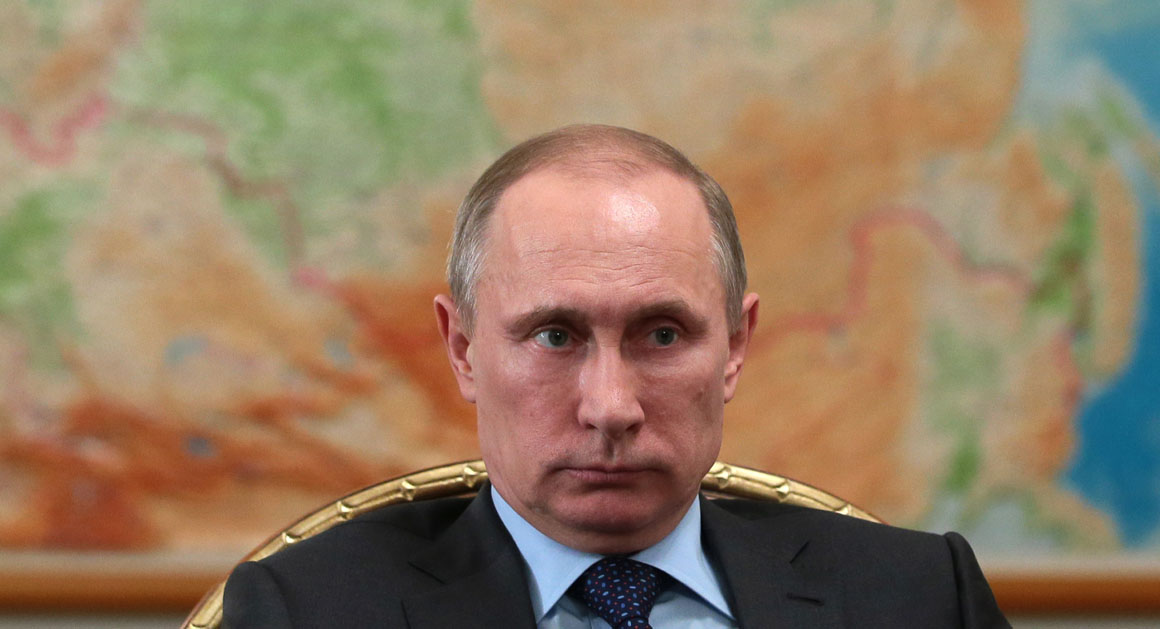
Now we have Putin talking about the need to “protect” ethic Russians in Eastern Ukraine.

“It’s all nonsense. There are no kinds of Russian units in eastern Ukraine. No special forces, no instructors. They are all local citizens.” Russia's President Vladimir Putin

“It’s all nonsense. There are no kinds of Russian units in eastern Ukraine. No special forces, no instructors. They are all local citizens.”
Russia’s President Vladimir Putin

On April 17, 2014, in a televised Q&A session with the Russian public, Putin observed that the Federation Council, the upper house of Russia’s Parliament, had granted him the right to use military force in Ukraine. “I really hope that I do not have to exercise this right and that we are able to solve all today’s pressing issues via political and diplomatic means,” he said.

And today, with Russian-connected demonstrators fomenting unrest in Eastern Ukraine, Russia had the gall to accuse the new Ukrainian government of flouting a just concluded agreement intended to diffuse the crisis. “The Geneva accord is not only not being fulfilled, but steps are being taken, primarily by those who seized power in Kiev, that are grossly breaching the agreements reached,” said Russian Foreign Minister Sergei Lavrov in a press conference in Moscow.

Here we go again?