Lynn Peterson is in Trouble

Lynn Peterson was primed and ready.

In June 2023, Metro President Lynn Peterson announced she was running in the Democratic primary for the 5th Congressional District seat occupied by Kurt Schrader until replaced by Lori Chavez-DeRemer.

“I’ll bring a track record of developing common sense solutions and getting things done to Congress,” Peterson said. “I’m going to fight not only for needed investments in housing, public safety, transportation and education, but also our fundamental rights to vote and seek reproductive health care.”

The race is a top target for Democrats trying to flip the U.S. House, which is now narrowly in Republican hands. The district, which voted for Joe Biden in 2020 and has more registered Democrats than Republicans, stretches from Bend to Portland. 

Peterson jumped out of the gate with an endorsement from DeFazio and over 50 endorsements from officeholders and community leaders from throughout the 5th District and the state.

What could go wrong?

Well, money.

In an email blast today, Peterson said, “For the next few months, our fundraising numbers will help set the narrative as we approach the primary and look toward the general election. (emphasis in originalFor many, these numbers serve as a proxy metric for viability.”

According to campaign finance numbers posted today by the Federal Election Commission (FEC), Peterson had just $52,834.13 cash on hand as of the end of 2023.

The other four Democratic primary candidates, Janelle Bynum, Kevin Easton, Jamie McLeod-Skinner and Matthew Davie, haven’t filed their campaign finance reports for all of 2023, but Bynum and McLeod-Skinner had healthy balances as of Sept. 30, 2023 (Bynum: $217,842.324; McLeod-Skinner: $154,767.48). 

In addition, The Democratic Congressional Campaign Committee gave Bynum a lift when it announced its support for her on January 29, noting that it had put her on its “Red to Blue” list of key candidates running to replace Republican members as  part of the Democrats’ strategy to reclaim the House majority.

 The primary winner will take on Republican U.S. Rep. Lori Chavez-DeRemer, who won her seat in 2020, defeating Democrat Jamie McLeod-Skinner 51% – 49%.

Chavez-DeRemer hasn’t filed her end-of-the-year campaign finance report with the FEC, but as of Sept. 30, 2023, she had cash on hand of $1,290,581.19. It’s expected that her aggressive fundraising efforts continued in the fourth quarter of 2023, making her a strong candidate in the race against her eventual Democratic opponent. 

Despite the Democratic lead in registrations in the district, the Cook Political Report rates the race as a toss-up. 

Berlin Redux: Those who cannot remember the past are condemned to repeat it

In July 2009, speaking at Moscow’s New Economic School, Obama said long-standing assumptions that the US and Russia were antagonists vying for spheres of influence were inaccurate.

“Given our interdependence, any world order that tries to elevate one value or people over another will inevitably fail,” he said. “That is why I have called for a ‘reset’ in relations between the United States and Russia. This must be more than a fresh start between the Kremlin and the White House, though that is important.”

“It must be a sustained effort among the American and Russian people to identify mutual interests, and to expand dialogue and co-operation that can pave the way to progress,” he added.

Obama calls for reset of U.S.-Russian relations in 2009

Obama calls for reset of U.S.-Russian relations in 2009

All this just 12 months after Bush’s hopes for better relations with Russia had been shattered by its war with Georgia.

Now, five years later, Russia has annexed the Crimean Peninsula of Ukraine and the United States is sitting by helplessly.

Obama has said that Russia, by its actions in Crimea, is on the wrong side of history.

Perhaps Obama is forgetting history.

In 1933, Adolph Hitler emphatically proclaimed Germany’s commitment to peace.

“The German government “…is…of the conviction that there can only be one great task in our time: securing peace in the world,” he declared to the Reichstag. “The German Government wishes to engage in peaceful discussions with the other nations on all difficult questions,” he added.

Hitler proclaims Germany's pursuit of peace

Hitler proclaims Germany’s pursuit of peace

That same year, however, Hitler laid the groundwork for what would become the pretext for forcefully absorbing other countries. “We have particularly at heart the fate of the Germans living beyond the frontiers of Germany who are allied with us in speech, culture, and customs and have to make a hard fight to retain these values,” he said in a policy statement submitted to the Reichstag on March 23, 1933. “The national Government is resolved to use all the means at its disposal to support the rights internationally guaranteed to the German minorities,” he said.

When Germany annexed Czechoslovakia’s Sudetenland in 1939, it was justified as an effort to “liberate” the predominantly German area and protect the abused ethnic German population . Foregoing action, Britain and France chose to negotiate a deal that preserved “peace in our time”.

Austria was next. In March 1938, a coup d’état was engineered by the Austrian Nazi Party of Austria’s state institutions in Vienna and Germany annexed Austria into the Third Reich that same month. The Nazis then held a plebiscite allowing the people to vote on the annexation and claimed that the vote in favor was 99.8 percent. (Sound familiar?)

The reaction from the Allies? Mostly words.

It wasn’t until Germany and the Soviets invaded Poland in 1939 that Britain and France declared war on Germany, too late to stop the Soviets and Nazis from slaughtering millions of Jews and Polish intelligentsia through starvation, forced labor and mass killings.

The Russian portion of Poland, by the way, was incorporated within Russia by Soviet “elections” and Russian citizenship was conferred on the Polish inhabitants. (Sound familiar?)

Allied action also came too late for Ukraine, which was overrun by the Nazis in 1941 after years of brutal killings under Stalin, during which millions of Ukrainians were murdered and millions more were sent to concentration camps.

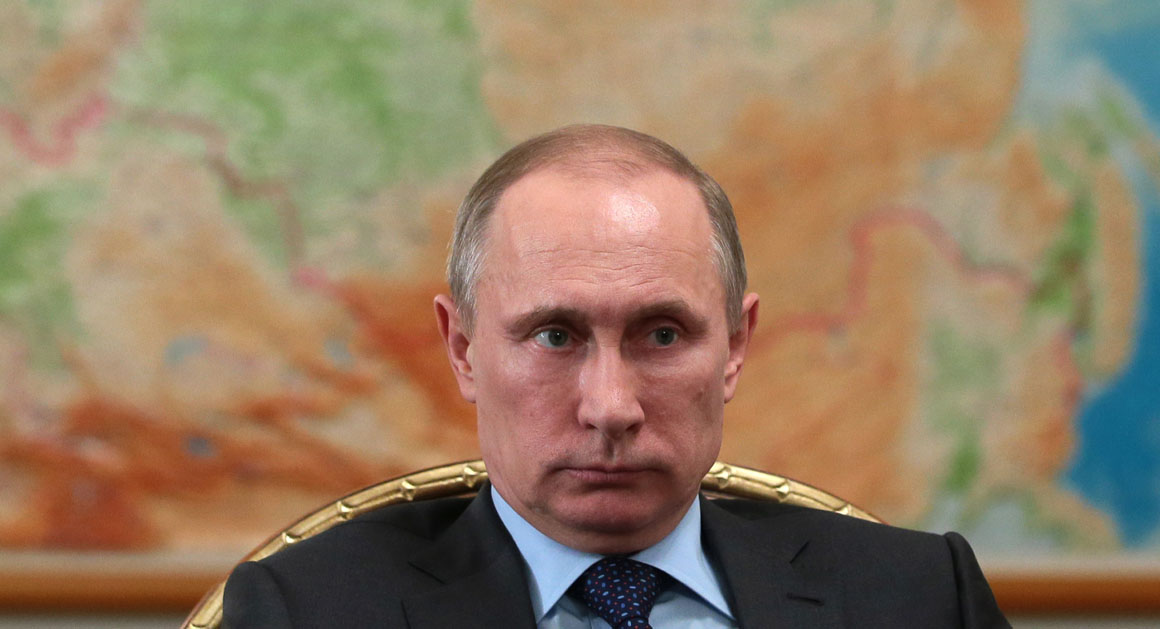
Now we have Putin talking about the need to “protect” ethic Russians in Eastern Ukraine.

“It’s all nonsense. There are no kinds of Russian units in eastern Ukraine. No special forces, no instructors. They are all local citizens.” Russia's President Vladimir Putin

“It’s all nonsense. There are no kinds of Russian units in eastern Ukraine. No special forces, no instructors. They are all local citizens.”
Russia’s President Vladimir Putin

On April 17, 2014, in a televised Q&A session with the Russian public, Putin observed that the Federation Council, the upper house of Russia’s Parliament, had granted him the right to use military force in Ukraine. “I really hope that I do not have to exercise this right and that we are able to solve all today’s pressing issues via political and diplomatic means,” he said.

And today, with Russian-connected demonstrators fomenting unrest in Eastern Ukraine, Russia had the gall to accuse the new Ukrainian government of flouting a just concluded agreement intended to diffuse the crisis. “The Geneva accord is not only not being fulfilled, but steps are being taken, primarily by those who seized power in Kiev, that are grossly breaching the agreements reached,” said Russian Foreign Minister Sergei Lavrov in a press conference in Moscow.

Here we go again?