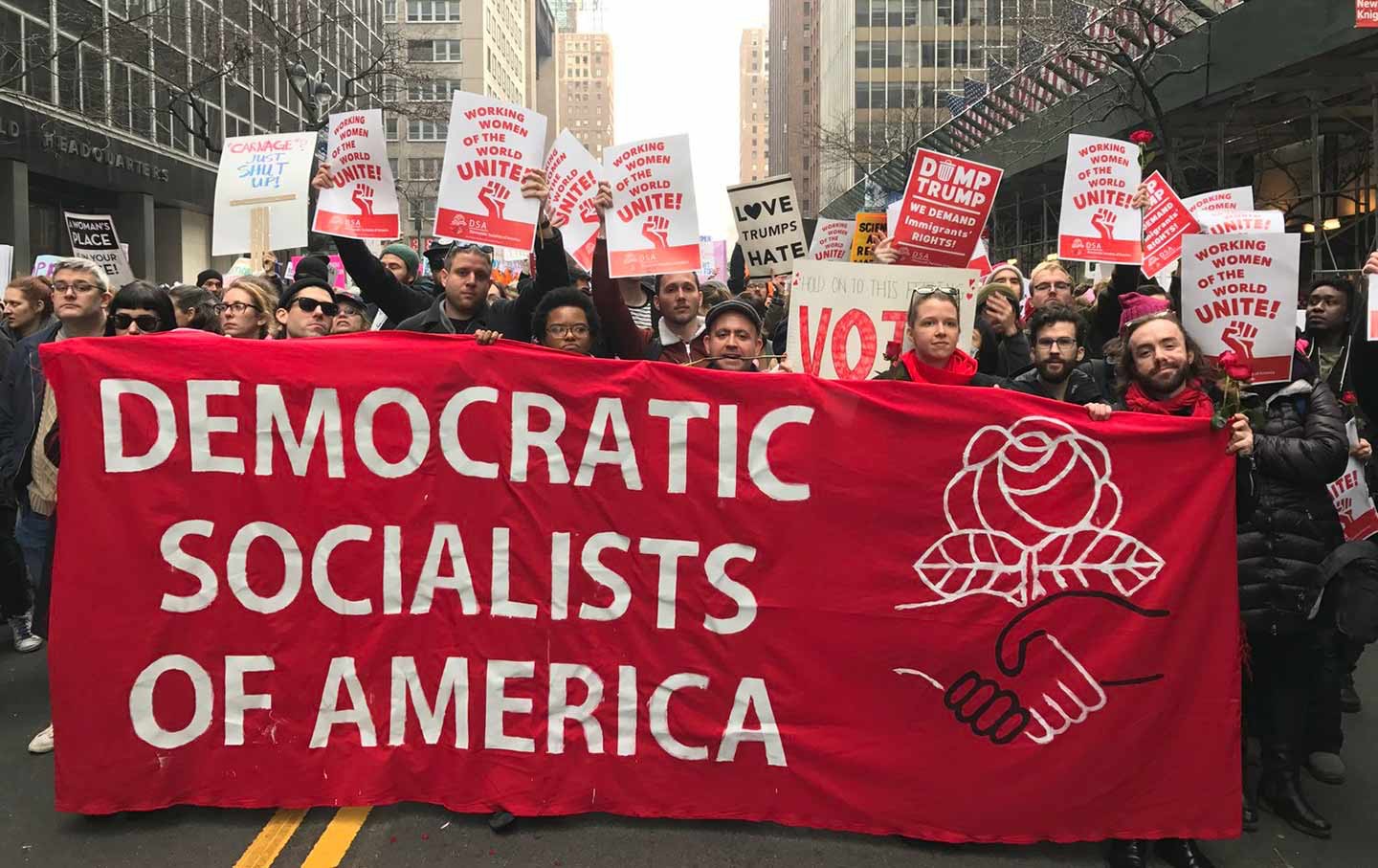
In Colorado’s June 2026 primaries, 29-year-old Democratic Socialist Melat Kiros unseated 15-term incumbent Rep. Diana DeGette in the dark-blue 1st Congressional District, which consists largely of Denver residents.
As the overwhelming favorite against her Republican opponent in November’s general election, Kiros, 29, is expected to be the first self-identified socialist to be elected to Congress in Colorado history.
“We just proved that if you organize the people, you can beat the organized money,” Kiros told Colorado Newsline after her win. “And we’re going to replicate it in races all across the state.”
Will they?
Before pundits and the public accept this assertion, let’s step back and examine what just happened in Colorado’s 1stCongressional District.
The numbers suggest that the real victor was voter apathy, as in so many political contests across the country. Non-voters default to being led by the preferences of voters. That, combined with the creation of safe party districts, is increasingly turning primaries into the real elections.
Bear with me now.
In looking at the 1st Congressional District race, it’s important to recognize that it was limited to registered Democrats and unaffiliated voters. There are 477,098 active registered voters in the district. Of those, 187,317 are registered as Democrats and 236,454 are registered as Unaffiliated voters. So, the number of eligible voters in the Democratic primary totaled 423,771.
But only 157,645 people, or 37.2 % of those eligible, voted in the primary.
That translated into 83,855 for Kiros, 62,715 for DeGette and 11,075 for the Democratic party candidate, Wanda James. In other words, the Democratic Socialist Melat Kiros won the primary with just 19.79 % of eligible voters, only a few more than would fit in the Denver Bronco’s stadium.
Overwhelming? A massive sign of a cultural shift? A rejection of a more moderate political climate? I don’t think so.
A similar situation in New York City is why caution is warranted in interpreting recent races.
“Turnout in New York’s closed primary races is typically small—even Mamdani won last year’s Democratic mayoral primary with less than 7 percent of the city’s overall population backing him,” City Journal reported. “Tuesday’s results do not prove, then, that the majority of residents in New York are hard-left socialists. They instead suggest that, since most potential voters remain politically apathetic, a small but well-organized machine like the DSA’s can deliver big results.”
There’s a parallel here with Democratic Socialist Janeese Lewis George’s victory in Washington, D.C’s mayoral Democratic primary, which has led some to declare her win a mandate. There are approximately 357,000 registered Democrats in Washington, D.C., making up roughly 75% of all registered voters in the District. Only about 38% of registered Democrats voted and George won with just 75,000 votes. A mandate? Hardly.
So, calm down folks.
This isn’t to say that the new socialist legislators in the House won’t be able to muck things up.
As commentator Gerard Baker has observed, “The victory by “democratic socialists” and their allies in New York Democratic primaries last week is a signal moment in the nation’s descent into political dystopia. Sure, we can overstate its importance. New York isn’t America. What passes for cool radicalism in Brooklyn’s Park Slope would get you a psychiatric evaluation in most of the country.”
In addition, if Democrats retake the House in November, their margin is likely to be slim and an enlarged cadre of disruptors will be able to challenge leadership. Republicans are also likely to try to tar the entire Democratic Party for its association with the Democratic Socialists. President Trump has already called the socialist nominees “godless” communists who are threatening the country. At a Faith and Freedom Coalition gathering, he urged religious conservatives to prevent a “communist” victory in the midterms,saying his pro-Christian policies would be reversed if Democrats returned to power.
Hyperventilating political prognosticators don’t always get it right.
“(New York City) Mayor Zohran Mamdani and his Democratic Socialists of America are now the most capable political force in the Democratic Party heading into 2028,” John Ketcham and Christian Browne at the Manhattan Institute, a conservative policy think tank, just wrote in City Journal. “In yesterday’s primaries in New York, his three endorsed candidates beat better-established adversaries, demonstrating how Mamdani and the DSA have become the face of the party’s progressive wing.”
“…the Democratic Party has been taken over by socialists,” says Republican Rep. Mike Lawler, who represents a suburban New York House seat.
Zeteo, a left-leaning digital media company, says “a new politics is brewing. And the epicenter is New York City.”
Wait a minute. Before other pundits and the public accept this assertion, let’s step back and examine what just happened in New York City, focusing on one of the winning socialist candidates, Darializa Avila Chevalier.
32-year-old Chevalier is no shrinking violet. In 2020, she branded Joe Biden a “rapist” and a “war criminal” and called the US a “fucking disgrace”. The day after the horrific October 7, 2023, Hamas massacre of Jews in Israel, she joined a pro-Palestinian rally in Times Square organized by leftist groups that appeared to celebrate the event. In posts onTwitter from 2018 through 2022, she maligned interracial relationships. She’s written that Russia invaded Ukraine because the United States had “been bullying Russia”. In a tweet disparaging America, she wrote, “I forgot to get napkins so I just wiped my hand on the American flag behind me”.
Voter apathy in primary races is the culprit here, as in so many political contests across the country. That, combined with the creation of safe districts across the country, is increasingly causing primaries to be the real elections.
In looking at the New York primary race, it’s important to recognize not only that the race was limited to registered Democrats, of which there are 373,000 in the District NY-13, but that only 67,473 voters participated in the primary, or 18.09 percent. That allowed the Democratic Socialists to wield disproportionate influence. Of those, who bothered to vote, just 32,790 voted for Chevalier, who came out ahead of her main challenger, Adriano Espaillat, by only 2,326 votes.
City Journal acknowledged this in a post on June 27: “Turnout in New York’s closed primary races is typically small—even Mamdani won last year’s Democratic mayoral primary with less than 7 percent of the city’s overall population backing him. Tuesday’s results do not prove, then, that the majority of residents in New York are hard-left socialists. They instead suggest that, since most potential voters remain politically apathetic, a small but well-organized machine like the DSA’s can deliver big results.”
There’s a parallel here with Democratic Socialist Janeese Lewis George’s victory in Washington, D.C’s mayoral Democratic primary, which has led some to declare her win a mandate. There are approximately 357,000 registered Democrats in Washington, D.C., making up roughly 75% of all registered voters in the District. Only about 38% of registered Democrats voted and Janeese Lewis George won with just 75,000 votes. A mandate? Hardly.
So, calm down folks.
This isn’t to say, however, that the new socialist legislators in the House, largely a result of voter lethargy, won’t muck things up.
As commentator Gerard Baker has observed, “The victory by “democratic socialists” and their allies in New York Democratic primaries last week is a signal moment in the nation’s descent into political dystopia. In it we see a Democratic base, relatively small in number but energized by anti-Trump rage, that has decided that the Black Lives Matter, No Such Thing as a Woman, Mostly Peaceful Rioting that the party nourished under Joe Biden and Kamala Harris is too timid for their tastes.
Sure, we can overstate its importance. New York isn’t America. What passes for cool radicalism in Brooklyn’s Park Slope would get you a psychiatric evaluation in most of the country.”
Also, even if the Democrats retake the House in November, their margin is likely to be slim and an enlarged cadre of disruptors will be able to challenge leadership. Republicans are also likely to try to tar the entire Democratic Party for its association with the Democratic Socialists. President Trump has already called the socialist nominees “godless” communists who are threatening the country. At a Faith and Freedom Coalition gathering, he urged religious conservatives to prevent a “communist” victory in the midterms,saying his pro-Christian policies would be reversed if Democrats returned to power.
And right on cue, Mike Marinella, a spokesperson for National Republican Congressional Committee, said, “Tonight wasn’t just a bad night for so-called ‘Leader’ Hakeem Jeffries. It was the night the Democrat establishment officially surrendered to Zohran Mamdani and the socialist wing of their party. Every House Democrat, in safe and competitive districts alike, will now answer to the radicals calling the shots. And Americans should be terrified by where the Democrat Party is headed.”
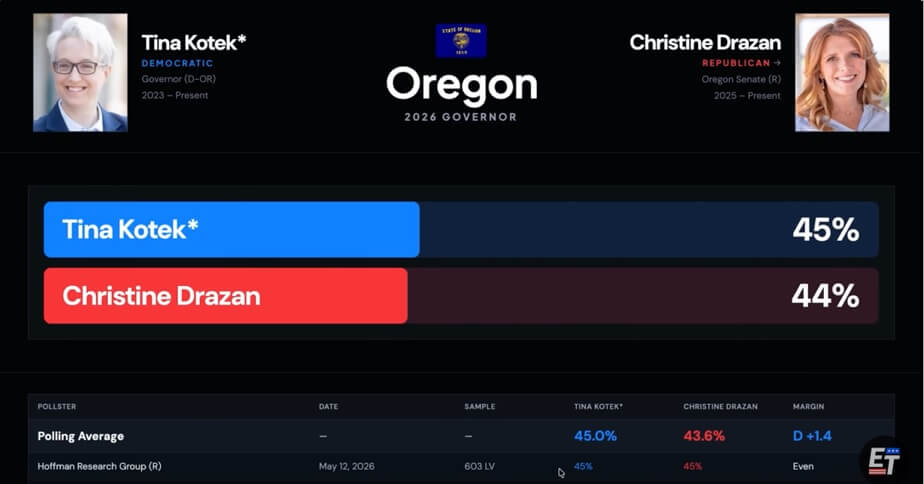
A YouTube channel called Election Time recently ran an item showing Democrat Tina Kotek polling at 45% and Republican Christine Drazan at 44% in the governor’s race.
And this isn’t the only outlet saying Kotek has the advantage.
“While Oregon’s 40-year history of electing Democratic governors and the state’s strong distaste for Republican President Donald Trump suggest Drazan has a difficult road ahead of her,” the Oregon Capital Chronicle opined on May 26. And I recently heard a couple political analysts on OPB saying Kotek will likely win it all again.
They can’t be serious.
This is the “Tax Everything that moves Kotek” who just tried to pull a fast one on Oregonians by shifting a despised transportation tax measure to May in hopes reduced voter participation would doom it, but still saw more than 83% of voters across the political spectrum reject it.
This is the leader of Oregon’s Democratic party that has fostered an anti-business climate for decades, enabled horrendous K-12 school performance despite high per pupil spending, filled the state Supreme Court with liberal judges ever since the administration of Republican Victor Atiyeh, whose term ended in January 1987, and exploded the state budget since then, increasing it from $12.57 billion in 1987-1989 to $138.9 billion in 2025-2027.
It’s the party that gleefully accepted, and then stalled returning, a $500,000 contribution from a disgraced and bankrupt crypto company after the U.S. Attorney’s Office requested it return the money to the federal government.
This is a party so beholden to unions, which represent just 15% of working Oregonians, that it enacted a law to pay striking public and private workers unemployment benefits, that has watched Oregon’s business reputation tank in national rankings, that tolerates underperforming K-12 schools while suspending the requirement that high school students must pass standardized proficiency exams (the “Essential Skills” requirement) to graduate, that has watched the projected cost of the Interstate Bridge Replacement project swell from $4.8 billion to $14.4 billion, and potentially $17.7 billion.
Oregon is in trouble and continuing Democratic Party control isn’t the solution.
There’s so much money sloshing around in American politics a lot of questionable activities get overlooked, like the sweet thing Virginia lobbyist Robert J. “Rob” Catron has going on.
Robert J. “Rob” Catron
A native of South Florida and a graduate of Florida State University, Catron worked as Chief of Staff for Rep. Ed. Schrock, a conservative Virginia Republican, during 2001 – 2003. He later joined the Arlington, VA-based lobbying firm of Alcalde & Fay, where he’s now a Partner. According to the firm, he is “a proud veteran of the United States Army Reserve” and “has successfully managed or consulted on more than 50 winning political campaigns for federal, state and local offices”.
On December 4, 2023, Catron registered Ranger PAC, a political action committee, with the Federal Election Commission (FEC). Based in Athens, Georgia, the PAC says its mission is to support the election of “highly accomplished conservative military veterans to Congress to defend the Constitution and get America squared away”.
The focus on veterans is an exploitation of the fact that although public trust in many institutions is in retreat, the public generally still has high confidence in veterans as effective leaders in civic life.
Ranger PAC’s treasurer is Paul Kilgore, CEO of Professional Data Services Inc (PDS), a political financial consulting company in Athens he founded in 1999 that is a leading compliance firm in Republican politics. In 2024, Kilgore represented more than 157 Republican candidates.
From January 1, 2025 to November 30, 2025, Catron’s Ranger PAC raised $1,394,894.74, according to its filing with the Federal Election Commission (FEC). In the same period, it spent $1,353,836.73.
The problem is that, in a deliberate assault on trust, Catron’s Ranger PAC spent just $69,500, 5% of its total spending, on aspiring or serving politicians. That’s right, a measly 5%. The rest, 95%, went to fundraising and administrative expenses.
Although there’s no legal minimum percentage of money raised that a PAC must donate to candidates, legitimate PACs generally spend less than a quarter of their donations on fundraising, with many spending considerably less.
Charity Navigator, an independent non-profit organization that evaluates U.S. charities on their financial health, accountability and transparency, encourages nonprofits to spend no more than 30% combined on administrative and fundraising costs. Organizations earning the highest scores spend less than 10 cents to raise $1 (a 10% ratio).
In Ranger PAC’s case, it added insult to injury: 5 the 19 politicians who received donations from January 1, 2025 to November 30, 2025 weren’t even veterans.[1]
The Center for Public Integrity, a nonprofit newsroom that investigates betrayals of public trust, calls PACs like Ranger PAC “Scam PACS”. They purport to raise money for political and social causes, but spend most of the money they raise from unsuspecting donors on fundraising, salaries and overhead.
In 2015, Politico reported, for example, that a PAC called the Black Republican PAC spent less than 1 percent of the $700,000 it raised on contributions to candidates or ads supporting them, according to government filings.
The FBI warns: “Scam PACs are fraudulent political action committees designed to reroute political contributions for personal financial gain. This is a federal crime—and can be costly to victims who thought they were making legitimate campaign contributions.”
If most of the money Ranger PAC raised didn’t go to candidates, where did it go?
$19,641.81 went to Paul Kilgore’s Professional Data Services Inc for “PAC Compliance Consulting”.
Most of the rest went primarily to enriching 10 firms involved in fundraising[2] , some of them with shadowy histories.
The website for Better Mousetrap Digital, which Ranger PAC paid $25,291.33, says it “is the premier digital fundraising consulting firm for Republicans…with decades of experience spanning from state house campaigns to the White House”.
Better Mousetrap Digital’s founder is Jack Daly. The company’s website doesn’t note that in December 2023, Daly was sentenced to 4 months’ imprisonment for conspiring to (i) commit mail fraud by defrauding thousands of conservative political donors out of money and (ii) lie to the Federal Election Commission (“FEC”). He was also ordered to pay a $20,000 fine, along with two separate payments of $69,978.37 for restitution and forfeiture.
Daly emerged from federal custody, nevertheless, to re-establish himself as a top Republican Party campaign fundraiser. NOTUS reported in Oct. 2025 that dozens of federal-level Republican political committees — including the Republican National Committee, numerous congressional committees and campaign operations tied to President Donald Trump — had together spent nearly $18 million on digital fundraising, donor lists and other services from Better Mousetrap Digital.
The FBI says it is actively looking for Scam PACs that only spend money on telemarketing and junk mail. It urges Americans targeted by a scam PAC to contact their local FBI office and ask to speak to an election crimes coordinator.
Unfortunately, scam PACs have been around for a while.
“Since the tea party burst into the political landscape in 2009, the conservative movement has been plagued by an explosion of PACs that critics say exist mostly to pad the pockets of the consultants who run them,” Politico wrote in 2014. “They collect large piles of small checks that, taken together, add up to enough money to potentially sway a Senate race. But the PACs plow most of their cash back into payments to consulting firms for additional fundraising efforts.”
A POLITICO analysis of reports filed with the Federal Election Commission covering the 2014 cycle found 33 PACs that courted small donors with tea party-oriented email and direct-mail appeals raised $43 million, but spent only $3 million on ads and contributions to boost the long-shot candidates often touted in the appeals.
In 2016, two Democratic FEC commissioners, Ellen Weintraub and Ann M. Ravel, urged their colleagues to take action against scam PACs, but there’s been little follow-up. On January 31, 2025, President Trump sent a brief letter to Weintraub firing her “effective immediately” as a FEC Commissioner and Chair. Weintraub challenged her dismissal, but is no longer serving on the commission. Ravel resigned from the FEC in February 2017. Weintraub has not been replaced, denying the FEC a quorum for votes.
During 2002 – 2018, Virginia political operative Scott B. Mackenzie served as treasurer of 12 PACs that spent 68% of the money they raised on fundraising, wages and administration. But he paid a price. In 2020, a Federal District Judge sentenced him to 12 months and one day in prison for making false statements to the FEC in relation to his association with the PACs. Mackenzie also had to pay $172,200 in restitution.
“If the Justice Department was seeking to send a message to others tempted to get into the ‘scam PAC’ game, that message came through loud and clear,” said Brett Kappel, a campaign finance lawyer at the Akerman law. “These are not victimless crimes and people will go to prison for them.”
It looks like Catron hasn’t gotten that message, even though he’s been in trouble before.
In June 2021, he was indicted by a Virginia Beach grand jury on 10 counts of making false statements and election fraud. He avoided prison when he pleaded no contest to three election-related charges. The charges stemmed from a petition scandal during a Republican congressman’s ultimately losing 2018 campaign for a second term in Congress representing a coastal Virginia district. Catron was accused of being involved in an effort to get a third-party spoiler candidate on the ballot with petitions using forged signatures.
Catron received a three-year suspended sentence and was ordered to pay court costs and fines after entering the plea to three counts of neglect of election duty.
With his Ranger PAC antics, maybe it’s time to bring morally hollow Robert J. “Rob” Catron back to court.
[1] Recipients of Ranger PAC donations, January 1, 2025 – November 30, 2025
Donation Recipient
Donation ($)
Service
Matt Van Epps, Tennessee
10,000
Army
Michael Whatley, N. Carolina
5,000
Not a veteran
Ronny Jackson, Texas
8,500
Navy
Derrick Van Orden, Wisconsin
5,000
Navy
Mariannette Miller-Meeks, Iowa
5,000
Army
Zach Nunn, Iowa
5,000
Air Force
Gabe Evans, Colorado
5,000
Army
Tom Barrett, Michigan
5,000
Army
Stewart Whitson, Virginia
1,000
Army
Dan Butierez, Arizona
1,000
Not a veteran
Jen Kiggans, Virginia
5,000
Navy
Ryan Zinke, Montana
5,000
Navy
Pat Harrigan, N. Carolina
2,000
Army
Nick Lalota, New York
1,000
Navy
Ken Calvert, California
1,000
Not a veteran
Warren Davidson, Ohio
1,000
Army
Abraham Hamadeh, Arizona
2,000
Army
Randy Fine, Florida
1,000
Not a veteran
Jimmy Patronis, Florida
1,000
Not a veteran
[2] Recipient / percent of total disbursements / Total disbursement
State Rep. Jim Murphy says the bill was prompted by The Independent’s story about a Nebraska veteran who gave 35 times this year to Eigel’s campaign for St. Charles County executive.
_________________________
Politicians running deceptive political fundraising campaigns can’t count on hiding in the dark.
A case in point.
Earlier this year I started getting bombarded with high-intensity inflammatory emails, such as one urging me to support President Trump’s use of the Insurrection Act and another telling me, “Without mandatory voter ID in ALL 50 states, your vote will be replaced by an illegal alien”. And, of course, every email asked for a contribution.
I noticed none of the emails actually listed a political candidate associated with it, just something called Bill PAC. It turned out BILL PAC is a political action committee associated with William C. (Bill) Eigel, a conservative former state senator from the 23rd District in Missouri’s St. Charles County who’s now seeking the post of St. Charles County Executive. Some more digging revealed he’s running a deceptive national fundraising campaign targeting vulnerable seniors.
Those stories came to the attention of Rudi Keller, Deputy Editor of The Missouri Independent, a nonpartisan, nonprofit news organization covering state government, politics and policy. It’s an affiliate of States Newsroom, the nation’s largest state-focused nonprofit news organization. The Capitol Chronicle in Oregon is part of the network.
Keller took a more exhaustive look at Eigel’s BILL PAC and wrote a story that ran today in the Missouri Independent and The States Newsroom. His in-depth story further exposed the deceptive tactics of Eigel’s BILL PAC:
Former State Sen. Bill Eigel of Weldon Spring, shown in a 2024 photo, is using recurring donations from across the country to finance his bid for St. Charles County executive (Rudi Keller/Missouri Independent).
Keller exposed how people across the country, overwhelmingly seniors, are being lured into contributing to BILL PAC, unaware that it is supporting a local Missouri Republican, not a national conservative campaign.
A retired man from Reston, VA, a consistent donor to Republican state and federal candidates and committees, made an astonishing 65 separate online donations to BILL PAC, according to reports submitted to the Missouri Ethics Commission in 2025.
Keller tracked down some donors who had unwittingly committed to monthly recurring donations.
A retired woman in Texas has contributed $1,205 in 74 separate donations since December. All are about the same dates each month.
A 92-year-old Korean War veteran from Nebraska named Russell Wood, made 35 donations totaling $1,050 over the last year to Bill Eigel’s campaign for St. Charles County executive. But Wood told Keller he has never heard of Eigel or set foot in St. Charles County and had no idea he had made so many donations to Eigel’s campaign.
People running for public office at the federal, state and local level always run the risk of taking an “ends justifies the means” approach to campaigning, observes Judy Nadler at the Markkula Center for Applied Ethics at Santa Clara University.
“The conduct of the campaign itself can say a lot about the ethical principles a candidate brings to public life,” she says. That’s something Eigel, Missourians and all voters should ponder.
That’s what it sounds like some Portland voters are saying when they voice support for Measure 26-260 to maintain the city’s parkswith a five-year levy that would increase the rate of taxation from 80 cents to $1.40 per $1,000 of assessed value, a massive 75% increase.
What business would reward a division’s mismanagement and profligacy by giving it more money?
What citizen would tolerate giving more money to a bureaucracy that has consistently failed in its mission while boosting its employment ranks? In 2020, Portland Parks and Recreation had 566 full-time employees. As of January 31, 2025, it had 792 full-time employees, almost a 30%increase. Good grief.
What voters already burdened with absurdly high taxes in an uncertain economy would purposefully burden themselves even more? What voters are unconcerned about the Legislature passing the $4.3 billion gas tax/wage tax bill Governor Kotek is eventually going to sign, particularly when, as numerous economists are observing, folks at the top part of the income and wealth distribution are doing fabulously well, but the other 80% are getting worried.
According to the Tax Foundation, an independent, nonpartisan non-profit research think tank, Portland residents already face some of the highest taxes in the country. “City, county, regional, and state taxes on individual and both net and gross business income combine to create a crushing tax wedge, yielding some of the highest marginal rates on wage income nationwide,” the Tax Foundation says.
What citizen would reward a bureaucracy that, according to a fiscal management audit released on Oct. 15 by the Portland City Auditor’s Office, “…has not taken a systematic approach to finding and implementing cost-saving, revenue-generating or service-reduction strategies.”
Then again, Portland voters have a history of tolerance for, even endorsement of, ineffective government.
In a May 2025 special election, Portland voters, ignoring cautionary arguments, supported Measure 26-259, a $1.83 billion bond to completely rebuild or renovate three high schools, the largest school bond in Oregon history, ignoring projections that there won’t be nearly enough students to fill them. The Oregonian also reported that the new schools would be three of the most expensive high schools ever built in the United States.
The massive spending will also result in space for 15,300 high school students, while Portland State University’s Population Research Center projected in July 2024 that the Portland School District will only have about 10,700 students by 2039.
The last thing Portland needs now is another irresponsible spending measure. Vote NO on Measure 26-260.
All you Portland voters. Remember how you voted 58.1% to 41.9% on Measure 26-228 to switch to a ranked choice voting (RCV) system for the Portland City Council?
“In the end, we saw monumental wins that will change the landscape of our local democracy and advance opportunity for communities of color,” enthused the Coalition of Communities of Color after the vote.
“Portlanders made history by demanding a government that is effective, accountable and representative,” said Debra Porta, co-chair of the Charter Commission, which initially recommended voters consider the sweeping changes .
“The passage of Measure 26-228 is an historic step towards a democracy that truly gives all Portlanders a seat at the decision making table and a government that meets their basic needs,” said Sol Mora of the group Portland United for Change, which advocated for the measure. “This victory was powered by the people for the people.”
Well, supporters got what they wanted. But while Measure 26-228 required mote than 50% yes votes in Portland to pass, the 12 new city councilors elected under the the quirky new system didn’t need 50% to win in the 4 new districts.
This is how the RCV reform proposal described the system:
“If no candidate receives a majority of the vote in the initial round, subsequent rounds are counted in which (i) candidates retain the number of votes counted for them in the first and any subsequent rounds that already occurred; and (ii) the candidates having the fewest votes are successively eliminated in rounds and their votes are counted as votes for the candidates who are ranked next on the ballots that had been counted for the eliminated candidates. The process of eliminating candidates and transferring their votes to the next-ranked candidate on ballots repeats until a candidate has a majority of the vote.”
The Councilors of each district were elected using a proportional method of RCV known as “single transferable vote” (STV). In this system, voters rank the candidates and if a candidate gets more votes than needed to be elected the extra, or surplus, votes get transferred to the voter’s next choices. The charter reform proposal was so convoluted it took almost 300 words to explain how it would work (See below for complete text).
Under this system, a candidate running for a seat in a multimember district could win a position on the Council with as little as 25% of the vote, or maybe even less.
And that’s exactly what happened.
Eleven of the twelve Councilors were elected with 25% of the vote in their district. One newly-elected Councilor, Jamie Dunphy in East Portland’s District 1, was even elected with just 22.8% of the vote.
District 1’s three final winners were Candace Avalos, Loretta Smith and Dunphy. In the 1st round, Avalos was the first choice of just 19.4% of the vote, Smith was the first choice of 13.1% and Dunphy was the first choice of 11.9%.
One consequence of all this is that the newly elected Councilors may be able to remain in office by consistently satisfying just that small segment of eligible voters and ignoring those who are disenchanted with their performance because it would require 75% of voters to vote against the entrenched councilor to remove him or her.
As Tim Nesbit, a former chief of staff to former Democratic Governor Ted Kulongoski and a critic of the ballot measure before its passage, wrote in the Portland Tribune, “This will be a ‘welcome to the Hotel California’ for candidates who seek office in the first council election to follow. It will be easy to check in to the council, but much harder to be forced to leave.”
Charter reform’s explanation of how “single transferable vote” (STV) would work:
“Councilors of each district are elected using a proportional method of ranked choice voting known as single transferable vote. This method provides for the candidates to be elected on the basis of a threshold. The threshold is determined by the number of seats to be filled plus one, so that the threshold is the lowest number of votes a candidate must receive to win a seat such that no more candidates can win election than there are seats to be filled. In the initial round, the number of first rankings received by each candidate is the candidate’s vote count. Candidates whose vote counts are at least the threshold are declared elected. Votes that counted for elected candidates in excess of the threshold are called surplus. If fewer candidates are elected in the initial round than there are seats to be filled, the surplus percentage of all votes for the candidates who received a surplus are transferred to the next-highest ranked candidates in proportion to the total numbers of next-highest rankings they received on the ballots that counted for the elected candidate. If, after all surpluses have been counted in a round, no additional candidates have a vote count that is at least the threshold, the candidates with the lowest vote counts are successively eliminated in rounds and their votes are counted as votes for the candidates who are ranked next highest on the ballots that had been counted for the eliminated candidates, until another candidate has a vote count that is at least the threshold or until the number of candidates remaining equals the number of seats that have not yet been filled. The process of transferring surpluses of elected candidates and eliminating candidates continues until all positions are elected.”
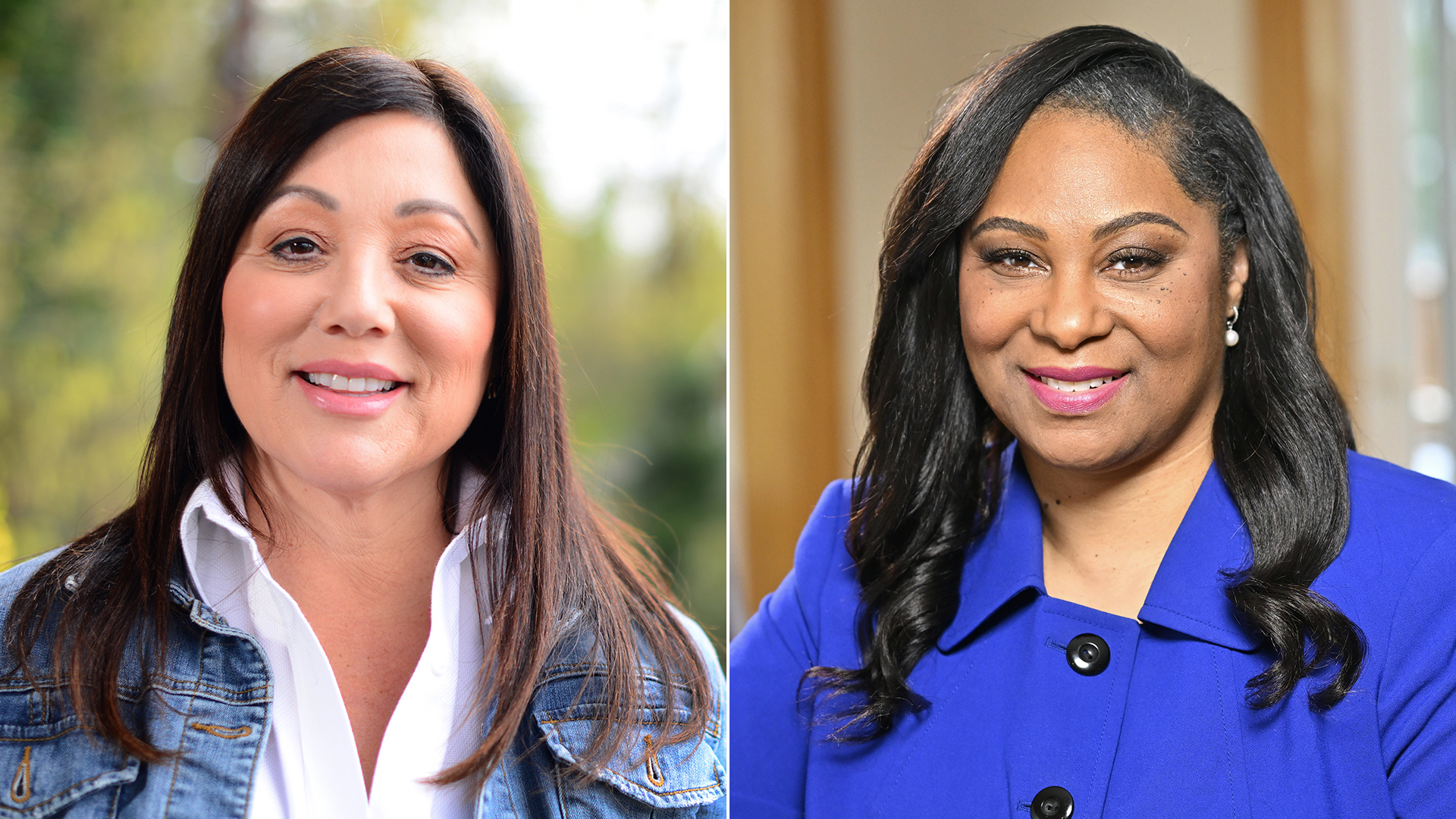
Republican incumbent Lori Chavez-DeRemer and Democratic challenger Janelle Bynum are at each other’s throats in Oregon’s 5th Congressional District race
At recent debates on KOIN TV in Portland and KTVZ in Bend, each candidate asserted that their opponent couldn’t be trusted. Bynum worked hard to tie Chavez-DeRemer to Republican presidential candidate Donald Trump and the conservative Republicans in the House. Chavez-DeRemer, in turn, attacked Bynum for supporting Measure 110, the drug decriminalization measure later amended by House Bill 4002 in the face of public backlash against the measure.
No question, Bynum is a flaming liberal. In September, House Minority Leader Hakeem Jeffries showed up in Portland to bolster her campaign. Par for the course, he accused Chavez-DeRemer of being aligned with extreme MAGA Republicans and Donald Trump., who Democrats portray as an imminent threat to democracy.
In contrast, Chavez-DeRemer works hard to portray herself as a moderate. She was ranked the 29th most bipartisan House member, and the most bipartisan Oregon member of the House, in an analysis released in May 2024 by the Lugar Center and the McCourt School of Public Policy at Georgetown University. But she has endorsed Trump’s return to the White House, has praised the Supreme Court ruling that overturned Roe v. Wade and has voted for a number of bills critics claim support the MAGA agenda.
The high-profile race is being run in a swing district created when the Legislature changed the district’s boundaries in 2021so it included a presumably more Democratic Bend. The race is now one of just a few that could decide who controls the U.S. House of Representatives.
So what to do if you are in the middle?
If Trump wins the White House, a vote for Chavez-DeRemer increases the likelihood that the House will stay in Republican hands. The Democrats now have a majority in the Senate but current thinking is that the Republicans have a high probability of retaking control with a net gain of two seats or by winning the presidential election along with a net gain of one seat.
A particularly endangered Democrat is Senator Jon Tester of Montana, who trails his Republican challenger, Tim Sheehy, a wealthy Republican businessman. Polls suggest he’s toast because of the changing demographics of the state. Republicans are also expected to flip West Virginia — where Joe Manchin is retiring- in the face of competition from Republican Governor Jim Justice .
Of course, Democrats are still hopeful they can hold onto critical Senate seats in states like Ohio and Arizona and there are signs of weakness in Republican Senator Ted Cruz’ s race against Democratic challenger Colin Allred.
But if Trump wins, and the Republicans can hold on to the House and retake the Senate, that clean sweep would give Trump and his MAGA allies an opportunity to govern with impunity. If that’s not what you want, your best choice might be to vote for Bynum , even if you lean conservative, to increase the likelihood the Democrats will at least control the House and be in a position to block the more unpalatable elements of Trump’s MAGA agenda.
In all the turmoil and media attention focused on Portland’s new ranked choice voting election in November, much of the focus has been on the contest for mayor.[1]
Why?
The next mayor is going to be a eunuch. No, I don’t mean a castrated man. I mean the word metaphorically, in the sense an ineffectual or powerless person.
It’s the new 12-person City Council that will have the power to enact laws. The new mayor won’t even sit on the City Council or vote on council items (except to break a tie). The mayor, and the new city administrator, who will be appointed by the mayor with council approval, will be in charge of carrying out City Council actions and crafting the city budget.
The mayor will also be tasked with appointing a city administrator, city attorney, and police chief, but that will also be only with the City Council’s approval. And to top it all off, the mayor won’t have veto power over council decisions.
The mayor will serve more as a $175,463-a-year figurehead than a legislator,Tate White, a member of the city’s government transition team, told OPB earlier this year.“They’re going to be partnering with other jurisdictions, they’ll be standing at press conferences, they’re going to be the people meeting with representatives from sister cities when they come and visit, it will be far more ceremonial,” she said.
But don’t count on the new 12-person City Council, with three representatives per four new geographical districts and only one staff person for each City Council member, to be all that cooperative, efficient or effective. It might be more functional than New York City’s 51-member City Council, but likely not much. After all, a City Council member can be elected with as little as 25% + 1 votes, so their constituencies will be pretty damn small.[2] One consequence could be a Councilor able to remain in office by consistently satisfying just that smaller segment of eligible voters.
Jeff Jacoby, an award-winning columnist for the Boston Globe, calls the ranked choice voting process “democracy on the Rube Goldberg model”, where ideas that supposedly simplify people’s lives wreak havoc instead.
[1] Mayoral candidates include three current members of Portland City Council: Rene Gonzalez, Mingus Mapps and Carmen Rubio. Others running are: Saadiq Ali, early childhood educator Shei’Meka As-Salaam, inventor James Atkinson IV, REAP youth advocate Durrell Kinsey Bey, financial advisor Nancy Congdon, Yao Jun He, advocate for the unhoused and community activist Michael O’Callaghan, artist and performer Liv Osthus, city hall veteran and green energy advocate Marshall Runkel, owner and president of TITAN Freight Systems Keith Wilson and maintenance supervisor Dustin Witherspoon.
[2] Charter reform’s explanation of how “single transferable vote” (STV) will work:
“Councilors of each district are elected using a proportional method of ranked choice voting known as single transferable vote. This method provides for the candidates to be elected on the basis of a threshold. The threshold is determined by the number of seats to be filled plus one, so that the threshold is the lowest number of votes a candidate must receive to win a seat such that no more candidates can win election than there are seats to be filled. In the initial round, the number of first rankings received by each candidate is the candidate’s vote count. Candidates whose vote counts are at least the threshold are declared elected. Votes that counted for elected candidates in excess of the threshold are called surplus. If fewer candidates are elected in the initial round than there are seats to be filled, the surplus percentage of all votes for the candidates who received a surplus are transferred to the next-highest ranked candidates in proportion to the total numbers of next-highest rankings they received on the ballots that counted for the elected candidate. If, after all surpluses have been counted in a round, no additional candidates have a vote count that is at least the threshold, the candidates with the lowest vote counts are successively eliminated in rounds and their votes are counted as votes for the candidates who are ranked next highest on the ballots that had been counted for the eliminated candidates, until another candidate has a vote count that is at least the threshold or until the number of candidates remaining equals the number of seats that have not yet been filled. The process of transferring surpluses of elected candidates and eliminating candidates continues until all positions are elected.”
I’m a member of Tau Kappa Epsilon fraternity, one of the largest men’s collegiate fraternities in North America. If I ran for office, would you assume all 12,000 voting-age collegiate members of my fraternity and all the living TKE alumni would support me?
Ronald Reagan was a member of Tau Kappa Epsilon fraternity, too. When he ran for president, did the news media assume the votes of all his TKE fraternity brothers were a sure thing?
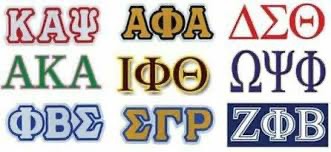
The New York Times seems to think that members of all the Black Greek-letter sororities and fraternities at US colleges are a ready-made bloc of Kamala Harris supporters in her quest for the presidency because she’s been a member of the Black sorority Alpha Kappa Alpha since her undergraduate days at Howard University.
“As Vice President Kamala Harris’s presidential campaign rushes to shore up its base, its efforts will be bolstered by a ready-made coalition: the more than two million members of Black Greek-letter organizations who have quickly united to mobilize Black voters nationwide,” the Times reported today.
“A united Black Greek front has the potential to offer even more significant political advantage, as their voter engagement programs reach millions every four years,” the Times added.
Maya King, the Times reporter who wrote the story, says in her bio, “As a native Southerner, I have been most fascinated by the ways the region has changed politically, culturally and demographically over the last few presidential election cycles — and how those changes are connected.”
But King barely acknowledged those changes in her article. The cheerleading article barely mentioned that there have been signs of deteriorating Black support for the Democratic ticket and growing Black consideration of Donald Trump.
In November 2023, the Times reported that Black voters were more disconnected from the Democratic Party than they have been in decades, frustrated with what many saw as inaction on their political priorities and unhappy with President Biden, a candidate they helped lift to the White House. Polls by the Times and Siena College found that 22 percent of Black voters in six of the most important battleground states said they would support former President Trump in the 2024 election, and 71 percent would back President Biden.
Erosion of Black support for the Democratic Party has also been found by the Pew Research Center. The Center reports that although the majority of Black voters across education levels are Democrats, there has been a decrease in affiliation with the Democratic Party in recent years. While 93% of Black voters with college degrees identified with or leaned toward the Democratic Party in 2012, that number decreased to 79% in 2023.
Biden’s withdrawal from the 2024 presidential contest and Harris’ ascension may well change some Black voters’ preferences, but it’s not likely to be a universal shift. Harris, for example, is a progressive Democrat, but only 28 percent of black Democrats consider themselves liberal, according to the Pew Research Center, while 70 percent identify as moderate or conservative.
On June 25, the Times reported on data captured by a new Harvard study that shows Black voters have slightly shifted toward Trump since 2020. “One possible explanation is that some Black voters’ economic gains have allowed them to focus more on noneconomic issues — such as abortion and L.G.B.T.Q. rights — on which they are more conservative than typical Democrats,” the Times said.
The fact is, Black candidates can’t rely on group solidarity. “It’s certainly true that black voters support black Democratic candidates at higher rates, … but analysis of past elections and campaigns shows that black voters have never prioritized simple descriptive representation over other factors, like party affiliation, campaign viability, candidate electability, preexisting relationships with the black community and a sense of authenticity,” according to the New York City-based Brennan Center for Justice.
For the New York Times to publish a story assuming Black solidarity for a Black presidential candidate who’s a member of a Black sorority is irresponsible journalism.
As James Bennett, who was the editorial page editor at The New York Times from May 2016 until his forced resignation in June 2020 over a controversial op-ed, has said, “The reality is that the Times is becoming the publication through which America’s progressive elite talks to itself about an America that does not really exist.”





 ThinkingOregon