“Last year’s One Big Beautiful Bill Act helped roughly triple the ICE budget, allocating $45 billion for building new immigration centers and hiring 10,000 new ICE agents. One dispiriting lesson of the imperial boomerang is that, once. bought and paid for, structures of intimidation and oppression tend to endure.” David Wallace-Wells, 1/25/2026
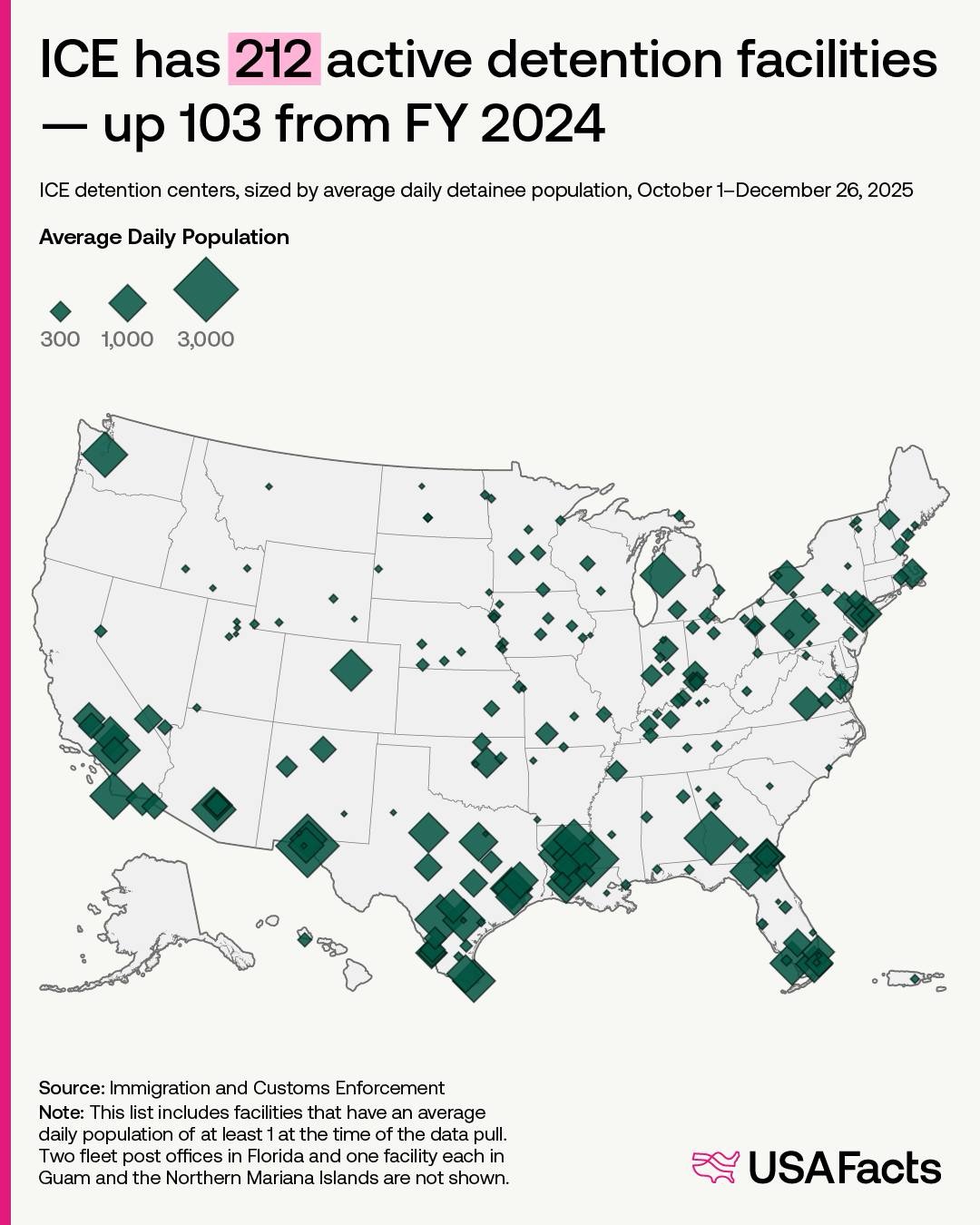
Update, 1/30/2026 – The Washington Post reported that local officials are raising logistical and humanitarian concerns in 23 towns where U.S. Immigration and Customs Enforcement plans to convert industrial buildings into detention centers that combined would hold up to 80,000 people. ICE has offered few details about its plan since The Washington Post first reported on it in December 2025. One detention center the Department of Homeland Security wants to open would be a more than 1 million sq. ft. industrial warehouse in Social Circle, Georgia that would be retrofitted to hold 8,500 detainees and hundreds of staff, more than the city’s total population. The City Manager, Eric Taylor, has said the city does not have the water or sewer infrastructure to support the facility. Unaddressed is the question of why the government needs such huge detention facilities when it says it’s objective is to deport people.
Update, 2/12/2026 – It’s not just more detention centers coming down the pike. Wired reported that ICE and DHS have quietly carried out a months-long expansion, securing more than 150 new leases and office expansions across nearly every state, often in or near major metro areas. Many new facilities sit near schools, medical offices, and places of worship, with DHS pressing the GSA to bypass standard procurement rules and hide lease details under claims of “national security.”
Update, 2/21/2026 – Funding for the Department of Homeland Security expired has expired and Democrats have made 10 demands to rein in Trump’s surge of deportation forces into U.S. cities. One of those demands is “Compliance with Basic Detention Standards and Oversight of Facilities.” Think about it. Incarceration facilities are already legally required to be humane and hygienic., but as Radley Balko has reported on SubStack in The Unpopulist, there is a growing pile of reports from attorneys, journalists, human rights groups, judges, and others about shocking, inhumane conditions at facilities around the country.
Update, 3/7/2026 – So far, DHS has completed the purchase of 10 of the 23 detention center properties it initially pursued, spending more than $890 million, according to deed records or statements by local officials. Efforts to acquire 10 other properties — in Indiana, Minnesota, Mississippi, Missouri, New Hampshire, New York, Oklahoma, Tennessee, Texas and Virginia — have failed, according to statements by local officials or building owners.
In the years preceding his death in 1875, George Templeton Strong, a prominent Wall Street attorney, kept a voluminous journal of his life and times. In April 1865, near the end of the American civil war, he wrote, “These four years have reduced me to something like pauperism, But I am profoundly grateful for them nevertheless. They have given me — & my wife & my boys, — a country worth living in & living for, & to be proud of.”
I can’t say President Trump’s inhumane crackdown on immigrants and harassment and murder of American citizens in the past year have given me a country worth living in, living for and to be proud of.
Not while the Trump administration promotes hatred of “the other”. David Masciotra. David Masciotrar ecently wrote in the Washington Monthly, “Through (Elie) Wiesel’s story and the stories he told and created, two truths become inescapable. The first is that it is naïve, if not catastrophic, to underestimate the power of hatred. “
I doubt 7-year-old Diana Crespo, a second grader at Gresham’s Alder Elementary School, and 5-year-old Liam Ramos, the bunny-hatted child detained by immigration agents in Minneapolis, see America as a country worth living in and living for and to be proud of either. They are both being held at the U.S. Immigration and Customs Enforcement’s South Texas Family Residential Center in Texas.
U.S. Immigration and Customs Enforcement has spread its detention center tentacles across the United States:
Oregon Public Broadcasting (OPB) reported on January 29, 2026 that ICE is planning another detention center in Newport, Oregon as soon as May.
The Atlantic reported that the warehouses expected to be detention centers could become white elephants if there’s a change in ICE policies and the detainee population decreases. “If the goal is to not have endless illegal immigration, those centers will be obsolete in three to five years,” a longtime ICE official told me. “The amount of money going into them is abhorrent.”
The spread of these. detention centers reminds me of another brutal time.
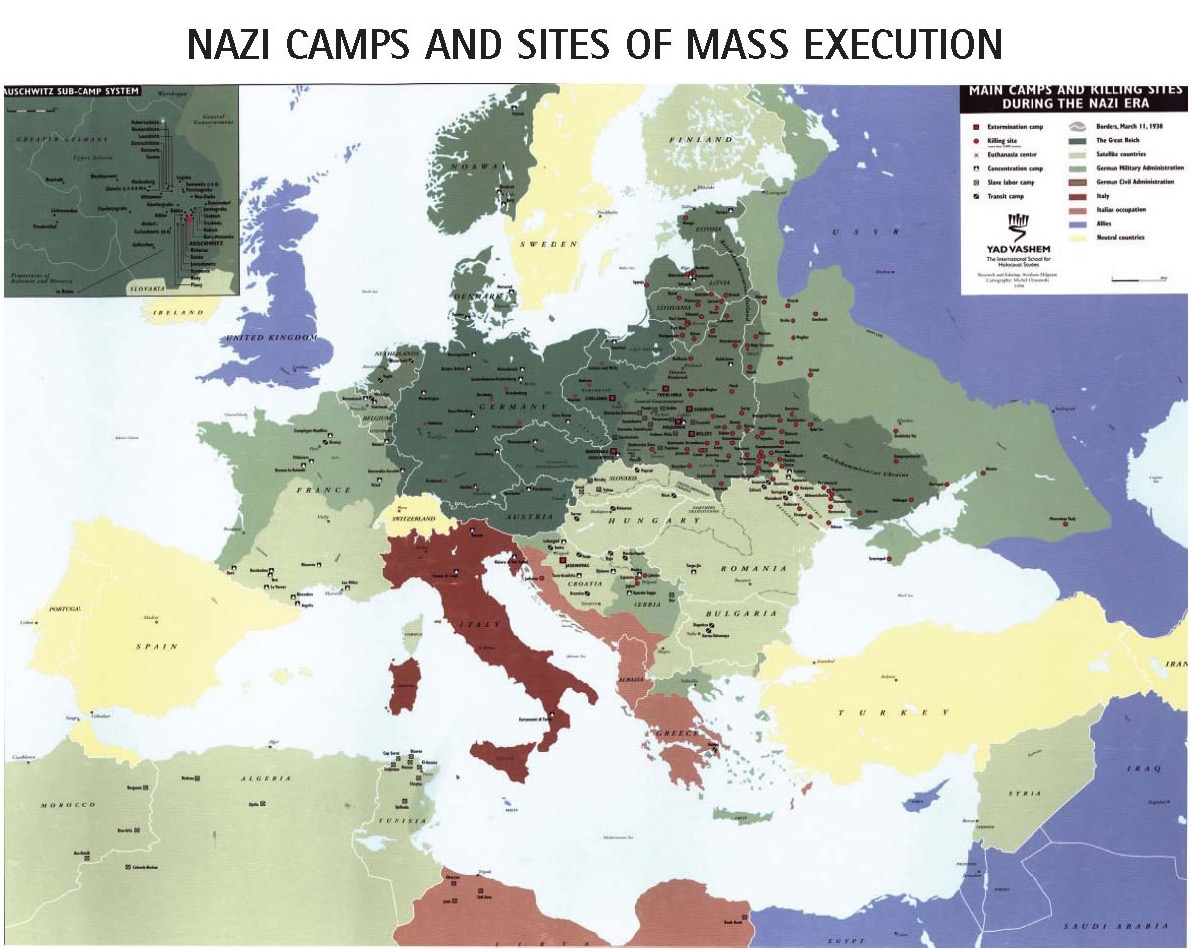
Most of us know the names of a few Nazi concentration camps, like Dachau, Auschwitz and Bergen-Belsen, where Anne Frank died. But they were part of a massive complex of more than 850 ghettos, concentration camps, forced-labor camps and extermination camps CNN has identified. They stretched from France and the Netherlands in the west to Estonia, Lithuania and Poland in the east that the Nazis established during the 12 years Adolf Hitler was in power. Their purpose — to segregate , oppress and persecute their opponents.
Like the ICE detention centers, the Nazi system started small and then metastasized like a cancer, according to the Wiener Holocaust Library.
Initially there were so-called SA camps. (Sturmabteilung (SA), or “Brownshirts,” was the Nazi Party’s original paramilitary wing). After the Night of Long Knives in 1934, the SS and Heinrich Himmler shut down the SA camps and consolidated control of all camps in Germany. Himmler and the SS used Dachau, an original SS camp, as a blueprint for all camps. From 1934 onwards, the SS developed and then operated the camp system, which lasted until Germany’s defeat in 1945.
The SS started building major camps, beginning with Sachsenhausen in 1936, then Buchenwald in 1937, Flossenbürg and Mauthausen in 1938 and Ravensbrück for women in 1939. Political prisoners were the first inmates. Then people with previous criminal convictions. Next were the so-called “asocials”, such as Roma, homosexuals, prostitutes, the homeless and the “work-shy”. The mass imprisonment of Jews began in 1938 after the Anschluss and Kristallnacht.
As the Second World War began in earnest, foreign citizens from newly occupied countries such as Czechoslovakia and the Netherlands began to be imprisoned , followed by Soviet prisoners of war (POW’s) after the invasion of the Soviet Union in June 1941.
Those who believe U.S. Immigration and Customs Enforcement can and will be restrained under the Trump administration might want to stop and reconsider.
With an administration where cruelty is the point, it can happen here.
It was 1943. By all appearances, Rudolph Höss, his wife, Hedwig, and their five children – Klaus, Heidetraud, Brigitte, Hans-Jürgen and Annegret – had an idyllic life in the Polish countryside. They lived in an exquisite villa with a tranquil garden, a greenhouse and a small swimming pool.
The children played in the yard, Rudolph and Hedwig went about their daily lives and Hedwig adorned herself with lipstick and jewelry.
The Höss family’s backyard (Scene from The Zone of Interest)
But something was amiss.
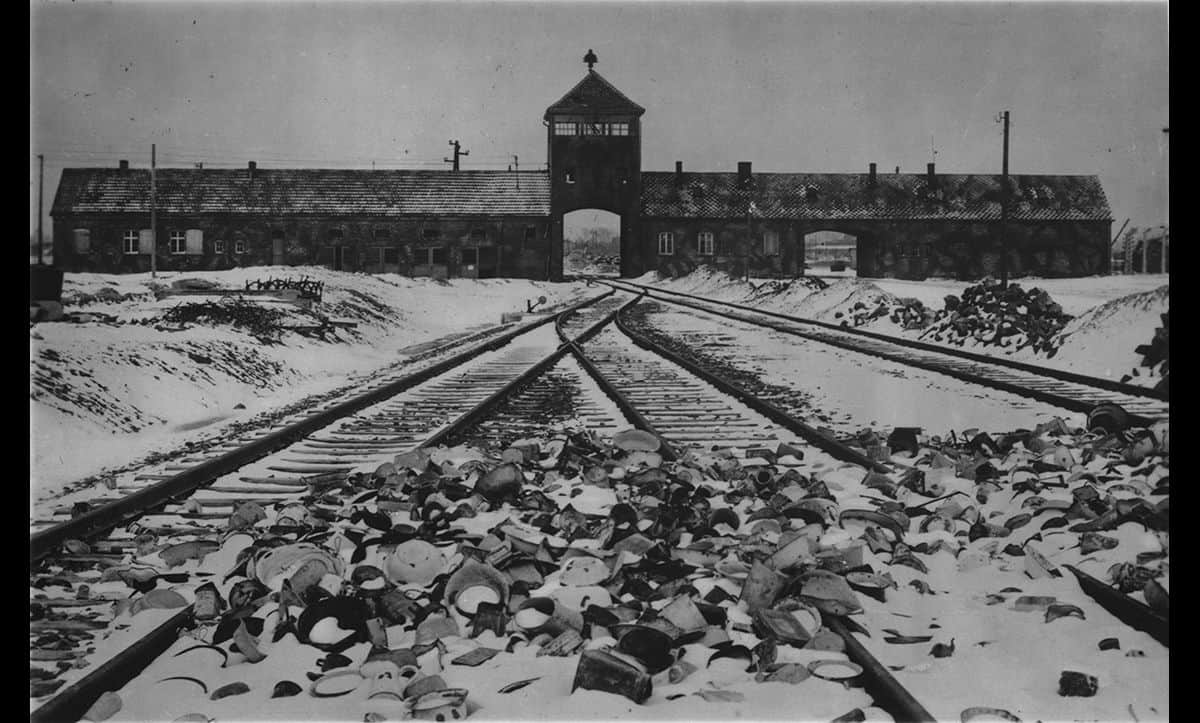
Hedwig’s clothing and jewels were taken from a Jewish woman on her way to the gas chambers. Beyond the concrete wall at the property’s edge, topped with barbed wire, was a sprawling complex of gas chambers and crematoria known as the Auschwitz-Birkenau concentration camp, the largest extermination camp run by the Nazis in Poland during WWII. Rudolph Höss, a German SS officer, was the camp commandant. An estimated 960,000 Jews were killed there.
Women and children deemed “unfit for work” being unknowingly led to gas chamber #3 at Auschwitz, where two thousand people at a time could be murdered. Source: The World Holocaust Remembrance Center
“Human beings did this to other human beings and it’s very convenient for us to try and distance ourselves from them because we think we can never behave this way, but I think we should be less certain than that,” said Jonathan Glazer, the director of a 2024 movie, “The Zone of Interest” that depicted the mundane daily activities of the family at their home during the war.
In the movie, when her husband is transferred to a new post in Germany, Hedwig is enraged. She demands that the family stay at Auschwitz, claiming, “This is the life we’ve always dreamed of.”
It all brings to mind Hannah Arendt’s talk about “the banality of evil”, which she cited when writing about one of Höss’ compatriots, Adolf Eichmann, in her 1963 book Eichmann in Jerusalem: A Report on the Banality of Evil.
“Never again,” proclaimed the weary idealists, the peace-seekers, the hopeful.
So much for that.
Moises Sotelo, 54, of Newberg, OR was on his way to work at about 5:30 a.m. on June 12 when U.S. Immigration and Customs Enforcement (ICE) officers swooped in and took him into custody. According to an ICE detention database, Sotelo was transferred to ICE’s Northwest Detention Center in Tacoma, Washington.
Moises Sotelo
“ICE Seattle arrested Moises Sotelo-Casas, 54, who is a citizen of Mexico, as a part of routine federal law enforcement activity that identifies, detains and removes criminal aliens to their country of origin,” ICE Public Affairs Officer David Yost said in a statement. “Sotelo has a criminal conviction for DUI in Newberg, OR, and he will remain in custody pending removal.”
Sotelo’s family sought community support through a GoFundMe account with a $175,000 goal to “Help the Sotelo Family with Expenses After ICE Detainment”. The account had raised $142,751 from 2,100 donations as of June 30.
There was a time when Moises Sotel0’s plight would have generated little public concern and certainly fewer helping hands. .
In 2022, the public perception of an invasion of migrants across the southern border of the United States bore some relation to reality.
U.S. immigration authorities carried out 2.38 million migrant encounters (a term encompassing apprehensions and expulsions) at the southwest border during Joseph Biden’s presidency in FY 2022, according to the Migration Policy Institute. For the first time, not only were there more Venezuelans, Cubans, and Nicaraguans encountered than migrants from El Salvador, Guatemala, and Honduras, but there were significant attempted crossings by Brazilians, Ecuadorians, Haitians, Ukrainians, Indians and Turks. Monthly encounters peaked at over 370,000 people in December 2023, nearly 12,000 a day. This isn’t count migrants who crossed the border and escaped detection. (For a better understanding of the brutal migration process, see Footnote 2)
The crescendo of arrivals overwhelmed processing capacities, federal infrastructure, and border communities. As the chaos at the border increased, the public became more hostile to the migrants. Donald Trump exploited that hostility in winning re-election to the presidency in November 2024.
His administration has since initiated vigorous, combative mass deportation efforts that resemble military-style attacks at homes, businesses and public spaces. Masked and heavily armed ICE agents wearing tactical gear and carrying high-powered rifles have been descending on areas in unmarked black SUVs and armored vehicles. Immigrants showing up at U.S. Immigration and Customs Enforcement offices for routine check-ins are being arrested. “What should be routine appointments are becoming detention traps,” Katrina Kilgren, an immigration attorney and pro tem instructor at the Knight Law Center in Eugene, OR told the Register-Guard newspaper.
Increasingly, ICE has been targeting work sites, such as farms, meat production plants and restaurants, and migrant worker gathering places, such as Home Depot, in immigration sweeps.
In April, Acting ICE Director Todd Lyons told attendees of the 2025 Border Security Expo in Arizona he wanted the agency to become as efficient at deporting immigrants as e-commerce giant Amazon is at delivering packages. “We need to get better at treating this like a business,” Lyons said, describing his ideal deportation process as “like [Amazon] Prime, but with human beings.”
In one deportation case reported by the Portland Mercury, Jorge (a pseudonym being used to protect his identity) received a text message on his cell phone in Spanish from ICE in early June.Jorge had immigrated to the US from Nicaragua in late 2021 as an asylum seeker. He has an active asylum case, a work permit, a job, and a young family. The message told him to report to the nearest ICE facility within 12 hours to check in and sign paperwork, or face deportation. After consulting a lawyer, he followed the instructions, only to be detained by ICE agents and sent to a federal detention center in Tacoma, Washington.
ICE was holding about 56,397 people in detention facilities across the country as of June 15, 2025 likely setting a record high, according to TRAC Immigration. Despite the government’s stated goal of pursuing criminals, 40,433 out of 56,397—or 71.7%—held in ICE detention had no criminal record, TRAC Immigration claims. Adams County Detention Center in Natchez, Mississippi held the largest number of ICE detainees so far in FY 2025, averaging 2,166 per day as of June 2025.
The vast majority of ICE detention centers are privately operated and for profit, with companies such as GEO Group and CoreCivic dominant in the space. Tom Homan, Trump’s border adviser, has called for boosting ICE’s detention capacity to at least 100,000 people. In furtherance of that goal, the U.S. Department of Homeland Security posted a request in April asking contractors to submit bids for new detention facilities, transportation, security personnel, medical services and administrative support.
Florida is now turning a remote abandoned mosquito-infested 39-square-mile airport next to Everglades National Park in Florida into the newest migrant prison featuring mostly tents and trailers in sweltering heat and nicknamed “Alligator Alcatraz”. Florida Governor Ron DeSantis has said the facility will be temporary and have “zero environmental impacts.”
“It’s like a theatricalization of cruelty,” Maria Asuncion Bilbao, Florida campaign coordinator at the immigration advocacy group American Friends Service Committee, told The Associated Press.
President Trump visited the Everglades detention center on July 1, 2025.
The Trump administration has also sent immigrants to detention facilities outside the United States, including to Cuba’s Guantánamo Bay in Cuba and Centro de Confinamiento del Terrorismo ( CECOT) in El Salvador, where brutal conditions predominate.
The Trump administration is also trying to deport a group of migrants convicted of violent crimes from countries including Cuba, Mexico and Vietnam to South Sudan, a country embroiled in fighting between various political and ethnic groups. In a Travel Advisory, the U.S. Department of State advises: “Violent crime, such as carjackings, shootings, ambushes, assaults, robberies, and kidnappings are common throughout South Sudan, including Juba. Foreign nationals have been the victims of rape, sexual assault, armed robberies, and other violent crimes.”
In June, the U.S. Supreme Court granted the Trump administration’s request to allow it to deport migrants to places other than their country of origin, often to countries plagued by violence. The Trump administration wanted the power to do so as part of its effort to discourage illegal migration by threatening to deport migrants a third country with no recourse.
Legal analyst Steve Vladeck told CNN, “…today’s ruling allows the government to remove those individuals and others to any country that will take them—without providing any additional process beyond an initial removal hearing, and without regard to the treatment they may face in those countries.”
To add insult to injury, Semafor reported on July 1 that the Trump administration is thinking about trying to void naturalized immigrants citizenship— potentially starting with New York City mayoral primary winner Zohran Mamdani. Asked about Tennessee Rep. Andy Ogles’ proposal to strip Mamdani, who was born in Uganda but became a citizen in 2018, of his legal status, White House press secretary Karoline Leavitt said it’s “something to be investigated.” Semafor reported that GOP leaders are increasingly comfortable with revoking foreign nationals’ visas over their political beliefs or actions, and that may soon extend to citizens.
An American naturalization ceremony
NPR reported on June 30 that the Justice Department is aggressively prioritizing efforts to strip some Americans of their U.S. citizenship, a practice heavily used during there McCarthy era of the late 1940s and early 1950s. “Department leadership is directing its attorneys to prioritize denaturalization in cases involving naturalized citizens who commit certain crimes — and giving U.S. attorneys wider discretion on when to pursue this tactic, according to a June 11 memo published online,” NPR said. Approximately 25 million immigrants are naturalized citizens.
Hans von Spakovsky, with the conservative Heritage Foundation, told NPR he supports the DOJ’s denaturalization efforts. “I do not understand how anyone could possibly be opposed to the Justice Department taking such action to protect the nation from obvious predators, criminals, and terrorists,” he said.
But Trump’s draconian efforts to halt border crossings and deport already settled migrants are now driving a new sympathy for migrants and resistance to ICE’s aggressive deportation efforts.
Even popular podcaster Joe Rogan is raising doubts about Trump’s deportation chaos. “Bro, these ICE raids are fucking nuts, man,” Rogan said in June. ” I don’t think if they, the Trump administration, if they’re running and they said, we’re gonna go to Home Depot and we’re gonna arrest all the people at Home Depot, we’re gonna go to construction sites, and we’re gonna just, like, tackle people at construction sites. I don’t think anybody would have signed up for that. They said, we’re gonna get rid of the criminals and the gang members first, right? And now we’re, we’re seeing, like, Home Depots get raided. Like, that’s crazy.”
Local government officials are raising concerns, too. A group of elected officials in one of Oregon’s most racially diverse counties pushed back Monday against the Trump administration’s immigration crackdown. (See footnote 3)
“ICE has no place in our neighborhoods,” Cornelius City Councilor Angeles Godinez told OPB in June. “When fear enters our community, trust leaves,” she said. “Without trust, our schools, our cities and even our local economies suffer.”
“To the immigrant community across Oregon, I am one of you, I see you. I know what you’re going through and I stand with you in unwavering solidarity,” said Tigard City Councilor Yi-Kang Hu.
And then there’s the massive cost of Trump’s immigration program, a veritable cornucopia of cash.[1] “If the bill passes, it could make ICE the nation’s largest jailer, Wirth more funding for detention than the entire federal Bureau of Prisons,” according to immigration expert Aaron Reichlin-Melnick.
With the federal deficit already high, and projected to increase to destructive levels under the Republicans’ “big, beautiful bill”, America is going to pay a heavy price for Trump’s deportation fiasco. With the immigration blowout, the Senate-passed a reconciliation bill that would add over $4 trillion to the national debt through Fiscal Year (FY) 2034, $1 trillion more than the House-passed One Big Beautiful Bill Act (OBBBA).
Protests against immigration arrests are multiplying as people rail against government overreach and a majority of Americans now say actions by the U.S. Immigration and Customs Enforcement have “gone too far,” according to a new PBS News/NPR/Marist poll..
But it’s not enough.
As The Leadership Conference on Civil and Human Rights said earlier this year, the Trump administration’s widespread and persistent cruelty, indiscriminate immigration enforcement tactics, wrongful questioning and detention of American citizens, unjust profiling, and abuse of common decency “signals a troubling shift toward a more punitive and dehumanizing approach to immigration enforcement.”
” History has shown us time and time again,” the Leadership Conference said, ” that when communities come together, our collective resistance has the power to rewrite the narrative and create change. While it may feel like we are in the midst of a dark chapter, together, we can write the next one — a chapter where compassion and justice prevail over cruelty and inhumanity. In the end, that’s what defines us — not just as a nation, but as human beings.”
We cannot be the Höss family. We cannot be innocent bystanders. Evil must not triumph. We must resist.
Immigration detention capacity: Expand capacity to detain immigrants taken into custody
$45 bil.
Border wall: Fund border barrier system construction and related activities
$45 bil.
U.S. Immigration and Customs Enforcement: Funding for hiring, training, transportation, facilities and legal resources to carry out immigration enforcement and removals
$31 bil.
State and local grants: Funding for border security, immigration enforcement and major event security. The Senate parliamentarian determined that this provision does not comply with the chamber’s rules, and it may be removed or modified.
$13 bil.
Homeland Security Department funding: For border security and immigration enforcement
$12 bil.
U.S. Customs and Border Protection: Funding to expand workforce and purchase new vehicles and technology
$12 bil.
Border surveillance technology
$6.2 bil.
Department of Justice grants: For state and local immigration and law enforcement
$3.5 bil.
Department of Justice funding: For immigration and other law enforcement
$3.3 bil.
Fund vetting for sponsors of unaccompanied alien children: Through the Office of Refugee Resettlement
$0.3 bil.
2. For a better understanding of what is driving migrants to the United States and who is guiding them through Mexico to the US border, read Soldiers and Kings: Survival and Hope in the World of Human Smuggling by Jason De León. In 2015, he began a long-term ethnographic project focused on understanding the daily lives of Honduran smugglers who profit from transporting migrants across the length of Mexico. This 2024 National Book Award-winning story examines the complicated relationship among transnational gangs, the human smuggling industry, and migrant desires for safety and well-being.
3 .An immigration scholar, Austin Kocher, has written a Journalist Resource guide analyzing U.S. Immigration and Customs Enforcement arrest data, based on datasets published by the Data Deportation Project. His observations are revealing as to the Trump administration’s motives:
“The Trump administration is now demanding that ICE make 3,000 arrests per day. That is to say, ICE did not come close to meeting the quota set in January until June—and even then; only for a few days at a time. To be clear: this is a lot of arrests. I’m not downplaying that. But it’s also clear that the Trump administration’s daily arrest quotas are detached from the reality of what ICE can do—and even more so now that the new quota is 3,000 per day.
This prompts a further question: if these quotas are demonstrably unattainable, why have them? In my view, the answer is simple: the unattainability of the quotas is the point.
An essential component of Donald Trump’s longstanding approach to politics is to invent crises, or exploit existing crises, in ways that ensure they are unsolvable. No amount of funding for immigration enforcement will ever be enough to achieve his mass deportation goals. No amount of power concentrated in the office of the President will ever be sufficient to exercise totalizing control over immigration. The goal is not to solve a real problem, but to manufacture an ever-expanding crisis that justifies ever-expanding unregulated power.”
“Go back to Poland,” protesters screamed at a group of Jewish students on Saturday night, April 20, inside the gates of Columbia University in New York City.
The cruelty and historical ignorance of Columbia’s privileged keffiyeh-masked student protesters in this time of turmoil in America is almost too much to bear.
When Poland was taken over by Germany and the Soviet Union in September 1939, 3.3 million Jews lived in Poland – more than any other country in Europe. At the end of the war, only 380,000 Polish Jews were still alive.
Entry to the concentration camp Auschwitz-Birkenau, Poland
Most Americans think of the Holocaust as the murder of Jews in concentration camps in Germany, but on the eve of the WWII, the Jewish population of Germany and Austria combined was just 300,000.
In other words, the horror of the Nazi’s Jewish extermination campaign, the Final Solution, was not confined to Germany; nor was it confined to Germans.
Daniel Schatz, a visiting scholar at Georgetown University, wrote in Foreign policy of a massacre in the Polish Village of Jedwabne. “On a sweltering summer day, July 10, 1941, hundreds of Jews were murdered by their Polish neighbors in the village of Jedwabne, almost 100 miles northeast of Warsaw. Babies were killed. Men were tortured. Women were raped. .Villagers whose lives had not been extinguished with axes, clubs, and knives were rounded up and taken first to the market square and then to the outskirts of town, where they were herded into a barn. The wooden structure was doused with kerosene and set alight. Women, children, and men were burned alive as the jeering crowd watched.”
In the small Polish town of Ostrow Mazowiecka, the population of 20,500 included 7,600 Jews before the war, according to The Holocaust: An Unfinished History. At one point, Jewish inhabitants, including women, the elderly and children, were taken to pits outside town and shot by the Nazis. By the spring of 1940, every single Jew in the town was dead.
In 1942, systematic mass killing in stationary gas chambers using carbon monoxide gas generated by diesel engines began at Belzec, Sobibor and Treblinka camps in Poland. “Use of gas vans began after Einsatzgruppe members complained of battle fatigue and mental anguish caused by shooting large numbers of women and children,” the United States Holocaust Museum says.
The bodies were taken to pits where they were burned. At the height of the deportations in 1943–44, an average of 6,000 Jews were gassed each day at the Auschwitz camps near Oswiecim, Poland.
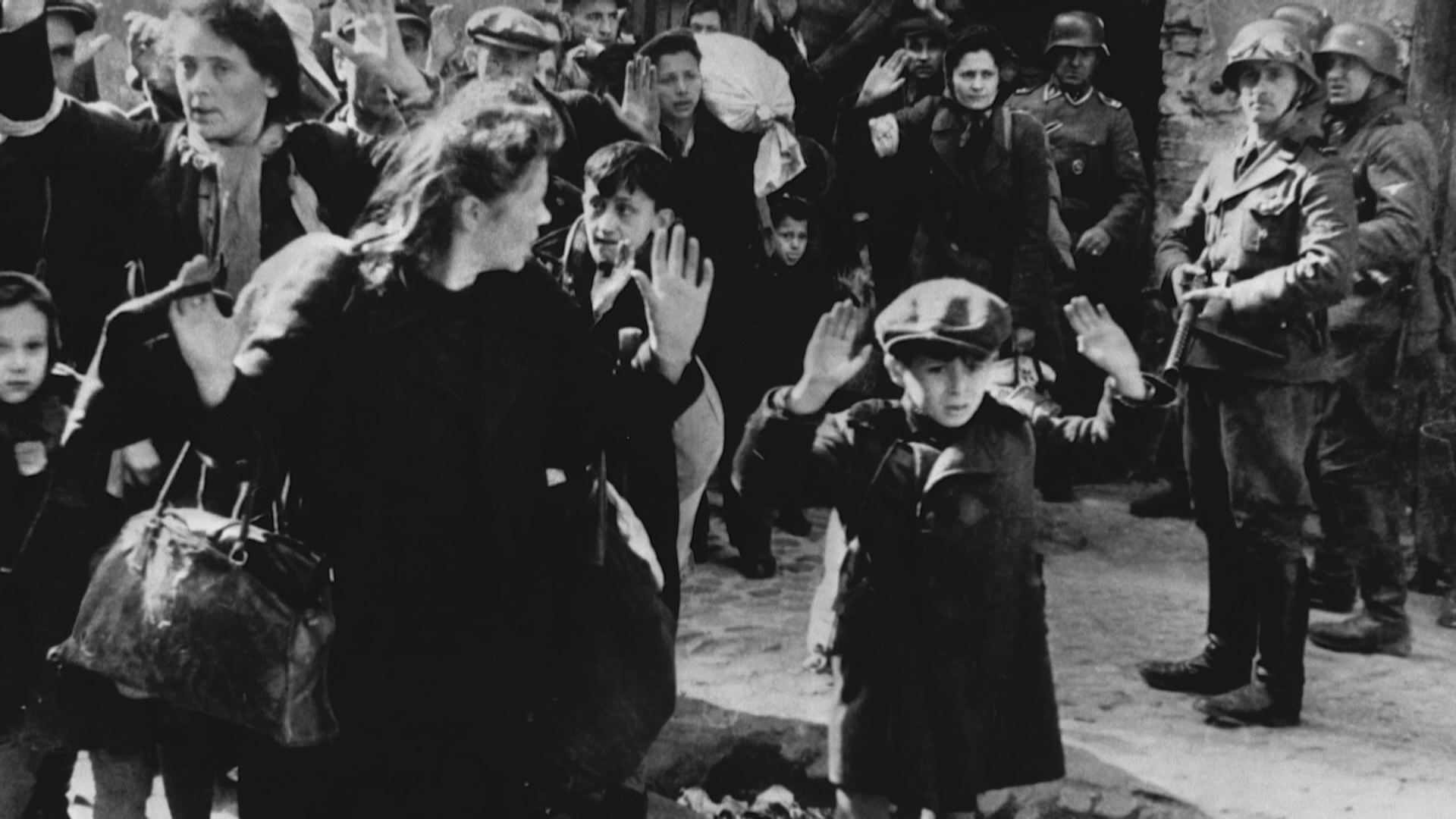
As Yad Vashem, the World Holocaust Remembrance Center, has documented, most of the Jews in Polish areas occupied by Germany were imprisoned in Polish ghettos and then deported to concentration and slave labor camps.
How can Columbia’s protesters, attending one of America’s most selective and expensive universities, be so callous and vile as to call for their Jewish classmates to be subjected to the terror of the Holocaust in Poland? What has allowed the hallowed halls of this Ivy League school, and others across the country embroiled in similar student uprisings, to descend into such moral aimlessness?
If there was ever a time for Oregon schools to teach about the holocaust, the time is now.
In a December 2023 YouGov/Economist poll, 20% of young American respondents aged 18-29 said the Holocaust is a myth. Another 30% said they don’t know if it’s a myth. And the proportion of respondents who said they believe the Holocaust is a myth was similar across all levels of education.
And now, denial of the well-documented Oct. 7 Hamas terrorist attack on Israel that left about 1,200 people dead is spreading, despite truly massive real-time documentation of the attacks.
On social media, an expanding group of denialists link Israel itself to the attack, claiming it was a “false flag” event spurred by Israel to cast blame on Hamas. And as the Washington Post has reported, the denialism is “bleeding into the real world.”
“Demonstrators have shouted the claim at anti-Israel protests and have used it to justify removing posters of hostages in cities like London and Chicago,” the Washington Post reported. “At a November city council meeting in Oakland, Calif., multiple residents disputed the veracity of the attack.”
According to the Post, “researchers are warning that Oct. 7 conspiracy theories may follow a similar trajectory to Holocaust denial, which was waning before social media platforms propelled a resurgence a decade ago.”
Fortunately, Oregon is ahead on educating its public school students on the Holocaust.
Claire Sarnowski, when she was a freshman at Lake Oswego’s Lakeridge High School, came up with the idea of mandating Holocaust instruction at Oregon’s public schools after hearing a Holocaust survivor, Alter Wiener, tell his story. Sarnowski approached state Sen. Rob Wagner, who agreed to introduce a bill, SB 664.
The bill passed unanimously in the Oregon House and Governor Brown signed it on June 4, 2019.
The bill required school districts across Oregon to provide instruction about the Holocaust and genocide in social studies classes, starting in the 2020-21 school year, to “enable students to evaluate the morality of the Holocaust, genocide and similar acts of mass violence and to reflect on the causes of related historical events.”
.As so often happens with legislation, the true believers expanded on Sarnowski’s vision and declared that the instruction must also address: the immorality of mass violence; respect for cultural diversity; the obligation to combat wrongdoing through resistance, including protest, and; the value of restorative justice. Like anti-terrorism laws, it was a classic example of mission creep.
But it was at least a start. And now it’s needed more than ever.
The question, of course, is whether schools are aggressively following the law’s mandates and whether students are absorbing the lessons. The State has also mandated drug prevention education in Oregon’s public schools, for example, but an investigative series from the Lund Report, the University of Oregon’s Journalism Project and Oregon Public Broadcasting (OPB) has revealed that what students are being taught varies widely and that many school districts don’t use programs backed by evidence that they are effective at delaying or preventing substance abuse.
And then there’s the question of whether students are acting on what they are learning about the Holocaust.
Rep. Ritchie Torres (D-NY) said recently in a Dr. Martin Luther King Jr. Sermon at Central Synagogue NYC that when he was asked why he spoke out so frequently and forcefully about anti-Semitism, his answer was, “The question is not why have I chosen to be outspoken. The question is why have others chosen to be silent amidst the deadliest days for Jews since the Holocaust?”
Even with Oregon’s public school students already suffering from abysmal scores on national reading and mathematics tests and one in five students failing to graduate from high school in four years, state politicians can’t seem to stop inserting themselves into school curriculum decisions.
State Senators James I. Manning Jr. and Deb Patterson want to add another labor-intensive, complicated and questionable instructional mandate on students and teachers.
SB 284, submitted by the two senators at the request of Oregon Educators for Climate Education, “a statewide group of educators working toward Oregon legislation that would integrate and infuse PK-12 climate change education across all core subject areas”, would:
Require each school district board to develop a written plan establishing a climate change instructional program for kindergarten through grade 12 no later than June 1, 2026.
Require school districts to submit their plan to the Oregon Department of Education (ODE) for initial approval and then again every seven years.
Require ODE to develop and adopt a model plan in consultation with other state agencies and stakeholders, to develop academic content standards, and to approve and make available list of resources and materials that meet academic content standards.
Require the Superintendent of Public Instruction to withhold distributions from Student Investment Account from school districts that fail to develop and implement climate change instructional program.
Require that career and technical education funding from High School Graduation and College and Career Readiness Fund be spent on programs that support climate-focused sustainability career pathways.
Meanwhile, state Rep. David Gomberg, D-Lincoln City, introduced House Bill 2905 that would add to existing requirements for Oregon’s schools to teach about BIPOC, LGBTQ, immigrant communities and others by requiring that schools “Ensure that the academic content standards for history, geography, economics and civics include sufficient instruction on the histories, contributions and perspectives of individuals who…are of Jewish descent.” The bill has already cleared the House awaits Senate action.
SB 284’s climate change mandate would come on top of a K–12 Native American curriculum for all Oregon public schools created after passage of SB 13, a Tribal History/Shared History initiative, in 2017. The initiative has developed more than 45 lesson plans for grades four, eight, and ten across multiple content areas. The Oregon Department of Education’s Office of Indian Education (ODE/OIE) launched the first phase of implementation in these grade levels During the 2020/21 academic year.
It’s all fine and good to want Oregon’s K-12 public school students to be up to speed on topics of the day, but adding more costly and time-consuming mandates when even the basic curriculum isn’t being effectively delivered is a recipe for failure.
And the legislature doesn’t have a particularly good track record with earlier curriculum changes it has imposed.
Legislation requiring that all Oregon school districts teach about the Holocaust beginning with the 2020-2021 school year is a case in point.
Claire Sarnowski, a freshman at Lake Oswego’s Lakeridge High School, came up with the idea of mandating Holocaust instruction after hearing Holocaust survivor Alter Wiener tell his story. Sarnowski approached state Sen. Rob Wagner, who agreed to introduce a bill.
It all sounded so simple and straightforward at the outset, but the final legislation was a classic example of mission creep.
The legislation went far beyond mandating that students be taught about the Holocaust. Employing the coercive power of government, teachers are now required to address a slew of social justice topics: the immorality of mass violence; respect for cultural diversity; the obligation to combat wrongdoing through resistance, including protest; and the value of restorative justice.
You can be sure that any mandated climate change curriculum would morph into similar broad terrain and impose even more demands on Oregon’s already overburdened teachers and students.
Oregon’s already underfunded and overwhelmed K-12 teachers are getting ready to deal with the addition of more labor-intensive, complicated and questionable instructional mandates imposed on them by politicians.
It began with the passage of legislation in the last session requiring all Oregon school districts to teach about the Holocaust and genocide beginning with the 2020-2021 school year.
Claire Sarnowski, a freshman at Lake Oswego’s Lakeridge High School, came up with the idea of mandating Holocaust instruction after hearing Holocaust survivor Alter Wiener tell his story. Sarnowski approached state Sen. Rob Wagner, who agreed to introduce a bill.
It all sounded so simple and straightforward at the outset, but the final legislation was a classic example of mission creep.
The legislation went far beyond mandating that students be taught about the Holocaust and genocide. Employing the coercive power of government, teachers are going to be required to address a slew of social justice topics: the immorality of mass violence; respect for cultural diversity; the obligation to combat wrongdoing through resistance, including protest; and the value of restorative justice.
Do we really need teachers encouraging a hodgepodge of demands from children, resistance to authority and protest by K-12 students rather than learning and dialog, particularly when adults are using students as part of a cynical political strategy?
Tom Nichols, author of The Death of Expertise, wrote in The Atlantic that too often faculty and administrators are engaged in “a shameless dereliction of duty” when they embrace student activism.
“Student activism can be an important part of education, but it is in the nature of students, especially among the young, to take moral differences to their natural extreme, because it is often their first excursion into the territory of an examined and conscious belief system, ” Nichols wrote. “Faculty (and administrators), both as interlocutors and mentors, should pull students back from the precipice of moral purity and work with them to acquire the skills and values that not only imbue tolerance, but provide for the rational discussion of opposing, and even hateful, views.”
Oregon teachers probably aren’t too enthused about another little – known new classroom instruction mandate either.
Starting this year, Oregon schools are required to teach tribal history and the Native American experience in class.
Senate Bill (SB) 13, enacted in the 2017 legislative session, called upon the Oregon Department of Education (ODE) to develop a statewide curriculum relating to the Native American experience in Oregon, including tribal history, tribal sovereignty, culture, treaty rights, government, socioeconomic experiences, and current events.
“When Governor Brown proposed SB 13 during the 2017 legislative session and subsequently signed it into law, it was because she deeply values the preservation of tribal cultural integrity and believes that honoring the history of Oregon’s tribal communities is critically important to our state as a whole, and to future generations of students,” said Colt Gill, Deputy Superintendent of Public Instruction.
The legislation stated that the required curriculum must be:
(a) For students in kindergarten through grade 12; (b) Related to the Native American experience in Oregon, including tribal history, sovereignty issues, culture, treaty rights, government, socioeconomic experiences and current events; and (c) Historically accurate, culturally relevant, community-based, contemporary and developmentally appropriate.”
Sounds admirable, but like the Holocaust legislation, it’s a classic example of mission creep.
First, the curriculum won’t be a limited add-on to current lesson plans. Instead, it will roll out as an extensive, complex set of 45 lessons in five subject areas, including English, social studies, math and science, for fourth, eighth and 10th grade classrooms.
It’s also a new responsibility for the Oregon Department of Education, which has never before been responsible for creating curriculum, and one more subject matter mandate imposed on already overloaded Oregon teachers.
Furthermore, it has the potential to become a tool for indoctrinating students in progressive social justice trends du jour.
According to OPB, The South Umpqua School District, which serves 1,500 students from Myrtle Creek, Tri-City and Canyonville, is already planning multiple days of teacher training sessions that will “expand beyond the tribal history and culture lessons to delve into racially sensitive topics, such as cultural appropriation, implicit bias and microaggressions.”
The basic idea of cultural appropriation is that a particular group, nationality or ethnicity who developed a practice should be the only ones allowed to practice it. Others insult the originating group if they practice it as well.
Too many Oregon adults have already disrupted lives by screaming cultural appropriation. This is not what we should want Oregon children to embrace.
Two white women were forced to close down their Portland pop-up burrito shop, Kook’s Burritos, in 2017 after being accused of cultural; appropriation.
“…the worst aspect of cultural appropriation is that it is inconsistent with the cultural development and enrichment that a free society promotes,” wrote Mike Rappaport in Law & Liberty. “In a free society, people from different cultures bring their practices to the wider society and they are followed by others in that society, making possible a richer and improved culture.”
Author Cathy Young made a similar point in the Washington Post, arguing that cultural appropriation protests ignore history, chill artistic expression and hurt diversity. “Appropriation is not a crime,” she wrote. “It’s a way to breathe new life into culture. Peoples have borrowed, adopted, taken, infiltrated and reinvented from time immemorial.”
Filling the heads of Oregon children with the frightening specter that they are burdened with implicit bias would be unwise, too.
Implicit, or unconscious, bias is the idea that the assumptions, stereotypes, and unintentional actions we make towards others are based on identity labels like race, religion, age, gender, sexual orientation, or ability. Because our implicit associations are stored in our subconscious, we may act on our biases without even realizing it.
The problem is that the implicit bias concept is of questionable validity, based on unproven suppositions and oversold as a solution to diversity issues. But buying into the concept of implicit bias is easy because it feels open-minded and progressive.
However, “almost everything about implicit bias is controversial in scientific circles,” Lee Jussim, a professor of social psychology at Rutgers University, wrote in Psychology Today. “It is not clear what most implicit methods actually measure; their ability to predict discrimination is modest at best, their reliability is low; early claims about their power and immutability have proven unjustified.”
Research suggests that implicit bias training can raise awareness, but there’s not much evidence it actually changes behavior. As John Amaechi, a psychologist and organizational consultant, puts it, the implicit bias concept has become “a ‘get-out-of-jail-free’ card for too many.” Implicit bias training, he says, is too often a “simply a way that organizations can achieve a level of plausible deniability” that they are addressing diversity issues.
And then there are microaggressions, well-intentioned comments or minor slights a speaker may not perceive as negative.
Several years ago, University of California President Janet Napolitano went so far as to tell faculty that saying “America is the land of opportunity” or “Everyone can succeed in this society, if they work hard enough” or even “America is a melting pot” were microaggressions. That’s because they delivered an inaccurate message that the playing field is even or that people of color are lazy and/or incompetent and need to work harder.
Teaching Oregon children about the horrors of microaggressions will turn them into perpetual victims hypersensitive to casual remarks. In other words, into carbon copies of a lot of today’s misguided college students.
What might be better would be to require that students spend 9/11 every year watching the videos recorded on that terrible day in New York City. Hours of it, the scenes on the street, the footage inside the buildings, and the aftermath. Then, a discussion about the heroism of the average American and the fact we have enemies who want to destroy us.
President Trump threw out the lure last Saturday and the media leaped at it like steelhead going after spinners. For almost a week now, the the media has been salivating over the Cummings/Baltimore story, playing right into Trump’s hands.
I’m sure that Trump, a manipulative narcissist if there ever was one, has been absolutely loving it.
“Rep, Elijah Cummings (D-MD) has been a brutal bully, shouting and screaming at the great men & women of Border Patrol about conditions at the Southern Border, when actually his Baltimore district is FAR WORSE and more dangerous. His district is considered the Worst in the USA…..,,” Trump Tweeted to start it all..
“….As proven last week during a Congressional tour, the Border is clean, efficient & well run, just very crowded,” Trump continued. “Cumming District is a disgusting, rat and rodent infested mess. If he spent more time in Baltimore, maybe he could help clean up this very dangerous & filthy place.”
According to Politico’s Daniel Lippman, despite Trump’s public anti-media screeds, he religiously reads four daily newspapers — The New York Times, The Washington Post, The Wall Street Journal and the New York Post, as well was a daily print-out of the Drudge Report, all of which have covered the Cummings/Baltimore contretemps like a thick blanket.
“BALTIMORE, MD—President Trump launched into a deranged attack against the city of Baltimore, calling it “a disgusting, rat and rodent infested mess” and a place “no human being would want to live.” This caused extreme confusion within the city — as, having been run exclusively by Democrats for decades and decades, it is a nearly perfect, progressive utopia and a beacon of hope to all.”
But most news outlets have pursued the Cummings/Baltimore stories with the kind of moral outrage and hand-wringing usually reserved for stories of great import.
The New York Times, for example, has been all over the story, with headlines like, “The Rot You Smell is a Racist Potus,” “Trump Accuses Black Congressman and Allies of Being Racist,” and “Some very Specific Things the President Could do to Help Baltimore.”
The Times went so far as to run a story featuring Trevor Noah of The Daily Show defending Baltimore and Fox News asked Dallas Cowboys wide receiver Tavon Austin, who grew up in Baltimore, what he thought about Trump’s comments. Even though Austin said he hadn’t even read Trump’s comments about Baltimore, Fox gave him an opportunity to opine on the city’s tough times.
On the Sunday, July 28 talk shows, commentators couldn’t stay away from the topic, relishing the chance to fulminate ad nauseam about Trump, racism, inequality, inner-city troubles, etc.
Tuesday evening’s network news shows continued with one quoting Trump saying that living in Baltimore is like “living in hell” and interviewing residents for their reactions.
Online news outlets have latched onto the story too. On Tuesday, The Bulwark, an American conservative news and opinion website, ran a 1048-word story, Republicans Can Defend Elijah Cummings Any Time Now. Huffpost has gone wild with Cummings/Baltimore stories, too, posting eight different stories just on Tuesday.
And the whole thing has presented an opportunity for all sorts of detestable people to raise their profile, aided and abetted by the media. For example, Al Sharpton, who shows up repeatedly at hot spots like Nadia Vulvokov in the Netflix series Russian Doll, has jumped on the Cummings/Baltimore flap.
At a Monday news conference in Baltimore with former Maryland lieutenant governor Michael Steele (R), Sharpton said Trump “has a particular venom for blacks and people of color.”
The story continued to draw in the media on Wednesday (July 31). A CBSN reporter, for example, asked a Republican National Committee official whether the controversy would alienate voters of color from the Republican Party.
House Speaker Nancy Pelosi (D-CA), also apparently unable to move on, continued the barrage on Thursday, saying Trump should ask “slumlord” Jared Kushner about Baltimore. Here comments generated multiple news stories, including a lengthy story on The Hill and television news stories across the country.
The hand-wringing continued on Friday, Aug. 2, as academics and politicians worked to find an angle they could exploit. William A. Donohue, a Distinguished Professor of Communication at Michigan State University, wrote a piece for The Conversation, an online publication, likening Trump referring to Baltimore as a “disgusting rat and rodent infested mess” to the “pattern of dehumanizing language in the lead-up to the genocide committed by the Turks against Armenians, where Armenians were “dangerous microbes.” Donohue went so far as to equate Trump’s remarks to Germans describing Jews as “Untermenschen,” or subhumans, during the Holocaust.
All of the country’s major news outlets, and many secondary ones, have been rabidly pursuing the Cummings/Baltimore story, elevating it to major coverage, as though it matters.
If the media had simply ignored Trump’s blathering, it would have died a natural, and appropriate, death. OK, maybe the Baltimore Sun had a reason to go with news coverage and a scathing editorial, but that’s it.
Instead, major media have seen in Trump’s tweetstorm an opportunity to promote rancorous public disputes and contrived mud fights, just as the Eugene Robinson, a Washington Post columnist, observed that the “clear intent of the (CNN) moderation was to spark fights” in Tuesday night’s Democratic debate.
Atlantic magazine writer Adam Serwer got it right. “The mainstream press has internalized Trump’s own reality-show standards for what counts as a significant political development,” Server wrote. “All the world is trashy television, and the president and his opposition are merely producers.”
Trump’s Cummings/Baltimore tweet storms were designed to be a distraction, and they’ve worked particularly well with an American media with a hive mentality, a kind of “On est tous dans le même bain, ” and a consistent race to the bottom. It’s likepornography has gotten more and more crude and explicit in order to compete for attention.
Trump’s outrageous tweets divert the world’s attention, and reporters, from real issues that matter. He manipulates the media by transforming out-of-the-blue poisonous rants into free, must-cover press opportunities. “I remain astonished by the ability of this former reality TV star to be our assignment editor,” bemoaned Kyle Pope, editor of the Columbia Journalism Review.
Frankly, Trump has led the media by the nose, as they’ve pursued audiences with ferocity, their eyes more than ever on the bottom line in this difficult time for journalism.
As a Wall Street Journal opinion column by Holman W. Jenkins Jr. put it, “He delights in making us dance to tunes he wantonly types out in the wee hours.” Jenkins went on to mourn “…the apparent ease with which he elicits ritualized behavior from our media.”
Who would want to be accused of voting against teaching kids about the Holocaust?
Obviously not the members of the Oregon Senate. On March 12 they voted unanimously for Senate Bill 664, which would require all of Oregon’s school districts to teach about the Holocaust and genocide beginning with the 2020-2021 school year. The bill is now in the House.
Claire Sarnowski, a freshman at Lake Oswego’s Lakeridge High School, came up with the idea of mandating Holocaust instruction after hearing Holocaust survivor Alter Wiener tell his story. Sarnowski approached state Sen. Rob Wagner, who agreed to introduce a bill.
It all sounds so simple and straightforward, but Senate Bill 664 is, in fact, an expansive progressive monstrosity that only a bureaucrat or lawyer could love. Like anti-terrorism laws, it’s a classic example of mission creep.
The 1338-word bill goes far beyond mandating that students be taught about the Holocaust and genocide. It declares, instead, that the instruction must address: the immorality of mass violence; respect for cultural diversity; the obligation to combat wrongdoing through resistance, including protest, and; the value of restorative justice.
Specifically, the bill says the instruction must be designed to:
(a) Prepare students to confront the immorality of the Holocaust, genocide and other acts of mass violence and to reflect on the causes of related historical events;
(b) Develop students’ respect for cultural diversity and help students gain insight into the importance of the protection of international human rights for all people;
(c) Promote students’ understanding of how the Holocaust contributed to the need for the term “genocide” and led to international legislation that recognized genocide as a crime;
(d) Stimulate students’ reflection on the roles and responsibilities of citizens in democratic societies to combat misinformation, indifference and discrimination through tools of resistance such as protest, reform and celebration;
(e) Provide students with opportunities to contextualize and analyze patterns of human behavior by individuals and groups who belong in one or more categories, including perpetrator, collaborator, bystander, victim and rescuer;
(f) Enable students to understand the ramifications of prejudice, racism and stereotyping;
(g) Preserve the memories of survivors of genocide and provide opportunities for students to discuss and honor survivors’ cultural legacies;
(h) Provide students with a foundation for examining the history of discrimination in this state; and
(i) Explore the various mechanisms of transitional and restorative justice that help humanity move forward in the aftermath of genocide.
Not only must Oregon schools tackle all this, but the State Board of Education, in consultation with a local organization that has the primary purpose of providing education about the Holocaust, is required to develop academic content standards for Holocaust and genocide studies that comply with the requirements of this section.
The bill is currently with the House Committee on Education which, hopefully will take a thorough look at it and narrow its mandate .
I doubt that Oregon’s already underfunded and overwhelmed teachers will welcome the addition of one more labor-intensive, complicated instructional mandate, no matter how well-intentioned.
And it’s hard to believe all this is what Claire Sarnowski had in mind.








 ThinkingOregon