“We have the best economy maybe in the history of the world,”President Trump insisted during his 60 Minutes interview on Nov. 2. Oregonians and other Americans who depend on food stamp benefits under SNAP, the Supplemental Nutrition Assistance Program, likely beg to differ.
While President Trump and his entourage were enjoying an over-the-top “Great Gatsby”-themed Halloween party at Mar-a-Lago last week, millions of Americans were worrying about the loss of their SNAP food benefits. The timing could not have been more unseemly.
On. display at Mar-a-Lago. “‘She’s got an indiscreet voice,’ I remarked. ‘It’s full of—’ I hesitated. ‘Her voice is full of money,’ [Gatsby] said suddenly.” – F. Scott Fitzgerald, The Great Gatsby
President Trump’s Great Gatsby-Themed Halloween Party at Mar-a-Lago, 2025
One-sixth of Oregon’s population. 0.16, 16%. No matter how you put it, a lot of Oregonians depend on SNAP benefits.
Currently, benefits average just over $6 per person per day. In fiscal year 2024, that translated into about 757,000 of our neighbors, including about 210,000 children and 130,000 adults aged 65 and older.
With the federal government shutdown, Oregon and other states have run out of money to distribute to the more than 42 million Americans who rely on SNAP. The Department of Agriculture has claimed it can’t spend $6 billion sitting in reserves, but two federal judges have ordered the Trump administration to use contingency funds to fund SNAP during the shutdown. The Trump administration responded in court filings that it would use contingency funds to provide partial SNAP benefits in November.
The administration said it would send partial payments this month, but eligible households may receive just half of their usual amounts and the partial payments could take weeks to arrive. (As of mid-day on Nov. 4, however, Trump muddied the waters by posting on Truth Social, “SNAP BENEFITS…will be given only when the Radical Left Democrats open up government, which they can easily do.”)
Further complicating matters, on Nov. 5 The New York Times reported that some normal food stamp recipients may receive nothing at all in November because of the way that the White House has chosen to pay partial benefits during the government shutdown.
“The problem stems from the way in which the administration has opted to fund benefits, and the intricate rules it has foisted on states this week to calculate aid amounts for the 42 million people enrolled in SNAP,” the New York Times said. “For nearly 1.2 million households, or almost five million people, the changes may result in benefits of $0 in November, according to the Center on Budget and Policy Priorities, a left-leaning group, which analyzed the government’s public filings and shared its findings early with The New York Times.”
On November 6, the situation changed again when a federal judge, John McConnell, ordered the Trump administration to fully fund November’s food-assistance benefits by November 6. Of course, the administration’s lawyers told the court it was appealing the order.
While the legal wrangling persists, it’s appalling that so many Oregonians, the majority children, disabled or seniors, are in such dire straits that the federal government has to step in to help them get enough to eat.
According to an analysis of USDA data by the Center on Budget and Policy Priorities (CBPP), Oregon ranks third in the percentage of the state’s population that relies on SNAP. Only New Mexico and Louisiana are in front of Oregon.
Meanwhile, in a reflection of the number of Oregonians living on the edge, Oregon food banks report they are being hit with a deluge of SNAP participants desperate for food, even though they got their last benefits as recently as last month. At the same time, food banks are seeing some of the thousands of federal employees who are going without pay during the government shutdown. That’s all consistent with the Federal Reserve’s report on America’s economic well-being in 2024 that found 37% of Americans couldn’t pay for an unexpected $400 expense without turning to a credit card and 60% of adults said that changes in the prices they paid compared with the prior year had made their financial situation worse.
In Oregon, high unemployment is partly to blame.
According to the most recent data from the Bureau of Labor Statistics, Oregon’s unemployment rate was 5.0% in August 2025, higher than the national rate of 4.3%, and has been climbing steadily for more than two years. The rate has been influenced by increasing layoffs and an overall cooling off of the state’s labor market. Oregon unemployment rate is higher than every state in the Pacific Northwest., including Alaska, Idaho, Montana, and Washington. .Too many Oregonians are also working less than they’d prefer, leading to a rising so-called “underemployment rate”.
Oregon’s economy also relies heavily on service, retail, and tourism jobs , many of which are seasonal, that pay lower wages, even with Oregon’s mandated hourly wage levels, resulting in many hard working families falling below the income threshold for SNAP eligibility.
And Oregon’s economy is retreating, diminished from job losses at Intel, PacificSource, Wells Fargo, Nike, OHSU and even Powell’s Books, which has had four rounds of layoffs this year. Despite President Trump’s claim he is leading a resurgence of manufacturing in the US, U.S. manufacturing has contracted for seven straight months—the exact opposite of what Trump and other tariff proponents predicted.
Overall, the number of jobs U.S. employers have announced they would cut in 2025 has reached 1,099,500, up 65% from the first 10 months of 2024, according to Challenger, Gray and Christmas, a Chicago-based outplacement firm.
Aggressive outreach is another reason for high SNAP usage. Some see getting more people on SNAP as a good thing, but that’s questionable when food stamp enrollment has surged from 17.3 million individuals in 2001 to 41.7 million in 2024, and that in the same period enrollment as a percentage of the population has doubled from 6.1 % in 2001 to 12.3 % in 2024.
Oregon’s SNAP error rate in fiscal year 2024 was 14.06%, eighth-highest in the nation. That was down from error rates of 16.7$ in fiscal year 2023 and 22.9% for fiscal year 2022, but there’s still really no excuse for such high error rates.
If anything, then, increasing dependence on food stamps by Oregon’s population reflects a failure of the state’s economy in providing opportunities for its people and holding down taxes. That’s not a good thing.
Jesse Albert Currey (1873-1927), founder of the International Rose Test Garden in Portland, OR.
One of the most persistent myths about big special events is that they all generate enormous economic returns for communities.
Event sponsors frequently try to reinforce that perception with much-ballyhooed economic impact analyses. The problem, as the Journal of Travel Research has pointed out, is that “Most economic impact studies are commissioned to legitimize a political position rather than to search for economic truth.”
A special interest group that stands to benefit from the project funds an economic impact study that purports to provide hard numbers on the number of jobs, the increase in wages, and the additional output that will be generated by the project or subsidy. It makes grandiose claims about how much overall economic growth will be enhanced for the state or region generally.
Once the report is completed, the special interest group that paid for the study will tout these results in press releases that will be picked up by the largely uncritical media establishment, ensuring that the political decision makers and others who determine the fate of the project receive political cover.
Current negotiations over how much the Nevada will contribute to construction of a new $1.5 billion Las Vegas ballpark for the now Oakland Athletics are typical for how the economic impact process works.
Advocates for the project, who want the state to kick in up to 25% of the cost, argue that public money is justified because of the positive economic impact of the project.
The Athletics and Las Vegas saythey are hoping to draw from the nearly 40 million tourists who visit Las Vegas annually to help fill the stadium, an inadvertent admission that the project is likely to draw from tourists the city already pulls in, not new out-of-state visitors, thus limiting any economic boost.
State lawmakers are questioning whether the stadium is worth it., according to the Associated Press. They cite a major league team with the worst record in baseball, financed in-part by a county and state struggling to fund public services including schools, which rank toward the bottom in per-pupil funding.
Economists are also questioning proposed state assistance. “Most spending that happens in and around stadiums is just reallocated local spending, so there doesn’t seem to be much net positive economic impact from the stadium,” J.C. Bradbury, a sports economics researcher and professor at Kennesaw State University in Georgia who authored The Baseball Economist, said in an interview with The Nevada Independent.“Anyone who is telling you that there is an economic benefit to a stadium deal is [lying] … I’ve studied this to death. There’s universal agreement.”
The Portland Rose Festival Foundation has been putting out a lot of economic impact numbers, too.
The foundation has been proclaiming for years that the event has a multimillion-dollar economic impact on Portland., throwing out numbers that are all over the map.
A 2001 economic impact study concluded the Festival had an economic impact of $79 million annually.
An internal, informal study in 2006 showed an economic impact of $50-60 million.
In 2009, Rose Festival Executive Director Jeff Curtis estimated the local economic impact of all the Rose Festival events that year would be $60 million.
A study that examined the festival’s economic impact in 2011 (The 2012 Portland Rose Festival Overall Economic Impact Assessment) concluded that the 2011 Festival injected $75.6 million into the local economy.
In comments about the 2023 Festival, the organization has been saying it will have a $65 million economic impact.
“Our current statement…regarding the impact, takes into account that older information, but is an internally conservative downgraded estimate because the changes that have taken place since then, including; the loss of the Rock n Roll Marathon partnership, the pandemic and other factors like the end of the Rose Cup Races at PIR and frankly, the changing weather patterns,” Rich Jarvis, Public Relations Manager at the Portland Rose Festival Foundation, said in an email.
The fact is it’s difficult to know whether any of the various economic impact numbers that have been put out with great fanfare, and repeated without question by the media, are reliable because the Portland Rose Festival keeps a tight grip on all the reports produced over the years.
“Our attendance numbers and financial information are proprietary and we don’t, as a policy, release those to the public,” Jarvis said.
This despite the fact the foundation is a 501(c)(3) non-profit with higher public disclosure responsibilities, and benefits from a subsidy from the city under which it pays just $1 a year for its offices in the former McCall’s restaurant building on the waterfront. A cherished institution, yes, but not one entitled to reject scrutiny.
The foundation’s resistance to disclosure is in stark contrast to the openness of major businesses such as Intel that has made public several analyses of the company’s economic impact on Oregon. It also runs counter to the Rose Festival’s efforts to position itself as a responsible, public-spirited organization.
Of course, even if the Foundation makes the reports public, there’s no guarantee they will be reliable. Economists who study the actual impact of big events often dismiss the economic impact estimates by event promoters as wildly inflated.
First, in many cases, variations in the estimates of benefits alone, as has been the case with the Rose Festival, raise questions about the validity of economic impact studies.
Then there’s the phenomenon known as the crowding-out effect. Tourists tend to avoid cities where a big event like the Super Bowl is taking place because those events drive up prices on everything from air travel to hotel rooms.
Some common assumptions may also not be valid. For example, it’s often assumed that mega events stimulate a big jump in out-of -town visitors. But that’s not always the case. Typically, for example, fewer than 20% of the Tournament of Roses Parade watchers in Pasadena, CA come from out of the area.
Data compiled by STR, a global hospitality data and analytics company, do show an 85.5% and 91.8% hotel occupancy rate in Portland the night before and the night of the 2017 Grand Floral Parade. However, the occupancy rate during the entire 17-day Festival averaged only 75.25%, which was actually lower than the 87.25% rate in the 17 days following the Festival.
Similarly, STR data shows the hotel occupancy rates during the 2018 and 2019 Festivals averaged just 74.1% and 75.6%.
Many studies also exaggerate the multiplier effect from event-related spending, assuming that it represents additional economic spending, when it may be simply spending by locals who end up spending less elsewhere. In other words, leisure spending is simply shifted from one segment of the marketplace to another, sending the misleading signal that the event is an economic boon.
This is often referred to as the substitution effect,with attendees at an event spending their money on that event instead of on other activities in the local economy. The event simply results in reallocation of expenditures in the economy, rather than in real net increases in economic activity.
Whatever the strengths and weaknesses of the Rose Festival’s economic impact analyses, they are unknown to the public if the studies are kept under wraps. The Portland Rose Festival Foundation should do better.
“The future cannot be predicted, but futures can be invented.” Dennis Gabor, 1963
The International Space Station. Magical, isn’t it?
Retirement can be a new beginning, not just an end.
Jim Nadir, who retired from Intel after 33 years there, is a space enthusiast with an impassioned commitment to kids.
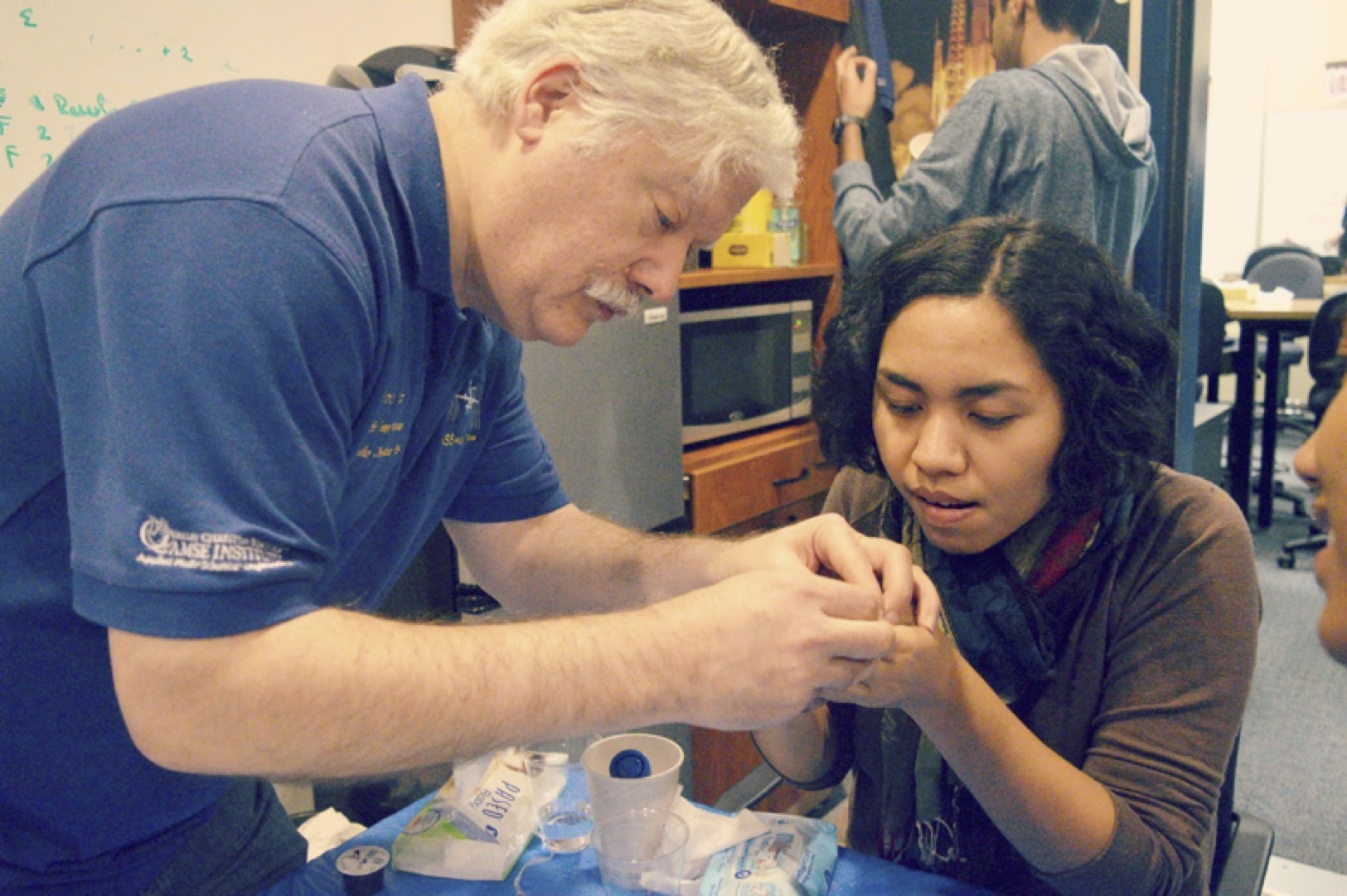
Jim Nadir mentoring a student
When he retired, Jim chose not to spend his time in an easy chair or on the golf course. Instead, he served as a volunteer at Valley Christian High School in San Jose, CA. For the past three years, he’s been mentoring students in the school’s unique advanced space program. The highly lauded program develops student experiments for the International Space Station (ISS), develops rockets and will launch the school’s first satellite from the ISS next year.
The ISS Program is a STEM (Science Technology Engineering Math) outreach to schools around the world. Together with the partner schools, it has launched 73 experiments to the ISS over the past 6 years.
Enthusiastically devoted to mentoring, Jim has helped junior high and high school students put experiments aboard the ISS. He also participates in the school’s satellite development and rocket programs. The rocket program launches high powered sounding rockets from the San Joaquin Valley and Black Rock, Nevada that go from two to eight miles into the atmosphere.
Allie is one of Jim Nadir’s success stories. When they first met three years ago Allie was in 7th grade at Valley Christian Middle School. She was withdrawn, so shy she often hung back from even telling her teachers and classmates her name.
Allie working on a project
A teacher noticed that Allie had a natural curiosity and placed her in the newly created junior high ISS class, a challenging class attended mostly by A-level students. The class was a proof of concept that junior high students were up to the task to put experiments aboard the ISS. There, Allie began to go through a gradual metamorphosis, like a butterfly emerging from a chrysalis.
Her enthusiasm ignited, Allie joined the high school’s ISS program as a freshman. “She got motivated and charged up there and just suddenly blossomed into a very responsible young person,” Jim said.
Once timid Allie, now a sophomore, recently made a video interview with NASA, describing her involvement with the ISS program. “She couldn’t even tell you her name three years ago and now she’s confidently standing in front of a camera,” Jim said. The video ran on NASA TV in connection with a March 22, 2016 launch of a resupply mission to the ISS.
A United Launch Alliance Atlas V rocket carrying Orbital ATK’s Cygnus spacecraft on a resupply mission to the International Space Station, with Valley Christian High School experiments on board, lifts off from Space Launch Complex 41 on Cape Canaveral Air Force Station in Florida on March 22, 2016
“One of the most exciting aspects to the ISS program is that students are given a chance to apply what is learned in the classroom to a project which will deliver unique results that can be applied to real world problems,” Allie said.
“When I first entered the program, I was not particularly sure what my true passions were,” Allie added. “ I have found that I possess talent in both science and mechanical engineering. I know precisely what my skill sets are and what I am actually capable of, and I owe it all to the ISS program.”
Andy’s another success story. He was in the same junior high ISS class as Allie where he innovated new fluidic bags, spore injectors and pioneered the use of peristaltic pumps. His innovations propagated into the high school and went to other schools as well. “I found out that I could innovate and make decisions,” said Andy.
His junior high experiment was presented at the ASGSR (American Society for Gravitational and Space Research) Conference in Pasadena where it won “Best Use of the Space Station” award from CASIS (Center for the Advancement of Science in Space), the sole manager of the International Space Station U.S. National Laboratory.
Valley Christian High School offers students the opportunity to specialize through its Applied Math, Science and Engineering (AMSE) program. The ISS Project provides students with the opportunity to conceive, design, build, test, integrate, and qualify computer-controlled science experiments that are then sent into space and are active on the International Space Station for a minimum of 30 days.
Recent experiments studied plant growth, protein crystallization, radiation profiles aboard the ISS, the behavior of ant colonies, and bacteria growth in a microgravity environment.
Many of these experiments have their roots in previous NASA experiments and are extending them to the next logical step. For example, Dr. Jan Leach (Colorado State) discovered that soy bean plants in microgravity are more susceptible to fungal infections. The students, after reviewing her NASA paper, sent two experiments to combat fungal infection, one uses inoculation and the other uses vibrations in an attempt to strengthen the plant’s cell walls to resist infection. This vibration experiment has caught NASA’s interest because of its unique approach.
Jim spends most of his time mentoring students developing experiments, guiding them on satellite development or developing rocket simulation environments. This involves helping with such things as how to design a transistor circuit, building reliable fluid bags, micro fluidic component validation, PCB design, mechanical planning, and software development.
Jim retired from Intel’s Santa Clara, CA site in 2007. He told me his story in the hope it will inspire other retirees who would enjoy “putting their DNA into space” while doing something meaningful for the next generation of students or whatever else will help change the world for the better.
______
Jim Nadir’s Intel career: Jim began his 33 year career at Intel developing peripherals for the 8086. He subsequently developed the layout and circuits for Intel’s first standard cell library and logic synthesis (pioneered at Intel Haifa), and later was the leader for the Pentium Instruction cache and the Itanium Data Cache. He then moved into New Business Development ASIC group and later pursued FPGA technology and other programmable fabrics for custom and small volume runs.
Resources:
The Encore Career Handbook, a comprehensive, nuts-and-bolts guide to making a difference and a living in the second half of your life.
http://www.Encore.org – A non-profit that is spearheading efforts to engage millions of people in later life as a vital source of talent to benefit society.
When Ellis Island opened in 1892, it welcomed immigrants escaping war, drought, famine and religious persecution and hoping America would offer them a new start.
Today, the Hillsboro School District is welcoming an increasingly diverse group of students, many of whom left their homes around the world because of brutal wars, punishing poverty, religious and political conflict, violence and/or a simple desire for a better life.
Tobias Elementary School, for example, is filling with children from Central America, Mexico, Ukraine, Thailand, Cambodia, Somalia, Egypt, Iraq and other countries speaking up to 30 languages. The mix depends, to some degree, on where the greatest turmoil and unrest is occurring, according to Steve Callaway, Tobias’ principal.
Many of these students are from low-income and, in many cases, low-educated, families where English is not the first language at home, behaviors and value systems vary widely and the American culture is not deeply embedded.
The shift has been dramatic. In the 1999-2000 school year, Tobias was largely white and culturally homogenous, with just 6.3 percent of the student body from principally mobile Hispanic migrant families and more from a smattering of other ethnicities, including Asian children whose parents worked in high-tech.
By the 2013-2014 school year, minority students from diverse cultures outnumbered white students at Tobias for the first time:
White: 47.8 percent.
Black: 3.5 percent.
Hispanic: 24.7 percent.
Asian/Pacific Islander: 12.2 percent.
American Indian/Alaskan Native: 0.6 percent.
Multiethnic: 11.3 percent.
The trend at Tobias is being replicated at the rest of Hillsboro’s schools, which were 49.5 percent white in the 2013-2014 school year.
Hillsboro School District demographics
Ethnicity No. of students Pct. of students
American Indian 174 0.83
Black 439 2.10
Hispanic 7,475 35.67
Asian 1,341 6.40
Pacific Islander 163 0.78
Multiethnic 965 4.74
White 10,368 48.48
TOTAL 20,955 100.00
Concentrations of children from particular ethnic groups are occurring in certain Hillsboro schools because their families want to live in close proximity. This has led, for example, to 19 Somali students attending Hillsboro’s Imlay Elementary School in the 2013-2014 school year and 15 this school year.
The U.S. Department of Education projects that minorities will outnumber whites among the nation’s public school students for the first time this fall. In other words, the minorities will become the majority.
What this means in the longer term is that Hillsboro’s workforce of the future is going to look quite different from today. Hillsboro’s economic viability and America’s greatness will be diminished if we don’t do all we can to educate these ethnically and culturally diverse children.
It’s critical that we prepare them for success as creative problem solvers and engaged community members in work and life. It’s also essential that we inculcate in them a belief in the American Dream and a commitment to the kind of effort that will bring them social and economic mobility.
“Kids don’t care how much you know until they know how much you care,” says Callaway. There are so many ways local businesses can show much they care about preparing children for work.
Companies can open their facilities to students who want to learn more about the world of work and career options by offering job shadows and paid internships. “All students need to be more aware of what job opportunities are out there,” says Leslie Smith Mayfield, a 3rd grade teacher and STEM Coordinator at Tobias. “We need help from business to expose kids, even in the elementary grades, to what options there are in the real world. Some bright kids are going to go to waste if they don’t realize the options they can work towards.”
Awareness also needs to expand to the skilled trades, which can offer well-paid, stable careers. For example, Callaway says he’d welcome having IBEW workers come in to teach kids about basic electrical circuitry.
Elaine Philippi, manager of student programs at the Business Education Compact, talks up the BEC STEM Connect TM Initiative. Volunteers from a business visit a school at least four times in an academic year, educating the students about their company, engaging students in activities that promote STEM concepts and collaborative processes and helping out at a science night or other community event.
Employees at local businesses can also get involved by helping with field trips, providing reading assistance, giving technical demonstrations, and even presenting on their hobbies. Astronomy and geology hobbyists, for example, have visited Tobias classrooms.
Businesses can give grants of all sizes to enable schools to offer innovative programs. For example, a Tobias teacher secured a grant to support an engineering math program for 6th grade girls.
Equipment can be donated to enhance the learning experience.
Companies can form partnerships with local schools, as FEI, Intel and Vernier have already done with Tobias.
All of this could help boost achievement levels and increase completion rates at Hillsboro’s increasingly diverse schools. That will benefit the local business community down the road when these youngsters enter the job market.
Watch video about Tobias Elementary School
This blog also appeared as a column in the Hillsboro Argus, October 1, 2014
Ronald Reagan once wisecracked, “The nine most terrifying words in the English language are, ‘I’m from the government and I’m here to help.’”
But sometimes, the government gets it right.
Julie Thomas knows that. Thomas recalls with sadness when her beloved black lab, Barney, had cancer. Wanting desperately to ease Barney’s pain, Thomas, an employee at Intel’s Hillsboro site, studied small animal massage and began treating her pet. When Thomas learned she was going to be let go by Intel, she decided to take a risk and change careers to work in canine water therapy.
But how could she get the business off the ground while unemployed? Oregon’s Self Employment Assistance Program (SEAP) came to her rescue.
The regular Unemployment Compensation program requires unemployed workers to be actively seeking work to get benefits. SEAP allows unemployed people to collect allowances equal to their benefits while devoting all their time to starting a business, rather than looking for another job.
The program was created in 1993 after passage of federal legislation championed by then-U.S. Rep. Ron Wyden. SEAP is now active in seven states, including Oregon. In 2012, legislation sponsored by Wyden — now Oregon’s senior U.S. Senator — provided for $35 million in grants to states to improve administration and promotion of the program.
With the economy still struggling, SEAP offers a lifeline to some entrepreneurs.
“It seemed a perfect fit for me,” Thomas said.
Thomas opened her business, Doggie Paddle, in Portland in October 2010.
“I’m not making the money I made working in a corporation,” she said, “but I’m doing something with animals, something of service, something for which I have a passion.”
Thomas is just one of several thousand Oregonians who have taken advantage of SEAP, including 55 now enrolled from Washington County, with seven of those from Hillsboro.
With SEAP support, Dave Crosswhite of Tigard started Oregon Backflow Testing, which tests backflow prevention devices that help to prevent hazardous materials from entering drinking water. He said SEAP was a huge factor.
“It took the pressure off of needing to produce an income right away and allowed me to focus on building the business and not having to job search in order to receive benefits,” he explained.
Glen Wagner and Steve Bauer signed up after they both lost their technology jobs. They decided to start a company called Open Lore in Beaverton that would deliver assisting technology to people having difficulty reading English, primarily those with dyslexia.
“Unfortunately, with multiple kids in college and still relatively young, at least at heart, we did not have the complete means to meet our family obligations and the capital expenses of starting a new technology business,” Wagner said. “With SEAP, we could put our heart and soul into the business.”
But SEAP is not without its weaknesses.
Key SEAP performance data is based only on surveys returned by program participants, but a lot of participants don’t return the surveys. For example, a recent Oregon survey sent out to 356 SEAP participants got only 78 replies — a 22 percent return.
So the state doesn’t know how many people sign up for SEAP, exhaust their benefits and end up with no business and no job. Some of those missing may be in worse shape than when they started.
Another glaring weakness is, success in Oregon hasn’t been determined on the basis of how many SEAP participants start and maintain a successful business. Rather, success has been judged by how well the state promotes SEAP and how much money is distributed to participants. Only government could think that way.
In addition, although SEAP requires that potential participants fill out an application scored to determine the feasibility of their proposed business, there’s no real follow-up. That means no assurance participants will take advantage of the array of support programs available to help grow and sustain a business. Failure may too often be the consequence.
Only about half of all new businesses survive five years or more, and only about one-third survive 10 years or more. To improve their odds, SEAP-related businesses need continuing guidance. After all, although new businesses create new jobs, it’s only when they succeed and expand that real job growth occurs.
Bill MacKenzie is a former congressional staff member, newspaper reporter and communications manager for a Hillsboro company.
Originally published in the Hillsboro Tribune, Sept. 13, 2013







 ThinkingOregon