Liberal Media Jump on the Kamala Harris Bandwagon

Gag me with a spoon.

Talk about shifting on a dime.

President Biden withdraws from the 2024 race, Vice President Kamala Harris picks up the mantle and the liberal media jump on board.

Even Biden’s withdrawal statement is being cast mostly as a brave, selfless, patriotic effort, like a “don’t speak ill of the dead” obituary, rather than an admission that the Democratic Party’s leaders and wealthy donors had abandoned him. 

It wasn’t long ago that the press delighted in portraying Harris as a largely ineffectual, slightly dim and somewhat daffy politician with a habit of speaking in a kind of garbled incoherent word salad and a failed policy effort as Biden’s border czar.  

Last week, New York Times columnist David Brooks cautioned that “…as of 18 months ago, she would not have made an effective president or even a good candidate. She ran a disastrous presidential campaign and has been a mediocre vice president, even measured by the low standards of the office. She could always repeat the normal Democratic positions but had no distinctive view for where the country needed to go.”

Now, with Biden out, the media is transforming Harris from a somewhat awkward and cringy figure in the Democratic Party to a “cool” pop culture personality with a sterling reputation in a matter of days, commented CNN commentator Van Jones. 

New York Magazine went over the top in its latest issue with this cover:

The New York Times has even attempted to turn the tide on Harris’ sometimes derided laughter, saying “The Trump campaign sees Harris’s laugh as a vulnerability to exploit. But far from a liability, it is one of her most effective weapons.”

In a flash, Harris has gone from an unaccomplished player in foreign affairs to a widely admired wonderkind. A New York Times story on her foreign policy chops was even headlined, “A Global Reputation For a Steely Resolve And Deft Diplomacy.”

“…the consensus among foreign officials and diplomats is that Ms. Harris has a firm grip on international affairs,” the Times enthused in a July 27 article quoting Chancellor Olaf Scholz of Germany: “She is a competent and experienced politician who knows exactly what she is doing and has a very clear idea of her country’s role, of developments in the world, and of the challenges we face.”

When Biden tweeted his exit, the Democratic Party and its acolytes “…declared a triumph of democracy and the end of popular “disillusionment,” observed author and reporter Matt Taibbi. “Attention shifted to the real candidate, Kamala Harris, who was not only MLK, Gandhi and Captain America, but a woman of color with a Jewish husband…” 

Party stalwarts are jumping on board with superlatives, too. “I’ve known Kamala Harris a long time,” wrote Hillary Clinton. “This brilliant prosecutor will make the case against convicted felon Donald Trump.”

On July 28, Lydia Polgreen, an opinion columnist with the New York Times, wrote that “…Harris had been significantly underrated, that the chatter about her flaws for the past four years maybe didn’t tell her full story and that she had some unique talents and traits that made her a stronger candidate than her record might suggest.”

Rather than hold Harris’ missteps against her, Polgreen turned them into positives. 

“I see a woman who struggled to compete for power against her peers, buried under an array of vague and unstated expectations about whether she gave the right answers, had the right ideas, was smart or specific enough,” Polgreen wrote. “Like any woman of ambition, I deeply relate to these experiences. As strange as it might seem, I have come to think these experiences could make her the ideal candidate in a surreal campaign against a man who is so certain of himself, who admits to no mistakes, who has no humility and who, for many of us, is utterly unrelatable.”

Jenny Holland, who writes “Saving Culture (from itself)” on substack, says “The establishment blob is so desperate to avoid a Trump presidency that they are willing to support a woman who is so flippant and unserious that she would embrace a youth culture trend of “brat”, which means being “just that girl who is a little messy and maybe says dumb things sometimes, who feels herself but then also maybe has a breakdown but parties through it.” 

Still, Harris may want to tread lightly before embracing her newfound adulation as a given. The press can be your friend, but it can also turn on you. 

Identity Politics is Alive And Well at The New York Times

I’m a member of Tau Kappa Epsilon fraternity, one of the largest men’s collegiate fraternities in North America.  If I ran for office, would you assume all 12,000 voting-age collegiate members of my fraternity and all the living TKE alumni would support me?  

Ronald Reagan was a member of Tau Kappa Epsilon fraternity, too. When he ran for president, did the news media assume the votes of all his TKE fraternity brothers were a sure thing?

The New York Times seems to think that members of all the Black Greek-letter sororities and fraternities at US colleges are a ready-made bloc of Kamala Harris supporters in her quest for the presidency because she’s been a member of the Black sorority Alpha Kappa Alpha since her undergraduate days at Howard University. 

“As Vice President Kamala Harris’s presidential campaign rushes to shore up its base, its efforts will be bolstered by a ready-made coalition: the more than two million members of Black Greek-letter organizations who have quickly united to mobilize Black voters nationwide,” the Times reported today.  

“A united Black Greek front has the potential to offer even more significant political advantage, as their voter engagement programs reach millions every four years,” the Times added. 

Maya King, the Times reporter who wrote the story, says in her bio, “As a native Southerner, I have been most fascinated by the ways the region has changed politically, culturally and demographically over the last few presidential election cycles — and how those changes are connected.”

But King barely acknowledged those changes in her article. The cheerleading article barely mentioned that there have been signs of deteriorating Black support for the Democratic ticket and growing Black consideration of Donald Trump. 

In November 2023, the Times reported that Black voters were  more disconnected from the Democratic Party than they have been in decades, frustrated with what many saw as inaction on their political priorities and unhappy with President Biden, a candidate they helped lift to the White House. Polls by the Times and Siena College found that 22 percent of Black voters in six of the most important battleground states said they would support former President Trump in the 2024 election, and 71 percent would back President Biden.

Erosion of Black support for the Democratic Party has also been found by the Pew Research Center. The Center reports that although the majority of Black voters across education levels are Democrats, there has been a decrease in affiliation with the Democratic Party in recent years. While 93% of Black voters with college degrees identified with or leaned toward the Democratic Party in 2012, that number decreased to 79% in 2023.

Biden’s withdrawal from the 2024 presidential contest and Harris’  ascension may well change some Black voters’ preferences, but it’s not likely to be a universal shift. Harris, for example, is a progressive Democrat, but only 28 percent of black Democrats consider themselves liberal, according to the Pew Research Center, while 70 percent identify as moderate or conservative.

On June 25, the Times reported on data  captured by a new Harvard study that shows Black voters  have slightly shifted toward Trump since 2020. “One possible explanation is that some Black voters’ economic gains have allowed them to focus more on noneconomic issues — such as abortion and L.G.B.T.Q. rights — on which they are more conservative than typical Democrats,” the Times said.

The fact is, Black candidates can’t rely on group solidarity. “It’s certainly true that black voters support black Democratic candidates at higher rates, … but analysis of past elections and campaigns shows that black voters have never prioritized simple descriptive representation over other factors, like party affiliation, campaign viability, candidate electability, preexisting relationships with the black community and a sense of authenticity,” according to the New York City-based Brennan Center for Justice. 

For the New York Times to publish a story assuming Black solidarity for a Black presidential candidate who’s a member of a Black sorority is irresponsible journalism.

As James Bennett, who was the editorial page editor at The New York Times from May 2016 until his forced resignation in June 2020 over a controversial op-ed, has said, “The reality is that the Times is becoming the publication through which America’s progressive elite talks to itself about an America that does not really exist.”

Words of Wisdom From Kamala Harris

Concerned about President Biden’s cognitive decline? If you believe president Biden. Is unfit to lead the United States for another term, one option is his vice president, Kamala Harris. If you think Harris , despite her 37% approval rating, is a better alternative and can speak with eloquence to heal this troubled nation, consider how she has addressed the issues of the day during her term in office.

“The governor and I, we were all doing a tour of the library here and talking about the significance of the passage of time, right, the significance of the passage of time. So, when you think about it, there is great significance to the passage of time…” Harris speaking in Sunset, Louisiana.

“We got to take this stuff seriously, as seriously as you are because you have been forced to have taken this seriously.”Harris speaking in the wake of the Highland Park High School shooting.

“I think it’s very important…for us, at every moment in time and certainly this one, to see the moment in time in which we exist and are present.” Harris speaking about efforts to lower home buying costs and efforts to lower energy prices.

“I think the first part of this issue that should be articulated is AI is kind of a fancy thing. First of all, it’s two letters. It means artificial intelligence, but ultimately what it is, is it’s about machine learning. And so, the machine is taught — and part of the issue here is what information is going into the machine that will then determine — and we can predict then, if we think about what information is going in, what then will be produced in terms of decisions and opinions that may be made through that process.”  Harris explaining artificial intelligence. 

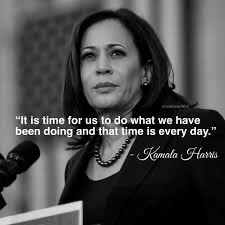
“It is time for us to do what we have been doing. And that time is every day.” Harris speaking on the urgency of immediate action on COVID-19.

“We invested an additional $12 billion into community banks, because we know community banks are in the community…”  Harris speaking about community banks.

“We will assist Jamaica in COVID recovery by assisting in terms of the recovery efforts in Jamaica …We also recognize just as it has been in the United States, for Jamaica, one of the issues that has been presented as an issue that is economic in the way of its impact has been the pandemic.” Harris on diplomacy re. Jamaica.

“I think that, to be very honest with you, I do believe that we should have rightly believed, but we certainly believe that certain issues are just settled. Certain issues are just settled.” Harris speaking on the Supreme Court overturning Roe v. Wade.

“So, during Women’s History Month, we celebrate and we honor the women who made history throughout history, who saw what could be unburdened by what had been.” Harris speaking on Women’s History Month.

“You know, when we talk about our children — I know for this group, we all believe that when we talk about the children of the community, they are a children of the community.” Harris speaking at Children’s National Hospital in Washington, D.C.

“That is especially true when it comes to the climate crisis, which is why we will work together and continue to work together to address these issues, to tackle these challenges, and to work together as we continue to work, operating from the new norms, rules, and agreements that we will convene to work together on to galvanize global action.” Harris speaking at the State Department before the Association of Southeast Asian Nations.

‘Culture is – it is a reflection of our moment and our time. Right? And present culture is the way we express how we’re feeling about the moment, and we should always find times to express how we feel about the moment. That is a reflection of joy. Because, you know, it comes in the morning.” Harris speaking at the 2023 Essence Festival of Culture at the Caesars Superdome.

President Biden: Stay or Go?

Option 1: Everybody just throw up their hands in dismay and let the fur fly.

Option 2: Adopt a “Stand by your man” attitude. Treat the current controversy as much ado about nothing, just “one bad night”. It wouldn’t be the first time the party ignored obvious personal failures by prominent members. Regardless of the current sturm and drang over Biden’s well-being and mental stability, just hang in there and hope the furor will dissipate, relying on the American public’s inability to focus on anything for more than a few days (or minutes). Count on spineless, wishy-washy electeds, such as Rep. Jerry Nadler (D-NY), to back off their calls for Biden to step aside. Ignore the fact that Biden, even if he hangs on, may not be well enough to lead for another four years even if he wins. 

Option 3: Keep up the practiced deception, despite the evidence. The Wall Street Journal reported today that aides, in order to protect the president from scrutiny (and keep their jobs and influence), kept a tight rein on his travel plans, news conferences, public appearances and meetings with donors. Ignore the fact that hordes of aides and elected Democrats have deceived the public and that most voters think Joe is just too damn old. Oliver Wiseman wrote today in The Free Press, “As Biden geared up for a second run, it was clear that any young, ambitious Democrat who dared to challenge him would be all but disowned by their party… In poll after poll, Democratic voters told the party they wanted someone other than Biden at the top of the ticket. But the party apparatus ignored them. Now look where we are.”

Option 4:  Convince Biden to step down before the convention, making Kamala Harris President. Anoint Harris as the nominee at the party’s convention, in the midst of riotous pro-Palestinian demonstrations  (Shades of the riots at the 1968 Democratic convention in Chicago, which lead to Hubert Humphrey’s loss to Richard Nixon in the general election) On June 27, the day of President Biden’s debate, Harris’ approval rating was 39.4 percent, while her disapproval rating was 49.4 percent.. ignore the fact that her approval numbers have actually fallen since the first presidential debate sparked calls for Biden to quit the race. According to FiveThirtyEight’s average, on June 27, the day of the debate, Harris’ approval rating was 39.4 percent, while her disapproval rating was 49.4  percent. On July 5, Harris’ approval rating stood at 37.1 percent and her disapproval rating was 51.2 percent, not a hopeful sign if she runs against Trump, whose approval numbers have actually been rising.

Option 5: Convince Biden to withdraw as the party’s nominee at the Democratic Convention and initiate an open convention, releasing the pledged delegates he has accumulated to date (3,894 of 3,937 committed so far). All those delegates could then vote for whomever they chose. That might, of course, run the risk of alienating minority voters who would resent the party automatically not elevating Kamala Harris (she wouldn’t even be assured of keeping the No. 2 job),  setting off chaos on the convention floor and leaving the party’s eventual nominee just weeks to make his/her case to voters before the Nov. 5 election.  

Option 6: Back to Option 1.

40% of American workers couldn’t come up with $400. Is that true?

payingbillsworry

There it was again.

Only six in ten American workers could afford a surprise $400 expense, John Hope Bryant, founder of Operation Hope, an Atlanta-based non-profit, told the Wall Street Journal for a profile that ran today (July 25, 2020)

That $400 figure crops up everywhere like a persistent weed, portraying a large segment of Americans as living perilously on the edge of catastrophe.

“Some 40% of Americans would struggle to come up with $400 for an unexpected expense,” reported CNBC.

“In America right now today, almost half of Americans are a $400 unexpected expense away from complete upheaval,” Sen. Kamala Harris (D-CA) said on April 1, 2020 when announcing plans to introduce a Rent Relief Act.

“The gap between incomes and costs is so gaping that 40% of Americans can’t come up with $400 in an emergency,” Sen. Elizabeth Warren said on May 9, 2019.

Those pushing the $400 story usually cite the Federal Reserve’s report, “Well-Being of U.S. Households in 2018.”   The Report writers interviewed a sample of over 11,000 individuals—with an online survey in October and November 2018.

But the 40% figure is wrong.

People who just skimmed the initial text of the executive summary of the Report or relied on a text message, probably saw this: “Results from the survey show that many adults are financially vulnerable and would have difficulty handling an emergency expense as small as $400.”

If they read the Report itself further, however, they would have seen this: “If faced with an unexpected expense of $400, 61 percent of adults say they would cover it with cash, savings, or a credit card paid off at the next statement—a modest improvement from the prior year. Similar to the prior year, 27 percent would borrow or sell something to pay for the expense, and 12 percent would not be able to cover the expense at all.

So it’s not true, as Warren claimed, that 39% of people “can’t come up with” the money they’d need to handle this situation.

The Federal Reserve report makes clear that, although 4 in 10 adults “would have more difficulty covering such an expense,” many of them would be able to make it work by carrying a credit card balance or borrowing from friends and family.

covering400

Parents are often the source of financial help. One in 10 adults received some form of financial support during 2018 from someone living outside of their home. Over one-quarter of young adults received such support and among young adults with incomes under $40,000, nearly 4 in 10 received some support from outside their home.

Only 12% of adults “would be unable to pay the expense by any means,” the Federal Reserve Report concluded.

This doesn’t mean, however, that all is well in the American economy. Although many families reported that they had made substantial gains since the survey started in 2013, persistent disparities remained by race, education, and geography. Also, the report relied on interviews in 2018, well before COVID-19 struck the United States and massive economic dislocation occurred.

All the research done so far is showing that the economic fallout from COVID-19 is hitting lower-income adults harder.

The Pew Research Center has noted that The financial shocks of the outbreak have hit Hispanic and black Americans especially hard. When it comes to public health, black Americans appear to account for a larger share of COVID-19 hospitalizations nationally than their share of the population. One result is that, according to a July 2020 Rand Corp. survey, 40% of non-Hispanic black households and nearly 50% of Hispanic households reported problems paying their bills, compared with 21% of non-Hispanic white households.

We won’t know for quite a while what the public has to say to the Federal Reserve about how things are 2020, but it probably won’t be good.

Nobody’s watching the Democratic debates. Does it matter?

Just 1.9% of Americans watched the Dec. 19 Democratic presidential debate.

APTOPIX Election 2020 Debate

The way things are going, the audience for the 10th and last 2020 Democratic Party presidential debate on Feb. 24, 2020 will be zero.

A total of 15.26 million viewers watched the first debate on June 26, 2019. By the most recent debate on Dec. 19, the number of viewers had sunk like a stone to 6.17 million.

That’s a miniscule 1.9% of Americans.

But it doesn’t matter. What really matters is how the media of all types, particularly social media, interpret the debates to the public and grab elements of the debates to advance agendas.

Social media is the dominant influencer because:

  • National television news has a steadily shrinking audience. In the 2016 presidential race between Hillary Clinton and Donald Trump, only 10 percent of people said national nightly network television news was the most helpful news source.
  • Print newspapers have a steadily shrinking audience. Total circulation of U.S. daily newspapers today, for a U.S. population of 329 million, is less than in 1940, when the U.S. population was 132 million. In the 2016 presidential election, as many people named late night comedy shows as most helpful for political news as named a print newspaper.
  • Local TV news tends to focus on murders, fires, car crashes and the weather, not presidential politics.

Regardless of the issues discussed by the 10 Democrats during the 120 minutes of the second night of the first debate on June 27, 2019, it was a terse exchange between Kamala Harris and Joe Biden about busing that dominated subsequent coverage of the debate and online discussion. “Kamala Harris attacks Joe Biden’s record on busing and working with segregationists in vicious exchange at Democratic debate”  proclaimed the CNBC headline.

Similarly, regardless of the consequential issues discussed by the seven Democrats during the 120 minutes of the Dec. 19 debate, the media, including social media, focused on:

  • Who “won” the debate.
  • Assertions that “the knives came out” for Pete Buttigieg.
  • The vile wine cave.  Elizabeth Warren castigated Buttigieg for holding a fundraiser with rich people in a Napa Valley “wine cave.” Politico reporter Natasha Korecki said that was “the most entertaining” part of the debate. “ The conservative National Review headline read, “Biden Cruises and Buttigieg Takes Fire in the Wine Cave Debate.” The left-leaning Mother Jones said, “The “Wine Cave” Debate Was One of the Campaign’s Most Consequential Arguments.” And the story still has legs. On Sunday, Dec. 22, the New York Times ran a story relating the frustration and disappointment of the wine cave’s owners, both of whom are active Democrats, at being thrust into the public eye in such a negative manner.
  • Elizabeth Warren’s statement that economists are “just wrong” when they argue her proposals for trillions in new taxes will stifle growth and investment.
  • It was a testy night. “The political press, always thirsty for conflict, pounced,” the Columbia Journalism Review noted. “In a push notification, the New York Times alerted readers that we’d seen a “contentious evening”; Dan Balz, of the Washington Postnoted that a “collegial start” had given way to “fireworks.” There was talk of gloves coming offpummeling, and slugfests, and that was just from Politico. Another Politico piece listed the “five most brutal onstage brawls” of the night, complete with a tally chart and boxing-glove emojis.”
  • Diversity is what matters. Time pointed out that the only non-white candidate on stage was Andrew Yang.“This forced the uncomfortable conversation about how the party that talks so big about including diverse voices and that depends on minority voters ended up with such a white set of candidates in a field that was, at one point, historically diverse,” Time said.

In any case, what the American public really cared about, some media observed, wasn’t the debate but the upcoming release of Star Wars: The Rise of Skywalker. The first item in the Dec. 21, 2019 NY Times On Politics newsletter referenced this. “It appears nobody consulted the Jedi Council before scheduling a Democratic debate on the same night “Star Wars: The Rise of Skywalker” opened, the newsletter noted.

Lots of folks have chimed in about all the debates on social media, but they’ve mostly talked to others in their bubble in response to algorithm-delivered news content. As noted in Towards a New Enlightenment? A Transcendent Decade“… the emergence of the political “Twitterverse,” … has become a locus of communication between politicians, citizens, and the press, has coarsened political discourse, fostered “rule by tweet,” and advanced the spread of misinformation.”

tweet

Twitter discourse on national politics also tends to be driven by a very small segment of the population. According to the Pew Research Center, Twitter dialogue by American adults about national politics is driven by a small number of prolific political tweeters. They make up only 6% of all U.S. adults with public accounts on the site, but account for 73% of tweets from American adults that mention national politics.

Furthermore, as a Knight Foundation study  put it, Twitter is “a distorted mirror of Americans’ political views,” because it is dominated by the center left, countered by the extreme right.

Facebook plays a major role in the political debate, too, and not in a good way. As the Columbia Journalism Review reported, “Facebook is a toxic town square.” And that makes it dangerous because, it’s a primary source of political news for a growing segment off the public. A recent study conducted by the Pew Research Center estimated, for example, that more than 60% of Americans got their information about the 2016 US presidential election on Facebook.

Instagram has a growing place in public perception of politics and the debates, too, and could be a flashpoint for online disinformation during the 2020 election. “Disinformation is increasingly based on images as opposed to text,” said Paul Barrett, the author of an NYU report that’s prompted a renewed look at the problem. “Instagram is obviously well-suited for that kind of meme-based activity.”

It’s an engagement powerhouse that attracts far younger users than its parent company, Facebook, according to the NYU report  The report cited a Senate Intelligence Committee report that noted the Internet Research Agency — which led Russia’s disinformation campaigns in the 2016 election — found more engagement on Instagram than any other platform.

So, does it matter whether  fewer and fewer people are actually watching the Democratic debates? Probably not.


Despite pledges, politicians fail to shed tainted donations. Surprise!

Senate Minority Leader Chuck Schumer (D-NY) says he’ll offset $7,000 in campaign contributions he’s received from accused sex trafficker Jeffrey Epstein by donating an equivalent amount to anti-sex trafficking and anti-violence against women groups.

Don’t count on it.

In 2017, when multiple women went public with accusations that Harvey Weinstein had sexually harassed them, Democratic politicians, including Schumer, leaped to disassociate themselves from him. In particular, they promised to donate Weinstein’s now-tainted campaign contributions to charity.

schumer_corporate_taxes_0

Sen. Chuck Schumer (D-NY)

Schumer was prominent among numerous politicians scurrying to say they would make amends. Federal Election Commission (FEC) records show that Weinstein donated $20,700 to the Friends of Schumer campaign finance committee during 2013-2017.

“Sen. Schumer is donating all of the (Weinstein) contributions to several charities supporting women,” Matt House, a spokesman for Sen. Schumer, told the Washington Post in October 2017.

weinstein 4

Harvey Weinstein

Republican National Committee chairwoman Ronna Romney McDaniel praised Schumer  for doing the right thing.

She was too quick in her praise.

FEC records reveal that Schumer’s campaign committee didn’t donate one thin dime to charities supporting women in 2017 or 2018.

During that same period, Schumer’s committee also received contributions from the DNC Services Corp (Democratic National Committee), to which Weinstein had donated $203,458.

There’s no evidence that Schumer’s committee re-distributed any of that money to women’s groups either.

To its apparent credit, the Democratic National Committee (DNC) said it would donate $30,000 of the funds it had received from Weinstein to three non-profits:

  • Emily’s List, a political action committee that aims to help elect pro-choice Democratic female candidates to office.
  • Emerge America, an organization that recruits, trains and provides a network to Democratic women who want to run for office, and
  • Higher Heights, a national organization working to elect Black women, influence elections and advance progressive policies.

FEC records of the DNC’s expenditures in 2017-2018 reveal that it lived up to its promise.

On Oct. 30, 2017, the DNC sent Emily’s List $10,290.15.  (The DNC also sent $5,000 to Emily’s List on May 25, 2017, but that was before the Weinstein scandal erupted.)

The DNC also sent $10,290.15 to both Emerge America and Higher Heights on Oct. 30, 2017. It sent $1250 to Higher Heights on Sept. 29.

But there was a hitch. The DNC collected $300,000 in donations from Weinstein, not $30,000. It kept the other $270,000.

Other Democratic politicians, including some who are now running for the Democratic Party’s presidential nomination, also had received funds from Weinstein and also made a lot of promises to send the money to deserving non-profits. The announced recipients, however, were largely organizations that would launder the money right back to Democrats and their causes.

Even then, not all the politicians followed through on their commitments.

  • Sen. Elizabeth Warren (D- MA) said she’d donate $5,000 she received from Weinstein to Casa Myrna, a nonprofit group in Massachusetts. The FEC’s records on expenditures of the Elizabeth Warren Action Fund during 2017-2018 don’t show any payments to Casa Myrna.
  • Sen. Kirsten Gillibrand (D-NY) said she would donate $10,000 received from Weinstein to RAAIN, (Rape, Abuse & Incest National Network), an anti-sexual violence organization. No such donation is reported in FEC records of expenditures by Gillibrand’s 2017-2018 campaign finance committees.
  • Sen. Al Franken (D-MN) said he’d send Weinstein’s donations to the Minnesota Indian Women’s Resource Center. According to OpenSecrets.org, Weinstein donated a total of $17,300 to Franken and his Midwest Values PAC. None of Franken’s campaign finance committees recorded on FEC.org show a donation to the Minnesota Indian Women’s Resource Center during 2017-2018.
  • Sen. Kamala Harris (D-CA) said she would give $5,000 she received from Weinstein to a women’s rights nonprofit, Equal Rights Advocates. FEC records on Harris’ campaign finance committees do not show such a donation during 2017-2018.
  • Bob Casey (D-PA) said he’d give $2,190 he received from Weinstein to the Women’s Center and Shelter of Greater Pittsburgh. FEC records on Casey’s campaign finance committees do not show such a donation.
  • The Clinton Foundation’s website says Weinstein has donated between $100,001 – $250,000 to the Foundation. In Oct. 2017, the Foundation announced it had no plans to return Weinstein’s contributions, saying they had already been spent on charitable programs. According to the Foundation’s Form 990 report to the IRS, it had net assets of $323,470,879 at the end of 2017.

Looks like a lot of politicians’ promises are no more than empty public relations gestures.  Surprise!


More Merkley drama: the Stop Cruelty to Migrant Children Act

razzledazzle

Not one to miss a chance to put himself in the spotlight, Sen. Jeff Merkley (D-OR) grandly announced on July 11 that he led a group of 40 senators in introducing the Stop Cruelty to Migrant Children Act.

Merkley was in so much of a hurry to claim leadership on the bill that he has issued a press release, a section-by-section breakdown of the bill (S. 2113) and a one-pagesummary, but the bill hadn’t even been written.  According to Congress.gov, text had still not been received for S.2113 as of July 16, 2019.

Nevertheless, the bill has been referred to the Committee on the Judiciary Committee. Suffice it to say, however, the bill isn’t going anywhere.

One reason – not a single Republican has signed on as a cosponsor. In this, Merkley is continuing to earn his reputation as one of the Senate’s most partisan Members.

The Bipartisan Index measures the frequency with which a Member co-sponsors a bill introduced by the opposite party and the frequency with which a Member’s own bills attract co-sponsors from the opposite party. The Index reflects how well members of opposite parties and ideologies work together.

According to the Bipartisan Index of senators released by The Lugar Center and Georgetown University’s McCourt School of Public Policy, Merkley had the third most partisan track record in the entire Senate in the most recent analysis covering the 115th Congress (2017-2018)

That was even worse than Merkley did in the 113th Congress, when he was ranked the 7th most partisan senator.

Another reason Merkley’s migrants bill is already dead in the water — – how many Republicans does Merkley seriously think are going to support a bill demanding that the Administration “Stop Cruelty to Migrant Children”?

Then there’s the expansive scope of the bill.

The bill would create “non-negotiable standards” for the treatment of migrant children, including:

  • Ending family separations except when authorized by a state court or child welfare agency, or when Customs and Border Protection and an independent child welfare specialist agree that a child is a trafficking victim, is not the child of an accompanying adult, or is in danger of abuse or neglect;
  • Setting minimum health and safety standards for children and families in Border Patrol Stations.
    • Requiring access to hygiene products including toothbrushes, diapers, soap and showers, regular nutritious meals, and a prompt medical assessment by trained medical providers.
    • Requiring children receive three meals a day that meet USDA nutrition standards.
    • Ending for-profit contractors from operating new Office of Refugee Resettlement (ORR) standard shelters or influx facilities.
      • Ensuring that temporary influx facilities are state-licensed, meet Flores standards, and are not used to house children indefinitely.
      • Expanding alternatives to detention and the successful Family Case Management Program.
      • Lowering case manager caseloads, mandating lower staffing ratios, and ending the information sharing agreement between ORR and Immigration and Customs Enforcement (ICE).
      • Ensuring unaccompanied children have access to legal counsel and continue to be placed in a non-adversarial setting for their initial asylum case review.

Additionally, the legislation would provide resources to non-profit centers that are helping to provide humanitarian assistance.

It all sounds all very high-minded, but it would be onerous. For example, at a time when shelter facilities are bursting at the seams, ending for-profit contractors from operating new Office of Refugee Resettlement (ORR) standard shelters or influx facilities would mean rapidly securing replacements.

Then there’s the bill’s cost. But you won’t find that in the hastily issued press release, the section-by section breakdown of the bill, the one-page summary or in a text of the bill itself. That’s because as of July 16, 2019, a Congressional Budget Office Cost Estimate for the measure has not been received.

But Merkley and the 39 senators signing on as co-sponsors don’t really care. They know the bill is nothing more than an exercise in stage management, part of legislative theater.

As they sang in Chicago:

Razzle dazzle ’em
Give ’em a show that’s so splendiferous

Row after row will grow vociferous

Give ’em the old flim flam flummox
Fool and fracture ’em

How can they hear the truth above the roar?
_________________

S.2113 is sponsored by Sen. Merkley and co-sponsored by Senators Charles E. Schumer (D-NY), Patty Murray (D-WA), Dianne Feinstein (D-CA), Dick Durbin (D-IL), Mazie Hirono (D-HI), Bob Menendez (D-NJ),Chris Coons (D-DE), Amy Klobuchar (D-MN), Patrick Leahy (D-VT), Maria Cantwell (D-WA), Jack Reed (D-RI), Michael Bennet (D-CO), Tammy Baldwin (D-WI), Bernie Sanders (I-VT), Chris Van Hollen (D-MD), Elizabeth Warren (D-MA), Ben Cardin (D-MD), Ron Wyden (D-OR), Brian Schatz (D-HI), Catherine Cortez Masto (D-NV), Sheldon Whitehouse (D-RI), Jacky Rosen (D-NV), Richard Blumenthal (D-CT), Edward J. Markey (D-MA), Kirsten Gillibrand (D-NY), Mark Warner (D-VA), Tim Kaine (D-VA), Kamala D. Harris (D-CA), Chris Murphy (D-CT), Tammy Duckworth (D-IL), Maggie Hassan (D-NH), Tina Smith (D-MN), Jeanne Shaheen (D-NH), Cory Booker (D-NJ), Bob Casey (D-PA), Angus King (I-ME), Debbie Stabenow (D-MI), and Sherrod Brown (D-OH).


Kamala was ready: that little girl was me

thatLittleGirlWasMe_black_unisexFront__33504.1561695616

If you don’t think political campaigns are tightly scripted, consider what Kamala Harris said in last night’s Democratic debate.

Acronym, which analyzes digital strategy and investments across the political spectrum, noted after the debate that the biggest breakout moment was when Harris went after Joe Biden on desegregation. In doing so, she drew on a story of her personal experience as a young girl who was bused to school that became a viral video clip.

Some viewers might have seen that moment as a deeply personal, spontaneous reaction by Harris that revealed her genuineness. Hardly.

As Acronym noted, “Her campaign team seemed *very* ready for the moment, sharing well-designed graphics on Facebook, Twitter, and Instagram, and quickly pushing out related t-shirts with her quote from the stage, “That little girl was me,” for sale.”

To help things along, Harris plugged her website in her closing remarks.

So much for spontaneity.