Kate Brown and the Willamette Falls Trust: Fess Up

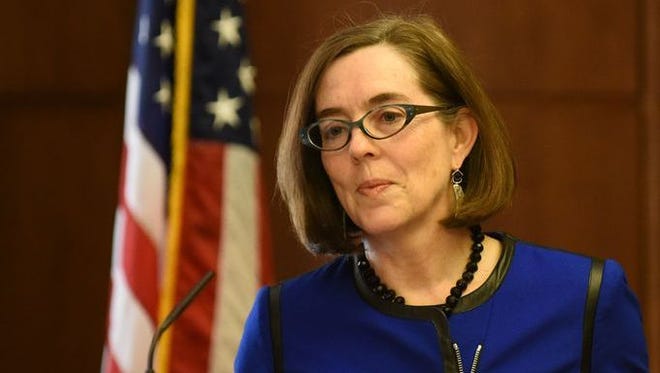
Kate Brown at Willamette Falls

Former Oregon governor, Kate Brown, and the Willamette Falls Trust don’t appear to be big on public disclosure. 

On June 4, 2024, the Willamette Falls Trust announced Brown had been selected as the group’s new president. She occupied her new position on May 28, taking over from Andrew Mason, who led the trust’s work for more than six years.

Willamette Falls Trust, created in 2015, is based in Oregon City. Made up of local, regional and tribal leaders, it is a non-profit working to promote and preserve public access to the Falls. It’s likely Brown’s appointment was based, in part, on an assumption she could secure state funding for the Trust. 

That bet paid off.

As the Legislature’s 2025 session ended, it approved giving $45 million to the Trust. The money will go toward the purchase of 60 acres of property on the West Linn side of the waterfall. 

But the appropriation was not without controversy. Willamette Week reported that the Grand Ronde Tribe, which has historic treaty rights at Willamette Falls, had urged Gov. Tina Kotek not to give money to the trust. Grand Ronde tribal chairwoman Cheryle Kennedy panned the appropriation. “Any state investment in land at Willamette Falls must center the voices and rights of Tribal nations with ancestral ties to this sacred site, not a private nonprofit,” Grand Ronde tribal chairwoman Cheryle Kennedy told Willamette Week. 

Going forward, you’d think the Trust would want to be transparent and straightforward about its operations in order to secure public support for its mission, but from the start it has been tight-lipped about what it’s paying Brown. Is it appropriate, modest, extravagant, embarrassingly over the top?

I e-mailed Brown asking her directly what total compensation she received from the Trust in 2024 and what her projected total compensation is for 2025. 

David Perry, Vice President of Internal Operations at the Trust, responded, saying Brown asked him to reply.Unfortunately, all personnel matters, including employee compensation, are considered confidential so I cannot provide the answers to your questions directly,” he said. 

He noted, however, that Brown’s 2024 compensation will be noted in annual report the Trust and all other Oregon non-profits are required to file annually with the Internal Revenue Service and the Oregon Department of Justice. Those 2024 reports will be filed no later than November 15, 2025. Financial information for 2025 will go through a similar review and filing process, so will not be available until late 2026, he said.

As the conservative commentator John Stossel often says, “Give me a break!”.

The Trust, which is in line to receive an infusion of $45 million in taxpayer funds, wants to hide Kate Brown’s 2024 compensation until mid-November 2025 and her 2025 compensation until November 2026. 

Why? 

UPDATE: August 1, 2025 –  Gov. Kotek weighs whether to veto funds for Willamette Falls inter-tribal project, OPB

Kotek’s office stated Thursday that she is considering a veto of a budget line item from the Legislature’s “Christmas Tree” bill that allocated funding for all sorts of projects and initiatives, including the Willamette Falls project. 

“[Kotek] is exercising her due diligence to understand more fully the use of these dollars and wants to hear more from all interested parties,” the governor’s office wrote. 

The announcement came amid an ongoing conflict among regional tribes over both the project and fishing access at Willamette Falls.
Oregon’s EV Predictions Are A Pipe Dream

Oregon’s hyper-projections for electric vehicle adoption are proving to be wishful thinking.

On Nov. 6, 2017, Gov. Kate Brown signed Executive Order 17-21 stating “It is the policy of the State of Oregon to establish an aggressive timeline to achieve a statewide goal of 50,000 or more registered and operating electric vehicles by 2020.” (emphasis in original). 

In 2019, Senate Bill 1044 restated the Zero Emission Vehicle (ZEV) adoption target as 50,000 registered on Oregon roads by 2020.

It didn’t happen.

According to information provided by the Oregon Department of Transportation on Dec. 25, 2023, there were just 5,537 registered and operating electric vehicles in Oregon in 2020, 13,572 in 2021 and 23,163 in 2022.

Senate Bill 1044 also set a target of 250,000 registered Zero Emission Vehicles on Oregon roads by 2025.

That ain’t gonna happen either.

As of July 2023, there were 51,355 Battery Electric Vehicles (BEVs), vehicles powered solely by an electric battery, with no gas engine parts, registered and operating in Oregon, according to the Oregon Department of Energy.[1] The number of Oregon-registered zero emission vehicles on Oregon roads as of September 2023 was just 70,000.  The likelihood that this number will grow to 250,000 over the next 12 months is nil.

In December 2022, Gov. Brown, in a burst of environmental overreach that slavishly followed California’s lead, announced that all new cars sold in Oregon would have to be emissions-free starting in 2035.

The way things are going, that’s a pipe dream.

The fact is adoption of zero emission EVs is falling far behind earlier exuberant expectations. Sales are growing, but the rate of growth is slowing and unsold inventory is piling up for multiple brands., despite car companies offering discounts and low-interest rates in an attempt to propel demand. The only segment seeing significant growth in demand is hybrids, which are not zero emission vehicles.

“The first wave of buyers willing to pay a premium for a battery-powered car has already made the purchase, dealers and executives say, and automakers are now dealing with a more hesitant group, just as a barrage of new EV models are expected to hit dealerships in the coming years,” according to the Wall Street Journal.  

Some resistance to EVs may also be emerging because of their environmental costs, particularly the need for minerals for the batteries. And as The Washington Post has pointed out, mining the minerals is only the first step. 

“The ore is almost never pure and needs to be refined, or processed, to become the minerals that go into batteries, the Post reported. ” When it comes to processing, there is one major player: China, which handles more than half of the minerals critical to EV batteries. These elements aren’t used only to power EVs; they also appear in everything from building materials to toys. But as the demand for EV components soars, so could dependency on China’s refining infrastructure.”

Resistance to EVs in Oregon may also be related to the insufficiency of charging ports. Oregon is hoping to install about 370 new electric vehicle charging ports across the state in 2024 as part of an Oregon Department of Transportation rebate program.

In the meantime, car companies are cutting back on plans for battery plants and EV production. 

In mid-December, for example, Ford announced it was cutting its 2024 F-150 Lightning products by half. Ford has delayed about $12 billion in new EV investments, reducing some Mustang Mach-E production and postponing opening one of two planned Kentucky planned battery plants. 

The high cost of EVs is one major factor that will likely continue to hold back their widespread adoption in Oregon. EVs remain much more expensive than internal combustion engine vehicles, especially in North America. High interest rates will also restrain purchases. Consumer frustrations with the availability of EV chargers, excessive charging times, questions about reliability and high repair costs are also undermining early robust sales predictions. 

While maintenance costs for EVs are proving to be lower than for internal combustion vehicles (EV-owners spend half as much maintaining their vehicles as their gasoline-owning counterparts, according to Consumer Reports), repairs after collisions can cost thousands of dollars because the fixes tend to require more replacement parts, the vehicles are more complicated and fewer people do such repairs.

The market is reflecting the concerns about EVs as investors have responded to the changed outlook for them. The iShares Self-Driving EV and Tech ETF | IDRV, set up in July 2019, seeks to track the investment results of an index composed of developed and emerging market companies that may benefit from growth and innovation in and around electric vehicles, battery technologies and autonomous driving technologies. A $10,000 investment at the fun’s inception would have more than doubled in value to $22,815 as of Nov. 2, 2021, but had declined to $14,432.58 as of Dec. 13, 2023.

So don’t bet the farm on EV predictions by politicians and bureaucrats. Their track record so far isn’t great.


[1] There were also 23,328 Plug-in Hybrid Electric Vehicles (PHEVs) similar to a Hybrid, but with a larger battery and electric motor, plus a charging port and a gas tank, which cannot truly be considered Zero Emission Vehicles. 


The Oregon Governor Race: Will the Republicans Blow It Again?

First impressions can be deceiving.

Washington, D.C. residents were baffled Wednesday when they saw people appearing to parachute into the city. Alarmed police ordered staff at the U.S. Capitol complex to evacuate due to a “probable threat” from a nearby aircraft. Turns out it was a pregame Army parachute-demonstration team performing for a Washington Nationals baseball game.

Rising public dissatisfaction with Oregon’s direction, delivering the impression that the Oregon governor’s race is going to be a win for Republicans this time around, could be a false alarm for Democrats, too. 

A February 17-23 , 2022 OPB Primary Election Survey by DHM Research asked, “All things considered, do you think that things in Oregon are headed in the right direction, or do you feel that they are off on the wrong track?” An overwhelming 73% of respondents said Oregon is on the wrong track. 

This should bode well for Republicans, out of the governor’s chair since 1987.  But, based on the campaigns currently being waged by candidates in the Republican primary, they could still snatch defeat from the jaws of victory.

An April 13, 2022, poll of likely Republican voters by Nelson Research showed that the leaders were Bud Pierce at 6.5%, Christine Drazan with 6.3%, Stan Pulliam with 4.2% and Bob Tiernan at 3.5%. None of the other Republican contenders garnered even 3%. 

The lack of real Republican enthusiasm for any of the candidates is evident, however, by the fact that with just two weeks from mail ballots going to voters and four weeks until the May 17, 2022 primary, almost 68 percent of respondents were still undecided.

Even counting the undecided who were leaning toward each candidate, Pierce was only at 10.7%, Drazan 8.2% and Pulliam, Tiernan and Bill Sizemore at 5.2% each. 

Pierce, who lost to Democrat Kate Brown in 2016, is pitching himself as “a true outsider” who is “sane, secure, stable”.  But already a one-time loser, Pierce, 65, comes across, to put it mildly, as old hat. He’s the Adlai Stevenson of the 2022 Republican primary.

Christine Drazan, 49, is promising “A new direction. for Oregon,” but she is also embracing some Republican views on abortion that turn off a lot of Oregon voters. “Christine received Oregon Right to Life’s endorsement in her previous two runs for office and is honored to have their support once again in the race for governor,” said Trey Rosser, Drazen’s campaign manager. Most Oregonians, on the other hand, have consistently opposed more restrictions on abortion.

Tiernan, in his current ad, comes across not as a hard-driving man of the people, but as a mean-spirited scold. “I’ve got what it takes,” he says, but his forced smile is insincere and off-putting.

Pulliam isn’t doing himself any favors with his outreach efforts, either.

In one television ad, he complains about critical race theory, a trendy topic that argues racism is racism is systemic in America’s institutions. In another ad, he promises not to “allow transgender athletes to compete in girls sports…Because my girls shouldn’t have to play against boys, and neither should yours.” Despite both of these issues being hot items for the right on the national stage, neither shows up on a list of hot-button issues for Oregon voters and could pigeonhole Pulliam in a general election.

Part of the problem for all the Republican candidates was revealed in a Nov. 2021 poll by  conducted by Republican pollster Fallon Research & Communications.

In the poll of 600 likely Oregon Republican primary voters, 75% viewed Donald Trump favorably, about 58% believed the 2020 election was “stolen” from Trump and about 60% said Republican candidates for statewide office should be “more like Trump.” In 2020, Joe Biden defeated Trump 56.5% – 40.4%. Those Biden voters aren’t likely to vote for a conservative Republican candidate for governor the general election.

Sure, a lot of Oregonians are pissed, but do any of the leading Republicans have an answer? Not so far. And as much as many Oregonians are frustrated with things as they are, that doesn’t make them all Republicans. As a politics junkie recently observed on twitter, “More and more I am convinced that the average voter is driven by repulsion, not attachment. They don’t vote for a party because they like it. They vote for a party because it isn’t the OTHER party, which they really despise.”

This may be a weak year for Democrats generally, but to win the governorship the Oregon Republican candidate will need to present a savvy, appealing, inspiring alternative.

So far, they’re all missing the boat.

The Oregon Employment Department fiasco: Gov. Brown needs to look in the mirror.

brokenmirror

In blasting the bungling at the Oregon Employment Department, Oregon Gov. Kate Brown needs to look in the mirror.

The fact is the Oregon Employment Department has been a dysfunctional mess for years under three Democratic administrations.

On May 31, 2020, Brown fired Kay Erickson, Director of the Employment Department, after an uproar over delayed payment of unemployment benefits to thousands of struggling Oregonians.

“In the middle of this pandemic, the continued delays from the Oregon Employment Department in delivering unemployment insurance benefits to thousands of out-of-work Oregonians are unacceptable,” Brown said in a statement.

Brown neglected to point out that it was she who named Erikson Director in Aug. 2016, effusively praising her at the time as “an innovative and collaborative leader.”

She also failed to point out that in January 2016 she had also fired the previous director, Lisa Nisenfeld, who had been appointed in September 2013 by another Democratic governor, John Kitzhaber.

Nisenfeld had also taken over a dysfunctional agency that had lost the trust of the Legislature and wasted money on problematic software projects.

In November 2013, The Oregonian reported the Employment Department poured nearly $7 million into development of a failed software project before scrapping the project altogether.

A July 2013 state assessment of the Employment Department had uncovered distrust, dysfunction and “warring factions” led by the agency’s top deputies, as well as multiple failures in the department’s IT department.

“The Information Technology department of the Oregon Employment Department (OED) is in need of leadership, governance, priority setting, methodology, contract administration, and appropriate HR practices,” the assessment said.

The 2013 assessment also lambasted IT governance. “When the (2008-2009) recession hit, multiple projects were added to the IT workload, senior managers left with poor hand off and no continuity with regard to IT sponsorship work,” it said. “These projects were not prioritized and IT was left relatively unsupported.”

Then there’s the fact Oregon received $85.6 million in one-time modernization funds from the U.S. Department of Labor way back in 2009, when Democrat Ted Kulongoski was governor.

The upgrade was supposed to solve problems associated with the use of computers that were running systems dating back to the Reagan administration and earlier. Although subsequent audits have warned that the Employment Department remained woefully unprepared for a spike in jobless claims, most of that federal money remains unspent.

Brown has been governor since February 2015. It’s time to stop blaming everybody but herself and fellow Democratic governors for the fiasco at the Employment Department.

Addendum:

Oregon leaders squandered years on jobless benefits computer upgrade. Now the project’s future is again in doubt, by Mike Rogoway, The Oregonian/OregonLive, May 19, 2021.

Guest Opinion: Gov. Brown’s Covid-19 Emergency Declaration is Unconstitutional

NOTE: On May 18, 2020 a Baker County, OR judge invalidated the governor’s restrictions on businesses and social gatherings, along with every other executive order Brown has issued under a state of emergency she ordered due to the COVID-19 pandemic. https://bit.ly/3dYTwM6

By Glen Wagner   GWagnersmall


One thing I have not seen addressed enough in regards to Oregon Governor Brown’s actions related to the COVID-19 situation is the literal unconstitutionality and illegal nature of her Emergency Declaration or her blatant continued violation of the constraints placed on her from the Oregon Constitution.

Willamette University professor Paul Diller has bloggedabout the matter, arguing that Brown’s emergency orders should have an expiration date, and Willamette Week has written about his argument, but that’s it.

In my view,  a basic reading of Section 6.1 of Article X-A of the Oregon Constitution (found at https://www.oregonlegislature.gov/bills_laws/Pages/OrConst.aspx) clearly states that emergency powers shall not extend beyond 30 days from the time of proclamation, after which the articles will expire.

Section 6.2 of Article X-A says that a 3/5 approval of the Legislative Assembly is required to extend the date beyond 30 days. Section 6.5 of Article X-A says that the Governor cannot issue a second proclamation for the same emergency.

Gov. Brown declared the COVID-19 emergency on March 8th. Per the Oregon Constitution, the emergency legally ended on April 8th. As far as I know, the Legislative Assembly did not vote to approve a time extension. Therefore, any of the Governor’s current actions justified by this emergency declaration are fundamentally unconstitutional.

Gov. Brown’s Emergency Declaration states it is to last 60-days. The declaration itself is in violation of Section 6.1 of Article X-A in the state constitution.

The governor’s Emergency Declaration further claims the 60-day term “can be extended or terminated by the Governor”. Per ORS 401.204 the Governor (or the Legislature) can terminate the emergency, but it does NOT give the Governor the authority to extend it. Article X-A Section 6.2 makes it clear ONLY the Legislative Assembly can do this.

According to ORS 401.165.1 the declaration needs to specify an area “no larger than necessary to respond to the emergency.” 433.441.2(b) Says it should state the political subdivision or geographical area subject to the proclamation. Governor Brown’s Emergency Declaration states the emergency to be “state-wide”.

While public health information is listed within the declaration, it is not a foregone conclusion that all counties in the state had equal risk of infection and not all asked for an emergency to be declared. The purpose of the limited geographical nature of an emergency is to ensure focus of state resources and limit emergency powers to a specific area. In can be argued that by making it immediately state-wide the states and county resources were de-focused and spread thin rather than concentrated at the points of highest risk such as in urban areas. While not in violation of the law, it is surprising no one in the legislature raised any challenge to this scope determination.

ORS 433.441.2(d) Says the proclamation must contain a duration IF LESS THAN 14 days; in other words, there is a statutory limit on the Public Health Proclamation of 14 days. Governor Brown’s Emergency Declaration clearly violates this requirement by stating a 60 days duration.

ORS 433.441.5 Says the proclamation expires when the Governor declares it or NO MORE THAN 14 days after the proclamation. The Governor can extend the duration by another 14-day period (1) for a total of 28 days. This is in compliance with the Constitution’s Article X-A since it is within 30 days. It does NOT give the right to the Governor to extend the duration indefinitely. Therefore, Governor Brown’s Emergency Declaration of 60-days and that the Governor can extend the time frame is in violation of this statute.

ORS 433.452 Says that it is reasonable for the state to detain an individual who has been exposed to the reportable condition only for the time necessary to collect contact tracing information. The individual is to be educated on the nature of their exposure. Nowhere can I find in this statute where the Governor is given the authority to detain ANY or ALL individuals who have not been shown to have been exposed to the reportable condition. Her order indicated only 14 people in a state with a population of over 4 million had contracted COVID-19 and only in a small geographical location. There was no justification for and no legal right for the Governor to issue a stay at home order for healthy individuals. Likewise, even if this order had been legal it should have expired on April 8th like everything else.

Therefore, the Governor has exceeded her authority to detain unaffected individuals and for durations far exceeding anything allowed in the state constitution or statutes.

The Governor just issued an extension to her originally unconstitutional declaration, which is an actual illegal act to the aforementioned references. In addition, she cites two statutory references: ORS 401.165 and ORS 401.204 as justifications of her right to extend the emergency for another 60 days.

401.165 only states the Governor’s ability to issue a declaration, which she already did on March 8th. 401.204 pertains to ENDING the emergency, not extending it. And then to sound all legal she says it is all under ORS 401.025. All this section does is define some terms for the rest of the statute. Basically, they included these references to give an air of legitimacy when in fact they have no bearing on the extension proclamation at all. This shows culpability and intent to continue to violate our laws.

Where is the push-back?

Kate Brown needs to bite the bullet on a Covid-19 budget

brownbudget4

Gov. Kate Brown wants all state agencies to submit plans for 8.5 percent cuts in their general fund dollars for the two-year budget cycle because of the expected impacts of the Covid-19 pandemic.

What a complete waste of time.

A smarter, bolder governor would abjure equal across-the-board cuts in favor of cuts targeted at lower priority, low-quality or ineffective programs.

The order for across-the-board budget cut scenarios is a lazy cop-out that substitutes simple, seemingly fair cuts for hard decisions that might raise political hackles.

If all programs are kept in place and just reduced in size and scope, opportunities to eliminate waste are lost and saved but ineffective programs tend to grow again when higher state revenues return.

As George W. Bush said, “There comes a time when every program must be judged either a success or a failure. Where we find success, we should reward it, repeat it, make it the standard. And where we find failure, we must call it by its name. Government action that fails in its purpose must be reformed or ended.”

Indiscriminate equal across-the-board cuts also ignore differential effectiveness between state government programs and differences in policy priorities. They are agnostic as to what the state should really be doing with its revenue and lock in current policy priorities.  They also penalize the leanest and most efficient agencies that have less fat to cut.

Some programs may also be able to sustain their core functions with a specific percentage cut, while others can’t.  You can’t, for example, cut the length of a bridge by 8.5 percent.

Uniform 8.5 percent cuts will mean that valuable, impactful projects and investments will be cut as much as in equal measure with bloated, duplicative projects and state employees doing great work will be cut along with those doing shoddy work.

In addition, although government frequently tries to cloak all spending in the “investment” bucket, it is true that some spending is intended to be more an investment in the future than a short-term outlay.  An across-the-board spending cut that applies to even productive public investments may reduce current spending, but make future budget problems worse.

“At this point, the reduction plans are a planning exercise that will give the Governor a series of options to consider,” Liz Merah, a spokeswoman for Gov. Brown, said to OPB.

Exercise is right, as in performance without a purpose.


One step by Gov. Brown; one giant leap in thwarting democracy in Oregon

Dirty-politics........


Where’s the outrage?

Gov. Kate Brown signed a bill today that effectively cancels petitions signed by thousands of Oregonians calling for a public vote on the Democrats’ $2 billion business tax (HB 3427).

In Oregon, that’s called democracy in action. In the rest of the country, that would be called dirty politics.

In June, the Governor signed a $2 billion $2.6 billion business tax bill (HB 3427).  Distressed Oregonians responded by starting a referendum petition (Petition #301) that would have put the tax on the ballot. The Democrat supermajority in the State Legislature cut off the nascent effort at the knees by passing a bill (HB 2164) that retroactively changed the language and wording of the original tax, canceling out the petition to that point because it referenced the original text.

“HB 2164 is designed to look like a cosmetic language change to a 40-page tax bill, but it contains poison words designed to murder the voter campaign to pass petition #301 (the repeal petition),” the Taxpayer Association of Oregon said on July 17. “….it is borderline criminal to rob the people of their right to vote on matters they care about. Politicians should not be able to subvert and void the people from using their initiative process to petition their government.”

“This subversive tactic of changing the laws in the middle of the process while people are trying to change the laws has never been done before in modern Oregon political history,” the Taxpayer Association said today.  “This subversive and vote-canceling attack can now be used to stop ANY petition effort that the public might wish to bring to the ballot.” (bold in original)

Having achieved a supermajority in the 2019 Legislative session, the Democrats have ignored their ethical responsibility to Oregonians and abused their power

“What kind of fool do you take me for?”, asked one of the Three Stooges in Saved By The Belle. Oregon voters should be asking the same thing of Democratic legislators and Gov. Brown.


Hijacking Oregon Justice


Kate Brown

Oregon Gov. Kate Brown

Former Portland City Commissioner Steve Novick was hired by  Gov. Kate Brown’s Oregon Department of Justice in June 2018 as a Special Assistant Attorney General (SAAG).

Sounds simple and straightforward. It’s not.

It’s just plan wrong and Brown and her Attorney General, Ellen Rosenblum, shouldn’t be allowed to get away with it.

Oregon’s Cascade Policy Institute is pointing out that Novick’s entire salary is being paid by an out-of-state private source, New York University’s State Energy & Environmental Impact Center, which is backed by Bloomberg Philanthropies. The Center is covering Novick’s legal fellowship with the aim of strengthening state attorney general offices in their crusade against the Trump administration’s environmental policies.

The unprecedented practice of providing external funding to state attorneys general to push a policy agenda ought to raise ethical concerns, the Cascade Policy Institute asserts, and justifiably so. As attorney Andrew Grossman put it: “What you’re talking about is law enforcement for hire….Really, what’s being done is circumventing our normal mode of government.”

In August 2018, Competitive Enterprise Institute published a report by Christopher Horner which details the roots and function of the SAAG program. Law Enforcement for Rent: How Special Interests Fund Climate Policy through State Attorneys General describes the genesis of the SAAG program as an informal coalition between states, spearheaded by former New York Attorney General Eric Schneiderman.

According to Justus Armstrong, a Research Associate at Cascade Policy Institute, a letter included in the report’s appendix from Schneiderman and Vermont Attorney General William Sorrell to Oregon Attorney General Ellen Rosenblum shows she was invited to a March 2016 meeting of this coalition. The letter describes the program as “an important part of the national effort to ensure the adoption of stronger federal climate and energy policies.” Correspondence between members of the coalition (also compiled by Horner) expresses a desire to collaborate on targeting companies in the energy industry with regulatory and enforcement tools.

This same environmental policy agenda drives NYU’s Center, as expressed in its communication with state attorneys general. Emails state that the “opportunity to potentially hire an NYU Fellow is open to all state attorneys general who demonstrate a need and commitment to defending environmental values and advancing progressive clean energy, climate change, and environmental legal positions.” NYU’s website directs interested attorneys general to demonstrate a need for outside funding to pursue these legal positions.

If this sounds questionable, imagine a similar practice being used to serve other political agendas. If a nonprofit backed by Charles and David Koch offered to fund a position in a state to provide legal assistance on regulatory matters, would it be considered a conflict of interest? If the National Rifle Association were bankrolling state employees to serve as a “resource” on gun law enforcement, would it raise red flags? This isn’t simply about protecting the environment versus not. It’s a question of impropriety and corruption. NYU states in its agreements that fellows owe their loyalty solely to the state attorney general once they’re assigned there, but SAAGs like Novick are still being paid by an outside source while working on behalf of the state.

According to the Associated Press, Oregon deputy legislative counsel Marisa James said in a Sept. 11, 2018 legal analysis that the fellowship program violates state law because special assistant attorney general Steve Novick is paid by an entity other than the state and reports to the center and the attorney general.

“We conclude that some aspects of Mr. Novick’s appointment conflict with the Attorney General’s authority to appoint assistants under ORS 180.140,” Ms. Jacobs said in a letter obtained by The Washington Free Beacon.

Oregon Deputy Attorney General Frederick Boss disagreed, arguing in a Sept. 24, 2018 letter that the arrangement is “consistent with many longstanding SAAG appointments in areas like tobacco enforcement, bond issuance, and complex health care transactions.”

It appears that Rosenblum was anxious about the ethical gray areas of this arrangement from the start. Emails from within the DOJ show that Rosenblum instructed the DOJ not to use the word “volunteer” to describe Novick’s position in his hiring paperwork. The obfuscating language of the hiring process is notable: In reality, Novick isn’t working as a “volunteer” or a “research fellow,” but as an environmental lawyer, as he has been for years. Rosenblum also showed apprehension about the potential media attention the unprecedented arrangement could draw, as one email states:

“We need to be sure we are prepared to explain his position to the media, who, no doubt, will be interested. (Because he is being paid by an outside entity—which is quite unusual I think)….”

As Armstrong notes, Novick’s position is quite unusual indeed, and Oregonians deserve an explanation. Regardless of one’s views on Novick, Rosenblum, or Bloomberg’s environmental policy agenda, embedding privately funded legal counsel in our justice department is a conflict of interest. The Attorney General’s office should be loyal to Oregon citizens, not out-of-state donors, and should uphold the law rather than push a legislative agenda.


Gov. Brown’s new solar power orders are a stealth tax.

Gov. Kate Brown must figure that if Barack Obama could govern by executive order, so can she.

So right before she was to head for Germany to attend the United Nations climate talks she imposed new taxes through Executive Orders 17-20 and 17-21 with absolutely no public debate.

brownsolar

Yeah, higher housing costs!

Brown doesn’t call her Executive Orders a tax. She calls them a direction to the state Department of Business and Consumer Services’ Building Code Division (BCD) to amend the state’s codes with respect to making new residential and commercial structures “solar ready”. She also mandated that all new parking structures for home and commercial buildings be wired for a charger for an electric vehicle by October 2022.

But all this will cost builders extra money, and they will pass those costs on to homebuyers and building users.

So, at a time when the state is struggling with a lack of affordable housing, Gov. Brown is unilaterally imposing additional costs on Oregonians to burnish her credentials with the environmental lobby. Would those now endorsing Brown’s move be as pleased if she had unilaterally eliminated some environmentally- friendly sections of the state’s building code?

There is always a cost associated with retrofitting a building to accommodate solar. With the proper solar ready preparations, these measures may cost less if done at the time of building construction. But the decision on whether to impose a requirement for solar ready structures should be made in a public process.

Building code amendments are typically accomplished by legislative action or the adoption of proposals from the public. Legislative action takes time and requires public hearings. If a member of the public proposes an amendment, the Division insists that proposals:

  1. Be shared with people and organizations that will be impacted.
  2. Be accompanied by substantiating evidence or information to support the change
  3. Include the cost impact the change would have on building construction.

Brown didn’t bother with any of these steps, including projecting costs. She probably doesn’t know what all this is going to cost….or care..

Oregonians should see Brown’s move for what it is, a new tax on homebuyers and a dangerous level of executive overreach.


.


Hy·poc·ri·sy in action: Oregon Senate Committee approves appointments by Gov. Brown that will undermine PERS

PERScartoon

Oregon legislators of both parties, with some help from Gov. Kate Brown, took care of their own today (Nov 13) and set up a raid on an already burdened PERS in the process.

The Senate Committee on Rules and Appointments, meeting in a packed Hearing Room B at the State Capitol, approved Gov. Brown’s appointment of two state senators, Richard Devlin (D-Tualatin) and Ted Ferrioli (R-John Day), to high-paying positions on the Northwest Power and Conservation Council.

committeeHeAringSen. Devlin (L) and Sen. Ferrioli (R) appear before the Senate Committee on Rules and Appointments

The Council is a federally funded panel that provides policy and planning leadership on regional power, fish and wildlife issues. Though the Council is a regional body with representatives from four states (Oregon, Washington, Idaho, Montana), Oregon members are considered state employees and take advantage of state benefits, including PERS.

As members of the Legislature, Devlin and Ferrioli are each paid an annual salary of $24,216. At the committee meeting, Ferrioli acknowledged that his new job will be a “lucrative position”. As members of the Council, they will each make $120,000 a year.

Neither man noted that the appointments will also mean big retirement rewards.   Conveniently for Devlin and Ferrioli, they have each been appointed to three-year terms. Lifetime retirement benefits under PERS are designed to provide approximately 45 percent of a state employee’s final average salary at retirement. Final average salary is generally the average of the highest three consecutive years or 1/3 of total salary in the last 36 months of employment.

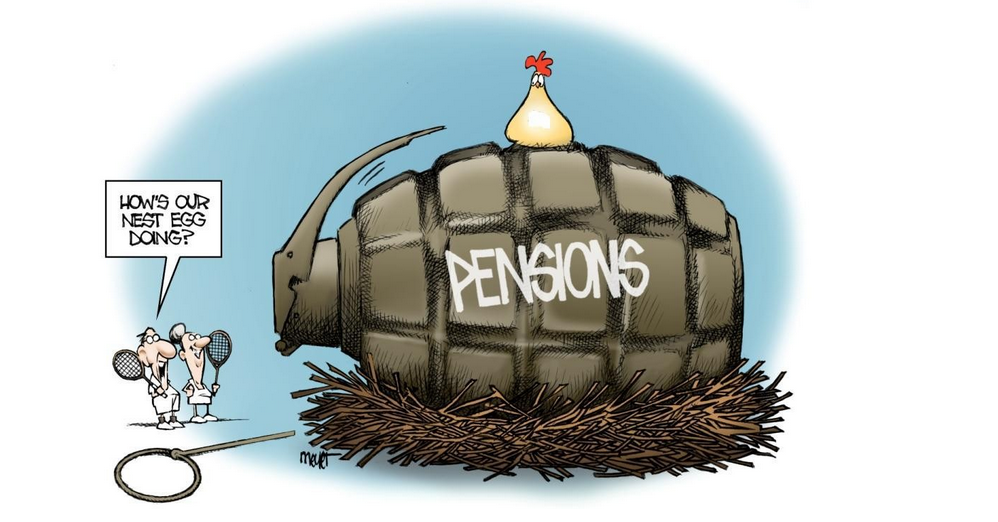
That means Devlin and Ferrioli will likely end up exploiting PERS for big payouts, potentially rewarding them with hundreds of thousands of extra dollars in benefits. This when PERS is already overwhelmed with billions of dollars in unfunded actuarial liabilities (UAL) and a task force appointed by Brown has just released a report outlining drastic measures that could be taken to partially address the problem.

johnmitchell2

Attorney General John Mitchell

“Watch what we do, not what we say,” President Nixon’s Attorney General, John Mitchell, told the press at the start of Nixon’s presidency in 1969.  Oregonians should do the same with the constant blathering of Gov. Brown and legislators about PERS’ deplorable financial condition and their determination to address the problem. Words, just words.