Virginia’s Nov. 7 election: rural vs. urban is the story

urbanrural

Democrats sweep in Virginia…as voters reject ‘Trumpism’, “ said OregonLive.

I’m not sure it’s that simple.

If you look at maps that break down election results by county in Virginia you will quickly see that it wasn’t so much Trumpism vs. Liberals as urban vs. rural. The Democratic gubernatorial candidate won by sweeping heavily liberal urban areas, but lost by big margins in rural areas.

It reminds me of statewide Oregon elections.

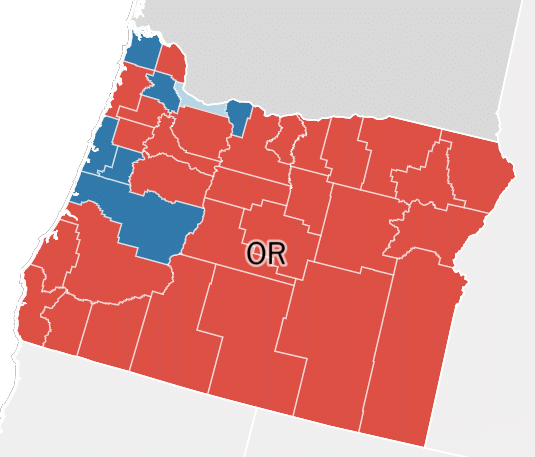
In 2016, when Kate Brown won the race for governor, her win was derived almost entirely from higher population urban areas, including counties with academic centers, such as the University of Oregon (Lane County) and Oregon State University (Benton County)

brownmap2

BLUE: Kate Brown; RED: Bud Pierce

John Kitzhaber’s 2014 race against Dennis Richardson followed the same pattern:

govenorsracepng

BLUE: Kitzhaber; RED: Richardsonn

Now look at the results of the Nov. 2017 governor’s race in Virginia, where voters chose Democrat Ralph Northam over Republican Ed Gillespie 54 percent to 45 percent.

votesharemapvirginia

RED: Gillespie    BLUE: Northam

The New York Times reported  that Lt. Gov. Ralph S. Northam won the race against Republican Ed Gillespie with huge margins in vote-rich metropolitan Virginia, and especially the populous Washington suburbs in Northern Virginia.

For example, in Northern Virginia’s Fairfax County, Virginia’s largest county (and where I used to live when working in Wash., D.C.) twice as many voters supported Northam than Gillespie. Northam also carried Northern Virginia’s Loudoun County by more than 23,000 votes — a 20-point spread.

Maps on the New York Times website  also show Northam’s big vote advantages in other urban areas, including Richmond (The State Capitol), Norfolk (Home to the largest U.S. Navy base in the world, Naval Station Norfolk, and one of NATO’s two Strategic Command headquarters, Roanoke ( Roanoke College , Hollins University and Virginia Tech  are in the area), and Harrisonburg (home to James Madison University, with an enrollment of 21,000 students).

Northam also did well in southeastern Virginia, where the state’s large black population is heavily concentrate. Northam also comes from Virginia’s eastern shore,

Meanwhile, Gillespie rolled up huge margins in rural areas, sometimes 70-80 percent of the vote. In southwest Virginia’s Scott County, for example, Gillespie took 81.4 percent, Northam 17.7 percent. The problem is all the rural areas couldn’t override Northam’s vote in populous urban areas.  Gillespie’s win got him just 4996 votes in Scott County., while Gillespie’s 67.9 percent win in Fairfax County got him 254,919 votes.

“Rural Virginia, mostly stuck with the GOP brand and backed Gillespie at almost the same levels as Trump,” Geoffrey Skelley, associate editor of Sabato’s Crystal Ball at the University of Virginia Center for Politics, told the New York Times. “However, the problem for the rural areas is that Gillespie didn’t make any inroads in the Urban Crescent, meaning that the more urban and suburban parts of the state trumped the heavily Republican vote in areas such as Southwest Virginia, Southside, and the Shenandoah Valley.

This election suggests that the state’s politics may remain very polarized, with urban areas being very Democratic, suburban and exurban areas leaning Democratic, and rural areas voting heavily Republican.”

In other words, despite the Democrat’s success this week, it’s no sure thing that 2018 will see a Democratic sweep.


/

]’;

Double dealing with PERS: enough of Gov. Brown’s shenanigans

kate-brown-10x8-d383f11824f1b171

What, me two-faced?

What one hand giveth, another taketh away.

Gov. Kate Brown knows how it works.

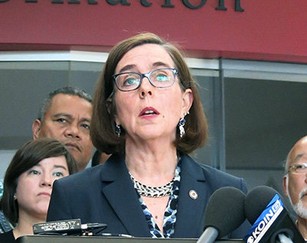
Just as a task force she appointed puts out a report on how PERS’ massive unfunded actuarial liability (UAL) might be reduced, Brown appoints two legislators to jobs that will drain PERS of hundreds of thousands of dollars.

The Task Force, which Brown charged with identifying options to generate additional funding to reduce the PERS UAL by up to $5 billion over the next five years, issued its report yesterday (Nov. 1). Ideas put forward in the report to generate revenue for PERS , which would impact all Oregonians, include:

  • Privatize state universities
  • Sell surplus port and airport property
  • Sell additional Common School Fund land assets
  • Expand the types of gaming the Oregon Lottery offers and direct revenue from these new options toward PERS
  • Impose a charge for new water rights based on market prices.
  • Sell or do an IPO of SAIF
  • Institute more aggressive foreclosures on properties with property tax and other liens (“Cities could use their own discretion to use the streamlined process (in order to make sure they don’t evict 85-year old grandmothers,” the report notes.)
  • Increase OLCC’s flexibility to operate the spirits business to maximize profits; Increase alcohol licensing fees and excise taxes on beer and wine; impose a surcharge on all distilled spirit (liquor) sales in Oregon, calculated as a percentage of the retail sales price (e.g., 1%, 5%, or 10%).

While all this revenue-raising analysis is going on, Gov. Brown is proposing to undermine PERS’ financial health by conspiring with Sen. Richard Devlin (D-Tualatin) and Sen. Ted Ferrioli (R-John Day) to enrich the legislators, fleece PERS and drive up the costs of PERS payers, such as schools and local governments.

As I’ve pointed out previously, on Oct. 23, Brown nominated Devlin and Ferrioli to the Northwest Power & Conservation Council, a federally funded panel that provides policy and planning leadership on regional power, fish and wildlife issues. The Senate Rules Committee is scheduled to consider the nominations on Nov. 13.

The council positions come with a $120,000 annual salary, substantially more than Devlin and Ferrioli have been making from their legislative salaries.

Furthermore, as The Oregonian’s Ted Sickinger reported this past week, both men will likely end up raiding PERS for big payouts.

The jobs “…will allow both legislators to double dip, turbocharge their public pensions, or both,” Sickinger reported.

As Sickinger explained it:

“Ferrioli already draws a $33,083 annual pension from the Public Employees Retirement System. That benefit stems from 6½ years working for the Oregon Department of Veterans Affairs in the late ’70s and early ’80s…And because he is already at retirement age, he is allowed to double dip, continuing to collect it while working full time at the council.

Meanwhile, Ferrioli is eligible for a separate pension for his 20 years of legislative service. And if his Senate colleagues confirm him to the new position, that pension will be calculated using his new higher salary and the extra years of service he earns at the power council, according to PERS.

It’s unclear how much service credit Ferrioli earned during his years at the Legislature, given the part-time work. But assuming he sticks with the job for the first three-year term, the new salary could quintuple his legislative pension, which could translate to hundreds of thousands of dollars in extra benefits over the course of his retirement (emphasis mine). And he could start drawing that while continuing to work at the council.

Devlin, too, could see a similar multiplier in his legislative pension if confirmed. He, too, has 20 years of legislative service and is eligible to start drawing his pension. But if he holds off, the new salary and service at the power council would balloon those benefits after three years.”

This brazen attempt to exploit PERS when it is already suffering from billions in unfunded liabilities needs to be cut off at the pass.

If they want to maintain their reputations as public servants, Devlin and Ferrioli should either decline the Council appointments or they should refuse any additional PERS benefits that may arise because of them.

And Gov. Brown and the Legislature need to put a stop to this practice of raiding PERS to enrich former Legislators. It’s time to stop taking Oregonians for rubes.


Dereliction of duty: How bad does it have to get before you shut down a failing virtual charter school?


badapple

Millions of taxpayer dollars! Appalling test scores! Horrific graduation rates!

Why are Insight School of Oregon – Painted Hills and Oregon Virtual Academy, both virtual charter schools run by K12 Inc., a for-profit, online education company, still operating?

Why are we letting this happen to our children?

Insight opened its doors in Oregon in 2012 as Insight School of Oregon Charter Option, sponsored by the Crook County School District in Central Oregon.

To operate the school, its board contracted with K12, Virtual Schools LLC, a wholly owned subsidiary of publicly traded for-profit K12 Inc. (LRN [U.S.:NYSE] ). K12 Inc. runs 58 separate virtual charter schools across the country. The company reported revenues of $888.5 million for the Year Ended June 30, 2017.

Insight’s Oregon headquarters was located in a nondescript one-story office building at 603 NW. 3rd St. in Prineville.

In its first three years, Insight’s K-12 enrollment grew to more than 500 students from around the state.

But all was not well.

K12 Inc. says its education program “is proven effective,” but the numbers told a different story to the Crook County School District. Even though the district netted $231,592 in the first year of its contract with Insight and $436,554 in the second, it began to have serious reservations about continuing the relationship.

In Nov. 2014, the Crook County School District sent a blistering letter to Insight expressing grave concerns about the school’s operations and academic performance.

School Superintendent Dr. Duane Yecha and school board Chair Doug Smith told the school they had major concerns about Insight’s: inadequate tracking of student attendance and enrollment; academic achievement; poor test participation; low four-year graduation rate (16.18 percent in 2013-2014); and failure to meet financial requirements stipulated in the district’s contract with Insight.

“…these issues have given the district reason to consider whether Insight is able to meet its ongoing obligations under the Charter Agreement and under ORS Chapter 338,” the letter said.

In 2015, even though the district was set to net $480,710 from its sponsorship of Insight in the 2014 – 2015 school year, it decided not to renew the sponsorship.

So Insight went shopping.

It quickly found a new partner, signing a sponsorship contract with the Mitchell School District 55 on April 29, 2015. The district had just one school serving a few local kids, some teens from around Oregon and high school students from Germany, Thailand, and Hong Kong. The 20 international and regional students all lived in a school dormitory at the school.

With a new sponsor in hand, Insight changed to a grade 7-12 school and renamed itself Insight School of Oregon – Painted Hills.

insightlogo

According to an audit by the Oregon Secretary of State’s office, Insight’s contract with Mitchell School District 55 removed school performance goals included in the the Crook County School District’s charter contract. Also removed was a requirement that Insight submit a written plan of correction if it did not meet the performance goals.

Academic performance didn’t change for the better, based on Report Cards by the Oregon Department of Education.


In the 2014-2015 school year, the last with the Crook County School District, only 16.4 percent of the students tested in Mathematics and 48.1 percent of those tested in English Language Arts met the state standard for college/career readiness. Just 37.8 percent met or exceeded state standards in Science.

On top of all this, the graduation rate was a horrific 19.1 percent.

In the 2015-16 school year, the first under the Mitchell School District, scores in Mathematics and English Language Arts got worse and science scores were only marginally better

Only 8.0 percent of the students tested in mathematics and 36.7 percent of those tested in English Language Arts met the state standard for college/career readiness. Just 45.5 percent met or exceeded state standards in Science.

Poor academic performance may have been due, in part, to the high absentee rate, the percentage of the school’s students who missed more than 10 percent of school days during the 2015-2016 school year. Insight’s rate was an extraordinary 66 percent, compared with 18.7 percent statewide

The lowest rate of absenteeism, 45 percent, occurred with 7th grade students, the highest , 86 percent, with 12th graders.

In 2016-17, with the school reporting enrollment of 390 students, performance in English Language Arts improved to 47.1 percent meeting the state standard for college/career readiness, though this was still far below the 60.9 percent performance of all schools statewide. Mathematics performance increased, but from an abysmal 8.0 percent to an abysmal 14.9 percent. Science dropped precipitously from 45.5 percent to 25.0 percent, compared with 60.5 percent statewide.

Other 2016-17 numbers were pretty weak, too. Only 34.5 percent of freshmen were on track to graduate in four years, up from  13.2 percent in 2015-16, but still pitiful compared with 83.4 percent of students at all schools statewide.

Meanwhile the percent of the school’s students that dropped out during the school year and didn’t re-enroll leaped to an almost unbelieveable 75.6 percent in 2016-17, compared with 49.8 percent in 2015-16.

To top it off, the graduation rate, students earning a standard diploma within four years of entering high school, sank from an already horrific 19.1 percent in 2014-15 to 11.8 percent in 2015-16. The graduation rate for 2016-17 is not yet available.

Even the share of students earning a regular, modified, extended, or adult high school diploma or completing a GED within five years of entering high school was just 27.7 percent, challenging the assertion that low 4-year graduation rates are due to credit deficiencies when students enroll.


oregonvirtualacademy

Another virtual charter school in Oregon powered by K12 Inc. is Oregon Virtual Academy (OVA), sponsored by North Bend School District 13.  “Oregon Virtual Academy awakens the power of learning in students through a personalized program of engaging courses, caring teachers, and a vibrant school community,” says the school’s website.

But, as at Insight, that awakening doesn’t appear to have brought about academic excellence, or even middling success.

For the 2015-16 school year, the North Bend School District received ​$14,874,303 ​from the State School Fund because of its sponsorship of OVA. The District retained $961,681 of that money and forwarded $13,912,622​ to OVA. OVA’s distribution was likely larger in 2016-17 because of increased enrollment.

But who was being taught with all that money? During the 2015-16 school year, OVA’s absentee rate was 41 percent. The lowest rate of absenteeism, 12 percent, was with 1st graders, the highest rate, 68 percent, with 12th graders.

And its academic performance is dreadful, contrary to an assertion by Interim Head of School Dr. Debbie Chrisop that “ORVA provides an education that meets or exceeds state standards, and students demonstrate their knowledge and skills through state standardized tests.”

With enrollment of 2,142 students from nearly every county in Oregon during 2016-17, only 47.9 percent of those tested in English Language Arts and 23 percent of those tested in Mathematics met the state standard for college/career readiness. Fewer than half, 44.1 percent, met or exceeded the state standard in Science. Worse, the Mathematics and Science scores have been going down each year for the past three years.

OVA’s graduation rate for in 2016 was just 28.3 percent, placing it among the worst performing 5 percent of all public schools in the state. Its 2017 rate has not yet been released.

Jessica Schuler, K12’s Corporate Communications Manager, offered the same explanation for the low graduation rates as other virtual charter schools. Every high school student enrolled in Insight School transferred in from another school or education program, she said. Furthermore, high percentages of these students enter behind in credits and not on track to graduate on time. The federal four-year cohort graduation rate does not account for this, she said.

The four-year cohort graduation rate unfairly penalizes schools with high mobility that serve under-credited transfer students (The grad rate of the sending school/district is not affected), Schuler said.  Even though these transfer students successfully earn high credits at Insight, they are unable to graduate “on time” in their four-year cohort, thus negatively impacting Insight’s grad rate.

A problem with this explanation is that even the share of students earning a regular, modified, extended, or adult high school diploma or completing a GED within five years of entering high school was just 42.8 percent, compared with 81.9 percent at all public schools statewide. Again, this challenges the common assertion that low student performance is due to the enrollment of many students who are credit deficient.

Excuses, excuses.

The fact is, full-time virtual schooling is the wrong solution for many young people, particularly those who are already struggling in a traditional hands-on school.

“Current online charter schools may be a good fit for some students, but the evidence indicates that online charters don’t serve very well the relatively atypical set of students that currently attend these schools, much less the general population,” said Stanford’s Center for Research on Education Outcomes (CREDO) in a 2015 report. “Academic benefits from online charter schools are currently the exception rather than the rule.”

In the same vein, a 2017 report from the Colorado-based National Education Policy Center (NEPC) concluded, “There is…little high-quality systematic evidence that the rapid expansion of (virtual charter schools) the past several years is wise. Research has …consistently found that students enrolled in full-time virtual schools have performed at levels well below their face-to-face counterparts.”

A 2016 Fordham Institute study of virtual charter schools reached similar conclusions. “Online schools offer an efficient way to diversify—and even democratize—education in a connected world,” the study said. “Yet they have received negative, but well-deserved, attention concerning their poor academic performance, attrition rates, and ill capacity to educate the types of students who enroll in them.”

Gov. Kate Brown and state legislators constantly reaffirm their commitment to ensuring Oregonians receive a quality education and that public dollars are spent wisely.

If these politicians mean what they say, why are these two schools being allowed to continue sucking up Oregon taxpayer dollars while failing to adequately educate Oregon children?

It’s time for the Oregon Legislature to act on failing virtual charter schools . The next session, which starts Feb. 1, 2018, will be a good time to start.


READ MORE about Oregon charter schools:

Virtual Charter Schools Don’t Compute

Too many Oregon virtual charter school students skip state tests

PERS problems? Some charter schools say, “Fugettaboutit”


Union Members Can Stop Subsidizing Liberal Candidates and Causes


liberalconservativesigns

A question to conservative Oregon union members (I know you’re out there): Why are you contributing to union political funds when most of the money ends up supporting liberal Democratic candidates?

About 18% of the electorate across the country was from union households in the Nov. 8, 2016 presidential election. Donald Trump captured 43% of those union-household voters.

In Oregon, 14.8 percent of the wage and salary workforce belonged to a union in 2015. It’s not clear how they voted, but it’s likely, based upon national patterns, that a decent share voted Republican.

Still, Oregon’s unions overwhelming endorsed Democrats. For example, all but two of the AFL-CIO’s 2016 Legislative endorsements in Oregon were for Democrats (one was an independent, one a Republican), as were all the statewide candidate endorsements.

Similarly, in the 2016 election, political contributions from Oregon’s unions went overwhelmingly to Democrats. For example, SEIU’s PAC, Citizen Action for Political Education (CAPE), spent $2,001,758.89 on the 2016 election. Of that, $706,750.00 went to Defend Oregon (the group pushing Measure 97), $205,000 to the Committee to Elect Brad Avakian, $180,000 to the Kate Brown Committee, and $37,380 to The Real Mike Nearman Committee (created to defeat Republican Mike Nearman).

So why don’t more union members who disagree with their union’s political stances decline to contribute to their union’s PAC and opt out of supporting the union’s political activities. It’s not that hard to do. All a union member has to do is become an “agency fee payer”, sometimes also called a “Fair Share Payer” or “Non-member.”

Oregon allows public employees who are part of a collective bargaining unit to refuse membership in the union that represents that unit. But because the union still has to negotiate on their behalf, these nonmembers must contribute to cover costs which cover collective bargaining, contract administration and grievance adjustment, but not costs associated with political activities.

This worker right was established in 2012 when the U.S. Supreme Court decided that while employees can be required to pay dues for the direct benefits they get from the union, they can’t be forced to give money to unions for political activities.

According to Steve Buckstein,  Founder and Senior Policy Analyst at Cascade Policy Institute, even before the 2012 Court decision, a telephone company employee named Harry Beck spent over two decades fighting for the right to opt out of paying the political portion of his union dues to the Communications Workers of America. In 1988, the U.S. Supreme Court ruled in his favor in Beck v. CWA and created what are now known as Beck rights. Harry is now retired and lives in Oregon. You can watch him tell his story here: https://www.youtube.com/watch?v=a29L3ouJ6tw.

Political spending by unions can be substantial…and influential.

In a Sept. 2015 report to individuals who pay Fair Share fees, the liberal-leaning Oregon Education Association (OEA) said 22.9 percent of its total expenses were nonchargeable for Fair Share fee payers and the liberal-leaning National Education Association (NEA) said a whopping 62.71 percent of its total expenses were nonchargeable for Fair Share fee payers.

This means that if annual OEA dues were $600, they could have been reduced to $462.60 and if annual NEA dues were $185, they could have been reduced to $68.99.

Think of it. Workers, rather than union bosses, deciding for themselves how, or whether, they want to spend their money on political causes.


Is Motor Voter Promoting Voter fraud in Oregon?

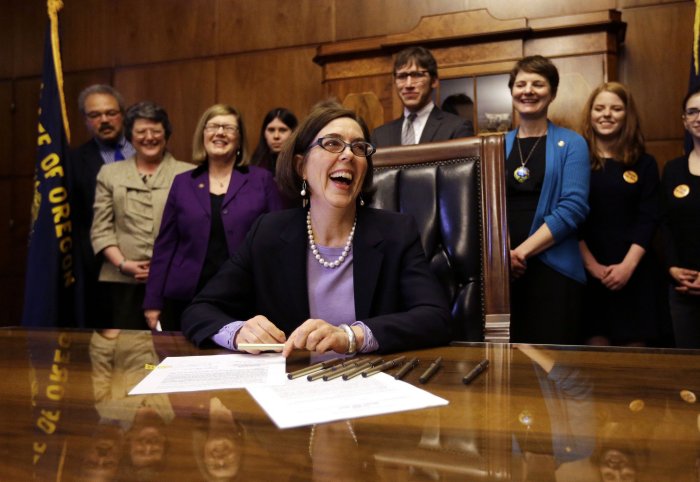
Oregon Gov. Kate Brown was thrilled when she signed the automatic motor voter registration bill on March 16, 2015.

motor-voter-law-brown

But does it have a flaw that could enable fraud?

Under Oregon’s Motor Voter law, when an eligible unregistered voter (over 17 years old, an Oregon resident and a US citizen) visits the DMV to apply for, renew, or replace an Oregon drivers’ license, ID card, or permit, that person receives a mailing from the Oregon Elections Division explaining their options for registering to vote.

Recipients of the mailing can:

  • Do nothing. In that case, the person is registered to vote as a nonaffiliated voter (not a member of a political party).
  • Choose a political party by returning the card. Joining a political party will allow the person to vote in its primary elections.
  • Use the card to opt-out and decline to register to vote.

On Oct. 25, 2016, Willamette Week ran a story that reviewed the new voter numbers. It noted that since the start of 2016, the Motor Voter law has added 247,501 newly registered voters. The story also noted that 9,292 DMV-generated voter registration cards could not be delivered.

Who are those 9,292 people? Could that mean that 9,292 people were fraudulently registered to vote?

According to Dr. Russell Terry, a Voter Engagement Advocate in the Oregon Secretary of State’s Elections Division, cards returned to the Elections Division as undeliverable can be because:

  • the address does not adhere to the USPS standardization for mailing addresses
  • the individual provided DMV with an address before updating their address through USPS
  • the individual is not identified as being at the address to which the mail is delivered

You might expect that a few addresses would be invalid if it took a while to send out the cards and people moved in the interim. But Terry said the transfer of data from the DMV to the Elections Division “…is only a few days, before or right around the time DMV would be mailing a driver’s license to that address as well.”

Is there a way, then, to check whether the people whose cards were undeliverable are legitimate voters?

I asked if I could access a list of all the names and addresses on those cards so a sampling could be checked.

Nope. “The Oregon Vehicle Code prohibits the disclosure of those individuals and their information,” Terry said.

So were up to 9,292 registered Oregon voters not eligible voters on Nov. 8? Who knows?

Given that situation, should the names of the 9,292 people whose cards were undeliverable be struck from the voter rolls?

Yes.


Measure 97: don’t buy a pig in a poke

piginapoke

After months of waffling and so-called reflection, Oregon Gov. Kate Brown now says she supports a whopping increase in business taxes through Ballot Measure 97. Surprise!

What liberal Democrat wouldn’t salivate over the prospect of $6.1 billion of additional state revenue in the 2017-19 biennium?

What’s dismaying is that Brown seems to be on the voters’ side, according to a recent poll by Clout Research. That poll, released on July 27, concluded the following with respect to Measure 97:

  • Yes              39%
  • No               34%
  • Not Sure    27.1%

The only saving grace here is that, according to FiveThirtyEight, Clout Research isn’t too reliable, earning a lousy C- ranking. Of the 9 Clout polls FiveThirtyEight reviewed, Clout called only 3 correctly. This compares, for example, with the ABC News/Washington Post which polled 78 percent of 51 races reviewed correctly and earned an A+ rating.

 Opponents of Measure 97 can also take some solace in the fact that The Clout poll  found support for the measure is diminishing. About 39 percent of respondents to the Clout poll favored the measure, versus 44 percent who favored it in early May.

Still, Brown’s support for Measure 97 is hard to fathom given the real impacts and uncertainties associated with the measure.

For example, Democrats always like to position themselves as dedicated, empathetic protectors of the poor. But Measure 97, if approved, would be a significant burden on the poor.

“…the gross receipts tax is subject to the same equity concerns as the retail sales tax because under most circumstances it eventually leads to higher consumer prices,” said Oregon’s nonpartisan Legislative Revenue Office in a report. “Any tax that is based on general consumption will have a regressive impact on the distribution of the tax burden, meaning that lower income households will experience a higher tax burden as a percentage of their income than higher income households.”

According to the report, families earning up to $48,000 a year will see a 9 percent decrease in net household after-tax Income under Measure 97 after wages and prices have adjusted to the new tax policy. In contrast, families earning over $206,000 a year will see just a 4 percent decrease in net household after-tax Income.

In the same vein, Measure 97 would change the distribution of Oregon’s state and local tax burden to disadvantage low-income Oregonians. According to the report, families earning up to $48,000 a year would see their effective tax rate go up in the range of .51 percent-.80 percent. In contrast, the effective tax rate of families earning more than $206,000 would go up just .27 percent.

So much for the Democrat’s commitment to low-income families.

For a party that says so often that it wants fairness and equality in the economy, its support for Measure 97 is also inconsistent. That’s because Measure 97 could really cause the equality of Oregon’s corporate tax system to go seriously awry.

According to the Legislative Revenue Office report, gross receipts taxes, such as those proposed in Measure 97, can distort tax payments because of something called pyramiding. “Pyramiding occurs when the gross receipts tax is built in at the time each transaction occurs and then passed on to the next stage,” the report said. “Because industries vary greatly in the number of transactions that occur, the effective tax rates can be considerably higher for those industries with multiple transactions compared to those that have very few.”

A study by the Washington Legislature, cited in the Legislative Revenue Office report, backed up this conclusion. “Because the degree of pyramiding varies widely, this means that effective tax rates will vary widely among industries, thereby distorting market prices and decisions,” the report said.

With all their talk of fighting inequality, is that really what Democrats want, a flawed, unequal business tax system?

Democrats will also be relying on some very iffy revenue expectations if Measure 97 passes and they grow spending based on the Legislative Revenue Office’s revenue projections. The office’s report projects that the largest 274 corporations based on Oregon sales would see their annual Oregon taxes increase by over $2 billion, or most of the total tax revenue increase from Measure 97.

But the office emphasizes that this is a very dubious number. “Since these corporations are large, operate globally in many cases, and often have substantial market power; accurately predicting their behavioral response to a large tax increase presents numerous challenges. The individual behavioral response of these corporations will be a key factor in determining how the tax burden is ultimately distributed.”

Finally, Oregonians who support Measure 97 because they believe Democrats’ claims that the revenue would be committed to things like K-12 education and healthcare are tragically misinformed. On Aug. 1, 2016, the nonpartisan Office of the Legislative Counsel released an opinion saying, in essence, the Legislature can do anything it damn pleases with Measure 97 revenue.

“Section 3 would not bind a future legislature in its spending decisions,” wrote Chief Legislative Counsel Dexter Johnson in the opinion. “If Measure 97 becomes law, the Legislative Assembly may appropriate revenues generated by the measure in any way it chooses.”

In other words, don’t bet your sweet bippy on how this would all play out.

With all these negatives and uncertainties, do Oregonians really want to buy the Democrat’s and unions’ Measure 97 snake oil?


An abuse of power: Oregon Democrats and the short session

When Governor Brown signed the new minimum wage law on March 2 she hailed it as an example of Oregon’s collaborative spirit. Far from it.

The Democrats have been using this year’s short session to run the Legislature like an authoritarian one-party state. That’s what happens when one party is in control for so long.

2013-congress

In one case, the Democrats steamrolled Republicans and rammed a minimum wage bill, SB 1532, through the Legislature in just one month.

The Senate passed the bill 16-12, with the vote going strictly along party lines. The House vote was 32-26, with every Republican again voting no.

Under this major law that will impact workers and employers across the state, the base state minimum wage will rise to $9.75 on July 1. Wages will then rise at different rates in in three geographic areas, with the Portland area reaching $14.75 in 2022.

Then there’s what The Oregonian has called “one of the most far-reaching pieces of energy legislation the state has ever seen.”

On March 1, the Democrats rammed through the House on almost a strict party-line vote, the latest version of a controversial bill that would end the use of coal to provide power to Oregonians within two decades and expand the use of renewables to 50% of the power supply by 2040. Republicans then repeatedly failed to derail the legislation, after which all but one Democrat voted to pass the bill, overwhelming the no votes of 12 Republicans (one didn’t vote).

In this case, it wasn’t only the Republicans that were shut out of the process; so was the Oregon Public Utility Commission. The Oregonian reported that state utility regulators say they were shut out when it came time to craft the legislation and when members of the Commission tried to voice their concerns publicly, the governor’s office muzzled them.

To top it off, Democrats have abused the short Legislative session itself.

When voters approved Measure 71, providing for annual legislative sessions, in 2010, there was a general expectation that the short sessions would deal with emergencies and lower-impact bills, leaving the longer sessions for comprehensive and high-impact bills where deliberation and public input would be required.

Democrats have cast that approach aside this short session and run amok with major partisan legislation.

Apparently its true, to slightly rephrase Mark Twain’s observation, that “No man’s life, liberty, or property are safe while the Oregon Legislature is in session.”


Gov. Brown & campaign finance reform: time to silence the megaphone

Governor Kate Brown says she wants campaign finance reform.

“No one should be able to buy a megaphone so big it drowns out every other voice,” Brown said last year. “It’s time to reopen conversations about reasonable campaign limits in Oregon.”

megaphone-review-abuse

But Brown can safely advocate campaign finance reform now because if it is imposed it won’t be until after her next race and all the usual suspects of unions, attorneys, and hangers-on have already contributed to her re-election campaign, some in jaw-dropping amounts.

A review of the records of the Kate Brown Committee during 2015-2016 (below) reveals dozens of $10,000 and up contributors, so there’s obviously no shortage of people and organizations willing to shovel out cash to ensure Brown has a big megaphone.

The Kate Brown Committee has already received contributions during 2015-2016 totaling $1,646,337 and has a current balance of $1,123,196.

Some of those contributions look like payback, such as the $100,000 contribution from the American Federation of State, County & Municipal Employees (AFSCME) following the state’s generous contract agreement with the labor union in 2015 and Governor Brown’s support for big increases in the minimum wage.

Other union contributions are undoubtedly intended to keep Brown on the straight and narrow in terms of supporting union agendas.

Another $10,000-and-over contribution that looks like payback is one from the Motor Vehicle Software Corporation, a California-based creator of DMVdesk electronic vehicle registration (EVR) software. The company began a phased introduction of its title and registration solutions, as well as training program, in Oregon last year. This is part of the company’s plan to automate registration nationwide.

I don’t doubt that there are more questionable contributions.

If Brown sincerely believes no one should be able to buy a megaphone, she could start by limiting her own contributions now.

______

Gov. Kate Brown’s $10,000-and-over contributors, listed on the Secretary of State’s website, are noted below:

Contributor/Payee Amount Aggregate Amount
Laborers’ Political League 75000 75000
Democratic Governors Association 10544.83 10544.83
James Summerton 10000 10000
Nike Inc. and Affiliates 10000 10000
Deloitte Services LP 10000 10000
AllCare Management Services, LLC 10000 10000
Stoll, Stoll, Berne, Lokting &Shlachter, PC 10000 10000
AFSCME 100000 100000
Jon Stryker 25000 25000
Planned Parenthood PAC of Oregon (4327) 10000 10000
DaVita Total Renal Care Inc 10000 10000
The Corson and Johnson Law Firm PC 10000 10000
Democratic Governors Association 10624.47 64920.75
John Koza 10000 10000
Oregon School Employees Assoc. – Voice of Involved Classified Employees (2307) 10000 10000
Global Companies LLC 10000 10000
Josh Kardon 10000 10000
Joshua Steiner 10000 10000
Motor Vehicle Software Corporation 10000 10000
Local 48 Electricians PAC (4572) 10000 35000
Swanson, Thomas, Coon & Newton 10000 10000
Steve Silberstein 10000 10000
Pfizer, Inc. 10000 10000
Timothy Quenelle 10000 10000
Kafoury & McDougal 10000 10000
Rosenthal Greene & Devlin PC 10000 10000
The Barton Law Firm, P.C. 10000 10000
jeffrey Bowersox 10000 10000
Johnson, Johnson & Schaller, PC 10000 10000
Erin Olson 10000 12500
D’Amore Law Group, PC 10000 10000
Tichenor & Dziuba LLP 10000 10000
Miller & Wagner LLP 10000 10000
Piucci Law 10000 10000
Mark Bocci 10000 10000
James Kelly 10000 10000
Linda Eyerman 10000 10000
Katherine Keane 10000 10000
Joseph Hawes 10000 12500
Charles Paulson 10000 10000
Stan Amy 20000 20000
Jane Paulson 10000 12000
Teevin Brothers Land & Timber 10000 10000
John Coletii 10000 10000
Democratic Governors Association 40000 54296.28
James Fuiten 10000 10000
Willamette Dental Management Corp. 10000 10000
Junki Yoshida 10000 10000
Democratic Governors Association 14296.28 14296.28
Robert Ball 10000 10000
Oregon State Fire Fighters Council 10000 10000
Barbara Lee 10000 10000
Local 48 Electricians PAC (4572) 25000 25000


Hypocrisy, thy name is Democrats

You can almost smell the Democrat’s hypocrisy.

hypocrisy-meter

On Feb. 20, the Oregon House passed a bill, H.B. 2177, that would automatically register to vote anybody with a driver’s license. Every single one of the 35 yes votes came from Democrats.

On March 5, the Oregon Senate passed the bill. Every single one of the 17 yes votes came from Democrats.

On March 16, an ebullient Gov. Kate Brown, another Democrat, signed the bill with a flourish.

“I am absolutely thrilled to be signing this into law as the new governor,” Gov. Kate Brown said at the signing ceremony. “Virtually every Oregonian will be able to have their voice be heard.”

Senate Majority Leader Diane Rosenbaum, D-Portland, echoed that sentiment. “Today our pioneering spirit brings us to a crucial reform that will empower our citizens,” she said. “While other states take steps to limit voter participation and to disenfranchise voters, the Oregon Legislature is bucking that trend. We are leading the nation.”

Yes, indeed, the Democrats patted themselves on the back for their grand support of voter’s rights.

But I guess they’re support of voting rights has its limits.

On March 25, the Senate voted 20 to 10 to approve S.B. 927, a bill that makes it clear Metro can move ahead with construction of an Oregon Convention Center hotel with $78 million of subsidies without having to be bothered by pesky voters. Every yes vote came from a Democrat. Now it’s up to the House.

How ironic that so many of the very people Oregonians have voted for are so quick to approve legislation that would deny others the right to vote.

Smell the aroma of hypocrisy? It stinks.