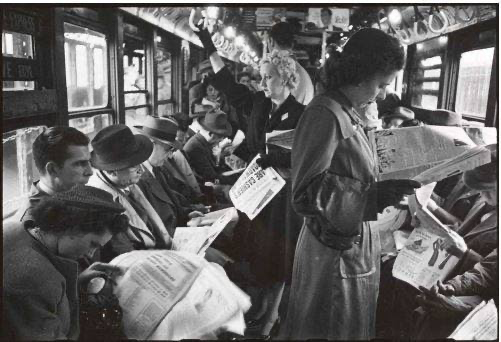
It used to be that if you didn’t read your local newspaper you simply didn’t know what was going on.
When I was growing up in the small town of Wallingford, Connecticut in the 1950s, my family read the Meriden Record, established in 1867, at the breakfast table and the New Haven Register, around since 1812, in the afternoon.
When I moved to Lake Oswego, Oregon, a suburb of Portland, in 1987, one of the first things I did was subscribe to the local paper, the Lake Oswego Review.
In 2006, Lake Oswego spent $20 million to acquire some property featuring an 89,000 sq. ft. office complex, intending to transform the site into a community center. But all hell broke loose when local opposition to the plan surfaced. Over coming years, the issue generated persistent news coverage in the Lake Oswego Review.
A couple years in, I asked a local friend, an educated professional, “So, what do you think about the controversy over the proposed community center?”
“Huh,” he replied. “Don’t know much about it.” I was shocked. He didn’t subscribe to the Lake Oswego Review, the principal news source for local residents.
That was back when as many as 8,500 local newspapers still played a critical role in the civic health of communities across America.
But since 2000, more than 3,200 newspapers in the country have simply vanished. In 2025, only about 36% of U.S. adults said they got news from their local daily paper at least sometimes, down from around 55% in 2000, and I suspect that percentage has continued to slip, particularly among young people. Overall news trust is also continuing to decline, although the most trusted news brands continue to be local television outlets and regional or local newspapers.
The loss of local media coverage in Oregon has been painful for the producers and consumers.
The Chronicle, which had served the southern Willamette Valley region in Lane County since 1909, focusing on Springfield, Creswell, Cottage Grove and Pleasant Hill, died a painful death earlier this month.

“We never put our heads down or ran on muscle memory,” Executive Editor Erin Tierney-Heggenstaller wrote in the last edition. “We were strategic, offering communities with virtually no other credible journalistic outlet what people say they want: award-winning hyper-local news about family, friends, and neighbors; practical reporting to make daily life easier; and curated content edited with standards that social media, AI slop, and corporatized commodity news no longer offer. “Build it, and they will come.” But they didn’t.”
The Lake Oswego Review hasn’t been spared from the same tumult.
Founded in 1921 as the Western Clackamas Review, renamed the Oswego Review in 1928, and then the Lake Oswego Review in 1961, the paper underwent several transformations, gradually expanding its readership and impact. By 1976, the paper was being published twice a week, totaling 90 pages and with a circulation of 8,200. In 1978, Eagle Newspapers, an Oregon regional newspaper group rooted in John Day, purchased the paper.
In 1996, former Review editor Steve Clark and his wife, Randalyn, bought the Review and its parent company, Community Newspapers Inc. Over the next few years, the company grew to include nine community newspapers. In August 2000, Lake Oswego residents Robert and Marilyn Pamplin bought Community Newspapers and transitioned it to Pamplin Media Group. Over the next 24 years, Pamplin grew to include two dozen newspapers in Oregon and their corresponding websites, including the Lake Oswego Review and the group’s flagship, the Portland Tribune, which had launched in February 2000.
“The Tribune and its family of newspapers provides the ‘right stuff’ that citizens need to engage effectively — with government, with each other, with the bigger world,” former Metro councilor Rex Burkholder said in 2016. “News, especially news that is about what is happening here and now, in one’s own community, is essential nourishment for anyone wanting to make a difference.”
On June 1, 2024, Mississippi-based Carpenter Media Group bought the entire Pamplin Media Group for an undisclosed sum. Carpenter, founded in 2023, says on its website, “The newspapers, websites and magazines we lead are the cornerstones of their communities, allies to businesses, incubators for innovation, and cultivators of journalistic talent. We aim to forge a well-informed, interconnected, and prosperous society – one community at a time.”
So much for that. In Oregon, a massacre followed.
Among the victims was the Lake Oswego Review, which had built a strong track record of publishing award-winning investigative and enterprise journalism, and two other Pamplin papers in adjacent cities, the West Linn Tidings and the Wilsonville Spokesman.
On February 11, 2026, the three papers were merged into one,The Review, a pale imitation of its three predecessors. The entire August 12, 2026 issue of The Review ran just 24 pages, including one self-congratulatory page promoting local stories in The Review, three pages of public notices and one page urging readers to let Oregon legislators know they value access to public notices in their local paper. The August 19 issue had just 15 pages of news.
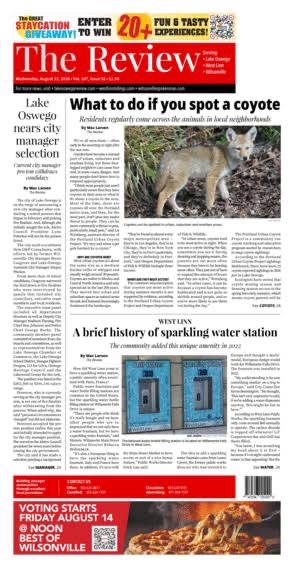
With that kind of shrinkage in news coverage, it hardly matters whether my Lake Oswego friend subscribes to the local paper today.
Meanwhile, other local news outlets have shriveled as well.
In October 2024, Carpenter Media Group bought the EO Media Group, which owned Oregon’s Bend Bulletin, the East Oregonian and other rural Oregon newspapers, and proceeded to slash and burn the papers’ staffs. John Carr, Senior VP of Oregon and Washington at Carpenter Media, said the cuts were “necessary financial changes and cost-cutting measures that will stabilize these publications for the future.”
The Portland Tribune had 40-50 newsroom staffers when it launched in February 2001. It ceased printing in June 2025 following major newsroom cutbacks and layoffs and now operates strictly as a digital, online-only news service that requires a paid subscription to access. Although Multnomah County still describes the Tribune on its website as a ” Portland city newspaper, offering comprehensive coverage of news, sports, business, people and entertainment”, it now has just one reporter, Hannah Seibold , who describes herself as “the sole survivor of the Portland Tribune at this point”.
The Oregonian newspaper, once the Portland area’s dominant local news source, has suffered as well. Founded in 1850 as a four page weekly, its first issue printed in a log shack on Portland’s SW First and Morrison,
I joined The Oregonian as a business reporter in 1987. It was a robust, well-respected paper then, with a proud past and a much-anticipated future. Daily Monday-Friday circulation was 319,624; Sunday circulation 375,914. When I left the paper 10 years later in 1997 to take a corporate communications job, daily Monday-Friday circulation was 360,000, Sunday circulation 450,000. We were on a roll.
Much of that success was attributed to Sandra Mims Rowe, who came on as editor in 1993 and tried to energize the newsroom with a hiring spree, bringing on reporters and editors from around the country. Under her leadership, the newsroom distinguished itself by winning five Pulitzers.
But the paper wasn’t able to escape the tumult of the newspaper business during her tenure. By the time she left the paper in Dec. 2009, she had to cut staff, salaries and benefits as circulation and revenue declined.
In 2009, The Oregonian’s daily circulation sat at 268,572 and Sunday circulation at 344,950, causing the paper to lose its position as one of the top 25 Sunday circulation papers in the country. That same year, the paper announced a long-term policy that protected full-time employees from layoffs for economic or technological reasons would end.
By 2012, daily circulation sank to 228,599, only slightly higher than circulation in 1950, and the declines continued. Talented reporters began departing in droves, some pushed out, others motivated by buy-outs. At the same time the once powerful paper saw its clout diminish as it abandoned rural Oregon and 7-day-a-week print distribution.
When I left The Oregonian in 1997 to take a corporate communications job, the paper employed a newsroom staff of about 400 journalists (reporters, editors, and photographers). The newsroom staff now consists of about 66 employees.
The paper publishes print editions just four days a week, while continuously updating its digital content. Average daily print circulation is 29,325 copies and Sunday print circulation is 44,294 copies. The days are long gone when what was in The Oregonian, particularly its opinion section and columnists, dominated local conversations all day.
So here we are. A once mighty paper hollowed out and humbled. A growing population served by a smaller paper. A weakened paper that no longer drives the daily discussion at the proverbial water cooler (or over a latte). A diminished, editorially impotent presence with a dwindling ability to hold powerful interests accountable.
But is the local news environment as depleted as often presumed? Is the gloomy view unwarranted?
As the size and impact of the traditional major dailies and weeklies in the Portland metro area have shrunk, other news outlets are working to fill the gap. Some of their audiences are limited and their coverage is not very deep, but together they are beginning to fill a continued need and judicious selectivity can provide unexpectedly broad local news coverage.
There is still, however, too much online coverage of national news and not enough of local. As Public Media Company CEO Tim Isgitt recently said to Poynter, “…public media is facing a perfect storm. We’re part of a rapidly changing media and technology landscape that is providing unlimited content — but perhaps not the content we need. We can get any national journalism we need, but we can get very little local journalism from this landscape…We’re part of a media and technology landscape that is largely failing our society — with detrimental societal impacts, whether it’s misinformation, lack of trust or the effects it’s having on polarization, teen mental health or the loneliness epidemic.”
Some local media in Oregon are trying to do better.
Willamette Week, an alternative paper and digital media outlet, continues to offers cultural, civic and political coverage and reaches hundreds of thousands of print and online viewers, even if it tends to focus on only a few topics each week and its daily local online news coverage is limited.
The Portland Mercury, an alternative bi-weekly, offers coverage of local arts, music, and city culture.
There are also a number of hyper-local outlets such as the Northwest Examiner, the Southeast Examiner, Montavilla News, The Bee, Star News, The St. Johns Review, The Mid-County Memo and The Skanner,
Other options include the solid news site OPB, City Cast Portland, a website and a daily podcast for local news, Oregon Capitol Chronicle, part of the States Newsroom, and a relative newcomer, Axios Portland, with two reporters, Meira Gebel and Kale Williams.
And there’s still Oregon Business, around since 1981, that reports on a wide range of topics such as leadership, innovation, technology, culture, politics and environment, and the Portland Business Journal, published since 1984, which delivers local commercial news, data, and networking opportunities for the Portland, Oregon metro area.
Another innovative outlet focusing on local business news is Portland Inno, a digital media outlet powered by the Portland Business Journal, focused on Portland’s local startup, technology and innovation economies. A recent story, for example, broke the news that Mark Ronay, who founded materials company Liquid Wire in 2016, had launched a company is called Spectralsurf, aimed at bringing down the costs of semiconductor manufacturing, with funding from Portland Seed Fund and ONAMI .
Then there are Portland’s television stations, KGW 8, KOIN 6, KATU 2 and KPTV Fox 12, offering varying levels of useful local news.
Portland’s local news outlets sometimes provide mindless drivel and poorly-researched gossip, comparable to the blitzing of the podium done by the Trump administration on a regular basis, and there’s a lot of slop out there, but they can also produce substantial deeply-researched impactful stories and the fact is the public is hungry for reliable local news.
Increasingly, however, that hunger for local news is being met not by the news outlets noted above, but by social media. Young people, in particular, move between podcasts, X accounts and YouTube livestreams where there’s no editorial control, no reviews and no accountability, where skepticism is required, but not often employed. Of course, young people will eventually grow older, but there is little likelihood that they will grow into accessing media as their parents did.
For the first time globally, more people are getting their news from social media platforms featuring independent online news personalities and commentators on platforms like Substack, TikTok and YouTube than television or news websites, according to a new report by the Reuters Institute for the Study of Journalism. This is particularly the case with younger audiences who often stumble upon information passively, consuming news that is automatically served to them through algorithm feeds, comment sections, and trending topics.
“…most Americans now get their information and form their opinions through creators, podcasts, Substacks, group chats,” says Renée DiResta, an Associate Research Professor at Georgetown University’s McCourt School of Public Policy. “Most traditional institutions have only minimal engagement or presence in those spaces. So that ecosystem runs on a very different model of legitimacy. People are following people, not institutions. They’re following people that they find appealing or relatable. Somebody coming to you from their kitchen.”
Substack is one beneficiary off this trend. One of the more prolific, and controversial, Substack commenters in the Portland area is Keven Dahlgren, who writes on homeless issues in Truth on the Streets. Another widely read site is Oregon Roundup by Jeff Eager, which says it covers “Oregon’s uniquely dysfunctional state government and the politics that create it.”
One problem, though, is that of the strong, reliable news, even local news, is only available if you are willing to shell out for a subscription, and many people are not. As one commenter on a substack post, Second Rough Draft, recently noted, “…the press sells what the public wants to buy. If there was a greater market for light, the media would cut back on the heat…elite audiences willing to pay are getting ample good information and others choose to pay less and get less.”
The Reuters Institute notes in a report, another troubling sign, that it is seeing stagnation or decline in overall online news engagement. People are turning away from the news. “The trends are worse among younger people and those without a university degree,” Reuters says.
Some of that decline may be simply due to the way social media works. “Social media algorithms are optimised for engagement, with the goal of keeping people on the platform as long as possible, ” according to Reuters. “This has seen social media companies prioritising things like entertaining short-form video and de-prioritising news…Political news caused headaches for them, so they turned away.”
The problem is locally-focused social media can be a swamp and it can be hard to separate truth from the muck.
“… in different, darker corners of the internet, it has become a source of endless misinformation and disinformation dispensed by a panoply of influencers, conspiracy theorists, edgelords, grifters and con men, DIY gurus, hostile foreign actors, and partisan echo chambers full of dittoheads and doxers,” observes John Ramage, a former and Arizona State University professor of English, on Substack. “It is a world without gatekeepers, regulators or arbiters, an epistemic wild, wild west where anyone who relies on evidence-based reasoning is dismissed as an establishment tool.”
Then there’s the problem of what’s happening when news-searchers engage with social media, such as items on X. 404 Media recently noted that X’s algorithm learns what you hate and shows you more of it, according to a new study just published in the Proceedings of the National Academy of Sciences (PNAS). The paper, titled Value misalignment of X’s feed algorithm is a reflection of value tensions in engagement, found that the site’s algorithm prioritized engagement above all else when it generated a user’s For You Page.
“When a user on X sees a post that makes them mad — like a press release from a politician from a political party they don’t like — sometimes they’ll fight about the post in the replies,” 404 Media noted. “It doesn’t matter who you follow or what your stated values are, X reads replying as engagement and will send more of the infuriating posts the user’s way.”
Reviewing The Story of Your Life: How Social Media Shapes the Way We Experience Everything, New York Times book critic Alexandra Jacobs noted that with social media,”All was sweet, innocent fun for awhile, then the algorithm came along and ruined everything, like a drifter in a Cormac McCarthy novel”, with all sorts of deleterious effects.
Or as historian Anton Jäger said recently on the Ezra Klein Show, “…our attention is fundamentally shaped now by algorithms that care about controversy, that care about newness, that are hunting amorally and constantly for whatever will get a rise out of people.”
It’s also important to realize that slop is proliferating on the web — some studies say 50 percent of online articles are now artificially generated. Then there are so-called “pink slime” sites, publications that mimic the appearance and output of traditional news organizations. Snopes, an online fact-checking and myth-busting website, can help sniff out such sites.
it’s incumbent on citizens to proactively be selective in their news habits. In “Ordinary People, Extraordinary Times: How to Reclaim Your Power, Fight for Freedom and Reimagine Democracy”, Skye Perryman, the president and CEO of the national nonprofit Democracy Forward, urges Americans to do an inventory of the sources of their news and information and “to become an active, purposeful seeker of information rather than passively absorb whatever comes our way.”
However you consume local news, “Studies have shown that the supply of local news is correlated with higher rates of civic engagement,” says the Agora Journalism Center at -the University of Oregon. “Robust local journalism matters to how informed citizens are, and according to another recent Knight Foundation report, a healthy news and information ecosystem creates “a virtuous circle whereby improved information contributes to improved community outcomes.”
If you want an educated, informed public in a position to make wise judgments, quality local journalism is key. As Thomas Jefferson wrote in 1787, “The way to prevent irregular interpositions of the people is to give them full information of their affairs through the channel of the public papers, and to contrive that those papers should penetrate the whole mass of the people.”

 ThinkingOregon