
Trump’s Shameful Attempts to Define American History

Of all things, an article in The Cut, a digital section of New York magazine, about the death of Gloria Steinem on September 2 at 92 spurred me to write this piece about Donald Trump and the Smithsonian’s interpretations of history.

Frankly, I’ve never thought much about Gloria Steinem, but for some reason I was intrigued and pored over the entire 5,948-word article. What a fascinating life!

“She was a talented, driven, and powerfully charismatic emblem for a movement that was always more complicated and sometimes more radical than she herself was,” wrote Rebecca Traister. “Her life, her work, and her contradictions together provide a remarkable illustration of the political and social disruption mainstream America is willing to tolerate, occasionally celebrate, and also revile.”

Traister wrote that Steinem frequently said she hoped to live to 100. “I’ve so loved being here,” she said in the HBO documentary. “I love it so much. I never want it to end.”

So what’s the connection of all this with Donald Trump and the Smithsonian?

The Washington Post reported on September 2 that the Trump administration is threatening to cut off executive agencies’ cooperation with the Smithsonian Institution “…if its leaders do not abandon what the administration described as “an ideological agenda that seeks to transform both the Smithsonian and the country.”

Trump set off a misguided attack on The Smithsonian when he launched his campaign against the institution last March. that was when he signed an executive order titled “Restoring Truth and Sanity to American History” that instructed his administration to eliminate what it called “divisive narratives” and “improper ideology” from the Smithsonian and restore it as “a symbol of inspiration and American greatness.”

The executive order instructed Vice President JD Vance, who sits on the Smithsonian’s board, to work with Congress and the Office of Management and Budget to withhold funding for exhibits or programs that “degrade shared American values” or “divide Americans based on race.”

What the order really did was order that the telling of America’s history conform to Trump’s ideological view that there be just one public interpretation of American history, his.

But the fact is history is constantly being reviewed, re-interpreted, revised, re-thought. Topics of intense interest to one generation slip back as new topics emerge. Historical revisionism is a fundamental element of the discipline as new evidence emerges and societal perspectives change. Interest in some figures declines as new heroes and villains emerge.

Benjamin Franklin spoke to this fact in 1787 when he called upon those gathered art the Constitutional Convention in Philadelphia to rally behind the new plan of government they had devised:

“I confess that there are several parts of this constitution which I do not at present approve, but I am not sure I shall never approve them,” he said, “For having lived long, I have experienced many instances of being obliged by better information, or fuller consideration, to change opinions even on important subjects, which I once thought right, but found to be otherwise.”

My decision to examine more closely Gloria Steinem’s life was a reflection of a new interest in somebody with whom I was only vaguely familiar. In a similar vein, I’ve been tackling books that offer new perspectives on historical events.

For quite a while there was a widespread belief that North America, for example, was some vast, wild, untouched wilderness barely populated by primitives before more sophisticated and civilized Europeans arrived. You will be dissuaded of that notion if you read Cahokia: Ancient America’s Great City on the Mississippi by archaeologist Timothy R. Pauketat. Research has revealed that in pre-Columbian America native civilizations built massive urban centers like Cahokia in southwestern Illinois which was populated by tens of thousands of people.

I long admired Apple’s leaps into China to grow its business, but I got a new perspective, and new concerns, on the implications of Apple becoming so deeply intertwined with China when I read “Apple in China: The Capture of the World’s Greatest Company” by Patrick McGee.

As the son of a man who served proudly in the U.S. Navy during WWII, I have always been interested in President Truman’s decision to drop the atomic bomb, wondering whether it was the right decision, particularly as some revisionists have challenged it. I’ve read multiple books on the war and that decision, arriving at the conclusion it was the right one in the face of up to a million American casualties if an invasion went forward. And, by the way, historians have been constantly re-evaluating Harry Truman the man and his presidency.

I’ve read the first two books of Rick Atkin’s trilogy on the American revolution, Bernard Bailyn’s “The Ideological Origins of the American Revolution”, Thomas Paine’s “Common Sense”, Ron Chernow’s “Alexander Hamilton” and countless others to better understand that world-changing event.

Before seeing Ken Burns’ documentary, The American Revolution, were you aware of the astonishing effort led by Boston bookseller Henry Knox to haul 59 heavy cannons and mortars from captured from British forces at Fort Ticonderoga across 300 miles of frozen wilderness to Boston, forcing a British evacuation of the city without a shot being fired? Wow! It spurred me to read an entire book, Henry Knox’s Noble Train by William Hazelgrove, about the endeavor.

The Noble Train

I’ve been taken aback to read of the extent to which slavery extended far beyond the South into into New England, even into the Norman Rockwell-perfect small town of Wallingford, Connecticut where I grew up. As Anne Farrow wrote in “The Logbooks: Connecticut’s Slave Ships and Human Memory”, In Connecticut and elsewhere in New England, “All the best families owned ‘captives’.”
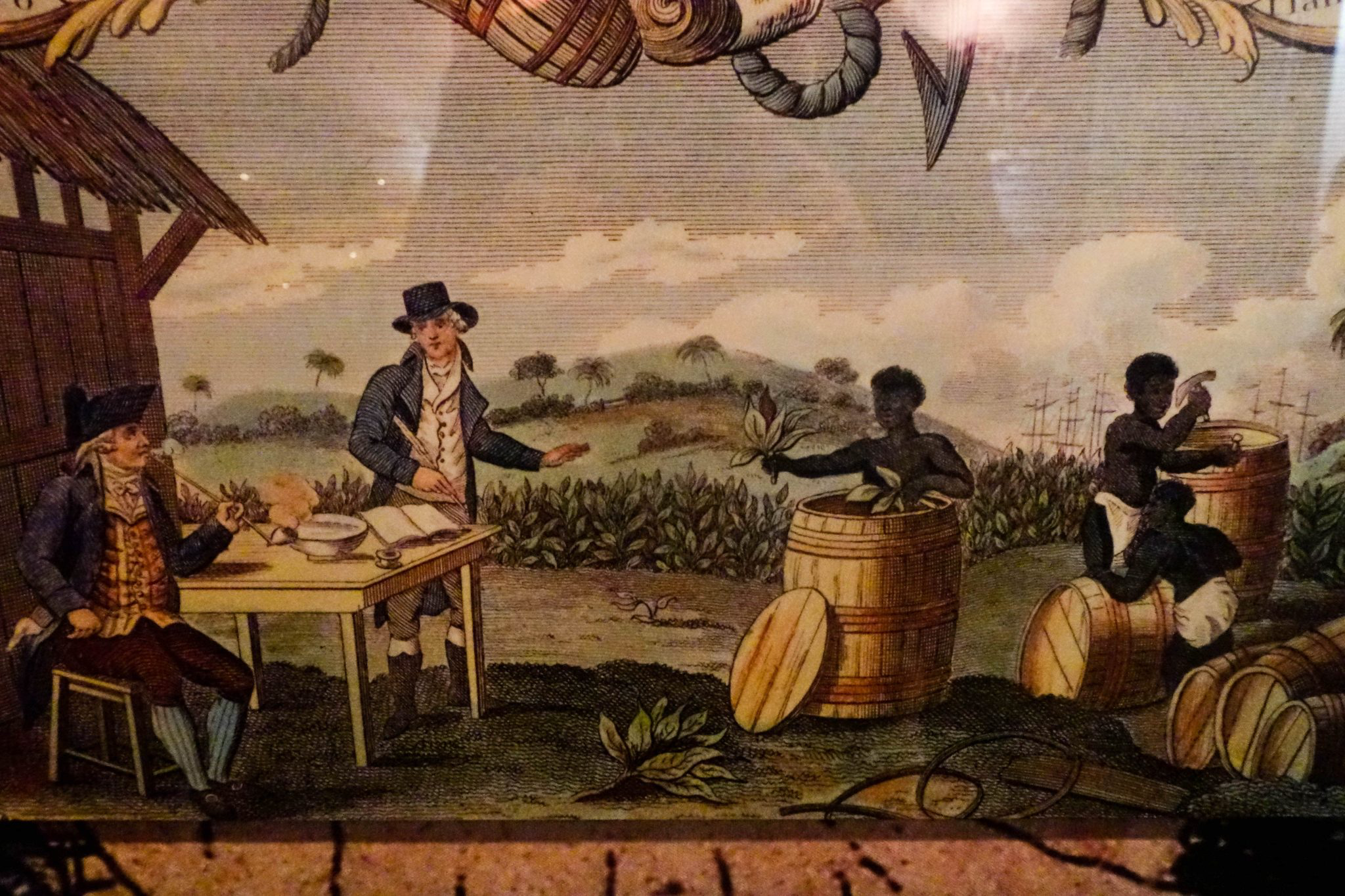
Slaves on a tobacco farm in Connecticut

I grew up as a child idolizing Charles Lindbergh for his single-handed crossing of the Atlantic to Paris in the Spirit of St. Louis. I even made a special trip during a later visit to Hawaii to visit his grave on the grounds of the Palapala Ho’omau Church at the end of the road to Hana on the coast.

t wasn’t until I read numerous books about his life that I learned he was a leading spokesman for the America First Committee that opposed America’s entry into WWII. Also, although many Americans shared his early opinions, Lindbergh went further, blaming “the British, the Jewish and the Roosevelt Administration” for pressing for American intervention. I also learned after he died in 1974 that he led a double life, starting a romance with a woman in Munich, Germany in 1957 and having three children with her who knew him only as ”Mr. Careu Kent”.

Charles Lindbergh speaking at an America
First Committee rally in Fort Wayne, Indiana,
October 3, 1941.

Suffice it to say, every time I turn around I find stories that challenge my views on people and issues of historical significance.

On July 4th, of all days, White House Domestic Policy Council Director Vince Haley released “Saving America’s Story,” a 162-page report accusing the National Museum of American History of “extreme political activism”. The report’s key finding: “museum leadership has explicitly adopted an ideological framework that no longer treats the American story as a shared national inheritance to be taught or celebrated, but as a political instrument to divide, dispirit, and discourage our citizens.”

What ought to dispirit all Americans is something else. That’s the Trump’s administration’s impulsive and capricious efforts to shut down debate on America’s glorious, and yes, flawed, history.

“Abortion Rights Are Safe In Oregon” Says Oregon’s Attorney General. Don’t Believe It.

Survey shows Americans' conflicted ...

During his presidential campaign, Donald Trump was all over the map on abortion. But you’d be a fool to think this means abortion rights are safe in Oregon or the rest of the country. They are not.

In June 2023, addressing a Faith & Freedom Coalition Gala, Trump said he was the “most pro-life president ever.” As with so many of his other c campaign promises, he’ll likely follow through with that promise.

Oregon’s attorney general says all is well. The Oregon Department of Justice website is adamant that the overturning of Roe v. Wade has not affected abortion rights in the state: “Abortion is still SAFE, ACCESSIBLE and LEGAL in OREGON” its says. “The United States Supreme Court decision in June 2022 overturning Roe v. Wade(called Dobbs v. Jackson Women’s Health) did not change Oregon laws protecting a pregnant person’s right to have an abortion in Oregon.”

The fact is, however, that no state is immune from federal actions limiting abortion rights.

With Pam Bondi’s Senate confirmation as attorney general still ahead, for example, her chief of staff, Chad Mizelle, who is temporarily leading the Justice Department, issued a memo sharply limiting prosecutions of people accused of blocking access to abortion clinics, calling such cases the “prototypical example” of federal weaponization.

On January 23, 2024 Trump followed up by pardoning 23 people who were convicted of violating the Freedom of Access to Clinic Entrances Act (FACE Act), including many who were serving prison sentences for physically blocking patients from accessing their doctors. Some of the offenses committed included breaking into clinics, stealing fetal tissue, and accosting pregnant patients.

Jessica Valenti, a prominent writer on gender and politics, has reported that:

  • Dozens of Republican lawmakers held a private meeting with anti-abortion activists where they pledged to repeal the FACE Act
  • The Department of Justice announced that they won’t enforce the FACE Act unless there are “extraordinary circumstances…such as death.”
  • Conservative legal groups are working to overturn Hill v. Colorado—the Supreme Court decision that established abortion clinic buffer zones.

Efforts are also underway to limit Planned Parenthood’s operations in Oregon access to federal Medicaid money, potentially cutting off its ability to provide abortions. 

On January 27,  the White House Office of Management and Budget  (OMB) issued an order setting off  a temporary pause of  federal grants to give agencies time to review spending priorities. On Jan. 28, OMB sent another sent a directive telling federal agencies to fill out an attached spreadsheet answering questions about programs that might require funding and whether they aligned with Trump’s agenda. One of the questions asked if the program supports abortion “in any way.”

At his Senate confirmation hearing for  Health and Human Services Secretary, Robert F. Kennedy Jr. assured Sen. Tim Scott (R-SC) he would appoint only pro-life deputies.

Abortion access in Oregon may be constrained by restrictions on access to pills used in medication abortions.  Access to the abortion pill mifepristone, for example, still largely depends on a patchwork of state laws, with only about half of states allowing full access under the terms approved by the federal government. According to PBS, A dozen or so states have laws specifically limiting how mifepristone can be prescribed, such as requiring an in-person visit with a physician or separate counseling about the potential risks and downsides of the drug.

In a sign of the times, a New York doctor, Margaret Carpenter, was indicted by a Louisiana grand jury on January 29 for allegedly prescribing an abortion pill online in the southern state, which has one of the strictest near-total abortion bans in the country. Under the law, physicians convicted of performing an illegal abortion, including one with pills, face up to 15 years in prison, $200,000 in fines and the loss of their medical license. Carpenter was charged charged with criminal abortion by means of abortion-inducing drugs, a felony. Carpenter was operating under New York’s telemedicine “shield law,” which protects providers who ship abortion pills across state lines, but it may not matter.

Project 25, The Heritage Foundations blueprint for Trump’s actions, calls for the Centers for Medicare & Medicaid Services to encourage states to remove Planned Parenthood facilities from the Medicaid program. Project 25 also proposes mobilizing an array of federal agencies to limit access to abortion, including a national ban on abortion pills even in states like Oregon with liberal abortion laws. 

“The Dobbs decision (overturning Roe v. Wade) is just the beginning,” Project 2025 says. “Conservatives in the states and in Washington, including in the next conservative administration, should push as hard as possible to protect the unborn in every jurisdiction in America.”

Oregon Right to Life, which says “We work to reestablish protection for all innocent human life from conception to natural death” is also continuing its efforts to restrict abortion in the state.

“Being a pro-life legislator in Oregon comes with unique challenges,” says the group’s website. “That being said, our mission remains the same: provide tangible, encouraging support to women and families, and protect as many unborn lives as possible from abortion. Understanding the unique terrain of this issue in Oregon, we want to continue to put forward limits that are widely supported with key exceptions, and considered “reasonable” even by self-proclaimed pro-choice voters.” 

 Undeterred by a generally hostile Legislature, the group is pursuing enactment of several bills during the 2025 session, including:

  • HB 2372 – would require a physician to provide a baby born alive during an attempted abortion procedure the same degree of care as any other baby at the same gestational stage.
  • HB 3248 – would place a limit on abortion when the baby can feel pain with exceptions for medical emergencies, rape, and incest.
  • HB 2381, 2382 – would establish the Pregnancy Launch Program to encourage healthy childbirth; support childbirth as an alternative to abortion; promote family formation; aid successful parenting; Increase families’ economic self-sufficiency; and improve maternal health, mortality, and postpartum outcomes. It would also create a hotline and set a requirement that this information be provided to an abortion-minded woman 48 hours prior to her abortion procedure. Finally, it would establishe an OHA grant program to help fund entities offering services related to encouraging and assisting mothers in carrying their pregnancies to term.
  • TBD – would require parental consent for minors (under 18) traveling into Oregon for an abortion.

The battle is on.

Trump/Vance Threaten The Competence of the Federal Civil Service

Donald Trump has made it clear he wants to overhaul the federal civil service and erode merit system principles. Sen. J.D. Vance, R-Ohio, Trump’s pick for vice president, has said that if Trump wins re-election, he should “…fire every single mid-level bureaucrat” and “replace them with our people.”

At campaign events, Trump has promised to “obliterate the deep state,” what he believes is a network of non-elected government employees working under cover to bypass elected officials and further their own contrary agenda.

I’m sure it sounds straightforward, simple and appealing to Trump’s ideological followers who think career civil servants would work to stymie Trump’s conservative policies if he’s re-elected.

But firing all the federal government’s mid-level bureaucrats and replacing them with political appointees would be a disaster for America.

I know that because I’m a former mid-level federal bureaucrat. I know that much of the work in multiple government agencies by U.S. civil servants is highly specialized, complex, and essential for an efficient government that serves the people. 

Under the U.S. General Service (GS) pay scale, the GS-1 through GS-7 range generally marks entry-level positions, mid-level positions are in the GS-8 to GS-12 range and top-level positions (senior managers, high-level technical specialists, or physicians) are in the GS-13 to GS-15 range.

I served in that mid-level band. As a Foreign Affairs Officer with the National Marine Fisheries Service during part of my professional career, I worked with the Department of State on international fisheries negotiations, principally with Russia, Canada and Asian nations. In preparing for that job, I earned a bachelor’s degree in International Relations, a master’s degree in Political Science and a master’s degree in Marine Affairs. I had also written a proposal for the United Nations Conference on the Law of the Sea and worked for an international marine conservation non-profit in Canada.

Many others on my team had similar backgrounds. During my time in government I worked with a wide range of exceptional people with broad experience and academic backgrounds doing specialized work that advanced American interests. 

“Almost all Western democracies have a professional civil service that does not answer to whatever political party happens to be in power, but is immune from those sorts of partisan wranglings,” says Kenneth Baer, who served as a senior Office of Management and Budget (OMB) official. “They bring… a technical expertise, a sense of long history and perspective to the work that the government needs to do.”

Gutting the civil service and replacing experienced workers with political hacks, as Trump and Vance advocate, would be irresponsible.

Don’t let it happen.