Local News: The Times They Are a-Changin’

It used to be that if you didn’t read your local newspaper you simply didn’t know what was going on.

When I was growing up in the small town of Wallingford, Connecticut in the 1950s, my family read the Meriden Record, established in 1867, at the breakfast table and the New Haven Register, around since 1812, in the afternoon.

When I moved to Lake Oswego, Oregon, a suburb of Portland, in 1987, one of the first things I did was subscribe to the local paper, the Lake Oswego Review.

In 2006, Lake Oswego spent $20 million to acquire some property featuring an 89,000 sq. ft. office complex, intending to transform the site into a community center.  But all hell broke loose when local opposition to the plan surfaced.  Over coming years, the issue generated persistent news coverage in the Lake Oswego Review.

A couple years in, I asked a local friend, an educated professional, “So, what do you think about the controversy over the proposed community center?”

“Huh,” he replied. “Don’t know much about it.” I was shocked. He didn’t subscribe to the Lake Oswego Review, the principal news source for local residents.

That was back when as many as 8,500 local newspapers still played a critical role in the civic health of communities across America.

But since 2000, more than 3,200 newspapers in the country have simply vanished. In 2025, only about 36% of U.S. adults said they got news from their local daily paper at least sometimes, down from around 55% in 2000, and I suspect that percentage has continued to slip, particularly among young people. Overall news trust is also continuing to decline, although the most trusted news brands continue to be local television outlets and regional or local newspapers.

The loss of local media coverage in Oregon has been painful for the producers and consumers.

The Chronicle, which had served the southern Willamette Valley region in Lane County since 1909, focusing on Springfield, Creswell, Cottage Grove and Pleasant Hill, died a painful death earlier this month.

The staff of the Chronicle on their last day.

“We never put our heads down or ran on muscle memory,” Executive Editor Erin Tierney-Heggenstaller wrote in the last edition. “We were strategic, offering communities with virtually no other credible journalistic outlet what people say they want: award-winning hyper-local news about family, friends, and neighbors; practical reporting to make daily life easier; and curated content edited with standards that social media, AI slop, and corporatized commodity news no longer offer. “Build it, and they will come.” But they didn’t.”

The Lake Oswego Review hasn’t been spared from the same tumult.

Founded in 1921 as the Western Clackamas Review, renamed the Oswego Review in 1928, and then the Lake Oswego Review in 1961, the paper underwent several transformations, gradually expanding its readership and impact. By 1976, the paper was being published twice a week, totaling 90 pages and with a circulation of 8,200.  In 1978, Eagle Newspapers, an Oregon regional newspaper group rooted in John Day, purchased the paper.

In 1996, former Review editor Steve Clark and his wife, Randalyn, bought the Review and its parent company, Community Newspapers Inc. Over the next few years, the company grew to include nine community newspapers. In August 2000, Lake Oswego residents Robert and Marilyn Pamplin bought Community Newspapers and transitioned it to Pamplin Media Group. Over the next 24 years, Pamplin grew to include two dozen newspapers in Oregon and their corresponding websites, including the Lake Oswego Review and the group’s flagship, the Portland Tribune, which had launched in February 2000.

“The Tribune and its family of newspapers provides the ‘right stuff’ that citizens need to engage effectively — with government, with each other, with the bigger world,” former Metro councilor Rex Burkholder said in 2016. “News, especially news that is about what is happening here and now, in one’s own community, is essential nourishment for anyone wanting to make a difference.”

On June 1, 2024, Mississippi-based Carpenter Media Group bought the entire Pamplin Media Group for an undisclosed sum. Carpenter, founded in 2023, says on its website, “The newspapers, websites and magazines we lead are the cornerstones of their communities, allies to businesses, incubators for innovation, and cultivators of journalistic talent. We aim to forge a well-informed, interconnected, and prosperous society – one community at a time.”

So much for that. In Oregon, a massacre followed.

Among the victims was the Lake Oswego Review, which had built a strong track record of publishing award-winning investigative and enterprise journalism, and two other Pamplin papers in adjacent cities, the West Linn Tidings and the Wilsonville Spokesman.

On February 11, 2026, the three papers were merged into one,The Review, a pale imitation of its three predecessors. The entire August 12, 2026 issue of The Review ran just 24 pages, including one self-congratulatory page promoting local stories in The Review, three pages of public notices and one page urging readers to let Oregon legislators know they value access to public notices in their local paper. The August 19 issue had just 15 pages of news.
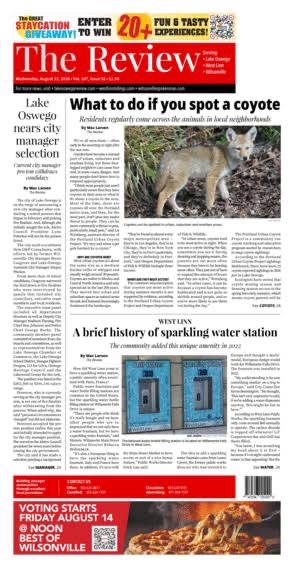
With that kind of shrinkage in news coverage, it hardly matters whether my Lake Oswego friend subscribes to the local paper today.

Meanwhile, other local news outlets have shriveled as well.

In October 2024, Carpenter Media Group bought the EO Media Group, which owned Oregon’s Bend Bulletin, the East Oregonian and other rural Oregon newspapers, and proceeded to slash and burn the papers’ staffs. John Carr, Senior VP of Oregon and Washington at Carpenter Media, said the cuts were “necessary financial changes and cost-cutting measures that will stabilize these publications for the future.”

The Portland Tribune had 40-50 newsroom staffers when it launched in February 2001. It ceased printing in June 2025 following major newsroom cutbacks and layoffs and now operates strictly as a digital, online-only news service that requires a paid subscription to access. Although Multnomah County still describes the Tribune on its website as a ” Portland city newspaper, offering comprehensive coverage of news, sports, business, people and entertainment”, it now has just one reporter, Hannah Seibold , who describes herself as “the sole survivor of the Portland Tribune at this point”.

The Oregonian newspaper, once the Portland area’s dominant local news source, has suffered as well. Founded in 1850 as a four page weekly, its first issue printed in a log shack on Portland’s SW First and Morrison,

I joined The Oregonian as a business reporter in 1987. It was a robust, well-respected paper then, with a proud past and a much-anticipated future. Daily Monday-Friday circulation was 319,624; Sunday circulation 375,914. When I left the paper 10 years later in 1997 to take a corporate communications job, daily Monday-Friday circulation was 360,000, Sunday circulation 450,000. We were on a roll.

Much of that success was attributed to Sandra Mims Rowe, who came on as editor in 1993 and tried to energize the newsroom with a hiring spree, bringing on reporters and editors from around the country. Under her leadership, the newsroom distinguished itself by winning five Pulitzers.

But the paper wasn’t able to escape the tumult of the newspaper business during her tenure. By the time she left the paper in Dec. 2009, she had to cut staff, salaries and benefits as circulation and revenue declined.

In 2009, The Oregonian’s daily circulation sat at 268,572 and Sunday circulation at 344,950, causing the paper to lose its position as one of the top 25 Sunday circulation papers in the country. That same year, the paper announced a long-term policy that protected full-time employees from layoffs for economic or technological reasons would end.

By 2012, daily circulation sank to 228,599, only slightly higher than circulation in 1950, and the declines continued. Talented reporters began departing in droves, some pushed out, others motivated by buy-outs. At the same time the once powerful paper saw its clout diminish as it abandoned rural Oregon and 7-day-a-week print distribution. 

When I left The Oregonian in 1997 to take a corporate communications job, the paper employed a newsroom staff of about 400 journalists (reporters, editors, and photographers). The newsroom staff now consists of about 66 employees.

The paper publishes print editions just four days a week, while continuously updating its digital content. Average daily print circulation is 29,325 copies and Sunday print circulation is 44,294 copies. The days are long gone when what was in The Oregonian, particularly its opinion section and columnists, dominated local conversations all day.

So here we are. A once mighty paper hollowed out and humbled. A growing population served by a smaller paper. A weakened paper that no longer drives the daily discussion at the proverbial water cooler (or over a latte). A diminished, editorially impotent presence with a dwindling ability to hold powerful interests accountable.

But is the local news environment as depleted as often presumed? Is the gloomy view unwarranted?

As the size and impact of the traditional major dailies and weeklies in the Portland metro area have shrunk, other news outlets are working to fill the gap. Some of their audiences are limited and their coverage is not very deep, but together they are beginning to fill a continued need and judicious selectivity can provide unexpectedly broad local news coverage.

There is still, however, too much online coverage of national news and not enough of local. As Public Media Company CEO Tim Isgitt recently said to Poynter, “…public media is facing a perfect storm. We’re part of a rapidly changing media and technology landscape that is providing unlimited content — but perhaps not the content we need. We can get any national journalism we need, but we can get very little local journalism from this landscape…We’re part of a media and technology landscape that is largely failing our society — with detrimental societal impacts, whether it’s misinformation, lack of trust or the effects it’s having on polarization, teen mental health or the loneliness epidemic.”

Some local media in Oregon are trying to do better.

Willamette Week, an alternative paper and digital media outlet, continues to offers cultural, civic and political coverage and reaches hundreds of thousands of print and online viewers, even if it tends to focus on only a few topics each week and its daily local online news coverage is limited. 

The Portland Mercury, an alternative bi-weekly, offers coverage of local arts, music, and city culture. 

There are also a number of hyper-local outlets such as the Northwest Examiner, the Southeast ExaminerMontavilla News, The Bee, Star NewsThe StJohns Review, The Mid-County Memo and The Skanner

Other options include the solid news site OPBCity Cast Portland, a website and a daily podcast for local news, Oregon Capitol Chronicle, part of the States Newsroom, and a relative newcomer, Axios Portland, with two reporters, Meira Gebel and Kale Williams.

And there’s still Oregon Business, around since 1981, that reports on a wide range of topics such as leadership, innovation, technology, culture, politics and environment, and the Portland Business Journal, published since 1984, which delivers local commercial news, data, and networking opportunities for the Portland, Oregon metro area.

Another innovative outlet focusing on local business news is Portland Inno, a digital media outlet powered by the Portland Business Journal, focused on Portland’s local startup, technology and innovation economies. A recent story, for example, broke the news that Mark Ronay, who founded materials company Liquid Wire in 2016, had launched a company is called Spectralsurf, aimed at  bringing down the costs of semiconductor manufacturing, with funding from Portland Seed Fund and ONAMI .

Then there are Portland’s television stations, KGW 8, KOIN 6, KATU 2 and KPTV Fox 12, offering varying levels of useful local news.

Portland’s local news outlets sometimes provide mindless drivel and poorly-researched gossip, comparable to the blitzing of the podium done by the Trump administration on a regular basis, and there’s a lot of slop out there, but they can also produce substantial deeply-researched impactful stories and the fact is the public is hungry for reliable local news.

Increasingly, however, that hunger for local news is being met not by the news outlets noted above, but by social media. Young people, in particular, move between podcasts, X accounts and YouTube livestreams where there’s no editorial control, no reviews and no accountability, where skepticism is required, but not often employed. Of course, young people will eventually grow older, but there is little likelihood that they will grow into accessing media as their parents did.

For the first time globally, more people are getting their news from social media platforms featuring independent online news personalities and commentators on platforms like Substack, TikTok and YouTube than television or news websites, according to a new report by the Reuters Institute for the Study of Journalism. This is particularly the case with younger audiences who often stumble upon information passively, consuming news that is automatically served to them through algorithm feeds, comment sections, and trending topics.

 “…most Americans now get their information and form their opinions through creators, podcasts, Substacks, group chats,” says Renée DiResta, an Associate Research Professor at Georgetown University’s McCourt School of Public Policy. “Most traditional institutions have only minimal engagement or presence in those spaces. So that ecosystem runs on a very different model of legitimacy. People are following people, not institutions. They’re following people that they find appealing or relatable. Somebody coming to you from their kitchen.”

Substack is one beneficiary off this trend. One of the more prolific, and controversial, Substack commenters in the Portland area is Keven Dahlgren, who writes on homeless issues in  Truth on the Streets. Another widely read site is Oregon Roundup by Jeff Eager, which says it covers “Oregon’s uniquely dysfunctional state government and the politics that create it.”

One problem, though, is that of the strong, reliable news, even local news, is only available if you are willing to shell out for a subscription, and many people are not. As one commenter on a substack post, Second Rough Draft, recently noted, “…the press sells what the public wants to buy. If there was a greater market for light, the media would cut back on the heat…elite audiences willing to pay are getting ample good information and others choose to pay less and get less.”

The Reuters Institute notes in a report, another troubling sign, that it is seeing stagnation or decline in overall online news engagement. People are turning away from the news. “The trends are worse among younger people and those without a university degree,” Reuters says. 

Some of that decline may be simply due to the way social media works. “Social media algorithms are optimised for engagement, with the goal of keeping people on the platform as long as possible, ” according to Reuters. “This has seen social media companies prioritising things like entertaining short-form video and de-prioritising news…Political news caused headaches for them, so they turned away.”

The problem is locally-focused social media can be a swamp and it can be hard to separate truth from the muck.

“… in different, darker corners of the internet, it has become a source of endless misinformation and disinformation dispensed by a panoply of influencers, conspiracy theorists, edgelords, grifters and con men, DIY gurus, hostile foreign actors, and partisan echo chambers full of dittoheads and doxers,” observes John Ramage, a former and Arizona State University professor of English, on Substack. “It is a world without gatekeepers, regulators or arbiters, an epistemic wild, wild west where anyone who relies on evidence-based reasoning is dismissed as an establishment tool.”

Then there’s the problem of what’s happening when news-searchers engage with social media, such as items on X. 404 Media recently noted that X’s algorithm learns what you hate and shows you more of it, according to a new study just published in the Proceedings of the National Academy of Sciences (PNAS). The paper, titled Value misalignment of X’s feed algorithm is a reflection of value tensions in engagement, found that the site’s algorithm prioritized engagement above all else when it generated a user’s For You Page. 

“When a user on X sees a post that makes them mad — like a press release from a politician from a political party they don’t like — sometimes they’ll fight about the post in the replies,” 404 Media noted. “It doesn’t matter who you follow or what your stated values are, X reads replying as engagement and will send more of the infuriating posts the user’s way.”

Reviewing The Story of Your Life: How Social Media Shapes the Way We Experience Everything, New York Times book critic Alexandra Jacobs noted that with social media,”All was sweet, innocent fun for awhile, then the algorithm came along and ruined everything, like a drifter in a Cormac McCarthy novel”, with all sorts of deleterious effects.

Or as historian Anton Jäger said recently on the Ezra Klein Show, “…our attention is fundamentally shaped now by algorithms that care about controversy, that care about newness, that are hunting amorally and constantly for whatever will get a rise out of people.”

It’s also important to realize that slop is proliferating on the web — some studies say 50 percent of online articles are now artificially generated. Then there are so-called “pink slime” sites, publications that mimic the appearance and output of traditional news organizations. Snopes, an online fact-checking and myth-busting website, can help sniff out such sites. 

it’s incumbent on citizens to proactively be selective in their news habits. In “Ordinary People, Extraordinary Times: How to Reclaim Your Power, Fight for Freedom and Reimagine Democracy”, Skye Perryman, the president and CEO of the national nonprofit Democracy Forward, urges Americans to do an inventory of the sources of their news and information and “to become an active, purposeful seeker of information rather than passively absorb whatever comes our way.” 

However you consume local news, “Studies have shown that the supply of local news is correlated with higher rates of civic engagement,” says the Agora Journalism Center at -the University of Oregon. “Robust local journalism matters to how informed citizens are, and according to another recent Knight Foundation report, a healthy news and information ecosystem creates “a virtuous circle whereby improved information contributes to improved community outcomes.”

If you want an educated, informed public in a position to make wise judgments, quality local journalism is key. As Thomas Jefferson wrote  in 1787, “The way to prevent irregular interpositions of the people is to give them full information of their affairs through the channel of the public papers, and to contrive that those papers should penetrate the whole mass of the people.”


OPB is facing a Big Hole. Will Donors step Up?

Oregon Public Broadcasting (OPB) is in trouble.

A bill clawing back $1.1 billion from the Corporation for Public Broadcasting (CPB), which provides funding for NPR and PBS, including OPB, has passed the Senate. It is expected to pass the House next and then to be sent to President Trump for his signature. 

Are you and thousands of other Oregonians prepared to start or increase donations to OPB to replace the federal money it now relies on?

Public radio across the country is already begging for money. On July 18, Alyson Brokenshire, Senior Director, Principal and Major Gifts at PBS News Hour sent out a message: “For the first time in history, Congress voted to zero out funding for public media, including PBS News HourThis decision creates a critical funding challenge for us, but one we can meet with your sustaining support.”  WBUR in Boston also sent out a plea on July 18: “Give. Longtime listener or reader? Become a first-time donor at this pivotal moment. Give again. Thank you, a million times over, for being in our corner. Give more. Help us close this $1.6-million funding gap, right now. Give every month. When you become a Sustainer, we know we can rely on you. Month after month. Year after year.”

In fiscal year 2023, government grants to OPB totaled $4,679,653 or 9.5% of the station’s $49,370,988 in revenue from contributions, including sponsorships.[1]

I’m already a sustaining contributor to OPB. I provide ongoing, monthly financial support through automatic deductions from a credit card. I recently increased my monthly donations because of the threats of funding cuts by the Trump administration. Am I prepared to donate even more when those cuts are real?

My sense is that OPB has a tough road ahead if it tries to replace all of the $4,679,653 in annual federal support it now receives. 

Current economic uncertainty is one thing likely to impact fundraising. There is already evidence that such uncertainty is leading people to scale back on discretionary spending, including charitable donations.Nonprofit giving in the US has taken a $65 billion hit since 2021, according to Philanthropy.org. 

Another reality is that a substantial percentage of America’s private wealth is held by conservative and center-right donors, many of whom are wary of institutions they perceive as liberal, and many of whom see public media as liberal. That perception was recently reinforced by Uri Berliner, a former senior business editor at NPR. In 2024, he wrote a blistering critique of NPR in The Free Press, accusing it of lacking viewpoint diversity and of a drift towards a progressive ideology

Trump administration officials and members of Congress have piled on, claiming that NPR and PBS push “left-wing propaganda” and accusing them of violating the CPB’s nonpartisan mandate.

Never one to be subtle, Trump has mercilessly blasted public radio and television. “NPR and PBS, two horrible and completely biased platforms (Networks!), should be DEFUNDED by Congress, IMMEDIATELY,” Trump wrote late Wednesday on Truth Social. “Republicans, don’t miss this opportunity to rid our Country of this giant SCAM, both being arms of the Radical Left Democrat Party. JUST SAY NO AND, MAKE AMERICA GREAT AGAIN!!!”

“NPR and PBS have increasingly become radical, left-wing echo chambers for a narrow audience of mostly wealthy, white, urban liberals and progressives,” Rep. Marjorie Taylor Greene (R-Georgia) said at a subcommittee hearing earlier this spring, 

Could OPB survive without the federal grants or any increase in donations? Probably, but the hit would be hard, though not as hard as the likely hit on KCUW in Pendleton, OR, which relied on federal money for 98% of its revenue in 2023. KCUW is is managed by members of the Confederated Tribes of the Umatilla Indian Reservation. Sen. Mike Rounds, R-S.D., said he secured a deal from the White House that some funding administered by the Interior Department would be repurposed to subsidize Native American public radio stations in about a dozen states, but there’s no firm provision in the bill for that.

The impact of any cut in OPB’s programming would be felt particularly by Oregon and Southern Washington’s more educated and higher income populace (71% of OPB’s TV audience, 82% of OPB’s digital audience and 85% of OPB’s radio audience has attended college). The public broadcast audience also typically falls into higher household income categories and have for years, primarily because households that listen to public media tend to have more formal education.

One potential threat to any OPB fundraising outreach is the changing media landscape and its burgeoning cost. 

Not only are media outlets multiplying, but alternative media are increasingly soliciting subscriptions. I have long subscribed to the Wall Street Journal (that subscription alone costs me $779.88 a year) and the New York Times, but added a subscription to Bari Weiss’ Common Sense newsletter, later renamed The Free Press, in 2021. I have since added subscriptions to a raft of other Substack publications with various points of view.  

I also make contributions to a number of Oregon and national non-profits, the Ukrainian Freedom Fund, and a Ukrainian news site, The Kyiv Independent.  And once in a while I’m a sucker for a GoFundMe plea. 

My point is, like many Oregonians, I’m already heavily invested in trying to do good. But there’s a limit. Periodically, I have to cull my subscriptions and donations because the cost gets out of hand. This means reprioritizing. And in the case of public broadcasting, fundraising pleas are going to come from various entities competing against each other for support, including individual programs, such as PBS News Hour, and individual stations, such as OPB and KCUW.

If OPB wants to replace the $4,679,653 in government financing it is set to lose, it is going to have to convince a lot of people to up their giving or chip in for the first time. 

This at a time when Oregon’s economy is facing a period of sluggish growth and some signs of weakness, with potential big givers from companies like Intel and Nike under stress and smaller givers uncertain about their economic prospects. President Trump’s One Big Beautiful Bill Act is also likely to put pressure on many Oregonians and the state budget and there’s potential harm from Trump’s aggressive tariffs.

All food for thought.


[1] In most instances, sponsorships are considered charitable contributions by the underwriters.  On OPB’s IRS Form 990, these sponsorships are included in the $49,370,988 reported as contributions and grants. There is also a small amount of sponsorships that meet the definition of advertising, which primarily occur on OPB’s digital platforms.  For FY 23, advertising is included in the program service revenue of $1,381,015 and in unrelated business revenue reported on OPB’s IRS Form 990-T.  

For FY 23, advertising is included in the program service revenue of $1,381,015 and in unrelated business revenue reported on our IRS Form 990-T.  Sponsorships are not otherwise disclosed on the tax filings.  Total revenue was $56,821,607.

Notable Sources of Revenue$Percent of Total Revenue
Contributions$49,370,988             86.9%
Program Services$1,381,015               2.4%
Investment Income$3,446,034               6.1%
Bond Proceeds$0 
Royalties$0 
Rental Property Income$415,851                0.7%
Net Fundraising$0 
Sales of Assets$2,207,719                 3.9%
Net Inventory Sales$0 
                                                                       

Figures are from Form 990 which non-profits are required to file annually with the IRS. These CPB grants are included in the Contributions and Grants revenue of $49,370,988 on OPB’s FY 2023 IRS Form 990. CPB grants are not included in government grants on the Form 990 as CPB is a private, nonprofit corporation, not a government agency. 

Oregon Democrats to Voters: ‘Let Them Eat Cake”

For all its screw-ups, Oregon is damn good at one thing, raising taxes and fees. 

One of the newest gambits, SB 687, would actually remove voters from the decision-making process.  Sponsored by State Senator Sen. Khanh Pham, D-Portland, and State Representatives Mark Gamba, D- Milwaukie and Zach Hudson, D – Troutdale, Wood Village, Fairview and North Gresham, the bill would allow a city or county to enact a fuel tax without going to voters first, eliminating a current requirement that local voters must approve city or county gas tax increases.

I guess in the sponsors’ view, voters just get in the way of sound policymaking.  

In a classic political gaffe, Gamba has already insulted voters, going so far as to tell OPB that voters too often act like “petulant children” standing in the way of taxes that are necessary to replace vital infrastructure like roads, sewage plants and libraries. “Someone needs to be the responsible adult in the room,” he told OPB. 

Oregon‘s tax system already ranks in the bottom half of states, coming in 30th overall on the 2025 State Tax Competitiveness Index and Portland enjoys the distinction of having the highest combined local income tax rate in the nation (4 percent), adding an extra layer of tax burden for residents of the state’s largest city.

You may be thankful Oregon forgoes a sales tax, but the Competitiveness Index points out it doubles down on other forms of taxation. The state has a complex and progressive individual income tax system with four tax brackets, a top marginal rate of 9.9 percent, and a personal exemption structured as a tax credit. Additionally, the tax brackets are not adjusted for inflation. 

The absence of a sales tax in Oregon is offset, the Index says, by an overly complex corporate tax system, which includes a 7.6 percent corporate income tax, a 0.57 percent gross receipts tax (the Corporate Activity Tax), and additional corporate taxes at the local level, particularly in the Portland area. Although gross receipts taxes typically do not allow any deductions from gross sales, the CAT provides a 35 percent deduction for either labor costs or the cost of goods sold. However, this does not significantly improve Oregon’s competitiveness in attracting businesses, as the state’s corporate tax system ranks among the worst in the nation, comparable to Delaware, the only other state to combine corporate income and gross receipts taxes.

Oregon’s property tax system is moderately competitive, the Index acknowledges, though the property tax burden relative to personal income is higher than in California and Washington. Additionally, the state imposes an estate tax with a maximum rate of 16 percent and the lowest estate tax exemption among states that levy the tax ($1 million), which further reduces the state’s competitiveness for high-net-worth individuals.

But what do the Democrats in the Legislature care? They have a supermajority in both  the Oregon House and Senate, so they’ll be able to increase taxes and fees without a single Republican vote. The hell with ordinary voters, I guess. 

More Oregon Insanity: OSU and In-State Tuition for U.S. Indian Tribal Members

In another episode of self-flagellation for past injustices by Oregon’s so-called institutions of higher learning, Oregon State University said on August 3 that enrolled members of all 574 federally recognized Indian tribes in the United States will be eligible for in-state tuition at the school starting this fall. This will  include currently enrolled students, no matter where they live. 

OSU has a branding video on YouTube called “It’s Out There.” It sure is. Way out. while the school pleads with the legislature for more money and with alumni for more donations, concern about revenue goes out the window when it wants to do some virtue signaling.

When Portland State University initiated an identical policy on July 21, it told Oregon Public Broadcasting (OPB) it was not aware of any other schools  in the United States that have also made the move to offer discounts to Native American students on a national scale. There’s probably a reason for that.

OSU’s action is by a school that increased tuition for the coming school year because of inflation and a decline in the amount of tuition it’s receiving from students, partially because of fewer international students. 

Continuing undergraduate students at OSU’s main campus in Corvallis will see about a $360 increase in annual in-state tuition and a $1,080 increase in out-of-state tuition, a 3.5% increase. New undergraduates starting at OSU this fall will pay about a $450 increase in annual in-state tuition and a $1,395 increase in out-of-state tuition, a 4.5% increase.

Continuing in-state students will pay $10,920 and out-of-state students $32,595, respectively next school year. New in-state undergraduates starting this fall will pay $11,010 and new out-of-state undergraduates $32,910.

It would be one thing, I suppose, if university leaders wanted to expiate their fathers’ sins by offering some benefits to tribal members in Oregon, but offering them to enrolled members of all 574 federally recognized Indian tribes in the United States if surely going overboard.

Allowing enrolled members of all federally recognized Indian tribes to pay in-state tuition will mean a potentially significant revenue loss to OSU from each out-of-state tribal student enrolled. 

But, hey, who cares. OSU can pat itself on the back for what, according to Interim OSU President, Becky Johnson, is past “…displacement, hardship, familial and cultural disruption and destruction, and the denial of educational opportunities for many members of Tribal nations.”

 “This new tuition policy advances our commitment – in the spirit of self-reflection, learning, reconciliation and partnership – that the university will be of enduring benefit to Tribal nations and their citizens throughout Oregon and the country,” Johnson said.

As with the PSU program, this is nothing more than academician’s guilt run amok.

Expanding resident tuition benefits to out-of-state tribal members means foregone revenue for increased services. And despite the tendency of left-leaning idealists to see government benefits as free, Oregonians will have to cover the cost of this new non-resident benefit. 

It’s just more wrong-headed feel-good performative activism, at the expense of Oregon taxpayers.

Portland Public Schools: Enrollment Down/Spending Up

Public school enrollment is plunging in Oregon and across the country. The New York Times calls it “a ‘Seismic Hit’ to Public Schools, “supercharged” by the Covid-19 pandemic. 

Enrollment at the country’s public schools have declined by at least 1.2 million students since 2020, according to a recently published national survey.

In 2016, PPS said, “Based on demographic studies conducted by Portland State University, it is anticipated that enrollment will level off at about 54,383 students by the 2030/31 school year under the PSU Medium Growth Scenario .”

Oh well.

Overall enrollment in Oregon has declined by almost 30,000 students since 2019-2020, slipping from 582,661 in 2019-2020 to 553,012 in 2021-2022. Oregon’s experience has generally followed national trends which are showing enrollment losses in city districts and growth in rural, suburban and town districts, according to the Burbio school tracking site. 

Some of the enrollment declines are likely due to parents frustrated with remote schooling, some to frustration with curriculum and “woke” instruction. Declines may also be attributed to economic dislocation of families, a decision that home schooling or charter schools were simply preferable or simply demographic changes. 

Portland Public Schools, the state’s largest district, is seeing the largest enrollment declines. Total enrollment in the district has dropped from 48,559 in the 2019-2020 school year to 45,123 in the 2021-2022 school year. District officials are projecting total enrollment of 41,723 in the next school year, a decline of another 3,400 students.

And yet, the Portland Public Schools budget keeps growing.

On May 24 2022, the Portland Public Schools board passed $1.89 billion budget for the 2022-2023 school year, This compares with a $1.5 billion budget for the 2018-2019 school year, when enrollment totaled 48,677 students, 6,954 more than expected enrollment of 41,723 in 2022-2023.\

Portland Public School central staff has risen 67% since 2017.  Elizabeth Thiel, Portland Association of Teachers President said in The Oregonian, “Since 2017, for example, there has been a 67% increase in the number of academic administrators in the central office. Over the same period, the central office budget has grown twice as fast as what PPS spends on frontline educators and support staff who deal directly with students, based on Portland Association of Teachers’ analysis of PPS’ budget documents.”

On May 25, OPB reported that after the school board’s budget vote, Superintendent Guadalupe Guerrero,  board members, teachers, and the few parents remaining at the end of the meeting all agreed on the need to head down to Salem next year to lobby the legislature for more school funding.

More. Ever more.

2020: Will the mainstream media make a difference?

trumpandreporters

There’s a lot of tortured handwringing going on among the mainstream media about how they covered the 2016 presidential race and what they need to do to fix things for 2020.

“…we have a chance to do things differently than we did the last time around – to redeem ourselves,” columnist Frank Bruni opined in The New York Times on Jan. 13, 2018. “Our success or failure will affect our stature at a time of rickety public trust in us.”

Bruni’s column focused on the role of the “mainstream, establishment media” and its responsibility to clean up its act, to avoid writing about the spectacle and cover, instead, substance, fitness for office and competing visions of government.

Sounds all very serious and high-minded. But Bruni’s angst is too late.

The fact is, what the mainstream, establishment print and television media have to say about politics simply doesn’t matter as much anymore because people are going elsewhere to find out what’s going on and what people think about it.

“The conversation that should concern everyone, in both media and politics, is not about what gets covered,” Peter Hamby recently wrote in Vanity Fair.  “It’s about what gets attention.”

“At a time when technology is transforming voter behavior at unprecedented speed, this is a problem that the mainstream media, even on its best behavior, cannot possibly solve without a drastic reimagining of what journalism is and how it reaches contemporary audiences.”

Diminishing influence

newspaperreaders1950

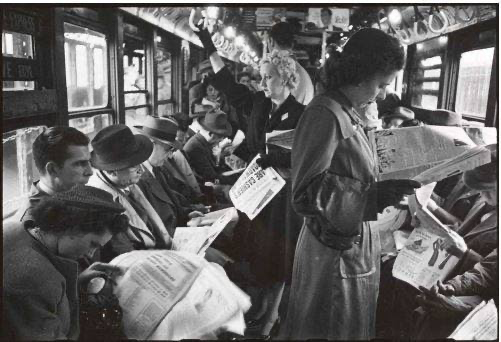
In 1950, almost every American household read a daily newspaper

In 1950, almost every American household read a daily newspaper. By 2000, only 50 percent of Americans read a printed newspaper on a daily basis.

As I write this in Jan. 2019, I’m sitting at a large, bustling coffee shop. A couple dozen people of all ages are busily engaged at their laptops. Not a single person is reading a newspaper.

The fact is fewer Americans read a daily newspaper today than in 1950, while the U.S. population has more than doubled. And the prognosis isn’t good. With just 2 percent of teenagers reading a newspaper on a regular basis, few are developing a newspaper reading habit.

Unlike the individualized, algorithm-determined, constantly updated news delivered to consumers online, print newspapers offer identical mass communications to their customers. And by the time the news in print newspapers reaches the intended audience, not only is it stale, but it has been superceded by newer news.

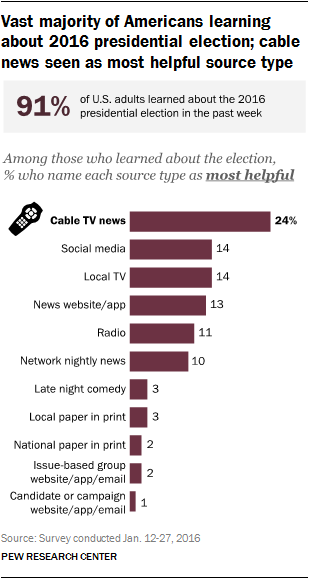
During the 2016 election, a survey of U.S. adults by the Pew Research Center revealed  that print versions of both local and national newspapers were named as key sources for election news and information by only 3% and 2% of respondents respectively. Late night comedy shows did just as well as sources at 3%.  (Maybe that explains why Sen. Kirsten Gillibrand (D-NY) announced she was forming a presidential exploratory committee during a Jan. 15 appearance on “The Late Show with Stephen Colbert”)

pewresearch2016electiontable

And even if you did read print newspapers during the election, policy issues — what the nominees would do if elected—got little press coverage in print outlets. In the 2016 general election, policy issues accounted for just 10 percent of the news coverage—less than a fourth the space given to the horserace between the candidates, according to a Shorenstein Center study.

And even if you did read print newspapers during the election, policy issues — what the nominees would do if elected—got little press coverage in print outlets. In the 2016 general election, policy issues accounted for just 10 percent of the news coverage—less than a fourth the space given to the horserace between the candidates, according to a Shorenstein Center study.

All this has translated into a drastic reduction in the influence of newspaper editorial endorsements.

“Once upon a time, a newspaper endorsement for a political candidate was about as good as it got,” Philip Bump wrote in the Washington Post  a couple weeks before the 2016 election. “In the era before the internet…big, important newspapers could shift the fortunes of people seeking the presidency. Nowadays, that’s … less of the case.”

Of the 269 U.S. newspapers that dispensed their wisdom by endorsing a presidential candidate in 2016, 240 endorsed Hillary Clinton and just 18 endorsed Donald Trump. Libertarian Gary Johnson secured nine endorsements and independent conservative Evan McMullin got one.

trumpendorsement

Of the top 100 largest newspapers in America with the largest circulations, just two endorsed Trump,

As Politico media reporter Hadas Gold tweeted when Trump’s stunning victory became clear, “… newspaper endorsements DO NOT MATTER.”

That may be partly due to slipping public respect for the mainstream media.  In a Pew Research Center survey taken shortly after the November 2016 balloting, only one in five respondents gave the press a grade of “B” or higher for its performance. Four of five graded its performance as a “C” or lower, with half of them giving it an “F.”

Declining newspaper circulation

Much of the waning influence of print newspapers can also be attributed to circulation declines (or the reverse).

newspapercirculationpercentofhouseholds

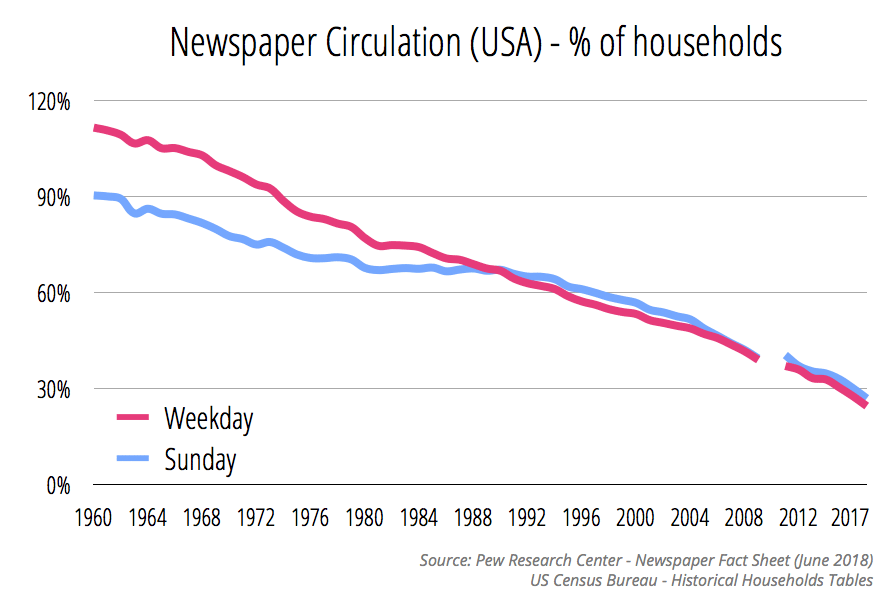
In 1960, nearly 120 percent of households bought a daily newspaper (i.e. there were 1.2 papers sold per household). By 2017, fewer than 30 percent of households bought a daily newspaper.

In 1990, circulation of U.S. daily newspapers totaled 62.3 million weekday and 62.6 million Sunday. By 2009, circulation had sunk to 55.8 million daily and 59.4 million Sunday.

According to the Pew Research Center, in 2016, despite the excitement and turmoil of the national elections, weekday and Sunday circulation for U.S. daily newspapers – both print and digital – fell 8%, marking the 28th consecutive year of declines. Weekday circulation fell to 35 million and Sunday circulation to 38 million – the lowest levels since 1945.

The following year, the first of Tump’s term, was equally discouraging. Estimated total U.S. daily newspaper circulation (print and digital combined) in 2017 was 31 million for weekday and 34 million for Sunday, down 11% and 10%, respectively, from 2016.

Some of that decline is because the United States has lost almost 1,800 papers since 2004, including more than 60 dailies and 1,700 weeklies, leaving 7,112 in the country, according to The School of Media and Journalism at UNC.

California lost the most dailies of any state. In one case, the 140-year-old, 500-circulation Gridley Herald used to serve Gridley (population 6,000) in the central California county of Butte, 60 miles from Sacramento. On Aug. 29, 2018, the paper’s staff and the community were notified by the paper’s owner, GateHouse Media, that the final issue of the twice-weekly paper would be published the next day.

Daily newspaper circulation in California totaled about 5.7 million 15 years ago. In 2018, that was cut in half to 2.8 million.

If print circulation continues to drop at current rates, as many as one-half of the nation’s surviving dailies will no longer be in print by 2021, predicts Nicco Mele, director of the Shorenstein Center for Media, Politics and Public Policy at Harvard University..

One of the most striking examples of decline is in Silicon Valley. The San Jose Mercury News, rebranded as The Mercury News in 2016, was once an influential publication with about 400 reporters, editors, photographers, and artists.

According to The Columbia Journalism Review, the Mercury News was one of the first daily newspapers in the U.S. with an online presence, the first to put all its content on that site, the first to use the site to break news, and one of the first to migrate its growing online content to the web.

Its commitment to innovation and hard news led to daily circulation of 200,258 in 2009 making it the fifth largest daily newspaper in the United States.

But subsequent years of bad business decisions, declining classified advertising (including job listings), layoffs, McClatchy’s purchase of the paper’s owner, Knight Ridder, in 2006, and the subsequent sale of the Mercury News to the MediaNews Group caused the paper to slip. “…sadly the San Jose Merc is a mere shadow of its former self,” commented one online reviewer.

Not that long ago, the San Jose paper proclaimed itself “The Newspaper of Silicon Valley,” media business analyst Ken Doctor wrote in Newsonomics. “Silicon Valley has done quite well, becoming the global economic engine and driving great regional affluence. But the economically fecund region has become — in less than a decade — a news desert.”

Here at home, The Oregonian, a paper with a long and storied history, is a story of decline, too.

oregonianbuildingold

The Oregonian Building, at the corner at the intersection of S.W. Sixth and Alder, occupied by the paper during 1892-1948.

In 1950, when Advance Publications bought the paper, its daily circulation was 214,916. For quite a while, things looked promising.

I joined The Oregonian as a business and politics reporter in 1987. It was a robust, well-respected paper, with a proud past and a much-anticipated future. Daily circulation was 319,624; Sunday circulation 375,914.

When I left the paper 10 years later in 1997 to take a corporate communications job, daily circulation was 360,000, Sunday circulation 450,000. It looked like the paper was on a roll.

But good times were not ahead. By 2012, daily circulation had sunk to 228,599, only slightly higher than in 1950. In subsequent years, daily circulation continued to slump, despite robust population growth in the Portland Metro Area.

Meanwhile, talented reporters have fled in droves, some pushed out, others motivated by buy-outs. At the same time the once powerful paper’s clout has diminished as it has abandoned rural Oregon and 7-day-a-week print distribution.

By 2018, The Oregonian had a print circulation of just 158,000 and distributed  to 15 fewer counties in Oregon and Washington than it did in 2004, when it had a circulation of 338,000, according to a UNC report on The Expanding News Desert.

A few smaller local Oregon papers are thriving, but most are suffering, too. And all of them have a tough time covering state and national politics consistently and with any depth.

Oregon Public Broadcasting OPB recently reported that Western Communications, which owns seven newspapers across the West, including the Bulletin in Bend, the Baker City Herald and the La Grande Observer, “is on the brink of foreclosure.” The company hasn’t paid nearly $1 million owed in local property taxes and interest and is between three and five years behind on taxes in counties across Oregon, OPB reported.

Comprehensive political coverage by the Eugene Register Guard is threatened, too. On March 1, 2018, GateHouse Media, the same company that closed the Gridley Herald, acquired the Register Guard, which had survived more than 90 years of independent, family ownership.

GateHouse publishes 130 daily newspapers. It has a reputation for tightfisted financial management accompanied by staff layoffs. It’s impact on the Register Guard has fit that pattern. In Dec. 2017, before the GateHouse takeover, the editorial and news staff at The Register-Guard totaled 42, according to the paper’s staff directory. Today the directory lists 27, of which just 12 are identified as reporters..

Not only has the Register Guard staff shrunk; so has its daily circulation, dropping from 54,325 in 2011 to 41,280 today.

“What’s happening with the Guard isn’t unique to the Guard,” Tim Gleason,professor and former dean at the University of Oregon School of Journalism and Communication, told the Eugene Weekly. “It’s what’s happening all over the country as these venture capital firms buy newspapers and then largely gut them.”

Of course, newspapers are being gutted whether or not they are investment targets.

In early January 2019, the Dallas Morning News eliminated 43 jobs, according to the Columbia Journalism Review, half of them in the newsroom, with the cuts  hitting reporters covering immigration, transportation, the environment, and the courts.

On Friday, February 1, The McClatchy Company, which owns properties such as the Miami Herald and the Kansas City Star, emailed staffers to announce that 450 employees would be offered voluntary buyouts as part of a “functional realignment,” essentially signaling that the jobs have been marked out of the budget. The news was first reported by the Miami New Times.

If print newspaper circulation across the board continues to drop at current rates, as many as one-half of the nation’s surviving dailies will no longer be in print by 2021, predicts Nicco Mele, director of the Shorenstein Center for Media, Politics and Public Policy at Harvard.

None of this is good news if you want an educated, informed public in a position to make wise judgments about public policy.

“The way to prevent irregular interpositions of the people is to give them full information of their affairs through the channel of the public papers, and to contrive that those papers should penetrate the whole mass of the people,” wrote Thomas Jefferson in 1787.

That is as true today.

How about network television news?

Given the decline of local print media, local network TV news is one of the few remaining sources of locally-focused journalism covering political issues, but local TV news has been experiencing declines as well.

Just from 2016 to 2017, the portion of Americans who often rely on local TV for their news fell 9 percentage points, from 46% to 37%, according to the Pew Research Center. Still, local tv news shows have multiple opportunities to cover educate their audience. The problem is that covering public policy is rarely their forte and it’s not what their audience is seeking.

Instead, local TV news is the outlet of choice by adults for weather, breaking news and traffic reports, although young adults are more likely to turn to the Internet, according to Pew Research.

Public policy and politics coverage is also suffering with a decline in the audiences for the national network news shows of NBC, ABC and CBS, although some scholars believe television news viewing has little effect on issue learning. In other words,  watching increasing quantities of television news will not lead to greater knowledge about political issues because of the paucity of real issue information. You may know more about polls and personalities, but not so much about political issues that affect your life.

Remember when the family used to gather in the living room every night for the evening news, either the Huntley-Brinkley Report, CBS Evening News with Walter Cronkite or ABC Evening News with Frank Reynolds and Howard K. Smith? That was so long ago.

family-gathered-around-tv-500x214

All three network evening news shows have been losing audience steadily since then. By 1998, the three network evening newscasts reached a combined average of only about 30.4 million viewers in a country with a population of 276 million.

In 2016, even with a turbulent presidential campaign, the average viewership for the ABC, CBS and NBC evening newscasts was 24 million, according to a Pew Research Center  analysis.

Compare that to the ratings of a single showing of 2016’s number one primetime TV show, The Big Bang Theory, which averaged 19.9 million viewers, or with Super Bowl 50 on Feb. 7, 2016, which got 112.6 million average viewers, according to Nielsen.

By the 2017-18 television season, ABC’s evening news had an average of 8.6 million viewers, NBC Nightly News 8.15 million and CBS Evening News 6.2 million. That’s a total of 22.95 million.


lonesomerhodes

Lonesome Rhodes, a master manipulator.

In Elia Kazan’s classic movie “A Face in the Crowd,” Lonesome Rhodes, played brilliantly by Andy Griffiths, rises from an itinerant Ozark guitar picker to a local media rabble-rouser to TV superstar and a political power. “I’m not just an entertainer. I’m an influence, a wielder of opinion, a force… a force!”, he exclaimed at one point.

Newspaper publishers and TV news anchors may once have felt the same way, but their days are numbered.

This doesn’t mean, however, that the demand for news is going to collapse. It just means there’s going to be a need for more imagination in formatting and delivering it in ways that grab an audience and rewards them for their attention.

Vanity Fair’s Peter Hamby cited a twice-daily news show produced by NBC that runs on Snapchat. According to Digiday, the brief show, Stay Tuned, was created specifically for the vertical-screen mobile experience. In 2018, Stay Tuned averaged 25 – 35 million unique viewers per month on Snapchat, according to data provided to NBC News by Snap. Only one-third of that audience also watches, reads or listens to NBC News content on other platforms, so two-thirds are a new NBC audience.

To top it off, about 75 percent of the “Stay Tuned” audience is under 25 and 90 percent is under 34, according to Snapchat, a significant accomplishment given that reaching younger audiences has provers to be a challenge for traditional print and network TV.

So the future isn’t all grim. It will just be different.


Oregon’s Republican Party is committing suicide

seppuku_by_mark_san

It’s hard to watch a party self-destruct.

If you look at all the races on the Oregon ballot on Nov. 8, it’s clear that the Republican Party has largely abdicated its position as the loyal opposition.

It starts at the top with the U.S. Senate race. Anybody know who the Republican candidate is? His name is Mark Callahan. I can tell you he went to OSU. But his website doesn’t list any events he’s attending and OpenSecrets.org reports he has raised just $15,852 (compared with Democrat Ron Wyden’s fundraising total of $11.4 million).

The 3rd and 5th District races for the House of Representatives aren’t any better.

In the 3rd, which includes most of Multnomah County, including Portland east of he Willamette, 10-term Democrat Earl Blumenauer is opposed only by Progressive Party candidate, David Delk, who says he has no experience. OpenSecrets.org reports he has raised nothing (compared with Blumenauer’s fundraising total of $1.1 million). Of course, the 3rd has been held by a Democrat since January 1937.

In the 5th, the Republicans did manage to recruit Colm Willis to run against Democrat Kurt Schrader. Willis has deep Oregon roots, graduated from Willamette University’s School of Law and worked as a staff member on a U.S. Senate committee, but he has raised just $239,113 (compared with Schrader’s $1.6 million)

How about the governor’s race?

budpierce

Bud Pierce

Bud Pierce may be a great doctor and a nice guy, but he was invisible statewide, a cipher, until this election. He’s managed to raise $2.5 million, but Brown has raised $3.5 million and Oregon hasn’t elected a Republican governor since 1982.

An OPB poll released on Oct. 17 showed that Brown leads Pierce by an astonishing 46 percent to 33 percent. This despite the fact that even Willamette Week offered faint praise for Kate Brown, declaring, “Brown’s greatest political strength is her affability—and her ability, so far, to blame problems on her predecessor.”

Work your way down the Oregon ballot and it gets worse, with many Democrats facing NO republican opponent.

The Republican Legislative Campaign Committee (RLCC), a state-oriented national organization that seeks to elect Republicans to state legislatures, identified the Oregon State Senate and House of Representatives as targets in the 2016 elections. You’d never know it.

In the Oregon State Senate races, there’s no Republican candidate in the 14th, 18th, 21st, 22nd and 23rd Districts.

In House races, there’s no Republican candidate in the 9th, 27th, 34th, 35th, 36th, 42nd, 43rd, 44th, 45th, 46th, 47th and 49th Districts.

How in hell the Republicans ever hope to recover power in Oregon under these circumstances is beyond me. And that’s not healthy for Oregon. One party dominance leads to corruption, cronyism, recklessness and abuse of power.

The thing is, if the Republicans would focus on building a strong bench, skillfully build public awareness of those with the greatest potential, encourage them to run for office and back them up with ample financial support, they can win and change the dynamic of state politics.

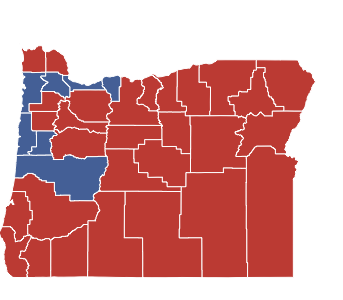
Look at the 2010 race between Democrat John Kitzhaber and Republican Chris Dudley. Despite some clear errors in strategy and execution, Dudley captured 694,287 votes, only 22,238 fewer than Kitzhaber’s 716,525. Damn close. More promising for the Republicans, Dudley carried all but 7 of Oregon’s 36 counties.

2010governorrace

Blue counties: won by Kitzhaber;                 Red counties: won by Dudley

Lane and Multnomah Counties, two Kitzhaber won, may be a lost cause for Republicans, but if Dudley had been able to peel off more votes in the other 5 he might well have won.

In other words, offer appealing, moderate candidates, back them up with financial resources, run strong campaigns across Oregon and Republicans can win.