Oregon Connections Academy (now Oregon Charter Academy), an online statewide charter school serving about 4500 students has been placed on the state’s a federally mandated improvement list. I’m not surprised.
Just look at the numbers.
Only 21.9 percent of tested students at the school met or exceeded math standards in 2018-2019, down from an already abysmal 22.7% in 2017-18.
English language arts (ELA) achievement has been poor, too. Only 41.8% of tested students met or exceeded ELA standards in 2018-2019 and an average of just 42.8% met or exceeded the standards over the past three school years.
School attendance is poor as well. Regular attendance at the school in 2018-19 was only 63.4%, and an average of 59.7% over the past three school years. That indicates chronic absenteeism. In 2018 – 2019, just 71% of the school’s students attended more than 90% of their enrolled school days.
Then there are graduation rates and college attendance. Only 57.1% of students in the school’s 2014-15 cohort graduated in four years and an average of 61.1% in the past three school years. And of the school’s graduates, only 41% enrolled in a two or four year college within one year of completing high school, as reported by the National Student Clearinghouse.
The fact is, Oregon Connections Academy, and the Oregon’s public virtual schools as a whole, are failing our children.
Despite that truth, the schools, also called cyber and online schools, are multiplying like fruit flies. Supporters are intoxicated by their potential and doubters are being pummeled as technical Neanderthals unwilling to accept change.
Virtual charters have taken root in at least 30 states and the District of Columbia and serve in excess of 200,000 students.
They are part of a movement that is exploding across the country and enjoys the support of President Donald Trump. Trump has called school choice “the civil rights issue of our time” and appointed Betsy DeVos, a fierce advocate of charter schools, Secretary of Education.
“Families want and deserve access to all educational options, including charter schools, private schools and virtual schools,” DeVos said in 2015, before becoming Secretary. “States are well ahead of Congress on this and their efforts should be encouraged and supported.”
On June 13, 2017, after being confirmed as Secretary of Education, DeVos told the National Alliance for Public Charter Schools, “…as a nation, we are simply not doing a good enough job educating our kids. A system that denies parents the freedom to choose the education that best suits their children’s individual and unique needs denies them a basic human right. It is un-American, and it is fundamentally unjust.”

Secretary of Education Betsy DeVos (R) with President Donald Trump
But the evidence clearly shows that within the charter school movement, the virtual charter industry is not “all about the kids.”
The growth of full-time public virtual charter schools in Oregon offers a case study of a misplaced faith in choice and technology.
OREGON CONNECTIONS ACADEMY

Oregon’s largest public virtual charter school is Oregon Connections Academy (ORCA), based in Mill City, a rural community of fewer than 2000 people.
Earlier this year, Jack Haldeman, then an intense eighth grader at ORCA, sat in a plastic chair at ORCA’s learning center hunched over a laptop computer. He was there to deliver a six-minute LiveLesson presentation on cloud formations. His audience? An unseen virtual teacher and 15 classmates in an ORCA literature class.

Jack Haldeman participating in an online class at Oregon Connections Academy
Jack completed 1st– 6th grade at highly rated schools in a well-off community outside Portland, OR when his parents decided to transfer him and his twin brother, Michael, to a virtual charter school. They enrolled at ORCA in the fall of 2015. Their mother, Jen Reinmuth-Birch, took on the job of serving as their Learning Coach. “We wanted a more ‘hands-on’ approach to our children’s education,” she said.
Jack said he was an average student at his brick and mortar public school, but has thrived at ORCA. He plans to stay at ORCA through graduation and expects to go on to Oregon State University on campus to pursue a career in battlefield archeology.
CLASHING SENTIMENTS
Students, parents and teachers both praise and assail ORCA.
“All in all, ORCA is a fantastic educational experience for those who don’t fit the mold for brick and mortar schools,” a student told a school rating organization.
“This school is the best of the best,” said an exuberant parent.
“School is about learning and getting excited about learning – this is pure stress…,” a student said. “This school is only for the child who is a robot and can work at lightening speed.”
“Unless your child…has zero interest in doing anything but sitting at the computer for 7-10 hours a day, then I really don’t think this is what you are looking for as an alternative to regular school,” said a parent. “Don’t do this to your child!”
Some teachers praise ORCA for having a hardworking professional staff, flexible schedules, and a commitment to children first.
Other teachers complain about high student/teacher ratios, a revolving door of employees, poor management and profit-driven policies. “Sometimes the bottom line is the goal and not student achievement,” said one teacher.
Both sides of the virtual charter school debate are fighting a raging propaganda war that is almost Darwinian in nature.
The virtual charter champions churn out a torrent of supportive stories, arguing that traditional schools are relics and choice wouldn’t be so necessary if traditional public schools hadn’t utterly failed to meet the needs of children.
Critics argue just as vociferously that the online schools rob traditional brick and mortar public schools of students and public money, lack accountability, exacerbate inequalities of opportunity and worst of all, fail to educate.
IN THE BEGINNING
The public charter school movement in the U.S. has moved quickly from the margins to the mainstream.
Minnesota passed the first state public charter school law in the United States in 1991. The first charter school opened 25 years ago in St. Paul, Minnesota in September 1992.
Now there are more than 6,900 charter schools across the country enrolling an estimated 3.1 million students.
The virtual public charter sector barely existed in the United States prior to 2000, but has grown rapidly since then. The siren song of technology as an education savior, particularly for disaffected students who want a non-traditional school setting, is proving irresistible to many parents and children.
Since enacting a charter school law in 1999, Oregon has become home to 126 charter schools, including 14 virtual charters with total enrollment of about 30,000 students. This is approximately 5 percent of enrolled K-12 public school students in the state.
Oregon’s newest virtual charter school is Frontier Charter Academy. Sponsored by the Gervais School District, the Academy recently began accepting students who entered 5th-9th grade in the fall of this year.

Frontier Charter Academy staff.
Beau Neal, Frontier’s co-founder, said the school plans to add a grade each year until it serves grades 5-12. The school will have 460 students at that point, Neal projected.
SHOW ME THE MONEY
Charter schools in Oregon, including virtual charters, are publicly funded, so parents don’t pay tuition. Instead, the Oregon Department of Education distributes State School Fund money to each school district that sponsors a charter school.
Oregon’s State School Fund distributed about $60 million to school districts sponsoring virtual charter schools for the 2015-16 school year.
Oregon law provides that a sponsoring district must pass on to its charter school at least 80 percent of its per-pupil grant for K-8 students and 95 percent of its per pupil grant for grade 9-12 students.
The system leads to big disparities among sponsoring districts in what they keep and what they pass on to the charter schools. This, in turn, can lead to “sponsor shopping” by charter school operators looking for maximum financial return and minimum oversight.
Ohio once encountered an egregious example of sponsor shopping. Charter school operators there that failed to get authorized or renewed by one sponsor simply shopped around for another.
“It’s been too easy for bad schools to find accommodating sponsors to keep them going…at least partly because sponsors in Ohio have earned fees for selling services to schools even when the schools in their portfolio produce poor results,” wrote two charter school supporters, Alan Rosskamm, CEO of Breakthrough Charter Schools, and Nina Rees, president and CEO of the National Alliance for Public Charter Schools.
Under ORCA’s 2005 contract with its initial sponsor, the Scio School District, Scio kept 10 percent of the State School Fund money it received for ORCA students in grades K-8 and 5 percent of the money it received for students in grades 9-12.
In 2005-2006, that translated into $311,358, half of which Scio had to send to the home districts of its ORCA students under Oregon’s charter law at the time.
As ORCA’s enrollment grew, so did the amount of State School Fund money retained by Scio. In the 2014-15 school year, the Scio district retained $1,886,498.34, half of which it had to send to the home districts of its ORCA students.
Scio was ecstatic to see the ORCA money rolling in and looking forward to the windfall continuing.
But while the Scio District and ORCA were in the midst of negotiations on a new contract, ORCA unexpectedly jumped ship. Abandoning Scio, ORCA signed a new contract with the nearby Santiam Canyon School District. The contract began with the 2015-2016 school year.
ORCA’s switch left the Scio School District perplexed and bitter. Not only was ORCA’s departure a shock, but it meant a big hit to Scio’s budget. Scio School District Superintendent Gary Tempel called the revenue loss “devastating” to the tiny district. But the switch was a bonanza for Santiam Canyon.
Charter schools have become cash cows for many school districts that sponsor them. This is even more true since the Oregon Legislature amended the charter school law in 2015 to eliminate the requirement that the sponsoring districts send half of the money they earned back to the home districts of their students. So Santiam Canyon got to keep all of the State School Fund money it held back.
Why, out of Oregon’s 197 school districts, did ORCA decide to switch to Santiam Canyon?
It was probably no coincidence that Todd Miller, appointed superintendent of the Santiam Canyon District in July 2013, served as ORCA’s executive director from April 2011 – June 2013.
The other key factor was likely money.
Instead of insisting on the same deal Scio had with ORCA, the Santiam Canyon district agreed to keep just 1 percent of the State School Fund money it received for ORCA.
ORCA also agreed to pay the district a 3.5 percent management fee to support things such as state reporting, business services, special education and other support services, but the payoff to ORCA (and Scio) was still substantial.
In 2014-15, Scio had retained $1,886,498 of the State School Fund money it received because of its sponsorship of ORCA. In 2015-16, Santiam Canyon retained just $1,362,272.49 of the State School Fund money it received because of its ORCA sponsorship. Not only did Santiam Canyon come out ahead because it didn’t have to share any of its money with the home districts of ORCA’s students, but ORCA paid its sponsor $532,235 less with the switch.
Miller defended the deal. “This fee structure does pass through more funds to ORCA than they previously received, yet the school board and I felt this arrangement was balanced for both of us and helped them add additional services to support struggling students,” Miller said.
REELING THEM IN
Oregon started with tough charter school enrollment restrictions.
The state’s charter law initially required that 80 percent of a public charter school’s student body live in the sponsor’s district and that no more than 10 percent of a district’s students could go to a charter school.
Those restrictions, however, lasted only five years. Charter schools can now recruit throughout the state with no limits.
ORCA is particularly aggressive in recruiting new students. Oregonians would be hard pressed to miss the ubiquitous ORCA television ads promoting the school.
ORCA spent $200,000 on promotional ads in 2015-16 alone, said Allison Galvin, ORCA’s executive director.
The ads, which don’t even use the words “charter school,” are persuasive blends of Wall Street and Madison Avenue that fit right in with Connections Academy’s profit-driven culture.
The result has been a rapid expansion of enrollment at ORCA and other Oregon virtual charters.
It’s hard, however, to pin down exactly how many students attend the schools at any given time. That’s because enrollment fluctuates wildly during and between school years, with some students going back and forth like ping pong balls.
On Oct. 1, 2015, the standard date for calculating charter school enrollment in Oregon, ORCA said it had 3,789 enrolled students. But 950 students left during the school year, and others enrolled. At one point during the year, total enrollment went as high as 5,631. At the end of the school year, 4035 students were enrolled.
“Many families enroll in virtual school for a short period of time to address a short-term issue or challenge, academically, socially or personally,” Galvin said. “Once the family has navigated through the issue, they may decide to return to their previous school. Other families may find online school the perfect fit and remain enrolled.”
ORCA’s NEST
The original vision for Oregon’s charter schools was that they would be small, locally run institutions that would be innovative and flexible. But over time the virtual charter system has become profit-propelled and the structure has changed.
ORCA is a prime example of that. The school is like the smallest wooden figure in a classic Russian matryoshka doll, where wooden dolls nestle one inside the other.

ORCA is a not- for-profit corporation governed by a Board of Directors.
The Board has a Professional Services Agreement with a for-profit company, Connections Academy of Oregon, LLC (CAO), to operate and manage the school, under the direction of the Board of Directors.
CAO is wholly owned subsidiary of Connections Education LLC (CE).
Connections Education (CE) is a Maryland-based for-profit online education company. It employs approx. 1,100 corporate employees.
In addition, a number of schools contract with CE to assist with staffing needs. That workforce varies from year to year. There are currently approximately 1,000 employees supporting the schools in that capacity.
CE provides online education products and services to virtual schools in 26 states that are operated by charter schools, school districts, and state departments of education, as well as district run virtual programs for students within that particular district.
CE also provides online education products and services to Nexus Academy schools, blended (online and in-person) high schools for students in three states; International Connections Academy, a private virtual school for students worldwide; and CE, which offers digital learning solutions to schools and school districts.
CE is a wholly owned subsidiary of UK-based Pearson PLC (LSE:PSON; NYSE: PSO), which reported $5.6 billion of revenue in 2016.
Critics of outsourcing the management of charter schools to companies like Pearson argue that it siphons off already limited school resources for service fees, profits, other layers of administration and costly marketing programs, such as television ads and online campaigns.
In 2015-16, Santiam Canyon passed on $28,740,437 to ORCA. ORCA said it paid $27,287,365.91
to Connections Academy of Oregon, LLC (CAO) to provide educational products and services. This included the costs of ORCA’s staff, including 153 teachers, 14 administrative support staff and a senior leadership team.
It’s not clear how much of that $27,287,365.91 ended up as Pearson profit.
ACADEMIC NON-PERFORMANCE
ORCA says its curriculum “develops critical thinking and problem-solving skills” and “builds a solid foundation in reading, writing, and mathematics.”
In a recent ORCA survey, families gave the school high marks for helping students succeed academically and emotionally. An impressive 94 percent of the parents agreed that the program’s curriculum is high quality and that their child is satisfied with the program.
But if they looked closely at academic performance data, parents and students might not be so pleased.
ORCA may offer a superior option for some students, but for many students it does not.
This is consistent with a 2016 national study of virtual charter schools which concluded, “Multiple or expanded measures of school performance reveal that virtual school outcomes continued to lag significantly behind that of traditional brick-and-mortar schools.”
Standard test results back that up.
Oregon assesses K-12 performance in English Language Arts, Mathematics and Science. The English Language Arts and Mathematics tests are aligned to Oregon’s Common Core State Standards and are called Smarter Balanced assessments. The Science tests are called the Oregon Assessment of Knowledge and Skills (OAKS) tests.
In 2016-17, 54.2 percent of tested ORCA students scored proficient or better in English Language Arts, down from 61.5 percent in 2015-2016, and 27.5 percent scored proficient or better in Mathematics, down from 30.6 percent in 2015-2016.
56.2 percent met or exceeded state standards in Science in 2016-17, down from 59.3 in 2015-16.
These scores are even worse than 2014-2015, the last year that ORCA was sponsored by the Scio School District. In that school year, 61.3 percent of tested ORCA students scored proficient or better in English Language Arts, 37.6 percent scored proficient or better in Mathematics and 62.7 percent met or exceeded state standards in Science.
ORCA officials said any evaluation of their academic performance needed to take into account that ORCA takes on many students who stumbled at their former traditional brick-and-mortar public schools. “We have a huge population of struggling learners,” Galvin said.
Research bears this out, documenting that students in virtual charter schools are more likely to come from the lower academic segments of traditional brick-and-mortar public schools.
But other research reveals that it’s the struggling learners who are least likely to be well served by online coursework. In other words, while struggling students are the ones most in need of traditional in-person courses, shuttling them off to online schools is exactly what they don’t need.
The same holds true for college students. Research on students taking online college courses indicates that virtual learning is most challenging for the least well-prepared students.
“These students consistently perform worse in an online setting than they do in face-to-face classrooms; taking online courses increases their likelihood of dropping out and otherwise impedes progress through college,” concluded a Brookings Institute study on the “Promises and pitfalls of online education.”
Michael Petrilli, Executive Director of the Fordham Institute, made this point in remarks at the June 2017 Education Commission of the States’ National Forum on Education Policy.
Because full-time virtual schools require “a kid who’s pretty driven, who has a pretty supportive home environment” for the best chance at success, Petrilli argued, “the schools would benefit from more selectivity and individual review of applications to determine fit, which is not now permitted at public virtual charter schools.”
Research on virtual charter school performance outcomes across the country generally paints a distressing picture linked to test-based outcomes.
A 2015 report from the Center for Research on Education Outcomes (CREDO) at Stanford University concluded that the majority of virtual charter school students showed poor learning growth in math and reading when compared to comparable students in traditional brick-and-mortar public schools.
The study also highlighted an intriguing finding, that the problem isn’t charter schools per se, but virtual charters. “Being an online school matters more than being a charter school, “the report said. “The principal impacts of attending an online charter school appear to be primarily driven by the online aspect of the school, rather than the fact it is a charter school.”
A 2017 CREDO report went even further, concluding that charter school operators with a for-profit orientation post significantly lower student academic gains than those with a non-profit status.
GRADUATION RATES: OREGON, WE HAVE A PROBLEM
Because they are public schools, virtual charter schools are required to meet the same diploma requirements as Oregon’s traditional brick-and-mortar Oregon public schools.
Graduation rates at all Oregon public schools, including virtual charters, are calculated the same way by the Oregon Department of Education (ODE) as an “adjusted cohort graduation rate.” That rate is the percentage of all students who graduate from high school with a diploma within a four-year cohort period after they start 9th grade.
The graduation rate of all Oregon public schools in 2016 was 75 percent. ORCA’s graduation rate in 2016 was 61.7 percent.
ODE calculated ORCA’s graduation rate by determining how many students enrolled in the school at some point during their four years of high school beginning with the 2012-2013 school year. That total was 1,349 students. Of those, 295 started as freshman at ORCA, 1,054 transferred in at some point after the beginning of the 2012-13 school year and 808 transferred out.
That left 541 students (1,349 – 808) accountable to ORCA. This is the “adjusted cohort”. Of these 541 students, 330 earned a regular diploma and 4 earned a modified diploma from ORCA, for a total of 334 graduates. 334/541 = 61.7%.
That’s bad enough, but the average graduation rate of all virtual charter schools in Oregon with a high school program was a miserable 42.93 percent, with one school at only 9.52 percent.
Seven of Oregon’s virtual charter schools had graduation rates below 50 percent, including North Bend-based Oregon Virtual Academy (ORVA) with a graduation rate of only 28.25 percent. ORVA, which enrolled 1,883 students from across the state in 2015-16, is part of a virtual charter network affiliated with another big for-profit company, K12 Inc., which has come under heavy criticism for the academic performance of its schools
Overall, Oregon’s virtual charter school sector resembles failed public school districts in some troubled American cities.

Virtual charter school advocates have an unending list of reasons for their poor performance.
Listening to them is like the scene in The Blues Brothers when Jake, played by John Belushi, tried to explain to his ex- fiancé why he left her at the altar.

“I ran out of gas! I had a flat tire! I didn’t have enough money for cab fare! My tux didn’t come back from the cleaners! An old friend came in from out of town! Someone stole my car! There was an earthquake! A terrible flood! Locusts! It wasn’t my fault! I swear to God.” John Belushi, The Blues Brothers
Galvin also attributed ORCA’s low graduation rate to many of the students being way behind in credits when they arrived at the school, so bringing them up to speed can be a long and difficult task.
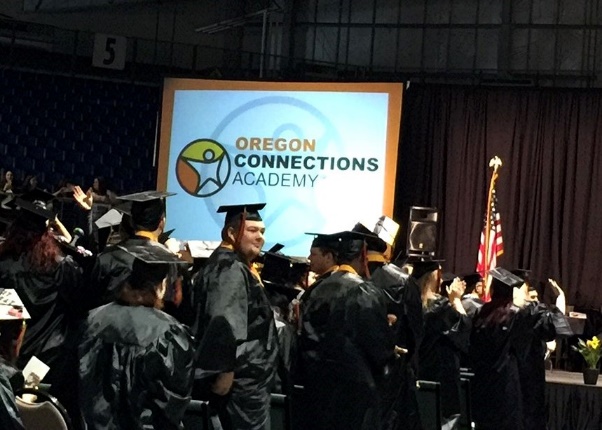
ORCA’s June 2017 graduation ceremony.
Left unsaid is that the transfer of many of these students to ORCA may, in a perverse sort of way, help the traditional public schools they come from. That’s because it removes academically struggling students from the rolls, improving graduation rates.
Research suggests this is a national problem.
“School officials nationwide dodge accountability ratings by steering low achievers to alternative programs,” ProPublica, an independent, nonprofit newsroom, reported in February 2017.
ProPublica cited a situation at Olympia High School in Orlando, FL. In the 2015-16 school year, 137 students in Olympia’s attendance zone went, instead, to Sunshine High, a charter school run by for-profit Accelerated Learning Solutions (ALS). Students at the school, located in a strip mall, sat for four hours a day in front of computers with little or no live teaching.

Sunshine High School in Orlando, FL
“Sunshine takes in cast-offs from Olympia and other Orlando high schools in a mutually beneficial arrangement,” ProPublica reported. “Olympia keeps its graduation rate above 90 percent…partly by shipping its worst achievers to Sunshine. Sunshine collects enough school district money to cover costs and pay its management firm, Accelerated Learning Solutions (ALS), a more than $1.5 million a year ‘management fee,’ 2015 financial records show.”
In another case, Voice of San Diego, a digital nonprofit news organization, reported that the San Diego Unified School District achieved an extraordinary 91.2 percent graduation rate in 2016 partly by unloading low-performing students to charter schools.
Voice of San Diego noted that concern about the practice goes a long way back. He cited a 2005 report from the California Legislative Analysts’s Office raising concerns that alternative schools gave traditional high schools an incentive to push struggling kids out to rid themselves of problem students or simply make schools appear more successful:
“When low achieving students leave, for instance, average school test scores increase,” the report said. “This gives the appearance that the school is improving, and it allows the school to focus on the education needs of the more motivated students that remain. In addition, when students marked as ‘problems’ or ‘trouble makers’ drop out, they relieve educators of administrative headaches. As a result, inattention to the needs of these types of students can actually make schools appear more successful.”
COMPUTING ALONE
In E.M. Forster’s 1909 dystopian story “The Machine Stops,” people live alone in small solitary rooms deep under the surface of the earth. Relying on “the Machine” to keep the technology running that allows them to survive, they connect, though rarely, via a Skype-like function on a blue optic plate.

“You mustn”t say anything against the Machine,” said his mother
“Why not?”
“One mustn”t.”
“You talk as if a god had made the Machine,” cried the other.
“I believe that you pray to it when you are unhappy. Men made it, do not forget that. Great men, but men. The Machine is much, but it is not everything. I see something like you in this plate, but I do not see you. I hear something like you through this telephone, but I do not hear you. That is why I want you to come. Pay me a visit, so that we can meet face to face, and talk about the hopes that are in my mind.” The Machine Stops by E.M. Forster
Virtual education can be like that for young people, alienating and isolating.
“A real course creates intellectual joy, at least in some,” Mark Edmundson, a professor of English at the University of Virginia, wrote in a New York Times column. “I don’t think an Internet course ever will. Internet learning promises to make intellectual life more sterile and abstract than it already is — and also, for teachers and for students alike, far more lonely.”
Some assume that virtual schooling for K-12 students must be appropriate and effective because it’s already been proven to work in higher education.
But even in higher education, there are doubts about the suitability of virtual instruction because of its focus on the individual rather than the group. “Learning at its best is a collective enterprise, something we’ve known since Socrates,” Edmundson wrote.
Studies show that the vast majority of students in online K-12 schools suffer because of isolation and the lack of a structured learning environment with required classroom attendance.
Then there’s the question of whether virtual charter schools that take students away from the daily face-to-face interaction of traditional public schools are exacerbating the fraying of the social fabric. That trend was explained in “Bowling Alone”, Robert Putnam’s provocative writing on civic disengagement in the United States.
A powerful tide that once pulled Americans into deep engagement in their communities reversed itself in the late 20th century and has pulled us apart from one another and our communities, Putnam wrote. The result is a society of isolated individuals deficient in social capital.
A “Social Capital Project” report prepared by the staff of a Congressional Committee observed that as Americans interact less with each other, particularly with people outside their immediate circle of family and friends, we trust those outside that circle less. But building broad relationships is exactly what’s needed to collectively develop community, the feeling of being part of something bigger than our close personal network.
In other words, k-12 virtual schooling may be one of the things compromising the health of America’s associational life.
THE VERDICT IS IN
The Center for Education Reform, a school choice advocacy group, said recently that the evolution of the charter school movement “…elevated educational choice to its current state as an invaluable good and an essential component of public education.”
Not so fast.
The charter school movement overall may have made significant gains, but the rapid, almost unrestrained, expansion of K-12 virtual charter schools is already showing itself to be a mistake.
A 2015 Organization for Economic Cooperation and Development study found that technology use could positively impact student learning, but only if used in moderation. Overexposure to computers and the Internet actually causes educational outcomes to drop, the study found.
“Students who use computers very frequently at school do much worse, even accounting for social background and student demographics,” the report said.
Similarly, a RAND Corporation study found that students with low test scores who enrolled in online-only schools tended to fall even further behind, rather than recover loses.
At the same time, the movement of big business into the cyber charter school movement is revealing a questionable embrace of for-profit over non-profit public institutions.
What started as individualized efforts by non-profits to serve small, centralized groups of students online has morphed into a huge national business. Already, about 70 percent of students enrolled in virtual charters across the U.S. are attending schools managed by big for-profit companies such as Connections Academy and K12 Inc.
The desire for school choice is understandable, but numerous studies have concluded that full-time virtual charter schools are not the right option for many K-12 students.
“Current online charter schools may be a good fit for some students, but the evidence suggests that online charters don’t serve very well the relatively atypical set of students that currently attend these schools, much less the general population,” said Stanford’s CREDO in a 2015 report. “Academic benefits from online charter schools are currently the exception rather than the rule.”
In the same vein, a 2017 report from the Colorado-based National Education Policy Center (NEPC) concluded, “There is…little high-quality systematic evidence that the rapid expansion of (virtual charter schools) the past several years is wise. Research has …consistently found that students enrolled in full-time virtual schools have performed at levels well below their face-to-face counterparts.”
A 2016 Fordham Institute study of virtual charter schools reached similar conclusions. “Online schools offer an efficient way to diversify—and even democratize—education in a connected world,” the study said. “Yet they have received negative, but well-deserved, attention concerning their poor academic performance, attrition rates, and ill capacity to educate the types of students who enroll in them.”
The National Education Association (NEA), never hesitant to raise doubts about charter schools, has piled on, too. In July 2017, 7,000 delegates to the NEA’s Annual Meeting approved a policy statement calling for prohibitions on for-profit charter school operations. “…virtual charter schools are never an appropriate part of the public education system as they cannot provide students with a well-rounded, complete educational experience,” the NEA said.
There’s even an antagonistic split within the charter school sector.
While brick-and mortar and virtual charter schools may be at the same dance, they’re engaged in an increasingly hostile pas de deux.
For a significant number of “students who are attending full-time, fully online schools, the outcomes are pretty devastating,” M. Karega Rausch, vice president of the National Association of Charter School Authorizers, told attendees at a 2017 panel at an Education Commission of the States’ National Forum on Education Policy.
Other national charter school advocates have also blasted the virtual charter schools sector for chronic underperformance.
The National Alliance for Public Charter Schools, the 50-State Campaign for Achievement Now (50CAN) and the National Association of Charter School Authorizers (NACSA) reported in 2016 that “…too many of these (full-time virtual charter) schools are not providing a quality educational program to the vast majority of their students, while enrolling too many who are simply not a good fit for attending a fully online school.”
Their report emphasized:
- “The well-documented, disturbingly low performance by too many full-time virtual charter public schools should serve as a call to action to state leaders and authorizers across the country.
- It is time for state leaders to make the tough policy changes necessary to ensure that this model works more effectively than it currently does for the students it serves.
- It is also time for authorizers to close chronically low-performing virtual charter schools.”
There’s also concern that virtual-charters are siphoning off money from other public schools, particularly some that are already in serious financial trouble.
“Some will argue that because we’re not serving those students, the loss of funding shouldn’t be an issue,” said Beth Graser, the Hillsboro School District’s Communications Director. “But because those students don’t leave in perfect sets of 30, all from the same grade and the same school, it doesn’t really reduce our costs because we still have to maintain the same levels of staffing and other services.”
Pulling money out of traditional brick and mortar public schools to support virtual charters is thought by many critics to be especially egregious when some of that money goes not to education, but to for-profit management companies.
Some states, including Washington, Tennessee, Rhode Island and New Mexico, have responded to this concern by prohibiting for-profit companies from contracting with not-for-profit charters to provide management services.
These prohibitions have often been sought by public school advocates, particularly teachers unions, who object to companies making profits on public education. Others support the prohibition because they want to limit the opportunities for scale in charter school systems that could challenge traditional brick-and-mortar school systems, according to Chester Finn Jr. and Paul Hill in “Charter Schools Against the Odds,” a book issued by the conservative-leaning Hoover Institution.
Oregon’s charter funding rules are also reason for concern.
With the potential for wide variations in sponsoring district fees and levels of oversight, it can be lucrative for virtual charters to go sponsor shopping.
In addition, school districts, particularly small struggling ones that are supposed to oversee the charters they sponsor, have a strong financial incentive to provide more lenient oversight and to ignore problems that might jeopardize the charter’s payments to the district.
Another issue is the wide disparity in amounts of state school fund money sponsoring districts are skimming off the top, leaving varying amounts for actually educating students.
The only groups finding positive results for full-time virtual charters, “have been advocacy organizations supporting charter schools and school choice—and the for-profit corporations operating many virtual schools,” the NEPC claims.
Even though charter schools are public, the movement is being driven, in part, by a loss of faith in traditional public institutions.
A recent Gallup survey reported that Americans have very low confidence in many major institutions. Education has taken a particularly hard hit. While per-pupil expenditures at K-12 schools have been rising, public confidence has been falling. According to Gallup, only 30 percent of Americans have a “great deal” or “quite a lot” of confidence in the public schools, down from 58 percent in 1973.
Nevertheless, it’s clear that virtual charter schools, given their track record and use of public money, are not the answer.
The market alone cannot be relied upon to provide quality control over virtual charter schools. As Chester Finn Jr., President Emeritus at the Fordham Institute, put it, operating on the principal that quality is in the eye of the beholder, and ignoring school outcomes, is “idiocy,”. “It arises from the view—long since dismissed by every respectable economist—that education is a private good and the public has no interest in an educated citizenry.”
“Once you conclude that education is also a public good—one whose results bear powerfully on our prosperity, our safety, our culture, our governance, and our civic life—you have to recognize that voters and taxpayers have a compelling interest in whether kids are learning what they should, at least in schools that call themselves ‘public,’ “ Finn said in June 2017.
Despite serious reservations about the efficacy of K-12 virtual charter schools and reams of data calling into question their impact versus brick-and-mortar traditional public schools and even brick-and mortar charter schools, there’s almost sycophantic adoration of the schools by the parents of many attendees and families are increasingly turning to them for their children’s education.
It may be because the debate about virtual charter schools is more about people’s values than academic performance. To a lot of parents and students, virtual charters are really about independence, bonding with like-minded parents, having the option of choice, and escaping from what are perceived as stifling, monopolistic government bureaucracies.
Living in a cocoon of misinformation, they’re not interested in contrary data. And as neuroscientist Tali Sharot observed in her book, “The Influential Mind,” it is hard to convince people with just data. When presented with hard evidence that contradicts their deeply held beliefs, people often work overtime to find reasons to defend those beliefs rather than modify them.
In the 2017 book issued by the Center for Education Reform, the authors argued that these parents should be trusted to make good decisions for their children. “We believe that parents (who see their child come home from school every day) are better able than bureaucrats (who see mostly standardized tests scores) to judge the quality of the school they’ve chosen,” they said.
But the fact is that many K-12 virtual charter schools are like tribute bands, just a facsimile of real education.
Relying solely on the presumed wisdom of the parents to determine the suitability of virtual charter schools is a grievous mistake with potentially damaging consequences for America’s children.
—————————————————————————————————————————————–
More: One of the more egregious practices of virtual charter schools is shifting sponsors to lessen oversight or increase revenue.
SHOPPING AROUND

“My mama told me, you better shop around.”
Oregon’s Insight cyber charter school took to heart this advice from Smokey Robinson and the Miracles.
Insight opened its doors in Oregon in 2012 as Insight School of Oregon Charter Option sponsored by the financially stretched Crook County School District in Central Oregon.
To operate the school, its board contracted with K12, Virtual Schools LLC, a wholly owned subsidiary of publicly traded for-profit K12 Inc. (LRN [U.S.:NYSE] ), which runs 58 separate virtual charter schools across the country. The company reported revenues of $888.5 million for the Year Ended June 30, 2017.
Insight’s headquarters in Oregon was located in a nondescript one-story office building at 603 NW. 3rd St. in Prineville.
In its first three years, Insight’s K-12 enrollment grew to more than 500 students from around the state.
But all was not well.
K12 Inc. says its education program “is proven effective,” but the numbers told a different story to the Crook County School District. Even though the district netted $231,592 in the first year of its contract with Insight and $436,554 in the second, it began to have serious reservations about continuing the relationship.
In Nov. 2014, the Crook County School District sent a blistering letter to Insight expressing grave concerns about the school’s operations and academic performance.
School Superintendent Dr. Duane Yecha and school board Chair Doug Smith told the school they had major concerns about Insight’s: inadequate tracking of student attendance and enrollment; academic achievement; poor test participation; low four-year graduation rate (16.18 percent in 2013-2014); and failure to meet financial requirements stipulated in the district’s contract with Insight.
“…these issues have given the district reason to consider whether Insight is able to meet its ongoing obligations under the Charter Agreement and under ORS Chapter 338,” the letter said.
In 2015, even though the district was set to net $480,710 from its sponsorship of Insight in the 2014 – 2015 school year, it decided not to renew the sponsorship.
So Insight went shopping.
It quickly found a new partner, signing a sponsorship contract with the Mitchell School District 55 on April 29, 2015. The district had just one school serving a few local kids, some teens from around Oregon and high school students from Germany, Thailand, and Hong Kong. The 20 international and regional students all lived in a school dormitory at the school.
With a new sponsor in hand, Insight changed to a grade 7-12 school and renamed itself Insight School of Oregon – Painted Hills.
Another change was the financial arrangements. Under its contract with the Crook County School District, Insight had agreed to the district keeping 5 percent of the State School Fund money it received for Insight students in grades 9-12 and 20 percent of what it received for kindergarten-8 students. Under the new contract with the Mitchell School District, the district agreed to keep just 10 percent of the total State School Fund money.
Academic performance didn’t change for the better, based on Report Cards by the Oregon Department of Education.
In the 2014-2015 school year, the last with the Crook County School District, only 16.4 percent of the students tested in Mathematics and 48.1 percent of those tested in English Language Arts met the state standard for college/career readiness. Just 37.8 percent met or exceeded state standards in Science.
On top of all this, the graduation rate was a horrific 19.1 percent.
In the 2015-16 school year, the first under its new sponsor, the Mitchell School District, the scores in Mathematics and English Language Arts got worse and science scores were only marginally better
Only 8.0 percent of the students tested in mathematics and 36.7 percent of those tested in English Language Arts met the state standard for college/career readiness. Just 45.5 percent met or exceeded state standards in Science.
In 2016-17, with the school reporting enrollment of 390 students, performance in English Language Arts improved to 47.1 percent meeting the state standard for college/career readiness, though this was still far below the 60.9 percent performance of all schools statewide. Mathematics performance increased from an abysmal 8.0 percent to an abysmal 14.9 percent. Science dropped precipitously from 45.5 percent to 25.0 percent, compared with 60.5 percent statewide.
Other 2016-17 numbers were pretty weak, too. Only 34.5 percent of freshmen were on track to graduate in four years , up from 13.2 percent in 2015-16, but still pitiful compared with 83.4 percent of students at all schools statewide.
Meanwhile the percent of the school’s students that dropped out during the school year and didn’t re-enroll leaped to an almost unbelieveable 75.6 percent in 2016-17, compared with 49.8 percent in 2015-16.
To top it off, the graduation rate, students earning a standard diploma within four years of entering high school, sank from an already horrific 19.1 percent in 2014-15 to 11.8 percent in 2015-16. The graduation rate for 2016-17 is not yet available.
Another virtual charter school in Oregon powered by K12 Inc. is Oregon Virtual Academy (OVA), sponsored by North Bend School District 13. “Oregon Virtual Academy awakens the power of learning in students through a personalized program of engaging courses, caring teachers, and a vibrant school community,” says the school’s website.
But, as at Insight, that awakening doesn’t appear to have brought about academic excellence, or even middling success.
For the 2015-16 school year, the North Bend School District received $14,874,303 from the State School Fund because of its sponsorship of OVA. The District retained $961,681 of that money and forwarded $13,912,622 to OVA. OVA’s distribution was likely larger in 2016-17 because of increased enrollment.
With enrollment of 2,142 students from nearly every county in Oregon during 2016-17, only 47.9 percent of those tested in English Language Arts and 23 percent of those tested in mathematics met the state standard for college/career readiness. Fewer than half, 44.1 percent, met or exceeded the state standard in science. Worse, the mathematics and science scores have been going down each year for the past three years.
OVA’s graduation rate for 2016-17 has not yet been released, but in 2015-16 it was just 28.3 percent. Even the share of students earning a regular, modified, extended, or adult high school diploma or completing a GED within five years of entering high school was just 42.8 percent .
Jessica Schuler, K12’s Corporate Communications Manager, offered the same explanation for the low graduation rates as other virtual charter schools. Every high school student enrolled in Insight School transferred in from another school or education program. High percentages of these students enter behind in credits and not on track to graduate on time. The federal four-year cohort graduation rate does not account for this. The four-year cohort graduation rate unfairly penalizes schools with high mobility that serve under-credited transfer students (The grad rate of the sending school/district is not affected). Even though these transfer students successfully earn high credits at Insight, they are unable to graduate “on time” in their four-year cohort, thus negatively impacting Insight’s grad rate. of its students earned a standard diploma within four years of entering high school in 2016-17.
With this kind of performance, why do these schools still exist?
By Bill MacKenzie
Bill MacKenzie worked as a business and politics reporter at The Oregonian newspaper for 10 years and as a Communications Manager at a Fortune 500 company in Oregon for 15 years.








 ThinkingOregon