Now more than ever, Oregon needs a hiring freeze

budget1


Senate Republican Leader Ted Ferrioli, of John Day, has called for a hiring freeze in Oregon’s public sector, saying it will ignite economic growth.

“A hiring freeze in the public sector will ignite growth in the private sector that has been suffering under the rapid growth of government,” said Ferrioli. “We should not be artificially growing government at the cost of the Oregon worker and their loved ones. Grandpa always said when you find yourself in a hole, quit digging.”

The State of Oregon Employment Department data shows that government has had an explosive growth in jobs that has not been matched by growth in the private sector, which is the engine of the economy.

Additionally, the Taxpayer Association says that Oregon out-spends 39 other states and that our state budget grows twice as fast as population and inflation rates combined. State employees make almost double what average working Oregonians make, earning on average $89,000 compared to $45,893.

Whats worse, 35 years of double-digit growth has produced big scandals and billions in preventable mistakes.

“We must end the era of government gone wild.”

Ferrioli has it right.

Most states, when they confront financial hard times, put a hold on hiring.

Gov. Asa Hutchinson of Arkansas, in an effort to strengthen state finances, imposed a state hiring freeze last year that whittled 1,161 employees from the payroll.

Nebraska Gov. Pete Ricketts, whose state missed revenue forecasts last fiscal year and is forecasting a miss again because of declines in farm income, also put on a hiring freeze for state employees. “As Nebraskans, we don’t spend money we don’t have,” Ricketts said.

 Businessess pull back when they face financial challenges, too.

Macy’s, faced with unfavorable earnings, decided to shut down 68 stores and cut more than 10,000 jobs.

Dow Jones & Co., like many news organizations that have been letting people go in the face of declining revenue, is planning to lay off dozens of reporters and editors at the Wall Street Journal because of persistent drops in print advertising income. The news and information business of News Corp, which publishes the Wall Street Journal and other newspapers, reported a 7% decline in revenue in the 4th quarter of 2016.

In December 2011, then Gov. John Kitzhaber, who was also facing budget troubles, ordered a hiring freeze. But when Gov. Brown released her recommended budget for 2017-19, she chose not to do the same.

In fact, with Oregon facing a $1.7 billion budget shortfall in the 2017-19 biennium, buried in the Governor’s Budget is a proposal to actually increase the state government workforce from 38,737 in 2015-17 to 39,412 in 2017-19. That’s an increase of 675 full-time equivalent employees.

“Using the cost information from the Legislative Fiscal Office, this 1.7 percent increase would cost the state more than $120 million in compensation costs for the 2017-19 biennium,” according to Facing Reality, a Cascade Policy Institute report offering alternative budget proposals. “A prudent step of a hiring freeze would free up resources and ward off some of the pressure to increase taxes, fees, and charges,” the report said.

An ever-expanding state is not sustainable without ever-increasing taxation.   If Oregon is to responsibly manage its finances, an across-the-board rigorously enforced hiring freeze, with stringent requirements for exceptions and restrictions on hiring contractors, should be instituted NOW.

Then the size of the state workforce should be held down by careful pruning of ineffective and bloated programs and the hiring freeze should be continued in the 2017-2019 budget, which would encourage state agencies to optimize the staff they have.

Surely the governor and Legislature, with a state workforce of 38,737, can find ways to meet the state’s needs by adjusting the workload and assignments of that workforce.

In the end, the state and taxpayers will be better off for it.


Free Is (not) A Very Good Price: Oregon Democrats Propose Co-Pay-Free Health Access Bill

freeis

The 79th Oregon Legislature got underway on Wednesday and already Democrats want to give away more free stuff to some Oregonians, even though the state is facing an almost $2 billion deficit.

Jennifer Williamson, D-Portland, Majority Leader in the Oregon House, posted on item on Facebook on Tuesday (Jan. 30) highlighting a bill before the Oregon Legislature. The bill would require coverage of specified health care services, drugs, devices, products and procedures related to reproductive health.

The bill, H.B. 2232, was introduced by Rep. Jeff Barker, D-Aloha, and Sen. Laurie Monnes Anderson, D-Gresham. It now sits in the  House Committee On Health Care. It would require insurers in Oregon to cover contraceptive drugs and devices approved by the Food and Drug Administration with no co-payment, co-insurance or deductible.

The same requirement would apply to a range of reproductive health services, including prenatal care, well-woman visits, screening for sexually transmitted infections, voluntary sterilization and abortion.

A complete list of items and services covered by the bill is provided below.

A story in the New York Times said 30 million women across the country gained co-pay-free access to preventive services like contraception under the Affordable Care Act. “By codifying the protections of the Affordable Care Act, the bill would protect Oregonians’ access to birth control and other preventive health care in the event of a repeal,” the Times reported.

The bill says health care providers will be reimbursed for providing all the required products and services without any deduction for coinsurance, copayments or any other cost-sharing amounts.

Of course, nothing is really free. Mandated free stuff is an illusion foisted on the public by pandering politicians. If the state requires insurance companies to provide products and services for free, and the state promises to reimburse them, the state will have to come up with the money to do that. At this point, nobody knows how much that would be.

But, hey, why worry. H.B. 2232 would give Democrats a chance to cater to a key constituency and the state is only facing a budget deficit of almost $2 billion.


Items and services covered by H.B. 2232

A health benefit plan offered in this state must provide coverage for all of the following services, drugs, devices, products and procedures:
(a) Well-woman care, including screenings, assessments and counseling.
(b) Pregnancy-related services, including pregnancy tests, preconception care, abortion and prenatal care.
(c) Counseling for sexually transmitted infections, including but not limited to human immunodeficiency virus and acquired immune deficiency syndrome. (d) Screening for:
(A) Chlamydia;
(B) Gonorrhea;

(C) Hepatitis B;
(D) Hepatitis C;
(E) Human immunodeficiency virus and acquired immune deficiency syndrome; (F) Human papillomavirus;

(G) Syphilis;

(H) Anemia;
(I) Urinary tract infection;
(J) Rh incompatibility;
(K) Gestational diabetes;
(L) Osteoporosis; and
(M) Cervical cancer.
(e) Screening and appropriate counseling or interventions for:
(A) Tobacco use; and
(B) Domestic and interpersonal violence.
(f) Folic acid supplements.
(g) Breastfeeding comprehensive support, counseling and supplies.
(h)(A) Screening to determine whether genetic counseling related to the BRCA1 or BRCA2 genetic mutations is indicated;
(B) Genetic counseling; and
(C) If indicated, BRCA testing.
(i) Breast cancer mammography.
(j) Breast cancer chemoprevention counseling.
(k) Any contraceptive drug, device or product approved by the United States Food and Drug Administration, subject to all of the following:
(A) If there is a therapeutic equivalent of a contraceptive drug, device or product approved by the United States Food and Drug Administration, a health benefit plan may pro- vide coverage for either the requested contraceptive drug, device or product or for one or more therapeutic equivalents of the requested drug, device or product.

(B) If a contraceptive drug, device or product covered by the health benefit plan is deemed medically inadvisable by the enrollee’s provider, the health benefit plan must cover an alternative contraceptive drug, device or product prescribed by the provider.

(C) A health benefit plan must provide coverage without a prescription for all contraceptive drugs available for over-the-counter sale that are approved by the United States Food and Drug Administration.

(D) A health benefit plan may not infringe upon an enrollee’s choice of contraception and may not require prior authorization, step therapy or other utilization control techniques for covered contraceptive drugs, devices or other products approved by the United States Food and Drug Administration.

(l) Voluntary sterilization.
(m) Patient education and counseling on contraception.
(n) Services related to the administration and monitoring of drugs, devices, products and services required under this section, including but not limited to:

(A) Management of side effects;
(B) Counseling for continued adherence to a prescribed regimen

(C) Device insertion and removal;

(D) Provision of alternative contraceptive drugs, devices or products deemed medically appropriate in the judgment of the enrollee’s provider; and

(E) Diagnosis and treatment services provided pursuant to or as a follow-up to a service required under this section.

(o) Any additional preventive services for women that must be covered without cost sharing under the 42 U.S.C. 300gg-13, as identified after the effective date of this 2017 Act by the United States Preventive Services Task Force or the Health Resources and Services Administration of the United States Department of Health and Human Services.


Is Motor Voter Promoting Voter fraud in Oregon?

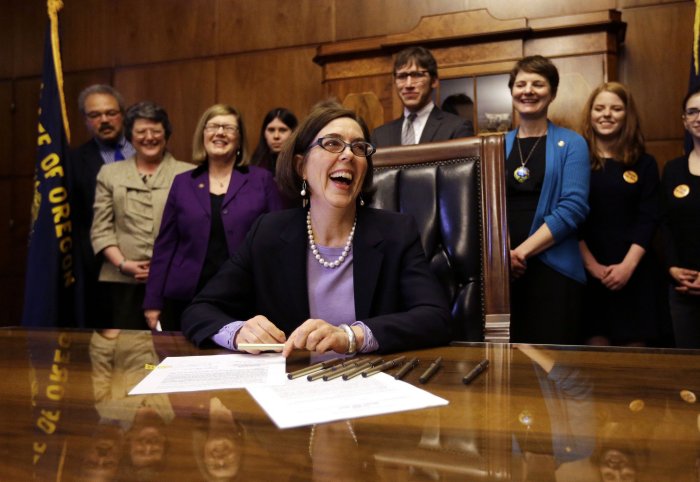
Oregon Gov. Kate Brown was thrilled when she signed the automatic motor voter registration bill on March 16, 2015.

motor-voter-law-brown

But does it have a flaw that could enable fraud?

Under Oregon’s Motor Voter law, when an eligible unregistered voter (over 17 years old, an Oregon resident and a US citizen) visits the DMV to apply for, renew, or replace an Oregon drivers’ license, ID card, or permit, that person receives a mailing from the Oregon Elections Division explaining their options for registering to vote.

Recipients of the mailing can:

  • Do nothing. In that case, the person is registered to vote as a nonaffiliated voter (not a member of a political party).
  • Choose a political party by returning the card. Joining a political party will allow the person to vote in its primary elections.
  • Use the card to opt-out and decline to register to vote.

On Oct. 25, 2016, Willamette Week ran a story that reviewed the new voter numbers. It noted that since the start of 2016, the Motor Voter law has added 247,501 newly registered voters. The story also noted that 9,292 DMV-generated voter registration cards could not be delivered.

Who are those 9,292 people? Could that mean that 9,292 people were fraudulently registered to vote?

According to Dr. Russell Terry, a Voter Engagement Advocate in the Oregon Secretary of State’s Elections Division, cards returned to the Elections Division as undeliverable can be because:

  • the address does not adhere to the USPS standardization for mailing addresses
  • the individual provided DMV with an address before updating their address through USPS
  • the individual is not identified as being at the address to which the mail is delivered

You might expect that a few addresses would be invalid if it took a while to send out the cards and people moved in the interim. But Terry said the transfer of data from the DMV to the Elections Division “…is only a few days, before or right around the time DMV would be mailing a driver’s license to that address as well.”

Is there a way, then, to check whether the people whose cards were undeliverable are legitimate voters?

I asked if I could access a list of all the names and addresses on those cards so a sampling could be checked.

Nope. “The Oregon Vehicle Code prohibits the disclosure of those individuals and their information,” Terry said.

So were up to 9,292 registered Oregon voters not eligible voters on Nov. 8? Who knows?

Given that situation, should the names of the 9,292 people whose cards were undeliverable be struck from the voter rolls?

Yes.


Troubling Tax Breaks for Data Centers

taxbreaks

One.

That’s how many jobs LinkedIn had to promise it would create to get five years of big property tax breaks for its new data center in Hillsboro that opened in mid-November.

LinkedIn told DatacenterDynamics that the major reasons it chose Hillsboro were: (1) access to green energy resources; (2) access to good global communications networks; (3) mild temperatures; and (4) tax exemptions in Oregon’s Enterprise Zones.

The reasons may be right, but don’t believe the order LinkedIn gave. “It is doubtful if this was the real decision-making hierarchy since taxes would be the data center’s biggest operating cost,” DatacenterDynamics said.

In other words, the property tax exemption under Oregon’s Enterprise Zone program, which can be worth millions to qualifying companies, was the major lure.

linkedindatacenterhillsboro

LinkedIn’s new data center in Hillsboro

Oregon’s Enterprise Zones are designed to attract investments by exempting businesses from 100 percent of local property taxes on new plant and equipment investments for up to two years while construction is in process and up to five years after that if they are growing employment in the zone.

Enterprise Zone contracts require that if a data center already operates inside the Zone and applies for benefits or renewal, it is required to increase employment by just ten percent. If a firm locates a new data center in the Zone it only needs to add one employee to be in compliance.

Because IT equipment in a data center must usually be refreshed within 5 years, the net effect is that there is no tax in Enterprise Zones.

But is the tax break justified?

Hillsboro’s aggressive marketing of the tax exemption has drawn multiple data centers to the city, all gobbling up valuable land within the urban growth boundary and generating a minuscule number of jobs. Current data center operators  include Infomart, ViaWest, Telx, NetApp and T5. LinkedIn’s data center is located in property leased from Infomart.

Infomart says its Hillsboro site benefits from a combination of energy efficiency, inexpensive power, abundant domestic and Trans-Pacific network choices. The most important benefit, however, is the five-year real and business property tax exemption for new equipment and construction. “Since IT equipment is typically refreshed within 5 years, the net effect is that there is no tax, neither sales nor property, on IT equipment in these Enterprise Zones,” Infomart highlights on its website.

That “translates to massive cost-savings for our customers,” Infomart says, and makes Oregon “… the lowest cost state for leased data center operations in the United States.”

Thankfully, Hillsboro taxpayers can easily find out the value of the tax abatement each of the multi-million dollar data centers is getting from the city. That way the public can judge whether the foregone taxes are worth it in terms of investments made and jobs created. Right?

Sorry.

The Washington County tax assessor’s office has determined that the amount the Enterprise Zone property tax exemptions save each data center annually is confidential and exempt from disclosure.

So before everybody gets carried away celebrating LinkedIn’s new data center, and heralding all the other data centers taking advantage of Enterprise Zone tax breaks, a harder look at what’s being given away to all these companies, for not much in return, is in order, particularly given the state’s budget situation.

Maybe this is something the Our Oregon folks could look at now that they’re not so busy after the defeat of Measure 97.

Is Brad Avakian running for Secretary of State or Director or Public Health?

doctor-image__opt

One of Brad Avakian’s more ubiquitous TV ads emphasizes how he will “ensure a woman can make personal medical decisions about her pregnancy.”

And Planned Parenthood says reproductive health care in Oregon depends on voting for Brad Avakian. “Your reproductive health care is on the Oregon ballot,” says an article by Mary Nolan, executive director for Planned Parenthood PAC of Oregon, on Blue Oregon, a progressive online news and commentary site. Nolan quotes Avakian saying, “As a civil rights attorney, legislator and now Labor Commissioner, I know access to safe and affordable abortion service is a fundamental civil right.”

Planned Parenthood PAC has also made a $7500 contribution to Avakian’s campaign. If I were a contributor to Planned Parenthood, I’d ask for my money back.

 After all, where is protecting reproductive health care listed among the duties of Oregon’s Secretary of State?

Numerous studies have shown that large numbers of voters don’t know which officials are responsible for which issues, a circumstance that makes it hard to hold them accountable for their performance.

All that cluelessness could work to Avakian’s advantage.  In a classic example of misdirection, instead of emphasizing his fit for the Secretary of State job, he’s running as a champion of liberal causes.

Don’t fall for it.

Measure 97 is just a Trojan horse for bigger government

biggovernment

The cat’s out of the bag.

Now we know what the Democrats and their union allies want with Measure 97.

It’s not the measure as written, with its deceptive promises of more money for education, healthcare and senior services. It’s $6 billion more out of taxpayer’s pockets each biennium that the Democrats can use to grow government, cover their disastrous PERS decisions over the years, reward their friends and punish their enemies.

Rep. Mitch Greenlick (D-Portland), when endorsing the measure in late 2015, said it would eliminate much of the constant need to choose between funding critical budget concerns each legislative session. “If that passes, we’ll have a lot of money to pay for stuff,” Greenlick said.

Stuff, indeed.

Oregonians who support Measure 97 because they believe Democrats’ claims that the revenue would be committed to education, healthcare and senior services are going to be mighty disillusioned if the Measure passes because, the fact is, the Legislature will be able to do just about anything it pleases with the resulting revenue.

On Aug. 1, 2016, the nonpartisan Office of the Legislative Counsel confirmed this when it released an opinion. “Section 3 would not bind a future legislature in its spending decisions,” wrote Chief Legislative Counsel Dexter Johnson in the opinion. “If Measure 97 becomes law, the Legislative Assembly may appropriate revenues generated by the measure in any way it chooses.”

It turns out that the Democrat-controlled Legislature could even change how the revenue is raised. Some people probably support Measure 97 now because they want to “put it to big business.” But there’s nothing to stop the Democrat-controlled Legislature from changing the entire tax formula, so long as it doesn’t result in more tax revenue, according to the Oct. 18 Portland Tribune. Only a simple majority of the Legislature would be required to approve changes in the formula, or anything else.

Sen. Mark Haas, D-Beaverton, Chairman of the Senate Finance and Revenue Committee, told the Tribune the Legislature can expect “a cavalcade of 10,000 lobbyists from every industry with valid stories about why their rates should be lower.”

And every one of those lobbyists will be expected to back up their pleas with campaign contributions, further exacerbating the already excessive role of money in Oregon politics.

A senior Democratic Legislator once defended Measure 97 as the best solution because there was no other option. Clearly, even the Democrats now believe that’s not the case.

Oregon’s Republican Party is committing suicide

seppuku_by_mark_san

It’s hard to watch a party self-destruct.

If you look at all the races on the Oregon ballot on Nov. 8, it’s clear that the Republican Party has largely abdicated its position as the loyal opposition.

It starts at the top with the U.S. Senate race. Anybody know who the Republican candidate is? His name is Mark Callahan. I can tell you he went to OSU. But his website doesn’t list any events he’s attending and OpenSecrets.org reports he has raised just $15,852 (compared with Democrat Ron Wyden’s fundraising total of $11.4 million).

The 3rd and 5th District races for the House of Representatives aren’t any better.

In the 3rd, which includes most of Multnomah County, including Portland east of he Willamette, 10-term Democrat Earl Blumenauer is opposed only by Progressive Party candidate, David Delk, who says he has no experience. OpenSecrets.org reports he has raised nothing (compared with Blumenauer’s fundraising total of $1.1 million). Of course, the 3rd has been held by a Democrat since January 1937.

In the 5th, the Republicans did manage to recruit Colm Willis to run against Democrat Kurt Schrader. Willis has deep Oregon roots, graduated from Willamette University’s School of Law and worked as a staff member on a U.S. Senate committee, but he has raised just $239,113 (compared with Schrader’s $1.6 million)

How about the governor’s race?

budpierce

Bud Pierce

Bud Pierce may be a great doctor and a nice guy, but he was invisible statewide, a cipher, until this election. He’s managed to raise $2.5 million, but Brown has raised $3.5 million and Oregon hasn’t elected a Republican governor since 1982.

An OPB poll released on Oct. 17 showed that Brown leads Pierce by an astonishing 46 percent to 33 percent. This despite the fact that even Willamette Week offered faint praise for Kate Brown, declaring, “Brown’s greatest political strength is her affability—and her ability, so far, to blame problems on her predecessor.”

Work your way down the Oregon ballot and it gets worse, with many Democrats facing NO republican opponent.

The Republican Legislative Campaign Committee (RLCC), a state-oriented national organization that seeks to elect Republicans to state legislatures, identified the Oregon State Senate and House of Representatives as targets in the 2016 elections. You’d never know it.

In the Oregon State Senate races, there’s no Republican candidate in the 14th, 18th, 21st, 22nd and 23rd Districts.

In House races, there’s no Republican candidate in the 9th, 27th, 34th, 35th, 36th, 42nd, 43rd, 44th, 45th, 46th, 47th and 49th Districts.

How in hell the Republicans ever hope to recover power in Oregon under these circumstances is beyond me. And that’s not healthy for Oregon. One party dominance leads to corruption, cronyism, recklessness and abuse of power.

The thing is, if the Republicans would focus on building a strong bench, skillfully build public awareness of those with the greatest potential, encourage them to run for office and back them up with ample financial support, they can win and change the dynamic of state politics.

Look at the 2010 race between Democrat John Kitzhaber and Republican Chris Dudley. Despite some clear errors in strategy and execution, Dudley captured 694,287 votes, only 22,238 fewer than Kitzhaber’s 716,525. Damn close. More promising for the Republicans, Dudley carried all but 7 of Oregon’s 36 counties.

2010governorrace

Blue counties: won by Kitzhaber;                 Red counties: won by Dudley

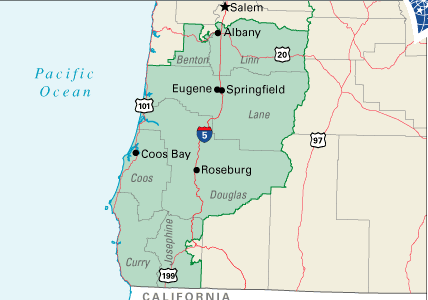
Lane and Multnomah Counties, two Kitzhaber won, may be a lost cause for Republicans, but if Dudley had been able to peel off more votes in the other 5 he might well have won.

In other words, offer appealing, moderate candidates, back them up with financial resources, run strong campaigns across Oregon and Republicans can win.

“Yes on 97” campaign relying on socialist endorser

The Yes on 97 campaign is featuring Martin Hart-Landsberg, Professor Emeritus of Economics at Lewis & Clark College, in its advertisements, assuming that an economist will be a persuasive voice of authority to the general public.

martin

Martin Hart-Landsberg

Economists support Measure 97

But what does the public know about Hart-Landsberg? Here’s some background on his views.

     About Martin Hart-Landsberg

“…seriously if I hear (in his class) how capitalism is bad, socialism is good one more time I might vomit.”

“(Class) mainly focuses on how capitalism is bad and socialism is good. You don’t learn very much else.”

Rate my Professors at Lewis & Clark College

___________________________________________

“…it is capitalism (as a dynamic and exploitative system), rather than neoliberalism (as a set of policies), that must be challenged and overcome.”

“…therefore, as participants in the resistance, …we can illuminate the common capitalist roots of the problems we face and the importance of building movements committed to radical social transformation and (international) solidarity.”

Neoliberalism: Myths and Reality by Martin Hart-Landsberg

___________________________________________

“…capitalist globalization is largely responsible for creating or intensifying many of our most serious economic and social problems.”

“…even a “robust” capitalism is now an obstacle to human progress.”

From the Claw to the Lion: A Critical Look at Capitalist Globalization, by Martin Hart-        Landsberg

_______________________________________

“The major obstacle to development is capitalism itself, and our efforts must be directed towards advancing new visions of democratic and sustainable development.”

Challenging Neoliberal Myths: A Critical Look at the Mexican Experience by Martin Hart-Landsberg

________________________________________

“If we want socialism for the twenty-first century, we need to understand why the ‘real’ socialisms of the last century so often ended in capitalism.”

Praise for “The contradictions of ‘real socialism’ by Martin Hart-Landsberg

_________________________________________

“For Hart-Landsberg and Burkett, a socialist program in China or elsewhere—which they identify with the confusionist formula of a “worker-community-centered economy”—must have little or no commerce with the corrupting evils of the world capitalist market.”

“Despite their professed Marxism, Hart-Landsberg and Burkett’s outlook amounts to a form of anarcho-populism.”

China’s “Market Reforms”: A Trotskyist Analysis, Workers Vanguard

___________________________________________

“…far from undermining the relevance of Marxism, the Chinese experience highlights its critical importance as a framework for understanding and overcoming the dynamics of contemporary capitalism.”

Thinking About China: Capitalism, Socialism and Class Struggle, By Paul Burkett and Martin Hart-Landsberg, Socialist Viewpoint


Enough said?

With Oregon school finances tight, Democrats and unions push to raise costs

Oregon Democrats talk out of both sides of their mouth when addressing school finances.

While arguing that our schools desperately need more money and advocating for Measure 97, which would impose huge business tax increases to cover the bill, they’ve been working to increase school costs.

It all has to do with unemployment insurance.

unemploymentapplication_media-week_flickr1

School districts, not their employees, pay for unemployment insurance benefits. Under ordinary circumstances, school employees released for summer break, customary vacation periods or holiday recesses aren’t considered unemployed and aren’t eligible for unemployment compensation benefits.

But leave it to the Democrats, allied with their union supporters, to try to chip away at these restrictions and pass along the added costs to Oregon schools.

Democrats made a run at changing the law in 2015 when State Senator Michael Dembrow (D-District 23), who receives substantial campaign contributions from unions, introduced SB 470.

michaeldembrow

Oregon State Senator Michael Dembrow

At the time, school employees who performed services other than instruction, research or administration did not qualify for unemployment insurance benefits during school breaks. A committee amendment which replaced the original language of SB 470 would have changed that, permitting school employees who left their jobs for good cause to receive unemployment insurance benefits.

The bill was still in committee upon adjournment, so it died.

But the Democrats persisted.

Earlier this year, Senator Dembrow introduced SB 1534, which again proposed permitting school employees who leave their jobs for good cause to receive unemployment insurance benefits during summer and school breaks.

Tricia Smith of the Oregon School Employees Association testified before the Senate Committee on Workforce and General Government that school employees who could be eligible for benefits under the bill are in non-instructional positions such as secretaries, food service workers, custodians, school bus drivers and others.

schoolbusportland

Like the proverbial camel’s nose under the tent, the law was likely the first salvo in a long-range union attempt to make teachers eligible for unemployment compensation during summer and school breaks, too.

I was curious how much this expanded unemployment compensation allowance had cost school districts so far. So I asked the Oregon Employment Department to tell me how many people had collected unemployment insurance benefits under the new standards, their job categories and the amount of unemployment insurance benefits paid out to them.

Fortunately, I learned that the Democrat’s misguided attempt to burden Oregon schools with higher unemployment compensation costs has been crushed.

After passage of the legislation, the Employment Department received notice from the U. S. Department of Labor that SB 1534 does not conform with federal guidelines to administer the Unemployment Insurance program.

According to Craig Spivey, a Public Information Officer with the Oregon Employment Department, “SB 1534 included a provision that if the changes to Oregon statute fail to conform to federal guidelines, they would not go into effect. Therefore SB 1534 is not in effect at this time and no unemployment claims have been filed” under the more expansive criteria in the legislation.”

Whew! Oregon school districts dodged a bullet on this one.


Rent control: Kotek’s folly

On Sept. 12, Oregon House Speaker Tina Kotek (D-Portland) said she planned to push for an end to Oregon’s ban on rent-control laws, enabling local governments to move ahead with measures of their own.

Kotek said she also wants to ban all rent increases above a “reasonable” percentage and end to no-cause evictions.

tinakotek

Oregon House Speaker Tina Kotek

The problem is, no matter how much liberals embrace the concept, rent control doesn’t work. Any short-term benefits, including the applause of some constituents, are always overshadowed by the long-term problems rent control creates.

  • However you phrase it, under rent control, government dictates what private owners are allowed to charge for their private property. Yes, the free market has flaws, but it is far better than having bureaucrats running things.
  • Landlords who can’t raise the rent on their property to a market price are more likely to cut back on maintenance and less likely to invest in improvements. Not only will landlords have absolutely no economic incentive to invest more in their properties, they may not even have the funds because of limits on their rental income.
  • Rent control distorts the housing market by misallocating rental units to those who are already renting them. Whenever government prevents the charging of prices high enough to clear the market, shortages will occur.
  • The imposition of rent control can lead to a “demolition derby” where older controlled rental units are purposely torn down and replaced with higher priced units.
  • Rent control does not guarantee low rents because it doesn’t regulate the starting rent for a new tenant. When a tenant in a rent-controlled unit moves out, any savvy  landlord will set the rent in the new lease at the current market rent, which is likely to be much higher.
  • In a review of 140 economics studies on rent control in Economics Journal Watch, economists overwhelmingly agreed that, “A ceiling on rents reduces the quantity and quality of housing available.” From the abstract: “I find that the preponderance of the literature points toward the conclusion that rent control introduces inefficiencies in housing markets. Moreover, the literature on the whole does not sustain any plausible redemption in terms of redistribution.”
  • A broad survey of economists by the IGM (Initiative on Global Markets) Forum revealed a similar repudiation of rent control. The Forum is a program of the University of Chicago’s Booth School of Business. “Rent control discourages supply of rental units,” said Associate Head of the MIT Department of Economics, David Autor. “Incumbent renters benefit from capped prices. New renters face reduced rental options.”
  • Once rent control is imposed, it is extremely hard to get rid of, even where its futility is eventually recognized. That’s because rent control will have held rents far below the market rate, so removing them is likely to cause immediate and substantial rent increases, something few politicians (and even some rent control critics) will be willing to embrace in the face of a potential public outcry.

As Art Carden put it in The Unintended Consequences of Rent Control, “Suppose that you want to destroy a city. Should you bomb it, or would it be sufficient just to impose rent control?”