Oregon Higher Education Endowments Under Threat

For Donald Trump, it’s always about the filthy lucre. 

Rewarding allies and punishing perceived adversaries financially has long been Trump’s raison d’être in business and politics. His life is a story of questionable real estate and tax payment shenanigans, a sham Trump University, hush money payments to porn star Stormy Daniels and misuse of charitable funds at the Trump Foundation. His greed and shameless behavior seem to have no limits. Nor does his assault on higher education.

Now he and his party are after higher education endowments and Oregon’s private institutions, including those with large and small endowments, should be worried.

Reed College has the largest endowment among Oregon’s private higher education institutions.

In 2017, during Trump’s first term, a Republican Congress passed the first excise tax on college endowments. Private colleges and universities now pay an annual 1.4% excise tax on endowment net investment income. The excise tax is levied on schools that have at least 500 tuition-paying students and net assets of at least $500,000 per student. 

Because the $500,000 is not adjusted for inflation, the threshold is being effectively lowered over time. The tax has affected about 50-55 institutions to date. 

In 2023, 56 universities paid about $380 million under the endowment tax, up from about $68 million in 2021 and slightly more than the $200 million annual forecast made by the Joint Committee on Taxation in 2017.

In 2023, when he was still a U.S. Senator, J. D. Vance introduced the College Endowment Accountability Act which proposed increasing the excise tax from 1.4% to 35% for secular, private, nonprofit colleges and universities with at least $10 billion in assets under management.

“University endowments…have grown incredibly large on the backs of subsidies from the taxpayers, and they have made these universities completely independent of any political, financial, or other pressure, and that is why the university system in this country has gone so insane,” Vance asserted. 

Vance’s bill went nowhere, but the issue resurfaced in January 2025 when Rep. Troy E. Nehls (R-TX) introduced the Endowment Tax Fairness Act, a bill that would raise the excise tax levied on certain private university endowment profits from 1.4% to 21%. 

The tax would apply to private colleges and universities with 500 or more students with an aggregate fair market value of assets of at least $500,000 per student of the institution, and more than 50% of the student body is located within the United States. 

The Tax Foundation, assuming a 7.5 percent average annual return, estimates Nehis’ bill would raise about $69.8 billion in additional revenue over 10 years.

The House Ways & Means Committee also appears interested in raising the endowment tax rate. Committee Chair Jason Smith (R-MO) pitched the idea during an all-member meeting among House Republicans in January as well. 

In February, Rep. Mike Lawler (R-NY) introduced the Endowment Accountability Act, proposing raising the excise tax rate from 1.4% to 10% of endowment income and lowering the per-student endowment threshold from $500,000 to $200,000, likely pulling in many more colleges.  

“If passed, such a tax would fundamentally alter the relationship between the government and many nonprofit colleges, as well as between those institutions and their donors,” reported Higher Ed Dive. “Moreover — and perhaps more importantly as a practical reality — such a tax could land hard on students, research programs and college operations.

Many institutions with much lower profiles than the Harvards of the world could get taxed if lawmakers broadened the threshold for paying, Jason Delisle, with the Urban Institute, said at an American Council on Education panel. And that’s exactly what higher ed institutions are preparing for. 

“University leaders and endowment chiefs also expect Congress to consider raising the tax on the richest endowments and expanding the number of schools affected,” the Wall Street Journal reported. And there’s talk of spreading the pain around more, hitting up smaller schools with smaller endowments, too. 

Although it may not be maintained in a final bill, under a tax plan unveiled by House Republicans on May 12, 2025, some universities would pay an annual tax of up to 21%. on their annual net investment income in endowments.

According to data from the National Association of College and University Business Officers and the asset management firm Commonfund, colleges spend the largest share of endowment funds on student financial aid (48.1% in FY2024), followed by academic programs and research (17.7% in FY2024).

Mauling endowments with egregious excise taxes would seriously threaten the ability of many schools to maintain these efforts, though that may not be of much concern to Trump and his allies, who have so far displayed little more than contempt for higher education.  

FY2024 endowments at selected private higher education institutions in Oregon[1]

InstitutionEndowment ($ millions)
Reed College814
Lewis and Clark College322
University of Portland315
Willamette University312
Linfield University118
Pacific University57
George Fox University34
Warner Pacific University18

[1]

 Source: 2024 NACUBO-Commonfund Study of Endowments (NCSE)

Say “No” to Oregon Republican Push for No Taxes on Tips

What’s in the water in Salem?

On one side you have a phalanx of Democrats proposing the ludicrous idea of paying strikers unemployment benefits, which would make Oregon the only State in the country to grant unemployment benefits to striking public and private sector workers.

Not to be outdone in making nonsensical proposals, now you have a raft of Republicans, mimicking President Trump, proposing that the state forego taxing tips.

Here’s a tip – exempting tips from state taxes is a bad idea.

In their determination to position themselves as supporters of the working man (and woman), 21 of Oregon’s House Republicans have proposed a bill, HB 3914, to end taxation of tips, which are generally perceived as discretionary payments determined by a customer that employees receive from customers.

As written, the bill would not count “service charges” as tips. A restaurant, for example, recently added an automatic service charge equal to 18% of my bill. Even if that was intended to cover for a “no tipping” policy, it would be part of the server’s wages because it was not discretionary.

The 129-word Oregon bill gets right to the point, “There shall be subtracted from federal taxable income any amount of tips properly reported as wages on the taxpayer’s federal income tax return.”  That would automatically subtract tips from taxable income in Oregon, too. 

The bill deserves a quick death.

According to the IRS, “All cash and noncash tips received by an employee are income and are subject to Federal income taxes. All cash tips received by an employee in any calendar month are subject to social security and Medicare taxes and must be reported to the employer.” So, tip income is taxable income.

Charges automatically added to a customer’s check by an employer and subsequently distributed to employees are not tips; they are “service charges”. These service charges, which are appearing more often on Oregon restaurant bills, are non-tip wages and are subject to Social Security tax, Medicare tax, and federal income tax withholding.

Many consumers think the expanding pressure on customers to leave tips is already out of hand. A no tax on tips policy would likely expand the use of tipped work even further, potentially leading to consumers being asked to tip on virtually every purchase everywhere. 

A  New York Times article about tipping generated a lot of comments, many of which lamented the seeming spread of tipping expectations to multiple businesses and regardless of the amount of actual service by an employee. “Collectively, we cringe when the iPad is swiveled into our face at the coffee counter or deli; we know it is extortion rather than appreciation for services rendered,” said one person.  

There’s also a sense that some businesses are customizing the tip configuration on screen to exploit customers. Most people tip between 15-20%. If you buy a $2.85 espresso and the screen offers 15%, 20% and 25% tip options, you are likely to hit 15%, generating a tip of 43 cents. If a business wants to jack that up, however, it can give you $1, $2, or $3 options on purchases below $10, instead of a percentage. If you pick $1, you have paid a 35% tip. Devious, but effective.

Despite the massive increase in tipping expectations in recent years at multiple businesses, tax experts say a relatively small share of the workforce depends on tips. Only about 2.5% of American workers are in occupations that depend on tips, according to the IRS.  Among those workers, 37% earn less than the federal standard deduction. So, they already don’t have to pay federal income taxes.

Other tipped workers benefit from the earned income tax credit (EITC) and/or child tax credit (CTC) to the extent that they don’t have any federal income tax liability. In addition, because tipped workers would keep more of their income, employers could use this law as a justification for lowering workers’ base pay if it is currently above the minimum wage.

In fact, exempting tips from taxation can actually lead to situations where low-income workers end up effectively losing income through losing eligibility to tax credits such as the Earned Income Tax Credit (EITC) and Child Tax Credit (CTC).

The Budget Lab at Yale, a non-partisan policy research center, estimates that less than 3 percent of families would benefit from a broad-based income tax deduction for tips in 2026, but it would still cost the federal government more than $100 billion over the next decade. Restricting eligibility to workers in the leisure and hospitality industries would reduce the cost by more than 40 percent, but that would still leave a big hit on the deficit unless taxes were raised elsewhere.

Even the liberal Oregon Center for Public Policy opposes the no tax on tips idea.

In October 2024, Daniel Hauser, Deputy Director of the Center, said that ending taxes on tips “makes the tax system less fair” because workers receiving tips would get a tax break, but not low-paid workers in general.

If you have two workers, one a bartender who earns about $10,000 of his $40,000 annual income in tips and the other a warehouseman who makes all of his $40,000 income in wages, it wouldn’t make sense to give the bartender a tax break but leave the warehouse worker hanging out to dry, Hauser argued. 

 It also “creates openings for people to think about, how can my income be categorized as a tip and get this tax break too?,” Hauser wrote.  Third, he said, “if the goal is to help the economic security of low-income workers, it’s not very effective…and there are much better ways for us to try and help low-income families in Oregon.” 

He’s right.


Pay Striking Workers Unemployment Benefits? No Way!

People gathered together for strike

We don’t have enough money for this, we don’t have enough money for that, Oregon legislators moan. And then the Oregon Senate votes for SB 916, a bill to pay striking workers unemployment benefits.

The Oregon Employment Department projects the bill could add $11.2 million in payments to striking workers. The Legislative Revenue Office predicts it could cost $5.6 million in the next two biennia, based on striking activities between 2015 and 2024.

SB 916 would make Oregon the only State in the country to grant unemployment benefits to striking public and private sector workers. Oregonians can be proud of some of the state’s groundbreaking legislation, but this is not one to be praised. 

 Russell Lum, a Political Organizer with the Oregon Nurses Association, said in written testimony to the Senate Committee on Labor and Business, “SB 916 … can bring about fair contracts faster”, but that is unlikely. 

I bet it will cost a lot more as public and private worker unions extend their strikes, safe in the knowledge they will get compensation during their strike.  As Terry Hopkins, the President & CEO of the Grants Pass & Josephine County Chamber of Commerce, said in written testimony to the Senate Committee on Labor and Business, ”By providing UI benefits during strikes, SB 916 could inadvertently incentivize prolonged labor disputes, as the financial pressure to reach a resolution is alleviated for striking workers. This potential for extended disputes not only disrupts the operations of the directly involved businesses but also has ripple effects throughout the supply chain, impacting small businesses that are indirectly connected.”

What makes Democrats’ strong support for this bill particularly egregious is that it is aimed at benefiting unions, an extremely small portion of the labor force, but a sector that overwhelmingly favors the Democrats in campaign contributions.

In 2024, just 15.9% of wage and salary workers in Oregon were union members, according to the Bureau of Labor Statistics. Dig deeper and you find that the union membership rate for public sector workers in Oregon, about 51%, is considerably higher. That is consistent across the country, where unionization is about five times higher nationwide in the public sector compared with the private sector.

The bill has now gone to the Oregon House, where Democrats hold a 36-24 majority. Two Democrats in the Senate showed great wisdom in voting against the bill, Jeff Golden, D-Ashland and Janeen Sollman, D-Hillsboro. “Counties, cities and schools are scrambling to just maintain current services,” Sollman said. “Now is not the time to be adding more uncertainty and more expenses.”

Amen.

Making It: The Fabric of Success in Portland

A wolf sculpture by native artists Marie Watt and Cannupa Hanska Luger made in collaboration with PGF for exhibition at the Denver Art Museum.

Portland, Oregon may be struggling, but there are some promising green shoots.

All the creative American garment design and manufacturing has gone offshore and it’s likely to stay there. That’s what some pessimists say. Britt Howard, Founder and Creative Director of Portland, Oregon-based PGF, doesn’t buy it.  

When Intel Corp. wanted to celebrate its 50th anniversary in 2018, it turned to PGF. The assignment?  Breathe life into some garment ideas. 

The result? Slick, comfortable updated replicas of “bunny suits” worn in Intel’s super clean microprocessor manufacturing fabs. Then suit up some employees for a lively, eye-catching flash mob on an Intel campus. 

Intel flash mob by PGF

In 1960, 1,233,000 Americans were employed in the manufacturing of apparel, 5.5% of the total manufacturing workforce, according to the U.S. Department of Labor. In 2024, only about 84,000 employees were part of the apparel manufacturing industry in the United States.

Now PGF is bringing back some of those “Made in America” jobs with a full-service creative design and fabrication studio.

“At PGF, we combine expert intuition with creativity, design, and flawless execution,” says Howard, who has been shepherding PGF’s evolution since 2008. 

Britt Howard at PGF

Howard showed she had some real entrepreneurial chops when she was just 25. 

She started Portland Garment Factory in 2008 with $2400 in start-up capital from a supportive friend. A brief contract with the friend essentially said, ‘If you ever get successful, maybe you’ll pay me back.” Eight years later, Howard did so. “And very handsomely,” the friend said. 

Howard started out in a 250 sq. ft. Portland studio. The company began as a sole proprietorship, then shifted to a limited liability company (LLC) one year later. 

After moving around a bit, the company settled in at a building  at 408 S.E. 79th Ave. in Southeast Portland.

Over its first 12 years Howard continued to grow the business, accruing an impressive list of clients, including Nike, Adidas, Cotopaxi and the global advertising agency, Wieden+Kennedy. 

In some cases, the company created prototypes of products a company was considering for mass production. Other work included creating product marketing displays and specialty items that could be featured in retail stores to wow customers with their ingenuity.

The company also created sculptures. In one case, it worked with native artists Marie Watt and Cannupa Hanska Luger to create Each/Other, a monumental wolf sculpture with a fabric “hide” attached to the steel frame that was exhibited at the Denver Art Museum.

The company made a foray into making baby clothes, too. “We used to make retail products, such as thousands of baby clothes, but we almost went out of business,” Howard said. “The seller wanted to put out a product that sold for $6, but it cost us $40 to make it because of all our overhead. It was really hard to make affordable garments in the United States.”

That was one reason why Howard changed the name of her company to PGF in 2018.  “I really needed to recalibrate because we couldn’t survive as just a garment manufacturing company,” Howard said. “We needed to get away from making retail products and get into more commercial work.”

As time went by, everything seemed on track and the company’s future looked bright. 

Then, disaster!

Early on the morning of April 19, 2021, a massive three-alarm fire, later determined to have been set by an arsonist, tore through the company’s building, destroying just about everything. 

Aftermath of the fire

The potential for failure was breathing down Howard’s neck. But Howard wasn’t out.

A broad network of friends and supporters came to her rescue, starting with a team of nine women who set up a GoFundMe account to help Howard resume her business. 

“The morning of April 19th, an arsonist set fire to PGF and everything was burned from the brick walls to sewing machines to skews of clothing for clients,” the account said. “Britt lost years and years of hard work and she needs help from us to re-build her business which employs many women and is a pillar in our community.  She has gotten so many fashion labels started, contributed charitably and taken risks to help people build their brands.  This money will go toward replacing all the machines that were lost, a deposit for a new location and securing the jobs of her beloved employees.”

An astonishing 1200 donors responded with contributions ranging from $5 to $5,000, generating a total of $119,125. 

“Britt has created a Portland mainstay, and Portland needs PGF!,” a $100 donor wrote. “Not to mention, she’s an inspiration and positive force of nature in the B Corp and broader business community here. Sending PGF love.” 

While grieving her loss, Howard embarked on a what she saw as an urgent need for recovery. Within 10 months, with the GoFundMe money, insurance coverage and a mortgage, in hand, Howard was able to buy another headquarters building in Southeast Portland, a 10,000 sq. ft. corrugated metal-clad building that had previously been a gym.

PGF Building

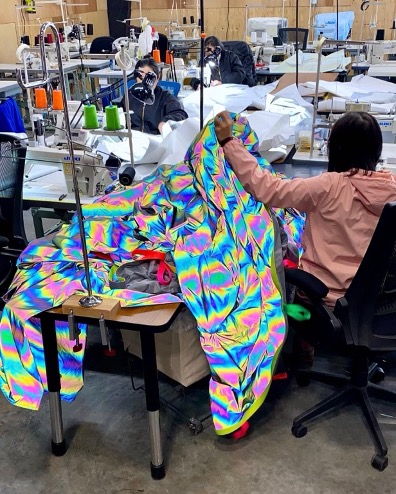
The three-level building is usually a beehive of activity for 17 employees, including designers, artists, expert fabricators and a Marketing and Community Coordinator.

Many of the fabricators are Vietnamese who have been with PGF for more than 10 years. “They are skilled sewers and they are really proud of the work they do,” Howard said.  

Sewers at work at PGF

“We’re now a full -service cut-and-sew manufacturing company,” Howard said. “We make soft goods, that includes wearables, clothing, accessories, curtains, upholstery items, sculptures. We also do design work in-house and we source the material, so we’re completely one-stop.”

Reflecting her commitment to responsible business practices, Howard has also secured certification of PGF as a B Corp, a company that meets high standards of verified social and environmental performance, and public transparency to balance profit and purpose.

Part of PGF’s commitment to sustainability is the reuse of materials. In 2023, for example, it created cushions using fabric scraps from past PGF projects and designed to invoke 90’s zine culture married to frenetic, modern-era multimedia art. All the cushions were stuffed with pulverized factory scraps, the result of PGF’s zero-waste manufacturing initiative.

To reward and retain her employees, Howard provides them with generous benefits, including health insurance. A particularly useful benefit that came into play when the fire hit PGF’s building in 2021 was payroll protection insurance. That allowed Howard to give paychecks to her employees for 10 months until the business could restart.

Howard has also focused on improving PGF’s operations, hiring a COO for five months in 2023. “She really helped me turn around a lot of the problems we were having, to look at them in a different way, “Howard said. “She created a reporting tool that’s very specific to this business and changed the structure of the business so more responsibility is placed on designated managers instead of everybody reporting to me,” Howard said.

In its new building, PGF has continued to create specialized products for a wide range of clients, including kimono-style uniforms for volunteers at Portland’s Japanese Garden, jackets for Oregon’s Tillamook Cheese company to highlight the launch of a shredded cheese product and Mad Hatter and White Rabbit costumes for an outdoor electronic dance music festival.

It has even created custom blue Nike tracksuits for the cast of the sports comedy-drama Ted Lasso to wear at the PEOPLE’s Post Screen Actors Guild Awards Gala in Feb. 2024.

With the pandemic, the 2023 fire and the fluctuating economy, Howard says business has been uneven in the past several years, but she maintains her optimistic spirit, tempered with acknowledgement that trouble can lurk just around the corner.

In a sign of her continuing optimism and willingness to take risks, in April 2024, Howard bought the assets of Cotton Cloud Futons in Portland’s Slabtown district and rebranded the company’s manufacturing space as “Oregon Natural Fiber Mill.”  She hopes the acquisition will enhance her company’s commitment to sustainable textile manufacturing.

Oregon Business covered the deal, noting that the factory milled U.S.-sourced cotton and wool into usable materials with a focus on organic cotton, regular cotton and polyester and that its equipment included a 100-year-old Garnett machine, a massive textile processing mechanism that converts waste into a uniform fiber to be used in other applications.

Never satisfied with standing still, Howard is aggressively pursuing new opportunities “It’s not a chill business, but we’re here to stay,” she says. “There’s lots going on, lots of opportunities everywhere. I just have to know where to put my energies.”

Paying Strikers: Oregon Democrats Keep A Foolish Idea Alive

Forrest Gump must have been thinking of Oregon’s Democrats when he said that.

They’re continuing to push a bill, SB 916, that would allow striking workers in Oregon to collect unemployment benefits. Because the Unemployment Insurance Trust Fund is funded through a payroll tax that is paid by employers, Oregon employers would be paying workers not to work.

The unemployment insurance program, as the state explains, ”provides partial wage replacement benefits to eligible workers who are unemployed through no fault of their own.” It is not, and was never intended to be, a source of money to compensate workers for refusing to work.

My heavens. The Democrats are shilling for the unions again with a blatant gift. What a shock!

What makes their strong support for this bill particularly egregious is that it is aimed at benefiting an extremely small portion of the labor force, but a sector that overwhelmingly favors the Democrats in campaign contributions.

In 2024, just 15.9%  of wage and salary workers in Oregon were union members, according to the Bureau of Labor Statistics. Dig deeper and you find that  the union membership rate for public sector workers in Oregon, about 51%, is considerably higher. That is consistent across the country, where unionization is about five times higher nationwide in the public sector compared with the private sector.

Supporters of SB 916 often try to bolster their cause by alluding to the fact that New York and New Jersey already allow unemployment benefits to be paid to strikers, but they neglect to mention that both states bar public employees, such as teachers, from striking.

If you want to know who’s responsible for this appalling bill, it was sponsored by Democratic Senators Kathleen Taylor, Wlnsvey Campos, James I. Manning, Jr., Chris Gorsek, Mark Meek, and Deb Paterson, as well as Democratic Representatives Dacia Graber and Ben Bowman.  The bill was passed out of the Senate Committee on Labor and Business on Feb. 6, with Democrats Senator Khanh Pham, Senator Kathleen Taylor and Senator Aaron Woods voting aye and Republicans Senator Daniel Bonham and Senator Cedric Hayden voting nay.

I Told You So: The Ritz-Carlton Portland Goes Bust

Two years ago I wrote a post about the likely failure of the Ritz-Carlton Residences in Portland:

THE RITZ-CARLTON RESIDENCES IN PORTLAND: A TOWERING MISTAKE

Now we know it was a towering mistake, indeed, a fiasco, a classic misreading of the market.

Keller Williams Realty Professionals began marketing individual condos at prices ranging from $1,1000,000 for a one bedroom 2 bath 1,105 sq. ft unit to $8,999,000 for a 3 bedroom 4 bathroom 3,256 sq. ft unit. Principal and interest on the mortgage, plus property taxes and condo fees, could have translated to an $8000 a month expense for the 1 bedroom.

Willamette Week’s Anthony Effinger reported today that only 8% of  the 132 Ritz-Carlton condominiums have sold, a failure of massive proportions that could have potentially major repercussions for the City of Portland  and its struggling downtown core. His entire article is reproduced below:

In July 2025, Ready Capital Corp., based in New York, said it had taken possession of Block 216, the 35-story building in Portland’s West End that has ground-floor retail, five floors of office space, a 251-room Ritz-Carlton Hotel and 132 Ritz-Carlton residences.

Lender to Ritz-Carlton Tower Says Foreclosure Best Option for $503 Million Loan

The lender to Block 216, Walter Bowen’s gleaming West End skyscraper, sounded an ominous note about the property in an earnings report Monday.

New York-based Ready Capital said the best strategy for its $503 million construction loan would be to take possession of the property, instead of waiting for repayment.

“Ownership is [the] best net present value outcome for RC,” Ready Capital wrote in a 25-page supplement to its fourth-quarter earnings.

Ready Capital CEO Thomas Capasse went into more detail on a conference call.

“While the original strategy was to refinance the construction into a bridge loan, the current appraisal and other factors favored ownership and serial asset disposition on the components as the best net present value outcome,” Capasse said, according to a transcript of the call.

Translation: foreclose on the 35-story building and sell it in chunks.

Block 216 has ground-floor retail, five floors of office space, a Ritz-Carlton Hotel and Ritz-Carlton Residences. Ready Capital acquired the Block 216 loan in March 2022, when it bought Mosaic Real Estate Credit LLC, the building’s original construction lender.

Like so many downtown towers, Block 216 has struggled to land office tenants. Just 23% of the office space is leased, according to Ready Capital. Nor has Bowen been able to sell many of the 132 Ritz-Carlton condominiums. Only 8% have sold, according to Ready Capital’s earnings report, at an average of $1,105 per square foot.

The hotel is underperforming, too, Ready Capital said. Its average revenue per available room was $188 in 2024, compared with $343.28, the average for all Ritz-Carlton hotels during the same period. The chain is owned by Marriot International Inc., which provided the average figure in its full-year earnings report.

Ready Capital said it plans to stabilize the three components of the angular glass tower—commercial, condo and hotel—then sell the office space and hotel portion within two years. Unloading the condos will take three years, Ready Capital said.

Neither Block 216 management nor Bowen’s company, BPM Real Estate Group, returned calls and emails seeking comment. Ready Capital’s press office didn’t return an email. Nor did its chief financial officer, Andrew Ahlborn.

One bright spot: Block 216’s retail space, where a food hall called Flock opened in January, is 100% leased, Ready Capital said.

The earnings report spurred a 27% decline in Ready Capital shares on Monday, mostly because the company halved the quarterly dividend it pays to investors to 12.5 cents a share to “better align the dividend with projected cash earnings in the short-term and to preserve book value,” Capasse said on the conference call.

Concern about the Block 216 loan also may have also weighed on the stock. In addition to the $503 million loan, Ready Capital also owns $62 million of preferred equity in the project, for a total of $565 million.

Ready Capital said it has set aside $130 million to cover the declining value of Block 216. Given that reserve, Ready Capital values it at about $435 million. At that valuation, Block 216 accounts for about one-quarter of common shareholders’ equity in Ready Capital.

Ready Capital shares closed at $4.95 today, down from $8.39 a year ago.

Paying Striking Workers: One More Bad Idea From Oregon Democrats

Dear Oregon Legislators. Who are you going to listen to, the unions or the rest of us?

 Oregon Democrats, at the request of the AFL-CIO union, have introduced a bill, SB 916, that would allow striking workers in Oregon to collect unemployment benefits. Because the Unemployment Insurance Trust Fund is funded through a payroll tax that is paid by employers, Oregon employers would be paying workers not to work.

Public hearings on the bill before the Senate Committee on Labor and Business were held on Feb. 6 and Feb. 11, 2025.  Union supporters, particularly representatives of nurses and educators, uniformly endorsed the bill. Pretty much everybody else opposed it. 

The bill is sponsored by Democratic Senators Kathleen Taylor, Wlnsvey Campos, James I. Manning, Jr., Chris Gorsek, Mark Meek, and Deb Paterson, as well as Democratic Representatives Dacia Graber and Ben Bowman. 

The unemployment insurance program, as the state explains, ”provides partial wage replacement benefits to eligible workers who are unemployed through no fault of their own.” It is not, and was never intended to be, a source of money to compensate workers for refusing to work.

Daniel Perez with the Economic Policy Institute, founded with a pledge from eight labor unions, delivered written testimony before the Committee in support of SB 916. Ignoring the issue of whether paying strikers made sense, Perez argued that it would “result in minimal costs to the state of Oregon “and “would ensure that critical dollars continue to flow into local businesses and communities during strikes.”

Perez argued that over half of strikes end within two days and over the past four years, the median strike duration in Oregon has been five days. Therefore, the bill’s requirement that there be a 7-day waiting period before striking workers would be eligible to apply for benefitsmeant few would qualify. This , of course, ignored the issue of whether strikes would be prolonged if strikers were paid.

The Oregon School Boards Association (OSBA) asserts, for example, that if Portland Public Schools teachers went on a one month strike in 2025, it would cost the Portland school district $8.7 million if SB 916 were law at a time when the district is already struggling financially. ,

Nurses also testified in support of the bill. “By not allowing unemployment benefits, workers are being discouraged from using their legal right to collective action, creating an advantage for employers,” said one nurse. “Many healthcare workers are forced into an indefinite labor dispute without financial support, making it almost impossible to stand up for necessary changes that need to happen in the workplace.”

Individual critics were more blunt, and more persuasive.

“Are you seriously attempting to KILL businesses in Oregon?” said one. 

“Stop this wasteful spending on foolish bills.,” said another. “Passing of bills such of this will only benefit the greater Idaho movement and have more business and people move out of the state.”

 “This bill appears to be an attempt by certain politicians to woo the union vote, who will in turn donate more money to their campaigns (quid pro quo),” said another. 

“When two parties are negotiating, the cost to both sides needs to be heavy or a settlement won’t be reached.,” said another. “Paying striking employees removes the incentive to reach an agreement quickly.”

A coalition of business groups, the Oregon Farm Bureau, the Oregon Forest Industries Council, chambers of commerce, the Oregon School Boards Association and others said the bill would be “putting the state’s thumb on the scale in what should be a negotiation process between workers and employers.” Further, “If public unions strike, the impact to state (or school district, local government) budgets could be catastrophic. This is particularly alarming given the number and frequency of recent teacher strikes.”

Local governments were also outspoken in opposition to the bill. 

“At a time when local governments and businesses are grappling with tight budgets, these additional expenses would place further strain on employers who already face rising costs for wages, benefits, and regulatory compliance,” said the Marion County Board of Commissioners. “This could lead to higher taxes, service reductions, or even layoffs, the very scenario that unemployment benefits are meant to mitigate.”

The City of Hillsboro was strongly opposed as well. “This bill provides an unfair advantage to labor in a dispute by forcing all employers to fund the act of striking (or other labor disputes) and undermining the purpose of a strike,” the city said.

In my view, the arguments against paying strikers unemployment benefits clearly win out. 

But, given the tendency of Oregon’s Democratic legislators to appease unions, which overwhelmingly bankroll Democrats, the bill may still well go forward.  If it does, Portland won’t be the only part of the state in a “doom loop”. The bill would be one more nail in the coffin of the entire state’s competitiveness. 

The Chickens are Coming Home to Roost for Oregon Republican Rep. Cliff Bentz

republican

Rep. Cliff Bentz (R-OR)

Conservative Republican Congressman Cliff Bentz won his 2024 race in Oregon’s 2nd Congressional District by a comfortable margin. Now there’s a feeling of betrayal in the air. A good number of his constituents in all or part of 20 counties across northern, eastern, central, and southern Oregon aren’t happy with Bentz, as President Trump  runs roughshod over government programs and people.

Bentz, who sided with Trump’s efforts to overturn the 2020 presidential election, won his 2024 congressional race with 63.9% of the vote, a solid victory, but down from 67.5% in his 2022 race. Recent town hall meetings he held in his district show that his support is on shaky ground.

A raucous crowd of about 300 people showed up at a town hall in Pendleton on Feb. 20 where “attendees continued to interrupt Bentz during presentation [sic], muttering throughout his talk, as well as directly calling out what Bentz was saying,” the East Oregonian reported. 

Republican Rep. Cliff Bentz holds a fractious town hall in Pendleton, OR on Feb. 20, 2025. (Credit: The East Oregonian)

Commenting on the firing of thousands of federal employees, Bailey Langley, a former Umatilla National Forest employee, lambasted the White House for being laid off 52 days before the end of her probationary period as a public affairs officer.

“This was a blanket butchering of employees who will one day carry on and sustain the agencies.,” Langley said. “Instead of contributing to our communities in a productive manner, I am now being forced to file for unemployment and other government services. Especially in our rural communities, this is your opportunity as a public servant to stand up for American values, to not follow a king, but serve the people.”

Much of the crowd stood, clapping, whistling and cheering, for more than 20 seconds once she finished, the East Oregonian reported. 

“I am not a federal worker, but I, too, am both concerned for my neighbors (that’s everyone in the country), who are going to suffer because of the arbitrary, wholesale firing of those tasked with carrying out the work of government on behalf of all citizens,” a commenter on the East Oregonian story posted later. “We all deserve better. And those who represent us, but refuse to protect us, deserve our anger.”

The La Grande Observer titled its story on Bentz’s town hall there, “Another Town Hall(s) Goes Off the Rails”.

Residents filled nearly all 435 seats at Eastern Oregon University’s McKenzie Theater La Grande and more people packed themselves into the side aisles and stood right outside the theater doors to listen in.

An irritated Bentz chided the La Grande audience, saying a lot of representatives had refused to even hold town halls, so they should be grateful he decided to show up. To say the least, that condescending attitude also was not well received. 

“A vocal majority of the audience expressed frustration and anger with President Donald Trump’s executive orders, the firing of thousands of federal workers and the actions of the Elon Musk-led Department of Government Efficiency,” the Observer reported. “[M]embers of the crowd started booing and jeering the congressman. People shouted “Move on,” “We can read” in reference to the slides projected with the information, and told the congressman to get to the Q&A section.”

The lambasting of Bentz at his Oregon town halls reflects growing public concern about the failure of Congressional Republicans to stand up for the constitutional separation of powers in the United States and for the willingness of Congress as a whole to fail to check presidential abuses of power.

“So now, when an autocratic president sends up patently unqualified nominees to be confirmed, asserts the power to ignore laws and appropriations passed by Congress, shuts down agencies created by Congress and fires officials confirmed by Congress, members of the president’s party are so unaccustomed to making independent decisions or taking responsibility for governing and so convinced that they must maintain party unity to win the next election that they go along,” Steven Pearlstein, Director of the Fixing Congress Initiative at the University of Pennsylvania, has written on Roll Call. “For the majority of members of Congress who know better, their lack of seriousness of purpose and self-respect is appalling. Their ability to rationalize the irrational, to themselves as well as the public, is stunning.”

Equally worrying are statements made by Trump and Vice President Vance suggesting that they don’t intend to honor court rulings against Trump’s voluminous executive orders. 

Somehow Trump has managed in a little over one month in office to stir up a hornet’s nest of worry among even his presumed supporters. Bentz and other members of Congress also facing contentious meetings with constituents would be well to show some independence if they want to protect their seats.

In the meantime, some Republican leaders are saying the answer to obstreperous constituents is to simply stop holding town halls. As SNL comedian Jonathan Lovitz used to say, “Yeah, that’s the ticket”.

On March 4, Representative Richard Hudson of North Carolina, the chairman of National Republican Congressional Committee (NRCC), advised members to stop having in-person town halls. Without evidence, Hudson said there town halls were being dominated by hostile Democratic activists and drowning out actual constituent voices. As a less threatening option, he encouraged House Republicans to hold tele-town halls or Facebook Live events that would allow more control and allow moderators to filter questions and comments.

Oregon’s Education Dilemma: Fewer Students & More Money = Lower Performance

It’s a classic sunk cost situation. Oregon has already invested so damn much money into K-12 education that, despite poor results, it is reluctant to change course to better serve students.

Georgetown University’s Edunomics Lab analyzed ROI data from 2013-2024 (NAEP 4th grade reading and 8th grade math scores alongside per-pupil spending) to see which states have been more (or less) successful at leveraging dollars to deliver academic improvement.

Here’s a look at the trends in Oregon:

Now Governor Tina Kotek and wants to invest even more money in education that would translate into a historic peak in K-12 school funding for the state.

Not only is Kotek proposing a budget that would be an historic high in school funding, but some politicians and education leaders want even more.

Will it ever end?

Oregon Democrats are going to get your kicker, one way or another

State Senator Jeff Golden wrote an Opinion column in The Oregonian recently calling for diversion of the next kicker, recently forecasted to be $1.8 billion, to a dedicated Wildfire Programs Fund, which the state treasurer would invest.

It’s just one more way for a hungry Democrat-run government to raid your pocketbook. 

The idea came out of a workgroup of 36 stakeholders chosen by Gov. Tina Kotek to deliberate over alternative funding sources for dealing with wildfires. 

The key options identified were:

  • Kicker Funds: One-time use to “jump-start” wildfire funding.
  • Bottle Bill Adjustment: increase the bottle deposit to include a non-refundable portion for wildfire funding.
  • Insurance retaliatory tax – Dedicate a portion of existing retaliatory taxes paid by out-of-state insurers to the State.
  • Ending Balance: Dedicate 0.5% of previous biennium’s appropriations (if there is an ending balance) to the Wildfire Fund. 
  • One time transfer from the Rainy Day Fund (RDF) – directed to wildfire.
  • Lottery Funds – Constitutionally dedicate a portion of lottery funds for wildfire.
  • Landowner assessment rates and existing structure – will be part of the solution. 

The proposal to create a Wildfire Programs Fund “stands out from the others,” Golden wrote.

“Funding for our programs would come not from the $1.8 billion principal—that would be preserved – but rather from the investment interest it earns.,” Golden wrote. “Assuming 5% annual return (a reasonable guess judging by the Treasury’s investment history), the fund would annually generate $90 million – $180 million each biennium – for wildfire programs. While that’s not enough to cover all our needs, it sure looks good relative to the $87 million budgeted in the current two-year cycle.”

The Legislature has fooled around with the kicker before. In 1991 and 1993, budget problems relating to Ballot Measure 5 of 1990 prompted lawmakers to suspend the kicker, withholding $246 million from taxpayers. Then, in 2007, lawmakers succeeded in diverting funds from the corporate kicker to a surplus account called the rainy day fund.

Public resistance to diversion of the kicker has historically been strong. As one current Reddit post says, “The Oregon State government is run as efficiently as an HOA. The kicker policy at least mandates them to return surpluses rather than letting this group of clowns spend it on whatever is fashionable and keeps them in office.”

There’s also long been suspicion that free-spending Democrats will take undue advantage of any relaxation in kicker policy.“This past session, I was approached multiple times by Democrats who wanted to use the kicker for some purpose, and their requests were well over $10 billion,” Senate Minority Leader Tim Knopp, R-Bend, told OPB in 2023. “The reason I haven’t done any of that is, once you open the door, you’re going to spend it all.”

That’s still true.