Flip or flop – resistance is futile

They should have known.

Tarek and Christina El Moussa, the hosts of HGTV’s show Flip or Flop, figured Portland would be a natural market for their traveling seminar on how to remodel and flip houses for a profit. So they scheduled four seminars in Portland to teach the tricks.

fliporflop1

And, of course, Portland’s lefties went ballistic.

“Stay out of Portland!!,” said a typical online post. “You’re preying on low income families and marketing to out of state buyers that are pushing locals out. You are not welcome!!”

But wait a minute. If you’ve ever watched Flip or Flop, you’d know that what the Moussas do is buy generally crummy houses, invest in substantial upgrades and sell them (hopefully for a profit), substantially enhancing the neighborhood. What’s wrong with that?

Would Portland’s lefties prefer that rundown houses just sit there as eyesores in nice neighborhoods? Would they prefer that dilapidated houses sit empty, attracting vandals and squatters?

Critics of the Moussa’s visit were likely motivated, in part, by their objection to so-called gentrification, upgrades of neighborhoods driven by economic and demographic changes.

What the objectors fear is a dislodging of the local culture and its replacement by higher income, higher educated, higher status residents of all racial and ethnic populations who patronize a more upscale mix of retailers.

But gentrification, for all its negative connotations to lefties (who, by the way, are often a key part of the gentrifying population) is what turns decaying areas of cities into neighborhoods of residents and businesses who pay taxes that lead to upgrades in infrastructure and government services across the board for everybody.

If you have children who recently graduated from college or are about to, they will likely be part of this process, too, as they look for good jobs and great places to live, push up the population and housing costs in already gentrified areas and put pressure on other not-quite-there-yet neighborhoods.

As they say in Star Trek, resistance is futile.


Still struggling: four Oregon areas still missing in action

The Great Recession is over. Right? Don’t tell that to the folks who live in four areas of Oregon designated among the most distressed communities in the state.

According to an exhaustive analysis just released by the Economic Innovation Group (EIG), a significant portion of Americans still feel like the recovery has left them behind. That translates into over 30 million Americans living in communities defined by slow job growth, vanishing businesses, and fewer opportunities to move up the economic ladder.

EIG used seven metrics to assess economic well-being:

  • Educational Attainment: Percent of population 25 years and over with a high school degree.
  • Housing Vacancy Rate: Percent of habitable housing that is unoccupied.
  • Unemployment Rate: Share of the labor force that is unemployed.
  • Poverty Level: Percent of population living under the poverty line.
  • Median Income Ratio: Ratio of the zip code’s median income to the state’s median income.
  • Change In Employment: Percent change in the number of individuals employed.
  • Change in Business Establishments: Percent change in the number of businesses.

Oregon compares relatively well overall to the rest of the country in terms of the economic health of its residents (EIG considers just 4% to be living in economic distress, http://bit.ly/1S2eoVR), but it’s not totally in the clear.

Based on the metrics above, the following Oregon zip codes earned the dubious distinction of being the state’s most economically distressed areas in four different population density categories:

Density Category Location Zip Code
Very High Portland 97209
High Portland 97204
Medium Medford 97501
Low Christmas Valley 97641

Zip code 97209 in Portland is the most distressed area in the Very High Density category in Oregon.

Zip Code 97209

Zip Code 97209

Approximately 35.1% of 97209’s population lives in a low-income household with an annual income of less than $25,000 and another 20.7 percent live in a household earning an annual income between $25,000 and $50,000.

Portland zip code 97204 is the most distressed area in the High Density category.

Zip Code 97204

Zip Code 97204

Estimated annual median household income is just $13,350, significantly below the state average, and 91 percent of the households have an annual income of less than $30,000. Residents with a high school degree or less comprise 78 percent of the population.

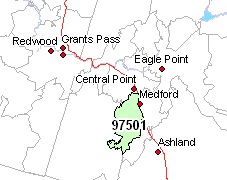
Zip code 97501 in Medford is the most distressed area in the Medium Density category in Oregon.

Zip Code 97501

Zip Code 97501

Approximately 34.6% of 97501’s population lives in a household with an annual income of less than $25,000. Another 29.1% live in a household earning an annual income between $25,000 and $50,000. Annual median household income is $36,157. That puts 97501 363rd among all of Oregon’s zip codes.

As a side note, maybe tied to the local economy, 97501 has almost 8 bars per 10,000 residents, 32% more bars than average for Oregon and  95% more than the United States as a whole.

Zip code 97641, a sparsely populated area in Christmas Valley is the most distressed area in the low density category in Oregon.

Zip Code 97641

Zip Code 97641

Only 12 percent of the population has education beyond high school, connected, perhaps, to the fact that the median annual household income is 20,795 and 66% of the households have an annual income below $30,000.

In the coming weeks, EIG will be developing tools to enable people to easily compare communities and dive deeper into what is driving economic distress or prosperity. You will be able to see how well your community is doing, and then compare it to others across the country

We’re waist deep in the Big Muddy: the Oregon Convention Center hotel

The 990,000 sq. ft. Crystal Palace opened at Britain’s Great Exhibition of the Works of Industry of All Nations in London’s Hyde Park in 1851.

The 990,000 sq. ft. Crystal Palace opened at Britain’s Great Exhibition of the Works of Industry of All Nations in London’s Hyde Park in 1851.

For some reason, politicians are infatuated with building stuff. They’re objectophiles, aroused by, even obsessed with, things rather than people

In Portland, politicians have fallen head over heels in love with the idea of building a Convention Center hotel. The object of their desire is a subsidized $212 million 600-room Hyatt Hotel.

But the fact is, it was a bad idea right out of the gate and it’s an even worse idea now.

On the one hand, given Portland’s vigorous emergence from the Great Recession and a skyline brimming with construction cranes, the assumption that government-mandated subsidies are critical to building a convention center hotel is outdated if Metro believes the hotel’s success is a slam dunk. On the other hand, if the growing competition in the convention market will make adding a subsidized hotel a foolish gamble, then why do it at all?

“Faced with convention centers that are routinely failing to deliver on the promises of their proponents and the forecasts of their feasibility study consultants, many cities wind up, as they say, “throwing good money after bad,” said a Brookings report. “Indeed, weak performance—an underutilized center, falling attendance, an absence of promised private investment nearby—is often the justification for further public investment. A new center is thus often followed by a subsidized or fully publicly-owned hotel…”

A May 2013 rendering of a proposed Hyatt hotel at the Oregon Convention Center.

A May 2013 rendering of a proposed Hyatt hotel at the Oregon Convention Center.

So here we are.

The Portland project would be funded with $60 million in Metro-issued revenue bonds, backed by taxes the hotel would generate, plus $18 million in grants and loans from Metro, the Portland Development Commission and the state lottery.

But there are problems with Portland’s hotel proposal, as well as with the arms race of convention center-related construction going on around the country. According to CityLab, there simply aren’t enough big conventions to justify all the convention center expansions. Since 1995, convention space in the United States has increased by 50 percent, but convention growth hasn’t kept pace. “So many were saying, ‘all you have to do is get one percent of the national market and you’ll do just fine,'” he says. “Three hundred cities bought the same logic.”

In fact, the number of conventions in the United States has fallen over the past decade, as has attendance at the largest conventions.

The optimistic predictions for the Oregon Convention Center and an associated hotel neglect to consider that lots of other cities are expanding, too.

Boston is considering a $1 billion expansion of its convention center with a massive 1,200 room $800 million hotel. A Marriott Marquis Hotel is expected to open in 2016 across from the George R. Brown Convention Center in Houston. Hotel operators Omni, Hyatt, Starwood, Peabody and Marcus have shown interest in a request issued by Oklahoma City to develop a 500- to 800-room downtown convention hotel to go with a $287 million convention center scheduled to open in 2019.

Even Des Moines, Iowa is in the game. In Feb. 2015, city and county officials approved a $101 million 10-story 330-room convention hotel project attached to the Iowa Events Center. Officials said they expected the project would draw many more national events to Des Moines and add considerable revenue to the property tax base.

And the list goes on and on.

But not to worry. Portland has advantages because it’s a happening city – food, culture, livability, young professionals – enthused the Oregon Convention Center’s ebullient 2013-2014 Annual Report. That year, the Center hosted 343 events attended by 549,762 people, many of them first time visitors to Portland, the report proclaimed.

But dig deeper into the dry numbers at the end of the report and you’ll find a less glowing story.

The number of events at the Oregon Convention Center actually shrank from 469 in FY2011 to 392 in FY2012, 377 in FY2013 and 343 in FY2014. Meanwhile, net operating results showed losses growing from $10 million in FY2011 to $11.6 million in FY2014.

Despite these numbers, and continuing controversy over the planned subsidized hotel, Metro president Tom Hughes calls critics “short-sighted and selfish” for wanting a public vote on the hotel project.

The hotel plan “promises generous returns for many years to come,” Hughes has said.

So we slog along.

Waist deep! Neck deep! Soon even a

Tall man’ll be over his head, we’re

Waist deep in the Big Muddy!


The VA and Portland’s road fee: two peas in a pod

More money. That’s the answer, says government. More money.

Portland has a problem with maintenance of its roads. So government does what government does best, it proposes spending more money. The city has “no alternative”, said Mayor Charlie Hales but to impose new street user fees on households, apartment complex owners, businesses and government agencies, including school districts.

The city claims it needs the extra money because revenue has been declining. But John A. Charles, Jr., President and CEO of the Cascade Policy Institute, took a closer look . Charles discovered that the city’s transportation revenue has actually been growing steadily and the city’s general fund has been flush. He concluded that it’s not a lack of money, but choices on spending priorities that has put the city in its current situation with road maintenance.

Meanwhile, back in Washington, D.C., a political debate is raging about what to do with the Veterans Administration, and more money seems to be the easy answer there, too.

department-of-veterans-affairs-lincoln-plaque

Democrats are already saying the solution to the VA’s problems is more money. At the same time they are attacking Republicans for opposing a VA bill earlier this year that would have addressed the crisis with more spending.

And Senator Bernie Sanders (I-VT), Chairman of the Senate Veterans Affairs Committee, has reintroduced a bill to reform the VA that copies the free-spending elements of a similar bill defeated in the Senate earlier this year,  including a provision that would open 27 costly new VA medical centers across the US and in Puerto Rico.

Senator Bernie Sanders (I-VT)

Senator Bernie Sanders (I-VT)

But more money isn’t going to solve the VA’s problems.

A May 28, 2014 report on problems at the VA’s Phoenix, AZ Health Care System noted, for example, that while conducting its work in Phoenix, the staff and Hotline of the Office of Inspector General (OIG) “received numerous allegations daily of mismanagement, inappropriate hiring decisions, sexual harassment, and bullying behavior by mid- and senior-level managers at this facility.”

The issues with excessive patient wait times identified in current allegations are also hardly new. The May 2014 report noted that since 2005, the VA OIG has issued 18 reports that identified, at both the national and local levels, deficiencies in scheduling resulting in lengthy waiting times and the negative impact on patient care. Each of the reports listed was issued to the VA Secretary and the Congress and is publicly available on the VA OIG website.

When the Senate failed to pass Sanders bill earlier this year it was principally because of Republican opposition, with Sanders’ cynically saying he hoped opponents would have the courage to face the vets they were depriving of care.

Other Democrats tried to position the party, which rarely sees a new spending bill it doesn’t like, as the pure for-the-good-of-the-people arm of the government, by raising the old “don’t play politics” argument. “Can we put politics aside for the good of our nation’s veterans?” said Sen. Patty Murray, D-Wash. “Can we show these heroes that – despite our differences – we will work as diligently toward getting them the benefits and care they’ve earned as they have worked for our nation?”

The problem is Sanders’ bill would have cost $21 billion dollars by vastly expanding existing programs and adding new ones, when the VA budget has already been growing like topsy.

The VA, with 151 hospitals and 821 clinics, already has an annual budget that’s more than double what it was a decade ago.

According to the Office of Management and Budget, the VA budget increased in real terms from $45 billion in fiscal year 2001 to $150.7 billion in fiscal year 2014 and President Obama’s 2015 budget for the VA proposes an increase to $163.9 billion.

But Senate Majority Leader Harry Reid is already going the class warfare route in urging even more spending.

Senate Majority Leader Harry Reid (D-NV)

Senate Majority Leader Harry Reid (D-NV)

On Monday he blasted Republicans for favoring tax cuts for the wealthy over the health of vets and spending for the war in Iraq on “America’s credit card”  but not being willing to pay for the medical care of vets. All senators should support the Sanders bill regardless of its cost, he said.

With the country already facing more than $17 trillion in national debt and with annual deficits continuing to contribute to that debt, adding more debt just plain makes no sense, even if it is to serve honored veterans.

Equally, adding more veterans services and vastly expanding the pool of veterans eligible for VA services makes no sense when the VA is apparently incapable of professionally providing its services now to its existing caseload.

It would make more sense for Congress to restrain the growth of its potential clients, facilitate a shift of veterans with service-connected disabilities who don’t require specialized VA care to medical services outside the VA system, and address the serious cultural problems that have led to a dysfunctional VA bureaucracy and interminable waiting times for vets deserving of our nation’s care.

In addition, Congress owes it to our heavily indebted country to pay for any additional costs that may be incurred in connection with VA reform with real money. That would require hard choices on budget priorities. Sanders’ February bill proposed that the additional spending be paid for with overseas contingency operations funds used to fund the war in Afghanistan. His new bill would also place caps on overseas contingency operations funds . That money isn’t real savings because it wouldn’t have been spent anyway with U.S. Afghanistan operations winding down.

So watch closely as Congress tries to get out in front of the VA mess. There’s reason to be worried. As Will Rogers said, “This country has come to feel the same when Congress is in session as when a baby gets hold of a hammer.”


I just can’t keep up; who am I supposed to deplore now?

It’s just getting hard to keep up.

So many people with so many different points of view is proving to be a real conundrum.

Brandeis University recently invited Ayaan Hirsi Ali,

Ayaan Hirsi Ali

Ayaan Hirsi Ali

a visiting fellow at the conservative American Enterprise Institute , a campaigner for women’s rights and a critic of intolerance, to receive an honorary degree at the school’s commencement on May 18.

Some of her comments allege a link between Islam and mistreatment of women. “The connection between violence, particularly violence against women, and Islam is too clear to be ignored,” she said in a Wall Street Journal piece. “We do no favors to students, faculty, nonbelievers and people of faith when we shut our eyes to this link, when we excuse rather than reflect.”

An outcry of opposition to her appearance arose from some Brandeis students and The Council on American-Islamic Relations, a civil rights and advocacy group. “She is one of the worst of the worst of the Islam haters in America, not only in America, but worldwide,” Ibrahim Hooper, a spokesman for the Council, told the New York Times.

Unwilling to face the heat, Brandeis cancelled its invitation to Ayaan Hirsi Ali. “We cannot overlook that certain of her past statements are inconsistent with Brandeis University’s core values,” the university, that bastion of free speech and academic inquiry, said in a statement explaining its decision.

So, if Ayaan Hirsi Ali comes to Portland to speak, should I go and listen or publicly deplore her, start a social media campaign against her and urge that everybody boycott her appearance?

I’ve also been reading about how upset some people are with Chauncy Childs, the owner of a planned Moreland Farmers Pantry in Sellwood. When it was discovered that she’d posted comments on Facebook about her opposition to same-sex marriage, some folks went ballistic.

Chauncy Childs

Chauncy Childs

According to The Oregonian, the outrage even extended to people who came to Childs’ defense. “The idea of blacklisting and boycotting people for their thoughts and beliefs, as opposed to their actions leads to a world that is less tolerant, less caring and more segregated,” Nick Zukin, co-founder of Kenny and Zuke’s delis, told The Oregonian. Gay rights activist Byron Beck lambasted Zukin and urged people to boycott his businesses, too.

“They’re choosing to open a business in a very open-minded neighborhood,” Tom Brown, president of the Sellwood Westmoreland Business Alliance, said without apparent irony to The Oregonian. “I think their personal views are going to hurt.”

Given this situation, should I stop by the Moreland Farmers Pantry if I’m in the neighborhood or deplore its owner’s views and pass it by?

And, by the way, I’m debating whether to install the Firefox browser on my laptop, but I’m conflicted.

Not long ago it was discovered that Brendan Eich, the newly appointed CEO of Mozilla, developer of the open source browser, Firefox, donated $1,000 in 2008 to support the campaign for Proposition 8, a California ballot proposition that aimed to ban gay marriage in California.

Brendan Eich

Brendan Eich

The donation was uncovered in 2012 when Eich was Mozilla’s Chief Technology Officer, but it didn’t become a huge controversial public issue until he was appointed CEO in late March 2014.

At that point Eich came under heavy fire from some Mozilla employees, gay-rights activists, executives of companies active in the Firefox marketplace and others.

Will Oremus, senior technology writer at Slate, said Eich’s departure was a sign of the times.

“There was a time when supporting gay marriage made you a radical,” Oremus wrote. “Then there was a time when it made you a progressive. Now we’ve reached a point where not (emphasis in the original) supporting gay marriage makes you unfit to lead a major Silicon Valley organization.”

The National Organization for Marriage, initially created to support Proposition 8, has jumped into the fray, too. It has called for a boycott of Firefox “to protest the company forcing out its CEO over his support of Proposition 8.” A conservative website, TruthRevolt.org, has urged people to uninstall the Firefox browser in protest of “Mozilla’s decision to fire Eich.” (Note: Eich resigned)

Others took the anti-Eich crowd to task for attempting to quell free speech and silence those who hold dissenting views.

So, what do I do? Should I deplore Mozilla for giving in to the pressure of the crowd and intentionally get a Firefox browser or should I bond with the critics of Eich’s donation and boycott Mozilla products?

And while I’m thinking about it, what should I do about all the other companies whose employees, including some executives, made donations in support of Proposition 8?

FiveThirtyEight put together a table of thousands of dollars of Prop. 8 donations by major Silicon Valley companies that showed money coming from employees of firms such as Google, Apple, Intel, Oracle and Yahoo.

A further analysis of the data showed that 83 percent of the donations by Californians were in opposition to Proposition 8, but there was a lot of variation between companies. At one big tech company based in California 60 percent of employee donations were in support of Proposition 8.

Should I deplore that company, maybe boycott its products?

Oh, I almost forgot Chick-fil-A. You may remember how, in 2012, the chain’s president, Dan Cathy, was reported to have said, “”We are very much supportive of the family — the biblical definition of the family unit…We want to do anything we possibly can to strengthen families.” His comments spawned outrage among some gay rights activists and politicians and calls for a boycott of Chick-fil-A.

Dan Cathy

Dan Cathy

I know there aren’t any Chik-fil-A’s in Oregon, but if I come across one out of state can I stop for a bite to support free speech or am I still supposed to be deploring them?


XRAY.fm: Brought to you by Portland taxpayers

xray-fm-1000px-screengrab*304XRAY.fm, a new left-wing radio station in Portland, plans to launch on Saturday, March 15th. Portland taxpayers may not know it, but the launch wouldn’t have happened without their generosity.

The station’s backers highlight the support they got from a Kickstarter campaign that generated $103,762 in pledges. What they don’t highlight is how the station got its start by hijacking what was supposed to be “a locally-focused music and arts-information radio station” with start-up funding from a taxpayer-funded program of the Regional Arts & Culture Council (RACC).

Until recently, RACC, which says its grants “provide artists and arts organizations with financial support,” had an Opportunity Grant Program funded by the City of Portland. It was designed to provide grants to Portland-based nonprofit arts and cultural organizations to help meet special opportunities or assist organizations with emergencies that arise during the year.

Phil Busse, director of the Portland-based Media Institute for Social Change and former managing editor of the Portland Mercury, submitted an Opportunity Grant application to RACC in 2012. The application said Busse wanted $10,000 to facilitate “a locally-focused music and arts-information radio station that will be broadcast throughout Portland starting in January 2013.” There was no mention of any plans for the station to focus on left-wing talk shows.

According to the grant application, the Institute was partnering with Common Frequency, a California-based nonprofit that provides technical assistance to community-based and low-powered radio stations. When Reed College abandoned its radio station, Common Frequency acquired it. But the license didn’t provide complete coverage of Portland, allowing only for radio coverage east to west from the Willamette to 82nd Ave, and north to south from the Columbia River to the Sellwood neighborhood.
The $10,000 was to go towards the purchase an FCC license. “The additional license the RACC grant would fund would allow sufficient coverage on Portland’s west side to truly create a city-wide station,” the Institute’s grant application stated.

The RACC Board approved the special Opportunity Grant to the Institute on July 20, 2012.
The Cascade Educational Broadcast Service, a Portland nonprofit working to launch the new station, said its goal was “to create a station that broadcasts new independent music and a plethora of rare historic vinyl by the innovators, but not officially bound by any specific genre descriptor.”

“I can already see the town dancing to the beat of XRAY.FM,” Jeff Hylton Simmons, an early advocate of the station, said in an Awesome Foundation online posting.

Then the music and arts-information radio station got hijacked.

In November 2012, Portland’s KPOJ-AM 620, a welcoming home to progressives, shifted to Fox Sports Radio 620. Previously, KPOJ had featured a three-hour morning show with an outspoken progressive host, Carl Wolfson, along with progressive talk shows featuring Thom Hartmann, Randi Rhodes and Mike Malloy.

Local progressives responded with fury to KPOJ’s format shift. BlueOregon, a blog describing itself as “the water cooler around which Oregon progressives will gather”, initiated a campaign to collect signatures on a petition aimed at saving progressive talk radio on KPOJ. But KPOJ and its owner, Clear Channel, didn’t yield.

So the new music and arts-information station championed by Busse, will, instead, feature progressive talk.The station’s website makes it clear that it’s primary objective is not music, but to be “a progressive, independent radio station.”

XRAY.FM will embrace the “mullet model”, as the station’s Facebook page once put it, “business in the front, party in the back.” Programs would focus on progressive talk during the day and relegate music to the night.

Talk show hosts on the station will include Carl Wolfson and Thom Hartmann, both well-known progressives, as well as Adam Klugman, also formerly with KPOJ, who describes himself as “the perfect host for a radio talk show dedicated to fanning the flames of 21st century progressive populism.”
Jefferson Smith, co-founder of the Oregon Bus Project and a onetime Democratic legislator, has also signed on as senior advisor on board development and community engagement and will be offering a show, Thank You Democracy.

RACC says its OK with the station’s shift to progressive talk. “We are satisfied that XRAY.FM is delivering strong local music programming and content as described in their grant proposal to us,” Jeff Hawthorne, RACC’s Director of Community Affairs, wrote in an e-mail to me. “It appears that the applicant is fulfilling its artistic mission as described (by the Cascade Educational Broadcast Service). Whether the station also delivers other types of content wouldn’t preclude our investment in arts programming.

How about you? Want an Opportunity Grant from RACC for a radio station featuring conservative talk shows? Sorry. The Opportunity Grants were a victim of Portland’s 2013-2014 budget cuts.

The Oregon Convention Center Hotel: Let the people decide

It’s a classic government argument to justify dumping dollars into a construction project. “It will mean JOBS.” How can you be against jobs?

In the case of the proposed government subsidies for a convention center hotel in Portland, Metro President Tom Hughes has gone even further, arguing at a 2013 Labor Day picnic sponsored by the Northwest Oregon Labor Council that hotel critics are engaging in “class warfare” to “keep families from putting food on their table.”
Good grief! What’s next, accusing critics of  “taking food out of the mouths of babies.”

Actually, what was next was a devious ruling from the Multnomah County elections department that critics can’t go to the county’s voters to seek to overturn the Multnomah County Commission’s approval of taxes to go towards the hotel’s construction.

“The initiative and referendum process is reserved to the people of the county relative to the legislative acts of the Board of County Commissioners,” said Multnomah County Elections Director Tim Scott. “The subject of the Petition filed… relates to the exercise of the Board of County Commissioner’s Executive and Administrative powers.”

“I want to build a hotel,” Hughes said at the union Labor Day picnic. “I want it to be built by union workers, and I want union workers running it.”

And he wants it so bad that he doesn’t want citizens voting on it, calling the decision of critics to seek a public vote “short-sighted and selfish”. A public official is opposing the public having a say.

That reminded me of a statement made by Iroquois Indians to the English in the mid-1700s when they felt the English were not listening to their deep concerns: “You ask us…to have faith in you…But how can we have faith in you and believe in you when by the very actions you have taken you have plugged up our ears and thrown sand in our eyes and sewn our lips together?”

Hughes even fell back again on the jobs mantra, this time upping the ante by throwing in a taunt that the critics didn’t care about minorities. Failure to go ahead with the hotel deal would harm “members of the minority and historically underserved communities of North and Northeast Portland,” he wailed.

The validity of Scott’s decision is now being considered by the Multnomah County Circuit Court. Hopefully, it will do the right thing and let voters have a say.


XRAY-FM: How the left hijacked a radio station

By Bill MacKenzie

Want to start a Portland radio station featuring left-leaning talk shows all day, but need $10,000. Not to worry. Say your station will be an “arts and music” outlet and a taxpayer-funded program of the Regional Arts & Culture Council (RACC) will pick up the tab.

RACC, which says its grants “provide artists and arts organizations with financial support,” has an Opportunity Grant Program funded by the City of Portland. It’s designed to provide grants to Portland-based nonprofit arts and cultural organizations to help meet special opportunities or assist organizations with emergencies that arise during the year.

Phil Busse, director of the Portland-based Media Institute for Social Change and former managing editor of the Portland Mercury, submitted an Opportunity Grant application to RACC in 2012. The application said Busse wanted $10,000 to facilitate “a locally-focused music and arts-information radio station that will be broadcast throughout Portland starting in January 2013.” There was no mention of any plans for the station to focus on progressive talk shows.

According to the grant application, the Institute was partnering with Common Frequency, a California-based nonprofit that provides technical assistance to community-based and low-powered radio stations. When Reed College abandoned its radio station, Common Frequency acquired it. But the license didn’t provide complete coverage of Portland, allowing only for radio coverage east to west from the Willamette to 82nd Ave, and north to south from the Columbia River to the Sellwood neighborhood.

The $10,000 would apply towards the purchase an FCC license. “The additional license the RACC grant would fund would allow sufficient coverage on Portland’s west side to truly create a city-wide station,” the Institute’s grant application stated.

The RACC Board approved the special Opportunity Grant to the Institute on July 20, 2012.

Then the music station was hijacked.

In November 2012, Portland’s KPOJ-AM 620, a welcoming home to progressives, shifted to Fox Sports Radio 620. Previously, KPOJ had featured a three-hour morning show with an outspoken progressive host, Carl Wolfson, along with progressive talk shows featuring Thom Hartmann, Randi Rhodes and Mike Malloy.

Local progressives responded with fury to KPOJ’s format shift. BlueOregon, a blog describing itself as “the water cooler around which Oregon progressives will gather”, initiated a campaign to collect signatures on a petition aimed at saving progressive talk radio on KPOJ. But KPOJ and its owner, Clear Channel, didn’t yield.

So XRAY.FM, the new music and arts-information station championed by Busse, will, instead, feature progressive talk during the day when it goes on the air in January if all goes as planned.

The Cascade Educational Broadcast Service, a Portland nonprofit working to launch the new station still says its goal is “to create a station that broadcasts new independent music and a plethora of rare historic vinyl by the innovators, but not officially bound by any specific genre descriptor.”

“I can already see the town dancing to the beat of XRAY.FM,” Jeff Hylton Simmons, an early advocate of the station, said in an Awesome Foundation online posting.

But the station’s website makes it clear that it’s primary objective is not music, but to be “a progressive, independent radio station.”

XRAY.FM will embrace the “mullet model”, as the station’s Facebook page puts it, “business in the front, party in the back.” Programs will focus on progressive talk during the day and relegate music to the night.

Talk show hosts on the station will include Carl Wolfson and Thom Hartmann, both well-known progressives. Jefferson Smith, co-founder of the Oregon Bus Project and a onetime Democratic legislator, has also signed on as senior advisor on board development and community engagement.

RACC says its OK with the shift to progressive talk. We are satisfied that XRAY.FM is delivering strong local music programming and content as described in their grant proposal to us,” Jeff Hawthorne, RACC’s Director of Community Affairs, wrote in an e-mail to me.It appears that the applicant is fulfilling its artistic mission as described (by the Cascade Educational Broadcast Service). Whether the station also delivers other types of content wouldn’t preclude our investment in arts programming.”


Meanwhile, BlueOregon is back at it trying to stir up opposition to Clear Channel and KPOJ, pleading for folks to sign a petition asking the FCC to deny Clear Channel’s license renewal for KPOJ. Blue Oregon is arguing that Clear Channel has an obligation to provide progressive radio programming because it “has a legal obligation to operate the airwaves in the public interest, with balanced news and informational programming.”

ImageHow about you? Want an Opportunity Grant from RACC for a radio station featuring conservative talk shows?  Sorry. The Opportunity Grants were a victim of Portland’s 2013-2014 budget cuts.


Giving the workforce a ride

By Bill MacKenzie

 If we want people to be at work instead of on welfare, small initiatives can make a big difference.

Emelia Moreno knows that.

When a used truck she owned was totaled in an accident, the insurance payment didn’t cover the full amount of the loan still due, leaving her owing $6,000. So when she bought a used Saturn to replace the truck, she added the $6,000 to a new $11,000 loan. That created a burdensome $17,000 loan from AmeriCredit, a General Motors subsidiary that offers auto loans to financially challenged “sub-prime customers.”

To make things worse, the loan had a punishing interest rate of about 35 percent, translating into initial monthly payments of $390 … which rose to $426.98 when she missed some payments.

Emelia Moreno (not her real name) is a single mother who grew up in south central Los Angeles and now works for a social services agency in Hillsboro. In the beginning, she figured she could handle the monthly payments on her car, but eventually they overwhelmed her.

“I couldn’t refinance because I owed more than the car was worth,” she said. “I was juggling my bills. Then I learned my employer planned to cut my work hours from 40 a week to 32.”

Compounding her troubles, she was caring for a daughter born with heart problem who required continuing medical care involving specialists and an extensive regimen of drugs.

“I got to a point where I just couldn’t make it, where I wanted to say, ‘OK, take my car. I just can’t make the payment anymore,’” Moreno said.

That was when a co-worker told Moreno about the “Ways to Work” program under the umbrella of Portland-based nonprofit called Metropolitan Family Service. The program helps low- and moderate-income individuals buy, refinance or repair cars with loans at reasonable rates.

According to the Urban Institute, families without cars often find it difficult to find a good job, get to work and stay in the work force — particularly in spread out suburbs. People without vehicles also have problems meeting their family’s needs, such as getting to and from medical appointments and childcare facilities and dealing with emergencies. Transportation difficulties may also limit where people look for or consider working.

It is to Hillsboro’s economic advantage, therefore, that residents have access to cars.

Moreno took her first step toward car contentment by scheduling a meeting with Abby Wood, Ways to Work’s program coordinator. Wood told Moreno to bring her current $9,000 loan balance down to $8,000 (all Ways to Work would refinance) and to draw up a budget.

When Moreno finally whittled down her existing loan, Ways to Work offered to refinance her car with an $8,000 loan at 8 percent, repayable at $150 a month.

So far, Moreno is another success story for Ways to Work.

In other situations, such as when clients seek a loan to buy a used car, Ways to Work teaches them how to do it.

“The financial part is important, but learning how to buy a used vehicle is a really important thing to learn,” said Wood. “A lot of people who come to our program have no idea that they have a choice of what car to buy; that they have the option of taking the car to be checked out before they purchase it; that they can research a car before they purchase it; that Consumer Reports could tell them this car is better than that car. It’s a really empowering thing.”

The Ways to Work program offers loans of up to $8,000 at 8 percent interest. The result is more than $1 million in loans to community members in Oregon and southwest Washington since the program began in 2004; a low payment delinquency rate of less than 10 percent; and a default rate of less than 4 percent.

“Ways to Work is not a handout,” Wood said. “It’s helping Emelia make sure she can keep her job, stay off public assistance and get her daughter where she needs to go.”

“It’s been a blessing,” Moreno said. “To me, it’s been a lifesaver.”

Bill MacKenzie is a former congressional staff member, newspaper reporter and communications manager for a Hillsboro company.

Originally published in the Hillsboro Tribune,  Oct 4, 2013

Hillsboro reaches too far with investments

By Bill MacKenzie

When others are playing with bright and shiny things, it can be tempting to bend the rules to join the game.

A case in point — the city of Hillsboro’s decision to succumb to the allure of venture capital investment.

In 2009, some local investors began advocating a city of Portland fund that would make venture capital investments in local startups.

Portland Mayor Sam Adams and the Portland Development Commission(PDC) were enthused by the idea, but the Oregon constitution prohibits cities

and counties from investing directly in for-profit companies. As the saying goes, however, “where there’s a will there’s a way.”

The PDC came up with an end-run — have Portland’s contribution go to a fund created by the non-profit Oregon Entrepreneurs Network (OEN). Then pick a firm to manage the money as the Portland Seed Fund and make OEN a limited partner in the fund. That way, any return on investment in startups would go back to OEN, not the city of Portland. In 2010, Portland announced it would make an initial contribution of $500,000 — later expanded to $700,000 — and a search began for additional donations and investments. One target — the city of Hillsboro.

In January 2011, officials with the Hillsboro’s Economic Development Department brought the concept to the Hillsboro City Council. The fund would provide seed capital to entrepreneurs, they said, helping to fill early funding gaps for new companies and increasing the job creation prospects for startups.

The officials said their department had already budgeted $250,000 for the seed fund, with the money to come from fees generated by the city’s Enterprise Zone program.

Because Hillsboro was subject to the same prohibition on investing in for-profit companies as Portland, Hillsboro would follow the same circuitous route. Its money would go to the Portland Seed Fund and investment decisions would be left to the fund managers.

“The city of Hillsboro is interested in supporting entrepreneurship and business growth in the Portland region and in Hillsboro specifically,” the officials told the city council. “We anticipate that the proposed seed fund will ultimately generate considerable business investment and job creation in Hillsboro.”

The city council approved the seed fund donation without public discussion.

Venture capital has played a major positive role in innovation, but if its intent in this case was the fertilization of some startups in Hillsboro, the results have been dismal. Of the 36 startups receiving money from the seed fund so far, only one was located in Hillsboro.

That company, Good Works Now, Inc., was developing Cloud-based tools for non-profits to modernize how they manage fundraising, boards and online reputation. In late 2012, the company collapsed, and the seed fund wrote off its investment.

Looking forward, there are no guarantees Hillsboro will see any direct benefits from the seed fund. That’s because no investment recipient is obligated to invest in Hillsboro, and there is no guarantee that any startup supported by the fund in the future will do so.

Hillsboro also won’t get a payoff if a startup becomes wildly successful.

A venture capital fund stands to make money by owning equity in the companies it invests in when the companies are sold or go public. But Hillsboro’s $250,000 was a donation, not an investment in the fund.

Other American cities, including New York and Philadelphia, are heading down the same venture capital route, but not to universal acclaim. Critics assert that private venture capital firms will find promising startups without government interference.

“The question is whether it’s justifiable for government to be involved,” Gary Kunkle, founder and CEO of Outlier, a research firm focusing on innovative approaches to nurturing and retaining high-growth companies, told Inc. Magazine recently. “Markets take care of themselves much more efficiently than governments want to give them credit for.”

Portland economist Bill Conerly agrees.

“Portland would do best creating a good business environment for all companies, big or small, startup or established …” he recently told me. “The idea of city money for seed capital is simply corporate welfare done in small pieces.”

In 2009, Brad Jones, an executive of the Redpoint Ventures investment firm, wrote to President Barack Obama’s economic adviser, Lawrence H. Summers, questioning the wisdom of the government’s $535 million loan guarantee to Solyndra, a solar cell manufacturer.

“I can’t imagine it’s a good way for the government to use taxpayer money.” Jones said.

“I relate well to your view that gov. is a crappy v.c.” (venture capital investor),” Summers wrote back.

In 2011, Solyndra went bankrupt.

The Portland Seed Fund is now raising money for a second round of startup investments. The city of Hillsboro should sit this one out.

Bill MacKenzie is a former congressional staff member, newspaper reporter and communications manager for a Hillsboro company.

Originally published in the Hillsboro Tribune,  May 3, 2013