Cruelty is the Point: Despicable Deportations

Marie Nahayo’s lifeless body was found hanging from a tree in the courtyard of her home in Burundi, East Africa on March 8 of this year.

Human rights monitoring groups flagged her case as part of a deeply worrying trend of “staged suicides”—disguised murders intended to cover up violent crimes. During that month alone, 11 lifeless bodies were found across the country all killed by extreme violence.

“March 2026 marks the continuation of a cycle of serious and systematic human rights violations in Burundi,” reported ACAT-Burundi, a human rights group. “The evidence gathered confirms that the right to life, a fundamental pillar of any rule of law, is repeatedly violated in various forms: assassinations, enforced disappearances and torture.” 
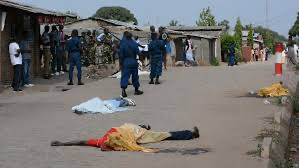
Bodies in the street in Cibitoke neighborhood of Bujumbura, Burundi (Human Rights Watch)

“At the same time, Burundi struggles with high malnutrition, limited access to clean water, sanitation, and healthcare, and frequent climate disasters that intensify hunger and poor living conditions,” says Third Country Deportation Watch.

The US State Department urges travelers to re-evaluate trips to Burundi due to safety and security risks, with the potential for political unrest and violent crime — such as armed robbery, carjacking, home invasions, and assault — existing nationwide.

Despite this perilous situation, on August 27, 2026, the United States detained and forcefully transferred 12 nationals from Cameroon, Angola, Mauritania, and Sudan to Burundi under a third country removal agreement.

“Such arrangements are taking shape in particular in Africa, where Mr. Trump has ushered in a new style of diplomacy that prioritizes deal-making over enforcing human rights and promoting democracy,” the New York Times reported in April 2026. “The policy is called “America First in Africa”.

The Trump administration has authorized or pledged at least $410 million to facilitate deportation agreements with 31 countries, mostly in Africa and Latin America, as of the end of June, the Washington Post reported on September 21, and documents from inside the Office of Remigration (A 1984-ish term if there ever was one) reviewed by The Post show financial commitments that include $81 million in direct payments to 13 of the foreign governments.

More than 23,000 people have reportedly been sent from the United States to 26 countries other than their own in 2026, including large numbers of children and adolescents. According to Third Country Deportation Watch, at least 35 countries have signed agreements with the United States to take deported immigrants as the Trump administration pays other countries with documented histories of corruption and human rights abuses millions of dollars to take in deported people under “third country” agreements.

The Guardian recently reported that in August about 20 people were put on a flight in the US, shackled at the wrists, waist and ankles, and sent to Liberia as part of a major third-country deportation arrangement. When six of them refused to get off the plane, they were dropped off in another African country, Equatorial Guinea, “one of the world’s most repressive and corrupt regimes, where armed men took them to a former luxury hotel turned detention centre in the capital, Malabo, where they have been held ever since,” the Guardian reported.

As of October 24, at least 63 third-country nationals had been sent to Equatorial Guinea since last November via at least six ICE-chartered flights, where they have reported being beaten, threatened, held at gunpoint, and deprived of food, water, hygiene products, and medical care, according to The American Prospect.

On Sept. 18, the New York Times reported that two men deported to Equatorial Guinea by the Trump administration “were hooded, bound, beaten with guns and shoved down a flight of stairs recently by police officers at a remote hotel where immigrants are being held indefinitely, according to witnesses and lawyers. Videos and interviews show that police aggression inside the hotel escalated in recent weeks and peaked on Sept. 11. The police put burlap sacks over the two men’s faces, tied their hands with rope, beat them with guns and shoved them down the stairs as several deportees watched. The beatings were recounted by multiple witnesses and lawyers.

Equatorial Guinea agreed to take deportees from the United States, but has given them no legal rights or documents that would let them live or work there, even temporarily, leaving them in limbo.

About 1200 Venezuelan migrants have been sent to El Salvador, with many of them deposited in CECOT (the Center for Terrorism Confinement)—a notorious maximum-security mega-prison. Migrants have testified that they were shot with rubber bullets and beaten on a regular basis. Many of them have alleged that they were routinely raped and tortured.

ICE has also deported migrants originating from countries such as Afghanistan and Iran to volatile regions like the Central African Republic and South Sudan. The U.S. State Department warns “Do not travel to Central African Republic due to risk of unrest, crime, kidnapping, landmines, and terrorism” and “Do not travel to South Sudan due to risk of unrest, crime, kidnapping, and health risks”.

Deported men shackled by both hands and feet, guarded by US service members, aboard the plane to South Sudan

Detainees have also been sent to the African nation of Eswatini, where they’ve been held in a maximum-security prison without charge and with no access to legal counsel.

On October 29, 2026, the Wall Street Journal reported that the Trump administration had agreed to send around $35 million in military aid to a Central African military unit in Cameroon previously accused of war crimes as part of a wider arrangement to deport third-country migrants to the region. The military aid and deportation deal were brokered simultaneously by State Department officials as part of the same package, according to U.S. officials and congressional aides.

Then, on October 30, the New York Times reported that the Trump administration had detained dozens of Afghan immigrants in Louisiana, including relatives of people who helped the U.S. military, and planned to deport them to Afghanistan. More than 150 Afghan immigrants were expected to be deported, one official said, making this one of the largest single expulsions of Afghans.

And on October 30, the New York Times reported that he Trump administration had detained dozens of Afghan immigrants in Louisiana, including relatives of people who helped the U.S. military, and planned to deport them to Afghanistan. More than 150 Afghan immigrants were expected to be deported, one official said, making this one of the largest single expulsions of Afghans.

Not only are people being deported, but the administration is making the process as cruel as possible.

“There have been widespread reports of ICE agents using the threat of sending people to third countries in order to pressure them to sign and accept deportations to their home countries,” says Amnesty International. “The cruelty is by design. It is meant to force immigrants to live in fear …filled with fear that they’ll be arrested and deported to an unfamiliar and possibly unsafe place.”

“The cruelty is the point,” Adam Serwer wrote in a seminal essay in The Atlantic in October 2018. “President Trump and his supporters find community by rejoicing in the suffering of those they hate and fear,” he said.

Pharmaceutical Industry Steps Up for Kurt Schrader As Primary Battle Nears End

A river of money is flowing into the Democratic primary race in Oregon’s Fifth Congressional District. 

“Who’s buying Congress this week?”, Primary School, a site that follows the financing of primary races, asked on May 5.

It answered its own question, revealing independent expenditures made by outside groups in congressional races using data from the Federal Election Commission (FEC). 

A standout is the activity of dark-money political action committee (PAC) Center Forward in support of Congressman Kurt Schrader.

“America is neither right nor left. Republican nor Democrat. Red nor blue.,” the PAC says in its Our Mission statement. “The mainstream values and principles that will move us forward come from where they always have – the center. The center is where we leave our political labels and baggage at the door, to find commonsense solutions to America’s great challenges.”

Bull!

Center Forward put $650,000 into television ads attacking Jamie McLeod-Skinner, bringing the PAC’s total spending on pro-Schrader/anti McLeod-Skinner efforts to $1.04M.

Critics says Center Forward is heavily funded by the pharmaceutical industry and concentrates on obstructing efforts to rein in the pharmaceutical industry.

According to The American Prospect, an online and print magazine “dedicated to American liberalism and progressivism,” not long ago the PAC “…kicked off an ad blitz championing six Democratic House members, nearly all of whom went on to lead the charge to undermine Democrats’ flagship drug pricing reform bill,… while also jeopardizing the Biden agenda bill being considered under budget reconciliation.” One of those six House members was Kurt Schrader.

Center Forward, as a 501(c)(4) nonprofit, doesn’t have to publicly disclose its donors. However, a  review by Sludge, which investigates money in politics, concluded that a significant portion of its funding in recent years has come from a drug company lobbying group the Pharmaceutical Research and Manufacturers of America (PhRMA). 

Schrader’s close ties to the industry are a primary attack point for McLeod-Skinner. “Kurt Schrader claims he’s fighting to get big money out of politics. I’m calling on Schrader to stand by his word and tell his Big Pharma donors to take these ads down,” Jamie McLeod-Skinner told Sludge. 

The Gannett/GateHouse deal: diminishing diversity of thought in American media

killingjournalism

If you want to see how a multi-outlet media company can play politics, take a look at Sinclair Broadcast Group.

According to Acronym, a progressive organization focused on winning elections through innovative digital advertising and organizing programs, much of the spending by Donald Trump’s re-election campaign on Facebook + Google last week focused on the release of the campaign’s new red “Keep America Great” hats.  Right in sync, over the weekend, Sinclair, the conservative owner or operator of 191 television stations in the U.S., promoted “news” stories about the availability of the hats.

The planned merger of two other American media giants, Gannett and GateHouse Media, announced on Aug. 5, 2019, could bring more such coordinated propagandizing.

If the merger goes forward, it will not end well.

(UPDATE: The Columbia Journalism Review reported on Oct. 9, 2019 that GateHouse’s acquisition of Gannett is set to go through before the end of the year, Nieman Lab’s Ken Doctor reports. Once it does, the combined company could lay off as many as 3,000 employees (the equivalent of rival chain McClatchy’s entire workforce), though the cuts are likely to fall mostly on the business side, sparing newsrooms for now. Gannett and GateHouse shareholders will vote on the deal November 14.)

GateHouse’s acquisition of Gannett is set to go through before the end of the year, Nieman Lab’s Ken Doctor reports. Once it does, the combined company could lay off as many as 3,000 employees (the equivalent of rival chain McClatchy’s entire workforce), though the cuts are likely to fall mostly on the business side, sparing newsrooms for now. Gannett and GateHouse shareholders will vote on the deal November 14.

  • GateHouse’s acquisition of Gannett is set to go through before the end of the year, Nieman Lab’s Ken Doctor reports. Once it does, the combined company could lay off as many as 3,000 employees (the equivalent of rival chain McClatchy’s entire workforce), though the cuts are likely to fall mostly on the business side, sparing newsrooms for now. Gannett and GateHouse shareholders will vote on the deal November 14.

Completion of the deal would mean the creation of a massive media company with 263 daily media organizations across 47 states and Guam, plus USA TODAY and hundreds of weekly and community papers.

Newspapers across the country may be struggling, but this deal isn’t the best solution. It will lead to centralized editorial control, stifle local creativity, guarantee additional pressure to impose draconian cost cuts and bring brutal widespread layoffs.

Consolidation can also have major consequences in the coverage of elections.

horse race reporting research elections politics

A study published in the Journal of Political Communication found that corporate-owned and large-chain newspapers were more likely to publish stories that frame elections as a competitive game than newspapers with a single owner.

Researchers for the study were Johanna Dunaway, an associate professor of communication at Texas A&M University, and Regina G. Lawrence, associate dean of the University of Oregon’s School of Journalism and Communication Portland.

When journalists covering elections focus primarily on who’s winning or losing — instead of on policy issues — voters, candidates and the news industry itself suffer, a growing body of research has found, according to Journalist’s Resource.

Denise-Marie Ordway, a writer for Journalist’s Resource, says academic studies find that horse race reporting is linked to:

  • Distrust in politicians.
  • Distrust of news outlets.
  • An uninformed electorate.
  • Inaccurate reporting of opinion poll data.

Ordway adds that horse race reporting:

  • Is detrimental to female political candidates, who tend to focus on policy issues to build credibility.
  • Gives an advantage to novel and unusual candidates.
  • Shortchanges third-party candidates, who often are overlooked or ignored because their chances of winning are slim compared to Republican and Democratic candidates.


GateHouse, owned by the private equity firm New Media Investment Group (NYSE: NEWM), already has a reputation for aggressive cost-cutting and layoffs at properties it owns.

In Oregon, multiple rounds of layoffs have taken place since GateHouse took over The Register-Guard in Eugene on March 1, 2018,

“What’s happening with the Guard isn’t unique to the Guard,” Tim Gleason, former dean of the University of Oregon’s School of Journalism and Communication, told the Eugene Weekly.”It’s what’s happening all over the country as these venture capital firms buy newspapers and then largely gut them,”

In May 2019, Gatehouse laid off staff at a wide swath of papers it owns, including The Columbus Dispatch, the Lakeland (Florida) Ledger, the Daytona Beach News-Journal, the Worcester (Massachusetts) Telegram & Gazette. the Providence Journal and The Beaver County (Pennsylvania) Times.  The Times newsroom had 60 staffers in the early 2000s; it is now down to 12 to put out a three-section paper six days a week.

Robert Kuttner and Hildy Zenger lay much of the blame for the evisceration of local newspapers on private equity companies like GateHouse.

“The malign genius of the private equity business model…is that it allows the absentee owner to drive a paper into the ground, but extract exorbitant profits along the way from management fees, dividends, and tax break,” they wrote in The American Prospect., a progressive political and public policy magazine.

“By the time the paper is a hollow shell, the private equity company can exit and move on, having more than made back its investment.”

It’s not a pretty picture.