Of all things, an article in The Cut, a digital section of New York magazine, about the death of Gloria Steinem on September 2 at 92 spurred me to write this piece about Donald Trump and the Smithsonian’s interpretations of history.
Frankly, I’ve never thought much about Gloria Steinem, but for some reason I was intrigued and pored over the entire 5,948-word article. What a fascinating life!
“She was a talented, driven, and powerfully charismatic emblem for a movement that was always more complicated and sometimes more radical than she herself was,” wrote Rebecca Traister. “Her life, her work, and her contradictions together provide a remarkable illustration of the political and social disruption mainstream America is willing to tolerate, occasionally celebrate, and also revile.”
Traister wrote that Steinem frequently said she hoped to live to 100. “I’ve so loved being here,” she said in the HBO documentary. “I love it so much. I never want it to end.”
So what’s the connection of all this with Donald Trump and the Smithsonian?
The Washington Post reported on September 2 that the Trump administration is threatening to cut off executive agencies’ cooperation with the Smithsonian Institution “…if its leaders do not abandon what the administration described as “an ideological agenda that seeks to transform both the Smithsonian and the country.”
Trump set off a misguided attack on The Smithsonian when he launched his campaign against the institution last March. that was when he signed an executive order titled “Restoring Truth and Sanity to American History” that instructed his administration to eliminate what it called “divisive narratives” and “improper ideology” from the Smithsonian and restore it as “a symbol of inspiration and American greatness.”
The executive order instructed Vice President JD Vance, who sits on the Smithsonian’s board, to work with Congress and the Office of Management and Budget to withhold funding for exhibits or programs that “degrade shared American values” or “divide Americans based on race.”
What the order really did was order that the telling of America’s history conform to Trump’s ideological view that there be just one public interpretation of American history, his.
But the fact is history is constantly being reviewed, re-interpreted, revised, re-thought. Topics of intense interest to one generation slip back as new topics emerge. Historical revisionism is a fundamental element of the discipline as new evidence emerges and societal perspectives change. Interest in some figures declines as new heroes and villains emerge.
Benjamin Franklin spoke to this fact in 1787 when he called upon those gathered art the Constitutional Convention in Philadelphia to rally behind the new plan of government they had devised:
“I confess that there are several parts of this constitution which I do not at present approve, but I am not sure I shall never approve them,” he said, “For having lived long, I have experienced many instances of being obliged by better information, or fuller consideration, to change opinions even on important subjects, which I once thought right, but found to be otherwise.”
My decision to examine more closely Gloria Steinem’s life was a reflection of a new interest in somebody with whom I was only vaguely familiar. In a similar vein, I’ve been tackling books that offer new perspectives on historical events.
For quite a while there was a widespread belief that North America, for example, was some vast, wild, untouched wilderness barely populated by primitives before more sophisticated and civilized Europeans arrived. You will be dissuaded of that notion if you read Cahokia: Ancient America’s Great City on the Mississippi by archaeologist Timothy R. Pauketat. Research has revealed that in pre-Columbian America native civilizations built massive urban centers like Cahokia in southwestern Illinois which was populated by tens of thousands of people.
I long admired Apple’s leaps into China to grow its business, but I got a new perspective, and new concerns, on the implications of Apple becoming so deeply intertwined with China when I read “Apple in China: The Capture of the World’s Greatest Company” by Patrick McGee.
As the son of a man who served proudly in the U.S. Navy during WWII, I have always been interested in President Truman’s decision to drop the atomic bomb, wondering whether it was the right decision, particularly as some revisionists have challenged it. I’ve read multiple books on the war and that decision, arriving at the conclusion it was the right one in the face of up to a million American casualties if an invasion went forward. And, by the way, historians have been constantly re-evaluating Harry Truman the man and his presidency.

I’ve read the first two books of Rick Atkin’s trilogy on the American revolution, Bernard Bailyn’s “The Ideological Origins of the American Revolution”, Thomas Paine’s “Common Sense”, Ron Chernow’s “Alexander Hamilton” and countless others to better understand that world-changing event.
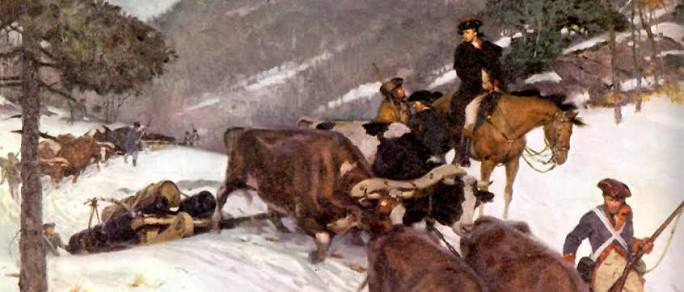
Before seeing Ken Burns’ documentary, The American Revolution, were you aware of the astonishing effort led by Boston bookseller Henry Knox to haul 59 heavy cannons and mortars from captured from British forces at Fort Ticonderoga across 300 miles of frozen wilderness to Boston, forcing a British evacuation of the city without a shot being fired? Wow! It spurred me to read an entire book, Henry Knox’s Noble Train by William Hazelgrove, about the endeavor.
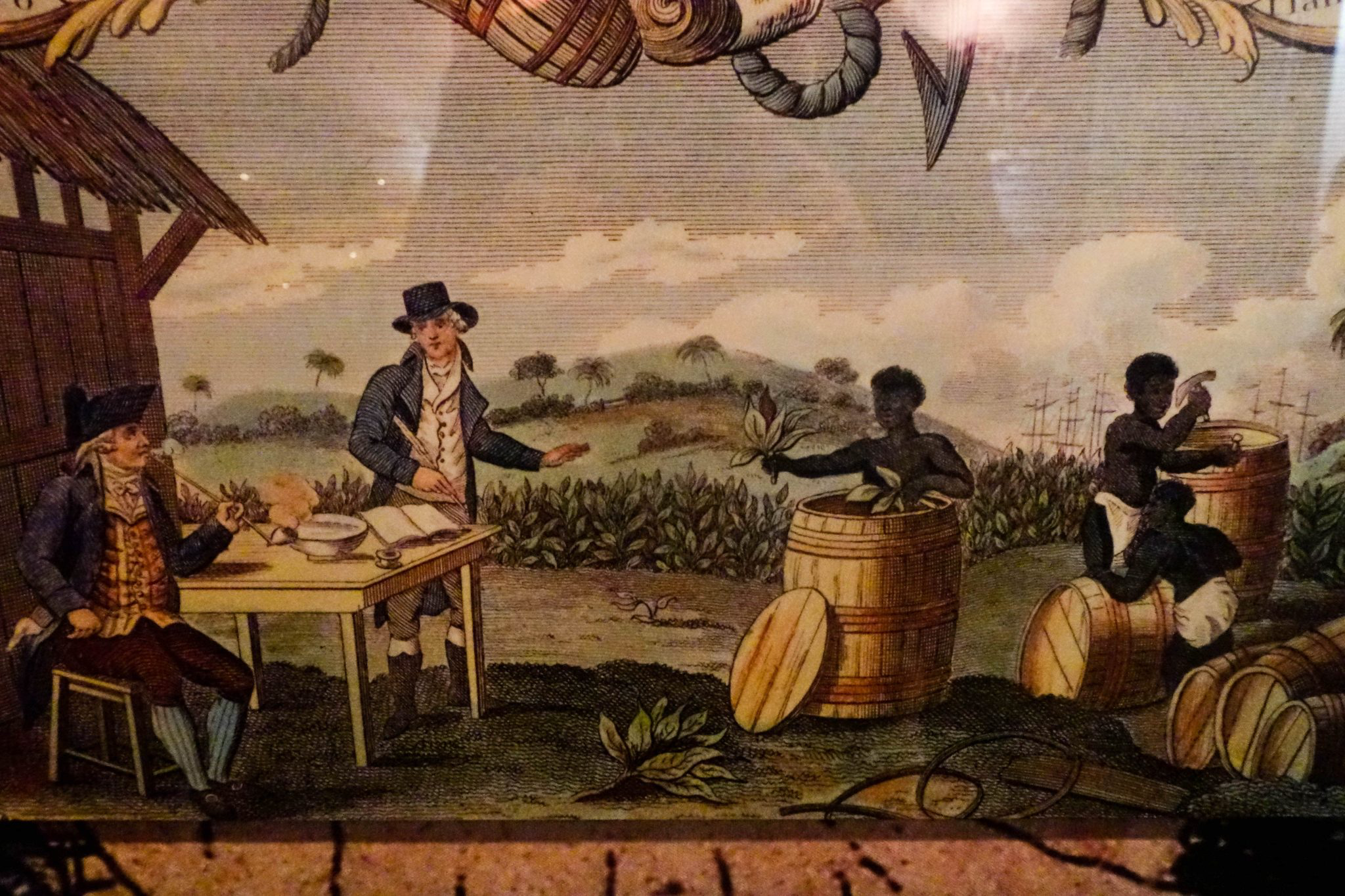
I’ve been taken aback to read of the extent to which slavery extended far beyond the South into into New England, even into the Norman Rockwell-perfect small town of Wallingford, Connecticut where I grew up. As Anne Farrow wrote in “The Logbooks: Connecticut’s Slave Ships and Human Memory”, In Connecticut and elsewhere in New England, “All the best families owned ‘captives’.”
I grew up as a child idolizing Charles Lindbergh for his single-handed crossing of the Atlantic to Paris in the Spirit of St. Louis. I even made a special trip during a later visit to Hawaii to visit his grave on the grounds of the Palapala Ho’omau Church at the end of the road to Hana on the coast.
t wasn’t until I read numerous books about his life that I learned he was a leading spokesman for the America First Committee that opposed America’s entry into WWII. Also, although many Americans shared his early opinions, Lindbergh went further, blaming “the British, the Jewish and the Roosevelt Administration” for pressing for American intervention. I also learned after he died in 1974 that he led a double life, starting a romance with a woman in Munich, Germany in 1957 and having three children with her who knew him only as ”Mr. Careu Kent”.
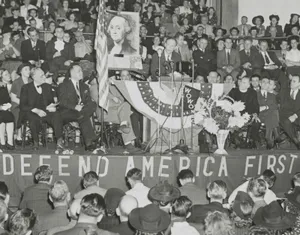
First Committee rally in Fort Wayne, Indiana,
October 3, 1941.
Suffice it to say, every time I turn around I find stories that challenge my views on people and issues of historical significance.
On July 4th, of all days, White House Domestic Policy Council Director Vince Haley released “Saving America’s Story,” a 162-page report accusing the National Museum of American History of “extreme political activism”. The report’s key finding: “museum leadership has explicitly adopted an ideological framework that no longer treats the American story as a shared national inheritance to be taught or celebrated, but as a political instrument to divide, dispirit, and discourage our citizens.”
What ought to dispirit all Americans is something else. That’s the Trump’s administration’s impulsive and capricious efforts to shut down debate on America’s glorious, and yes, flawed, history.

