Gov. Kotek: Don’t Sign The Bill Paying Strikers

Bill to grant striking workers unemployment pay fails final vote in Oregon  Senate - OPB

Sometimes it’s nice to be first.

Oregon is justly proud, for example, that in 1971 it was the first state to pass a bottle bill to address the growing problem of litter from beverage containers and to encourage recycling.  

Other times being first is an abomination. 

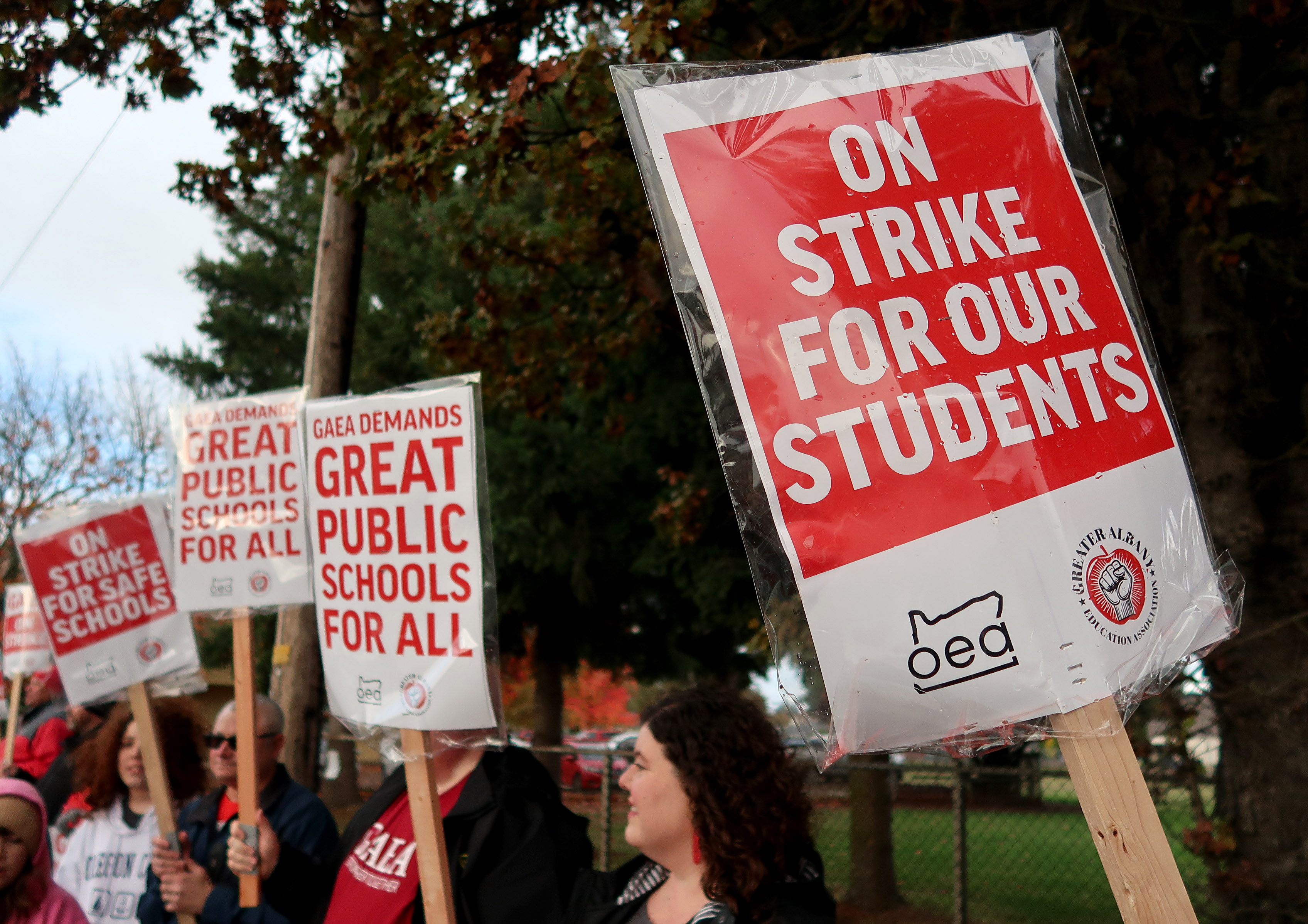
That will be the case if Oregon Gov. Kotek signs SB 916, which would award up to ten weeks of unemployment insurance benefits to workers who go on strike.

The Oregon Employment Department (OED) anticipates that the bill would result in an additional $2.1 million of benefit payments in the 2025-27 biennium. Critics of the bill say this doesn’t take into account the likelihood of longer and more frequent strikes if workers can count on some income while striking.

The whole concept of strikes is an assumption that the loss of income for workers and the loss of production by employers will motivate an eventual settlement. SB 916 would change that whole dynamic, putting employers at a disadvantage. Equally egregious, because the Unemployment Insurance Trust Fund is funded through a payroll tax that is paid by employers, Oregon employers would be paying workers not to work.

What makes their strong support for this bill particularly egregious is that it is aimed at benefiting an extremely small portion of the labor force, but a sector that overwhelmingly favors the Democrats in campaign contributions. 

In 2024, just 15.9% of wage and salary workers in Oregon were union members, according to the Bureau of Labor Statistics. Dig deeper and you find that the union membership rate for public sector workers in Oregon, about 51%, is considerably higher. That is consistent across the country, where unionization is about five times higher nationwide in the public sector compared with the private sector.

Supporters of SB 916 often try to bolster their cause by alluding to the fact that New York and New Jersey already allow unemployment benefits to be paid to strikers, but they neglect to mention that both states bar public employees, such as teachers, from striking.

No wonder the bill has drawn across-the-board opposition from businesses and public entities, including already stretched local governments and school districts.

Earlier in the process, two Senate Democrats, Jeff Golden, D-Ashland and Janeen Sollman, D-Hillsboro, showed praiseworthy wisdom in voting against the bill. “Counties, cities and schools are scrambling to just maintain current services,” Sollman said. “Now is not the time to be adding more uncertainty and more expenses.”

Both senators subsequently changed their minds and voted for a scaled back bill, but Sollman’s statement is still valid.  As Senate Minority Leader Daniel Bonham, R-The Dalles, said, “This is bad policy. It’s going to be harmful to our students. It’s going to be harmful to the state.”

Despite the financial strains facing Oregon, and even the likely diversion of kicker money to address forest fires, Gov. Tina Kotek, a Democrat with strong ties to labor, has said she plans to sign the bill.

“I know the argument has been that this will be highly detrimental to our school districts,” Kotek said in a June 9 media availability. “I don’t particularly believe that is an accurate assessment of that bill and at the end of the day I support the right of folks to strike and I believe the way the bill is drafted we will actually see shorter strikes.”

Don’t count on it. 

Pay Striking Workers Unemployment Benefits? No Way!

People gathered together for strike

We don’t have enough money for this, we don’t have enough money for that, Oregon legislators moan. And then the Oregon Senate votes for SB 916, a bill to pay striking workers unemployment benefits.

The Oregon Employment Department projects the bill could add $11.2 million in payments to striking workers. The Legislative Revenue Office predicts it could cost $5.6 million in the next two biennia, based on striking activities between 2015 and 2024.

SB 916 would make Oregon the only State in the country to grant unemployment benefits to striking public and private sector workers. Oregonians can be proud of some of the state’s groundbreaking legislation, but this is not one to be praised. 

 Russell Lum, a Political Organizer with the Oregon Nurses Association, said in written testimony to the Senate Committee on Labor and Business, “SB 916 … can bring about fair contracts faster”, but that is unlikely. 

I bet it will cost a lot more as public and private worker unions extend their strikes, safe in the knowledge they will get compensation during their strike.  As Terry Hopkins, the President & CEO of the Grants Pass & Josephine County Chamber of Commerce, said in written testimony to the Senate Committee on Labor and Business, ”By providing UI benefits during strikes, SB 916 could inadvertently incentivize prolonged labor disputes, as the financial pressure to reach a resolution is alleviated for striking workers. This potential for extended disputes not only disrupts the operations of the directly involved businesses but also has ripple effects throughout the supply chain, impacting small businesses that are indirectly connected.”

What makes Democrats’ strong support for this bill particularly egregious is that it is aimed at benefiting unions, an extremely small portion of the labor force, but a sector that overwhelmingly favors the Democrats in campaign contributions.

In 2024, just 15.9% of wage and salary workers in Oregon were union members, according to the Bureau of Labor Statistics. Dig deeper and you find that the union membership rate for public sector workers in Oregon, about 51%, is considerably higher. That is consistent across the country, where unionization is about five times higher nationwide in the public sector compared with the private sector.

The bill has now gone to the Oregon House, where Democrats hold a 36-24 majority. Two Democrats in the Senate showed great wisdom in voting against the bill, Jeff Golden, D-Ashland and Janeen Sollman, D-Hillsboro. “Counties, cities and schools are scrambling to just maintain current services,” Sollman said. “Now is not the time to be adding more uncertainty and more expenses.”

Amen.

Paying Striking Workers: One More Bad Idea From Oregon Democrats

Dear Oregon Legislators. Who are you going to listen to, the unions or the rest of us?

 Oregon Democrats, at the request of the AFL-CIO union, have introduced a bill, SB 916, that would allow striking workers in Oregon to collect unemployment benefits. Because the Unemployment Insurance Trust Fund is funded through a payroll tax that is paid by employers, Oregon employers would be paying workers not to work.

Public hearings on the bill before the Senate Committee on Labor and Business were held on Feb. 6 and Feb. 11, 2025.  Union supporters, particularly representatives of nurses and educators, uniformly endorsed the bill. Pretty much everybody else opposed it. 

The bill is sponsored by Democratic Senators Kathleen Taylor, Wlnsvey Campos, James I. Manning, Jr., Chris Gorsek, Mark Meek, and Deb Paterson, as well as Democratic Representatives Dacia Graber and Ben Bowman. 

The unemployment insurance program, as the state explains, ”provides partial wage replacement benefits to eligible workers who are unemployed through no fault of their own.” It is not, and was never intended to be, a source of money to compensate workers for refusing to work.

Daniel Perez with the Economic Policy Institute, founded with a pledge from eight labor unions, delivered written testimony before the Committee in support of SB 916. Ignoring the issue of whether paying strikers made sense, Perez argued that it would “result in minimal costs to the state of Oregon “and “would ensure that critical dollars continue to flow into local businesses and communities during strikes.”

Perez argued that over half of strikes end within two days and over the past four years, the median strike duration in Oregon has been five days. Therefore, the bill’s requirement that there be a 7-day waiting period before striking workers would be eligible to apply for benefitsmeant few would qualify. This , of course, ignored the issue of whether strikes would be prolonged if strikers were paid.

The Oregon School Boards Association (OSBA) asserts, for example, that if Portland Public Schools teachers went on a one month strike in 2025, it would cost the Portland school district $8.7 million if SB 916 were law at a time when the district is already struggling financially. ,

Nurses also testified in support of the bill. “By not allowing unemployment benefits, workers are being discouraged from using their legal right to collective action, creating an advantage for employers,” said one nurse. “Many healthcare workers are forced into an indefinite labor dispute without financial support, making it almost impossible to stand up for necessary changes that need to happen in the workplace.”

Individual critics were more blunt, and more persuasive.

“Are you seriously attempting to KILL businesses in Oregon?” said one. 

“Stop this wasteful spending on foolish bills.,” said another. “Passing of bills such of this will only benefit the greater Idaho movement and have more business and people move out of the state.”

 “This bill appears to be an attempt by certain politicians to woo the union vote, who will in turn donate more money to their campaigns (quid pro quo),” said another. 

“When two parties are negotiating, the cost to both sides needs to be heavy or a settlement won’t be reached.,” said another. “Paying striking employees removes the incentive to reach an agreement quickly.”

A coalition of business groups, the Oregon Farm Bureau, the Oregon Forest Industries Council, chambers of commerce, the Oregon School Boards Association and others said the bill would be “putting the state’s thumb on the scale in what should be a negotiation process between workers and employers.” Further, “If public unions strike, the impact to state (or school district, local government) budgets could be catastrophic. This is particularly alarming given the number and frequency of recent teacher strikes.”

Local governments were also outspoken in opposition to the bill. 

“At a time when local governments and businesses are grappling with tight budgets, these additional expenses would place further strain on employers who already face rising costs for wages, benefits, and regulatory compliance,” said the Marion County Board of Commissioners. “This could lead to higher taxes, service reductions, or even layoffs, the very scenario that unemployment benefits are meant to mitigate.”

The City of Hillsboro was strongly opposed as well. “This bill provides an unfair advantage to labor in a dispute by forcing all employers to fund the act of striking (or other labor disputes) and undermining the purpose of a strike,” the city said.

In my view, the arguments against paying strikers unemployment benefits clearly win out. 

But, given the tendency of Oregon’s Democratic legislators to appease unions, which overwhelmingly bankroll Democrats, the bill may still well go forward.  If it does, Portland won’t be the only part of the state in a “doom loop”. The bill would be one more nail in the coffin of the entire state’s competitiveness. 

I Beg Your Pardon! Oregon Democrats Want Employers to Pay Strikers 

Talk about absurd legislation. 

In an insult to common sense, Oregon Democrats, at the request of the AFL-CIO union of all things, have introduced a bill, SB 916, that would allow striking workers in Oregon to collect unemployment benefits. Because the Unemployment Insurance Trust Fund is funded through a payroll tax that is paid by employers, Oregon employers would be paying workers not to work, actually encouraging more strikes. 

The bill is sponsored by Senators Kathleen Taylor, Wlnsvey Campos, James I. Manning, Jr., Chris Gorsek, Mark Meek, and Deb Paterson, as well as Representatives Dacia Graber and Ben Bowman. 

The unemployment insurance program, as the state explains, ”provides partial wage replacement benefits to eligible workers who are unemployed through no fault of their own.” It is not, and was never intended to be, a source of money to compensate workers for refusing to work. 

Oregon employers contribute between 0.9% and 5.4% of an employee’s wages to the unemployment compensation fund. The exact amount depends on the employer’s tax rate and the employee’s wages. In 2025, Oregon employers are projected to contribute $1.3 billion to the unemployment compensation fund, an increase from the $1.2 billion projected for 2024. 

A similar proposal is being considered by Washington’s Legislature after a bill to make strikers eligible for unemployment benefits after two weeks on strike passed the state house last year, but didn’t have enough support to move forward in the senate. 

Sen. Marcus Riccelli, D-Spokane, is sponsoring this year’s proposal in Washington,  Senate Bill 5041. “Unions should finance their own strike funds and they are trying to make employers be on the hook to pay for strikers.” Says Elizabeth New (Hovde), Director, Center for Health Care and Center for Worker Rights at the Washington Policy Center. 

A public hearing on SB 916 before the Senate Committee On Labor and Business was held on Feb. 6, 2025. Witnesses opposing the bill included representatives of the Northwest Grocery Retail Association, the National Association of Independent Business (NFIB), the Oregon School Boards Association (OSBA) and the League of Oregon Cities. Witnesses supporting the bill included representatives of the Oregon AFL-CIO, the Oregon Education Association, the Oregon Nurses Association, SEIU Local 503 and the Oregon arm of the the American Federation of State, County & Municipal Employees (AFSCME) 

The high cost of doing business in Oregon already hinders the state’s economy. “Passing SB 916 would make Oregon less appealing for business investment, which is needed to create jobs and generate revenue needed by state and local governments,” says Oregon Business & Industry, a statewide business advocacy group. They’re right.

The Senate hearing will continue on Feb. 11. Sensible Oregonians need to tell Oregon’s Democratic legislators to stop the bill in its tracks.

Reshaping Oregon’s Kicker: If You Can’t Win the Game, Change the Rules

Like a casino that changes the Blackjack odds by shifting from one hand-held deck to multiple decks critics of Oregon’s kicker law are preparing for a stealth raid on your wallet.

State economist, Carl Riccadonna, hired in August by Gov. Tina Kotek, “has taken it upon himself to get the forecast more in line with reality” KGW reported in November. In other words, to try to minimize (or eliminate) it.

 “I think that the truing up of the calculation under the new chief economist is really going to be helpful to provide stability when we are trying to do budgeting every two years, ” Kotek said in November. 

The Oregon Legislature passed the “Two percent kicker” law in 1979.  It requires the state to refund surplus revenues to taxpayers when actual General Fund revenues exceed the forecast amount by more than two percent. The personal income tax kicker money comes from all state General Fund revenue sources, except for corporate tax revenues. Personal income tax is the largest contributor. In 2000, voters acting on a legislative referral put a large portion of the 2% surplus kicker statute into the state constitution (Article IX, Section 14).

In October 2023, the Oregon Office of Economic Analysis (OEA) confirmed a $5.61 billion revenue surplus in the 2021-2023 biennium, triggering a tax surplus credit, or kicker, for the 2023 tax year. The surplus—the largest in state history[1]—was returned to taxpayers through a credit on their 2023 state personal income tax returns filed in 2024. 

Democrats, never at a loss for ideas on how to spend more government money, in league with unions and liberal special interest groups, are eager to see the kicker refunds throttled.

Because the kicker is in the Oregon Constitution, a ballot measure would need to be referred to the people to get them to surrender their Kicker refund, but don’t put it past the Democrat-dominated legislature to get creative to facilitate higher government spending.

“Oregon’s inaccurate revenue forecasting costs billions needed for critical public services,” said a memo Service Employees International Union Local 503, Oregon’s largest public-sector union, sent recently to Gov. Kotek.

SEIU research director, Daniel Morris, has complained that poor economic forecasting has resulted in too much money going out the door as kicker refunds.  “Over the last five forecasts it’s been embarrassingly bad,” he told OPB. “There are real consequences for the families of Oregon.”

Joe Baessler, interim executive director of  American Federation of State, County and Municipal Employees Council 75, has lambasted the kicker as well. “They’re deciding to under-inflate our revenue,” said Baessler. “It forces budgeting that is not in line with how much revenue is coming into the state and rolls back the amount of money we have for services that Oregonians want.”

The Oregon Center for Public Policy regularly rails against the kicker too. “Oregon’s kicker is a policy that worsens income inequality, racial inequality and geographic inequality,” says the Center. 

With a new state economist committed to forecast reform, Democrats holding a supermajority in the Oregon House and Senate, Tina Kotek serving as governor, and special interest groups salivating over a bigger state budget, the generous kickers of the past are in jeopardy. Count on it. 


[1] Personal Income Kicker History

Two Percent Kicker, Biennia 1979-81 to 2021-23
BienniumTax YearSurplus/Shortfall ($ millions)PercentMean ($)
1979-811981-$141None
1981-831983-$115None
1983-851985$897.70%$80
1985-871987$22116.60%$190
1987-891989$1759.80%$130
1989-911991$186Suspended
1991-931993$60None
1993-951994/5$1636.27%$110
1995-971996/7$43214.37%$290
1997-991998/9$1674.57%$100
1999-012000/1$2546.02%$160
2001-032002/3-$1,249None
2003-052004/5-$401None
2005-072006/7$1,07118.60%$610
2007-092008-$1,113None
2009-112010-$1,050None
2011-132012$124None
2013-152014$4025.60%$210
2015-172016$4645.60%$250
2017-192018$1,68817.17%$910
2019-212020$1,89817.34%$990
2021-232022$5,61944.28%

The House’s  “Build Back Better” plan: A Costly Collection of Misfires

Build Back Better Is Worse - YouTube

Democrats say Americans love their $2.2 trillion Build Back Better bill passed by the House on Nov. 19. That must be because they don’t know what’s in it.

While the media has largely concentrated on overarching themes of the legislation, gone largely unnoticed are all sorts of provisions most folks would probably find unpalatable if not downright unseemly.

Take a look at the catalog of misfires:

  • Think the Democrats are all about the little people? The current state and local taxes (SALT) deduction allows taxpayers who itemize their deductions to reduce their federal taxable income by the amount of state and local taxes they paid that year, up to $10,000. The House bill would raise the cap to $80,000 through 2030, mostly benefiting the wealthy from high-tax states such as California, New Jersey and New York. Even liberal Jason Furman, a Harvard economist who served as chair of President Barack Obama’s Council of Economic Advisers, has said the provision’s benefit to “the super-rich” is “obscene.” 
  • Just 6.3% of private sector workers in the U.S. were union members in 2020. The House bill adds a $4500 credit exclusively for Electric Vehicles (EVs) built in the United States with unionized labor. This heavily favors the Big Three American auto manufacturers, all of which operate unionized factories in the U.S. Excluded from the credit: Tesla, Rivian, and every foreign automaker that operates a U.S. assembly plant, none of which are unionized. Vehicles such as the Ford Mustang Mach-E full-electric sport utility vehicle, which is built in Mexico, wouldn’t meet the domestic production requirement either. Canada, the European Union, Germany, Japan, Mexico, France, South Korea, Italy, and other countries recently sent a letter to U.S. lawmakers saying the tax credit proposal would also violate international trade rules. In a separate letter, Canadian Trade Minister Mary Ng told U.S. lawmakers and the Biden administration that the credits, if approved, “would have a major adverse impact on the future of EV and automotive production in Canada.” Way to go Democrats. Piss off a lot of automakers and allies to placate the UAW.
  • “We’re for working parents,” the Democrats crow. The House bill would guarantee that families making up to 250 percent of a state’s median income would not have to pay more than 7 percent of their annual income on childcare. Sounds good, but it will inevitably federalize child care, favor big corporate providers, raise childcare costs overall and increase the burden on families making more than the cap. 
  • In another sop to unions, the House bill would allow union members to deduct up to $250 of dues from their tax bills, allowing them to exclude the cost of dues from their gross income. The Joint Committee on Taxation says this would cost taxpayers $1.8 billion. A lot of union dues money goes into supporting political campaigns and lobbying. OpenSecrets, a non-partisan analyst of political money, says Democrats got 90% of union donations in 2020 federal races. 
  • Americana’s journalism industry, which prides itself on its independence, got a piece of the Build Back Better pie in the House bill, too. The House bill would provide a payroll tax credit for companies that employ eligible local journalists. The measure would allow newspapers, digital news outlets, and radio and television stations to claim a tax credit of $25,000 the first year and $15,000 the next four years for each of up to 1,500 journalists. The theory is this would incentivize some publishers to hire or retain local reporters. The projected cost of putting journalism outlets on the public dole – $1.7 billion. I’m a former newspaper reporter and the struggles of local news are undeniable, but this is embarrassing. Why large and small journalism enterprises deserve taxpayer bailouts like this is beyond me. Supporters say there will be guardrails to prevent the tax breaks from going to partisan or fake-news sites. Good luck.  

Who knows what other godawful provisions lurk in the 2000+ page Build Back Better bill. As House Speaker Nancy Pelosi said of another contentious legislative process, “We have to pass the bill so that you can find out what is in it …”

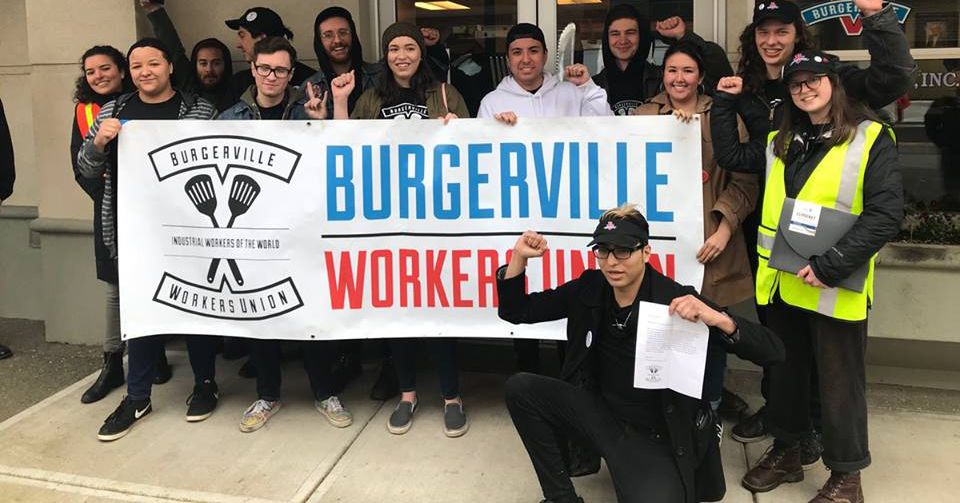
Unionizing Burgerville: workers of the world unite…then quit.

Time passes. Things change.

That’s certainly been the case at Burgerville, where workers at the company’s restaurant at 3504 SE 92nd Ave. in Portland voted 18-4 in April 2018 to form a union.

burgervilleworkersunion

Over the next 12 months, employees at four more Burgerville sites followed suit:

May 13, 2018: 19119 SE McLoughlin Blvd. site – 17 yes, 5 no

Dec. 11, 2018: 1122 SE Hawthorne Blvd. site –  13 yes; 9 no

April 3, 2019: 8218 NE Glisan St. site – 15 yes, 9 no

April 4-5, 2019: 1135 NE Martin Luther King Jr Blvd. site – 14 yes, 7 no

Adding it all up, 111 Burgerville employees at a total of five locations have voted on whether to form a union.

Burgerville says it hasn’t kept track of which specific employees participated in the union votes, so it can’t quantify how many of the 111 voters are still employed by the company. It has determined, however, that of the 142 employees who were working in the five unionized locations during their respective votes, only 94 of them, or 66%, are still employed at Burgerville.

Furthermore, the lead organizers of the unionizing effort at three of the five restaurants no longer work at Burgerville. Two resigned their positions less than one month following their locations’ votes and a third organizer just resigned.

The fast-food industry is currently grappling with record employee turnover. According to MIT Technology Review, the turnover rate in the fast-food industry is 150%. In other words, the typical fast food restaurant is seeing its entire workforce, plus half of its new hires, replaced in 12 months.

Burgerville is doing better, perhaps because of its expansive benefits, including health insurance, vacation pay and financial wellness training. Still, the annual turnover rate across its 42 restaurants in 2018 was 83% (up from 71% in 2017), according to the company.

What all this means is:

  • Three of the five union organizers are no longer working at Burgerville.
  • A significant share of all the Burgerville employees who voted in the five union elections since April 2018 are likely not still working at the company.
  • It is highly likely that few of the 142 employees who were working at the five unionized locations during their respective votes will still be employed at Burgerville 12 months from now.
  • Few of the employees at the five Burgerville locations 12 months from now will have participated in the original votes to unionize.

Why, then, should the employees at the five locations one year from now be forced to be members of a union?

Unfortunately, future employees at the five Burgerville  restaurants probably won’t be given an opportunity to vote on whether to be represented by a union and, if so, which one.

One option to address this situation could be automatic representation elections whenever employee turnover by a bargaining unit over time exceeds a certain percentage. A bill introduced in Congress in 2017 (H.R. 2763 – Employee Rights Act) proposed 50 percent be the trigger.

Another possible solution, suggested by both Samuel Estreicher, a Professor of Law at New York University School of Law, and Michael Oswalt, an Associate Professor of Law at the Northern Illinois University College of Law, is regularly scheduled union representation elections the same way we regularly schedule political elections.

Estreicher, who called his proposal “easy in, easy out,” suggested that every two or three years the employees in a unit, after an initial minimal required showing of interest, would have an opportunity to vote in a secret ballot whether they wish to continue the union’s representation, select another organization, or have no union representation at all.

Oswalt argued that regularly scheduled union representation elections would be better than the simple continuation of the status quo.

“…workplace culture would slowly shift, creating an atmosphere where workers would feel internal pressure to, at the very least, think about the ramifications of selecting or not selecting a bargaining agent,” Oswalt wrote.

That would  be a good thing for Burgerville workers.


Union Members Can Stop Subsidizing Liberal Candidates and Causes


liberalconservativesigns

A question to conservative Oregon union members (I know you’re out there): Why are you contributing to union political funds when most of the money ends up supporting liberal Democratic candidates?

About 18% of the electorate across the country was from union households in the Nov. 8, 2016 presidential election. Donald Trump captured 43% of those union-household voters.

In Oregon, 14.8 percent of the wage and salary workforce belonged to a union in 2015. It’s not clear how they voted, but it’s likely, based upon national patterns, that a decent share voted Republican.

Still, Oregon’s unions overwhelming endorsed Democrats. For example, all but two of the AFL-CIO’s 2016 Legislative endorsements in Oregon were for Democrats (one was an independent, one a Republican), as were all the statewide candidate endorsements.

Similarly, in the 2016 election, political contributions from Oregon’s unions went overwhelmingly to Democrats. For example, SEIU’s PAC, Citizen Action for Political Education (CAPE), spent $2,001,758.89 on the 2016 election. Of that, $706,750.00 went to Defend Oregon (the group pushing Measure 97), $205,000 to the Committee to Elect Brad Avakian, $180,000 to the Kate Brown Committee, and $37,380 to The Real Mike Nearman Committee (created to defeat Republican Mike Nearman).

So why don’t more union members who disagree with their union’s political stances decline to contribute to their union’s PAC and opt out of supporting the union’s political activities. It’s not that hard to do. All a union member has to do is become an “agency fee payer”, sometimes also called a “Fair Share Payer” or “Non-member.”

Oregon allows public employees who are part of a collective bargaining unit to refuse membership in the union that represents that unit. But because the union still has to negotiate on their behalf, these nonmembers must contribute to cover costs which cover collective bargaining, contract administration and grievance adjustment, but not costs associated with political activities.

This worker right was established in 2012 when the U.S. Supreme Court decided that while employees can be required to pay dues for the direct benefits they get from the union, they can’t be forced to give money to unions for political activities.

According to Steve Buckstein,  Founder and Senior Policy Analyst at Cascade Policy Institute, even before the 2012 Court decision, a telephone company employee named Harry Beck spent over two decades fighting for the right to opt out of paying the political portion of his union dues to the Communications Workers of America. In 1988, the U.S. Supreme Court ruled in his favor in Beck v. CWA and created what are now known as Beck rights. Harry is now retired and lives in Oregon. You can watch him tell his story here: https://www.youtube.com/watch?v=a29L3ouJ6tw.

Political spending by unions can be substantial…and influential.

In a Sept. 2015 report to individuals who pay Fair Share fees, the liberal-leaning Oregon Education Association (OEA) said 22.9 percent of its total expenses were nonchargeable for Fair Share fee payers and the liberal-leaning National Education Association (NEA) said a whopping 62.71 percent of its total expenses were nonchargeable for Fair Share fee payers.

This means that if annual OEA dues were $600, they could have been reduced to $462.60 and if annual NEA dues were $185, they could have been reduced to $68.99.

Think of it. Workers, rather than union bosses, deciding for themselves how, or whether, they want to spend their money on political causes.


Hear that sucking sound? That’s Oregon tax Initiative Petition 28

Democrats and their union allies want to suck more money out of Oregon businesses than we thought.

govttaxes

Oregon’s Legislative Revenue Office predicted today (May 23, 2016) that Initiative Petition 28, if approved in November, would generate $6.1 billion in new revenue by the 2017-19 biennium. That’s almost $1 billion more than the $5.3 billion initially predicted.

Talk about greed!

The Revenue Office’s report also estimated that 38,220 private sector jobs would be lost by 2022 if the initiative passed. Meanwhile, in an odd twist, the public sector would add 17,700 jobs.

Talk about an absurd outcome!

And Gov. Kate Brown’s thoughtful response?  “I greatly appreciate the analysis provided by the Legislative Revenue Office, which helps inform our understanding of the impacts of IP-28,” Brown said. “As I have said previously, the problem I remain focused on is how to improve our graduation rate and fund essential services while sustaining economic growth and protecting Oregon jobs. I will begin discussions with my legislative colleagues about a way forward that, should the measure pass, would safeguard new revenue for education while sustaining economic growth and protecting Oregon jobs.”

Whew! Makes you wonder if the governor is being paid by the word.

Initiative Petition 28 is being promoted by A Better Oregon, a campaign organization operating under the umbrella of Portland-based Our Oregon, a coalition of unions and progressive groups.

The measure would raise the corporate minimum tax on Oregon sales of more than $25 million a year from the current minimum of $50,000 to $30,001 plus 2.5 percent of the excess over $25 million. The tax would be based solely on sales, not profit.

Corporate taxes during the 2017-2019 biennium under the current system are projected to reach about $1.1 billion.

In other words, the passage of Initiative petition 28 would increase corporate tax collections per biennium by almost 600 percent in one fell swoop.

Rep. Mitch Greenlick (D-Portland), when endorsing the measure, said it would eliminate much of the constant need to choose between funding critical budget concerns each legislative session. “If that passes, we’ll have a lot of money to pay for stuff,” Greenlick said.

Otherwise, Greenlick said, most of the additional revenue in the economic forecast for the 2017-2019 budget would go to cover increased PERS liabilities and the state’s increased share of Medicaid funding, leaving little additional revenue for new stuff.

“This measure will make sure that large and out-of-state corporations do their part to fund the schools and services that will make Oregon thrive,” Our Oregon says.

As long ago as I can remember advocates for higher taxes in Oregon have been making “out-of-state corporations” the bogeyman, the malignant beast that’s doing Oregonians wrong and needs to pay.

But as attractive a target as these corporations are, they’re not fools. They will find a way to avoid paying the taxes or they’ll pass on the added taxes to Oregon consumers.

Then we’d all pay.

The liberal coalition behind Initiative petition 28, recalling their success in a tax increase battle in 2010, may be figuring they have a sure thing again with another measure targeting big business, but hopefully Oregonians in their wisdom will see this proposal is a reach too far.


Our Oregon: shooting Oregon in the foot – Dems and unions want more money to spend on more “stuff”


Tax big business. “Yeah.. that’s the ticket! Yeah, you betcha!,” SNL’s Tommy Flanagan would say.

bloated-government-cartoon

A Better Oregon, a campaign organization operating under the umbrella of Portland-based Our Oregon, a coalition of unions and progressive groups, agrees.

A Better Oregon is promoting Initiative Petition 28 for the November 2016 ballot. The measure would raise the corporate minimum tax on Oregon sales of more than $25 million a year from the current minimum of $50,000 to $30,001 plus 2.5 percent of the excess over $25 million. The tax would be based solely on sales, not profit.

The Legislative Revenue Office estimates the corporate tax measure would raise $5.3 billion during the 2017-2019 biennium. Corporate taxes during that biennium under the current system are projected to reach about $1.1 billion.

In other words, the measure would increase corporate tax collections per biennium by a whopping 400 percent in one fell swoop.

Rep. Mitch Greenlick (D-Portland), when endorsing the measure, said it would eliminate much of the constant need to choose between funding critical budget concerns each legislative session. “If that passes, we’ll have a lot of money to pay for stuff,” Greenlick said.

Otherwise, Greenlick said, most of the additional revenue in the economic forecast for the 2017-2019 budget would go to cover increased PERS liabilities and the state’s increased share of Medicaid funding, leaving little additional revenue for new stuff.

But not to worry, says Ben Unger, executive director of Our Oregon. The extra money won’t come out of your pocket. It will come mostly from large out-of-state corporations.

About 1,000 corporations doing business in Oregon, mostly multi-state corporations, would be affected by the higher taxes.

“This measure will make sure that large and out-of-state corporations do their part to fund the schools and services that will make Oregon thrive,” Our Oregon says on its website.

As long ago as I can remember advocates for higher taxes in Oregon have been making “out-of-state corporations” the bogeyman, the malignant beast that’s doing Oregonians wrong and needs to pay.

But as attractive a target as these corporations are, they’re not fools. They will find a way to avoid paying the taxes or they’ll pass on the added taxes to Oregon consumers as a stealth sales tax.

Moving a company’s headquarters to another state with a more congenial tax environment, as GE is doing with its recently announced shift from Connecticut to Massachusetts, won’t solve the problem, but there are always run-arounds.

Maybe some businesses will change their ownership form to get sales in Oregon under the $25 million trigger. Others may institute some special, higher regional pricing.

Some creative companies may become benefit corporations. Our Oregon thought it was being clever and supportive of the “good guys” when it inserted a provision in its initiative to exclude benefit companies under ORS 60.754 from the higher taxes. But this opened a loophole ripe for exploitation.

The liberal coalition behind Initiative petition 28, recalling their success in a tax increase battle in 2010, may be figuring they have a sure thing again with another measure targeting big business, but hopefully Oregonians in their wisdom will see this  proposal is a reach too far.