By Bill MacKenzie
Introduction
For the Twiss brothers of Connecticut in the early 1800s, it wasn’t “Go West, young man”. It was “Go North”.
Members of a pioneering American family imbued with deep religious faith and an entrepreneurial spirit, the brothers were true risk-takers. Their pursuit of success is quite a tale.
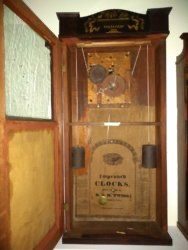
I came across the Twiss brothers ands their parents, Joseph and Lois Twiss, because of a longcase pendulum clock with a wood movement, often called a grandfather clock, made in Canada in1833 and signed “J. & R. Twiss Montreal”. It stood for years in a hallway at my parents’ home in Wallingford, Connecticut, a village established in 1667 along a ridge above the Quinnipiac River.
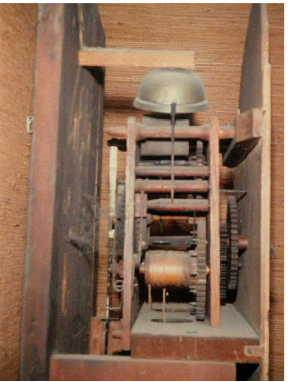
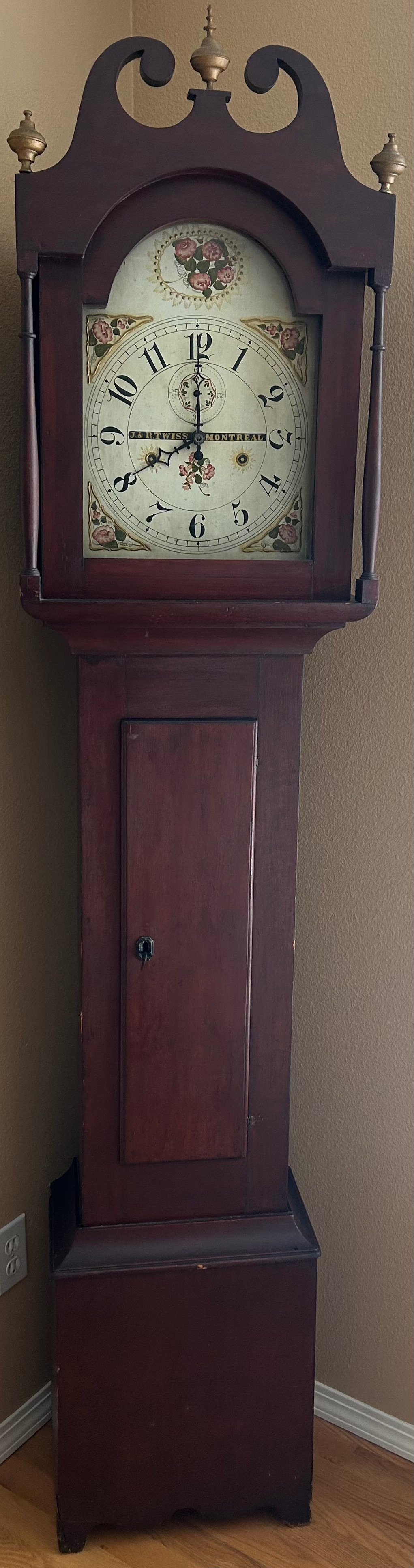
My father, William Neal MacKenzie, retrieved the clock from the Wallingford home of his mother, Helen May MacKenzie, after she died in 1968. When my parents died, my father in 1999 and my mother in 2001, I had the clock shipped 2,987 miles to my home in Lake Oswego, Oregon.
I admired the clock, but I was mystified as to my family’s association with it. My father never disclosed a connection with the Twiss family and though one of my sisters, Elizabeth Kennard MacKenzie, now deceased, researched our family history, she never made a Twiss connection.
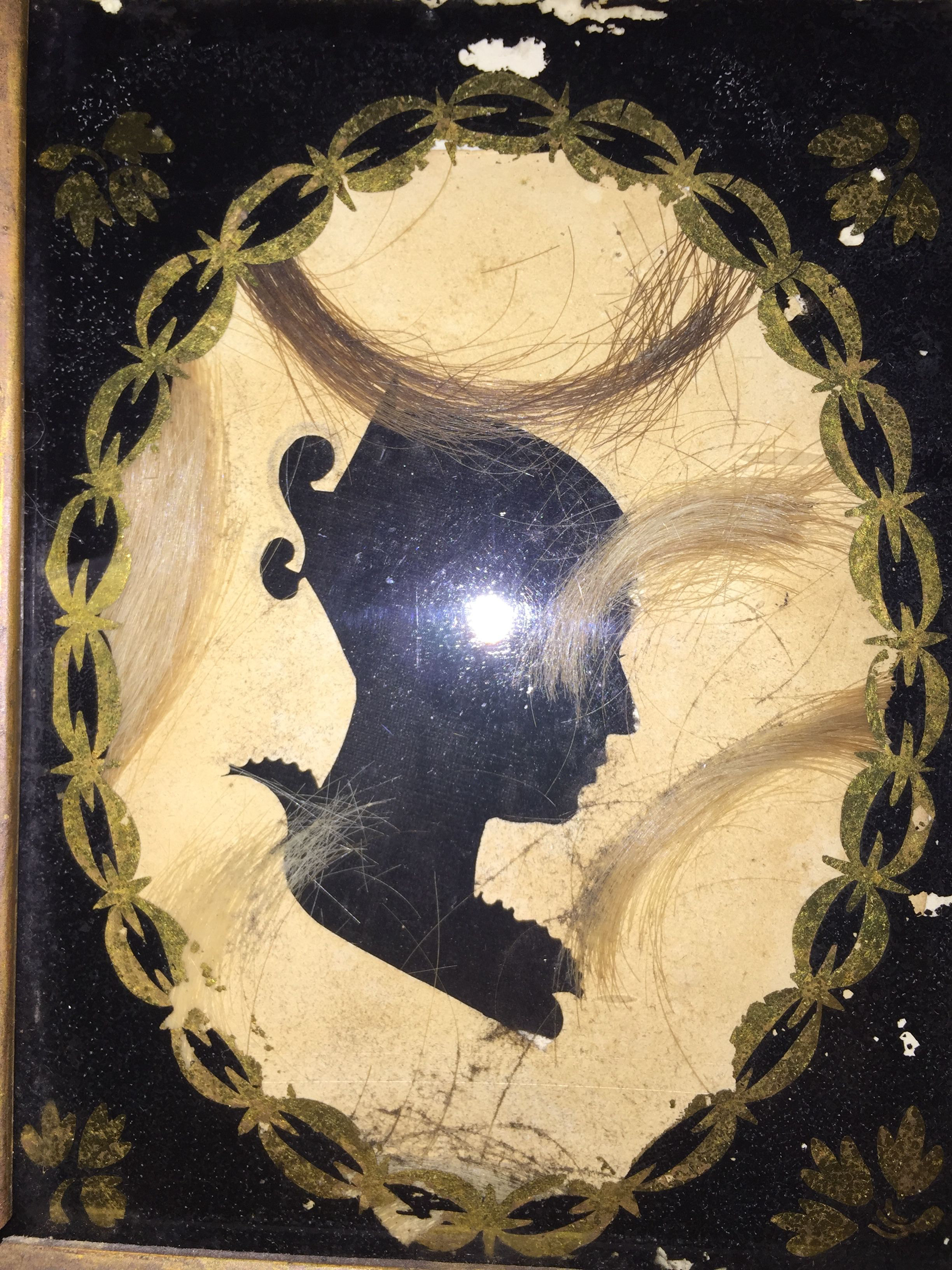
In February 2026, I came across a black-and-white profile cutout of Lois and Joseph Twiss, known as a silhouette in the 1800s, among a collection of MacKenzie family artifacts I had inherited. The signature of Carrie Twiss Burgess in longhand was on the back of the silhouette. Her maiden name, before marrying Horace Burgess on Dec. 27, 1911, in New Haven, Connecticut, was Carrie Twiss. A genealogy search revealed that Carrie Twiss’ father was Gustavus D. Twiss, a son of Russell Twiss, one of the Twiss family of clockmakers.
Also written on the back of the silhouette in longhand was “Grandfather of Helen Kennard MacKenzie”. Further genealogical research revealed:
- My father’s mother, Helen May MacKenzie, who was born on October 18,1876, married William Atkins MacKenzie on Oct. 5, 1905. It is likely she was mistakenly identified on the silhouette as Helen Kennard MacKenzie because her maiden name was Helen May Kennard
- Helen May Kennard and her brother Benjamin Leighten Kennard were the children of Benjamin Champion Kennard and Justina Clindora Kennard of Meriden, Connecticut.
- Justina Clindora Kennard was the daughter of Ransom Baldwin and Sarah Baldwin of Meriden, Connecticut.
- Sarah Baldwin was a daughter of Joseph and Lois Twiss of Wallingford and Meriden, Connecticut, parents of the Twiss brothers.
- Mystery solved.
Clockmaking in Connecticut
Connecticut has a long clockmaking history. Even in the 1700s, more than 80 clockmakers were at work in the state, according to Philip E. Morris Jr.1 The earliest clockmaker there, Ebenezer Parmelee, may have started manufacturing clocks independently in Guilford, Connecticut as early as 1712, followed by Macock Ward, who may have received training from Parmalee and established a shop in Wallingford in 1724.
Another early Connecticut clockmaker, Morris wrote, was Thomas Harland, who arrived in Connecticut from England in 1773 and set up a shop in Norwich. I mention him because Daniel Burnap learned the craft from Harland as an apprentice. He then established his own business making clocks of t the heavy cast brass English type in East Windsor and provided instruction to another young man named Eli Terry (1772 – 1852). After receiving some training from Benjamin and Timothy Cheney in East Hartford, Terry apprenticed himself to Burnap at the age of 14 in 1786. He remained under Bernap’s tutelage until 1792, when he was 20 years old. He then set off on his own, later helping initiate the clockmaking journey of Joseph Twiss’ family.
Terry was “a young man of great ingenuity and good native talent”, wrote Chauncy Jerome, an entrepreneur in America’s 19th century clockmaking industry. His first wooden clocks were patterned after clocks made by Benjamin and Timothy Cheney. He started out making his clocks with no machinery, cutting the wheels and teeth with a saw and jack-knife. Early clock movements were custom made one tooth at a time, one gear at a time and the labor and materials costs were quite high. His earliest known wooden clock was made about 1792. It has an engraved brass dial has an engraved brass dial signed “Eli Terry / E. Windsor”.
The shift to wood movements in so-called shelf clocks was propelled by the high cost of brass movements in longcase clocks. The most common brass longcase clocks around 1800 sold for $25 – $50. If the buyer didn’t want to simply hang the odd-looking mechanism on a wall, adding a case meant adding 30-60% in cost, limiting the product to the well-off. The bulk and weight of such devices also limited their distribution in the marketplace.
Murphy pointed out that the idea of using wooden movements was not an origlnal idea of the Connecticut craftsmen. As early as the 17th century, clockmakers in Germany and Scotland were making clocks with wooden mechanisms and some of those clockmakers brought that skill across the Atlantic to the colonies. “It was eighteenth century Connecticut artisans, however, who perfected the art of wooden clockmaking,” Murphy said.
Shifting to wood movements sharply reduced the cost, but the problems of production, weight and bulk remained.
Terry moved to Northbury, a part of Watertown, Connecticut in 1793. Two years later Northbury was incorporated as the independent town of Plymouth. In 1804, Terry entered into a partnership with a former apprentice, Heman Clark, who had gone to work for him at the age of 14, and embarked on his first factory.
According to a 1961 Yale PhD dissertation by John Joseph Murphy, The Establishment of the American Clock Industry, Terry obtained a lease from Joseph Wright on January 23, 1806, giving him the right to erect a factory in Plymouth, Connecticut for high quantity production “not more than 20 feet square to be improved for turning and doing mechanical business by water”.
Terry opened his own business in 1793 and in 1794 bought some land on which he built his first house in the spring of 1795. On March 12, 1795, he married Eunice Warner and started housekeeping.2
His technical skill revealed itself on November 17, 1797, when he received the first patent for a clock mechanism granted by the United States Patent Office and signed by President John Adams. Terry went on to receive 9 more patents over the course of his lifetime.
That enterprise lasted until December 30, 1807, when he sold the clock shop to Clark for $200.3 Clark later sold his property to Seth Thomas “…with a clock factory standing thereon , together with all the machinery, & tools belonging to said Factory and every building and other thing there unto appertaining…”4
Terry then set up a factory in a gristmill with a waterwheel already in operation on 17 acres in the southern part of Plymouth that he had bought from Calvin Hoadley for $2,000 in July 1806. The new factory had access to water power from the Naugatuck River that could drive new machinery capable of producing interchangeable clock parts. Funding for his new venture came from the Rev. Edward Porter , an ex-pastor of the First Church of Christ in Waterbury, and Levi Porter, an investor, sometimes cited as brothers, but not actually related to each other.5
“Forty-five years ago a plain man, of few words but great ingenuity, purchased an old grist mill in Plymouth, at the south-eastern extremity of Litchfield County Connecticut and converted it into a wooden Clock Factory,” Wm. A. Alcott wrote in The History of Yankee Clocks and Clock-Making in 1851. “The writer of this article, then a mere child and residing in the neighborhood, distinctly remembers the event. Wooden clocks had indeed been made long before that time by Lemuel Harrison of Waterbury, Gideon Hoberts of Bristol, and perhaps others. They were, however, few in number and sold at enormous prices.”
According to the Porter-Phelps-Huntington House Museum, after spending a year ensuring that his factory had the correct machinery to begin production, the shop was able to work on up to five hundred clocks at a time, all of which had fully interchangeable parts due to the industrialized nature of their manufacture.
“Mr. Terry, the foolish man, they said, had begun to make two hundred clocks; one said he never would live long enough to finish them; another remarked, that if he did, he never would, nor could possibly sell so many, and ridiculed the very idea,” Chauncey Jerome wrote.6
But Terry did manufacture and sell those clocks. He followed that by signing a contract to make four thousand wooden clock movements at $4 per movement in three years for Waterbury, Connecticut merchants Edward and Levi Porter. “A lack of competency with timekeeping mechanisms among the target market is reflected in the fact that these tall-case clocks came with detailed instructions, most of which addressed the clock movements’ potential failings,” according to Marking Modern Times: A History of Clocks, Watches and Other Timekeepers in American Life by Alexis McCrossen.
Alcott wrote of how Terry’s neighbors “ransacked” nearby woods and valleys for laurel, boxwood, sugar maple and other woods to make the wheels, pinions and pillars of Terry’s clocks, cherry and pines from other regions for other purposes and nearby fields for flax to serve as the cords by which weights were suspended.
To handle the large order, Terry paid a local carpenter, Calvin Hoadley, $2,000 for an old mill on 17 acres of land beside Hancock Brook in Plymouth, Connecticut at Greystone Falls, in the south end of Plymouth, near the Waterbury town line. According to the Porter-Phelps-Huntington House Museum, after spending a year ensuring that his factory had the correct machinery to begin production, the shop was able to work on up to five hundred clocks at a time, all of which had fully interchangeable parts due to the industrialized nature of their manufacture.
One of the people Terry hired to build wood clock cases at his new clock factory was Silas Hoadley (1786–1870), a skilled wood worker who was living in Plymouth. Another hire was Seth Thomas, who would later become a widely known clockmaker himself.
After Terry completed the contract with the two Porters, he sold his shop to Thomas and Hoadley on July 7, 1810, for $6,000 .
Terry’s next significant move reflected his realization that his new more efficient production methods would only be efficiently used if there was an expanded market for his products. A new smaller cased clock movement that could be sold for less and more easily distributed was critical, he decided.
Murphy wrote that Terry began working on a design for such a clock in 1810 after selling the mill site to Silas Hoadley and Seth Thomas for $6,000. By the end of 1812, deciding he’d figured out how to manufacture an affordable shelf clock, he bought a new factory site near the Naugatuck River and began to equip a factory there.
After Terry perfected his “Pillar and Scroll” shelf clock, he patented it in 1816. Considered by many “a revolutionary technological and aesthetic achievement,” the shelf clock with its ten-inch pendulum was easy to make, easy to transport and easy to sell. By 1820 Terry, with the help of thirty workmen, manufactured twenty-five hundred of these clocks a year, in four different styles, according to McCrossen.
In 1824, Terry branched out by signing an agreement with the First Ecclesiastical Society of New Haven, Connecticut, to manufacture a wood movement tower clock for the Center Church on the Green in New Haven. The clock was placed in the tower in working operation in the late fall of 1826.
The movement was removed from the New Haven steeple and reinstalled in the steeple of the First Congregational Church of Plymouth, Connecticut in 1838 and still runs today, requiring winding every nine days. It holds the distinction of being the only surviving, fully functional wooden gear tower clock crafted by Terry.
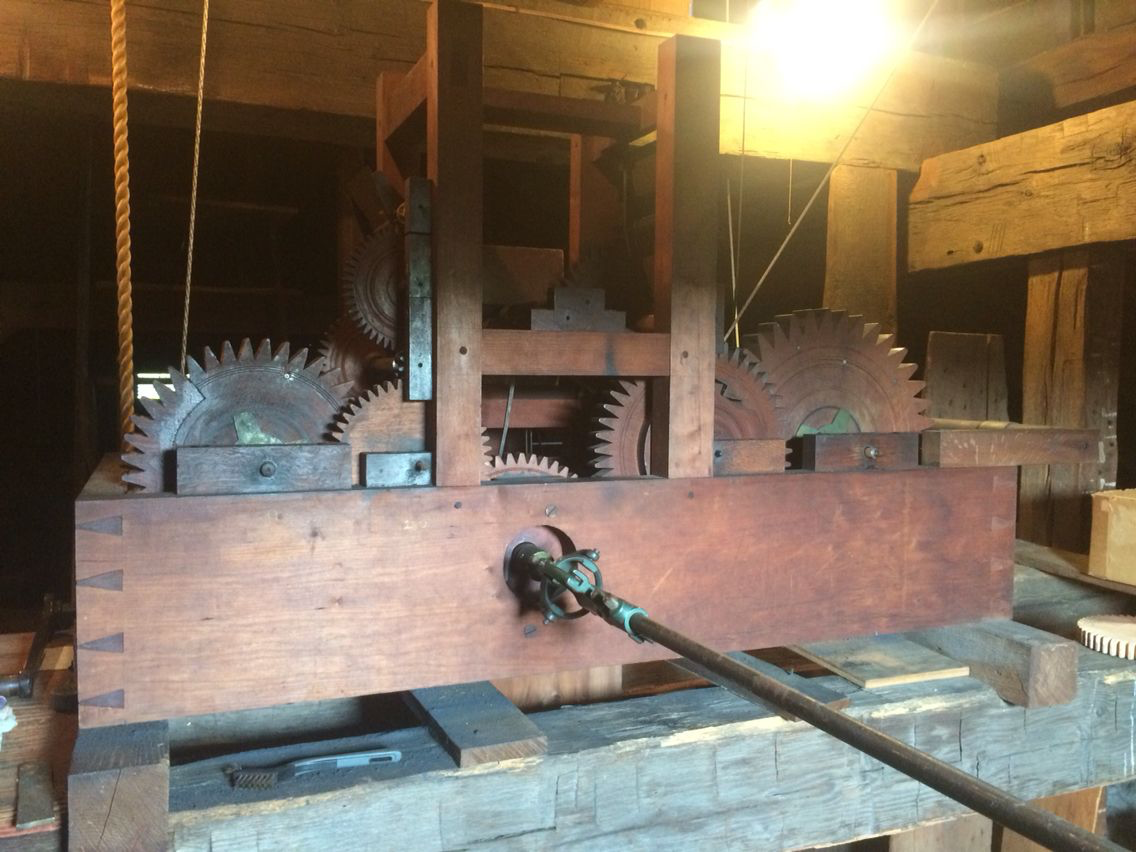
steeple of the First Congregational Church of
Plymouth, Connecticut.
Terry’s shelf clock initiative was a bold move in an industry that relied on individually crafted gears and cogs. His techniques enabled him and Hoadley to mass produce, at the peak, about 12,000 clock works per year at around $4 a piece. That was down from the $20 or so required for individually produced works, according to Jane Varkaris and James E. Connell, two early clockmaking experts.
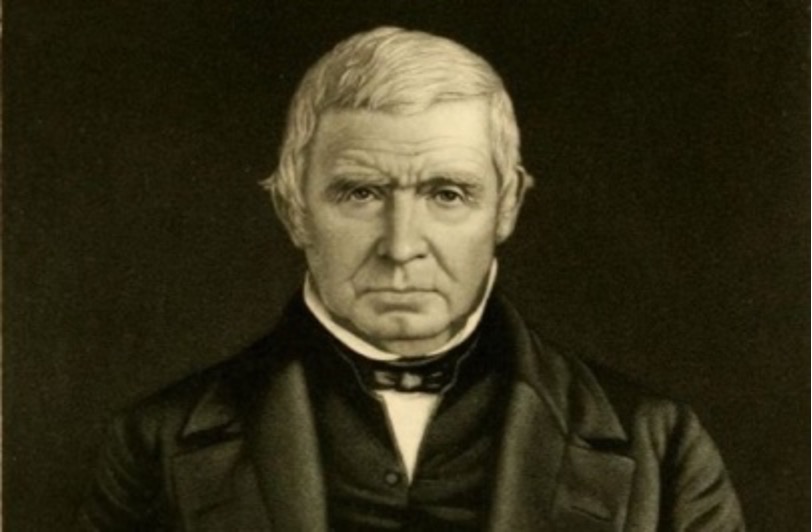
Terry later sold his factory to Silas Hoadley and Seth Thomas, both of whom became prominent clockmakers in their own right. Terry died a wealthy man on February 24, 1852.
“The young apprentice, Seth Thomas, fell in love with and eloped with Eli Terry’s daughter (much to Eli’s chagrin) and relocated (or was run out of town by Eli) to the next town,” Alexander H. Phillips , a Bar Harbor, Maine clockmaker, wrote in Clock Lore. “With him, he took his father-in-law’s teachings and established his own clock factory in Plymouth Hollow, Connecticut.”7 On May 3, 1853, the Seth Thomas Clock Company was organized as a joint stock corporation, succeeding the founder’s operation. After Thomas died in 1859, the town of Plymouth CT was renamed “Thomaston” in his honor. The Seth Thomas clock factory survived until 1982-83, when the historic, but obsolete, Thomaston plant was closed.
About 1815, Hoadley also started manufacturing movements in his own factory. He continued to make clocks of all styles until 1845 or later.
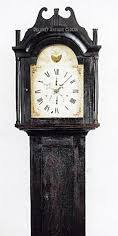
Of importance to this story, some of Silas Hoadley’s clockmaking apprentices were sons of Joseph Twiss, a former Revolutionary War soldier, and his wife, Lois.8
The Twiss Clockmaking Family
In 1901, Julius Twiss, a descendent of Joseph Twiss’ clockmaking family, wrote by hand a genealogy of the family. He asserted in that document, which I have in my possession, that Joseph Twiss descended from a William Twiss of German ancestry who took up residence in a suburb of Newbury, England.
Julius said Anthony. Wood’s Athenae Oxonienses, a massive biographical dictionary of writers and bishops educated at the University of Oxford, published during 1691–1692, included an entry for William Twiss. “A very able, learned and good man”, according to the dictionary. He died in Holburn, a suburb of London, on July 20, 1646, and was buried at Westminster Abby on July 24, 1646.
Julius wrote that three brothers, Robert, Nathan and Daniel Twiss, descendants of William, later travelled across the Atlantic to Salem, Massachusetts, with Robert settling in New Hampshire, Daniel in Massachusetts and Nathan in Connecticut.
A 1906 publication, Men of Mark in Connecticut, included an item that tied the Twiss clockmaking family to a German emigrant to England:
“The earliest known ancestor of the family…was without doubt William Twisse, a Teuton, who emigrated from Germany about 1500 and settled in Newbury, England, whose grandson, a graduate of Oxford College, known as Dr. William Twiss, was chaplain to Elizabeth, daughter of King James, and a ” divine of great ability, learning, piety, and moderation.” He died July, 1646. Daniel, Nathan, and Robert Twiss, undoubtedly the sons of Dr. William Twiss, came from England to Salem, Massachusetts, about 1650. By direct descent from one of the three brothers and through Thomas, Benjamin, and Joseph Twiss, all of Cheshire, Connecticut, came the grandfather of the subject of this sketch, whose name was also Joseph Twiss and who lived and died in Meriden, Connecticut.”9
An undated handwritten document headed “From Julius” also says: “Thomas Twiss of Cheshire Conn. was probably a grandson of either Robert or Nathan Twiss who with another brother, Daniel, are supposed to have settled in the vicinity of Salem somewheres about 1650. These were probably the sons of Dr William Twiss who died about 1646, and who lived in Newbery.”
Documenting with high confidence that the three brothers were, in fact, sons or descendants of the William Twiss of England cited in the Athenae Oxonienses has, however, been difficult. There is, however, at least one entirely un-traced generation between the original emigrants to America and Thomas Twiss of Cheshire, Connecticut (the known ancestor born around 1675). Papers in the Twiss family files at the New England Historic Genealogical Society in Boston, Massachusetts also raise questions about the connection.
Julius said a second cousin, Albert Twiss, stopped at his home in New Haven, Connecticut during a visit to New England about 1880 and showed him a document that had an account of the landing of the three Twiss brothers in Salem. Unfortunately, Albert died soon after his return home and Julius lost the document he left with him. “This incident is mentioned to show that the landing of three brothers of our name at or near Salem is an established fact,” Julius wrote.
According to volume 1 of Genealogical and Family History of the State of Connecticut by William Richard Cutter, on December 2, 1702, Thomas Twiss, a descendant of one of the three brothers, most likely Nathan, married Abigail Howe of Wallingford, Connecticut. One of their children, Benjamin, married Ruth Kerns on July 15, 1728. They had a son, Joseph, born in Wallingford on January 31, 1729.
On September 3, 1751, Joseph married Mahitabel Burr of Farmington, Connecticut. They had seven children, including one they also named Joseph, born April 13, 1761.
That Joseph went on to witness America’s Declaration of Independence in 1776 at the age of 15 and in time became the head of the Twiss clockmaking family.
Joseph was a teenager when he began serving in George Washington’s army during the long, brutal and bloody Revolutionary War. According to US, Revolutionary War Service Records, 1775-1783 at the National Archives, he enlisted as a private for a three year term with the Continental Troops on February 16, 1778, after the Valley Forge encampment in the winter of 1777-1778.
He served his entire time in Captain William Sizer’s company in Jeduthan Baldwin’s Regiment in the Corps of Artificers. Artificers were skilled mechanics and artisans essential for repairing wagons, forging tools, repairing weapons, and building fortifications.
During his service, Joseph is reported to have fought in the battles of Germantown, Brandywine, Monmouth and the victorious battle of Saratoga. He may also have participated in the pivotal 1781 Battle of Yorktown, a three-week siege that ended when British troops surrendered to the Continental Army and its French allies.
This last major land battle of the American Revolution led to negotiations for peace with the British and the signing of the Treaty of Paris in 1783. That firmly brought into being the United States of America. That name of the union was formally adopted on Sept. 9, 1776, when the Second Continental Congress ordered that in official documents “where, heretofore, the words ‘United Colonies’ have been used, the stile”—an old-fashioned spelling of “style” “ —“be altered, for the future, to the ‘United States”.10
Upon his return from the war, Joseph joined many other former soldiers who settled in Wallingford, Connecticut. As many as 85 Revolutionary War soldiers are known to be buried in the town’s historic Center Street Cemetery,11 and the town honors its contributions to the war at the Wallingford Revolutionary War Memorial12
On October 11, 1786, Joseph married Lois Austin (May 11, 1764 – January 31, 1848) and they made their home on Wallingford’s North Colony Street. (There’s been speculation that they lived in a home built in 1711 that survives today as a historic museum called the Solomon Goffe House at 677 North Colony Street, but that has been shown to be in error.)
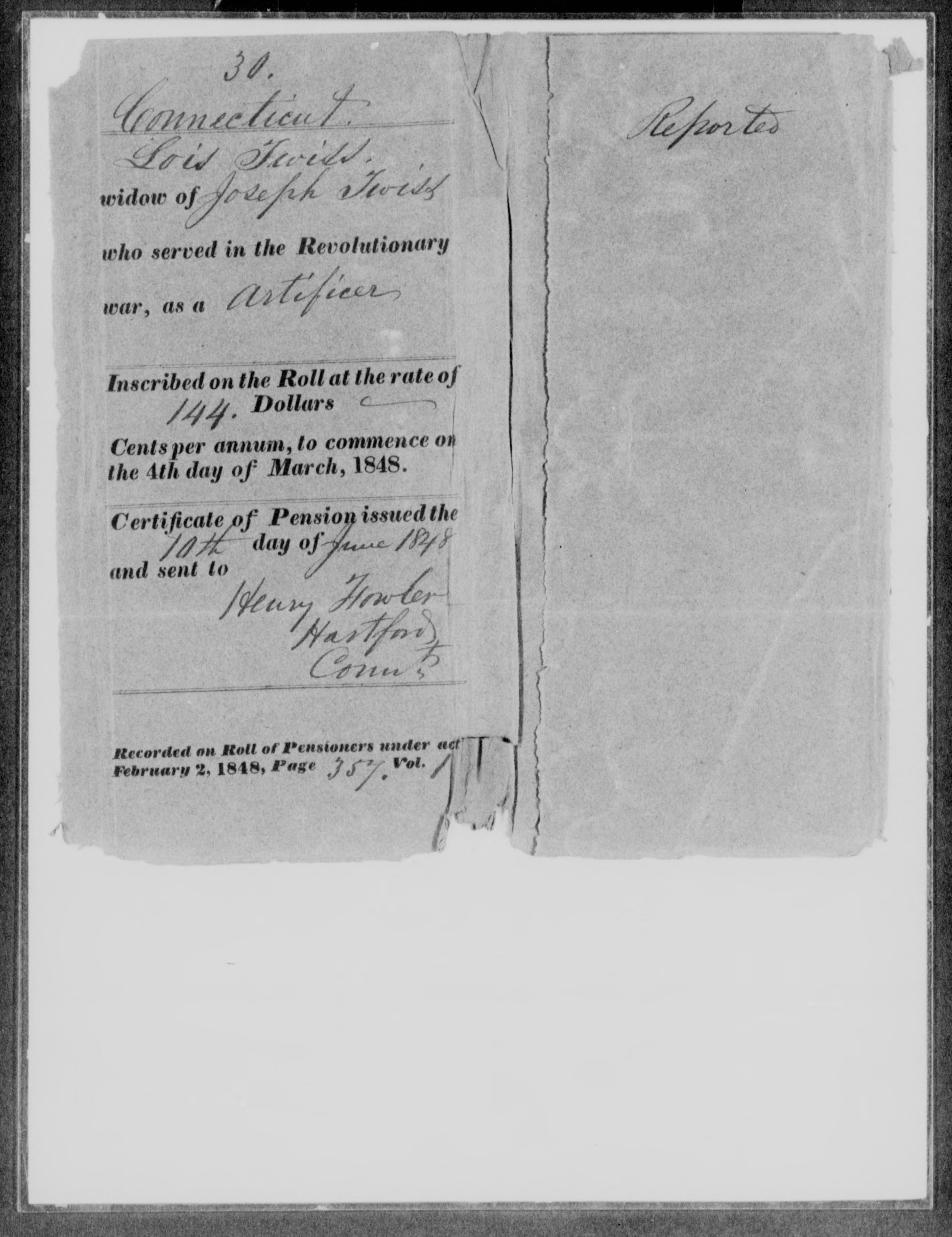
In consideration of his service during the Revolutionary War, Joseph later received a pension of $144 a year under an Act of 7 June 1832.
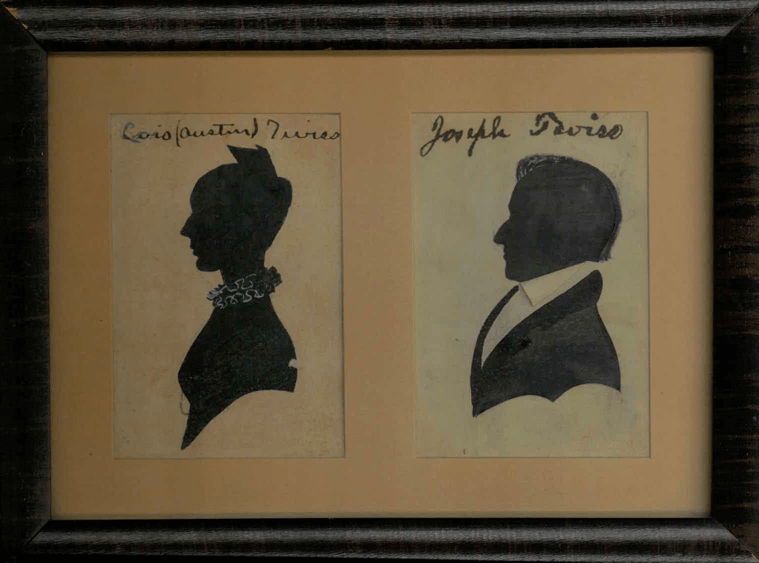
Silhouette of Lois and Joseph Twiss (In my possession) Silhouette portraits reached their peak of popularity in the 18th and early i9th century before the development of photography.
Joseph and Lois Twiss had 13 children, 8 sons and 5 daughters.
- Sons: Austin (April 29,1790 – May 18, 1826), Joseph (May 17, 1791 – April 3, 1799), Ira (April 17, 1797- Sept. 14, 1870), Benjamin (Oct. 31, 1798 – Jan. 23, 1854), Twins Joseph B. (May 6, 1803 – March 31, 1877) and Joshua (May 6, 1803 – May 29, 1829), Hiram (April 1,1805 – Nov. 12, 1846), Russell (Sept. 4, 1807- May 14, 1851).
- Daughters: Abigail (1788 – 1789), Abigail (1792 – 1793), Lois (March 3, 1794 – Dec. 20, 1822), Abigail (1795 – 1819), Sarah (Jan. 9, 1801 – Oct. 30, 1872)
Some Twiss-related articles say Joseph and Lois had 12 children, omitting a son, Joseph, who was born in 1791 and died at the age of 7. His birth is in the Connecticut, U.S., Town Birth Records, pre-1870 (Barbour Collection) and his death is listed in the Connecticut, U.S., Deaths and Burials Index, 1650-1934 (Barbour Collection).
It was assumed for many years that the father of the Twiss family of clockmakers was named Hiram. In 1914, however, the Fitchburg Historical Society of Fitchburg, Massachusetts published Proceedings that included an article on wood clocks by Ezra S. Stearns that disputed that assumption. The article noted a clock by the Twiss brothers could be found in Fitchburg and identified “Austin, Ira, Benjamin, Joseph and Russell, brothers and sons of Joseph and Lois (Austin) Twiss….”13 For some reason, Stearns did not identify Hiram as one of Joseph and Lois’ sons.
The frequent misidentification of Hiram as the father continued, however, until a horologist, Robert C. Booth of Georgia also reported in 2009 that the father was, in fact, Joseph.14
It is also worth noting that the Connecticut, U.S., Town Birth Records, pre-1870 (Barbour Collection) incorrectly lists this Joseph’s death date (Apr. 3, 1799) as a birth date for an ‘extra’ Joseph whose parents are Joseph and Lois, but this date is correctly listed as the first Joseph’s death date in the Connecticut, U.S., Town death Records, pre-1870 (Barbour Collection). This may have been a transcribing error in the birth records index and might have helped sow confusion about the often missing first Joseph Twiss.
The inscription on Joseph’s grave marker in Meriden’s East Cemetery reads: “In Memory of Joseph son to Mr. Joseph & Mrs. Lois Twiss who died April 3rd AD 1799 in his 8th year. From my dear flock one now is gone /To appear before the eternal throne / & pass the great desisive (sic) test / There… (illegible)”. The lines of the epitaph are a modification of a poem written by Samuel Davies, an influential 18th-century early American Presbyterian minister, poet, and church planter, who wrote:
A Clergyman’s REFLECTIONS on the Death of one of his pious Pariſhioners.
OF my dear Flock one more is gone _.
T’ appear before th’ Almighty’s Throne,
And paſs the grand decifive Teſt,
” Aſhes to Aſhes, Duſt to Duſt;”
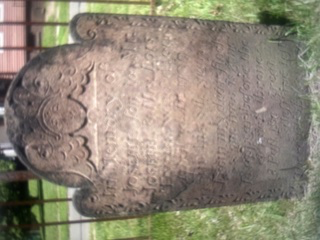
It is remarkable that Lois Twiss survived having 13 children over 19 years in a period when so many women died giving birth.
Unremarkably, she lost two daughters shortly after their birth and one son at the age of 7. In that, she was still more fortunate than one of her daughters, Sarah, who married Ransom Baldwin on November 20, 1823. Five of Sarah Twiss Baldwin’s children died: Hiram at 2, Viney Ann at 6, Lois Augusta at 3, Augusta Ann at 2, Roxanna at 1. Only four of her children, Sarah Maria, Ransom, Mary E., Justina C., survived to adulthood. Although many basic facts of fatalities at birth in the 19th-century United States are unknown due to a lack of reliable data, they are thought to have been exceptionally high in the late 1700s and early 1800s, based on what records do exist.
A grieving silhouette of Sarah Twiss Baldwin, in the possession of Susan Moynihan of Storrs, Connecticut, shows five locks of hair around Sarah’s head. Each of them are from a child of hers who died.
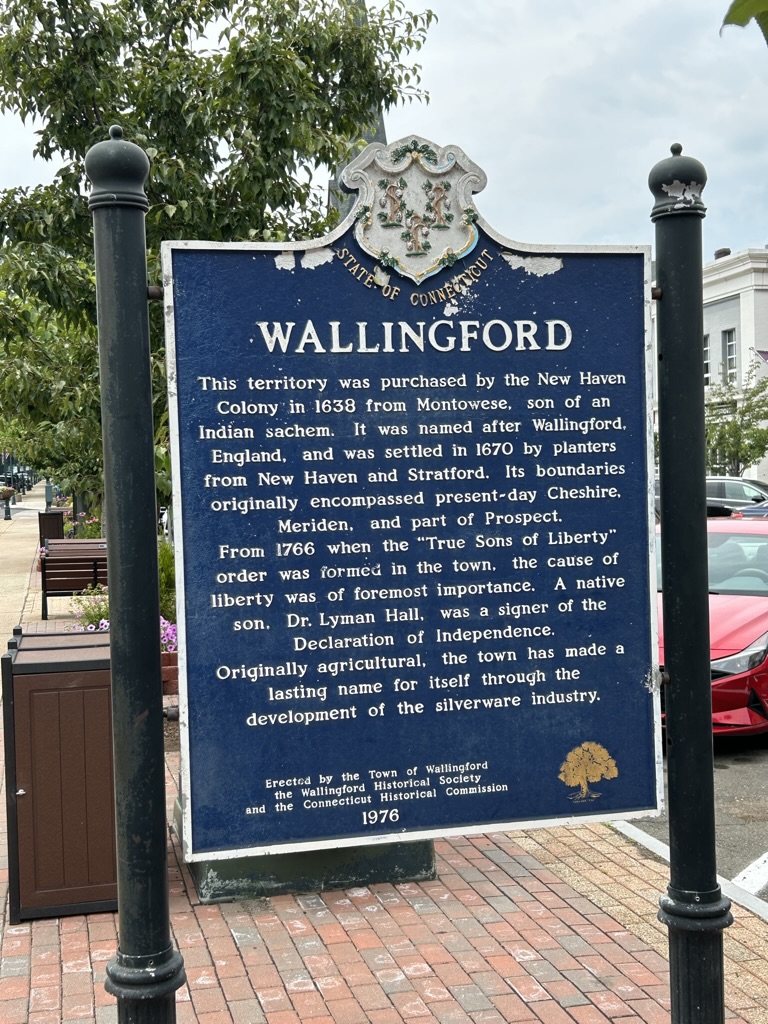
Most of the men in the clockmaking Twiss family were born in Wallingford which, at the time of Joseph and Lois Twiss’ marriage in 1786, was a small close-knit farming town. Home to both free residents and enslaved Black people, it had a population of roughly 3,300.
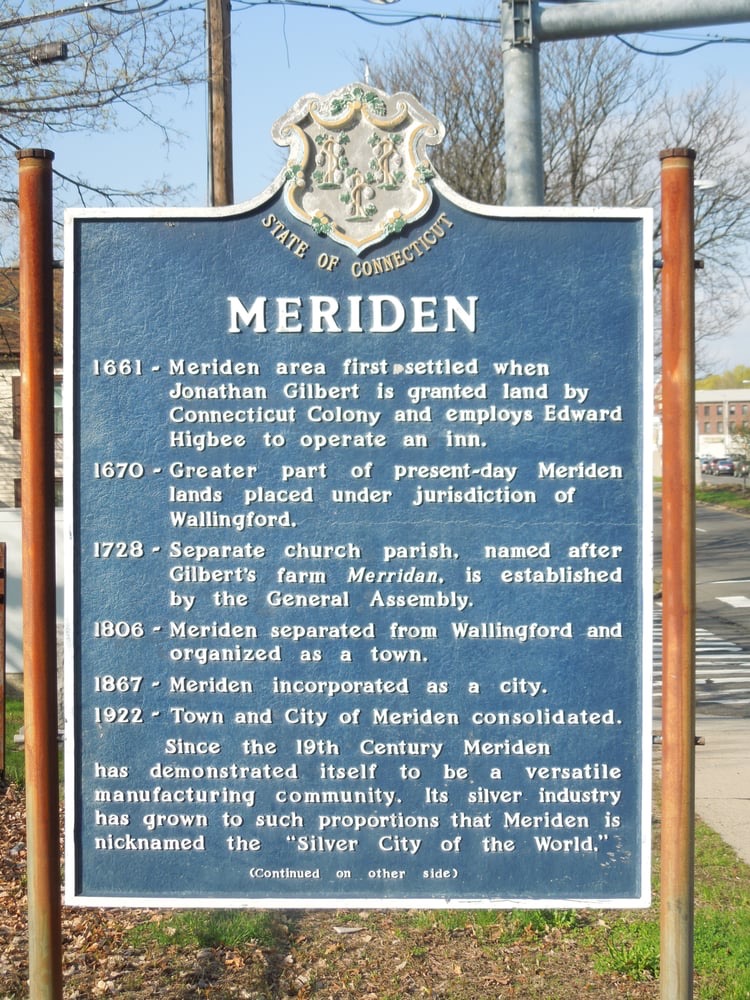
Meriden was originally a society in Wallingford that formed in 1725 and consisted of 30 to 40 families. The town split in 1806 and the portion where the Society and the Twiss family lived, which by then had a population of 1,249, was named Meriden.
A Clockmaking Business of Their Own
Following the mass production clockmaking standard introduced by Terry, two of the Twiss brothers, Benjamin and Hiram, opened a factory of their own in Meriden in 1828 for the manufacture of shelf clocks with wooden gears.
There is also evidence that some longcase clocks came out of the factory. One longcase clock with its dial signed “A. TWISS – MERIDEN” has been found. “This clock is installed in a handsome grain-painted pine case that was probably made in Connecticut,” wrote Philip E. Morris, Jr. “The movement was made by Silas Hoadley, confirming Austin (Twiss) only cased the movement. These Meriden clock cases were probably prototypes manufactured prior to their entering into full production in Montreal.”15
When the factory was established, the village’s total population was only about 1,708. According to Murphy, entrepreneurs such as the Twiss family were able to enter the wooden clockmaking business because it required relatively simple and inexpensive machinery and could be carried on efficiently by independent and disaggregated entrepreneurs with modest initial investment.
As time went on, firms began to differentiate their products with styling changes and brand names, as the Twiss sons did by printing their names on clock faces. Murphy theorized that adding maker’s names may also have occurred because artisans wanted to highlight pride in their workmanship.
The Twiss factory also distinguished itself by manufacturing alarum (a common phonetic variant of “alarm” in colonial days) clocks. In 1957, Wm. L. Wadleigh, Jr. wrote of acquiring a 25-inches high and 13 inches wide Twiss alarum clock at an antique shop. “It didn’t have the third hand for the alarum; instead, it had a brass alarum ring around the posts for the hands. As soon as we reached the clock, I opened the door and looked at the label — Timepiece with Alarum, Benjamin Twiss, Meriden, Conn”. 16
“It’s an excellent timekeeper and reliable alarum,,” Wadleigh wrote. ” I know because it ‘wakes me up every morning.at 5:30 am so I’m at my train from Fairfield, Conn. to New York as I’m commuting for the summer.”
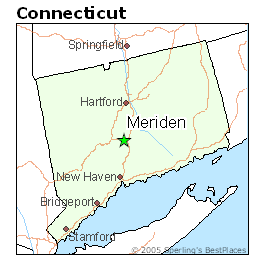
In its early years, Meriden had been a small village dominated by farming. Over time it became clear that if the village was to grow and prosper, it could not rely on farming for long-term prosperity, so it began developing a manufacturing base.
“Whether or not the poverty of the land was the main incentive, it is certain that the trend of occupations was away from agriculture and toward manufacturing in the 1820’s and the 1830’s, and that industry had been established as the chief source of livelihood here by 1845”, according to 150 Years of Meriden, published in 1956 in connection with observance of the town’s sesquicentennial. “In that year, the records of the time showed that 640 Meriden men, out of a population of about 3,200, were engaged in manufacturing.”
“This is one of the most nourishing and enterprising manufacturing towns in the State,” said an 1836 publication,The History and Antiquities of Every Town in Connecticut. “There is a considerable variety of manufactures here, forming the chief employment of the inhabitants. The following is a list of the manufactories, viz. 2 for patent augers and auger bits, 3 for ivory combs, 6 for tin ware, 4 for Britannia ware, 2 iron founderies, 1 manufactory for coffee mills, 1 for clocks, 1 for Norfolk door-latches, 3 for block-tin spoons, 1 for wood combs, 1 for skates and iron rakes, and I for gridirons. The value of articles manufactured yearly, has been estimated from 300,000 to 1,000,000 of dollars.”
An 1819 Gazetteer of Connecticut and Rhode Island by Pease & Niles asserted that one reason for the success of small manufacturers in Connecticut like the Twiss clock factory was the fact that slavery, although present, was not prominent in the state, “for wherever slavery prevails, mechanical ingenuity and industry will be excluded.”
This observation ignored, however, that at the time of the American Revolution Connecticut had the largest number of slaves (6,562) in New England and in the 1840s there were still some African Americans enslaved in Connecticut. It wasn’t until 1848 that slavery was outlawed in the state. “The effects of the New England slave trade were momentous,” wrote Lorenzo Johnston Greene in The Negro in Colonial New England, 1620-1776. “It was one of the foundations of New England’s economic structure; it created a wealthy class of slave-trading merchants.”
Harvard Professor Bernard Bailyn, in an essay on how New Englanders had achieved such a high standard of living by the time of the revolution, wrote, “The most important underlying fact in this whole story, the key dynamic force, unlikely as it may seem, was slavery.” It was only about 3.4 percent of the area’s population, “but it was slavery, nevertheless, that made the commercial economy of 18th-century New England possible and drove it forward,” Bailyn wrote. “The dynamic element in the region’s economy was the profits from the Atlantic trade, and they rested almost entirely, directly or indirectly, on the flow of New England’s products to the slave plantations and the sugar and tobacco industries they serviced.”17
Whatever the situation, the Twiss family’s clock factory was part of a dynamic local economy, though the town remained for many years rudimentary in its public services. For example, the common council didn’t order the first sewers installed on Main and Veteran Streets until 1887 and there weren’t any paved streets in Meriden until the 1890s.
In the 1830s, the population of Meriden, about 2000 – 3000 within the town limits, was distributed in groups known as Clarksville, Prattsville, Webbsville and so forth. The Twiss clock factory was located in Prattsville near the east end of Pratt’s pond on the West side where it could be seen from Broad Street. Featuring the words “Clock Factory” in 3-ft-long letters on the side next to the turnpike, the site was designed to attract the attention of passing stage passengers.
The Gazetteer of the U. S. published in 1833 , that referenced Meriden, likely also referenced the Twiss factory: “An important manufacturing place but with little water power : $1,000,000 annually produced: 1 company has 230 hands in making britannia coffee pots, spools, coffee mills, waffle irons, signal lanthorns: $200,000: other manufactures in wooden clocks value $50,000; ivory, wood and boxwood and horn combs value $40,000…”
“The factory itself although one of the most imposing at the time, would today be considered a very small affair,” said an article in the March 12, 1892 edition of Meriden’s The Journal.
My father, William Neal MacKenzie, was able to access the insurance policies the Twiss family took out on their factory during 1833-37. The policies were issued by Hartford Fire Insurance Co., where my father worked during 1934-1952. Copies of the policies are in the Appendix.
For a supply of power, Benjamin and Hiram built a dam that formed a pond. The pond appeared on historic city maps of Meriden in 1893 and was still known as Twiss Pond in 1906. It was later filled in and as of 2026, the site was occupied by the Westfield Care & Rehab Center at 65 Westfield Rd.
At the time, New England’s clockmaking industry was pivoting from a handmade craft into mass production and interchangeable parts, centered primarily in western Connecticut.
“The manufacture of Clocks has become one of the most important branches of American industry,” Chauncy Jerome wrote in an 1860 article, History of the American Clock Business for the Past sixty Years. “Its productions are of immense value and form an important article of export to foreign countries. It has grown from almost nothing to its present dimensions within the last thirty years, and is confined to one of the smallest States in the Union.”
In an article written for the Journal of Economic History, Entrepreneurship in the Establishment of the American Clock Industry, Murphy posited that clockmaking in Connecticut was a classic example of the transformation of a craft into an industry.
While that was occurring, the United States was also going through an unprecedented period of political transformation and economic expansion. After winning a war with Mexico in 1848 and expanding from a circumscribed area in the East all the way to the Pacific, the country was on the cusp of greatness.
According to Old Home Week, two of the Twiss family’s sons, Benjamin and Hiram, began the manufacture of shelf clocks at a factory in Meriden in 1828, by which time the town’s population was about 1,708.
An 1836 publication cited what was likely the Twiss factory in its description of Meriden:
“This is one of the most nourishing and enterprising manufacturing towns in the State. There is a considerable variety of manufactures here, forming the chief employment of the inhabitants. The following is a list of the manufactories, viz. 2 for patent augers and auger bits,3 for ivory combs, 6 for tin ware, 4 for Britannia ware, 2 iron foundries, 1 manufactory for coffee mills, 1 for clocks, 1 for Norfolk door-latches, 3 for block-tin spoons, 1 for wood combs, 1 for skates and iron rakes, and I for gridirons.”
Mrs. Frances A. Breckenridge reminisced about the Twiss factory in her 1899 book, Recollections of a New England Town.
“Very prominently to the memory comes the picture of the vividly red building at the head of Prattsville Pond on the east Side with ‘Clock Factory’ painted in brilliant white letters three feet long on the side next the turnpike and so placed that the attention of the stage passengers might be attracted thereto.
Although even though the tradition of a manufactory of clocks in that locality has nearly been lost from the annals of the town, yet it was in its day, and for that period, an extensive business interest. Like most of the enterprises of that day, this one sought the market by sending out peddlers, who were not in the least disconcerted by the appellation, the term being simply the equivalent of the salesman of a later day.
All the decorating of the clocks was done by two or three young women in a small shop no larger than an ordinary pantry located back of the dwelling house at the south-west corner of North Broad and Britannia Streets.”
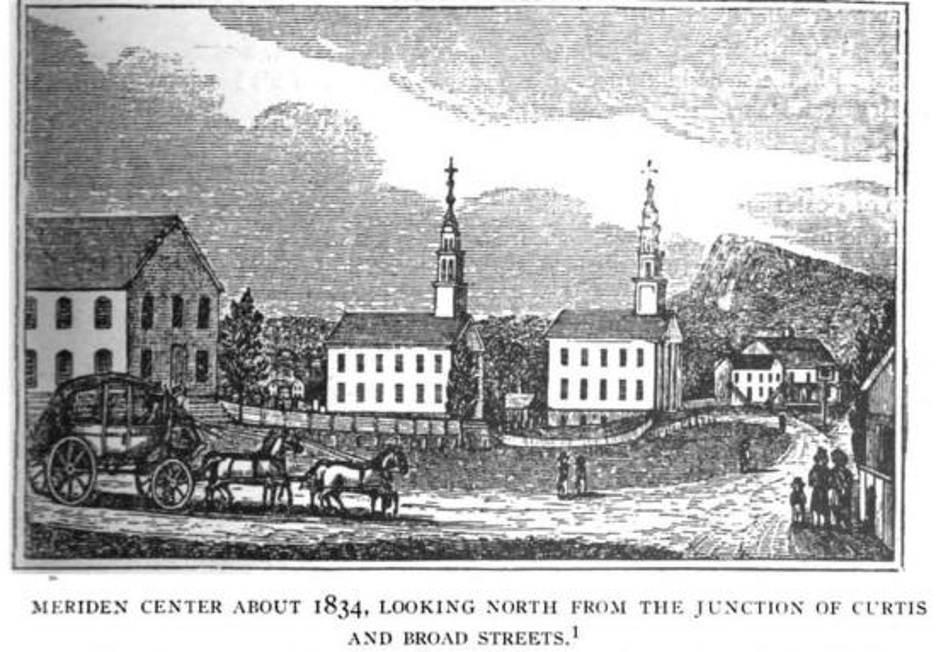
Source: Barber’s Historical Collections of Connecticut
Although the factory prospered, shelf clocks with wooden wheels, while widely sold in the United States and relatively inexpensive, had a dubious reputation. According to Old Home Week, a 1906 report on Meriden’s Centennial:
“The clocks were distributed by peddlers, all over the country, and everybody that could afford it, bought one, but having used it, never bought another. The contraction and expansion of the wood responding to atmospheric changes caused confusion and chaos in the works, and the peddlers became shy of going over the route twice. The novelty, while it lasted was profitable to the manufacturers, but that was another of the industries that died in infancy.”
Many small clockmaking firms had emerged in the wake of Eli Terry’s success, copying his process and product. By the 1830s the market was flooded with Connecticut-made wooden movement shelf clocks which were being peddled in cities and frontier towns alike.
Still, the Twiss factory enjoyed some prosperous years. In 1831, Benjamin and Hiram even acquired another wooden clockmaking company, Wadsworth’s & Turners of Litchfield, Connecticut, which produced traditional pillar and scroll shelf clocks, according to Clockmakers & Watchmakers of America by Thomas Spittler, Sonya Spittler and Chris Bailey.
Murphy wrote that in 1836 there were sixteen clock factories in Bristol, Connecticut and seven more in Plymouth. Clock factories had also started up in Burlington, Goshen, Torrington, Waterbury, Winsted and other Connecticut communities. All those clock factories were producing an estimated 80,000 clocks a year, according to McCrossen, supplemented by clocks produced in Massachusetts, New York, Pennsylvania and Ohio.
Competition between all the clockmaking firms revealed a fault, however, that caused many to fail. “The entrepreneurs who established the American clock industry were not “well-rounded’ businessmen who could handle with equal facility different categories of business problems”, Murphy wrote. While they became skilled at marketing, “In other areas, such as finance and organization, they were never really attuned to the nature of the problems presented.”
When an economic depression hit in 1837, and lasted until the mid-1840s, it crippled American industry, including many smaller, less well-financed clockmakers. “The depression of 1837 hit Connecticut clock manufacturers so hard that they feared the entire industry might collapse,” according to the Smithsonian’s National Museum of American History.
The emergence of more accurate weight-driven, one-day clocks made of brass and mass produced more cheaply than wooden clocks also hampered the recovery of Connecticut’s wooden movement industry. “Wooden clocks, though sporadically produced until the middle of the 1840°s, never really recovered from the double blow of the depression and the introduction of an inexpensive brass clock,” Murphy wrote.
The Twiss factory failed at some point amidst all the turmoil, then shifted to weaving webbing, narrow textile strips that held industrial and personal items together, under a new owner, Ira Couch. The building later burned down and there is no longer any evidence of it on the site, which is now occupied by homes and condominiums.
Though the Twiss family became well known in Meriden during and after the operation of their clock factory, Murphy never mentioned them in his 286-page 1961 PhD dissertation. That may be because in the larger scheme of things they were minor players in New England’s wooden movement shelf clock industry in the early 1800s that included dozens of players. Their more lasting influence and historic visibility was in Lower Canada, where they were innovators with longcase wooden movement clocks and their manufacturing and distribution efforts gained more prominence.
O Canada
Before the Twiss factory failed, with competition growing at home, some of the Twiss sons sought out a new market. They settled on Lower Canada.
Canada had a small population, little wealth and a small market for luxuries, but clocks were in daily use from the earliest times and were bought and sold through the years, beginning as early as 1700, according to The Canadian Encyclopedia. Practicing watch and clockmakers in Canada through the 18th and much of the 19th centuries did not make the movements, however. Instead, a watch or clock mechanism would originate in England, continental Europe or the US, arriving in Canada as an ébauche (basic, unfinished movement)..
The mechanism was then finished by the local expert in timepieces, known as a horologist, and would thus bear his initials or signature, or the stamp of his silversmith. From these beginnings, retailers of clocks, and especially watches, were closely associated with silversmiths and jewellers. The arrangement was logical as the two groups were dependent on the same market and required one another’s skills.
From the early 1800s, the pride of some homes in Canada was the longcase clock, which would be passed from one generation to the next as a treasured heirloom.
The Twiss sons’ move into Canada for their longcase clock business was likely a strategic business expansion into a region where affordable, mass-produced clocks were not yet common and most clocks in Canada in the early 19th century were expensive imports from England. Reflecting a strong American entrepreneurial spirit, the Twiss brothers probably saw an opening to provide “modern” American clocks to middle-class Canadian families.
Their shift to Canada was also likely influenced by a variety of other factors.
In Early Canadian Timekeepers, Jane Varkaris wrote that there was a rapid increase in clock production in Connecticut after 1820, resulting in an increase in clock peddlers and increasing competition. “Canadian settlements, while smaller in size, offered a nearby market where competition was less intense, particularly since there was little local clockmaking activity,” Vakaris said.
Another issue was the logistical difficulty of shipping fully assembled longcase clocks up into Quebec due to their considerable size and weight. The common height of Twiss clocks sold in Canada was about 7 feet and their weight could be in the 100–150 lb.(45–68 kg) range, including the case, wood movement, and lead/iron weights.
Importing wooden, weight-driven movements from Connecticut and building the wooden cases in Canada also allowed the Twiss brothers to bypass high Canadian import duties on finished furniture while still selling affordable, imported American technology, allowing local buyers to bypass expensive imports from England.
In some respects, the move was an early effort at what we now call offshoring, identifying a ripe foreign market ripe and moving tactically and with perseverance to manufacture there and serve it with American know-how.
The Twiss family’s foray into Canada came at a time of profound political, social, and economic unrest in the country. Between 1820 and 1840, Lower Canada (present-day Quebec) experienced a struggle for democracy, economic distress, cultural tensions between French and English speakers and even some violent rebellion.
In 1822, Lower Canadian British merchants and bureaucrats petitioned for the Union of Upper and Lower Canada into a single colony before the British Parliament in London, and Montreal, which was emerging as a commercial center, wasn’t even incorporated until 1831.
The late 1830s also brought rebellions against the Crown and the political status quo in Upper and Lower Canada, leading to passage of an Act of Union by the British Parliament in July 1840 merging the two colonies of Canada West (formerly Upper Canada) and Canada East (formerly Lower Canada) into the Province of Canada. With Confederation in 1867, the Providence of Canada was dissolved, Canada West became the province of Ontario and Canada East became the province of Quebec.
With the strong appeal of the Canadian market, only one of Joseph Twiss’ sons, Hiram, stayed permanently in the United States, though he, too, pursued the clock business.
Though he produced some shelf clocks in the Meriden factory, Hiram saw opportunities in the south, moving to Nashville, Tennessee and selling Twiss shelf clocks there for an undetermined time. His move to a southern city may have been motivated by the growth of population centers that made the peddler distribution system less suitable and the establishment of stationary merchants more practical.
Hiram married Caroline Miller Lampman about 1828, and they had at least two children, Byron, born on Oct. 17, 1828, and Christiana, born on Sept. 10, 1832 (FamilySearch lists a 3rd child, Christina Twiss, born in Meriden about 1837, but this child is not documented elsewhere)
While in Nashville, Hiram secured two shelf clock-related patents, both granted on May 13, 1834. The inventions were described as an “…improvement in the construction of Clocks and Time pieces…” and a “Twiss-improved balance pendulum…”18
An apparent innovator beyond the clock business, Hiram also secured a patent on a grinding coffee mill in 1837.
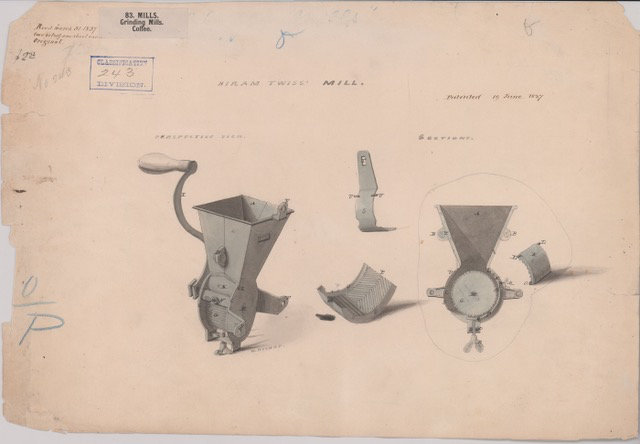
Produced: June 19, 1837, Records of the Patent and Trademark Office
There’s a likely reference to Hiram’s time in Nashville in the August 26, 1839, edition of the Tri-Weekly Nashville Union newspaper. The article noted a citizens meeting called to urge the arrest of William G. Harrison for the murder of one William Sandy. “On motion of H. Twiss, it was Resolved – that a committee of nine, be appointed to inquire into the facts of the late murder and devise proper means for the arrest of the murderer, now at large.”
Later in the article, it said, “…therefore, be it Resolved-That Messrs. Joseph Miller, Lewis Hoto, T. Kezer, V. K. Stevenson and Hiram Twiss, be a committee, whose duty it shall be to endeavor to ascertain in what direction the murderer has gone, and to engage the services of some shrewd, vigorous and persevering persons to go after, and if possible, apprehend him.” Given that Nashville had a population of only about 3,000 in 1839, the odds are high that this was Hiram Twiss, the clockmaker.
Hiram died in Nashville of tuberculosis on Nov. 14, 1846, at the age of 41. Inexplicably, Meriden’s East Cemetery has a record of his burial there, but he is, in fact, buried at the Nashville City Cemetery and identified as a “clockmaker” in the cemetery’s interment book, according to the cemetery’s site manager.
Hiram’s wife went on to live until the age of 93, dying on January 19, 1913, in Manlius, New York.
The first Twiss son to seek adventure and prosperity in Canada is believed to have been Austin, the family’s youngest child, who was manufacturing clocks in Côte-des-Neiges, Montreal, around 1821, when he would have been about 31.19
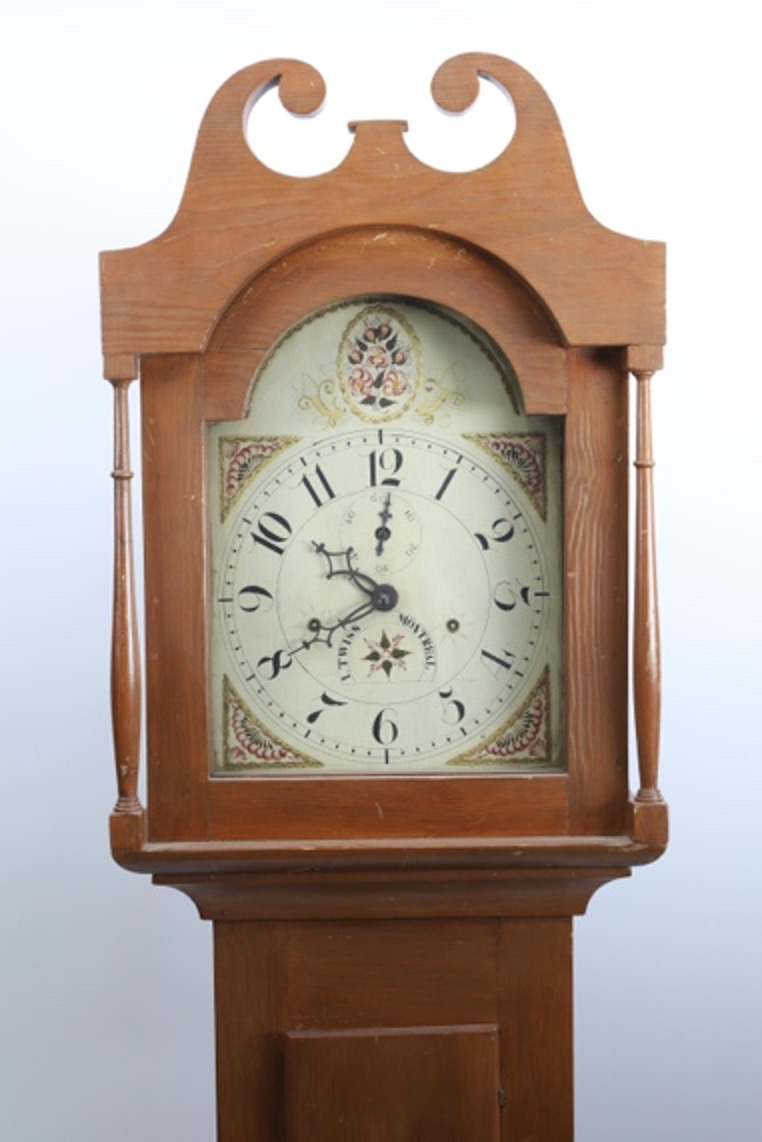
The longcase clocks he made there, such as the one shown below, bore the name “A. Twiss”.
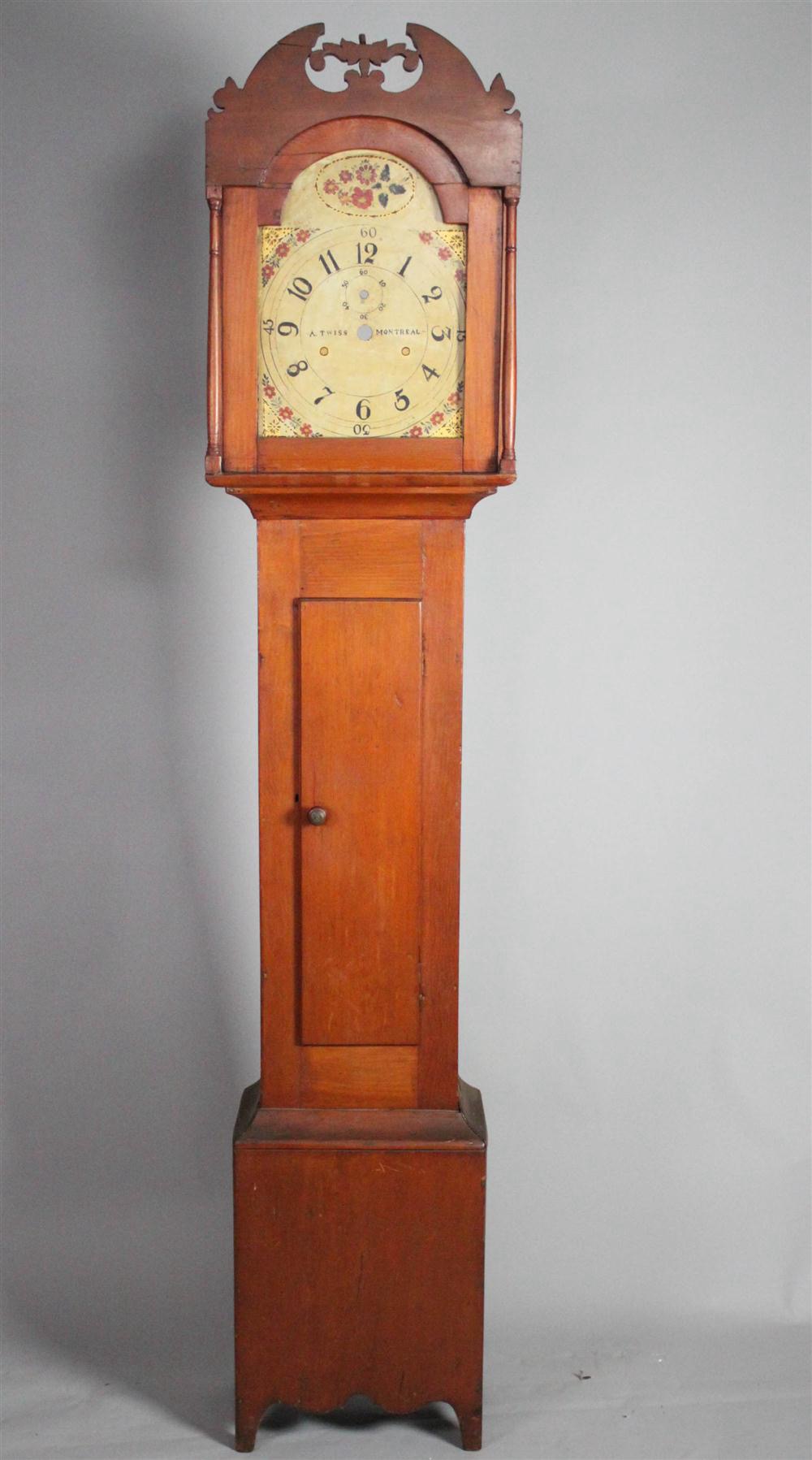
Austin’s initial foray into Canada may have occurred earlier than 1821, however. I donated to the New England Historic Genealogical Society a letter that Joseph and Lois Twiss wrote to Austin in St. Liguori, Quebec on June 6, 1819.
At that time, Montreal, founded by French settlers in 1642 as Fort Ville-Marie, was still a frontier-oriented fur-trading town. In the ensuing years, while Austin and his brothers established themselves as clockmakers, it transformed into a burgeoning industrial metropolis and the economic engine of British North America. The population makeup of the area changed as well, from a predominantly French-speaking town of about 19,000 to a city with an Anglophone majority before changing back again to a firmly French-speaking majority toward the end of the century.
According to a February 5, 1910 article in the Montreal Star about the Twiss family’s business operations in Canada, the buildings in which Austin manufactured his clocks were located on the westerly corner of the old Cote des Neiges Road and what was then known as Lachapelle Lane. None of the buildings still existed by 1910.
In a March 23, 1912, Montreal Star article reminiscing about old Montreal, Mr. H.A.Lemieux, 75, recalled how in the early days there was a stream at the base of the mountain at Cote des Neiges . “The stream was used by Mr. Twiss, who made wooden clocks,” he said. “Why, my dear man, that Twiss nearly flooded the country with wooden clocks, with wooden works, which he sold at $100 each and took pay on the instalment plan. It had to be very much of an instalment plan, indeed, for there was very little money at that time…Most of the great men I mentioned are gone…but I have a lively recollection of the men and the events with which they were associated; they took a large part in the making of this country.”
Most, if not all, of the movements in the Twiss clocks made in Canada by Austin, and later by his brothers as well, were made of cherry wood (gears included) and designed, when wound, to run a little over a day. It is often assumed that the 30-hour movements in the Twiss clocks are all of Connecticut origin and almost all were crafted by Thomas Hoadley, although some were clearly made by Riley Whiting of Winchester, Connecticut and others may have come from clockmakers in Bristol, Connecticut., according to Philip E. Morris Jr.
Whiting was born on April 16,1785. In 1806 he married Urania Hoadley, whose brothers Samuel and Luther Jr had settled in Winchester in 1803. In 1807 Whiting was making wooden clocks with his two brothers-in law under the name ‘Samuel Hoadley & Co’. Both Hoadley’s served in the war of 1812. When Luther was killed in 1813, the business was renamed “Hoadley & Whiting'” In 1819 Whiting took over the business, continuing it under his own name. He died on August 5, 1835. and his widow subsequently sold the business to what was to become the Gilbert Clock Co. of Winstead, Connecticut.
“Hoadley’s long period in business is one good explanation for the fact that there is remarkable uniformity in Twiss movements over their long business career,” Varkaris and Connell wrote.
Still, there is some evidence that the Twiss brothers tried fashioning movements in Canada. There is a statement on an Ira Twiss clock label that states “…clocks made by Ira Twiss at his carding mill at Cote des Neiges, three miles from Montreal, where are manufactured every part comprising these clocks which are warranted to keep time…” An Austin Twiss label on another clock made an identical claim in French and on the reverse of the label is a bill of sale showing that the clock was sold in 1830.
For a short period after moving to Canada, Austin partnered with James Adams Dwight, a watch and clock maker from the United States. Dwight had previously partnered with other clockmakers, including Martin Cheney, Martin Griffin and George Savage.
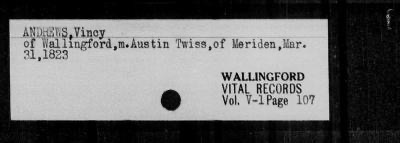
On March 31, 1823, Austin travelled back to Wallingford to marry Vincy (sometimes misspelled Vincey) Andrews.
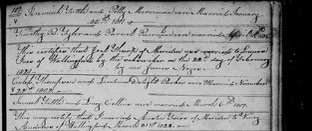
On May 10, 1823, Austin signed a document before a Judge Doucet, renting for a period of nine years a large building from a tanner named Pascal Persillier Lachapelle. The building was on what was then known as “Lachapelle Lane” on the westerly corner of old Côte des Neiges Road, about 3 miles from the city of Montreal.
While he was away, on November 20, 1823, his sister, Sarah, married Ransom Baldwin (March1, 1793 – Nov. 3, 1870). They went on to have nine children, several of whom died young, as was not uncommon at the time: Hiram (1825 – 1827), Vincy Ann (1827 – 1833), Lois Augusta (1829 – 1833), Sarah Maria (1831–1882), Augusta Ann (1834 –1837), Ransom (1836–1897), Mary E. (1839–1924), Roxana (1840 – N/A), Justina Clindora (1843 – 1925).
In 1825, Austin bought a building in Laprairie on the South shore of Montreal with his brother Joseph. At that time, In Laprairie was a busy agricultural area and a vital river-ferry transport hub on the south shore of the St. Lawrence River with an overwhelmingly French-Canadian and Catholic population. That same year, in a census of Montreal produced by Jacques Viger, an “A. Twiss” was recorded on Côte-des-Neiges Street with a family of 14 people; in the “Remarks” column the enumerator noted “Clock factory, carding machines.”
Unfortunately, Austin was struck down by an illness at the beginning of 1826, leaving Vincy a widow. “DIED: On Thursday last, Mr. Austin Twiss aged 37 years, leaving a widow and two children to deplore his loss,” the Montreal Gazette reported on May 22, 1826.
Other Twiss brothers were then drawn to Quebec like iron filings to a magnet. Austin’s brother, Ira, married Vincy in Wallingford and moved to Montreal, where they became joint guardians of Austin and Vincy’s two children, Lois and Bolivar.
Ira and Vincy then had two more children, Waldo Clinton Twiss (1829 -1920) and Ira L. Twiss (1834 – 1888). They also, however, suffered the loss of both Lois and Bolivar. Lois died on December 24, 1842, at 19 years of age. Her grave marker noted: Friends nor physicians could not save my mortal body from the grave nor can the grave confine me here when Christ my Savior doth appear. Bolivar A. Twiss died on March 25, 1844, at the age of 18.
Ira and Joseph had a clockmaking association in Laprairie until 1830, when they sold their shop to a hotel keeper, Jacques Villeneure.
On Sept. 14, 1831, Joseph married the former Rebecca G. Hall (1811 – 1836) in Meriden. On October 27, 1831, the Montreal Gazette reported their marriage – “MARRIED: At Meriden, Con. Mr. Joseph Twiss of Cote des Neiges, to Miss Rebecca Hall, of the former place”. They had one child, who died in infancy and then had no more.
After splitting up with Joseph, Ira began to sell clocks bearing the name I. Twiss. The census of 1831 in Lower Canada records that Ira Twiss, head of household, had the following occupation: “Fabrique d’horologes de cardes et de corps de chapeaux, mouvements, mus par une cheval et par l’eau alternativement.” (Translation: Clock factory, also manufacturing carding machines and hat forms, the machinery driven alternately by horse and water power.)
Ira and his wife remained in the Montreal area until about 1836, when they moved back to Meriden.
From 1839 to 1843 Ira operated the Central Tavern (formerly Hough’s Tavern) at the corner of Broad and East Main streets in Meriden, selling it in 1844 to a firm of partners by the name of Andrews & Warren.
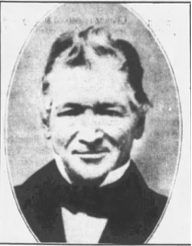
Ira also acquired considerable undeveloped land on the north and east sides of Meriden and built homes for sale on Pearl, Clinton, Murray and Twiss Streets, in Meriden. In addition, he erected a sawmill and built a grist mill where farmers brought their grain, principally wheat and rye, to be ground into flour.
Ira and Waldo continued acquiring vacant land during the Civil War era and moved a number of structures in the city at a time when many structures were shifted to new locations, rather than torn down, according to articles in the Meriden Record-Journal.
On December 17,1861, Ira L. Twiss married Imogene Cotton and on 15 October 15, 1862, Waldo Twiss married Cornelia Ives.
Over the years, Ira Sr. frequently made the news in Meriden, particularly when his company moved a prominent local structure, such as when it hauled a Baptist Chapel to a new site opposite Meriden’s Town Hall.
Upon his return to Meriden, records indicate he gained some early local prominence by participating in the anti-abolition cause. It’s worth remembering in this context that slave catchers were still active in the north with the 1850 passage of the Fugitive Slave Act, which put the full weight of the federal government behind a requirement that states return runaways under threat of harsh penalties.
In American mobbing, 1828-1861: toward Civil War, David Grimsted wrote of how in 1837, 24 years before the Civil War, Ira and a church member, James S. Brooks, led a mob that opposed an abolitionist speaker at a Meriden Congregational Church. Throwing rocks and rotten eggs, the mob used a battering ram to cave in a door and forced the audience from the cellar meeting hall. Eight men were arrested during the melee, including Ira Twiss, who was assessed over $1,000 in court costs. Reflecting the tenor of the times, the Democrats, the majority party in town, voted Brooks their representative to the state legislature in the next election.
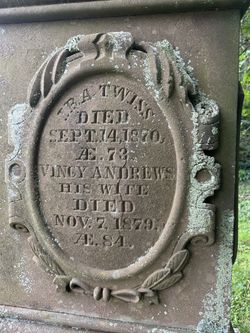
Ira Twiss Sr. died on Sept. 14, 1870, at the age of 73 at his home in Meriden. He was buried in East Cemetery, Meriden.
The Meriden Daily Republican ran Ira’s obituary on September 16, 1870:
“OUR CITIZENS will hear with regret of the death of Mr. Ira Twiss, which occurred on Wednesday evening at 6 o’clock. Though doubtful of his recovery, it was not imagined that his end was so near. On Tuesday he arose and shaved himself. On Wednesday evening he was up a short time, and at 6 o’clock his son, Ira L., had just raised him into a sitting position, when he gave a gasp, and falling back, instantly expired. He was a man of strong conservative opinions, of great independence of character, and excellent judgment in business matters. Possessed of a quaint, dry humor, he was always listened to in town or city meetings with attention, even though his sentiments might not always be in accordance with those of his hearers. He had arrived at the ripe age of 73 years, and up to the time of his unfortunate accident some nine days ago, was a hale and hearty man. He was very temperate in his habits, an active member in the First Baptist Church, and, we believe, a charter member of Centre Lodge, F. and A. M. His funeral will be attended from the house this afternoon at 2 o’clock, and from the Baptist Church, the Masonic fraternity following him to his grave.”
Ira’s wife, Vincy, died on Nov. 7, 1879. The Nov. 8, 1879, notice of her death in the Meriden Daily Republican was brief:
“Mrs. Vincy Twiss, one of the oldest residents of the city, died on Friday at the age of 84 years. She was one of the best of women, and one of the oldest members of the First Baptist Church, and after a long life of unselfishness, she has gone to her reward.”
According to A Genealogical History of the Redfield Family in the United States, published in 1839, another of Joseph Twiss’ sons, Benjamin, married Susan Maria Redfield in 1824 and then divided his time until about 1830 between Meriden and a clockmaking venture in Montreal. There is a paucity of Canadian made longcase clocks inscribed with Benjamin’s name, however. Also, records on Benjamin’s life focus principally on his time in Connecticut, where he is connected with mantel or shelf clocks made in the Twiss factory in Meriden.
Benjamin and Susan had a son, Samuel Twiss, on June 14, 1831, but he died in Meriden the following day on June 15, 1831. Susan died about two weeks later, on July 3, 1831. That suggests Susan’s death at the age of 30 may have been tied to giving birth to Samuel, a significant and common risk for women in America at that time. Both Samuel and Susan were buried in Section 4 of Meriden’s East Cemetery according to cemetery records.
On March 8, 1832, Benjamin married again, this time to Lucy Goodrich Francis of Wethersfield, Connecticut. According to a January 8, 1912 “Record of the Benjamin Twiss Family”, handwritten by their daughter, Fannie Lucy Twiss and held by the New England Historic Genealogical Society, the marriage took place at the Francis homestead at the corner of Hartford Avenue and State Street in Wethersfield where Lucy had been born. The next day they rode to Meriden, Connecticut and took up residence at what was known as 1096 Broad Street.
Benjamin and Lucy Goodrich Francis had four children, all born at their home at 1096 Broad Street in Meriden: Jane (January 25, 1835 – February 8, 1840); Fannie Lucy (January 24, 1839 – December 24, 1929; Herbert (August 2, 1845 – February 7, 1904); Bruce (April 18, 1848 -1922).
Benjamin Twiss died on January 23, 1854, at the age of 55, leaving three of his children fatherless. His reported cause of death — suicide. He was buried in Meriden, Connecticut’s East Cemetery.
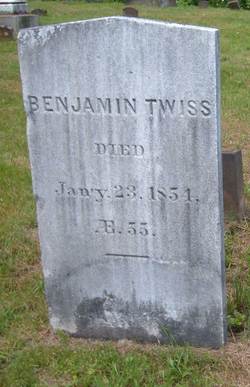
Benjamin’s wife survived him by 24 years, dying at her home on Meriden’s Broad St. on July 25, 1878, at the age of 70. “The venerable lady was the fullest type of a motherly, Christian woman, having all through life the most abiding faith in the goodness of the Father to whose mansion she has removed,” noted her obituary in the July 26, 1878, Meriden Daily Republican. She was buried in the family plot in Meriden’s East Cemetery on July 29, 1879. Surviving her were their sons Bruce C. Twiss (1848-1922) and Herbert M. Twiss (1846-1904) and their daughter, Fannie L. Twiss (1839-1929).
Another of Joseph Twiss’ sons, Joshua, followed his brothers’ moves to Canada, although facts are limited on the order and locations of his Canadian movements and he died shortly after turning 26 in 1829.
Records of Russell and Joseph Twiss’ life and their activities in Canada are much more substantive.
Joseph moved to Canada in 1825. On Sept. 28, 1825, he and Austin bought from Joseph Barbeau Boirore a building at Laprairie on the South Shore of the St. Lawrence River in Quebec, immediately south of Montreal. In the contract drawn by a notary public, Lanctôt, Joseph was referred to as an itinerant clock merchant.
Russell followed, moving first to Montreal, then to Joliett and lastly to Saint-Liguori, a municipality in the Lanaudière region of Quebec.
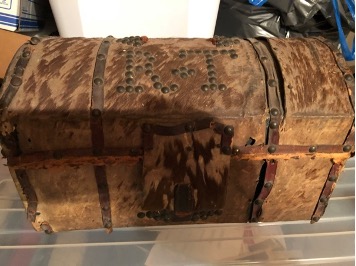
In his travels, he used a substantial deer-skinned covered case to transport his belongings. My father acquired the case from his mother and passed it, still in excellent condition, along to me. In 2018, I donated it to the New England Historic Genealogical Society in Boston, Massachusetts.
On Sept. 14, 1831, Joseph married the former Rebecca G. Hall (1811 – 1836) in Meriden. Their marriage was reported in the Montreal Gazette on October 27, 1831. They had one child, who died in infancy and then had no more.
On Nov. 5, 1834, Russell married Permela Hall (1817-1891), a “minor and spinster” daughter of Augustus Hall of Meriden Connecticut. The marriage took place in Montreal in the American Presbyterian Church, with Rev. G.W. Perkins (or Parkins) officiating. Ira and Joseph were witnesses.
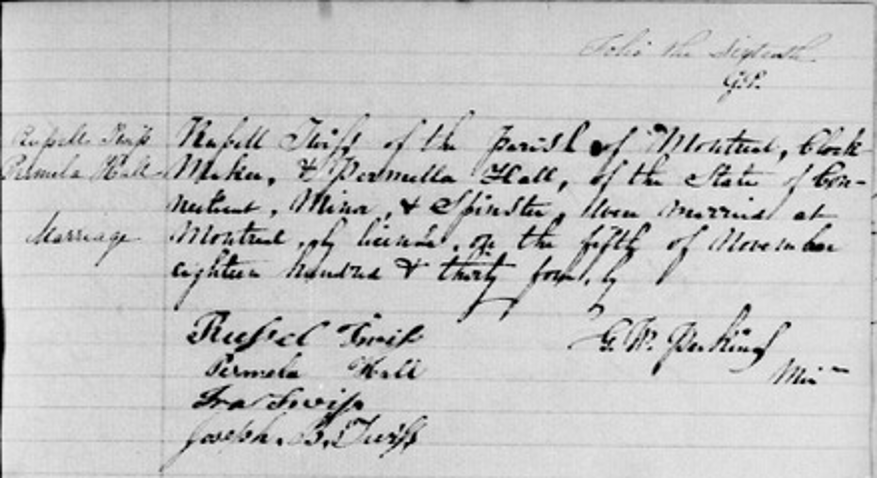
Permela had an interesting family background. Her father was Augustus Hall. His father was Brenton Hall. Brenton Hall was a large landowner in the eastern part of Meriden, active in getting Meriden set off as a separate town in 1806, and its first representative in Connecticut’s General Assembly. Brenton Hall’s father was the Rev. Samuel Hall, a pastor in Cheshire, CT. John Hall, a brother of Samuel Hall, was the father of Lyman Hall, who was born in Wallingford, CT and later signed the Declaration of Independence for Georgia.
Russell and Permela had five children. On July 18, 1835, the Montreal Gazette reported the birth of their first child – “BIRTHS: At Cote de Neiges, on Tuesday, Mrs. Russell Russell and Permela had five children. On July 18, 1835, the Montreal Gazette reported the birth of their first child – “BIRTHS: At Cote de Neiges, on Tuesday, Mrs. Russell Twiss, of a son”. On October 26, 1835, however, their son, Joshua Austin, died at the age of three months. Another son, Julius, born on April 18, 1838, became quite successful in New Haven, Connecticut (More about him later). Their third child, Albert Hall Twiss, lived only until the age of 21 (1841-1862). The fourth was Nelson W. Twiss (1840-1921), the fifth Gustavus D. Twiss (1848-1926).
One child, Joshua Austin, died on October 26, 1835, at the age of three months. Another son, Julius, born on April 18, 1838, became quite successful in New Haven, Connecticut (More about him later). Their third child, Albert Hall Twiss, lived only until the age of 21 (1841-1862). The fourth was Nelson W. Twiss (1840-1921), the fifth Gustavus D. Twiss (1848-1926).
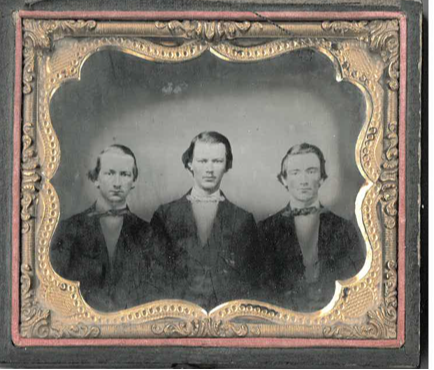
(unknown date; framed photo in my possession),
Russell and Joseph continued as business partners from 1834 to 1838,
According to Guillaume Petit, a historian in Joliette, Canada in southwest Quebec, in a notarial contract dated January 21, 1837, J. B. (Joseph Burr) Twiss and R. (Russell) Twiss ordered 5,000 feet of pine boards for clock manufacturing from Michel Boisvert, merchant and innkeeper of Kildare. That same day, they signed an agreement with Antoine Dyonne to have him saw 800 pine boards, each one foot wide and eight feet long, at his mill in Saint-Ambroise-de-Kildare, Quebec.
On March 27, 1838, Joseph signed a two-year lease with Étienne Partenais for a property in the built-up part of the village consisting of a house, shed, stable, and dairy. On May 7 of that year, Joseph and Russell hired Léon Godard, aged seventeen, as an apprentice and on May 12, 1838, they signed a power of attorney to Alonzo French authorizing him to collect debts owed to them for the sale of their clocks.
There are multiple instances where the business activities of Joseph and Russel were recorded.
On March 27, 1838, Joseph B. Swiss, described as a clockmaker residing in the Village de l’Industrie, signed a two-year lease with Étienne Partenais for a lot in the village, including a house, shed, stable. The village, which had been founded in 1823 and later became Joliette, was a bustling, ambitious private enterprise and early manufacturing hub in the Lanaudière region. Founded in 1823, the settlement was designed to break away from purely subsistence farming and harness local economic power.
On May 7, 1838, Joseph and Russell hired 17-year-old Léon Godard as an apprentice.
On July 14, 1838, Joseph hired Louis Ethier as a journeyman carpenter for one year. On September 8, he purchased from Antoine Lacombe and his wife Sophie Hervieux a lot on Rue du Moulin with house, barn, and other buildings. On March 29, 1841, Jacques Desroches, a carpenter from the Village de l’Industrie, apprenticed his minor son Olivier to Joseph B. Twiss, clockmaker, for one year.
On April 26, 1839, Joseph and Russell purchased a tract of land in the seigneury of Lavaltrie and on September 5, 1839, Julia, Joseph’s wife, bought a lot with a house and stable, for 300 pounds.
On 29 March 29, 1841, Jacques Desroches, a carpenter from the village, signed an agreement placing his minor son Olivier as an apprentice with Joseph B. Twiss, clockmaker, for one year.
On June 2, 1842, Joseph signed a contract with Pierre Majeau, another carpenter from the village, for the delivery of 900 clock cases, a substantial order that showed Joseph’s continued success as a clockmaker. On August 11, 1844, Joseph bought a lot in the village adjacent to his own.
In 1843, Joseph returned to Connecticut, likely influenced by the death of his wife, Rebecca on August 18, 1842. He later returned to Quebec, however, and re-established a residence there. He continued as a clockmaker in the Village de l’Industrie into at least 1856, remaining an important merchant in the town.
The Twiss children also had to seek continuation of their father’s Revolutionary War pension to his widow, their mother, in 1843.
In July of 1843, when Lois was 79, her son, Ira, appeared before a Justice of the Peace in Hartford County, Connecticut as conservator of Lois, then a resident of Meriden “incapable of transacting Business by reason of insanity”, according to a court record in the National Archives, which may have meant unable to manage her own affairs in the mid-1800s. Ira was there to obtain additional pension benefits under a provision made by an Act of Congress passed on March 3, 1843, granting pensions to widows of persons who served during the Revolutionary War.
To qualify for a widow’s pension, a woman had to legally prove both her marriage to the veteran and the births of their children. Because official civil vital statistics, such as state-issued birth certificates, weren’t common, the government permitted families to submit personal documents as proof. In Lois’ case, a “Family Record” was submitted that remains in Records of the Department of Veterans Affairs at the National Archives. The document details the family of Joseph Twiss (written as Twifs due to the historical “long s”) and his wife Lois Austin, who were married in Wallingford, Connecticut in 1786.
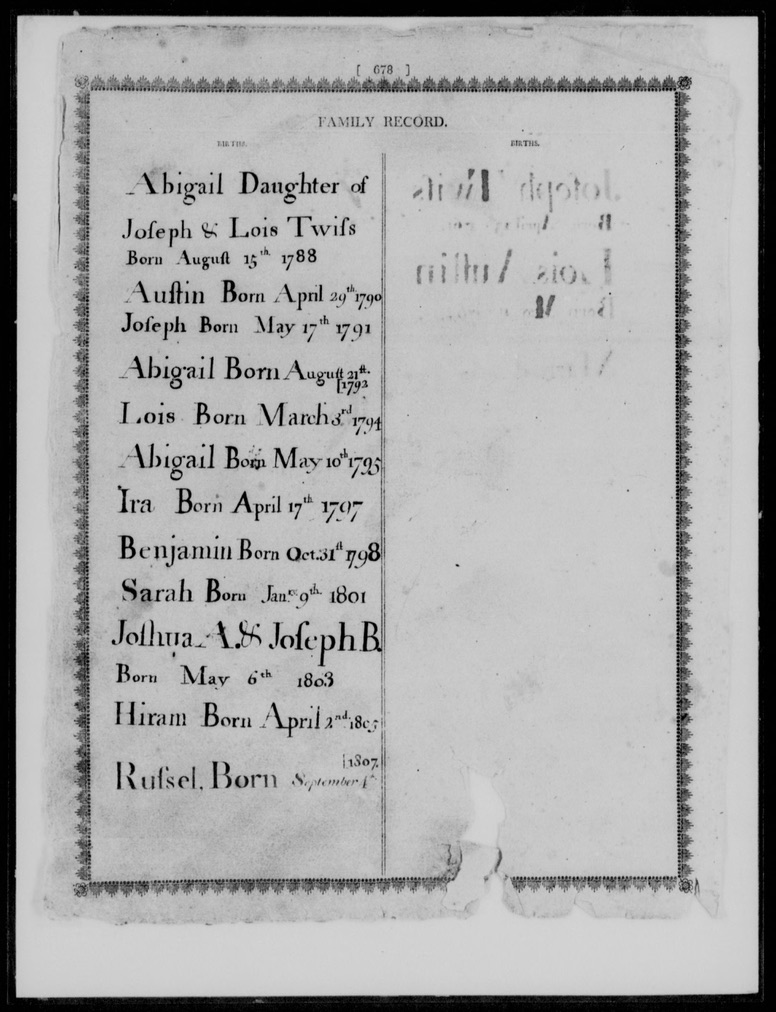
Lois subsequently received a pension as Joseph’s widow at the same annual allowance he had received.
In 1848, Joseph and Russell had to cope with the loss of their mother, who died in Meriden on January 31, 1848, at the age of 83, outliving her husband by 6 years. Remarkable when you consider this was a woman who had 13 children over 19 years in a period when many women died in giving birth.
On May 27, 1856, Joseph sold three lots containing a horse-powered mill with all mechanisms, instruments, and tools in said mill or shop in the Village de l’Industrie and it appeared he was liquidating his business affairs.
Canadian records show that the Twiss brothers, with the exception of Russell and Joseph, left Canada and returned to the United States before 1850. They continued, however, to travel back and forth to Montreal, often bringing Connecticut-made made clock movements in at least two parts in order to avoid a high duty on imported “complete” clocks.
Russell disconnected himself from Connecticut to some degree in Nov. 1845 by selling three pieces of land in Meriden, CT, including 45 acres of land, with buildings, belonging to his father, Joseph, who had died on May 15, 1842, plus 36 acres owned by his deceased brother, Austin. Russell also further cemented his Canadian roots by establishing a shop where he continued to make and repair clocks in St. Jacques.
Russell was still active in Canada on January 5, 1846, when Elie Langlois sold him a parcel of land with no buildings in St-Jacques and on March 29, 1847, when he purchased more land in St-Jacques from Joseph Ratelle.
The health of his business is evidenced by a March 15, 1849, sales agreement he signed with “William Balleray, of the village of Christieville in the Parish of Saint Athanase in the District” of Montreal. I have a copy of the contract (see Appendix) and prepared a transcription (See appendix) that turned the hard-to-read cursive into easily readable type. In the agreement, Russell promised “to furnish the quantity of one hundred and fifty wooden clocks with each a long case painted and completely made in a workman like manner, every year, for two years”.
Balleray, in turn, agreed “to act according to his knowledge and skill to Sell and dispose of the Said clocks or of any quantity he may be able to Sell during the Space of the term aforesaid, to the best advantage pofsible(sic), but not for lefs (sic) than four pounds ten Shillings for each clock”. For selling the clocks, Balleray would keep “one half or just moitie (a French term meaning half)” of what was collected.
According to Philip E. Morris Jr., the Balleray family produced a small number of clocks, with the majority signed by Joseph Balleray of Longueuil, Quebec, but little biographical information is known of him. Other members of the family produced similar clocks in Canada with Connecticut-made movements , Morris said, with one found with a painted wooden dial signed “W. Balleray – Chambly”.
The contract with William Balleray raises interesting questions regarding the family’s business operations in Canada. In 1993, Jane Varkaris wrote in Early Canadian Timekeepers that the Balleray family sold longcase clocks with wooden movements in Longueuil Lower Canada in the 1830s and that she had come across one Balleray clock with a pine case that seemed identical to those sold in Lower Canada by the Twiss brothers in the same time period. “The Balleray clock exhibits all the details of decoration, artificial graining, coiled wire hinges, and general outline that are found in Twiss clocks,” she wrote, though “the dial is marked ‘J Balleray & Co. Longueuil.”
As late as March 24, 1851, Russell entered into an agreement with François Bellemare of Yamachiche, Quebec to sell his clocks and grain sieves. The contract specified that their partnership had begun in 1841 and that the clocks sold for as little as five pounds each.
It’s not clear precisely when the general manufacture of wood movements for which the Twiss brothers were so well regarded ceased. Wooden movements were produced in fairly large quantities from around 1810 to 1845, by which time most clock makers in the United States had changed over to brass movements, although some wooden clocks continued to be sold in Canada. .
One man in Canada carried on the wood movements tradition in handmade longcase clocks in the 1960s, but his production was relatively brief and small.
In 1969, the Toronto Star Weekly ran a story about the man, Frank Maw, whose small white house in the quiet village of Buttonville, a few miles north of Toronto, sported a sign, “F. Maw, Clockmaker.”
For the previous 10 years Maw had been making wooden clocks by hand. Maw learned his trade in Sheffield, England in the 1920s, making parts for fine hand-made watches. Following service in the Merchant Navy in the Second World War, he brought his family to Canada in 1948 and settled on the eastern outskirts of Toronto. In 1957, the Maws moved to the house in Buttonville built in 1812 by the Button family, who had founded the village. In a workshop out back, he carried out a wooden clockmaking trade.
None of the early clockmakers’ tools were still available, so Maw designed and made his own, including a cutting machine for wooden gears. Frank made the wooden movements for his clocks, which typically took about a week. His son, Derek, built and finished the cases in three or four days in his Brooklin, Ontario workshop using pine salvaged from an old Buttonville barn.
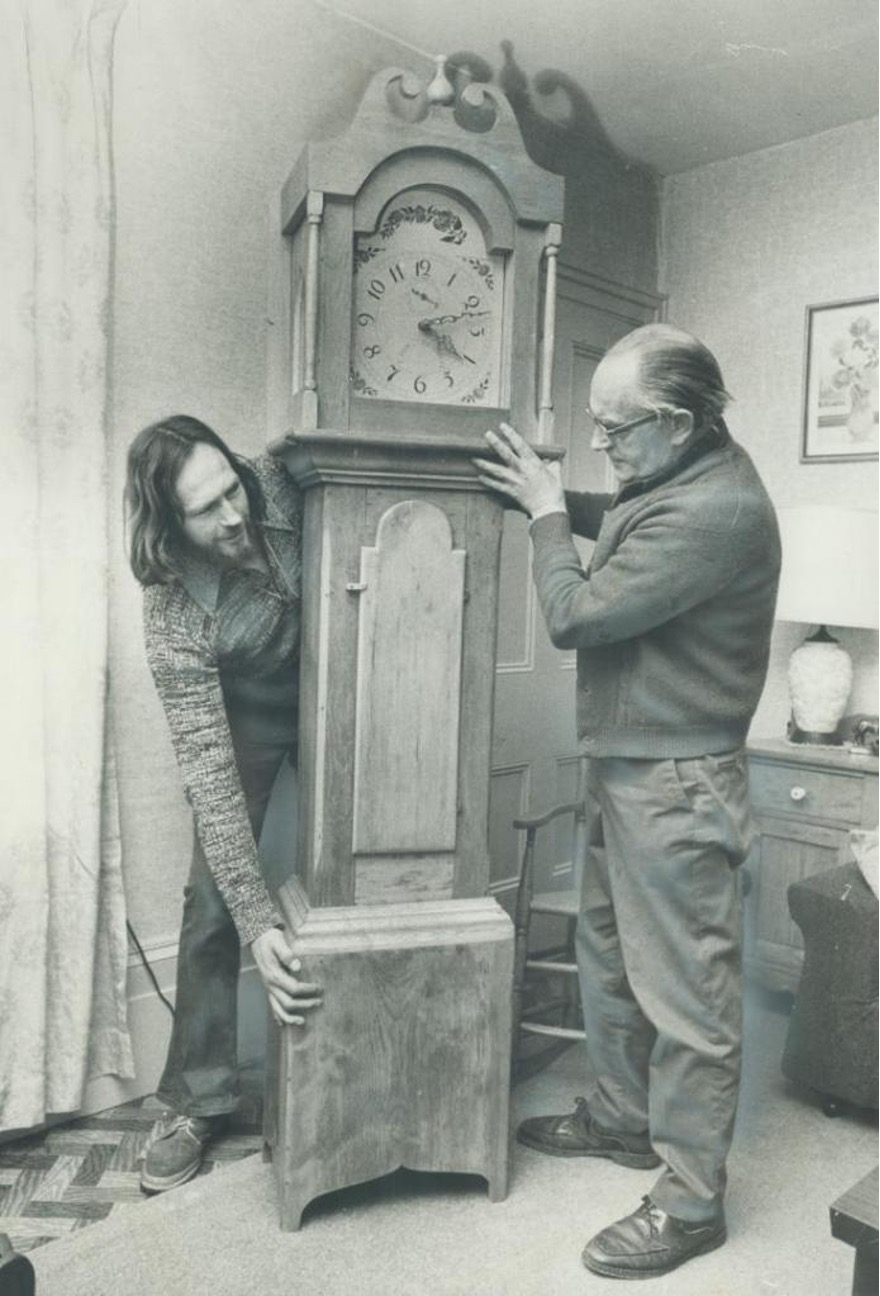
The wood was dressed and the cases made and polished by hand in much the same manner as the originals – with one important exception: the Twiss clocks were painted to imitate burl woods, fine veneers, inlays, and other elaborate cabinetwork. The Maw reproductions favored natural pine finishes, waxed and polished. Frank Maw used cherry wood for the gear wheels, birch for the pinions, and white oak for the plates. The weights were of cast iron, made to Maw’s patterns by a Toronto foundry.
Nylon was substituted for the cotton lines used in the Twiss originals. Maw’s dials were hand-painted on wood and decorated to the customer’s taste. After The Maw’s Buttonville home was sold in 1971, they moved on, ending production of the wooden clocks. On January 31, 1986, the Toronto Star reported that Frank Maw died on January 28, 1986.
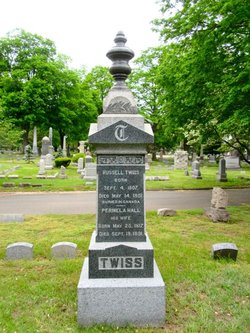
Russell Twiss died from a gunshot wound in a hunting accident on October 17, 1851, in Saint-Alphonse-de-Liguori, Montcalm, Quebec, at the age of 43. He was buried in Rawdon, Quebec. A tombstone for Russell and his wife, Permela, is also in place at New Haven, Connecticut’s Evergreen Cemetery.
A February 1852 census of St. Jacques de l’Achigan (known today as simply Saint-Jacques), Leinster County, Quebec, showed as residents: Pamelia (sic Permela) Hall, Age 34, Widow; Julius Twiss, Age 14; Nelon (sic. Nelson) Twiss, Age 12; Alfred Twiss, Age 8; Gustavus Twiss, Age 4.
Russell’s death left his widow with numerous valuable properties, including their home. Coincidentally, according to Histoire de la paroisse de Saint-Liguori, comté de Montcalm, P. Q., the people of Saint-Liguori were building a new church and bringing in a new parish priest. Permela sold a portion of her furnishings to the new parish priest and also ceded her house to him.
The remaining inventory of Russell Twiss’s estate was drawn up and his properties were put up for sale with multiple identical advertisements in the Montreal Gazette between June 9, 1851 and July 15, 1851. Below is one of the advertisements:
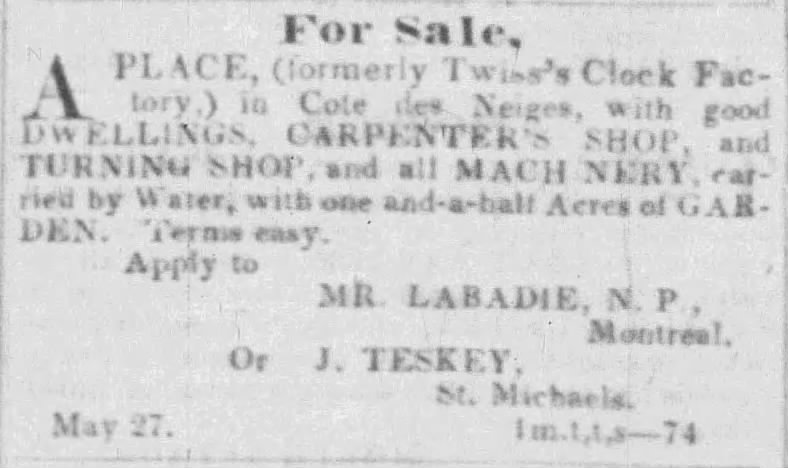
With her husband gone and her property sold, Permela returned to Connecticut In February 1852.
By that time, the era of wooden clock movements which had sustained the Twiss brothers’ businesses was waning.
On September 29, 1891, Julius Twiss, Russell Twiss’ son, attested to the death of his mother, Permela Hall Twiss, in New Haven, Connecticut on September 19, 1891, at the age of 74.
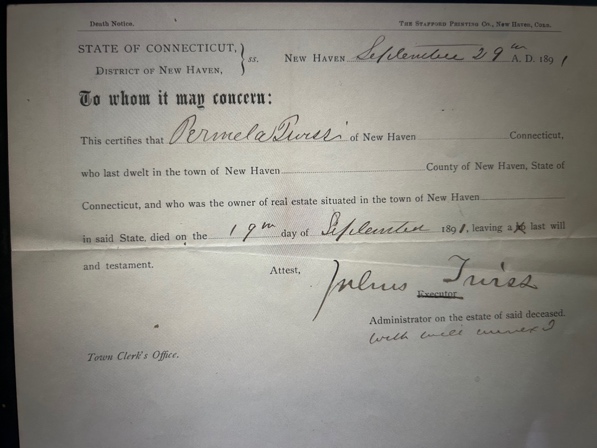
She was buried at New Haven’s Evergreen Cemetery.
Despite raising five children and standing by Russell Twiss in his Canadian business affairs over the years, it appears that none of her children placed an obituary in the New Haven, Meriden/ or Wallingford, Connecticut papers. Only a brief post ran in the December 19, 1891, New Haven Daily Morning Journal and Courier noting that her estate, valued at $6,491.25, had been admitted to probate. She also earned notice in a biography of her son, Julius Twiss, that ran in a 1906 publication, Men of Mark in Connecticut. “Mr. Twiss’ mother was Permela Hall Twiss, a woman of many virtues and the highest influence,” the biography said.
With her death, the Twiss clockmaking family largely left the Canadian stage, reappearing only once on January 13, 1877 when The Montreal Star ran a brief amusing item titled “HONESTY”:
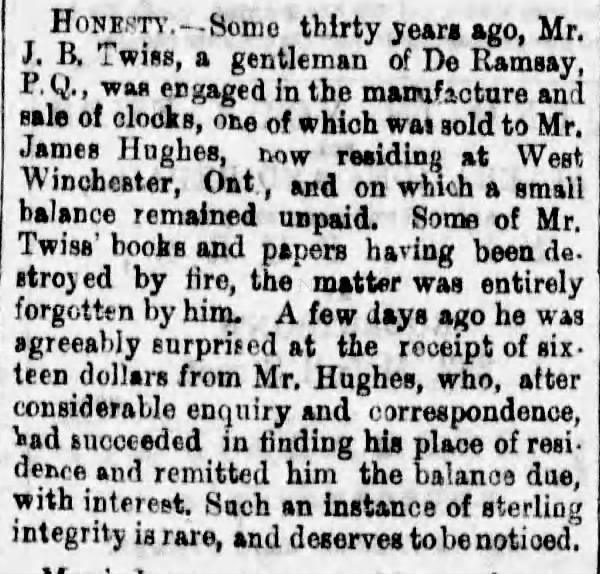
In the end, how many longcase clocks did the Twiss brothers manufacture and sell in Canada and what did each brother contribute? Hard to tell. Though the brothers were aggressive over a number of years, there is no surviving historical record or exact ledger count of the longcase clocks they sold in lower Canada.
As for the activity of each individual brother, the Twiss family’s longcase clocks produced in Lower Canada bore the initials of the Twiss men who were involved with their manufacture. The following initials are known to exist on those clocks: A. Twiss, J.B. & I. Twiss, J.B. & R. Twiss, I. Twiss, J.B. Twiss, J. & H. Twiss, J. & R. Twiss, H. & R. Twiss, R. Twiss.
A question has arisen concerning the initials J. B. appearing on the Twiss clocks. Joseph’s middle name, Burr, began with a B. There is, therefore, the possibility that clocks with the initials J.B. refer to Joseph only and are not meant to indicate that Benjamin Twiss was also involved, despite the fact that clocks do exist with the initial J. alone on Twiss clocks.
In a survey of clocks carried out by J. Varkaris in 1978, fifty-seven Twiss tall case clocks were reported. Seventy percent were in private collections and 30 percent of the clocks were in museums and public buildings. Of these fifty-seven Twiss clocks:
39% had initials J.B. & R.
25% had initial I.
14% had initials J. & R.
12% were clocks with unspecified markings
3.5% had initials J.B.
3.5% had initials J. & H.
1.5% had initial A.
1.5% had initials H. & R.
The longcase clocks manufactured by the Twiss family are highly sought after by collectors and are documented by The Canadian Clock Museum.20 Some of those still in existence are in Quebec and Ontario and can be seen at multiple locations, including: Vaudreuil Museum, Vaudreul, Quebec; Montreal Museum of Fine Arts; Chateau de Ramezay, Montreal; Upper Canada Village near Morrisbourg, Ontario; Royal Ontario Museum, Toronto, Ontario; Robert Phillips clock museum, Cookstown, Ontario; Provincial Museum, Quebec; Historical Society Museum, Cornwall, Ontario.
Russell’s Bible
As much of the surviving correspondence between members of the Twiss family showed, their commitment to the Christian faith was paramount. It was such that Russell Twiss carried on all his travels a bible that was given to him by his mother.
My father retained a treasure trove of items associated with the Twiss family of clockmakers that had been passed down through generations and were at his parents’ Wallingford, Connecticut home, including the bible. The items were passed on to my grandmother by Carrie Twiss, who bequeathed the longcase Twiss clock to her.
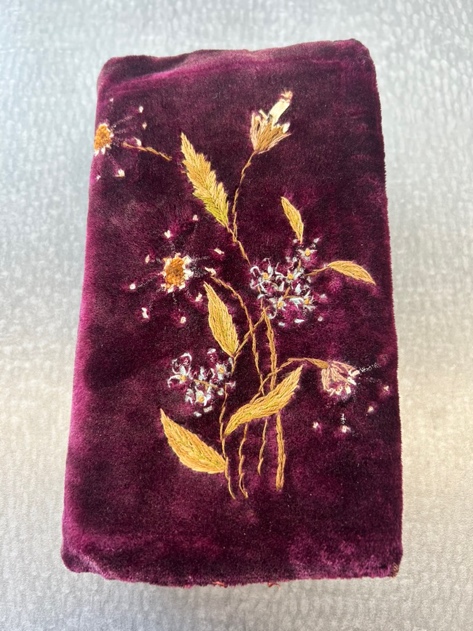
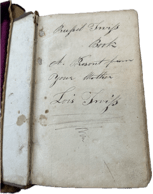
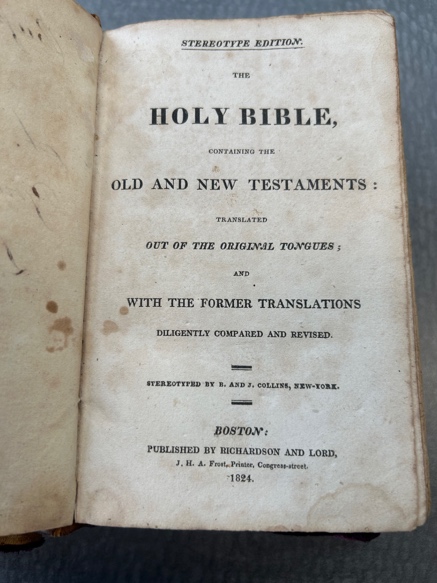
In the bible, published in Boston by Richardson and Lord in 1824, Russell devoted one page to summarizing the Torah, the beginning of the Old Testament’s historical narrative in the first five books (Genesis through Deuteronomy), together with Joshua.
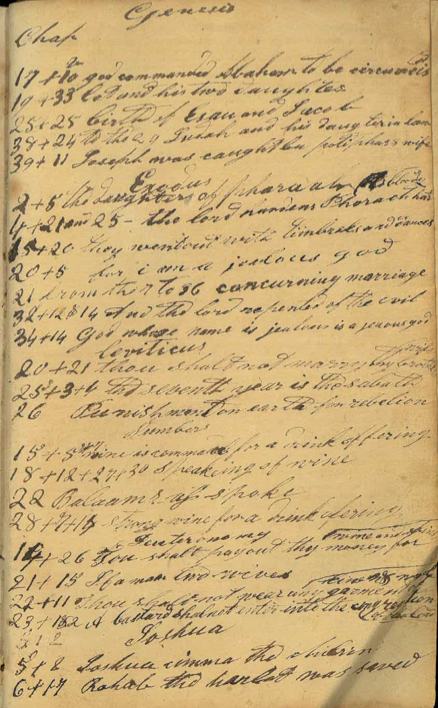
Russell also used his bible to faithfully record the births, deaths and marriages in his family.
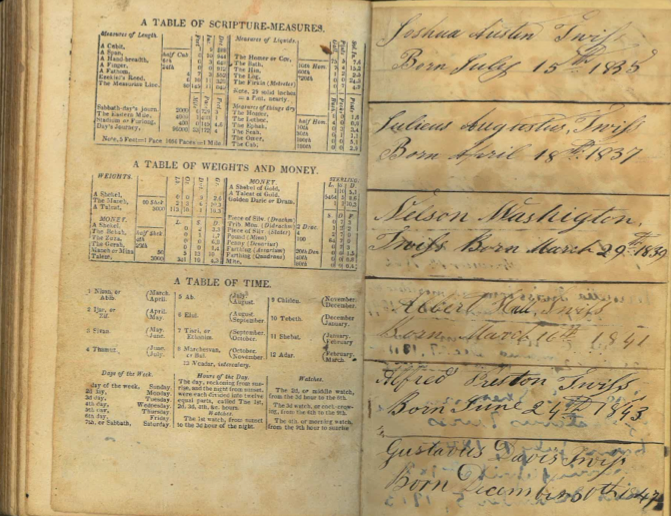
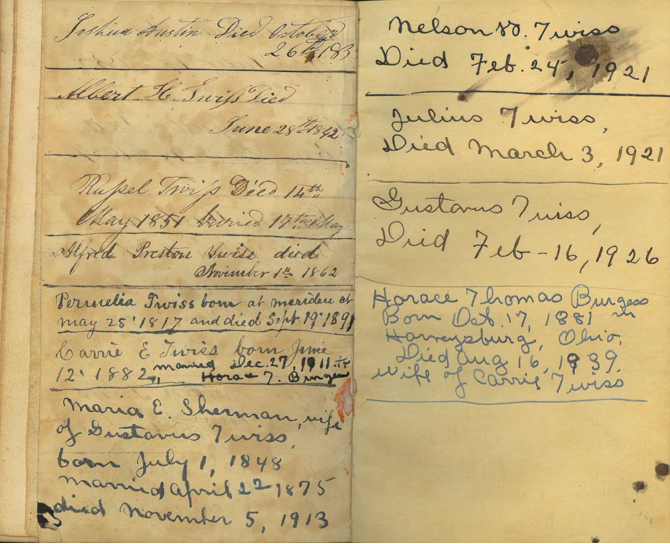
The first entry noted not his marriage to Permela Hall (May 25, 1817 – Sept. 19, 1891) in Montreal on Nov. 5, 1834, but the Montreal birth of Joshua Austin Twiss, his son, on July 15, 1835. The reason for the name – Russell’s mother’s maiden name was Lois Austin. Her father was Joshua Austin, Jr. and her grandfather was Joshua Austin.
Subsequent entries were:
- Russell’s son, Julieus Augustus Twiss, born on April 18, 1837. (Other historical records spell his son’s first name as Julius and set his birth date as April 18, 1838. Since it is reasonable to assume that Russell himself entered his son’s name as Julieus and his birth year as 1837, my assumption is that Russell is correct in both instances and the historical record is incorrect, although this son later spelled his own name as Julius, as does his obituary.)
- Russell’s son, Nelson Washington Twiss, born on March 29, 1839 (at St. Ligouri, Canada). (Some genealogy records say Nelson was born in 1840)
- Russell’s son, Albert Hall Twiss, born on March 16, 1841 (at St. Ligouri, Canada).
- Russell’s son, Alfred Preston Twiss, born on June 24, 1843 (at St. Ligouri, Canada). (Some genealogy records of Russell’s children omit Alfred Preston Twiss)
- Russell’s son, Gustavus Davis Twiss. (Gustavus’ birth date is not clear in Russell’s bible, but other records say it was December 30, 1847 at St. Ligouri, Canada.
- Joshua Austin Twiss’ death on Oct. 26, 1835, just three months after his birth. (Joshua was buried at the American Presbyterian Church in Montreal). Why Russell delayed entering this sad information for so long is unknown.
- Albert Hall Twiss’ death on June 28, 1842, only about 15 months after his birth. (He was also baptized on that same day)
After Russell’s death in Canada in 1851, and burial in Meriden, Connecticut’s East Cemetery, others continued to add notes on family births, deaths and marriages. The identity of the persons making these entries is unknown. The additional entries were:
- Russell Twiss’ death on May 14, 1851; burial on May 17, 1851.
- Alfred Preston Twiss’ death on November 1, 1862.
- Oddly, there is no entry noting Joseph Burr Twiss died in Joliett, Canada on March 31, 1877, at the age of 73 and was buried in Meriden, CT.
- Permelia Twiss’ birth at Meriden, CT on May 25, 1817, and death on Sept. 19, 1891. (Other genealogy records say her first name was spelled Permela. That is the spelling of her name on her gravestone in New Haven, Connecticut’s Evergreen Cemetery. A brief obituary in the Sept. 21, 1891, edition of the Morning Journal-Courier of New Haven, which mistakenly identified her as Permelia Twiss, reported she “was attacked with apoplexy and survived but a short time”. On Dec. 19,1891, the paper reported her estate, which had been admitted to probate in September 1891, was valued at $6,491.26.)
Correspondence
Looking back, the Twiss sons ventures into Quebec in the early 1800s were a bold move by an ambitious family of modest means and no evident cross-border business experience. Their apparent success in such circumstances was remarkable.
What do we know of how they handled the experience? Some of the story of the tight-knit Twiss clockmaking family has been brought to life in family correspondence.
In 2018, my sister, Elizabeth Kennard MacKenzie (1/26/1943 – 3/2/2022) and I donated a cache of letters and Twiss family-related papers, as well as the deerskin-covered travelling case that had belonged to Russell Twiss, to the New England Historic Genealogical Society in Boston, Massachusetts. Those letters, now in the Society’s archives, are part of the society’s expansive collection of Twiss family correspondence over almost 100 years.
I retained nine letters, one now 210 years old and others nearly 200 years old. Because of their age and fragility, I had ACA Paper Restoration of Devon, PA restore and preserve them for posterity.
The letters are all written in cursive scripts that differ significantly from contemporary handwriting and can be challenging to read today, as the portion of a letter below illustrates:
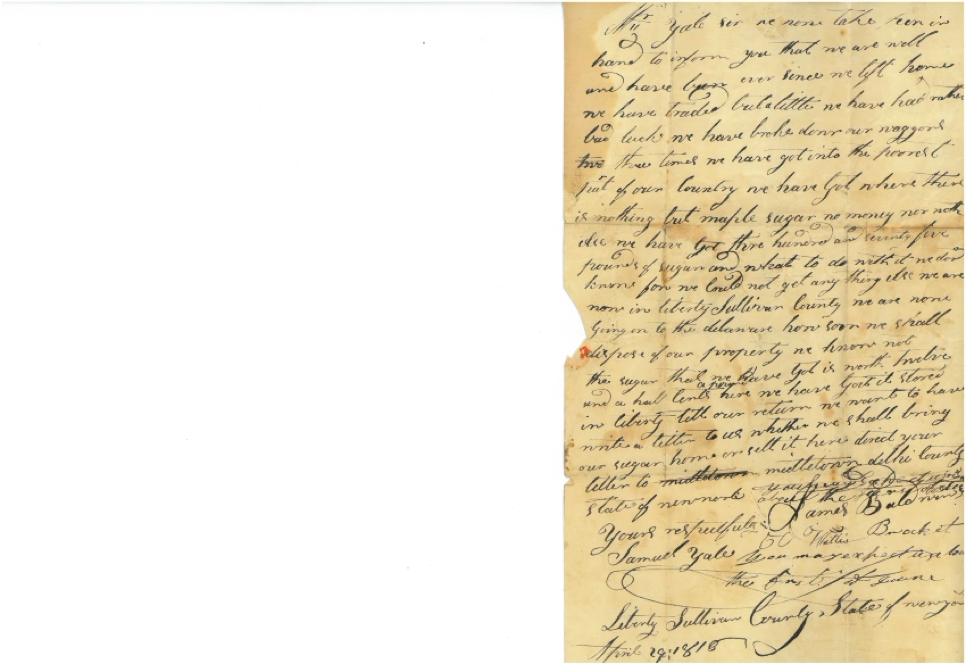
I was able to partially transcribe the letters in my possession, as well as those in the New England Historic Genealogical Society’s collection, into modern type with HandwritingOCR, an app which can scan and convert handwriting into digital searchable text.21
Though imperfect in many cases, the transcriptions offered rare insights into the Twiss family’s lives. One thing of particular note — they didn’t write much about clocks. You don’t find long discourses on the business of making, marketing, selling, transporting, or pricing their exquisite timepieces that have established their place in history. The family also didn’t display much of an interest in storytelling. Instead, the letters often thread together expressions of religious faith, personal observations of family goings-on and wishes for the good health of all. There are few observations about current events and there is no sense of an intellectual life to speak of in their letters, unless you consider religion to be an intellectual exercise.
One undated and unsigned letter addressed simply to “Dear Brothers”, conveys broad satisfaction with life, but concern for their father:
“I can inform you that my mind is perfectly settled and at ease about it is now live as free from cares and perplexities of this world as I wish to and myself for I have no remembrance of enjoying better health than I do at the present time together with all the necessaries of life to make me comfortable. But it is some times a grief to me that we are separated from each other so that we cannot enjoy each others company but more particular the situation that our aged parents is left in I know that I cannot see far ahead and what they may want to make them comfortable…”
Another letter, sent by Sarah Twiss in Meriden to Canada on February 21, 1821, offers praise to the Lord that she has recovered from an illness:
“…since I saw you last it has pleased the Lord to lay his afflicting hand upon me so as to bring this earthly tabernacle near to the side of the pit but all things being not ready for me to go over the Jordan of death my life is spared and health restored so far that am permitted once more to meet with the dear Saints of God and write upon him in her earthly court…”
The earliest Twiss family letter I have is one written in Meriden on August 13, 1816, by Joseph and Lois Twiss and two of their daughters to Austin in Cincinnati, Ohio. Although Cincinnati was then rapidly transforming from a small town to a bustling city of about 9,000, it’s not clear from the letter what Austin was doing in a city 754 miles west of Meriden.
Subsequent letters better reveal the story of the family’s experiences and the activities of the Twiss sons in Canada.
Many of the letters exchanged between members of the Twiss family include text that suggests the entire family was quite close and had a strong spiritual foundation, reinforced by their parents’ deep convictions.
A reliance on Christian faith was evident in a Dec. 9, 1820, letter from the father, Joseph, to one of his sons:
“…we hope you will retain your internal principle of love to God & religion if you ever knew it as we hope you have done and that she may do the same let us all the at distance from each other mingle our prayers unitedly to the throne of grace that if we are not permitted to meet on the shores of time we may meet in a better world of glory in our fathers kingdom never more to part for this let us pray earnestly & daily remembering each other when we approach the throne of grace…”
In a letter dated June 6, 1819, Joseph and Lois Twiss were filled with grief, writing to Austin, Ira and Benjamin, this time in St. Liguori, Quebec, of the passing of their sister, Abigail Twiss, at the tender age of 24:
“Dear and Affectionate Sons Austin & Ira & Benjamin I have Sad News To write. Abigail is Dead. Abigail
is No more. she Departed this Life the Second Day of this present Month… We shall All in a Short time have to follow our departed friend into the world of spirits. She cannot return to us but we must go to her… May it please the holy Lord to preserve us whilst apart and bring us together again in peace…We remember you with concern & much affection.”
The first Twiss letter I have discovered that was sent from Canada was sent from Montreal by Joshua Twiss to his father, Joseph, in Meriden on January 11, 1823.
The letter was another particularly sad one in which Joshua lamented the death of his sister, Lois, on December 20, 1822, at the age of 28, just 2 years after having married Almer Hall of Wallingford, a son of David and Thankful Hall.
“She has left this world of sin and of sorrow and we have no reason to think but what she is now singing anthems of redeeming love around the kingdom of our God,” Joshua wrote. “Dear parents, it is impossible for me to write to you with my pen the feelings of my heart.”
In that same letter, Joshua wrote in similarly theocentric language to Lois’ husband, Almer, on his loss:
Brother Almer,
What language shall I make use of to address you on this solemn occasion that you are left to mourn the loss of a dear wife and I the loss of a lovely sister. May we not take this as the chastening rod of a just God. Let us remember that sin is the cause of all our troubles. Since we have been doing that which our heavenly father has forbidden are we not deserving judgements rather than mercies. Let us remember that it is not for us mortals to murmur that the Lord has not dealt in justice with us, for he is a God dealing in justice with all his creatures. It is for us to submit to his will and to say not my will but thine be done. Can I realize that Lois is gone and that I shall see her no more this side the grave and in other worlds. Should I ever return I must see the place that she filled empty, but let us remember the language of her last moments. She says weep not for me. I trust that we have no reason to weep, for we have reason to believe that she has left a world of sorrow and has gone to a world of pure delight.
Having lost another sister, Abigail, on June 2, 1819, when she was just 24, the Twiss sons were clearly heartbroken.
Other letters better reveal more of the story of the Twiss sons in Canada.
In a March 18,1824 letter starting with “Dear affectionate children at Montreal”, Joseph and Lois Twiss, wrote that Austin had delivered a letter to them by hand informing them that Joseph and Hiram had arrived in Montreal.
“We bless the hand of providence that conducted them there,” they wrote, “and we feel reconciled to have you together at a distance.”
“We can have no greater joy than to hear our children walk in the truth, live in peace & fear god & keep his commandments,” they wrote. “In this way both parents & children, though parted at a great distance on earth so that they cannot converse face to face, yet they may contemplate ere long they may meet never to part, these thoughts may console us when we think of each other in time that when we shall have finished our course it may be with joy & satisfaction. May we so live that when we leave this world & all terrestrial things we may ascend to our heavenly fathers court his kingdom where we shall behold our redeemer & praise him together for ever & ever.
From your honorable affectionate parents, Joseph & Lois Twiss”
In the coming years, as the Twiss sons travelled back and forth to Canada, their correspondence frequently referred to the difficulties of being apart. They also noted at times sorrow at the loss of family members during a time when many families suffered losses from childhood deaths and life-threatening diseases.
Many of the letters exchanged between members of the Twiss family include similar text that suggests the entire family was quite close and had a strong spiritual foundation, reinforced by their father’s deep convictions.
An August 13, 1816, letter from the father Joseph to one of the sons in Canada begins with the following:
“Dear Son – A few days since we received your letter dated July the 5th 1816 which informs us of your good health which to us is as good news from a far country so much rejoices our hearts as we are able to inform you that we are all enjoying the same blessing. It is through the indulgence of a kind providence our lives are continued till the present & we can heartily join with you in praising God for the same & desire to continue in waiting on the Lord by united prayer & supplications for the same blessings to be continued till we shall all meet again in this world if it can be consistent with the counsel of heaven. We have nowhere else to go or look for help or counsel for wisdom & strength. God is our sun & shield. He shall give grace & glory. No good thing will he withhold from those that walk uprightly.”
A similar reliance on Christian faith was evident in a Dec. 9, 1820, letter from the father, Joseph, to one of his sons:
“…we hope you will retain your internal principle of love to God & religion if you ever knew it as we hope you have done and that she may do the same let us all the at distance from each other mingle our prayers unitedly to the throne of grace that if we are not permitted to meet on the shores of time we may meet in a better world of glory in our fathers kingdom never more to part for this let us pray earnestly & daily remembering each other when we approach the throne of grace…”
On Nov. 16, 1834, Russell wrote to his parents, including almost as an afterthought that he had married Permela Hall:
“I can also inform you together with all the family and any who may take the trouble to inquire that on the evening of the 5th of November at Colebrook by the Rev G M Perkins I was Married to Miss Permela Hall and Mr. Perkins thought proper to read to us on the occasion the last part of the fifth chapter of Ephesians”
On March 14, 1842, Austin wrote to his sister Sarah of his hope that she and her husband, Ransome Baldwin, would be able to come up to visit him in Canada as it could be 18 months before he would be back in Connecticut to visit with them there.
In an 1834 letter to Austin in Montreal, Ira advised that a prospective partner in Connecticut was hesitant to move his family to Canada:
“…he thought that it would be hard for them to take his family and children to Canada where they could not enjoy the privileges of school and society.”
One frequent theme in the family’s correspondence was dealing with illnesses of various sorts, while expressing their trust in God and acceptance of whatever may come. In an April April 25, 1831 letter from from Sarah Twiss Baldwin in Connecticut to Ira Twiss in Canada (now in the possession of Susan Moynihan of Storrs, Connecticut), Sarah spelled out a litany of troubles that seem overwhelming:
“…in short I would mention that since your return Brother – we have experienced sickness. Vincey has had spells of being quite ill. Lois had the misfortune to fall into the fire and burn her face very bad, but by close attention she soon
was cured so as not to disfigure her but very little. I would also mention that Father has been very mush afflicted for nine weeks past with the rheumatic”complaint we have almost given him up several times but he is now upon
the gain. Hiram has been very deeply afflicted with sickness as he has but just survived with a severe spell of the lung fever. Maria is also very ill…we are fearful she is in the consumption.”
Despite the troubles, Sarah added, as was common in Twiss correspondence, a message of faith: “Thus you see that sickness is prevalent everywhere, but through the mercy of a kind providence our lives are preserved until the present for which cause we have great reason of thankfulness but how soon we may be called to give up our account is uncertain, but could we be so happy as to have the welcome sentence well done good and faithful servant enter thou into the joy of thy Lord it would be not matter how soon or sudden the summons comes.”
On April 2, 1836, Hiram wrote to Ira with another worrisome message that their father was not feeling well and their mother was possibly close to death:
“Father has his old complaints so bad that he is not able to move without help,” he wrote .“Mother has been failing for the last 4 weeks and is now very low and we are afraid she will never be better; physicians has done all that can be done and unless the over ruling hand of providence arrest her disease she must to all human appearance become a victim to the stubborn jaws of Death.”
Fortunately, at a time when serious illnesses were frequently fatal and when several of their sons were far away in Quebec, both parents recovered. Joseph lived until May 16, 1842, dying in Meriden, CT at the age of 81. He was buried in East Cemetery, Meriden. His wife, Lois Austin Twiss, died in Meriden, CT on January 31, 1848, at the age of 83, and was also buried in East Cemetery, Meriden.
It is worth noting that an initial search for the location of the Twiss memorial using the AI Mode in Google’s main search interface generated an initial response that the memorial is in Meriden’s Broad Street Cemetery, but an onsite visit verified that it is in East Cemetery.
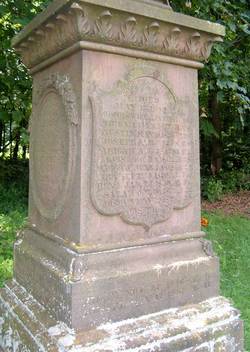
In October 1857, Joseph wrote from Canada to his family members in Meriden that he was enjoying good health and had opportunities to make and sell “Canadian chairs”.
“This I expect will be my business this winter & then can be at home where I can enjoy life better than travelling the country,” he wrote. “I don’t ponder over past events, but look ahead for better days which I have good encouragement to believe are coming from the chair business I am about to commence.”
At the same time, he was contemplative, reflecting on his mortality, “How long it may be before we meet again is known to him and him only who knows all things,” he wrote. “Should it be so ordered by the hand of providence that we are never to meet again on earth I trust we shall so live as to meet in that world of joy and happiness prepared for all the followers of the Lord.”
Though most of the available Twiss family correspondence is filled with the mundane details of daily life, one letter to Sarah from Quebec sent on April 11, 1862, made note of the Civil War then occurring in the United States.
“My thoughts are often with you and my friends in Meriden and we sympathize with all those that are embroiled in that dreadful war that is going on at the South. And we have just heard of another terrible battle in the South West but as yet have no particulars it is the common topic of conversation and war is the cry here in all languages as well as with you. It has had a Bad effect on the Country already and to what extent it may go we cannot tell but my prayer is that good may come out of evil.”
The Saga Continued
After Permela Twiss’ death the family continued to exhibit local prominence in Meriden and New Haven, Connecticut for many years.
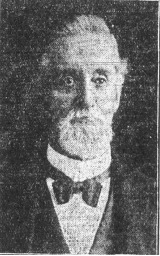
Waldo Clinton Twiss, one of Ira and Vincie’s sons, had been born in Montreal in 1829 , but grew up in Meriden, attended Meriden Academy and finished his schooling at Suffield Academy in Nuffield, Connecticut. He stayed in the news in Meriden because of his real estate investments and sawmills, which made him one of the city’s wealthier residents and quite the man about town, and his frequent generous donations to the First Baptist Church, to which he belonged.
On October 15, 1860, he made the local news when he married Cornelia Ives of Meriden They stayed together for 40 years until her death on September 29, 1900 after a cerebral hemorrhage in June 1899 and a long illness. In 1908, Waldo made the news again when, on his 79th birthday, he unexpectedly married 32-year-old, Carrie M. Walker of Brooklyn, NY, at his Meriden home at 455 Broad St. “Very little information could be obtained regarding the marriage,” the Meriden Record-Journal commented.
The Twiss family continued to generate news in Meriden as the years passed.
On April 18, 1888, the Meriden Journal reported that Ira L. Twiss had died at his home that day at 853 Broad Street in Meride after 12 years of “rheumatic troubles”. “Ira L. Twiss was not only well-known in Meriden, but throughout the state,” the paper reported.
On October 21, 1892, descendants of Joseph and Lois held an inaugural gathering “for social and friendly intercourse” at West Peak near Meriden, according to the Meriden Weekly Republican newspaper. “Pastor Fennell gave thanks and it was something to be profoundly grateful for in the memory of so rich an inheritance of a Christian and liberty loving country ancestry,” the paper reported.
A second gathering on July 4, 1893 attracted 43 attendees to the home of Waldo Twiss on Money Island in Long Island Sound.
Attendees included – From New Haven, CT: Mr. Julius Twiss, Mr. Nelson W. Twiss, Mr. and Mrs. Gustavis Twiss and their daughter, Carrie Twiss, Mr. Waldo C. Briggs, Misses Della and Lizzie Briggs, Mr. and Mrs. Charles A. Ferry and daughter; From Meriden, CT: Mr. Waldo C. Twiss, Miss Fannie L. Twiss, Mr. and Mrs. Ransom Baldwin and children, Leland, Misses Flora and Alice Baldwin, Mr. and Mrs. Russell Hall and children, Howard and Hazel Hall, Mr. and Mrs. Benjamin Kennard and children, Helen and Leighton Kennard; From Hartford, CT: Mr. and Mrs. Herbert M. Twiss and children, Marsha C., Clara L., Clavon W., Ernest B., Edna F. and Herbert Twiss; From Westfield, CT: Mrs. Amelin Twiss Roberts; ; From Westfield, Mass: Mrs. Caroline Garrigus.
At the close of the event, an invitation was extended to a third gathering at a cottage owned by Ransom Baldwin at Short Beach in Stratford, CT on July 4, 1894. “The hymn ‘America’ was sung, and all scattered for general amusement, strolling about the island, bathing and sailing. A delightful occasion throughout,” the Meriden Daily Republican reported.
The 1894 event took place as planned and was reported on at length again by the Meriden Daily Journal on July 6, 1894. According to the paper, remarks were made by Julius Twiss of New Haven, Nelson and H.W. Twiss of Hartford and B.C. Twiss of Meriden. The assemblage also made note of the Sept. 1893 marriage of Marshall C. Twiss of Hartford, a great-grandson of Joseph Twiss, to Clarabel White. “Another milestone on time’s onward march has marked the reunion of these family ties and Historical interests,” the article concluded.
On Dec. 19, 1907, the Meriden Weekly Republican newspaper reported on a Dec. 17th gathering celebrating Waldo’s 78th birthday. He went on to outlive his second wife as well. Carrie M. Walker Twiss died at the age of 44 on July 27, 1913. Waldo held on until April 17, 1920, dying at the age of 90.
His death and the value of his estate led to an acrimonious dispute that ended up in court and attracted widespread media and public attention.
The case involved Myra Ives Marshall, a niece of his first wife, Cornelia Ives. At some point, Myra came under Waldo’s care and lived in his home. (Coverage of the case in the Meriden Journal said Myra was Waldo’s adopted daughter. She was not.) She later married a Samual A. Tyler, becoming Mrs. Myra Marsha Tyler. In 1920, she filed suit against the American Foreign Mission Society and the American Home Mission Society, both affiliated with the Baptist Church.
The suit sought to recover Waldo’s homestead on Broad Street in Meriden, valued at about $15,000 (equivalent in purchasing power to approximately $250,000 today) that she claimed had been deeded to the defendants by Waldo “under undue influence and when he was in an enfeebled condition and weak in mind”. In the end, the court upheld the validity of Waldo’s will and its assignment of the homestead. to the Baptists.
The Twiss family’s continuing prominence was evident on January 26, 1929, when the front page of the Meriden Daily Journal ran a lengthy piece on another large Twiss gathering. “Miss Twiss Celebrates Her 90th Birthday” read the bold headline, highlighting the birthday of Fanny Lucy Twiss , a daughter of Benjamin Twiss, and an event with more than 60 of her friends following a prayer meeting at the First Baptist Church. The article noted that she had been born on January 24, 1839, baptized by immersion in Meriden’s Twiss Pond, visited the World’s Fair in Chicago in 1893 and regularly voted Republican.
Fanny died on Dec. 26,1929 and is buried at Meriden’s East Cemetery. (Some records say she died on September 2, 1902, but that is incorrect)
Russell and Permela Twiss’ son, Nelson, went on to live in New Haven, Connecticut. A Manufacturers Index identified him as engaged in the manufacture of “Steam and Gas Engines”. In 1879, the United States Patent Office recorded his application filed Nov. 1,1878 for Patent No. 212,285 dated February 11, 1879.
“Be it known that I, NELSON W. TWISS of New Haven, in the county of New Haven and State of Connecticut, have invented a new Improvement in Automatic Cut-Offs for Steam- Engines; and I do hereby declare the following, when taken in connection with the accompanying drawings and the letters of reference marked thereon, to be a full, clear, and exact description of the same.”
Nelson’s business cards (undated) showed two steam autos and refer to “The Twiss Automobile”. They gave his business address as 28 Whitney Ave., New Haven, Conn.
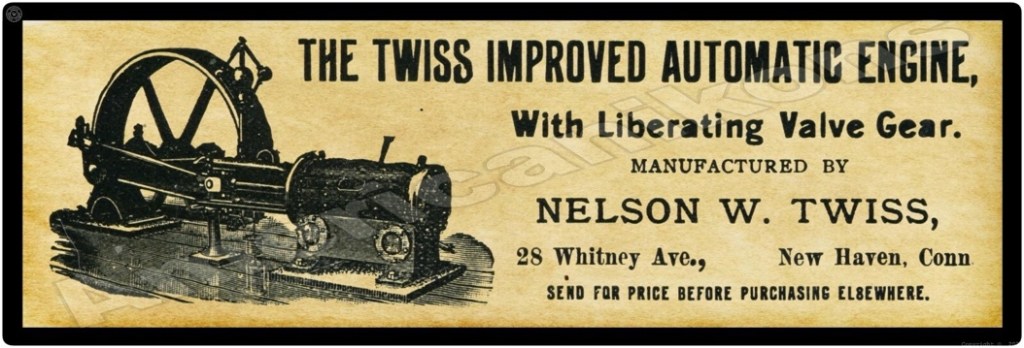
Nelson, who never married, died on Feb. 24, 1921. He was buried at the Evergreen Cemetery in New Haven in the same plot as his brother Alfred, who had died on Nov. 1, 1861.
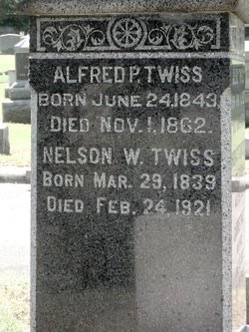
Gustavus D. Twiss, born in 1848, was just three years old when his father, Russell, died at the age of 43 in Quebec. On April 22, 1875, Gustavus married Maria E. Sherman in New Haven, Connecticut and they resided in New Haven for the next 30 years. They were the parents of Carrie Twiss, who bequeathed the Twiss clock now in my possession to my grandmother. Carrie was born on June 12, 1882 and married Horace Thomas Burgess, a graduate of Yale University, on December 27, 1911.
The 1898 New Haven Directory included an advertisement for Gustavus and a George H. Smith, “Engineers and Machinists”.
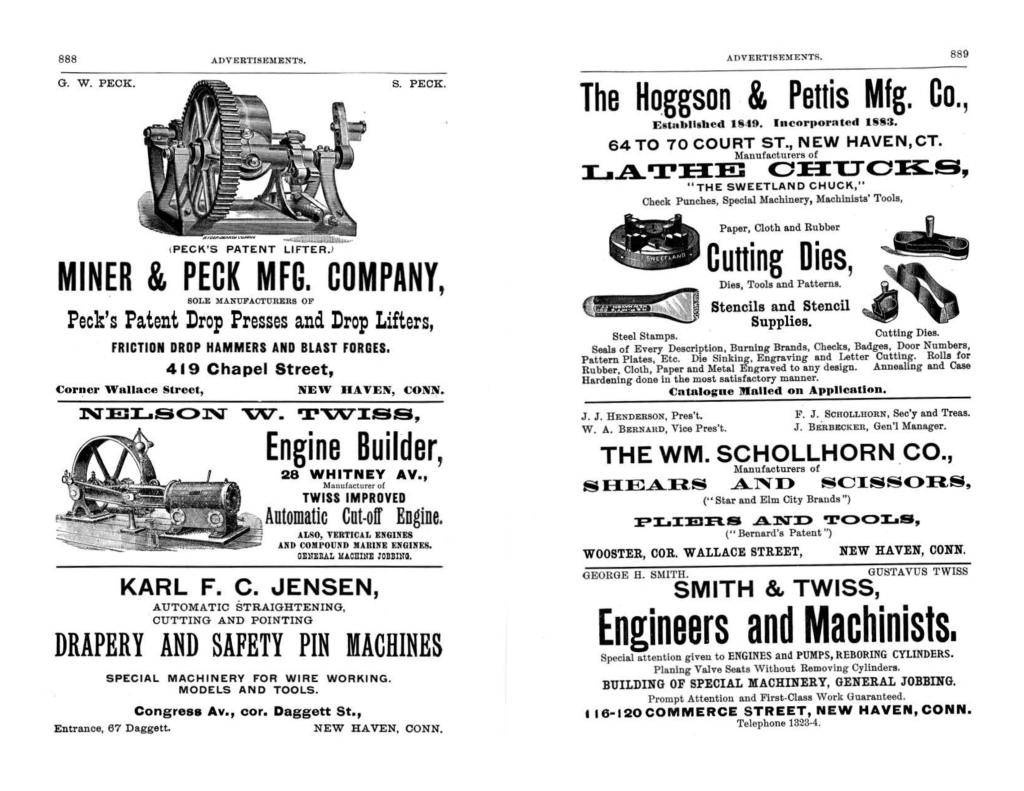
Maria Twiss passed away on Nov. 5, 1913 at her family home on Beers Street in New Haven and was buried at Evergreen Cemetery in New Haven. (Some family tree records inaccurately say she died in 1918) Gustavus died on Feb. 16, 1926, and was buried at Evergreen Cemetery as well.
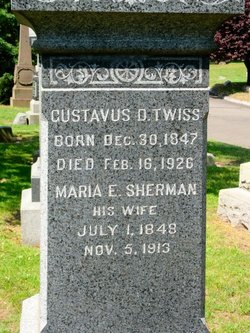
On October 21, 1892, descendants of Joseph and Lois held an inaugural gathering “for social and friendly intercourse” at West Peak near Meriden, according to the Meriden Weekly Republican newspaper. A second gathering in 1893 attracted 43 attendees to the home of Waldo Twiss on Money Island in Long Island Sound.
Attendees included – From New Haven, CT: Mr. Julius Twiss, Mr. Nelson W. Twiss, Mr. and Mrs. Gustavis Twiss and their daughter, Carrie Twiss, Mr. Waldo C. Briggs, Misses Della and Lizzie Briggs, Mr. and Mrs. Charles A. Ferry and daughter; From Meriden, CT: Mr. Waldo C. Twiss, Miss Fannie L. Twiss, Mr. and Mrs. Ransom Baldwin and children, Leland, Misses Flora and Alice Baldwin, Mr. and Mrs. Russell Hall and children, Howard and Hazel Hall, Mr. and Mrs. Benjamin Kennard and children, Helen and Leighton Kennard; From Hartford, CT: Mr. and Mrs. Herbert M. Twiss and children, Marsha C., Clara L., Clavon W., Ernest B., Edna F. and Herbert Twiss; From Westfield, CT: Mrs. Amelin Twiss Roberts; ; From Westfield, Mass: Mrs. Caroline Garrigus.
At the close, an invitation was extended to a third gathering at a cottage owned by Ransom Baldwin at Short Beach in Stratford, CT on July 4, 1894. “The hymn ‘America’ was sung, and all scattered for general amusement, strolling about the island, bathing and sailing. A delightful occasion throughout,” the Meriden Daily Republican reported. The 1894 event took place as planned and was reported on by the Meriden Daily Journal.
On January 26, 1929, the Meriden Daily Journal ran a lengthy piece on a large gathering to celebrate the 90th birthday of Fanny Lucy Twiss, a daughter of Benjamin Twiss. She had been born on January 24, 1839, in the Twiss homestead at the corner of Broad and Britain Streets and baptized by immersion in Twiss Pond. Fanny died on Dec. 24, 1929. “She was active in church work and conducted a non-sectarian Sunday School in her home for seven years,” the Meriden Daily Journal reported on the day of her death. “She travelled extensively here and abroad in the interests of home and foreign missionary work.”
My Twiss Clock
Varkaris and Connell wrote that one very seldom knows the exact history of a specific clock. That is not entirely the case with mine because my father and others were assiduous in retaining documents associated with the clock, although there are some historical gaps.
My clock was manufactured by Joseph and Russel Twiss in Montreal, Canada in 1833. According to a document attached to the trunk or waist door, it was first acquired by Thomas Pearce, then by John Onieal, Isaac Blagrath and others.
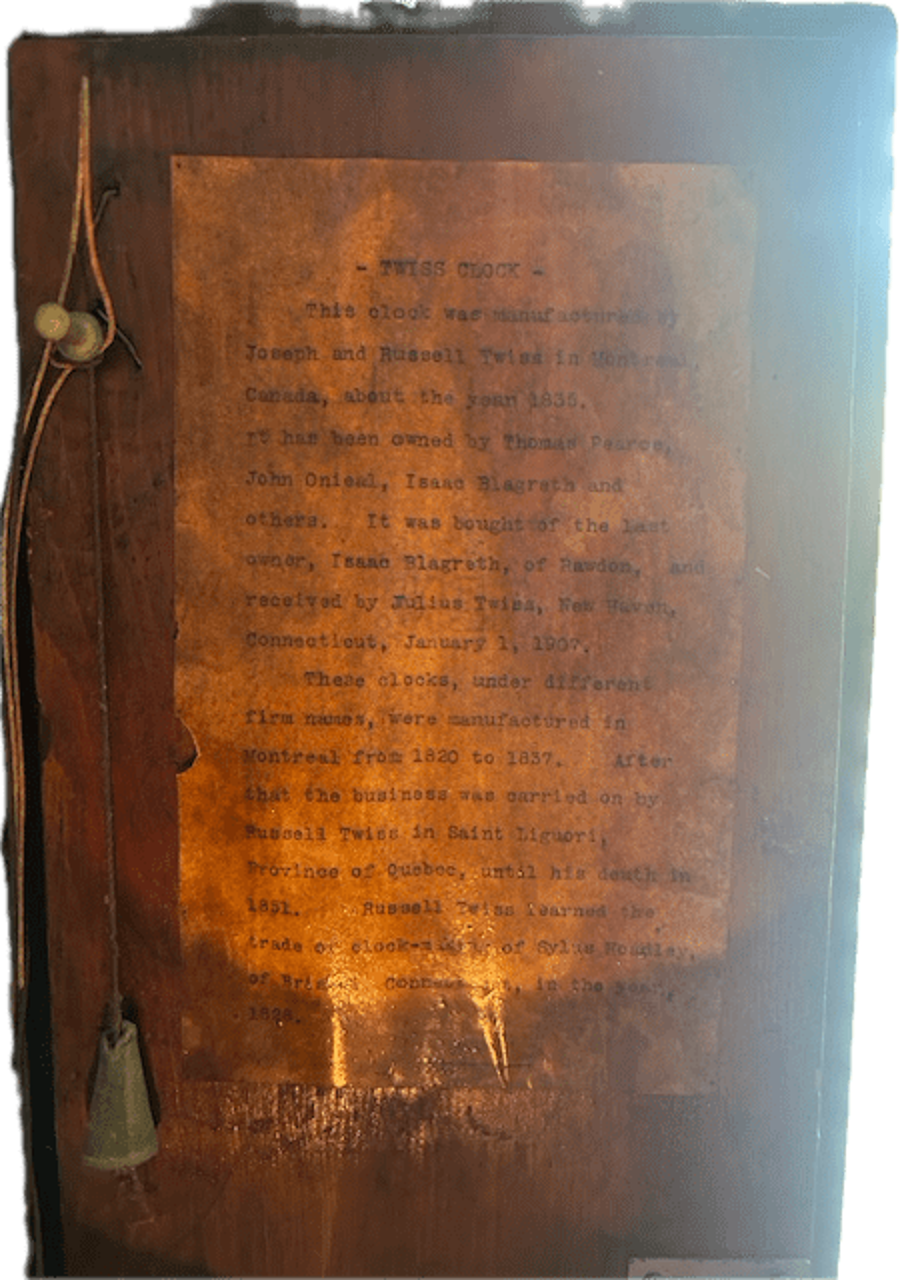
The document says Isaac Blagrath, of Rawden, Canada, a municipality on the Ouareau River in southwestern Quebec, Canada, about 37 miles north of Montreal, owned the clock when it was acquired by Julius Twiss, the wealthy Treasurer of New Haven, Connecticut’s National Savings Bank and a son of Russell Twiss.
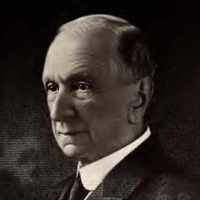
Julius Twiss was born in Joliette, Quebec, Canada on April 18, 1838, and lived there in his boyhood. According to A Modern History of New Haven and Eastern New Haven County, Vol. 2, 1918, after the death of his father, Russell Twiss, on May 14, 1851, he accompanied his mother to Meriden, Connecticut. He was first employed as a clerk in the local post office, of which his uncle, Hiram Hall, was postmaster. He was not in good health during his boyhood days, but he persevered in his efforts to obtain an education. He attended Hopkins grammar school in New Haven, CT and Yale University, where he earned a B.A. in 1863 and then an LL.B. degree from Yale Law School in 1865. He never married. He practiced law in New Haven at an office on Church St. until 1894. In 1872, he became connected with National Savings Bank of New Haven, first as a trustee, then as Secretary, then as Treasurer in 1894. after which he gave up the practice of law. He became Comptroller of the bank in 1916.
“Mr. Twiss is a Republican but does not hesitate to vote independently in accordance with his conscience”, Men of Mark in Connecticut said of Julius. “For the young man of average ability, I would say that true success can ordinarily be secured by diligence, honesty, close application to one’s vocation, correct habits, economy, judgement in investments, and belief in and practice of the principles of Christianity,” Twiss was quoted as saying.
Julius was such a prominent resident of New Haven that the New Haven Journal-Courier of July 20, 1899, ran a lengthy article on a trip he was planning to Canada.
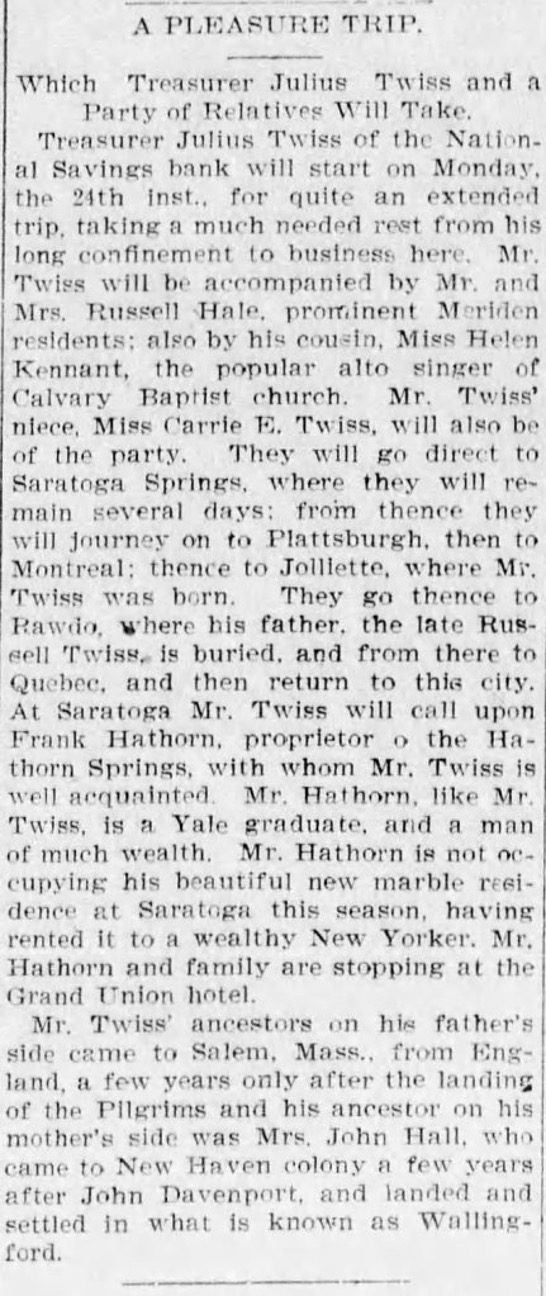
The “Miss Helen Kennant” of the group was a misspelling of my grandmother’s name, Helen Kennard, before her marriage. Helen, a graduate of Smith College, was then 22 and a resident of Meriden, CT.
The article noted that Miss Carrie E. Twiss, Julius’s niece (daughter of Russell Twiss’ son, Gustavus, and his wife, Maria), would also join the party and that the group would visit Rawdon, Quebec, where Russell Twiss, Julius’s father ,was buried.
An odd side-note: On August 20, 1897, about two years earlier, the Montreal Star included “Mr. Julius Twiss, New Haven, Conn” in a lengthy list of guests who had arrived at Montreal’s Queens Hotel as of noon that day. It’s not known whether that trip had any connection with his later acquisition of the Twiss longcase clock.
As for the 1899 trip, the group started out on a train to Quebec and Helen subsequently sent multiple letters to family members. I have the original letters.
One day, they travelled to Joliette, Quebec, staying overnight at “L’ Hotel Royal., P.O.P Chevalier, Proprietaire’. On August 1, 1899, Helen Kennard wrote to her mother, Mrs. Benjamin Leighton Kennard, in Meriden, CT on stationary from the hotel. “When we arrived in Joliette, which is a place of about 6,000 inhabitants – larger than most – a gentleman met us who knew Julius (Twiss)”, she wrote. “We have already met two gentlemen who knew Uncle Joseph,” she added. They also saw the site where Joseph’s clock factory had been located, by then occupied by another building.
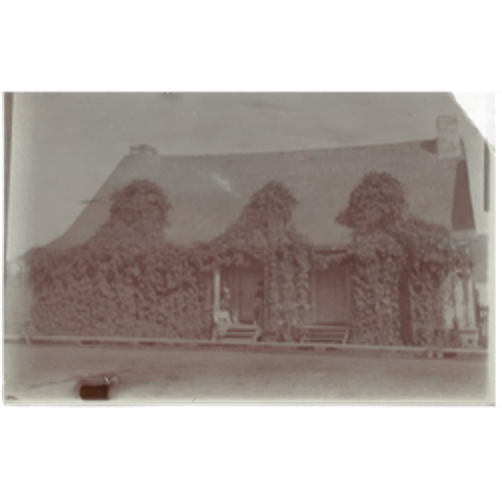
Julius Twiss was born. (Picture taken by Helen Kennard)
They journeyed next to Saint-Liguori, a municipality in the Lanaudière region of Quebec where Russell Twiss once lived.
On August 3, 1899, Helen Kennard wrote to her brother again: “When we arrived at St. Ligere (a misspelling of Saint-Liguori) Carrie (Twiss) took ever so many pictures. The house where her father was born, several views inside and out, also the house just a little farther on where Nelson (Twiss) was born. We find the old clocks all about here – everybody around here knew the Twiss people – and Julius is at home.”
Helen added that the group stayed in a house “right opposite the little church that the Twiss brothers built, and where they attended church. There we sit in the big room and listen to the tick of the big Twiss clock, she wrote. “J & R, not R. Twiss”.
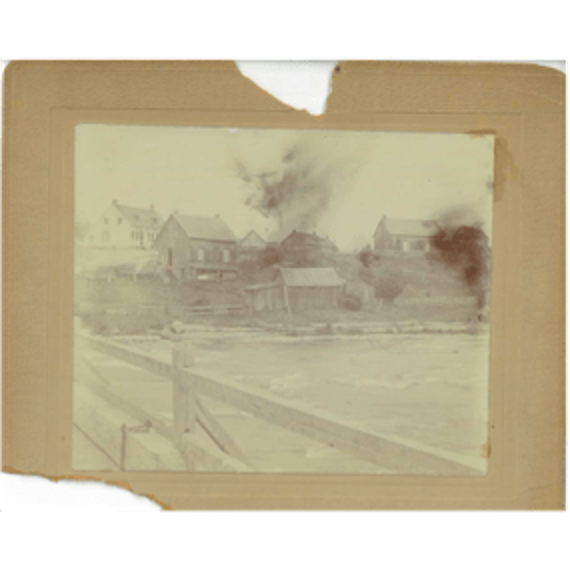
picture is where my Twiss clock was found.
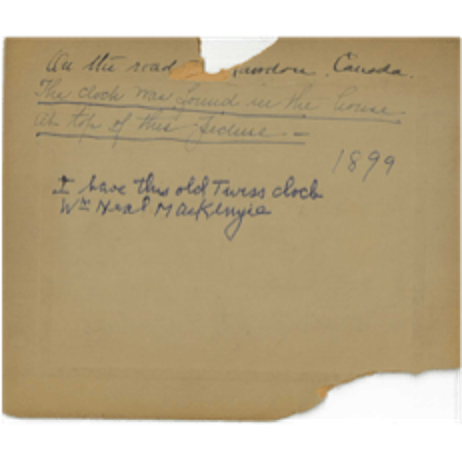
Helen said they also visited and took a photo of Russell’s grave site in Rawdon where his gravestone read, “Sacred to the memory of Russell Twiss who departed this life 14 of May 1851 aged 43 years & 8 months. Luke 12th Chapter 40 verse.”
It has been difficult to locate that gravestone today. The writing on the grave marker in Helen’s picture is illegible. Up to Rawdon, a two-part book self-published by Daniel Parkinson, says Russell was buried at the Rawdon Methodist Cemetery, but the name of that site has changed over the years. A search of online sites for all the cemeteries in Rawdon/Saint-Liguori failed to reveal a gravesite for a Russell Twiss (1807-1851). The only Russell Twiss gravesite found was in Rawdon for a boy who died May 14, 1851, at the age of 13 years and 8 months. It may be that Russell’s grave marker has been lost due to abandonment or vandalism, as has occurred in various old Quebec cemeteries.
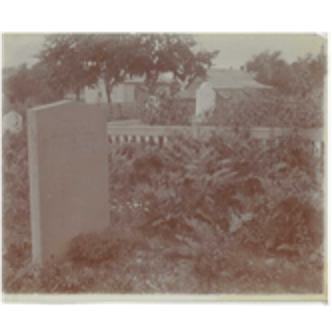
Whatever happened to Russell’s gravestone, it is notable that almost all the Twiss brothers, despite their adventurism and Canadian experiences, came home to the place that raised them in death, as if by gravitational pull.
Austin, Ira, Benjamin, Joshua, Joseph and Hiram are all buried in East Cemetery in Meriden, Connecticut, joining their parents, Joseph and Lois. Even Russell’s wife, Permela, was buried in Connecticut at New Haven’s Evergreen Cemetery. Only Russell was buried in Canada, his adopted home.
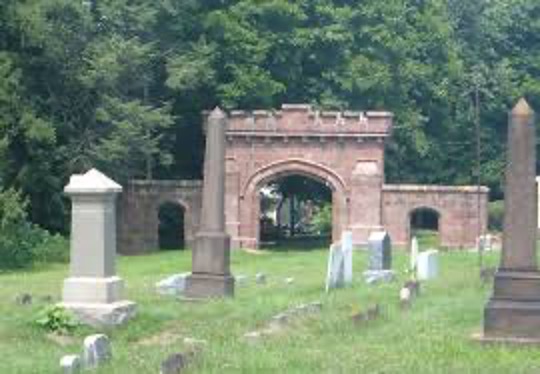
Evidence of the Twiss family in Meriden is still visible in Meriden where there is a Twiss Avenue and a Twiss Street.
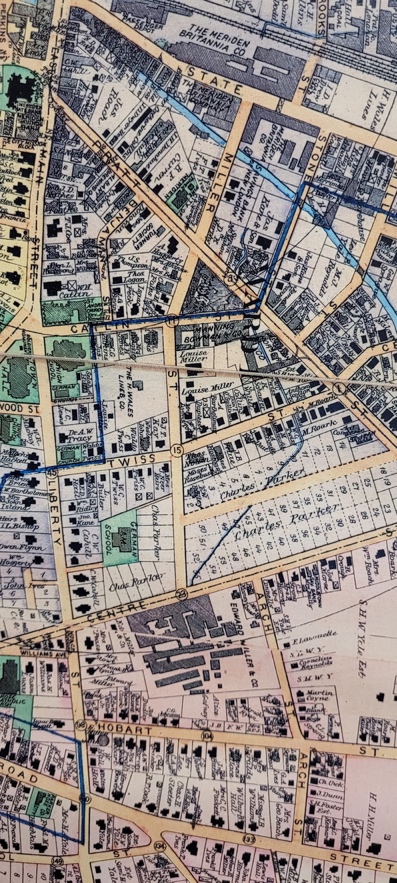
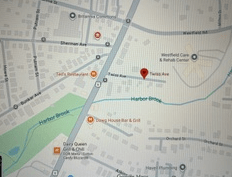
The Twiss clock the group found in Saint-Liguori was later shipped to Julius Twiss in New Haven, CT, arriving on January 1, 1907. It’s not clear why there was such a long delay in shipping the clock from the time of his visit to Saint-Liguori in 1899.
At Julius’ death in New Haven on March 3, 1921 at the age of 82, the clock went to his niece, Carrie Twiss Burgess.
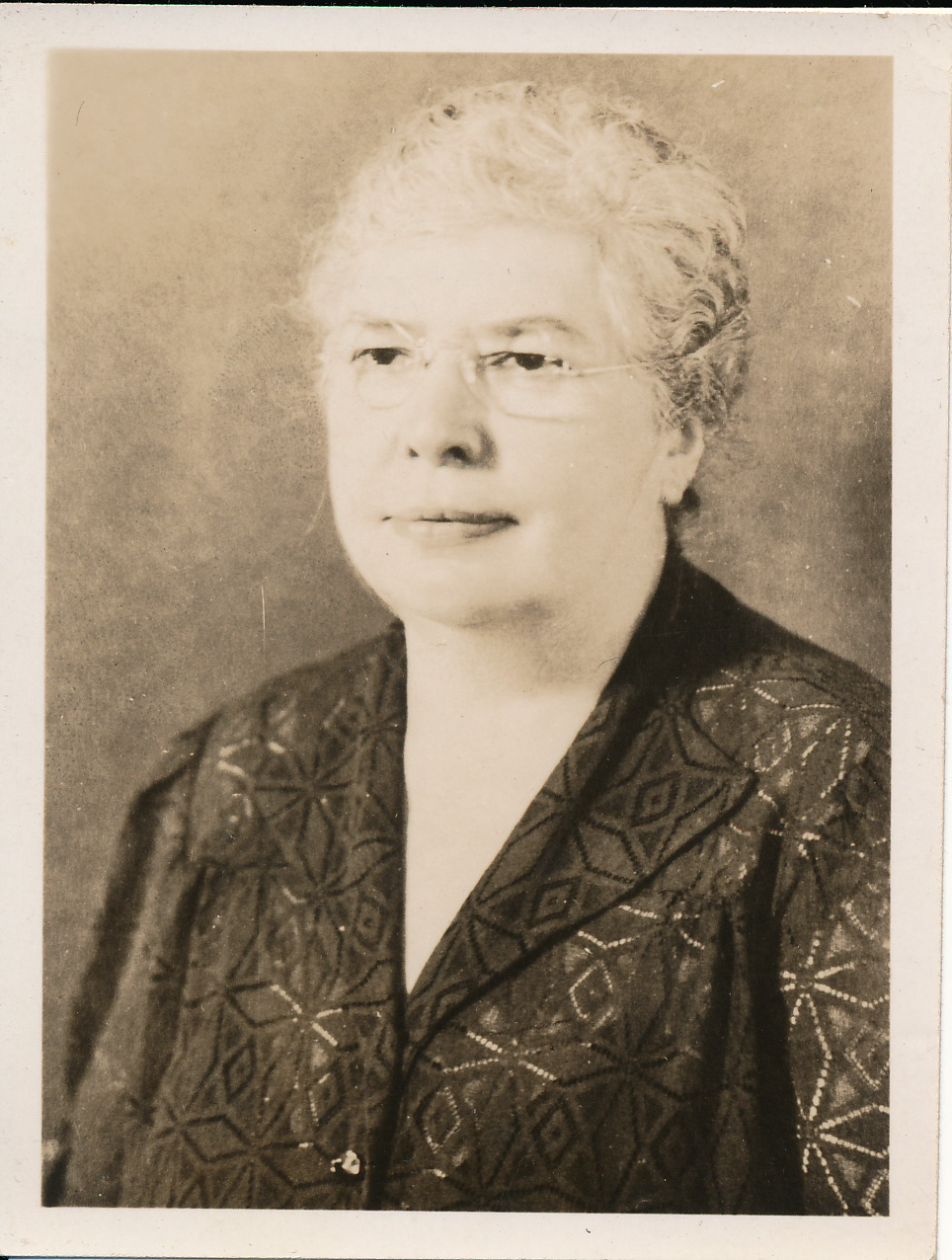
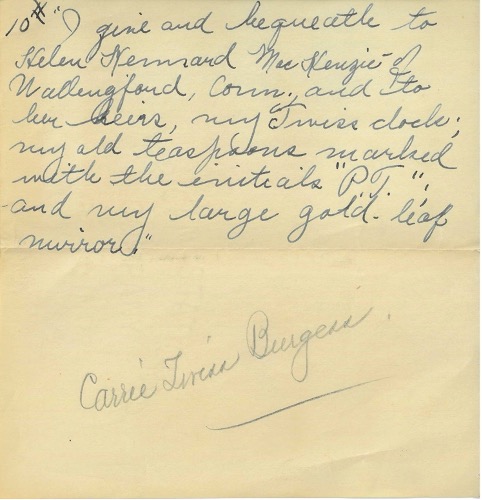
Carrie bequeathed it at her death (Dec. 18, 1946) to my grandmother, Helen Kennard MacKenzie, who received the clock at her home at 390 North Main St. in Wallingford, CT.
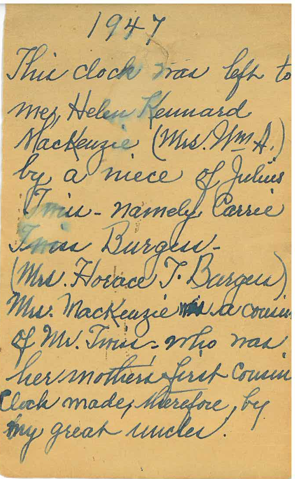
At her death in 1968, my father, William Neal MacKenzie, transferred it to his home at 222 North Main St. in Wallingford.
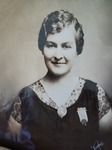
At my grandmother’s death on Sept. 28, 1968, my father brought the clock to our home at 222 North Main St. in Wallingford.
Now almost 200 years old, the clock is in my home in Lake Oswego, Oregon. Hopefully, it and the various Twiss family artifacts in my possession, will be preserved for many years to come.
Conclusion
So, what are we to make of the Twiss family’s hometown initiative and exploration into Canada?
In my view, it was all part of America’s maturation, of its people’s pursuit of the American dream. The exact term “The American Dream” was coined by Pulitzer Prize-winning historian James Truslow Adams in his book The Epic of America, published in 1931 during the Great Depression. He defined it as “that dream of a land in which life should be better and richer and fuller for everyone, with opportunity for each according to ability or achievement”. But the concept was alive and well many years earlier.
In 2026, Judith Dobrzynski wrote of how, even before independence, Americans had begun spreading out, seeking land and opportunity. “Word of the country’s natural grandeur and abundant resources seeped back east, and by the mid-1800s Manifest Destiny—the supposedly divinely ordained quest to expand across the whole continent—became a rallying cry,” she wrote.22
The Twiss family’s American dream, including strong families and economic success, originated in Meriden, Connecticut, but extended into Canada. The dream was rooted in upward mobility, not only for the Twiss sons to succeed, but also to lay the groundwork for their children to prosper as well. The foundational vision was the “self-made man” achieving prosperity, independence, and land ownership through hard work, regardless of birth status. Diligence and thrift could allow a person to elevate their social class and achieve financial independence.
In the process of achieving their goals, they created masterpieces of ingenuity that have stood the test of time, with many of their longcase clocks still working today. A brief item in the March 1, 1916 issue of the Montreal Star misjudged the continued value of the old Twiss clocks, saying “The Twiss grandfather clock has no particular value, so a jeweler assures me. He says it is not many years since the Twiss people had a place on the Cote des Neiges road, and that their clocks are not worth, at the most more than five dollars”. That jeweler has been proven wrong, with many of the Twiss clocks now commanding substantial prices from avid collectors.
Ralph Waldo Emerson, a prominent thought leader in the first half of the 19th century, championed individualism and self-reliance. Joseph and Lois Twiss’s family lived that guiding philosophy and made their mark on history.
Appendix 1
Genealogy of the Twiss Family/ Written by Julius Twiss
Branch of the Twiss family to which Russell Twiss belonged.
My father Russell Twiss moved to Canada when a young man and he lived first at Montreal, then at Joliette and lastly at St Liguori. He is buried at Rawdon, nine miles beyond St Liguori.
After his death mother returned to Meriden Conn, her native place and my father’s also. I was born at Joliette. My brothers Nelson W and Gustavus were born at St Liguori.
I will now give a brief genealogical descent of this branch of our family so far as we have traced out the same.
We get our starting point from the several biographical sketches of Dr William Twisse or Twiss, an eminent divine, who lived from 1575 to 1646. Such as, Dr Chalmers Biographical Dictionary Vol 30, who says that the Dr was of German ancestry said to have been the first who settled in England. Dr Chalmers says further that his father was a successful clothier at Newbury, Berkshire County England. Wood’s Athenae Oxonienses continued by Philip Bliss vol III Page Column 169 says that the grandfather of Dr Wm Twisse, sometimes written Twissius and Twissius, was by Nativity a Teutonic and that in the prime of his years he settled himself with his family near Newbery, England. Additional Sketches of Dr Wm Twisse can be found in the third volume of Middleton’s Biographica Evangelica and in Thomas Fuller’s Worthies vol 1. Page 134 and in other writers of that period.
Wood says that Dr Twiss had a son named Robert Twiss who died in 1674 and who preserved his father’s original Manuscripts. In a history of Antrim, New Hampshire a Short Sketch is given of Daniel Twiss who was killed at Bunker Hill and this account says that he was a descendant of Daniel Twiss who came to America from England with his two brothers Robert and Nathan Twiss.
Some twenty years ago, a second cousin of ours whose name was Albert Twiss from near Binghamton N.Y. came to New England for his health. He visited Boston, Salem and adjoining places and on his return he called on our family and left with us a copy of an account of the landing of three brothers by the name of Twiss at Salem Mass. Albert Twiss died soon after his return home and we have lost this account.
This incident is mentioned to show that the landing of three brothers by our name at or near Salem is an established fact. As we know from Wood that Dr Wm Twisse or Twiss had a son named Robert Twiss and, from the history of Antrim N.H., that one of the three brothers who migrated to America was name Robert; as we also know that Dr Twiss became very much reduced in financial matters towards the close of his life which was in 1646, and as England at this time was an uncomfortable place for Puritans and non-conformists; is it not a fair presumption to assume that the three brothers Daniel, Robert, and Nathan Twiss who landed at or near Salem about this time, ex, from 1646 to 1650, were the sons of Dr William Twiss? Much could probably be learned on this subject from records, manuscripts etc at Newbury and adjoining towns.
There is a tradition among us that one of the three brothers settled in New Hampshire, one in Massachusetts and one in Connecticut. The History of Antrim establishes the fact that Daniel settled in New Hampshire. From Thomas Twiss who was born about 1675 and who lived and died in Cheshire, Conn. we now have a continuous and quite authentic record down to the present time.
There seems to be one generation between either Robert- or his brother Natan Twiss who came over from England and Thomas Twiss of Cheshire, Conn. not yet-traced out.
We know Robert Twiss died in 1674 and that Thomas Twiss of Cheshire was born about- 1675.
Therefore a condensed genealogical descent of our branch so far as traced by us and supplemented by several reasonable presumptions, would read about- as follows;
1- A Mer Twisse, sometimes written Twissius and Twissius, a teuton, who was born probably in Germany about- the year 1500. and who migrated from Germany to England, with his family in his early manhood, and settled near Newbury, Berkshire County.
2- His son, Mer Twisse, who lived in and was a successful clothier at Newbury, Berkshire County England and who gave his son Dr William Twisse a liberal education at Oxford.
3 – Dr William Twiss or Twisse, the eminent divine. He was born at Newbury about the year 1575 and died July 20, 1646. For a history of his life read the authors referred to, above cited.
4 – The three brothers, Daniel, Robert and Nathan Twiss who migrated to America at or near Salem probably about the year 1650 and who were without doubt the sons of Dr William Twiss who died in 1646.
5 – This generation is not yet located. He was the son, either of Robert or Nathan Twiss and the father of Thomas Twiss of Cheshire, Conn. Not the son of Daniel Twiss who settled in New Hampshire.
6 – Thomas Twiss of Cheshire, Conn, who was born about the year 1675 and who died in Cheshire probably about the year 1750. He was without doubt a grandson of either Robert or Nathan Twiss who migrated to America.
7 – His son Benjamin Twiss was born in Cheshire about the year 1703 and died in the same place about the year 1780.
8 – His son Joseph Twiss was born in Cheshire Jan 31-1729. We know that his last child was born in 1762 and how long he lived after that we do not know. He lived and died in Cheshire.
9- His son Joseph Twiss, our grandfather, was born in Cheshire April 13-1761. He served three years in the war of the Revolution and was at the battle of Saratoga. Upon his return from the war he settled in Meriden Conn, and he died in that place May 16-1842. He raised a large family of thirteen children and the youngest of these was
10- Russell Twiss, our father. He was born at Meriden Sept 4. 1807 and he died at St Ligouri Canada May 14. 1851. His children now living are Julius, Nelson W and Gustavus Twiss.
11- His son Gustavus Twiss born at St Ligouri Canada, Dec 30. 1847. He is now living at New Haven Conn and engaged in the machine jobbing business, and
- His daughter Carrie E Twiss was born at New Haven June 12 – 1882,
New Haven March 1901, Yours, Julius Twiss
Twiss Genealogy by Julius Twiss
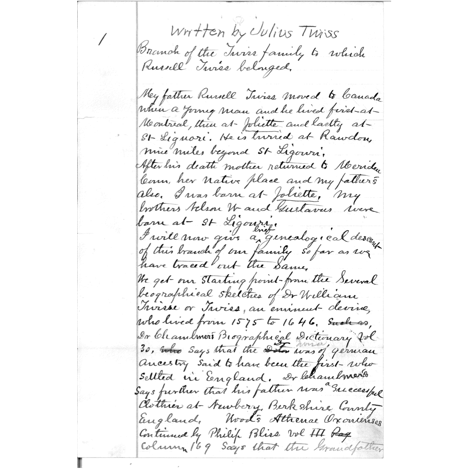
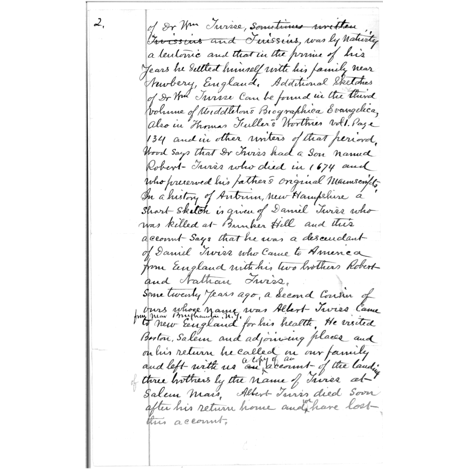
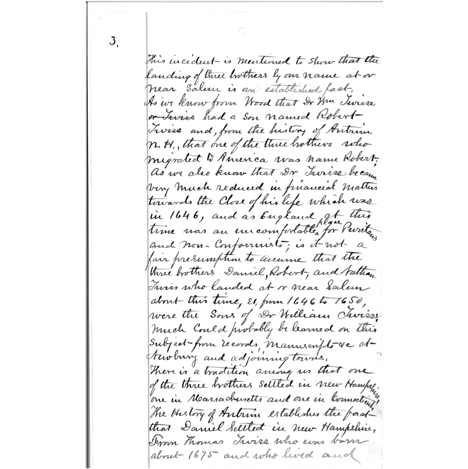
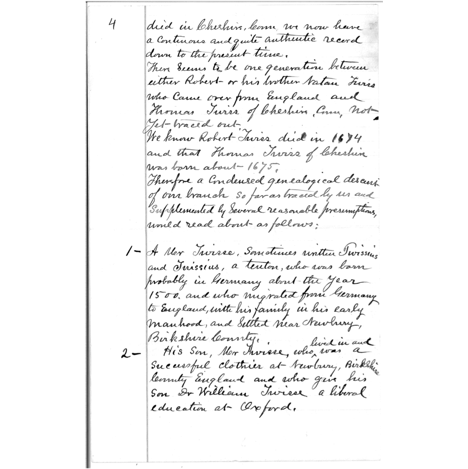
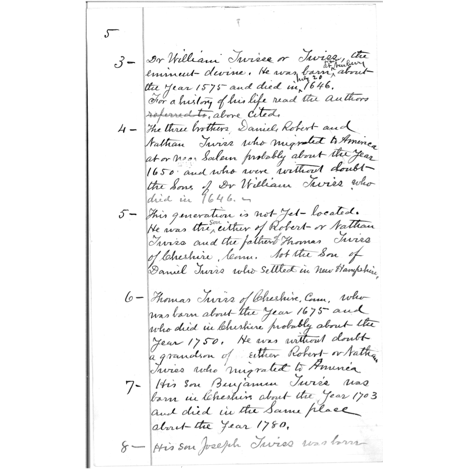
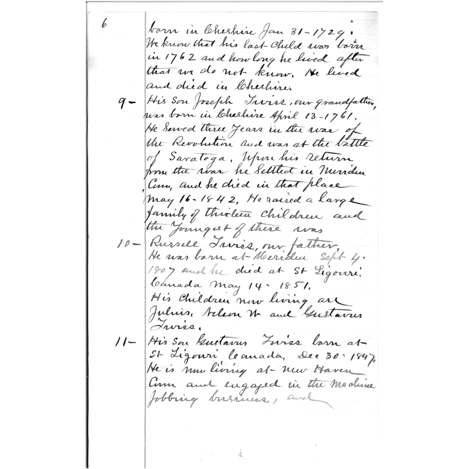
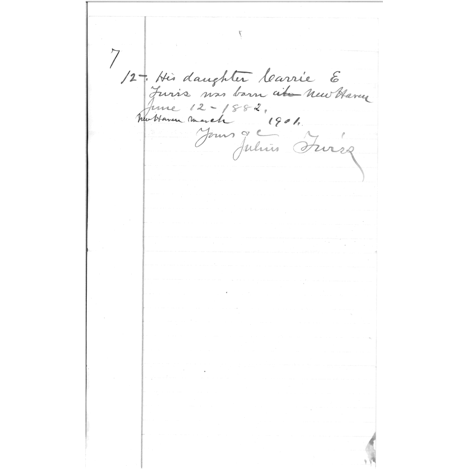
Appendix 2
15th March 1849
Act of Agreement between Mr. Russel Twifs and Mr. William Balleray (Transcription)
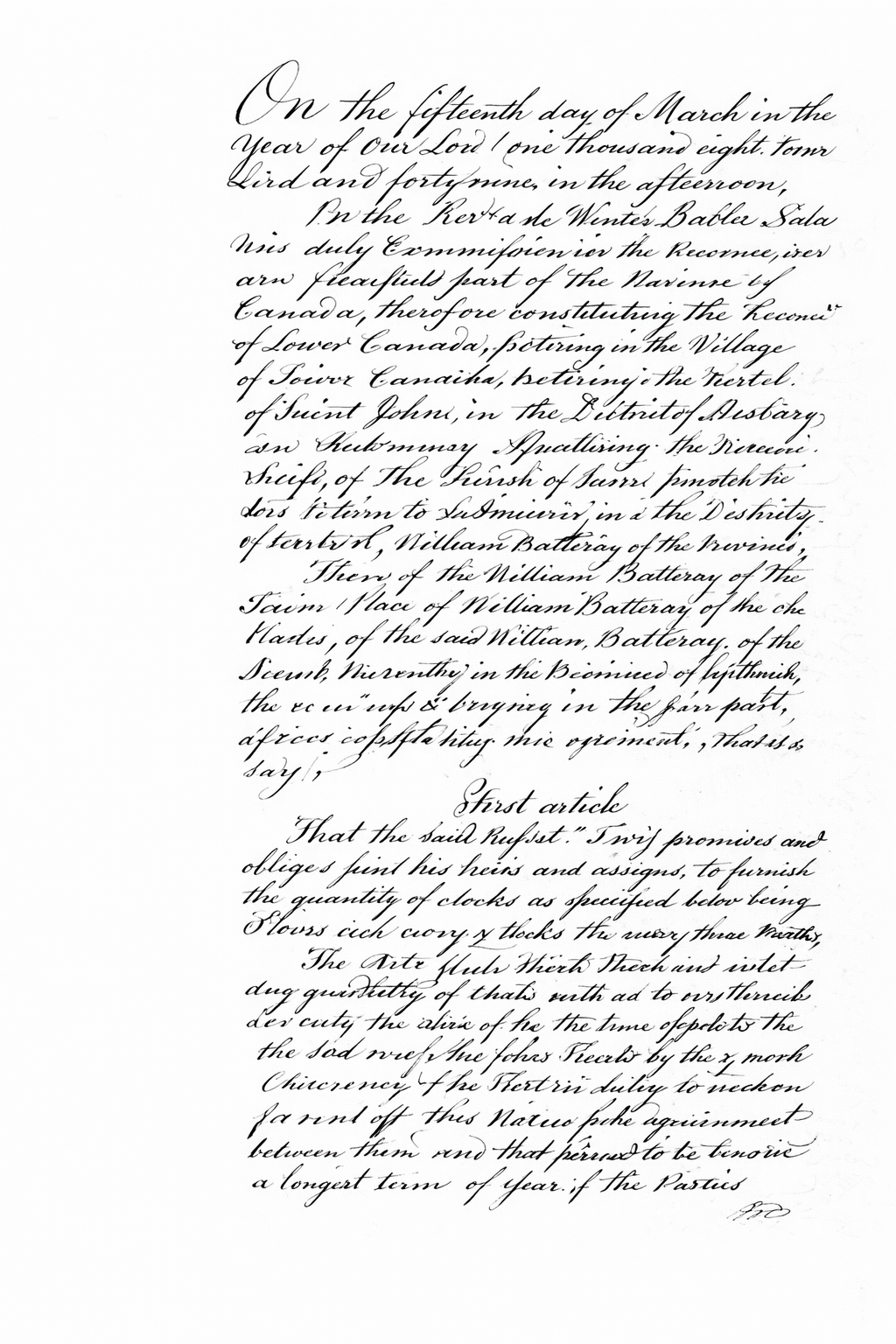
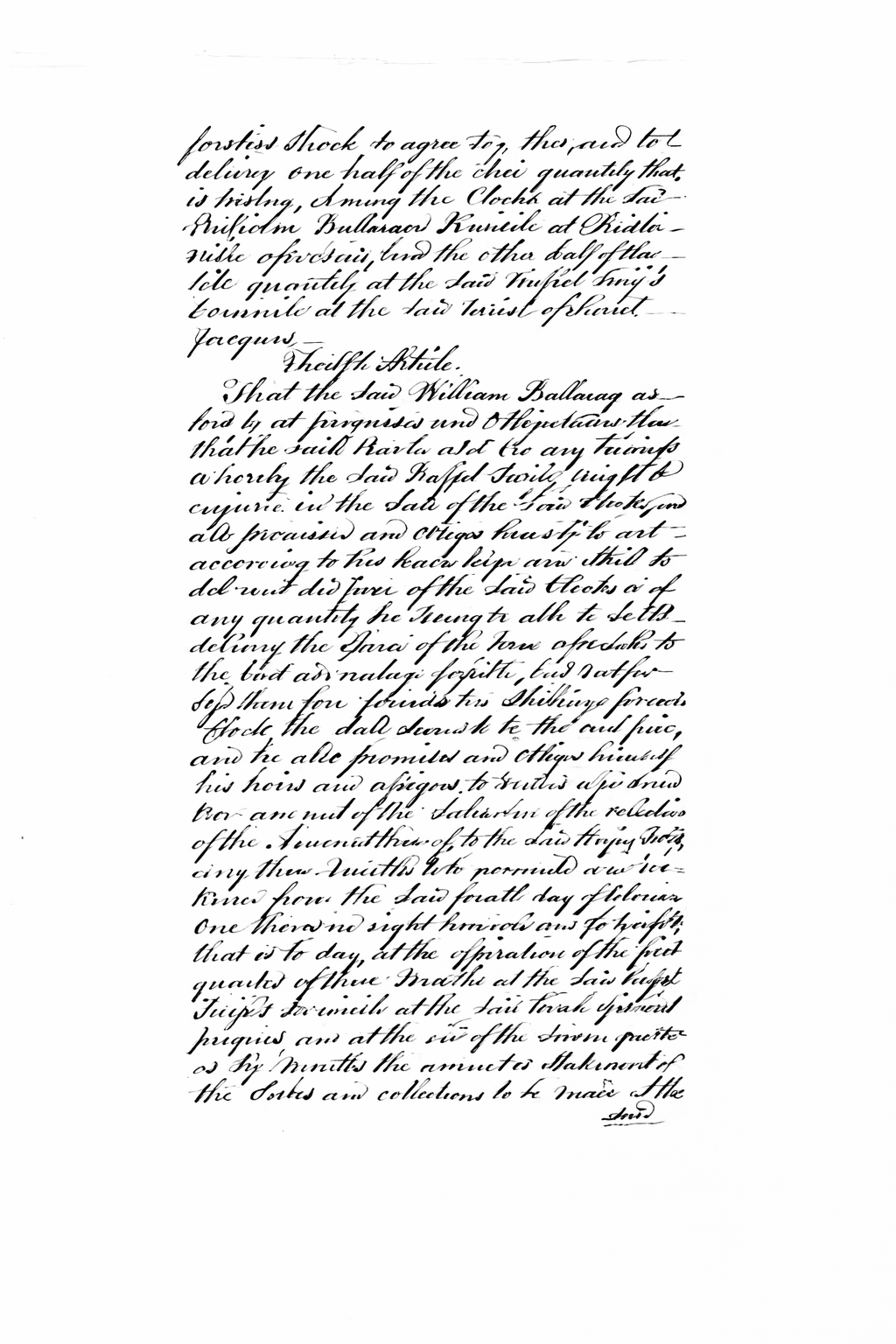
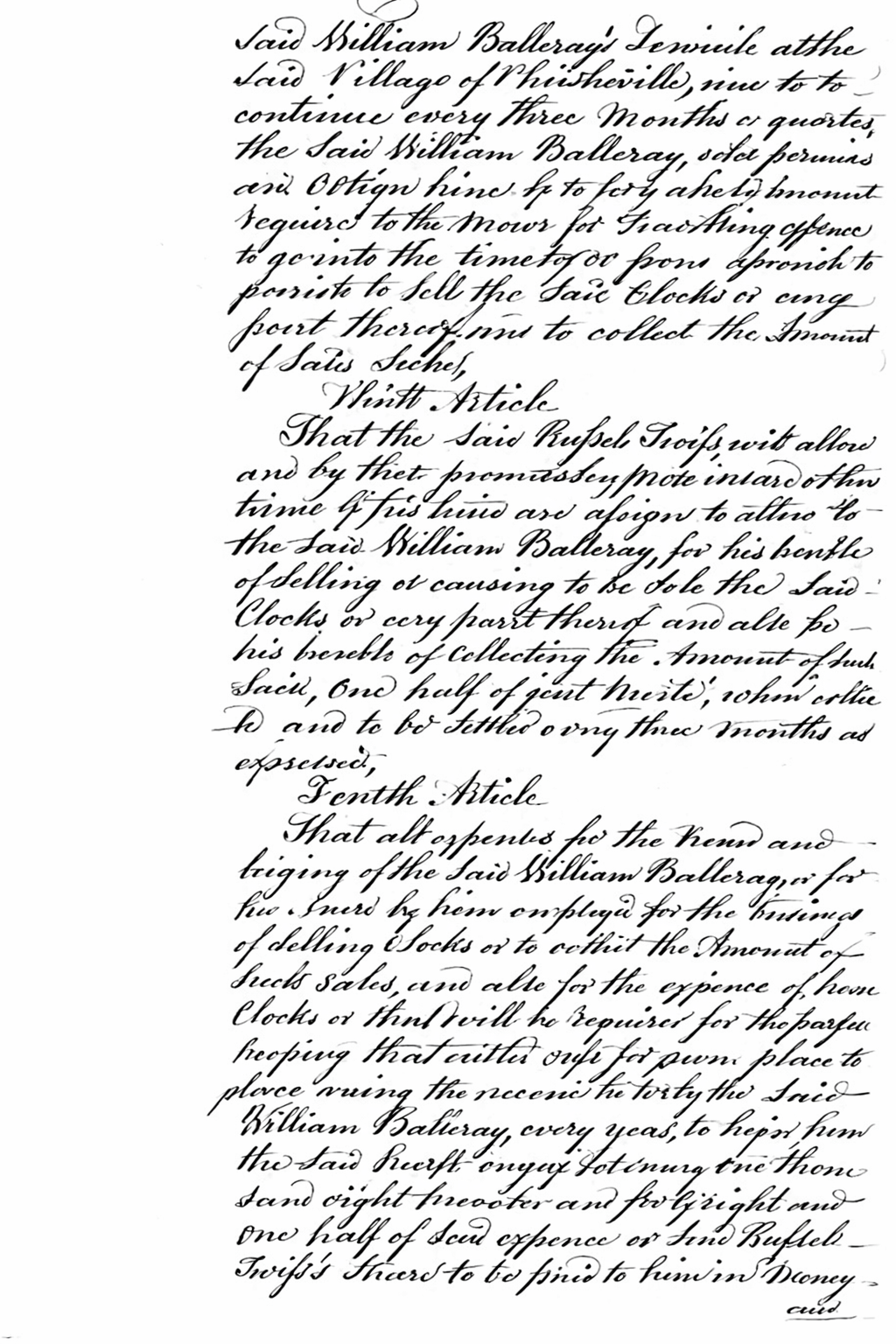
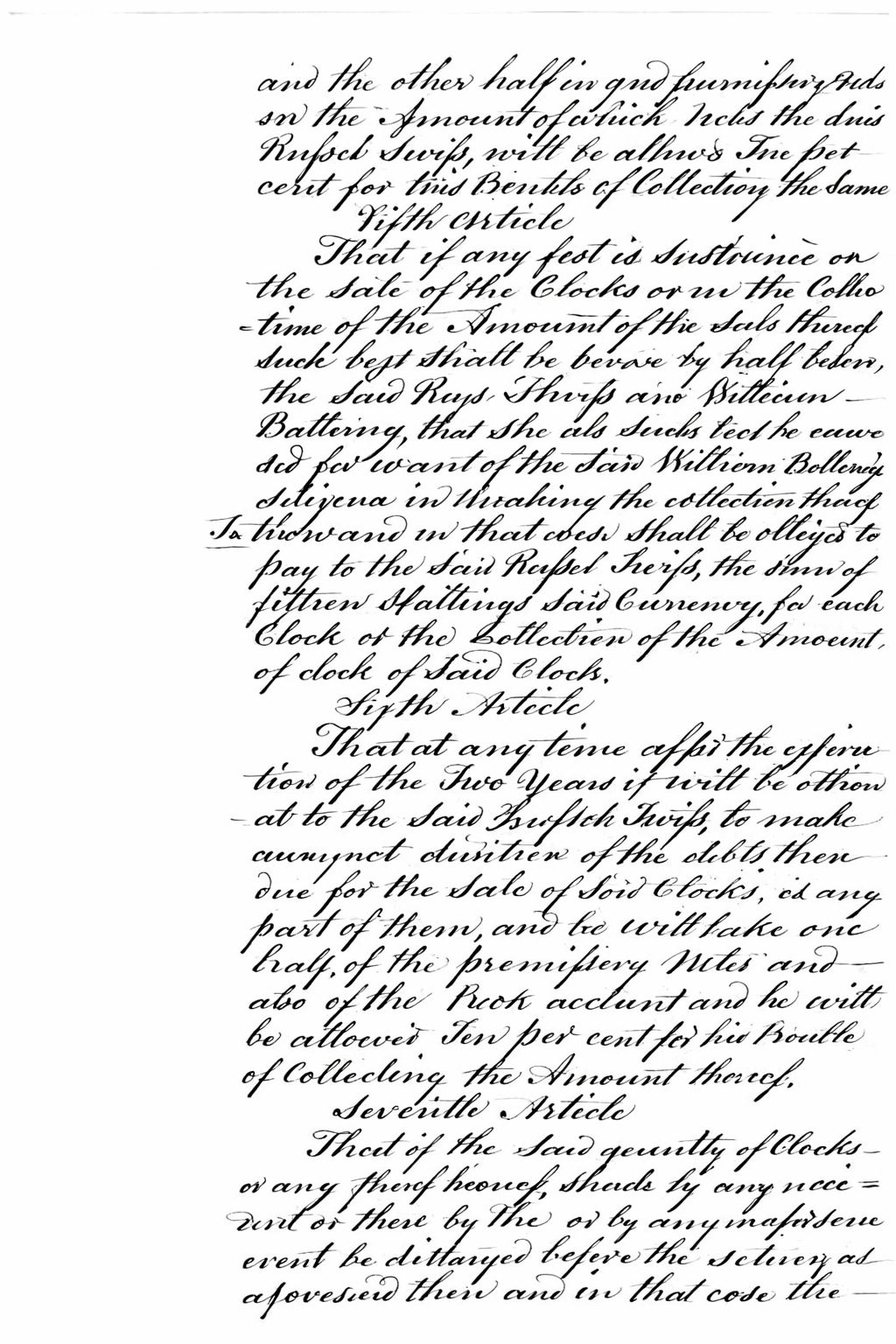
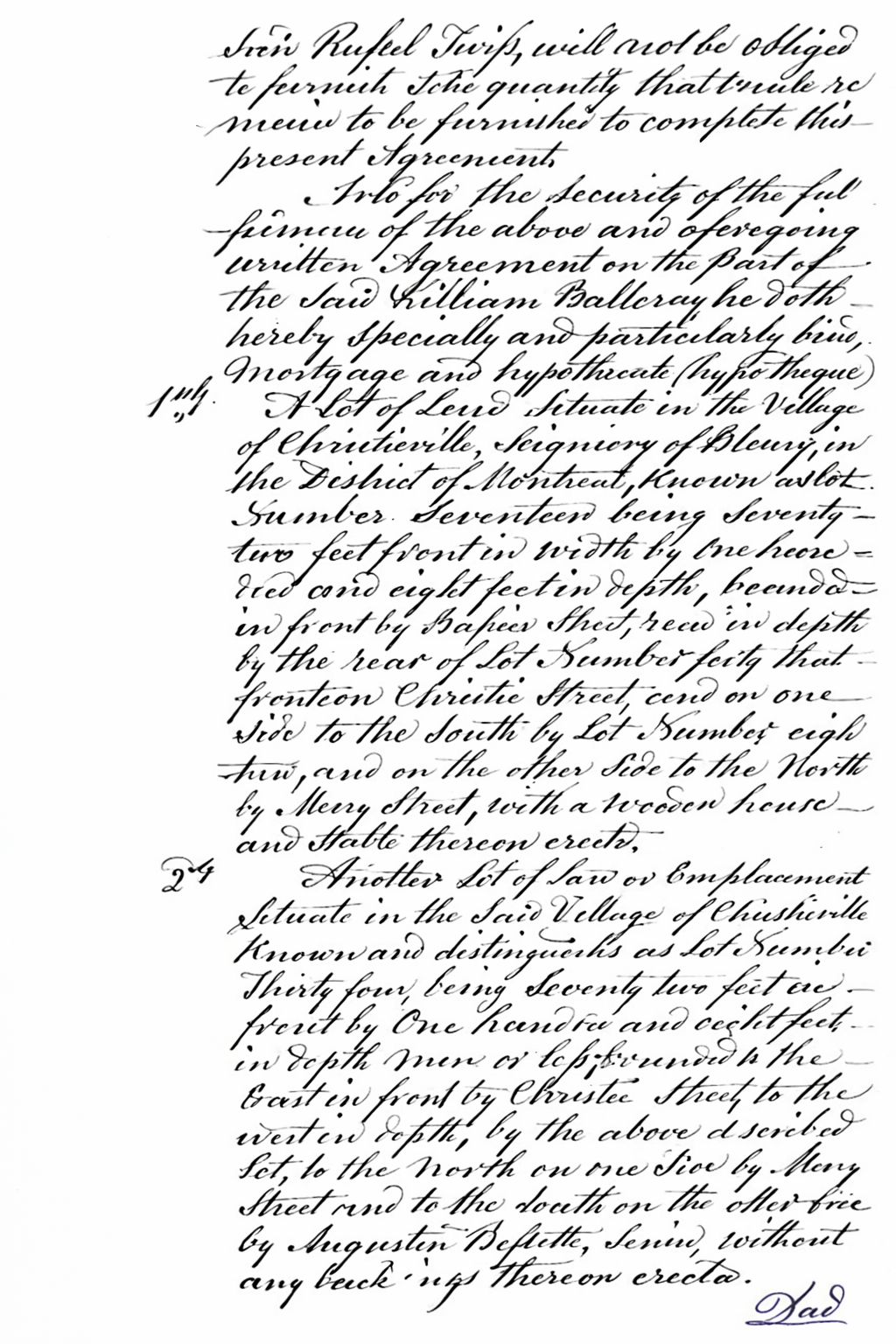
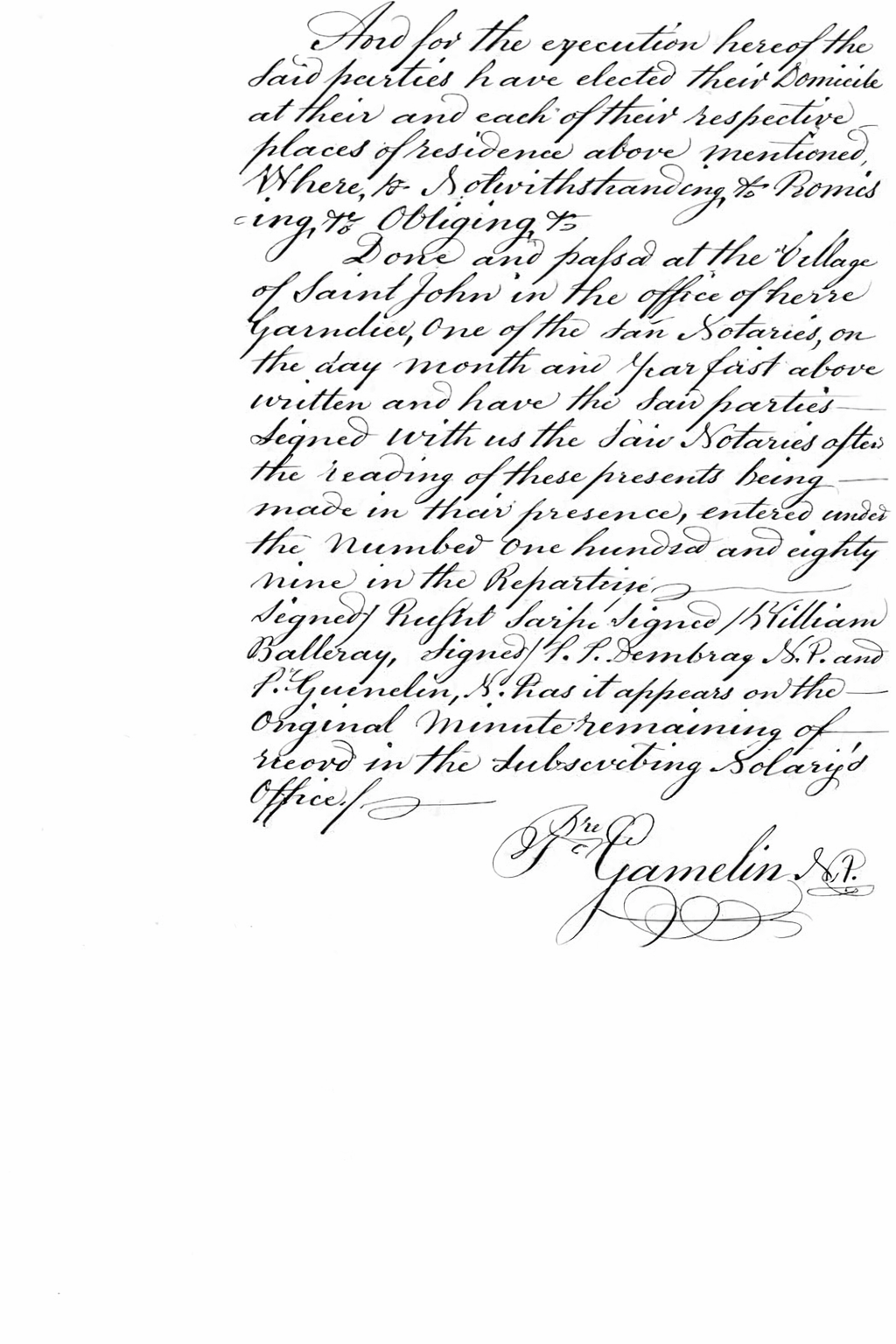
Appendix 3
Insurance policies issued by the Hartford Fire Insurance Co. covering the Twiss Factory and the Central Tavern in Meriden.
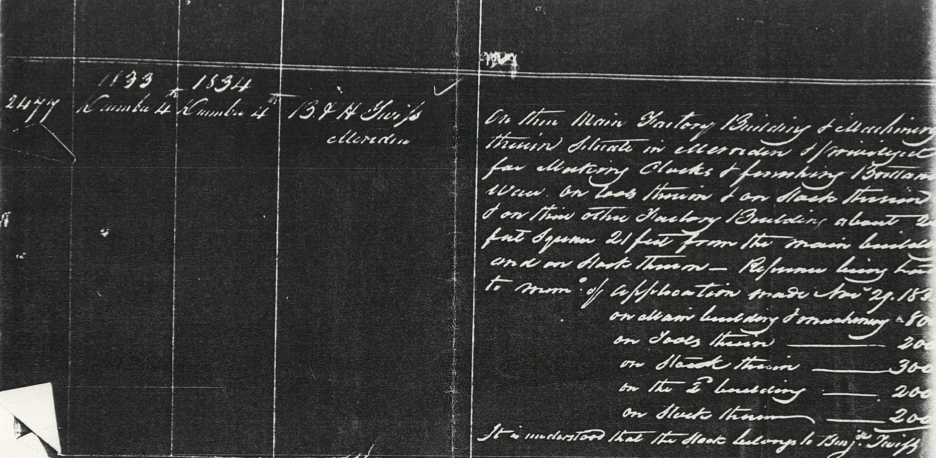
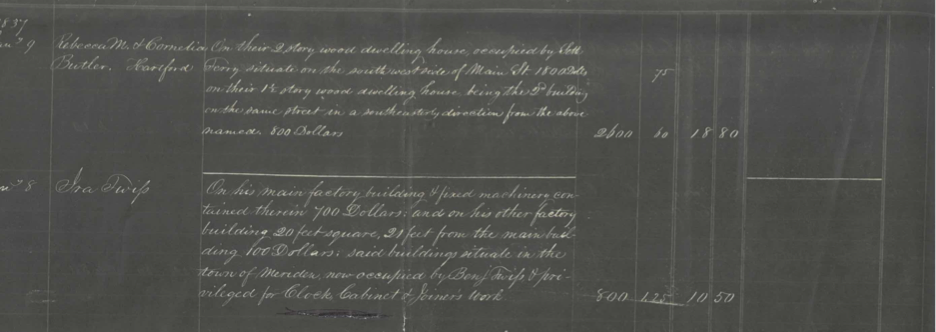
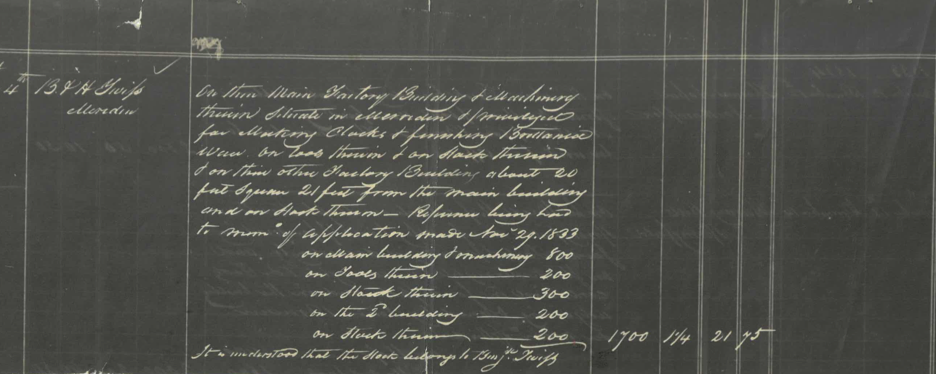
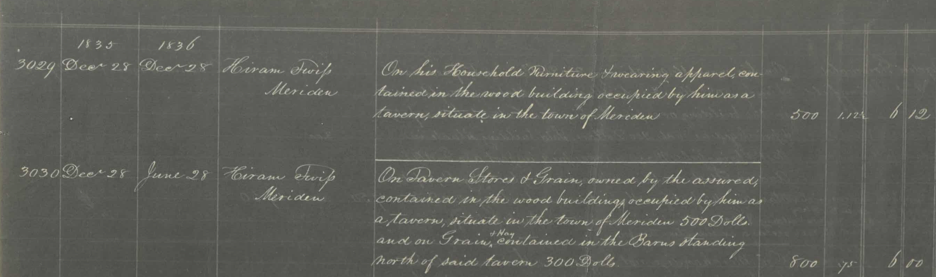


- American Wooden Movement Tall Clocks, 1712 – 1835, Philip E. Morris Jr., Heritage Park Publishing, 2011 ↩︎
- The Death of “Tick-Tok Town”, Joseph L. Reeves, NAWCC Bulletin, Vol. 10 ↩︎
- Sloan and Sloan, NAWCC Bulletin, No. 204 ↩︎
- Bailey and Blackwell, NAWCC Bulletin Supplement No. 13, p. 7. ↩︎
- Anderson, Pritchard and Ward, The Town and City of Waterbury Connecticut, from the Aboriginal Period to the Year Eighteen Hundred and Ninety-Five, 1896, p. 105. ↩︎
- History of the American Clock Business for the Past Sixty Years, and Life Of Chauncey Jerome, Written by Himself, https://www.gutenberg.org/files/12694/12694-h/12694-h.htm. ↩︎
- Alexander H. Phillips, Clocklore, https://www.clockmagic.com/clock_lore.html ↩︎
- Varkins and Connell, Early Canadian Timekeepers, 1993 ↩︎
- Men of Mark in Connecticut, Vol. II, Norris Galpin Osborn, William R. Goodspeed, Hartford, Connecticut, 1906, p.289 ↩︎
- How Did the Nation Get Its Name?, Smithsonian Magazine, September 8, 2026, https://www.smithsonianmag.com/history/how-did-the-nation-get-its-name-other-suggestions-included-the-united-colonies-columbia-and-the-united-states-of-alleghania-180989435/ ↩︎
- Center Street Cemetery, Wallingford, Connecticut, https://www.historic-structures.com/ct/wallingford/center-street-cemetery/#google_vignette ↩︎
- Wallingford Revolutionary War Memorial, https://www.nationalwarmemorialregistry.org/memorials/wallingford-revolutionWary-war-memorial/ ↩︎
- Fitchburg Historical Society, Fitchburg, Mass. Proceedings of the Fitchburg historical society and papers relating to the history of the town, “Old Clocks in Fitchburg, 1 – Wood Clocks”, by Ezra S., Stearns, 1914, Periodical, Volume 5 – Copy 1, Retrieved from the Library of Congress, <www.loc.gov/item/07018608/>. ↩︎
- Research Activities and News, NAWCC Bulletin, 2009, Vol. 51, p. 222 ↩︎
- An “Unusual” Timepiece”, Wm. L. Wadleigh, Jr., NAWCC Bulletin, 1957, Vol. 7 ↩︎
- Engines of Enterprise: An Economic History of New England by Peter Temin, published by the Federal Reserve Bank of Boston in advance of establishing a museum of New England economic history ↩︎
- U.S. Patents X8194 and X8195, reproduced in the Cog Counter’s Journal 18, 1982, pp. 10-17. ↩︎
- Clockmakers and Manufacturers: Canada, https://clockworks-horloges.com/home/clockmakers/clockmakers-manufacturers-canada/?doing_wp_cron=1780777576.9480750560760498046875 ↩︎
- The Canadian Clock Museum, http://www.canclockmuseum.ca ↩︎
- https://www.handwritingocr.com ↩︎
- https://www.wsj.com/arts-culture/fine-art/america-250-the-essential-paintings-of-our-nation-585f1dc0 ↩︎


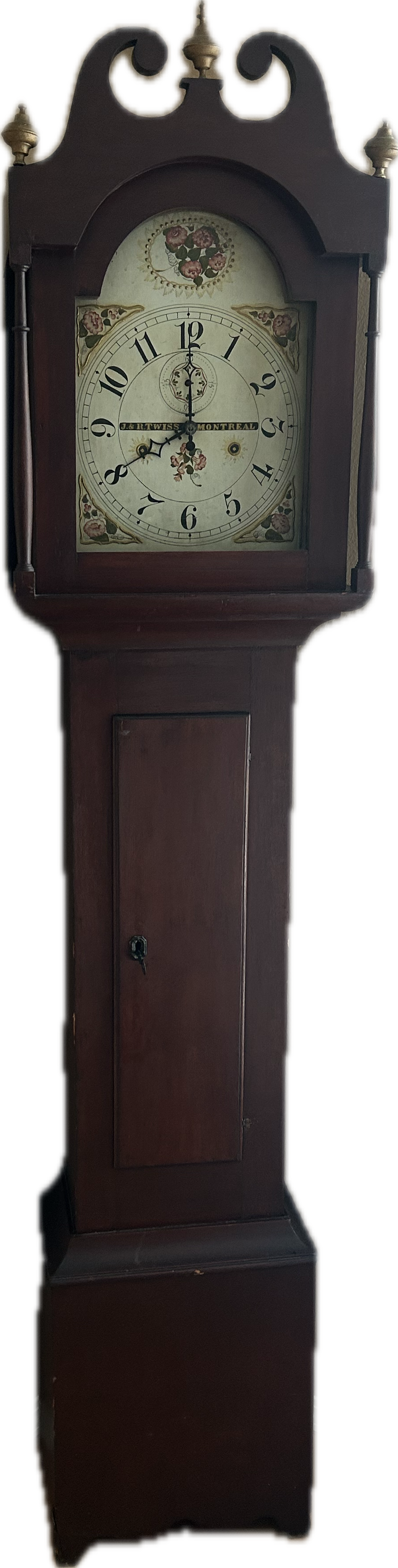
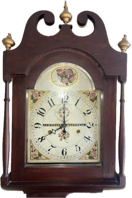
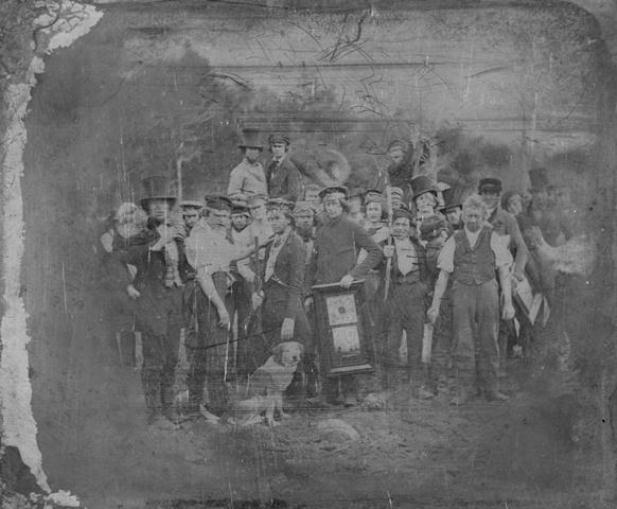
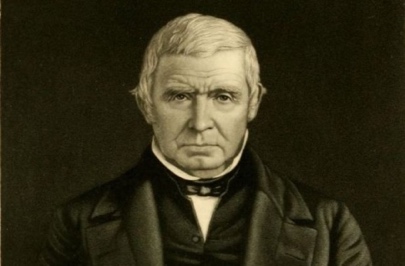
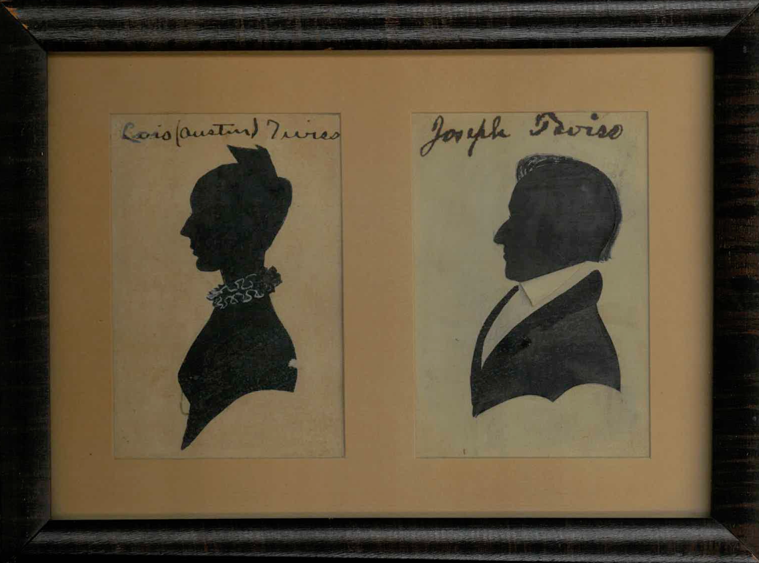
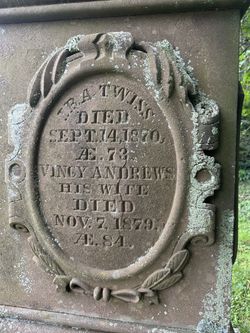
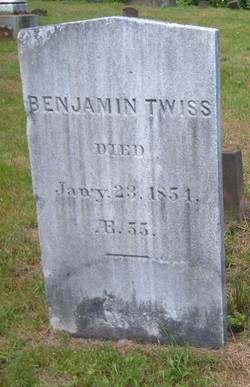
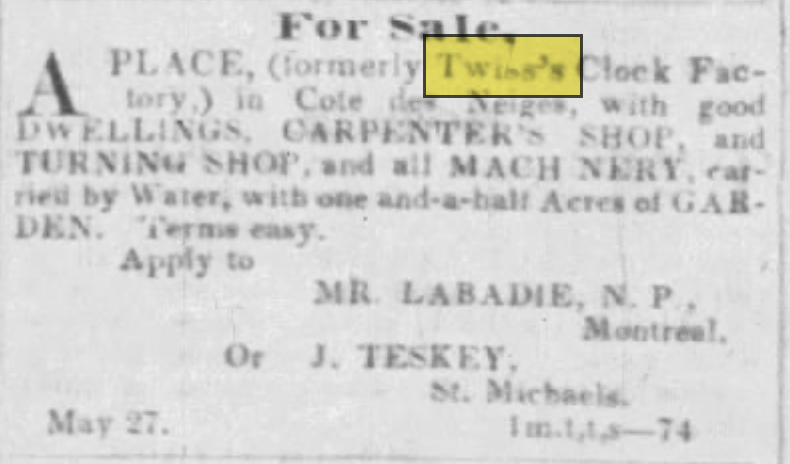
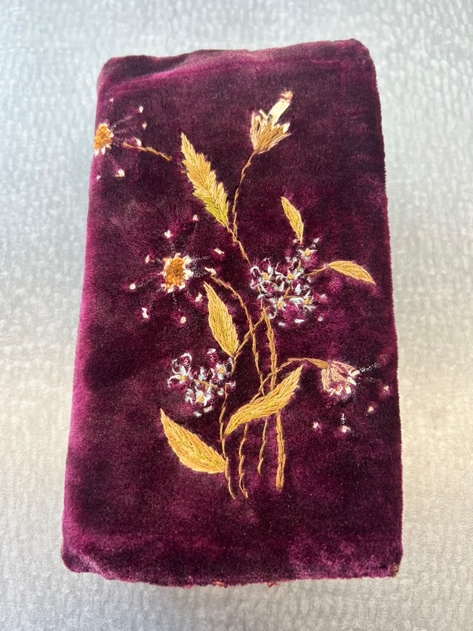
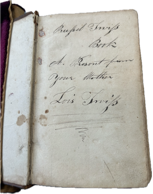
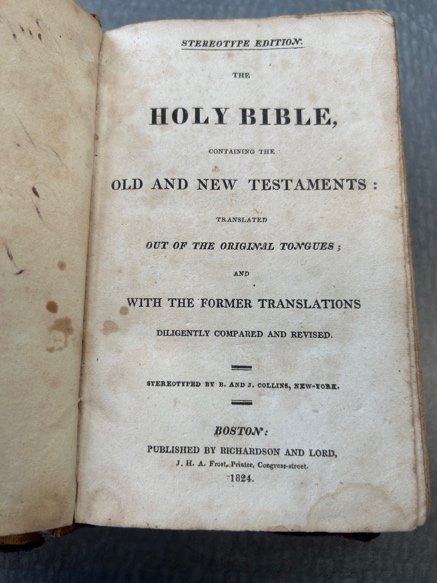
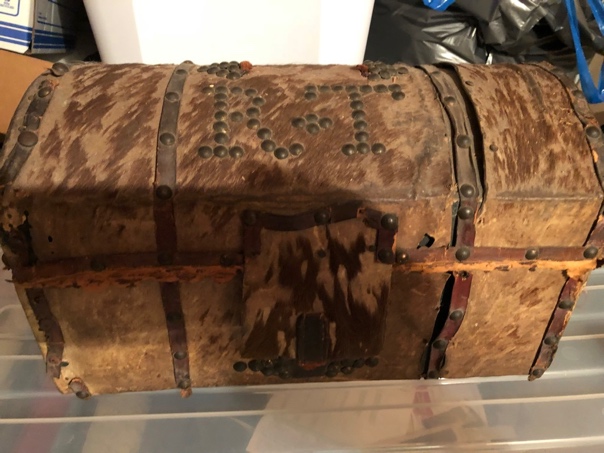
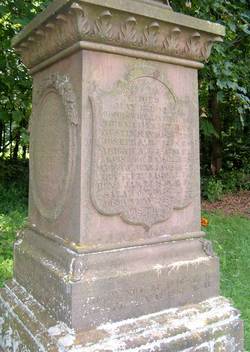
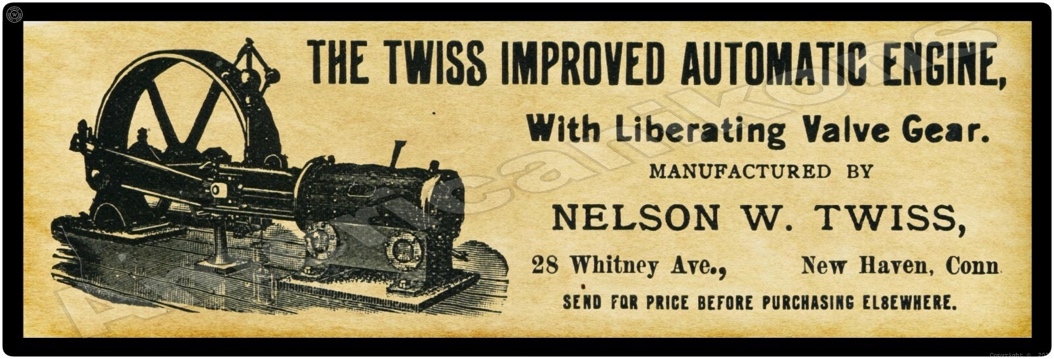
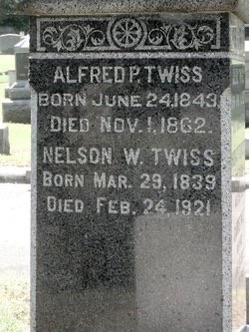
Thank you, connecting the dots is a beautiful personal event and I had
one once in Dayton Ohio. Corporately I was sent to live and work Dayton
and found in a historic display the wedding vest of my great, great
grandfather. I call my mother and asked if there might be some
connection. Going west in the early 1800 was Ohio.
Paul Edgar