The city claims it “operates on a tough set of financial controls” to ensure it balances its annual budget.
It doesn’t.
According to a report recently released by a nonprofit, Truth in Accounting (TIA), in order to “balance the budget” Portland has been failing to include its true costs, pushing costs onto future taxpayers.
“Despite receiving support from COVID relief grants and other federal programs, Portland remained in dire fiscal shape during the onset of the pandemic ,” the Report said.
TIA examined the nation’s 75 most populous cities. At the end of FY 2020, 61 of them did not have enough money to pay all their bills.
Grades of A to F were assigned to the 61 cities to give greater context to each city’s Taxpayer Burden or Taxpayer Surplus. TIA divides the amount of money needed to pay bills by the number of city taxpayers to come up with the Taxpayer Burden.
The “D” and “F” grades apply to governments that have not balanced their budgets and have significant Taxpayer Burdens. No cities received A’s, 14 received B’s, 26 received C’s, 29 received D’s.
Six cities received Fs for failing grades. One of those was Portland.
“…government officials are responsible for reporting their actions and the results in ways that are truthful and comprehensible to the electorate,” the TIA Report says. “Providing accurate and timely information to citizens and the media is an essential part of government responsibility and accountability.”
One of the ways Portland makes its budgets look balanced is by shortchanging public pension and Other Postemployment Benefits (OPEB) that it provides toretired employees, according to the Report. These benefits principally involve health care benefits, but also may include life insurance, disability, legal and other services.
In other words, Portland has been using some of the money that’s been owed to cover pension and OPEB costs to keep taxes low instead and to pay for politically popular programs without real accountability.
Portland was ranked one of the poorest performing cities at the end of FY20 in terms of its taxpayer burden, the report says. Because the city didn’t have enough money to pay its bills, it had a $5.6 billion financial hole. To erase this shortfall, each Portland taxpayer would have had to send $24,900 to the city. That was up substantially from $18,800 at the end of FY15.
“Portland’s overall financial condition (from FY19) worsened by $1.2 billion mostly because the city’s Fire and Police Disability and Retirement Plan had no assets and it is assumed that the plan will have to borrow money to pay benefits.,” the report says. “Overall, the city had set aside only 36 cents for every dollar of promised pension benefits and eight cents for every dollar of promised retiree health care benefits.
“Portland has been in poor fiscal shape for years.,” the TIA report said.
Last week, musician Neil Young set off fireworks when he demanded that his music be pulled off the audio streaming service Spotify because he objected to its high visibility podcaster, Joe Rogan, spreading alleged Covid misinformation.
Claiming the moral high ground, Young wrote in a letter published on his website on Jan. 24, “I am doing this because Spotify is spreading fake information about vaccines — potentially causing death to those who believe the disinformation being spread by them.”
Others have jumped enthusiastically on Young’s condemnation train, including Joni Mitchell, Nils Lofgren, India Arie, Dwayne Johnson, Kevin James, Jewel, Jamie Kennedy, Tulsi Gabbard, Troy Aikman, Kat Von D, Domanic Monaghan, Candice Owens, Jillian Michaels, Tomi Lahren and Andrew Dice Clay.
On Feb. 3, Roxane Gay, an author and a contributing Opinion writer for The New York Times decided she needed to join the fray, wrote an opinion column for The New York Times announcing shew was pulling her podcast, “The Roxane Gay Agenda,” from Spotify.
Also signing on to the crusade — David Crosby, Graham Nash and Stephen Stills. “Until real action is taken to show that a concern for humanity must be balanced with commerce, we don’t want our music — or the music we made together — to be on the same platform,” they said in a statement.
Even Tedros Adhanom Ghebreyesus, director-general of the World Health Organization, endorsed Young’s action on Twitter.
So where did uber-moral Young direct his listeners as one of the acceptable alternative music streaming services? Amazon. Clearly he did not consider the negative consequences of his well-intentioned actions.
In a Twitter post, Young included a link for new subscribers signing up for Amazon Music and saying they can receive four months free. “Amazon has been leading the pack in bringing Hi-Res audio to the masses, and it’s a great place to enjoy my entire catalog in the highest quality available,” Young said.
Talk about jumping out of the frying pan and into the fire!
Amazon is hardly a paragon of virtue either.
The company has been accused of:
Using data about products offered by independent sellers on the company’s platform to develop competing products.
Vigorously opposing trade unions at its massive warehouses.
Directly or indirectly benefiting from forced labor of Uyghur peoples in internment camps in Xinjiang, China and at factories in major supply chains.
In other words, Amazon is a poster child for questionable business practices.
Amazon is also already a dominant player, with Amazon Marketplace accounting for about 25% of all online spending in America, meaning a quarter out of every dollar spent online goes to the marketplace. You’d have to combine the next five mass-market retailers (Walmart, eBay, Apple, The Home Depot and Target) to equal its size.
And it keeps spreading out, invading every part of our lives. In 2020, Amazon announced Amazon Pharmacy, a new store on Amazon that allows customers to complete an entire pharmacy transaction on their desktop or mobile device through the Amazon App. In January 2022, Amazon, already the largest clothing retailer in America since it started selling clothing in 2002, announced it planned to open Amazon Style, its first clothing, shoe and accessories’ store, later this year at a posh shopping complex in Los Angeles.
Do all these high minded critics of Spotify really think Amazon is a more ethical socially conscious company than Spotify? Is it really wise to direct even more business its way, as Young suggests?
Late last year, the left-leaning Oregon Center for Public Policy (OCCP) put out a podcast firmly asserting that “…Oregon’s tax system entrenches and even deepens racial inequality.”
The organization then proceeded to undercut its argument by admitting it doesn’t have the data to prove its point. So now it is including in its 2022 Legislative Agenda passage of a bill that would add a race and ethnicity question to Oregon’s income tax forms.
“We must also better understand how the tax code impacts racial equity,” the OCCP now says. “Tax justice is a racial justice issue. We need better data to see which tax loopholes worsen racial inequality, so that together we can craft solutions to fix the problem.”
In other words, OCCP wants the state to collect data that it hopes will prove its point. It’s kind of an Alice in Wonderland “Verdict first, trial later” situation.
But even if the bill, SB 1569*, passes, the data it produces and the “racial impact statements” the bill would require the Department of revenue to produce would be useless.
That’s because the bill “Directs (the) Department of Revenue to develop schedule allowing personal income taxpayers to voluntarily report taxpayers’ self-identified race and ethnicity identifiers.” That’s right, the submission of the data the OCCP plans to rely on to prove its point would be voluntary.
That would inevitably result in bias due to unrepresentative samples of taxpayers submitting data, known as selection bias.
There could be under-coverage, for example, if some taxpayers are inadequately represented in the sample, or nonresponse bias, if respondents differ in meaningful ways from nonrespondents. Respondents might also be principally those who have strong opinions on the issue. For example, the reliability of surveys on call-in radio shows that solicit audience participation on controversial topics such as abortion, affirmative action, gun control and the legacy of Donald Trump are typically unreliable.
Unconvinced that this bill’s reliance on voluntary participation and potential sampling errors would undermine its value?
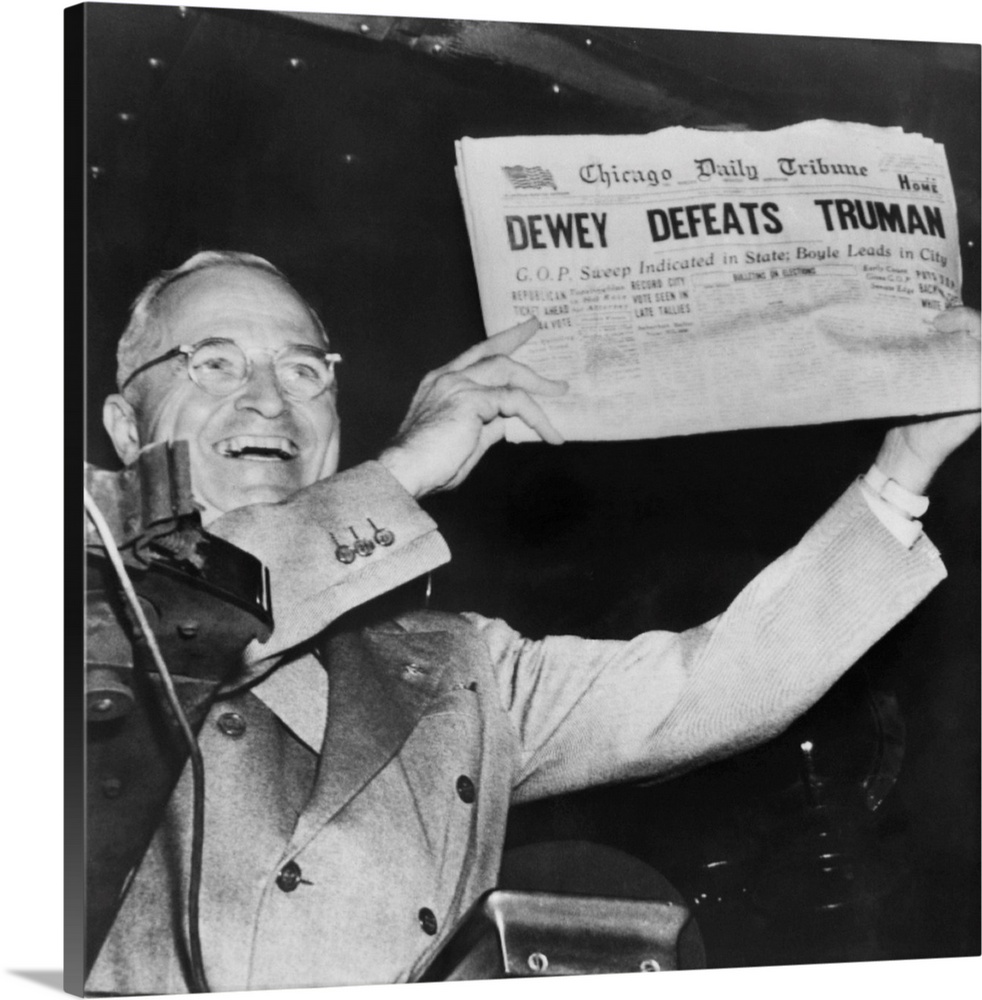
A while ago there was an election when a botched presidential poll conducted over the phone unintentionally oversampled Republicans because the well-off were more likely to have a phone.
That’s my advice to Oregonians considering going to a pop-up Covid testing site operated by GS Labs, an Omaha, Nebraska–based company.
I took a break Friday morning and stopped by the GS Labs pop-up site at a former restaurant 10935 SW 68th Parkway (Google says this is in Portland; GS Labs says it’s in Tigard). A worker told me I needed to schedule an appointment online and the test cost would be $179, but I might be able to get the testing center to agree to a 50% discount. He added that GS Labs only takes commercial insurance or cash payments, and does not accept Medicare, federal health insurance that covers much of the elderly population most vulnerable to COVID-19.
(NOTE: Medicare pays for COVID-19 tests performed by a lab, such as PCR or antigen/rapid tests, at no cost to you when the test is ordered by an authorized health care professional.Those in a Medicare Advantage Plan should check with their plan to see if their plan offers coverage and payment for at-home tests.)
The GS Labs appointments website allows visitors to pick a location in eight states across the country, view available appointments and select a payment option, either “Book with Insurance (*Rapid Antigen and Standard PCR only)“ or “Book Rapid PCR (*Out of Pocket only $299)”
Formed in January 2020, GS Labs spun out of a clinic, 88 Med, owned by City+Ventures, a privately held Omaha, Nebraska-based investment and development company. 88 Med specialized in cosmetic procedures and hormone treatments.
City+Ventures was founded in 2012 to pursue strategic business and real estate opportunities both locally and regionally. Two men, Danny White and Chris Erickson, co-founded the company and are now co-owners. White has a B.S. in Business Administration from Skidmore College in New York. Erickson has a B.S. in Civil Engineering from Iowa State University.
The company’s website says, “We are a group of business savvy, community-minded individuals….” Based on its covid testing practices, “community minded” hardly applies.
Some health insurers have refused to pay GS Labs’ fees, contending that the laboratory is price-gouging during a public health crisis, the New York Times reported in Sept. 2021.
A Blue Cross plan in Missouri, for example, has sued GS Labs over its prices, seeking a ruling that would void $10.9 million in outstanding claims. In August 2021, the insurer claimed that the fees were “disaster profiteering” and in violation of public policy.
Suburban Seattle-based Premera Blue Cross sued GS Labs on Oct. 14, 2021, alleging that the company was exploiting the COVID-19 pandemic by overcharging for COVID-19 testing. Premera alleged that GS charged prices ranging from $380 to $979 per test, which often amounted to 10 times more than what other labs were charging.
Premera further alleges GS Labs “peppers its claims with falsehoods,” including false diagnoses to get higher payments, and it frequently fails to maintain high quality levels in its testing and reporting of results.
According to Pharmacy Practice News, Premera’s suit alleged that GS Labs has improperly filed claims for more than $26 million worth of COVID-19 tests. Blue Cross and Blue Shield of Kansas City, which filed a lawsuit against GS Labs in July 2021, alleged that the lab provider billed $9.2 million in improper charges for COVID-19 testing.
In an Oct. 2021 interview with the Omaha World-Herald, Chris Erickson said he and his partners are proud of their testing business. He said it helped consumers navigate an unpredictable pandemic at a time of inadequate testing options. Fees billed to insurers reflect a high level of service and the cost of building an infrastructure of equipment and trained personnel in an “insanely short period of time,” Erickson said.
It’s not just insurance companies that are less then enthralled with GS Labs.
Indeed.com reviews of working for GS Labs are largely harsh. Typical are the following:
“Management seems to have their own motives (money)…Management seems disorganized, unfair, and corrupt based on their own agendas.”
“… it is clear, they work with no morals, no ethical treatment of employees and you are just a number…Greedy company,”
“It’s almost like being in middle school. If you are lazy, unmotivated and are just looking for a paycheck, then GSLabs Omaha is the place for you.”
“Patients are being lied to just so this company can make a profit.”
So, what to do if you want a Covid test?
The Biden Administration announced today that it is purchasing one billion at-home, rapid COVID-19 tests to give to Americans for free. A half-billion tests will be available for order on January 19th and will be mailed directly to American households. The initial program will allow four free tests to be requested per residential address. Starting January 19th, Americans will be able to order their tests online at COVIDTests.gov, and tests will typically ship within 7-12 days of ordering.
(NOTE: Guard against scammers trying to steal your personal information. When ordering tests, use the official, secure government website: https://COVIDtests.gov.Watch out for phone scammers, too. If you get a phone call requesting information so that free at-home tests can be mailed to you, hang up — it’s a scam!)
The Administration is also highlighting that there are over 20,000 free testing sites across the nation, including many pharmacies participating in the federal pharmacy free testing program, as well as federal surge free testing sites, with more free testing sites opening each week. Millions of free, at-home COVID-19 tests have also been delivered to thousands of community health centers and rural health clinics to distribute to their patients, with more delivered each week.
In addition, the Administration provided schools $10 billion in American Rescue Plan (ARP) funding to get tests to K-12 school districts. And, the Administration invested nearly $6 billion in ARP funding to cover free testing for uninsured individuals, and support testing in correctional facilities, shelters for people experiencing homelessness, and mental health facilities. Just this week, the Administration also announced that starting January 15th, private health insurance companies will be required to cover at-home COVID-19 tests for free—and made an additional 10 million COVID-19 tests available to schools nationwide, each month.
In the meantime, the Oregon Attorney General has issued a consumer warning:
“The huge demand for Covid-19 testing of all kinds—at home tests, rapid antigen tests, PCR tests–brings bad actors and some businesses trying to make a quick buck out from the shadows,” Attorney General Ellen Rosenblum said. “We see it all the time in moments of desperation like this testing urgency.”
ADDENDUM, Feb. 17, 2022 – The Oregonian reported on Feb. 17, 2022, that Oregon’s Democratic primaryrace for governor narrowed significantly, with the state Supreme Court ruling that former New York Times columnist Nick Kristof can’t run because he does not meet the state’s three-year residency requirement. The court’s unanimous ruling leaves former House Speaker Tina Kotek and state Treasurer Tobias Read as frontrunners for May’s Democratic primary, which will also feature a long list of lesser-known candidates.
——————————
If the New York City Council can approve a bill allowing 800,000 non-citizen New Yorkers to vote in municipal elections, surely Oregon can bend its rules to let Nicholas Kristof run for governor.
Oregon already has made it clear it has no problem with one of its U.S. Senators living for extended periods in New York City in a $8.6 million 19th century townhouse.
Kristof, who was born in Chicago, has lived in Yamhill, Los Angeles, Hong Kong, Beijing, Tokyo and New York City. He was registered to vote in New York from 2000 until December 2020 and voted there as recently as November 2020. He only registered as an Oregon voter on Dec. 28, 2020.
But let’s be honest. Other politicians have maneuvered around election residency requirements.
In 2010, then-former-senator Dan Coats was trying to win back his old seat in Indiana when it was reported that even though he was from the state, he’d been living and voting in Virginia since 2000. But, as Roseanne Roseannadanna used to say on Saturday Night Live, “Never mind.” Coats won the election anyway.
Richard Lugar served as a U.S. Senator representing Indiana from 1977 to 2013, even though he sold his Indianapolis house in 1977 and moved to Washington, D.C. His excuse? He told reporters he and his wife wanted to keep their family together and they couldn’t afford two houses.
Even though Kristof has moved around a lot, in a statement posted on Twitter on Jan. 6, 2022, he said he owes his “entire existence” to Oregon. “This state welcomed my dad as a refugee, and he put down roots here,” he wrote. “Oregon has provided a home to me and my family as those roots deepened. Because I have always known Oregon to be my home, the law says that I am qualified to run for governor.”
Kristof has also put forward an opinion from William Riggs, a justice on the Oregon Supreme Court from 1998 to 2006, saying Kristof is an Oregon resident because he has frequently described Yamhill as “home” and has always considered himself an Oregonian.
“Candidate’s conduct over decades and in recent years, as well as his description of Oregon as ‘home’ in contemporaneous writings, leaves no doubt that he has considered Oregon to be his home; in these circumstances, having voted in New York does not indicate otherwise,” Riggs wrote.
I’m so convinced by the logic of Kristof’s arguments that I’m thinking of running for governor of Connecticut.
All gubernatorial candidates in Connecticut must be:
at least 30 years old
a registered voter
a resident of Connecticut for at least six months on the day of the election
I’m way past 30 years old. OK, I first registered to vote in Colorado when I was 18 and I’ve been a registered voter in Oregon since 1984, but I can change that to Connecticut in a wink. And as far as being a resident of Connecticut for at least six months on the day of the next election, I’ve considered Wallingford, CT my “home” from the time I was born.
Ask anybody about my connections to Connecticut. They go back a long way.
In 1833, at the age of 20, a fellow named William of Scotland departed from the port of Greenock and embarked on a voyage to America on the ship “Moscow”, a 461-ton, 80 HP Iron Screw Steamer built by Palmer Brothers of New Castle. A tempestuous six weeks later, the ship docked in New York City. On July 9, 1838, William married Mary Hall, 29, and in 1842 they built a home in Wallingford, CT where they lived for the rest of their lives.
After Mary died in 1845, William married Temperance Hall. They had a son, Theodore. When William died in 1872 his children sent away to Scotland for red Scotch granite for his monument, which still stands in Wallingford’s Center Street Cemetery.
Theodore became one of the foremost leaders of the engineering profession in Connecticut. He married and had a son, William, who later became Superintendent of Wallingford Water Works. After William married Helen, they had a son, William, my father. Except for when he lived in Washington, D.C. as a Navy officer during WWII, he lived his entire life in Wallingford, I was raised in Wallingford, too, living on N. Main St. until I went to college.
I have other strong ties to Connecticut, too. I’m a descendent through marriage of Samuel Andrews, one of the founders of Wallingford in 1670, and of Lyman Hall, who was born in Wallingford in 1724 and later signed the Declaration of Independence.
So, with all this, I figure I owe my “entire existence” to Connecticut and it is as much my “home” as Oregon is Kristof’s.
One more thing.
On. January 14, Kristof’s lawyers filed their first brief to the Oregon Supreme Court. Stretching their argument about as far as possible, the brief argued that denying Kristof, who has lived in lots of places, a spot on the ballot would disenfranchise other Oregonians who have lived in lots of places.
“There are many peripatetic Oregonians who, for various reasons, live in more than one place and may prefer candidates who understand the experience of living in multiple places or changing residences often,” the brief says. “Such Oregonians come from all walks of life: houseless and housing-insecure persons; university students; seasonal migrant workers; servicemembers; snowbirds; the list goes on. These groups are disserved by the Secretary’s interpretation, contravening the spirit of free and equal elections.”
I haven’t yet set up a website for my gubernatorial race, but I plan to let all my celebrity, journalism and Washington, D.C. friends know that they should start setting aside some big bucks to contribute to my campaign. I may not be able get money from Angelina Jolie, who has given to Kristof, but Kim Novak stayed at a house next to mine in Wallingford when she was performing at a local musical theater when I was a kid and I met the actress Tuesday Weld once in California. Maybe I could hit them up for some cash.
Gubernatorial hopeful Nicholas Kristof is just another classic tax-and-spend liberal promising more free stuff. Secretary of State Shemia Fagan may have determined that Kristof doesn’t meet Oregon’s residency requirement to qualify to run for governor, but he has made it clear he doesn’t plan to drop out.
His agenda for Oregon reminds me of an observation by American journalist and cultural critic H.L. Mencken that the principal device of many seeking to get and hold office in government “… is to search out groups who pant and pine for something they can’t get, and to promise to give it to them.”
In a January 3, 2022, newsletter, Kristof lamented that Americans aren’t guaranteed health insurance, dental care, Internet access, shelter, child-care, jobs, free pre-K and so much more. “Some of (these) services would be difficult or expensive to provide, but the same was true of universal postal service and electrical power,” he asserted.
Is there anything on that list you haven’t heard people such as Senators Bernie Sanders and Elizabeth Warren and Representatives Alexandria Ocasio-Cortez and Pramila Jayapal advocate?
Is there anything on that list Tina Kotek, another gubernatorial hopeful and a key member of the Democratic party’s left wing, wouldn’t support?
The fact is Kristof’s agenda is a list of proposed entitlements for Oregonians that would be almost guaranteed to become more costly over time and, like opiates, become addictive.
Tightrope: Americans Reaching for Hope, a bookwritten by Kristof and his wife, Sheryl WuDunn, has been widely praised for its empathetic portrayal of struggling Americans. I’ve read the book. What has been less noted is how the book excuses individuals from responsibility for life’s travails and makes them victims of circumstance.
Even the Goodreads summary of the book sees things this way, attributing personal failures to public policy, not personal choices: “Taken together, these accounts provide a picture of working-class families needlessly but profoundly damaged as a result of decades of policy mistakes.”
As one reviewer put it, “Where this book struggles is the complete removal of personal responsibility for any of life’s difficulties, instead completely shifting this to the failings of Government and Society in general. I do think this can play part of a role in the situations people find themselves in, but personal drive and responsibility has to be a factor, or even a government program cannot succeed.”
Another reviewer expressed a similar concern: “My opinion is that Kristof focuses more on the lack of safety nets that let his friends down instead of the real culprits: Parenting and personal responsibility. The friends and families I knew did not shoot guns at their spouses, engage in criminal activity as children, or begin using drugs at a young age. These are behavioral patterns that are passed down from parent to child, not something that befalls them only as a result of bad luck. To give this perspective so little attention in his book is shortsighted.”
As a conservative, I find Kristof’s approach to social issues troubling and worry it would guide his approaches to governing.
I also worry that, in any case, he’s simply not prepared to lead Oregon, increasing the likelihood he would be an incompetent governor and make things worse.
In a time when for some people the words “political experience” are a slur, Kristof is trying to get around his inexperience by likening himself to innovative and widely admired former Oregon governor Tom McCall, who served during 1967-75.
“I bring the same experience that Tom McCall brought when he was elected,” Kristof told Willamette Week. “McCall, of course, was a journalist who had never been in the Legislature. And what he brought was a skill set that I think is essential for a successful governor. It’s articulating a vision for the state to rally people around that agenda and then using the convening power of the office to help achieve it.”
Chuck Sheketoff, former director of the left-leaning Oregon Center for Public Policy, has bought into Kristof’s argument. “In the current political environment, it’s refreshing to have someone who doesn’t have baggage and history,” Sheketoff said in November 2021.
Only somebody who knows their candidate lacks qualifications for the job they’re seeking would say this.
Colt Gill, appointed by Governor Brown as Deputy Superintendent of Public Instruction, serves as Director of the Oregon Department of Education.
Oregon HB 2845, signed into law by Governor Kate Brown in June 2017, called for an advisory group to create recommendations for ethnic studies standards. A panel of K-12 teachers aligned the recommendations to 2018 social science standards for use in the classroom. After engaging with the public, the Oregon Department of Education made adjustments to the standards.
The new standards were approved for classroom use in March 2021. School districts will be required to address the ethnic studies standards beginning in the 2026 – 2027 school year.
The theory behind the new standards was that commonly used textbooks and classroom lessons had too narrow a focus of the history, politics, and human geography and that students would benefit from a more complete and inclusive understanding of U.S. and Oregon history.
So far so good.
Then not so good.
The Kindergarten Standards with Ethnic Studies, yes kindergarten, start off with the following:
Civics and Government
* Engage in respectful dialogue with classmates to define diversity comparing and contrasting visible and invisible similarities and differences.
*Develop an understanding of one’s own identity groups including, but not limited to, race, gender, family, ethnicity, culture, religion, and ability.
History
* Identify examples of unfairness or injustice towards individuals or groups and the “change- makers,” who worked to make the world better.
Historical Thinking
* Make connections identifying similarities and differences including race, ethnicity, culture, disability, and gender between self and others.
Social Science Analysis
* Identify possible solutions to injustices
The questionable guidance continues for later grades. First grade standards, for example, include:
*Define equity, equality and systems of power”
*Describe how individual and group characteristics are used to divide, unite and categorize racial, ethnic, and social groups.”
How, in heaven’s name, do 5-year-olds conduct “respectful dialogue” over “visible and invisible similarities and differences.” How and why should they “develop an understanding of one’s own identity groups,” and identify racial, ethnic and cultural differences?
How and why should 1st graders “define…systems of power”?
“In reality, the point of the exercise is to make children hyper-sensitive to racial differences and encourage them to internalise an identity-based consciousness,” Prof. Frank Furedi wrote in Spiked. “The main objective of this curriculum is to introduce youngsters to an identitarian worldview. When small children are exposed to topics suitable for mature adults it is clear that indoctrination rather than education is taking place.”
Did anybody outside the education establishment read these standards before they were adopted?
Is this really how Oregon parents want their children taught?
Still struggling with finding the right Christmas gift for your toddler? American book publisher Penguin Random House says it has “the perfect gift” for your child, a book it is proudly promoting as part of its new offering, “PRH Education Classroom Libraries.”
“Books are a students’ passport to entering and actively participating in a global society with the empathy, compassion, and knowledge it takes to become the problem solvers the world needs,” says Laura Robb, an author and teacher featured in the program’s promotional materials.
So what does PRH recommend this year?
Once upon a time toddlers drifted off to sleep on a diet of bedtime stories that grew out of folklore, depended on magic or were just enchantingly simple, like Goodnight Moon, Charlotte’s Web or Where the Wild Things Are.
But not anymore. According to PBH, bedtime is now all about getting woke, so it’s promoting “Antiracist Baby Picture Book” by Ibram X. Kendi as part of its new initiative.
“With bold art and thoughtful yet playful text, Antiracist Baby introduces the youngest readers and the grown-ups in their lives to the concept and power of antiracism.,” says PRH. “Providing the language necessary to begin critical conversations at the earliest age, Antiracist Baby is the perfect gift for readers of all ages dedicated to forming a just society.”
“Critical conversations at the earliest age” about racism? Kendi, author of the bestselling book How to be an Antiracist, wants parents to proselytize about antiracism to babies. That’s right. Babies.
Somebody obviously is buying the book and its message. After all, the book has been at the top of the New York Times Best Seller List and was chosen as one of National Public Radio’s 100 favorite books for young readers.
But does that mean you should buy it and read it to your baby?
Is your toddler ready for text such as:
“No one will see racism if we only stay silent. / If we don’t name racism, / it won’t stop being so violent.”
“Knock down the stack of cultural blocks.”
“Antiracist Baby is bred, not born./Antiracist Baby is raised to make society transform.”
Kendi told the Harvard Gazette parents should start talking to their children about racism as early as preschool and kindergarten. “We know that by 2 years old, children are already consuming racist ideas,” Kendi said. “They’re already discerning whom to play with based on kids’ skin color, and so if we wait till they’re 10 or 15, they may be a lost cause, like some of us adults.”
That’s a pretty bleak point of view.
I much prefer the view of David Schonfeld, M.D., professor of pediatrics at the University of Southern California and Children’s Hospital Los Angeles. “In these early years, your task is to lay positive groundwork, addressing hate by cultivating its opposite—compassion and tolerance. Luckily, your child has a head start: an innocent indifference to what sets people apart. Kids are very aware of ways we differ, but they aren’t born identifying people with a particular race, gender, or ethnicity,” he says.
A Goodreads reviewer echoed Schonfeld’s observation. “… the main problem with Kendi’s) book is that conceptually it does more to divide than unite,” the reviewer commented. “How can anyone set out to write a book for toddlers with the intention of making some of its tiny listeners feel guilt and shame (for nothing they have done wrong), and others feel wronged (for nothing they’ve experienced), before they barely know what a duck or a bike or a picnic are? The presumption seems to be that every baby is racist until taught not to be, when the opposite is the reality – it is racism and division which are taught – and I worry that is exactly what this book, if unwittingly, achieves.”
“… I admit I find myself a bit repelled by some of the more inelegantly antiracist books, which, at least in coastal cities, have become a main draw in the children’s sections of bookstores. What does it mean, really, to have an antiracist baby? Are these books actually written for kids, who, as far as I can tell, mostly like stories about dinosaurs and cats? Or are they a commodity for white parents who want to prove their progressive bona fides?”
I can’t help but agree. As another reviewer commented, “If you’re looking for a tool to help you indoctrinate your kids into a worldview of racist white-hating woke intersectional progressivism then this is the book for you.”
My advice – spare your toddler the divisive lecturing. Skip Kendi’s book. Go for something like Brown Bear, Brown Bear, What Do You See?, Chicka Chicka Boom Boom or If you give a mouse a cookie.
Not that long ago, printed newspapers dominated the news landscape and seemed to have a promising future.
In 1940, daily circulation of print newspapers in the U.S. was 41.1 million, according to the Pew Research Center. It was a rare home that didn’t start the day with a newspaper at the breakfast table. At my home in Wallingford, CT, we had two papers delivered daily in the 1940s. In the morning, we got the Meriden Record; In the afternoon we got the New Haven Register. Established about 1812, the Register was one of the oldest continuously published newspapers in the United States.
In the mid-1980’s, weekday print newspaper circulation in the U.S. reached a peak of 63.3 million. Americans avidly followed stories about events such as the assassination of Indian Prime Minister Indira Gandhi, the introduction of Apple’s original Macintosh personal computer (accompanied by a still heralded Orwellian-themed “1984” TV ad), the agreement between China and the United Kingdom to transfer power in Hong Kong from the UK to China in 1997 and Villanova’s stirring 66-64 upset victory over Georgetown in the NCAA championship.
Onward and upward, thought media leaders.
Print newspapers hung in there until the early 2000s. Then the bottom began to fall out. By 2012, daily print circulation was down to 43.4 million. By 2020, Pew Research estimated that print circulation had fallen to just under 24.3 million. What happened? The internet and age.
Print newspaper readers have always tended to be older, more affluent, and more educated. Publishers and advertisers used to like that. The problem is that as those older readers have aged and died, they have not been backfilled by subsequent generations. Instead, younger readers have been gravitating to digital communications channels.
And the shift has accelerated across print platforms where readers have been aging fast.
In a 2012 Pew Research Survey, just 23% of respondents said they read a printed newspaper the previous day. The highest readership, 48% was among those 65 and older. The lowest was those 18-24, at 6%, and 25-29, at 10%.
The percentages saying they read a printed newspaper yesterday have continued to steadily decline.
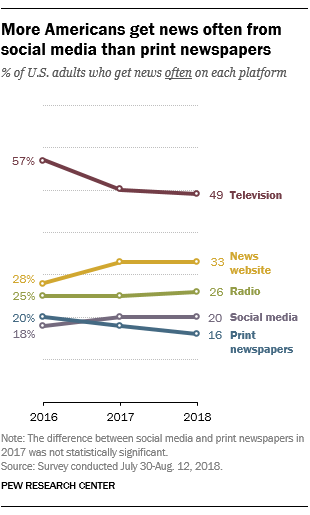
A newer May 2021 survey revealed that most consumers never use newspapers as a source of news, and only 25 percent of adults aged 65 or above (those who engage with newspapers the most) reported reading newspapers every day. Meanwhile, even older folks are warming up to online news. Those over 50 are also warming up to the web. In 2016, 32% of the news readers in the 50+ age group expressed a preference for the web. This increased to 43% in a 2019 survey. Newspapers have become even less popular as a news source than radio, and are also among the least used daily news sources among adults aged 18 – 24.
If this young cohort keeps its print avoidance as it ages, print newspapers will eventually lose almost their entire audience.
The biggest threat is probably to local papers with smaller circulation. Papers with a significant number of print subscribers, such as the still profitable Wall Street Journal and The New York Times, are in a better position.
About five years ago, the Journal’s Editor-in-chief, Gerard Baker, was asked by a writer for the Nieman Lab whether he saw a day when there would be no print edition at all.
“I don’t really foresee the day when there’s no print edition,” Baker said. ” I mean, who knows — we live in a rapidly changing world. Who can really say anything with conviction about what will be 10, 15, 20 years hence? But as things stand, we have a million print subscribers who really value the print edition of the paper. They really want it. They’re prepared to pay a significant amount of money for what they pay for a print newspaper. There continues to be strong demand for the print product, and we will continue to need to meet that demand. I don’t foresee any other changes in the foreseeable future.”
Notwithstanding this rosy prediction, in Sept. 2017 the paper announced it would stop publishing its European and Asian editions. Falling overseas sales and plunging print advertising revenue in recent years drove the decision, according to the Journal. In Oct. 2020, it took another step away from print, cutting print editions of its fashion and luxury lifestyle insert WSJ. Magazine from a dozen to eight.
Those are the drip drip signs of changing attitudes at the Journal about the viability of print.
Meanwhile, most of the paper’s subscription growth is on the digital side. In 2017, of the paper’s 2.1 million subscribers, 1.08 million were digital. Daily print readership now stands at about 734 thousand copies, while digital subscribers total about 2.7 million.
It’s a similar story at The New York Times. In 2017, the paper had 540,000 daily print and 2.2 million digital subscribers. Daily print readership now stands at about 795,000 copies, while digital subscribers total about 5.7 million.
A friend of mine told me he used to subscribe to the daily print version of the Columbus (Ohio) Dispatch, even after he moved away from Columbus, until he realized he was spending $1000 a year for the subscription. A 12-month digital subscription today is just $119.88.
In all three cases, it costs a lot less to be a digital subscriber, so you have to really love print to go that way. Fewer and fewer people do.
An added note: Covid-19 isn’t helping either. Covid-19’s devastation has hit the elderly the hardest. Of the more then 800,000 Americans who have died from Covid-19, 75% have been 65 or older, according to theCenters for Disease Control and Prevention. That’s the newspaper audience.
Once upon a time, printed newspapers serving local audiences were in high demand.
But over 2200 newspapers in the United States have closed in the past 15 years and the carnage continues.
Circulation has declined drastically. Pay has been cut. Advertising revenue has plunged. Newsroom employment has plummeted. The vast majority of remaining print newspapers have a circulation of less than 15,000, according to a review by the University of North Carolina’s journalism school.
It’s a grim picture, made worse by the fact that, as Harvard’s Shorenstein Center has pointed out, “Printed newspapers are a manufacturing business. For some, the non-newsgathering cost structure can be the majority of total operating expense. This means that in a world of declining demand for print editions of local newspapers, legacy costs become an increasing share of declining revenue. Much of the underlying reality of the current market failure for local news coverage can be traced to this simple fact.”
But the newspaper industry and some members of Congress think they have found a solution — a federal taxpayer bailout.
This is the wrong solution. And, frankly, it’s embarrassing.
America’s journalism industry, which until now has prided itself on its independence, got a tax break in the Build Back Better bill passed by the House on Nov. 19.
The bill would provide a payroll tax credit for companies that employ eligible local journalists. The measure would allow newspapers, digital news outlets, and radio and television stations to claim a tax credit of $25,000 the first year and $15,000 the next four years for each of up to 1,500 journalists.
The theory is this would incentivize some publishers to hire or retain local reporters. The Democrats project the cost of putting journalism outlets on the public dole will be $1.7 billion over the next five years, with an estimated $38 million of that injected into approximately 113 newsrooms in Oregon.
Supporters say there will be guardrails to prevent the tax breaks from going to partisan or fake-news sites. Good luck. The battles over eligibility will be never-ending.
I’m a former newspaper reporter and the struggles of local print news in our Internet-juiced landscape are undeniable, but why print journalism enterprises, or other journalism forms, deserve taxpayer bailouts like this is beyond me. And, unfortunately, you are not likely to read about criticisms of the bailout in your local paper. No surprise there.
Some tax credit supporters argue that government support for media goes back a long way, that the two have always been joined at the hip, so this new idea just continues long-established practices. The latest help is the pandemic-related small business loan program, for example, provided millions to news organizations.
Fundamentally, this argument is that print media already get some subsidies so they should get more. A dubious assertion that too many are willingly embracing.
Media figures also argue that the Build Back Better subsidies will only be temporary anyway. But let’s be honest. When was the last time you saw a government subsidy discontinued?[1]
It’s a given that when the subsidy ends in five years, newspaper publishers and others raking in the subsidies will be back in Congress hat in hand seeking an extension. The Congressional Budget Office estimates that if the subsidies continue for ten years, the cost will be $3 billion, far from small change.
It’s also defies logic that taxpayers should subsidize already well-off newspapers.
One of the vocal tax-break supporters, for example, is The Washington Post, owned by tech billionaire Jeff Bezos since 2013.According to Americans for Tax Reform, if the tax break becomes law, Gannett, one of the nation’s largest remaining newspaper chains, could gain as much as $127.5 million in tax benefits over five years.
And why should the government give breaks to papers owned by super-rich hedge funds?
Hedge fund Alden Global Capital, for example, is one of the country’s largest newspaper owners. It has been buying up newspapers, imposing draconian cost cuts, and implementing widespread layoffs. Its current target is the local newspaper chain Lee Enterprises, whose Oregon titles include the Albany Democrat-Herald, the Corvallis Gazette-Times and the Lebanon Express.
Local print newspapers have been a key element of our civic life for generations, but Build Back Better’s tax breaks are not the solution to the challenges they face. And despite the special show of neediness among many newspaper people these days, we won’t be doing them a favor if we succumb to their pleading.
Maybe a little creative destruction is in order, instead.
—————–
[1] The situation with the federal child tax credit (CTC) is a classic example of the never-ending subsidy. The CTC is not new, but it was expanded in the March 2001 American Rescue Plan (ARP). Before the ARP, parents were eligible to receive up to $2,000 in tax credits every year for each child under 17 they claim as a dependent. The benefit began to phase out at $200,000 of annual income for single filers and $400,000 for married couples filing jointly. Families had to earn just $2,500 a year to qualify. Parents claiming the credit would receive it as one single refund at tax time, and the credit was partially refundable, meaning families with a tax burden smaller than the size of their credit could still receive up to $1,400 per child.
The ARP increased the program’s benefits, raising the maximum credit to $3,000 for every child aged six to 17, and $3,600 for children under 6. The new credit was fully refundable. In 2021, half was paid out in monthly installments, with the rest to be meted out in families’ annual tax return.
The ARP expanded the CTC only through 2021. Democrats figured it would prove to be so popular they could extend it indefinitely. So far, they haven’t been able to secure enough votes to do so, but efforts to do so were still underway at the end of 2001.